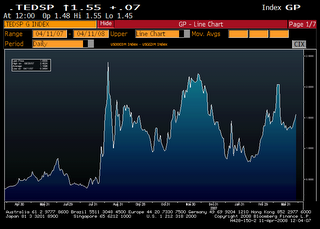
The Wall Street Journal reports on another sign of how bad the credit crunch has gotten: banks fudging on what they are reporting as their short-term cost of interbank borrowing, out of fear of revealing how stressed they are. So the Libor becomes less useful as a guide. That in turn means that the so-called TED spread (the difference between three month Libor and ninety-day Treasuries), which is one of the preferred measures of stress in the interbank markets, is understated by as much as 30 basis points. So just imagine what this chart looks like if you add that amount to, say, the 2008 data points (chart courtesy The Financial Ninja). It goes from ugly to uglier:
The Journal mentions another consequence, that Libor-indexed borrowers are getting a better rate than they deserve. But it misses an implication that is ultimately more serious: as more and more statistics and benchmarks come into doubt, it creates uncertainty and undermines planning, which in turn is a deterrent to investment.
I saw this when working briefly in Mexico in 1984. The local McKinsey office confirmed that there was no reliable data in the entire economy. As one colleague noted, “We do a lot based on feelings.” It made the US premium for equity-related investing (10-15% over the local equity premium) seem entirely logical. Similarly, marked inflation also corrodes the usefulness of quantitative information.
From the Journal:
In a development that has implications for borrowers everywhere, from Russian oil producers to homeowners in Detroit, bankers and traders are expressing concerns that the London inter-bank offered rate, known as Libor, is becoming unreliable…
Some banks don’t want to report the high rates they’re paying for short-term loans because they don’t want to tip off the market that they’re desperate for cash. The Libor system depends on banks to tell the truth about their borrowing rates….
No specific evidence has emerged that banks have provided false information about borrowing rates, and it’s possible that declines in lending volumes are making some Libor averages less reliable. But bankers and other market participants have quietly expressed concerns to the British Bankers’ Association….
Questions about Libor were raised as far back as November… In a recent report, two economists at the Bank for International Settlements, a sort of central bank for central bankers, also expressed concerns that banks might report inaccurate rate quotes…..
In a recent research report on potential problems with Libor, Scott Peng, an interest-rate strategist at Citigroup Inc. in New York, wrote that “the long-term psychological and economic impacts this could have on the financial market are incalculable.” Mr. Peng estimates that if banks provided accurate data about their borrowing costs, three-month Libor would be higher by as much as 0.3 percentage points….
Libor has become such a fixture in credit markets that many people trust it implicitly. Concerns about its reliability are “actually kind of frightening if you really sit and think about it,” says Chris Freemott, a Naperville, Ill., mortgage banker who depends on Libor to tell him how much his firm, All America Mortgage Corp., owes First Tennessee bank for a credit line that he uses to make loans…..
Today, Libor rates are set for 15 different loan durations — from overnight to one year — and in 10 currencies, including the pound, the dollar, the euro and the Swedish krona. They serve as the basis for payments on trillions of dollars in corporate loans, mortgages and student loans. Libor rates are also used to set the terms of more than $500 trillion in “derivatives” contracts such as interest-rate swaps, which companies all over the world, including U.S. mortgage guarantors Fannie Mae and Freddie Mac, use to protect themselves against sudden shifts in the difference between long-term and short-term interest rates…..
…. jitters have made many banks unwilling to extend loans to each other for more than one week. As a result, the rates they quote for loans of three months or more are often speculative, because there’s little to no actual lending for that time period, brokers say….
In one sign of increasing concern about Libor, traders and banks are considering using other benchmarks to calculate interest rates, according to several traders. Among the candidates: rates set by central banks for loans, and rates on so-called repurchase agreements, under which borrowers provide banks with securities as collateral for short-term loans.
In a report published in March by the Bank for International Settlements, economists Jacob Gyntelberg and Philip Wooldridge raised concerns that banks might report incorrect rate information. The report said that banks might have an incentive to provide false rates to profit from derivatives transactions. The report said that although the practice of throwing out the lowest and highest groups of quotes is likely to curb manipulation, Libor rates can still “be manipulated if contributor banks collude or if a sufficient number change their behaviour.”


Hey, I’ve mentioned this in comments here (and on Calculated Risk). It’s been going on for around 6 months, if not longer. Glad that the MSM finally has picked it up.
“Mr. Peng estimates that if banks provided accurate data about their borrowing costs, three-month Libor would be higher by as much as 0.3 percentage points….”
By the way, this is an underestimation. Any bank out there willing to lend at 30 bips above Libor on the USD 3M? Please leave your number…
This is seriously troubling but fits with the mosaic of S&P jawboning about downgrading United States and regarded investors blatantly talking about the massive treasury bubble. Putting aside valuation implications, a nice adjunct to the post wiould be the FT Alphaville chart on declining confidence in free market economics (sort of ironic considering our free market). Check it out.
And now the BBA says (according to Bloomberg) that any member deliberating misquoting lending rates will be banned.
What a bunch of effing hypocrites. They’ve known about this for 6 months and they’ve done squat. Now they pretend they take the matter seriously because it has hit the MSM.
I wouldn’t blame the BBA too much, there is likely to always have been a degree of fudge in the quote. Market benchmarks are always more flexible than they seem from the outside.
Anyways, I’ve written about this myself, from my own syndicated loan perspective (as the WSJ says, Libor was developed for the syn loan market). My comment is here on my blog.
The speculators seem to enjoy the volatility of TED and the continuing lack of liquidity and Fed collusion, so maybe we should all get in before we get priced out of a good hedge bet!!
The similarities with the late Soviet Union are more and more striking.
It’s not a market we have here. It’s the Gosplan.
Anyone know of a trustworthy inflation measure with which to deflate GDP, retail sales, house prices, etc ?
Without a valid measure, no one knows what is more “stuff” and what is just higher prices for the same (or less) “stuff”.
A serious failing IMO.
Jim
“Little to no actual lending” for loans of three months? So the TED spread is marked to model (or make believe)?
Interest on US debt was about $240B last year on ~$9 trillion of debt – or 8% of outlays. If yield curve gives a 200 bps parrellel shift would double the cost to the government. 400 bps triple. etc.
an inflation true up is asking the governement to raise its cost of capiytal. we saw what happened when the bond insureres were taken to task for their failed bsuiness model – we got Dodd accusing Wall Street of raising the cost for hospitals. The whole thing is so sureal it is beyond belief. hard to get shocked these days.
TIPS: yet another example of letting the fox guard the henhouse
“Treasury-Inflation Protected Securities, also known as TIPS, are securities whose principal is tied to the Consumer Price Index. With inflation, the principal increases. With deflation, it decreases. When the security matures, the U.S. Treasury pays the original or adjusted principal, whichever is greater.
TIPS pay interest every six months, based on a fixed rate applied to the adjusted principal. Each interest payment is calculated by multiplying the adjusted principal by one-half the interest rate.”
Here’s what I don’t get: if bank X under reports its borrowing costs, eventually the other players in the market (who’ve loaned to X) will catch on and drive X’s borrowing costs even higher on the theory that X is hiding something real bad. If LIBOR is actually being underreported, it would seem to require the complicity of most or all of the reporting banks, and I can’t see a motive there other than gaming derivative positions, and that would suppose that the underreporting banks had made similar bets.
Steve, The player that’s enabling X to offer this low rate is Fed ( through their discount window operations). No wonder some US banks (Citi) is offering the lowest interbank rates.
rates can still “be manipulated if contributor banks collude
Sounds a bit like the Federal Reserve. :-)