We’ll first turn to what looks like an accelerating rout in Bitcoin and other crypto currencies and then to what we see as potentially much more important, in terms of crisis risk, which is private debt market repricing driven by a reassessment of tech company risk.
Even investors who don’t much subscribe to technical trading use it (and more than you could possibly imagine, astrology) to help inform when and at what price level to act. Enough market players use it for it to have some influence. From what I can tell at a considerable remove, technical factors are even more important in the crypto realm, given the lack of fundamental value
As I was turning in, Bloomberg had an article entirely on this issue, describing how $67,000 was a critical price level for Bitcoin and what the next support levels would be if that threshold was breached.
I see this morning my time that not only has Bitcoin fallen below that level, but the investor mood remains terrible. This morning I see:

Mind you, going back merely to 2024 levels for any investment should not be such a big deal…save for the part the headline makes explicit, that Trump had thrown his administration’s weight behind crypto boosterism. From the article:
Bitcoin sank below $65,000 on Thursday for the first time since 2024, wiping out all of the gains it had made since Donald Trump was elected to his second term as US president.
The world’s biggest cryptocurrency dropped 12 per cent to just below $64,000 as digital tokens were swept up in a sell-off in tech stocks. Bitcoin has lost more than a fourth of its dollar value this year.
“Sentiment has deteriorated sharply,” said Jasper De Maere, a strategist at trading firm Wintermute. “The crypto market still feels tired as we see little appetite from anyone to step in convincingly at these levels.”
Liquidations of leveraged bitcoin bets contributed to the downward spiral as traders who used significant leverage in their positions were forced to sell in order to meet margin calls — further depressing prices.
The price of ether, the second-largest coin, fell 13 per cent to $1,849, taking its decline this year to 37 per cent….
On prediction market platform Kalshi, traders began making bets last month on how low the price of bitcoin would fall this year. It shows a roughly 85 per cent chance that it will fall below $60,000.
And as for the argument that the energy cost of mining Bitcoin provided a price floor, that has gone into reverse:
The average cost to mine a single Bitcoin is now over $90,000. The price of Bitcoin has collapsed to $67,000. Everyone mining Bitcoin at the moment is losing a fortune. pic.twitter.com/oERwZCaPso
— Jake Broe (@RealJakeBroe) February 5, 2026
The pink paper points out that even though Trump did get some crypto-boosting legislation passed, other bills have stalled.
In early December, we described the role of levered Bitcoin players like Michael Saylor’s Strategy, misleadingly labeled as “Treasuries,” in accelerating a rout then. From that post:
We’ll soon discuss crypto “treasuries,” a cleverly misleading branding of entities that bought cypto and borrowed against it and then sold interests to investors as ETFs, giving them an all-too-easy way to turbo charge their crypto exposure. But let’s first look at the level of carnage.
“Since October 2024” ought not sound that bad….unless you were among the punters who added to Bitcoin or crypto positions since then.
LIKE, IF YOU ARE NOT SELLING #BITCOIN pic.twitter.com/uRb5F4kGMO
— Vivek Sen (@Vivek4real_) December 1, 2025
But all eyes are on the crypto treasury Stragegy. The lead story in Bloomberg Asia now:
From the text:
- Retail investors who invested in Michael Saylor’s Bitcoin experiment are paying a heavy price as Strategy Inc.’s shares plunged more than 60% from recent highs.
- The most popular exchange-traded funds tracking Strategy’s stock have dropped more than 80% this year, with the trio of MSTX, MSTU, and MSTP losing about $1.5 billion in assets since early October.
- Strategy Inc. has created a $1.4 billion reserve to fund dividend and interest payments, hoping to calm fears that it may be forced to sell Bitcoin if prices fall further.
Strategy Inc. — the company once hailed for wrapping crypto exposure into a public stock — is scrambling to calm markets after its shares plunged more than 60% from recent highs, amid a sweeping digital-currency rout. On Monday, Strategy said it had created a $1.4 billion reserve to fund dividend and interest payments, hoping to calm fears that it may be forced to sell Bitcoin if prices fall further.
But for many investors, the damage is already done. The most popular exchange-traded funds tracking Strategy’s volatile stock — MSTX and MSTU, which offer double the daily return — have both dropped more than 80% this year. That puts them among the 10 worst-performing funds in the entire US ETF market, out of more than 4,700 products currently trading — just behind obscure short bets against gold miners and semiconductor stocks. A third fund, known as MSTP, launched during the crypto mania in June, is down a similar amount since its debut. Together, the trio has lost about $1.5 billion in assets since early October…
At the center of concern is a valuation metric known as mNAV — or market net asset value — which compares Strategy’s enterprise value to its Bitcoin holdings. That premium has largely vanished, bringing the ratio to around 1.15 — a level executives have flagged as a warning zone. CEO Phong Le said on a podcast that slipping below 1.0 could force the company to sell Bitcoin to meet payout obligations, albeit only as a last resort.


The update from the Financial Times about Strategy has a whistling-past-the-graveyard feel:
Strategy reported a $12.4bn loss in the fourth quarter, which ended before the latest rout in bitcoin. Chief executive Phong Le said: “We’re not worried, and no, we’re not having issues.”

Notice the “paper gains,” with the Financial Times also saying “Bitcoin’s price drop has left the company with billions of dollars in paper losses”? I guarantee this is the doing of Strategy’s in-house PR person having beaten up on the Financial Times fact-checker to do whatever they can to soften how bad things look.
The Wall Street Journal published a story focused on Strategy’s woes. Key sections from Bitcoin Booster’s $12 Billion Loss Headlines Crypto’s Worst Day Since 2022 Crash:

Bitcoin tumbled to $63,596.56 at 4 p.m. Eastern time, sliding 13% during its worst 24-hour trading period since June 2022. Minutes later, Michael Saylor’s Strategy MSTR -17.12%decrease; red down pointing triangle said crypto’s late-2025 swoon had left the bitcoin-stockpiling company with a staggering paper loss in the fourth quarter.
Strategy’s fourth-quarter net loss widened to $12.4 billion, or $42.93 a share, from $670.8 million, or $3.03 per share, a year earlier. In the most recent period, the company recorded an unrealized fair-value loss of $17.4 billion on its digital assets, complying with accounting rules that require companies to value their holdings at current market prices.
An update from Bloomberg. Bitcoin swooned further to just above its support level, then bounced:
Bitcoin fell as much as 4.8% to a fresh low of $60,033 on Friday morning, then bounced back to $66,721, up roughly 5.8% for the session. The token had briefly more than halved in value from an all-time high on Oct. 6 of over $126,000, and other tokens also fell sharply before rebounding. Traders are now focused on whether Bitcoin can hold $60,000, with a failure to do so potentially seeing downside in the mid-$50,000 range.
I am not a technical trader, but isn’t that $67,000 once hoped-for floor now resistance on the upside?
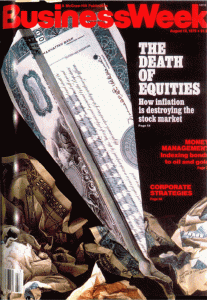 The bigger question is whether crypto is about to enter a period of longer-term revulsion. It took twenty years for stocks to get back to their pre-Great Crash levels. Stocks were also very much in disfavor in the later 1970s and start of the 1980s, witness the famed Business Week Death of Equities cover.1
In the meantime, Twitter is full of delicious schadenfreude. A tiny sample:
This Bitcoin crash is worse than a divorce
I lost half of my money and my wife is still around pic.twitter.com/0wyoAFaCiz
— Bitcoin Teddy (@Bitcoin_Teddy) February 5, 2026
I am generally not a fan of engagement algorithms except when bitcoin is crashing. Then HOOK IT TO MY VEINS
— Matt Stoller (@matthewstoller) February 5, 2026
Remember when the bitcoiners were telling us that bitcoin would eliminate wars and usher in global peace?
Die hard bitcoiners are basically goldbugs with a lobotomy
— Dow (@mark_dow) February 4, 2026
Looks like it's time to start tweeting the Bitcoin chart on a log scale…
— Tracy Alloway (@tracyalloway) February 5, 2026
More substantively:
Because it's a Ponzi scheme and the insiders are dumping it. There is no natural use case or need for Bitcoin. It is a control fraud. https://t.co/V5R74ZraO1
— Jesse's Cafe (@JessesCafe) February 5, 2026
Actually, on the point of Bitcoin and crypto having no use case, as much as I very much like and respect Jesse (we were running buddies back in the financial crisis days), they do. But they are not socially productive. In addition to the oft-mentioned tax evasion, money-laundering, and criminal payoff situations, former State Department official Mike Benz has said that a major user in total transaction volume are intel agencies, for payoffs to recently recruited assets and to otherwise move funds covertly to support things like regime change operations. So that alone suggests these, erm, vehicles2 will not go to zero since they have an official use.
Izabella Kaminska’s hidden history reinforces that idea (do click through to read in full):
1/2 🧵There's a very compelling theory that the person who really bankrolled the foundations of bitcoin (irrespective of who technically wrote the paper and coded it) was mob boss Meyer Lansky.
If you don't know who Meyer Lansky is, you should look him up.
I've always found…
— Izabella Kaminska (@izakaminska) February 5, 2026
Keep in mind that despite all the drama, unless there is a lot more leverage in crypto-land than most of us knew about, its decline (and possible rally) is not systemically important, but more a canary in the coal mine as a sign of how much markets react in a time of radical uncertainty. Thank you Trump!
Repeat after me: it is untenably high levels of private debt that produce financial crises.3 The US is at a troubling nearly 2x GDP. As bad is that many tallies show China at nearly the same ratio. China-watcher PlutoniumKun contends that this means if anything, the proportion is even higher, and from what he can tell, exceeding even Japan’s level before its joint real estate/stock market implosion. And China, like Japan at the start of its lost decades, is entering a deflationary dynamic, which will worsen the real economy effects of its debt overhang.
Even if China is adept enough not to suffer an overt financial crisis, its big debt overhang means it will be exceedingly unlikely to engage in the aggressive stimulus it launched after the 2008 crisis, which greatly blunted the global impact. So a crisis in the US will probably not have any meaningful offset overseas.
The Wall Street Journal reports that investors are demanding higher interest rates for borrowing by big tech players. This matters for many reasons. One is that many of these debtors were already in risky category. The pattern in financial crises and in mere downturns is that lower-quality credits reprice first. Then if things continue to get worse, investors demand more yield from better borrowers.
In this case, there’s an important knock-on effect. What passes for growth in the US has become increasingly depending on big tech spending on AI and data centers. And these companies were planning to fund that capex with borrowing.
From The Software Rout Is Spreading Pain to the Debt Markets:
The steep selloff in software stocks is spreading to the debt market….
That expanding pain is worrying many on Wall Street, because software has come to assume an outsize presence in the corporate-debt market—the result of a wave of private-equity buyouts that stretched from the late 2010s through the early 2020s. A downturn in the sector has the potential to drag down other areas of the market, cooling what has been a humming credit engine.
Software currently makes up 13% of the Morningstar LSTA U.S. Leveraged Loan Index—which tracks speculative-grade loans that are originated by banks and broadly distributed to investors—more than double the share of the next largest sector. The sector makes up an even larger percentage of private-credit loans made by asset managers directly to companies, with estimates putting the share at around 20% to a third of those loans.
Since mid-January, the prices of loans issued by the likes of Cloudera, a data analytics company, and Qlik, the maker of business intelligence software, have sunk by around 10 cents on the dollar or more, according to S&P Global Market Intelligence. Overall, the average price of software company loans in the Morningstar LSTA index has dropped to 90.51 cents on the dollar, as of Wednesday, from 94.71 cents at the end of last year, according to PitchBook LCD.
A 10% move in the credit markets is big. CLO prices (as in tranched corporate loans; unlike CDOs, they have better diversification and structures and have performed well over time) fell to 85 cents on the dollar during the worst points of the crisis and stayed there for a while.
Back to the Journal. Investors are concerned about rollover risk, which in most cases is years away:
Many software-company loans will mature in just a few years, and investors and analysts say there is little indication that AI is hurting the companies right now. Still, businesses typically repay maturing loans with money raised from new loans.
That means if investors are holding a loan that matures in 2028, they have to be confident now that there will be a new lender at that time “that is confident in at least another five years,” said Michael Anderson, global head of credit strategy at Citigroup.
However, there is also a more general repricing:
Throughout the 1990s and early 2000s, debt investors largely avoided tech companies because they thought of them as either home runs or strikeouts. That meant they could be good for shareholders, who could reap the rewards from the successes, but bad for lenders, whose best-case scenario was regular coupon payments, and who ran the risk of significant losses in bankruptcies.
Attitudes shifted in the 2010s, with the growth of high-speed internet, cloud computing and subscription-as-a-service business models, which offered the promise of predictable revenue streams. Investors came to view the sector as so stable that they were willing to fund private-equity buyouts that loaded companies up with more debt than other types of businesses.
Even before AI worries emerged, some software companies had started to look more vulnerable, thanks in part to the 2022 jump in interest rates and rising competitive pressures…
Some analysts say there is at least some potential for trouble in the software sector to spill into other areas of the loan market.
In comments, reader Uday Yadati observed:
The structural issue here is about the erosion of the switching cost moat that justified these loan-to-value ratios. For a decade, lenders treated SaaS revenue as bond-like, assuming high switching costs made leaving impossible. That stickiness was the collateral.
Gen AI automates migration and commoditizes code, dropping switching costs. This transforms recurring revenue into volatile spot revenue. It’s hard to justify 6x leverage on spot dynamics. The market is simply stripping away the predictability premium.
In other words, software and big tech companies will have not just to pay higher interest rates than before, but will see other terms tighten, such as leverage ratio. This translates into more costly and less available credit, which will dent their AI spending and data center buildout plans. How quickly this will play out is anyone’s guess, but it’s another sign that the “AI inevitability” story runs into real world constraints, even before getting to credit crunch risks. Stay tuned.
____
2 Very few investors appreciate how public stocks are a very vague and weak legal promise. You get dividends if and when the company makes money and feels like paying them. You have a vote on comparatively few matters that can be diluted at any time. Even with the appearance of extensive disclosure, it is inadequate to make informed decisions. Companies cannot tell you much about their strategies and plans because it is competitively sensitive.
2 Lambert regarded the use of the term “vehicle” with respect to fancy finance as truth in advertising: “They call them vehicles because they are designed to drive away with all your money.”
3 High levels of official debt are most often “addressed” via financial repression. However, given how self-and-other destructive the Trump Administration has proven to be, it is not impossible that they will shoot themselves and the world economy in the head by a voluntary default on Treasuries via force extending maturities.


Thanks for the excellent piece. It’s looking real bad for bitcoin, folks. Have most leveraged positions been closed by now? Surely they must all be underwater (not considering shorts, of course).
“In other words, software and big tech companies will have not just to pay higher interest rates than before, but will see other terms tighten, such as leverage ratios. This translates into more costly and less available credit, which will dent their AI spending and data center buildout plans.” Wouldn’t OpenAI implode without further credit? They owe such a gargantuan amount I don’t think it’s reasonable to expect they can manage to get enough revenue to repay it; also, data centers are subject to such brutal devaluation (per Zitron) that even if they sold everything it probably wouldn’t make that big of a dent. Wasn’t Softbank on the hook for OpenAI?
“it is not impossible that they will shoot themselves and the world economy in the head by a voluntary default on Treasuries via force extending maturities.” Wouldn’t this be absolutely catastrophic? At the very least it would wreak total havoc on bond markets.
(Small detail: the first footnote on the main text is labeled 2, and the second one is labeled 1. Not really a big deal, but felt like it should be pointed out.)
Yes, I agree this would be catastrophic. But do not underestimate this crowd.
And sorry re the footnotes. I had to run out, hence the untidiness, Fixing now.
I would think that an idiot move like extending treasuries would collapse the Euro as well. Maybe these goons would like that.
The socially dominant geniuses running the place tend to mistake systemic feedbacks from systems for which they’re responsible but have no understanding, as personal affronts, and respond accordingly.
Systemically, at the Federal level, we’ve had the blind lead the blind into a minefield, where feeling you way out is likely to be fatal.
I have come across one real usage for Crypto (anecdata, I don’t know more than I’ve been told)
I live in a city with a large sized international population, most working online, with about 50% being Russian.
Several of my Russian friends have said they get paid in crypto (by US and other companies) as they are otherwise excluded/very limited in access to the international financial system.
Whether this usage is net-good or net-bad I couldn’t say.
Your anecdata is correct, and I can confirm it from own experience. Several times over the last decade I’ve been excluded or hit badly by bank availability and general incompetence. Many times the only answer was to divert to crypto.
And I say that being some form of crypto native, even as I hate the stuff. It’s such a disappointment, but it does work better than the banks if you’re not a salaryman.
So if the US is headed for a financially induced slow down there could be some serious knock on overseas dollar debt crisis issues… With the exception of Nov’s reporting on the US trade deficit, the deficit has been shrinking at a very fast pace since last spring. If a consumer slowdown cuts imports further and pushes the trade balance positive for any sustained period that will mean a dollar drain for the rest of the world which would not be good for foreigners who hold dollar denominated debt.
Maybe, when you look at https://ycharts.com/indicators/us_trade_deficit_monthly it shows a large buildup of imports prior to Liberation Day in April. It may be that the country is running down inventories instead of importing, and that has a short term lifespan. There are some indications towards more investment in US manufacturing, which will help grow the sector in the future. In 2025 there has been a decrease in manufacturing employment, https://www.macrotrends.net/3109/us-manufacturing-employment , so that could mean more automation or that the investment hasn’t happened yet.
Some while back I remember reading an article on this site about US manufacturing and the Trump tariffs. The writer was talking about how US manufacturers import a lot of components and the tariffs had actually increased the cost of manufacturing. The writer was also talking about how tariffs on raw materials like aluminum and steel also affect manufacturing costs. Most countries that use tariffs to bolster their manufacturing put tariffs on imports of finished goods and encourage the import of cheap inputs to production.
It is going to take years for the US to rebuild its manufacturing to where it can run balanced trade with the world. Especially when other countries like China and Mexico have labor costs that are one-tenth of US costs.
Wouldn’t Bitcoin be such a handy thing to blame a major financial downtrend on?
‘The Dow 30 went down sharply when Bitcoin plummeted into the teens…’
1. Bitcoin and crypto have never been significant enough and the direct links to the financial system (like Strategy, both its stock and its borrowing) are comparatively limited.
2. As we have repeatedly said, declines in equities do not create financial crises. Even the massive dot com bubble implosion did not. They can and do ONLY if there is serious leverage involved in the equity buys. They can, however, cause serious economic downturns due to the deflationary effect on spending on the perceived loss of wealth. The punters cut back on spending.
Its more perception than anything else.
I’d imagine a 30 year old male knows of Bitcoin, but would be hard pressed to name a stock in the Dow 30.
We all know a big downturn is in the cards, why not blame it on something that not only doesn’t matter in terms of the business Wall*Street does, as its a scintilla at best.
Interesting how the article mentions how AI causes erosion of protective moats of companies. I experienced this in my private life when switching from Windows to Linux. This used to be daunting for most people, because to find out how to do certain things when you are not yet familiar with Linux, you would spend hours googling and browsing tech forums.
Today, you simply ask ChatGPT, and most of the time you’ll immediately get a solution that works. This has significantly lowered the barrier to making the transition from Windows to Linux.
Excellent point. I would add that I think AI is also having a detrimental effect on consulting firms bottom lines. I have been thinking of switching to Linux as well. MS with their Windows 11 blunders are driving users away.
I am somewhat embarrassed to say that this use case for AI had not occurred to me until I read it here today. I was talking to my wife about taking a six month sabbatical to figure out how to transition away from the leeches. Now I will be implementing this strategy as soon as I can manage to schedule a couple days off.
Yeah, I rage-quit Windows 11 on my little laptop a few weeks ago due to Windows being slow and chewing through battery life.
One really good use case for AI (in my specific case, Gemini) is quickly setting stuff up and troubleshooting it. You can just copy-paste errors and it will walk you through exactly what happened and what you need to do to fix it.
Yes, that is exactly what I do too. If it doesn’t do what you want, just copy the output to your AI and it will tell you why it didn’t work and what to do about it.
I’ve been vastly amused to see many EU governments run away from Win 11 due to its horrible security holes. And it seems every update blows something else up.
As a Linux mint user, I applaud.
I can’t help but wonder if the premise in this post has some merit. (This is way outside my knowledge/experience area so please don’t judge me too harshly if it’s a bunch of hooey.)
https://occupywallst.com/yen
I haven’t read the entire post yet, but the first part starts with ripple effect around the Yen related policy changes. In short, Wall St used 0% interest Yen from the BOJ to then buy interest paying bonds and thus the Yen was source of free money. The policy change is that the BOJ has now increased the interest rate which is causing a lot of things to unwind and assets being liquidated.
As I said, I haven’t read the entire piece, but did not know that 0% Yen based loans were a thing, but easy to understand how this could be exploited and would cause excessive leverage.
The unwind of the yen carry trade was a big amplifier of the global financial crisis. Hedgies and other investors back then had been borrowing in yen to fund investments in other currencies. But then yen started rallying, which meant the cost of the borrowing (particularly the principal amount) was rising, so investors were selling foreign currencies to buy yen to pay off the yen loans, which drove the yen even high and triggered even more carry trade unwinds. The yen went to the moon back then; I traded it with some success at the time.
But if foreign currency investors are having to exit yen borrowings, they would need to buy yen. The yen has been falling. So I have trouble understand the argument.
I like the ‘ploy out’ typo in the last sentence. NC has a nice habit of Freudian typos.
Re.astrology. I knew a very wealthy person who was a hippy in India when he decided to “gain control of my material destiny”. He used astrology for investment very successfully. His biggest win came when the stars told him the next epoch would be communication in air so he bought big in early cell frequency allocation auctions.
Maybe he was just lucky. He predicted a mega catastrophic Jackpot which seems just to have been his own death since the diffuse sub-critical Jackpot lurches on.