Trump, whose deal fixation reveals a desire to score wins at others’ expense, instead keeps creating lose-lose outcomes, with tariffs and Iran as the biggest current examples.
We’ll turn to tariffs soon. On the Iran front, we are in the process of seeing Trump create a massive geopolitical and economic train wreck with his escalation. A conflict would severely harm the Islamic Republic but likely even more the stability of the region, the global economy, US pretenses to dominance, and even potentially the survival of Israel. Yet politically, as Max Blumenthal explains persuasively in a new discussion with George Galloway, Israel is not willing to allow Iran to become more powerful in the Middle East, as Iran has been doing despite concerted US pressure. Israel sees a shrinking window of opportunity to reverse that trajectory. Blumenthal contends that Trump is too hostage to Zionist and evangelical political forces to stare them down and somehow find an exit ramp.
On the tariffs front, it is critical to understand how destructive Trump’s bullying has been. Mind you, tariffs could be a useful mechanism as part of industrial policy. But the US in general and Trump in particular lacks the stick-to-it-ivness to pursue any long-term initiative to improve productive capacity. Tariffs are a long-standing Trump fixation, part of his desire to reduce the US to the 1890s, when robber barons ruled, and to exercise personal power.
And these tariffs have hurt US businesses and consumers. Even though the inflation bite was not as bad as predicted, tariff costs have fallen, as just about any economist with an operating brain cell had predicted, on buyers, meaning Americans. A New York Fed study found they bore 90% of tariff costs; the Kiel Institute found they bore 96% of the burden.
Mind you, this framing of who picks up the tab is a bit too anodyne. Small businesses, the traditional US engine of job growth, have been hit hard. For instance:
microcontrollershop.com – MicroController Pros LLC Close of Business Announcement
After 25 years in business, MicroController Pros LLC will close its business operations on December 13th 2025. We would like to express a heart-felt “Thank You” to all our loyal customers and vendors whom we had the pleasure of working with during this time. Goodbye and keep on having fun with programing & designing Embedded Systems.
Our company always had a large product selection from companies around the globe. Unfortunalty, the current, completely unpredictable, US import tariff policy, makes it impossible for us to continue to import products and make a living from it.
We do not have the manpower, nor the patience, lawyers & finances to fight US customs, Fedex, UPS, etc. over mis-classified goods, incorrectly imposed with 30% …50% import taxes. Imports are incorrectly classified, despite the fact that the correct classifications are being listed on all import papers. It is obvious, that the parties involved in handling imports are complety overwhelmed by the current tariff jungle chaos and lack the manpower, training & know-how to handle it – or is it just indifference towards doing the job right, as they do not have to foot the bill for their mistakes?
We all know whom we have to thank for the current situation – so no naming names. Everyone reading this, please draw your own conclusions. We are pretty sure that we are not the only small business impacted this way. You can make a change by voting in the next election. And remember, even if the alternative that you can vote for is also pretty pathetic – it can’t be any worse than what it is now. ;-)
Before you try arguing that this closure is just an example of Schumpeterian creative destruction and surely this loss was more than offset by gains elsewhere, Trump’s tariffs have not produced “reshoring” as claimed. Manufacturing employment in 2025 fell by 108,500.
Even though most observers expected the Supreme Court to affirm lower-court rulings against the tariff mechanism to which Trump had become addicted, the International Emergency Economic Powers Act (IEEPA), Trump’s failing about after the 6-3 verdict against them came down indicated he was caught by surprise. He quickly made a whinging statement about the Justices that ruled against him, and scrambled to reassert his tariff macho:
In just 25 hours, the U.S. has had four tariff regimes:
1. Liberation Day Mark_II_re-revised
2. Liberation Day Mark_II_re-revised – IEEPA tariffs
3. Liberation Day Mark_II_re-revised – IEEPA tariffs +10%
4. Liberation Day Mark_II_re-revised – IEEPA tariffs +10% + 5%
Hours after the decision, Trump decided that instead of taking the loss and moving on, he would instead “FAFO.” At a press conference, Trump called the majority justices — including three conservatives and two of his own appointees — a “disgrace to our nation” and his appointees “an embarrassment to their families.” The president announced new temporary tariffs of 10% on all imports via an obscure provision of a 1974 law, and then upped the rate to 15% via a post on his social media app. As of writing, a judge has not weighed in on the legality of these new taxes. Trump’s many other uses of emergency powers are in jeopardy, too.
But let’s focus on the narrow analytical question of how this will play with the public. In attacking the Court and doubling down on unpopular tariffs, the president has blundered a major political gift for the sake of ideology and a blind pursuit of his trade war….
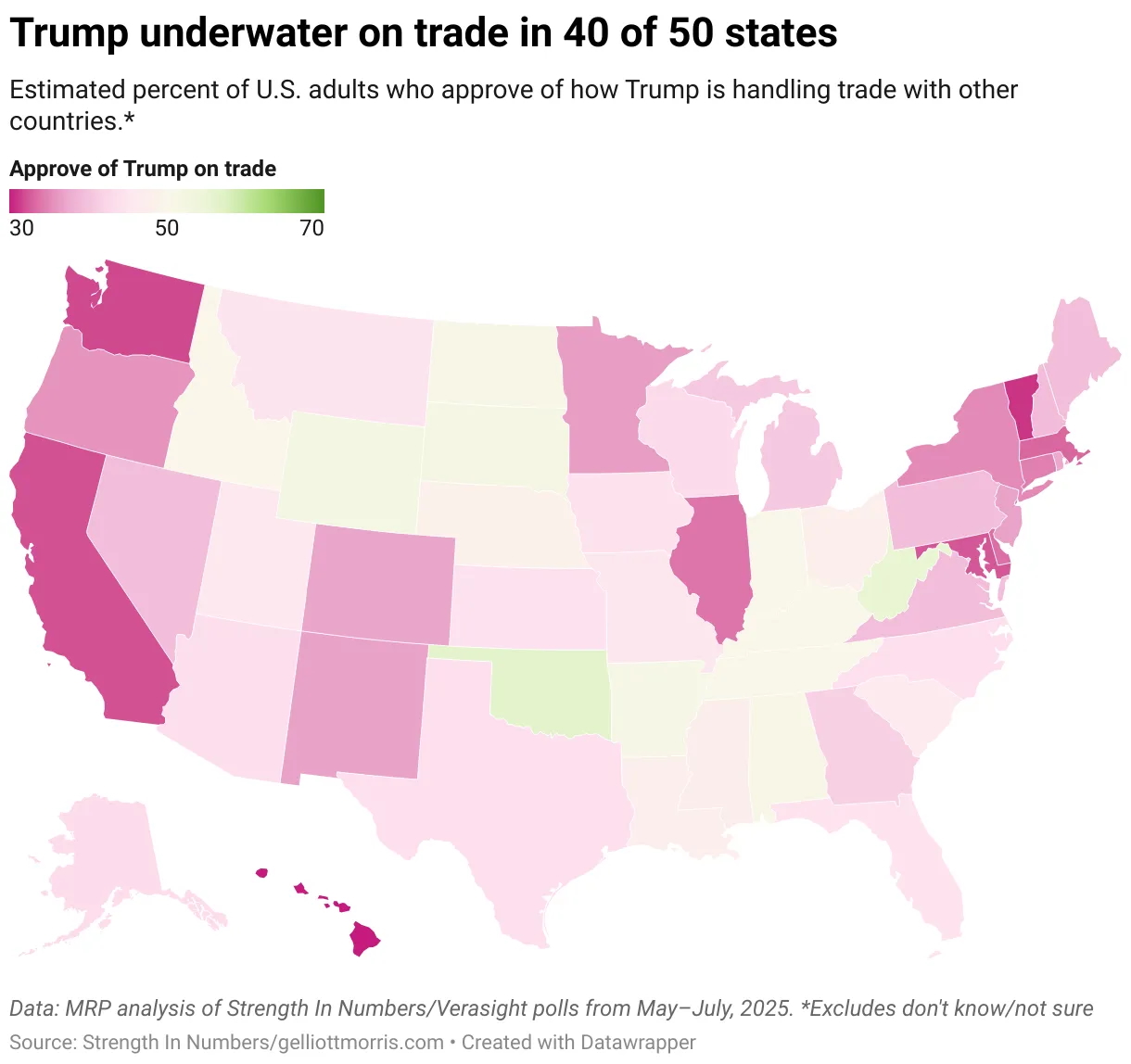
In our Strength In Numbers/Verasight polling, Americans say by a margin of 19 points that they disapprove rather than approve how how he’s handling trade and tariffs. President Trump gets a worse grade on tariffs than he does on handling foreign policy, jobs and the economy, or his job overall….
A -20 margin nationally is pretty devastating electorally. My MRP analysis showed Trump underwater on trade in 40 out of 50 states. These 40 states are worth 80 votes in the Senate and 483 votes in the Electoral College (486 when you count Washington, D.C.)
So by doubling down on tariffs, Trump is doubling down on a policy a supermajority of Americans disapprove of. If “tariff man” were a presidential candidate, he would lose by a larger margin in the Electoral College than Michael Dukakis did in 1988….
Now, consider also the impact of publicly attacking the Supreme Court justices who invalidated his executive orders.
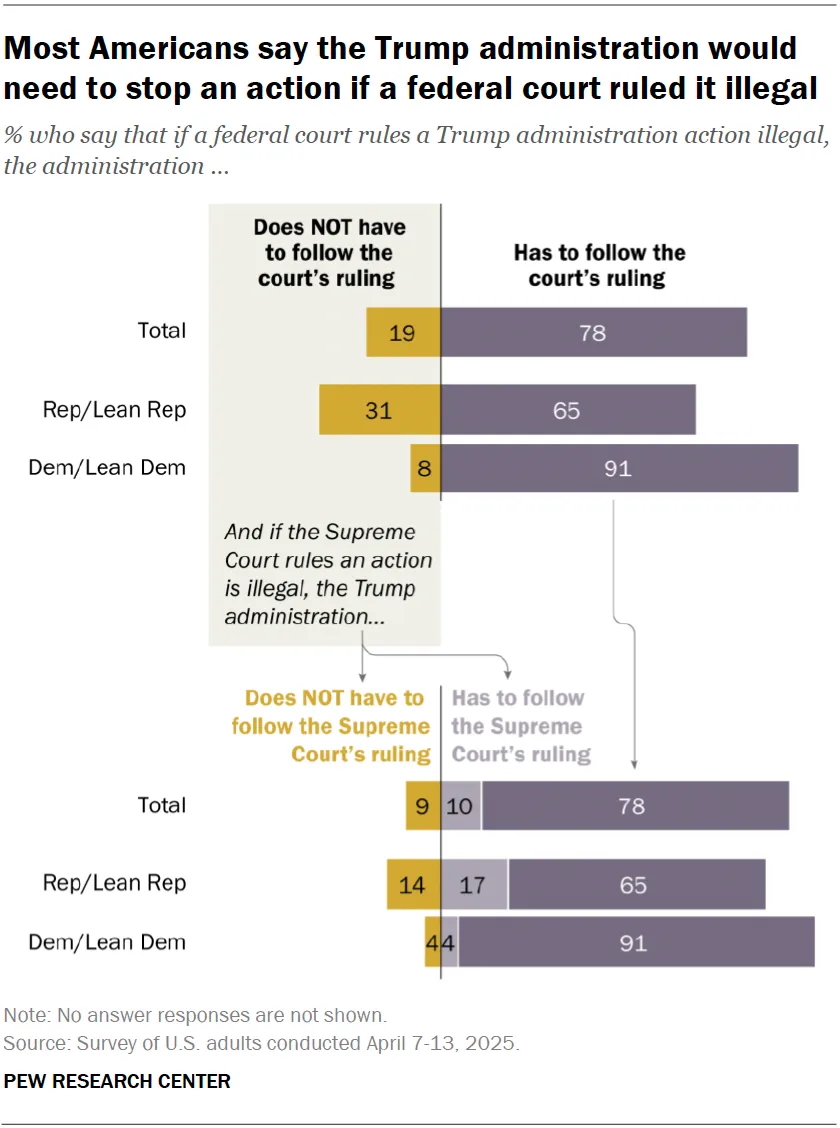
A Marquette Law School national survey, conducted January 21-28, found that 82% of Americans — including 76% of Republicans — said the president must obey Supreme Court rulings. In April 2025, a Pew poll found that 88% of adults said the Trump administration would need to stop an action if the Supreme Court ruled it illegal. That included 82% of Republicans.
The Wall Street Journal focused on the uncertainty of yet more tariff whipsawing in its headline, Tariffs Are a Wild Card for the Economy Again. This is more damning than many might realize. Businesses hate uncertainty. It impedes planning, investment, and hiring, It has the effect of creating additional risks. That in finance terms means a higher risk premium, particularly for concerns exposed to international trade. That also translates into a higher discount rate for financial assets, above all equities.
Keep in mind, first that Trump has only 150 days tops for his 15% global tariffs unless Congress extends them. Given the data on how unpopular they are politically, that is na ga happen. And even these global tariffs could be overturned if challenged:
Section 122 of the 1974 Trade Act, on which Trump’s 10% tariff is based, does not apply in the current macro environment. A balance of payments deficit is not the same thing as a trade deficit. You cannot have a balance of payments if you have a flexible exchange rate, as the US… pic.twitter.com/ZX9pzrGBKa
Seems hard for the President to rely on the 15 percent statute (sec 122) when his DOJ in our case told the Court the opposite: “Nor does [122] have any obvious application here, where the concerns the President identified in declaring an emergency arise from trade deficits, which…
Michael Shedlock provided detail from case history that confirms these readings.1
Trump does have other tariff authorities, as we have described, so even more tariff changes are sure to be coming, given Trump’s love of them. But they are all much less sweeping than what Trump attempted with his “emergency” claim, as in are limited in level and time like Section 122, or require supporting evidence, like Commerce Department findings.
We will put aside the question of refunds. It is certain that the Administration will fight against them. Experts anticipate that it will be years before they will be adjudicated.
The body of the Wall Street Journal article includes estimates of effects:
Trump quickly imposed a 15% global tariff on imports. Accounting for exemptions and other trade deals, the new tariff brings the average effective U.S. tariff rate just slightly lower than where it was before the ruling. The Yale Budget Lab estimates it is now at 13.7%, compared with 16% before the ruling.
By comparison, over the course of 2025, the effective tariff rate soared over 10 percentage points, to levels not seen for decades….
The new tariffs can only stay on for a maximum of 150 days because of the specific law Trump used to impose them. Assuming they end after that time, the Yale Budget Lab estimates the average effective tariff rate will drop to 9.1%. Whether that level sticks is unclear, however, as Trump has vowed to add more duties using other legal means.
Some companies could decide that a floor on tariffs is here to stay and move forward with decisions like raising prices to transfer more of the tariff burden to consumers. Others may continue to put off investment and hiring….
“The whole uncertainty of tariff policy is really not favorable for employment or investment in the real economy,” said Gary Clyde Hufbauer, economist at the Peterson Institute for International Economics. “The temptation to postpone business decisions will be very strong.”…
Now, even with Trump imposing a fresh 15% tariff, estimated revenues will be cut by about half: The Lab estimates that Trump’s tariff regime will raise $1.3 trillion in total if 15% stays in effect for 150 days. In the scenario that the 15% becomes permanent, Trump’s tariff regime would raise $2.2 trillion….
The Trump tariffs before the Supreme Court ruling amounted to an average tax increase per U.S. household of $1,000 in 2025, and would have added an increase of $1,300 in 2026 had Ieepa stayed in place, according to the Tax Foundation. After the recent changes, the average burden per U.S. household will be $700 in 2026, according to a Tax Foundation forecast, about $250 of which will come from the new, temporary 15% tariff.
Donald Trump’s new 15 per cent global tariff will most greatly benefit countries he has singled out for heavy criticism, including China and Brazil, data analysis shows.
An examination of the new regime by independent trade monitoring body Global Trade Alert found that Brazil will enjoy the biggest reduction in average tariff rates — falling by 13.6 percentage points — followed by China, with a 7.1 percentage point reduction.
Long-standing US allies including the UK, the EU and Japan will suffer the largest hit from the new levy…
And that’s before getting to yet another downside of Trump’s practice of using his now-expired tariff authority as a bludgeon, regularly changing the level inflicted on a particular nation at whim. In keeping with that “nothing is final” mode, former US ambassador Chas Freeman pointed out that diplomats (notably Japan) had complained that they would show up for trade negotiations with the Trump team, which was in shakedown mode. They had no proposals at all, and would make demands that the other side make concessions. Freeman also stressed nothing was reduced to writing. One assumes it eventually was since most of these “deals” would be subject to ratification by the counterparty’s legislature
The refusal to formalize understandings much if at all is now going to bite Trump:
Even though many countries may still be too cowed by Trump to clear their throats and say their trade agreement was not ratified, and since Trump is changing terms on his end so they want to reopen those terms, the EU looks like it will do just that. From Bloomberg:
The European Parliament’s trade chief will propose freezing the ratification process of the European Union’s trade deal with the US until they’ve received details from President Donald Trump’s administration on its trade policy.
Bernd Lange, chairman of the parliament’s trade committee, said he’ll propose suspending legislative work on approving the so-called Turnberry Agreement at an emergency meeting on Monday “until we have a comprehensive legal assessment and clear commitments from the US.”
“Pure customs chaos on the part of the US government,” Lange wrote on social media Sunday. “Nobody can make sense of it anymore – only unanswered questions and growing uncertainty for the EU and other US trading partners.”
….
EU Is the Biggest Source of US Imports
Source: US Census BureauNote: Figures are sum of January-May in 2025
The deal struck last summer between Trump and European Commission President Ursula von der Leyen would impose a 15% tariff rate on most EU exports to the US while removing tariffs on American goods heading into the bloc. The US would also continue to impose a 50% tariff on European steel and aluminum imports….
After Friday’s supreme court ruling, Trump said he would institute a 10% global tariff to maintain protective trade measures on the rest of the world. On Saturday, he said he would increase that rate to 15%, stirring up more economic turbulence and uncertainty about US policy.
In other words, the tumult around Trump’s tariffs is even worse than you might imagine, and that will continue to impose all sorts of costs on hapless bystanders. But the intended message is clear: this is Trump’s world and he is going to continue to impose his will on as many as he can, irrespective of whether there is any prospect for good outcomes, even for him.
Please consider Case 2025-1812 Trump vs State of Arizona, Colorado, Illinois, Minnesota, Nevada, etc. Emphasis Mine
Plaintiffs’ attempts to defend the CIT’s actual reasoning—that “regulate … importation” authorizes only some tariffs—likewise fail. Plaintiffs rely on Section 122 of the Trade Act of 1974, but that statute cannot be read to narrow the President’s IEEPA authority. The statutes “coexist harmoniously.” Department of Agric. Rural Dev. Rural Hous. Serv. v. Kirtz, 601 U.S. 42, 63 (2024). Section 122 authorizes measures to address non-emergency balance-of-payments concerns. And IEEPA supplies a distinct, complementary authority to address balance-of-payments concerns and other issues when they constitute emergencies. Congress commonly provides overlapping authorities, especially in this context, and it is particularly clear that Congress intended these two statutes to buttress each other given that Congress enacted IEEPA after Section 122.
Even if Section 122 had been enacted after IEEPA, reading it as “‘displac[ing]’” part of the President’s authority under IEEPA would be improper unless plaintiffs could overcome the “‘strong presumption’” that the statutes “can coexist harmoniously.” Department of Agric. Rural Dev. Rural Hous. Serv. v. Kirtz, 601 U.S. 42, 63 (2024). Plaintiffs cannot carry that “‘heavy burden,’” id. Indeed, Yoshida articulates how the two statutes coexist: Congress “said what may be done with respect to foreseeable events” in various statutes, including Section 122, and “what may be done with respect to unforeseeable events in the TWEA,” 526 F.2d at 578 (emphases added), and now in IEEPA. That is, while Section 122 empowers the President to address non-emergency balance-of-payments concerns, IEEPA supplies a distinct, complementary authority to address emergencies, including but not limited to balance-of-payments concerns.
[The Killer Phrase]
Nor does it have any obvious application here, where the concerns the President identified in declaring an emergency arise from trade deficits, which are conceptually distinct from balance-of-payments deficits. See, e.g., S. Rep. No. 93-1298, at 89 (1974) (Senate report on Section 122, recognizing the possibility of “a large payments surplus” at the same time as “a large trade deficit”).
[Killer Phrase II]
Section 122 fully applies to balance-of-payments tariffs when the President has not declared an emergency and identified an “unusual and extraordinary threat,” 50 U.S.C. § 1701; IEEPA supplies additional power to address balance-of-payments concerns when those preconditions are met, and to address other concerns
TWEA authority had impliedly been limited by the later enactment of Section 122, that is now irrelevant because Congress enacted IEEPA after Section 122 (and Yoshida). As discussed above (at 5-6), it defies credulity to suggest that when Congress enacted IEEPA, using the same language that had been construed to authorize a balance-of-payments surcharge in TWEA, Congress meant to exclude such authority.
Finally, Section 122’s legislative history—which the private plaintiffs invoke, Br. 31—does not help them. Plaintiffs inaccurately paraphrase the Senate committee report on the statute containing Section 122 as saying Congress passed that provision “to provide ‘explicit statutory authority’ to deal with the type of emergency President Nixon declared in 1971.” V.O.S. Br. 31. In fact, the report says that Congress wanted the President “to have explicit statutory authority to impose certain restrictions on imports for balance of payments reasons,” S. Rep. No. 93-1298, at 88—not that Congress meant for the provision to cover “emergenc[ies]” (V.O.S. Br. 31).
I wonder if Japan will still be on the hook for its $500 billion donation to Trump’s investment fund? If so double whammy before Takaichi visits in March
Acacia
Apparently, yes.
But no worries. The usual fake polls will say Takaichi has an approval rating up at Kim Jong levels.
Piotr Berman
Japan explained that they will organize a bank (?) facilitating investments in USA according to the wishes of Japanese companies, which is a rather symbolic change in respect to status quo. The “hook” in your question is only in one-sided imagination of Trump, Lutnick and their ilk. (Lutnik means “maker of string instruments”, but his talent is in “story telling” like the origin of his revulsion to Jeffrey Epstein or the brilliance exhibited by Trump in trade negotiations.)
ChrisFromGA
I have to admit to being totally confused. If the tariffs under IEEPA are now legally “null and void” aren’t all deals previously made using them (EU, India) also null and void? Then why are the Europeans insisting that taco sticks to the (bad) deal they made last year?
No, the trade deals are free standing even if the IEEPA cudgel was the reason for entering into them.
In the old days before abortions, if a man “had” to get married because he got a girl pregnant, he would still be married if the baby was stillborn.
But as I understand it, the EU trade deal was never ratified, so I don’t think they have much of a leg to stand on. But that is not an IEEPA mattter.
ChrisFromGA
Thanks, that’s a good analogy.
The EU would be crazy-pants not to use this opportunity to renegotiate if the trade deal was never ratified. But we know that they’re supplicants. So perhaps they’ll go along with the bullying.
Carolinian
Trump has boasted that he has the power to destroy nations but the only nation he can really destroy is this one. And that is only if the remainder of our ruling class let him do it. They’ve spent decades talking about the dangers of “appeasement” in the face of absolutist madness and now that we have a president who also wants to build a world with himself at the center they sit on their hands.
Trump is just a boob, but the madness is real and to be found in our makeup despite all the rationalizing liberals who go on about our “better angels.” They can’t handle the truth but the truth is here and threatening everyone.
t
Mind you, tariffs could be a useful mechanism as part of industrial policy.
We should all stop with this and instead refer to “Trump’s moronic play-pretend idea of “tarrifs”‘ or “Trumps so-called tarrifs and the real world consequences” or “toddler-baby Trump’s idiotic tarrif ideas.”
Aligning this administration’s tariffs and deal and international relations with history is a trap.
Did you get out of the wrong side of bed? Your comment is out of line.
I am not having you make readers stupid or act as a censor. Trying to do so is a fast track to losing your comment privileges.
Using your logic, because Trump files defamation suits on bogus grounds, no one should ever even MENTION the concept of defamation
Tariffs can be a legitimate economic tool if used narrowly in connection with other policies. Having a hissy over a statement of fact is not on.
lyman alpha blob
I think your penultimate sentence is what t was getting at – tariffs can be a legitimate economic tool but what Trump is doing is not, and then humorously suggested calling Trump’s actions something different so his kneejerk reactions aren’t confused with legit policy tools.
Piotr Berman
Nevertheless, restoring some industries may be possible with calibrated tariffs, but it definitely needs more stimulative tools and overall strategy. “Free market” will not suffice. The question is: should the “collective West” resign itself to a standard of living something in-between China and Bangladesh within a generation.
Gary B Puckett
Well said, Yves, but if “tariffs could be a useful mechanism as part of industrial policy,” then I’d be wary of citing an undifferentiated count of lost manufacturing jobs, which gets successfully used as an argument against using tariffs at all. Any tariff able to foster a degree of manufacturing autarky will at least temporarily disrupt the sector that currently dominates what is left of US “manufacturing”: assembly. The automotive industry is a good example. Foreign brands set up assembly plants in the US to get around tariffs. Domestic brands compete by offshoring the manufacture of as much as possible before assembling some remaining product lines in the US. If you’re going to use tariffs to reverse that course, you need to break out where the impacts are down the supply chain, and so make sense of what disruptions may be necessary.
Obviously, the ham-fisted Trump tariffs have little prospect of fostering component parts manufacturing, but encouraging a granular measure of impact would be helpful, going forward.
I hate to sound harsh, but your comment is nonsensical. Saying that tariffs can be beneficial in certain circumstances, most important as part of integrated policies that will be sustained over time, has absolutely nothing to do with the fact that Trump’s tariffs, applied mainly to bully other countries as opposed to do anything useful, has hurt manufacturing. Quite a few small businesses closed or cut back, FFS. And separately, the tariffs indisputably hurt the farm sector in a big way.
. There is no evidence, nada, that reshoring is happening on any scale. The onus is on you to prove your assertion. There is plenty of evidence otherwise. For instance, from Supply Chain Management Review:
Six months after the administration’s latest wave of tariffs took effect, the headlines tell an optimistic story. The U.S. trade deficit is narrowing. Tariff revenues have doubled. Companies have announced more than $1.7 trillion in new manufacturing investments, from semiconductor fabs in Texas to EV battery plants in Tennessee.
It looks like progress. Yet, if success is measured by the strength of American manufacturing, the reality is more complicated. Tariffs can shift incentives, but they can’t solve the structural issues that determine where and how products are made.
For decades, globalization built supply chains optimized for cost rather than resilience. Production followed inexpensive labor, solid infrastructure, and efficient logistics; advantages that favored Asia. Reversing that pattern takes more than policy; it requires rebuilding America’s manufacturing muscle from the ground up.
So far, much of the “reshoring boom” exists in planning documents. Some sites are breaking ground, but construction will take years. And even when facilities open, the deeper supplier networks that make local production sustainable take far longer to mature. Without those layers, new U.S. plants risk becoming costly assembly hubs, still dependent on imported components and vulnerable to the same shocks tariffs were meant to guard against.
Cost remains the biggest hurdle. U.S. labor averages $25 to $30 an hour compared to roughly $6 to $7 in China. Productivity and energy efficiency narrow the gap, but not enough to offset the difference at scale. Without significant automation, many reshoring projects struggle to make financial sense once startup subsidies and tax incentives run out.
People are the next challenge. About half a million manufacturing jobs remain unfilled because the skills required in modern factories are changing faster than training systems can keep up. Running robotic cells or managing digital twins demands fluency that traditional shop-floor experience doesn’t provide. Until upskilling becomes a coordinated national priority, labor will remain a weak link.
Suppliers are the third hurdle to overcome. Manufacturing doesn’t thrive in isolation; it depends on ecosystems of specialized suppliers that produce the materials, tools, and components feeding every stage of production. Those networks hollowed out over decades of offshoring. Recreating it requires sustained collaboration among companies, regional leaders, and education systems to rebuild both capability and scale.
The economic rationale for the tariffs is they will bring back manufacturing to the USA. The architect of this outmoded idea is the economist Peter Navarro. His theory is that as goods become more expensive to import into the USA, companies will start relocating their manufacturing here — an idea called “onshoring” of manufacturing.
I scrutinised this scheme with my own MBA students in strategic management at Penn State University. Here are the reasons why the idea of onshoring is a fallacy.
Onshoring or relocation of manufacturing to a home country is a very complex decision for companies. It is based on the costs of doing business in different countries; tariff and non-tariff barriers of doing business; proximity of production to markets; availability and cost of resources such as raw materials, finance and labor; and companies’ long-term strategies.
Onshoring decision analysis itself takes months if not years, must be cleared by multiple levels within organisations and by country regulatory agencies at local and national levels.
Complexity number one: Reshoring to America will require investments in land, buildings, equipment and workforces within the USA. Higher costs on these were a major reason why offshoring occurred in the first place. Costs of all these factors of production have escalated over the past few decades. With under 17 percent of the USA economy in the manufacturing sector, some of these factors, and a manufacturing ecosystem, are simply no longer available in America.
Complexity number two: Reshoring would require rebuilding the supply chain. Global supply chains are complex and multilevel. There are many layers of suppliers who are based in different countries with different tariff rates. Large companies have thousands of suppliers. Renegotiating contracts can take months or even years. Higher tariffs will increase the cost of supplies from even home-based suppliers if those suppliers are using imported goods.
Complexity number three: Can companies trust that the current Trump tariffs will remain stable for long enough to match corporate calculations for return on investment? Large-scale investments involved in moving manufacturing across nations run into the hundreds of millions of dollars. These sunk costs take upwards of 10 years to recoup.
Trump’s flip-flopping on tariff rates, application dates, delays and reversals in his first administration, and his current attitude that countries can individually negotiate lower tariff deals with him, presents no guarantee of stability. Instead, it injects enormous uncertainty into the decision for any corporate board to accept. Shareholders would likely sue corporate boards that approve such uncertain investments.
So, the hope that tariffs will lead to onshoring of manufacturing to the USA is a fantasy.
And the manufacturing job fall is happening when the economy overall is having pretty good growth.
Tariffs are best suited in developing economies and to protect infant industries.
mrsyk
I’ll emphasize these two thoughts from the WSJ article. “The whole uncertainty of tariff policy is really not favorable for employment or investment in the real economy,” said Gary Clyde Hufbauer, economist at the Peterson Institute for International Economics. “The temptation to postpone business decisions will be very strong.”…
Now, even with Trump imposing a fresh 15% tariff, estimated revenues will be cut by about half: The Lab estimates that Trump’s tariff regime will raise $1.3 trillion in total if 15% stays in effect for 150 days. In the scenario that the 15% becomes permanent, Trump’s tariff regime would raise $2.2 trillion….
That’s Capital reluctant to invest combined with the reduction/destruction of an important revenue stream. (Trump immediately imposing a blanket 15% tariff speaks to how important that revenue stream is.) One irony here is that if Trump had just gone with the blanket tariff to start with, Capital would probably be more willing to participate, because (I reckon) it’s the ever-changing landscape that’s the buzzkill.
On Iran, W Webb put this bug in my ear and it won’t go away. A, or perhaps the top priority for the people that Epstein worked for is a US led war on Iran.
XXYY
META COMMENT: Naked Capitalism posts are interesting because of their extensive inclusion of material from other authors. However, posts can be very difficult to read because of the difficulty of determining the source of a particular passage.
The general practice seems to be merely to indent the quoted material by one or two spaces. If the quote is long, or includes charts and figures, or itself includes further quotes from elsewhere, it can become literally impossible to understand who wrote the words one is reading. This post is a good example.
I’m wondering if NC could experiment with style sheet changes that would correct this. I am no expert, but margin bars, font changes, colored backgrounds, or even larger indents are well accepted in the publishing field as a way to demarcate quotes.
I’m making this as a well-intentioned and minor suggestion, that would make your excellent but sometimes complex postings clearer for this poor reader and others.
XXYY
META COMMENT P. S.: See Larry Johnson’s post on February 24th for some examples of how to set off embedded quotes. He uses two of the strategies mentioned above, a larger font and a quote bar on the left side.
It’s extremely clear which are Johnson’s words and which are the words of others.
I am sorry but I do not have the time to change site formatting. You are the only one to be having this issue in the entire 19 years of this site.
Acacia
One cool thing about using a web browser is that you yourself can change all of this on the client side.
ISL
I have purchased several high-value items directly from China during this period of tariffs. The actual tariff I paid (to the UPS driver at delivery, as a check, NOT a credit card) was about 5%, because the value listed was much lower than the purchase price. I also saw that clearance occurred in China! This has assuaged my concerns about a new solar business that would require significant importations. I noted when I last flew into LA, that there was only two CBP in a corridor – not the dozen there used to be in pre-DOGE days in a special room with tables – hassling a middle eastern family.
I regularly order high-precision inclinometers and INUs. With tariffs, they now cost $140 delivered. The nearest US comparable items is in the thousands of dollars, whereas the US tech service is nonexistent. The Chinese tech service is awesome. They respond in good English (thanks to a positive use of AI) within a few hours (even in the middle of the night), including videos on how to set up and use the videos.
It would take a 95-98% devaluation of the dollar to make the US inclinometer, which is buggy!!, comparable.
Retaj
At work, I needed to send some parts from here in the US to Germany for an RMA. I asked about the cost via DHL, and there was a fee called “temporary import export” of $150 doubling the cost of the returned goods. This was the output of the shipping software, so I think it is built in. It would take some IT effort by DHL to implement whatever the correct interpretation of duties, I assume.
Our shipping department just seemed to shrug, so I did too. This was a one off shipment. I am very curious about other duties, but I do not have insights.
GF
Bringing things down to my financial level, if we (consumers) are paying 90% – 96% of the tariff costs, why are the importers going to be made whole (Albeit in a possible long time frame) even as they passed those tariff costs down to us? We could sure use a check for $1,000 – $1,700 to help out finances.
lyman alpha blob
Thanks for including the excerpt from MicroController Pros. I’d been wondering how in the world these tariffs were being enforced and collected when the percentages seem to change every time Trump breaks wind. Apparently the answer is ‘not very well at all’ which is exactly as I’d (and probably the rest of the world too) suspected. One hopes these companies are keeping their receipts.
Safety First
A few things.
1. It strikes me that 150 days from now is in July. In fact, today, February 23, plus 150 days, is July 22, so if we assume that the 150-day tarriffs are in effect as of…a couple of days ago? That’s roughly the time frame.
So what is Trump going to do?
a) There exist some other laws, and I am no expert here, and so he’ll “roll” the 15% or whatever tarriff from the 150-day law to those.
b) He rages, fumigates and discombobulates online and on camera, and this causes the Republicans in Congress to pass a law extending these tarriffs, or enshrining them in some fashion, or giving him some other authority. [Alexander Mercouris seems to think the pending Blumenthal-Graham sanctions bill could give him the authority to slap tarriffs on just about anyone, anywhere, for “trading with our mortal enemy”, if drafted right.]
In point of fact, Politico had a story a couple of days ago about how some Republicans in Congress want another huge bill to cram things into before their likely loss in the Midterms, but congressional leaders have thus far been fairly lukewarm to the idea.
c) Trump pretends that nothing has expired, signs some nonsensical executive orders, and we have to wait for the courts to actually try and do anything about it.
At this point, I just do not know. If we were talking Bush Jr. or Obama or something, I’d have assumed (a), or maybe (b), but who knows. That this year’s Independence Day is a round 250 years throws an additional monkey wrench in the works, I think – Trump will want to own the spectacle in some fashion.
2. I’ll relate what my mother – neither a Trumpist nor a Republican in the slightest – has said to me on a couple of occasions. All that Trump has to do to guarantee himself a victory in the Midterms is to, a little while before hand, send every American a check for $2,000 under his own signature claiming this to be the “tarriff dividend”. All of a sudden, everyone likes Trump, and everyone likes tarriffs, or so the idea goes.
Now, I do not think this is going to happen. But that would be one hell of a zag to zig from the standpoint of dealing with the “quasi-illegal” tarriff revenue already collected. Though that would work out to only about $400 for every American, or about $520 if you only count the 18+ cohort, and I’m not sure that would resolve any legal issues, but hey.
3. I think it goes without saying that the rational thing to do for every other nation is to just wait out the chaos, hoping that whoever succeeds Trump will either roll the whole thing back, or at least conduct “normal” trade negotiations with written terms and ratified agreements. Of course, the EU, and some others, have demonstrated staggering levels of spinelessness in recent past, so who knows.
4. Broadly speaking, the original point of these tarriffs was…clearly not what was advertised. Surely even the modern-day neoclassical economists, however low my opinion of them, could tell that one cannot reindustrialize with tarriffs alone, especially in an era when even “American-made” products usually have materials or components imported from overseas.
So Trump himself can think whatever he wants, but the people around Trump – Bessent, for example – I keep asking, what’s their real game. Ideas:
– Stealth-transition from income to sales taxes, which is what Republicans had wanted to do for many years. Not completely, and not officially, but cut-income-tax-slap-on-tarriffs is a bit too neat to be a complete coincidence.
– Use the tarriff threat to extract more stuff from vassals and flunkeys. Perhaps, and maybe this is how the idea was sold to Trump himself, but at some point you’d want to lock in written and ratified agreements, not to mention that threatening the Chinese has clearly been counterproductive. So a maybe here.
– These people, I mean the ones around Trump, are genuinely not sane in their understanding of how things work. I cite Bessent’s 2024 (!) speech to the Manhattan Institute (https://manhattan.institute/article/the-fallacy-of-bidenomics-a-return-to-central-planning), specifically the only section of the speech that deals with “prescriptions” for how to fix things.
U.S. economic policy must cast aside the latest failed central planning experiment of Bidenomics and reorient back towards private sector led innovation and growth. The solutions are known: slay inflation, achieve energy dominance, execute meaningful deregulation, control federal spending, reorder unsatisfactory trade arrangements, reassert control on immigration, and project strength internationally.
I mean, most of these read like the boilerplate Republican Party Platform from the past 30+ years – cut (social) spending, deregulate and privatize everything, drill-baby-drill. But “reorder unsatisfactory trade arrangements”? The word “trade” only occurs two more times in the speech, once referencing “fair trade” under Trump I, and once in the context of households not able to “trade down” to cheaper goods. Most of the speech is how Biden’s “communism”, I mean, “central planning”, caused inflation. So the solution is…tarriffs? Am I missing something in how these people understand economics works?
ChrisFromGA
Thanks for the detailed rundown of possible scenarios.
As I posted up the thread, I am increasingly perplexed by all this. Trump cited emergency authorities to justify the first round of tariffs, and that has been roundly rejected by the courts. Now he’s moving to temporary tariffs, under different authorities.
Lost in all of this is a keyword you put in your comment – Congress. How are these “deals” he negotiated with foreign countries even legally binding without Congress’s approval? I distinctly remember NAFTA having to pass Congress back in 1993 or 1994. Bill Clinton had to spend political capital to get that done.
Now Congress seems to have become irrelevant.
It seems that a new President could simply ignore or revoke any Trump trade deals, as they have only the effect of an executive order, not legislative authority that binds one presidency after another.




I wonder if Japan will still be on the hook for its $500 billion donation to Trump’s investment fund? If so double whammy before Takaichi visits in March
Apparently, yes.
But no worries. The usual fake polls will say Takaichi has an approval rating up at Kim Jong levels.
Japan explained that they will organize a bank (?) facilitating investments in USA according to the wishes of Japanese companies, which is a rather symbolic change in respect to status quo. The “hook” in your question is only in one-sided imagination of Trump, Lutnick and their ilk. (Lutnik means “maker of string instruments”, but his talent is in “story telling” like the origin of his revulsion to Jeffrey Epstein or the brilliance exhibited by Trump in trade negotiations.)
I have to admit to being totally confused. If the tariffs under IEEPA are now legally “null and void” aren’t all deals previously made using them (EU, India) also null and void? Then why are the Europeans insisting that taco sticks to the (bad) deal they made last year?
See:
https://seekingalpha.com/news/4554960-eu-says-it-wont-accept-increase-in-us-tariffs-a-deal-is-a-deal
Why wouldn’t you insist on renegotiating on better terms, as the Indians have, per today’s links?
(Taco tried the 15% tariffs under a different authority, but that expires within 150 days.)
No, the trade deals are free standing even if the IEEPA cudgel was the reason for entering into them.
In the old days before abortions, if a man “had” to get married because he got a girl pregnant, he would still be married if the baby was stillborn.
But as I understand it, the EU trade deal was never ratified, so I don’t think they have much of a leg to stand on. But that is not an IEEPA mattter.
Thanks, that’s a good analogy.
The EU would be crazy-pants not to use this opportunity to renegotiate if the trade deal was never ratified. But we know that they’re supplicants. So perhaps they’ll go along with the bullying.
Trump has boasted that he has the power to destroy nations but the only nation he can really destroy is this one. And that is only if the remainder of our ruling class let him do it. They’ve spent decades talking about the dangers of “appeasement” in the face of absolutist madness and now that we have a president who also wants to build a world with himself at the center they sit on their hands.
Trump is just a boob, but the madness is real and to be found in our makeup despite all the rationalizing liberals who go on about our “better angels.” They can’t handle the truth but the truth is here and threatening everyone.
We should all stop with this and instead refer to “Trump’s moronic play-pretend idea of “tarrifs”‘ or “Trumps so-called tarrifs and the real world consequences” or “toddler-baby Trump’s idiotic tarrif ideas.”
Aligning this administration’s tariffs and deal and international relations with history is a trap.
Did you get out of the wrong side of bed? Your comment is out of line.
I am not having you make readers stupid or act as a censor. Trying to do so is a fast track to losing your comment privileges.
Using your logic, because Trump files defamation suits on bogus grounds, no one should ever even MENTION the concept of defamation
Tariffs can be a legitimate economic tool if used narrowly in connection with other policies. Having a hissy over a statement of fact is not on.
I think your penultimate sentence is what t was getting at – tariffs can be a legitimate economic tool but what Trump is doing is not, and then humorously suggested calling Trump’s actions something different so his kneejerk reactions aren’t confused with legit policy tools.
Nevertheless, restoring some industries may be possible with calibrated tariffs, but it definitely needs more stimulative tools and overall strategy. “Free market” will not suffice. The question is: should the “collective West” resign itself to a standard of living something in-between China and Bangladesh within a generation.
Well said, Yves, but if “tariffs could be a useful mechanism as part of industrial policy,” then I’d be wary of citing an undifferentiated count of lost manufacturing jobs, which gets successfully used as an argument against using tariffs at all. Any tariff able to foster a degree of manufacturing autarky will at least temporarily disrupt the sector that currently dominates what is left of US “manufacturing”: assembly. The automotive industry is a good example. Foreign brands set up assembly plants in the US to get around tariffs. Domestic brands compete by offshoring the manufacture of as much as possible before assembling some remaining product lines in the US. If you’re going to use tariffs to reverse that course, you need to break out where the impacts are down the supply chain, and so make sense of what disruptions may be necessary.
Obviously, the ham-fisted Trump tariffs have little prospect of fostering component parts manufacturing, but encouraging a granular measure of impact would be helpful, going forward.
I hate to sound harsh, but your comment is nonsensical. Saying that tariffs can be beneficial in certain circumstances, most important as part of integrated policies that will be sustained over time, has absolutely nothing to do with the fact that Trump’s tariffs, applied mainly to bully other countries as opposed to do anything useful, has hurt manufacturing. Quite a few small businesses closed or cut back, FFS. And separately, the tariffs indisputably hurt the farm sector in a big way.
. There is no evidence, nada, that reshoring is happening on any scale. The onus is on you to prove your assertion. There is plenty of evidence otherwise. For instance, from Supply Chain Management Review:
Six months after the administration’s latest wave of tariffs took effect, the headlines tell an optimistic story. The U.S. trade deficit is narrowing. Tariff revenues have doubled. Companies have announced more than $1.7 trillion in new manufacturing investments, from semiconductor fabs in Texas to EV battery plants in Tennessee.
It looks like progress. Yet, if success is measured by the strength of American manufacturing, the reality is more complicated. Tariffs can shift incentives, but they can’t solve the structural issues that determine where and how products are made.
For decades, globalization built supply chains optimized for cost rather than resilience. Production followed inexpensive labor, solid infrastructure, and efficient logistics; advantages that favored Asia. Reversing that pattern takes more than policy; it requires rebuilding America’s manufacturing muscle from the ground up.
https://www.scmr.com/article/tariffs-us-manufacturing-reshoring-impact-2025
And:
https://www.clubofrome.org/blog-post/shrivastava-tariffs-manufacturing-america/
And the manufacturing job fall is happening when the economy overall is having pretty good growth.
Tariffs are best suited in developing economies and to protect infant industries.
I’ll emphasize these two thoughts from the WSJ article.
“The whole uncertainty of tariff policy is really not favorable for employment or investment in the real economy,” said Gary Clyde Hufbauer, economist at the Peterson Institute for International Economics. “The temptation to postpone business decisions will be very strong.”…
Now, even with Trump imposing a fresh 15% tariff, estimated revenues will be cut by about half: The Lab estimates that Trump’s tariff regime will raise $1.3 trillion in total if 15% stays in effect for 150 days. In the scenario that the 15% becomes permanent, Trump’s tariff regime would raise $2.2 trillion….
That’s Capital reluctant to invest combined with the reduction/destruction of an important revenue stream. (Trump immediately imposing a blanket 15% tariff speaks to how important that revenue stream is.) One irony here is that if Trump had just gone with the blanket tariff to start with, Capital would probably be more willing to participate, because (I reckon) it’s the ever-changing landscape that’s the buzzkill.
On Iran, W Webb put this bug in my ear and it won’t go away. A, or perhaps the top priority for the people that Epstein worked for is a US led war on Iran.
META COMMENT: Naked Capitalism posts are interesting because of their extensive inclusion of material from other authors. However, posts can be very difficult to read because of the difficulty of determining the source of a particular passage.
The general practice seems to be merely to indent the quoted material by one or two spaces. If the quote is long, or includes charts and figures, or itself includes further quotes from elsewhere, it can become literally impossible to understand who wrote the words one is reading. This post is a good example.
I’m wondering if NC could experiment with style sheet changes that would correct this. I am no expert, but margin bars, font changes, colored backgrounds, or even larger indents are well accepted in the publishing field as a way to demarcate quotes.
I’m making this as a well-intentioned and minor suggestion, that would make your excellent but sometimes complex postings clearer for this poor reader and others.
META COMMENT P. S.: See Larry Johnson’s post on February 24th for some examples of how to set off embedded quotes. He uses two of the strategies mentioned above, a larger font and a quote bar on the left side.
It’s extremely clear which are Johnson’s words and which are the words of others.
I am sorry but I do not have the time to change site formatting. You are the only one to be having this issue in the entire 19 years of this site.
One cool thing about using a web browser is that you yourself can change all of this on the client side.
I have purchased several high-value items directly from China during this period of tariffs. The actual tariff I paid (to the UPS driver at delivery, as a check, NOT a credit card) was about 5%, because the value listed was much lower than the purchase price. I also saw that clearance occurred in China! This has assuaged my concerns about a new solar business that would require significant importations. I noted when I last flew into LA, that there was only two CBP in a corridor – not the dozen there used to be in pre-DOGE days in a special room with tables – hassling a middle eastern family.
I regularly order high-precision inclinometers and INUs. With tariffs, they now cost $140 delivered. The nearest US comparable items is in the thousands of dollars, whereas the US tech service is nonexistent. The Chinese tech service is awesome. They respond in good English (thanks to a positive use of AI) within a few hours (even in the middle of the night), including videos on how to set up and use the videos.
It would take a 95-98% devaluation of the dollar to make the US inclinometer, which is buggy!!, comparable.
At work, I needed to send some parts from here in the US to Germany for an RMA. I asked about the cost via DHL, and there was a fee called “temporary import export” of $150 doubling the cost of the returned goods. This was the output of the shipping software, so I think it is built in. It would take some IT effort by DHL to implement whatever the correct interpretation of duties, I assume.
Our shipping department just seemed to shrug, so I did too. This was a one off shipment. I am very curious about other duties, but I do not have insights.
Bringing things down to my financial level, if we (consumers) are paying 90% – 96% of the tariff costs, why are the importers going to be made whole (Albeit in a possible long time frame) even as they passed those tariff costs down to us? We could sure use a check for $1,000 – $1,700 to help out finances.
Thanks for including the excerpt from MicroController Pros. I’d been wondering how in the world these tariffs were being enforced and collected when the percentages seem to change every time Trump breaks wind. Apparently the answer is ‘not very well at all’ which is exactly as I’d (and probably the rest of the world too) suspected. One hopes these companies are keeping their receipts.
A few things.
1. It strikes me that 150 days from now is in July. In fact, today, February 23, plus 150 days, is July 22, so if we assume that the 150-day tarriffs are in effect as of…a couple of days ago? That’s roughly the time frame.
So what is Trump going to do?
a) There exist some other laws, and I am no expert here, and so he’ll “roll” the 15% or whatever tarriff from the 150-day law to those.
b) He rages, fumigates and discombobulates online and on camera, and this causes the Republicans in Congress to pass a law extending these tarriffs, or enshrining them in some fashion, or giving him some other authority. [Alexander Mercouris seems to think the pending Blumenthal-Graham sanctions bill could give him the authority to slap tarriffs on just about anyone, anywhere, for “trading with our mortal enemy”, if drafted right.]
In point of fact, Politico had a story a couple of days ago about how some Republicans in Congress want another huge bill to cram things into before their likely loss in the Midterms, but congressional leaders have thus far been fairly lukewarm to the idea.
c) Trump pretends that nothing has expired, signs some nonsensical executive orders, and we have to wait for the courts to actually try and do anything about it.
At this point, I just do not know. If we were talking Bush Jr. or Obama or something, I’d have assumed (a), or maybe (b), but who knows. That this year’s Independence Day is a round 250 years throws an additional monkey wrench in the works, I think – Trump will want to own the spectacle in some fashion.
2. I’ll relate what my mother – neither a Trumpist nor a Republican in the slightest – has said to me on a couple of occasions. All that Trump has to do to guarantee himself a victory in the Midterms is to, a little while before hand, send every American a check for $2,000 under his own signature claiming this to be the “tarriff dividend”. All of a sudden, everyone likes Trump, and everyone likes tarriffs, or so the idea goes.
Now, I do not think this is going to happen. But that would be one hell of a zag to zig from the standpoint of dealing with the “quasi-illegal” tarriff revenue already collected. Though that would work out to only about $400 for every American, or about $520 if you only count the 18+ cohort, and I’m not sure that would resolve any legal issues, but hey.
3. I think it goes without saying that the rational thing to do for every other nation is to just wait out the chaos, hoping that whoever succeeds Trump will either roll the whole thing back, or at least conduct “normal” trade negotiations with written terms and ratified agreements. Of course, the EU, and some others, have demonstrated staggering levels of spinelessness in recent past, so who knows.
4. Broadly speaking, the original point of these tarriffs was…clearly not what was advertised. Surely even the modern-day neoclassical economists, however low my opinion of them, could tell that one cannot reindustrialize with tarriffs alone, especially in an era when even “American-made” products usually have materials or components imported from overseas.
So Trump himself can think whatever he wants, but the people around Trump – Bessent, for example – I keep asking, what’s their real game. Ideas:
– Stealth-transition from income to sales taxes, which is what Republicans had wanted to do for many years. Not completely, and not officially, but cut-income-tax-slap-on-tarriffs is a bit too neat to be a complete coincidence.
– Use the tarriff threat to extract more stuff from vassals and flunkeys. Perhaps, and maybe this is how the idea was sold to Trump himself, but at some point you’d want to lock in written and ratified agreements, not to mention that threatening the Chinese has clearly been counterproductive. So a maybe here.
– These people, I mean the ones around Trump, are genuinely not sane in their understanding of how things work. I cite Bessent’s 2024 (!) speech to the Manhattan Institute (https://manhattan.institute/article/the-fallacy-of-bidenomics-a-return-to-central-planning), specifically the only section of the speech that deals with “prescriptions” for how to fix things.
I mean, most of these read like the boilerplate Republican Party Platform from the past 30+ years – cut (social) spending, deregulate and privatize everything, drill-baby-drill. But “reorder unsatisfactory trade arrangements”? The word “trade” only occurs two more times in the speech, once referencing “fair trade” under Trump I, and once in the context of households not able to “trade down” to cheaper goods. Most of the speech is how Biden’s “communism”, I mean, “central planning”, caused inflation. So the solution is…tarriffs? Am I missing something in how these people understand economics works?
Thanks for the detailed rundown of possible scenarios.
As I posted up the thread, I am increasingly perplexed by all this. Trump cited emergency authorities to justify the first round of tariffs, and that has been roundly rejected by the courts. Now he’s moving to temporary tariffs, under different authorities.
Lost in all of this is a keyword you put in your comment – Congress. How are these “deals” he negotiated with foreign countries even legally binding without Congress’s approval? I distinctly remember NAFTA having to pass Congress back in 1993 or 1994. Bill Clinton had to spend political capital to get that done.
Now Congress seems to have become irrelevant.
It seems that a new President could simply ignore or revoke any Trump trade deals, as they have only the effect of an executive order, not legislative authority that binds one presidency after another.