Yves here. This article discusses a study performed in Brazil, which in essence found that city slums offer some hope of upward mobility since the public schools there, although less good that in higher income neighborhoods, were still better than those in the countryside.
Of course, that pre-supposes free public education. We don’t have that where I am now. Parents have to pay for uniforms, shoes, and books. Many can’t afford it. I donate to a charity here that helps families in slums. It provides for a place for younger kids to go and get some education, but its big funding needs are for food distribution and paying for the school costs.
Comments on Reddit give an idea of how significant those expenses are:
Mysterious_Bee8811
Uniforms are not free. School isn’t free in Thailand. One uniform outfit for a public school can be found at Big-c. It’s about 500 THB for a set, and you need five sets. The uniform also needs to have the child’s name stitched on, and the school logo. Shoes are extra, and cost about 500 THB for each pair. They need a black formal pair and a white exercise pair.
Public school is about 30K THB for high school a year in rural-ish Thailand.
This commenter argued that somewhat pricier uniforms were necesssary, the cheap ones fell apart. Mind you, tuition is free in public schools:
Token_Thai_person
A kid needs 4 school uniforms which are around 3-4000 baht, a boy/girl scout uniform which is another 7-800, a PE uniform for about another 500. And a new pair of school shoes every year which all in all about 6-7000 bath a year on top of the cost of tuition and living expense for the child. And the uniform dirties easily, is a bitch to clean and you get made fun off if you wear your brother’s hand me downs.
As someone who have worn his brothers’ hand me downs I would ask you to try to empathize with the struggling parents a little.
Most people in Thailand make sub 20 k per month so I would not be lying that most people could not afford to raise a child. And the country is fucked with a capital F if we can not raise and educate enough children for the future generation.
Note that the scout uniform requirement was eliminated last year.
Even so, the cost pressures are getting worse. From ASEAN Now in Desperate for School Funds, Thai Families Turn to Pawn Shops:
Parents across Thailand are scrambling to convert belongings into cash, as they face mounting pressures to meet school term expenses. With the onset of the new school year on May 16, there’s a rush to pawn shops for funds to cover the cost of uniforms and other essentials.
In anticipation, pawn shops nationwide have boosted their cash reserves. The Nakhon Ratchasima Municipality has readied a whopping 300 million baht among its branches, while offering low interest rate promotions to assist cash-strapped families.
Siriphan Kuanha, manager of one of these branches, assures customers that their needs can be fully met….
However, not everyone finds a solution in these establishments. A man in Pak Kret district faced rejection from several shops when attempting to pawn a 40-inch TV, illustrating a gap in available storage for larger items. This left him with no option but to resort to a loan shark to secure the necessary 1,000 baht for his nephew’s schooling fees.
The scene underscores the desperate measures families are being driven to, highlighting the societal reliance on short-term financial solutions. The incident also raises concerns about communication, prompting calls for clearer signage at pawnshops regarding what items they accept.
As the countdown to the school year begins, pawn shops remain a critical lifeline for many, despite these challenges. The swift cash turnover aims to aid parents striving to fund their children’s education in increasingly difficult economic circumstances.
It is clear from dealing with expats here who work with charities that help slum families that most of these kids do not attend school due to not being able to afford the costs. It is a point of pride that one of these groups got some kids though college (there is a charity university that is very good, due among other things to the students needing to pass competitive exams and being highly motivated if they gain admission). One who became a medical technician got her family out of the slums.
In other words, I don’t know how many countries effectively do not have free public education by virtue of having parents pay for not-trivial costs like uniforms and books. Can any informed readers comment?
By Luciene Pereira, Assistant Professor of Economics Sao Paulo School of Economics. Originally published at VoxEU
Rapid urbanisation has been accompanied by the expansion of urban slums, raising concerns about whether cities foster opportunity or entrench poverty. This column shows that slums can play a dual role: they act as stepping-stones for low-educated households but become barriers for more educated families. Poor school quality in rural areas and within slums is a key driver of slum formation and persistence, respectively. These effects imply that education and urban policies must be targeted and adapted to a country’s stage of development.
Urbanisation and industrialisation are widely viewed as hallmarks of economic development (Lewis 1954, Kuznets 1973). As countries grow, workers move out of low-productivity agriculture into manufacturing and services (activities that are overwhelmingly urban). Barriers to urbanisation, therefore, translate into barriers to growth. In many developing countries, this process remains incomplete: large shares of the workforce still labour in low-productivity rural sectors, and urbanization often coincides with rapid slum growth.
Yet urbanisation is rarely smooth. In both historical and contemporary settings, it has been accompanied by the emergence of urban slums. While slums in today’s advanced economies have largely disappeared, they remain a defining feature of urban life in many developing countries. The urbanisation and industrialisation processes have motivated extensive research exploring the extent to which moving away from low-productive agriculture may foster economic growth, and whether settling in urban areas can facilitate the dissemination of ideas and the formation of human capital (Lucas 2004, Glaeser 2011). But much of the macroeconomic development literature ignores the fact that many rural migrants to cities ultimately end up living in slums.
According to the United Nations, roughly one in five people in developing countries lived in urban slums in 2020, and in some nations the slum population now exceeds the rural population. Slum dwellers typically face poor housing conditions, weak access to basic services, and limited schooling opportunities (conditions often interpreted as evidence that slums are poverty traps).
This raises a fundamental policy question: are slums obstacles to development that should be eliminated, or can they, under some circumstances, facilitate mobility and growth?
In a recent paper (Cavalcanti et al. 2025), my coauthors and I study the emergence, persistence, and consequences of slums during urbanisation, using Brazil as a case study. Our goal is to understand how the interplay of housing markets, labour markets, and schooling shapes the emergence and persistence of slums, and what this implies for development policy.
Slums, Labour Markets, and Human Capital
Two central insights come from our work: slums play very different roles for different families, and partial integration into urban economies is a defining feature of slums.
Using Brazilian census and household survey data, we document a striking asymmetry: while slum residents, however imperfectly, can access the broader urban labour market, their children typically attend schools within the slum or nearby neighbourhoods. This has important consequences and creates a trade-off. Parents gain access to urban jobs, but their children’s human capital accumulation depends on local schooling conditions.
The consequences vary sharply by parental education. Children of very low-educated parents perform substantially better in slums than in rural areas. For families with mid-level education, the gap between slums and rural areas shrinks. But for children from higher-educated families, slums are a significant barrier: educational attainment is markedly lower than it would be in the formal city. In short, slums help low-educated families begin the climb out of poverty but become barriers for families further up the education ladder. This pattern appears consistently in measures of school attendance, years behind in school, and intergenerational mobility.
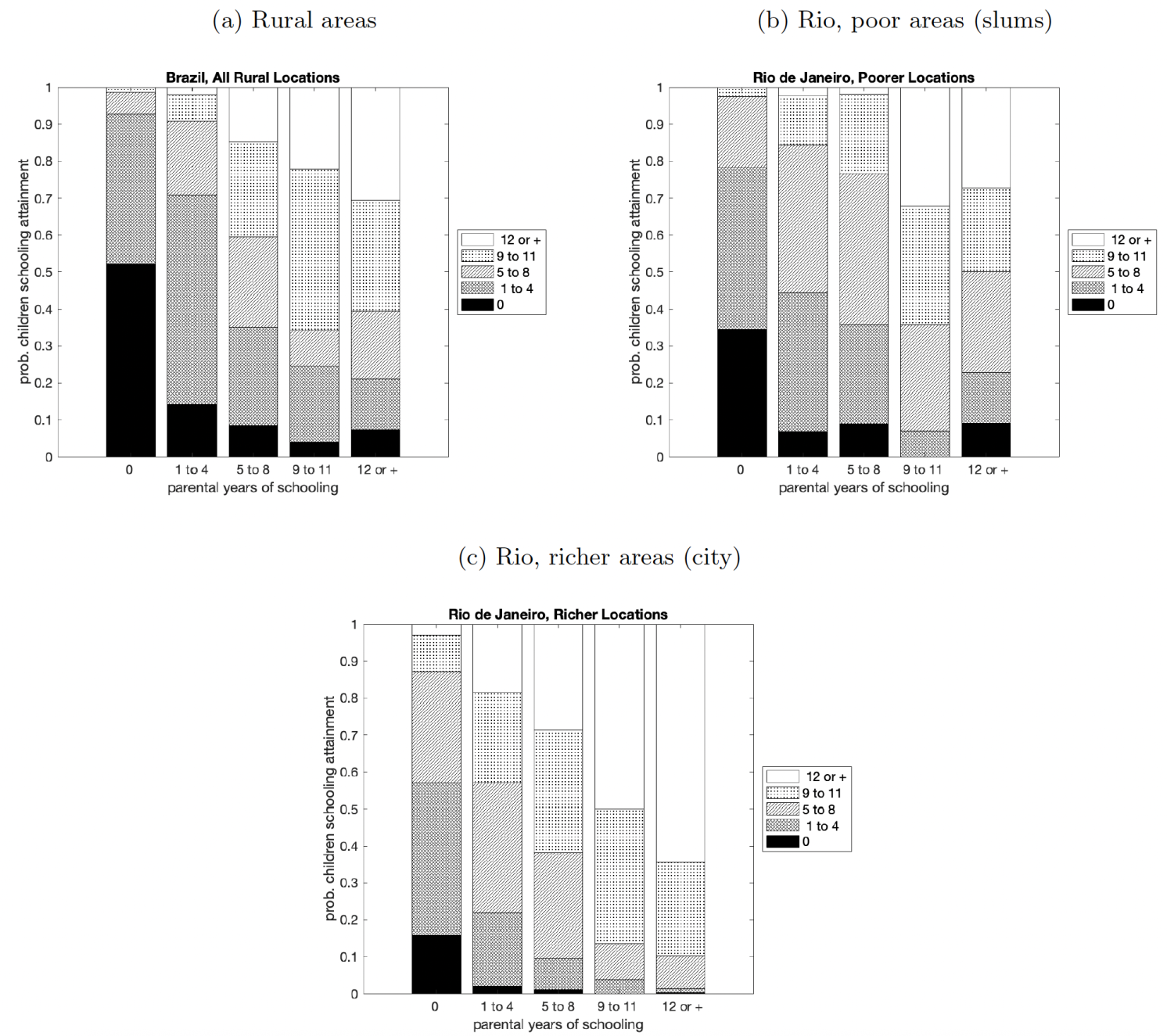
For example, to measure intergenerational mobility, we examine the distribution of children’s educational attainment across regions. In each panel of Figure 1, the horizontal axis shows parental education grouped into five categories, while the bars sum to one and represent the probability that a child attains 0, 1–4, 5–8, 9–11, or 12+ years of schooling. Panel (a) reports these transition probabilities for rural areas, panel (b) for low-income households associated with slum dwellers, and panel (c) for high-income households in the formal city.
Figure 1 Brazil: Education attainment probabilities, by parents and locations
Source: Cavalcanti et al. (2025)
Figure 1 reveals significant disparities in children’s educational outcomes across different locations. Across all educational brackets, raising children in the formal, more affluent parts of Rio vastly outperforms raising them in slums and rural areas. For example, fewer than 20% of children of uneducated parents in the city receive no schooling, compared with over 52% in rural areas and nearly 40% in slums. In rural regions, the likelihood of a child from an illiterate household reaching the top two educational tiers is nearly non-existent, while in cities this share rises to about 15%. Conversely, 61% of children from highly educated parents (with 12+ years of education) in the city attain similarly high educational levels, compared to only 30% in rural areas and 27% in slum regions.
A Model of Urbanisation with Slums
To understand how these forces shape development, we embed these empirical facts in a dynamic general equilibrium model with endogenous urbanisation and skill formation. Households choose where to live (rural areas, slums, or formal cities) based on housing costs, labour market prospects, living conditions, and educational opportunities for their children.
Formal urban residence requires paying a fixed housing cost, determined endogenously in the housing market. Slums offer a cheaper entry point into urban labour markets for households with limited skills. As a result, the spatial distribution of households emerges endogenously from their choices.
Children’s education depends on parental education, peer effects, and location-specific school quality. Because location affects human capital accumulation, housing and education policies jointly shape aggregate growth.
And the existence of slums as accessible housing fundamentally transforms urban dynamics. Their presence affects educational opportunities across the urban economy. The consequences, however, are not uniform across households. For some children, growing up in slums offers opportunities; they can reach higher levels of education than if their families had stayed in rural areas. For others, slums limit educational attainment compared to what would be possible with different urban housing. There is also a third group: by concentrating lower-educated households within informal settlements, slums raise the average educational profile of formal urban areas and strengthen the educational environment for children there. Therefore, the design and evaluation of slum-reduction policies should explicitly account for these heterogeneous, potentially offsetting effects.
Education Policy and the Persistence of Slums
Our model also allows us to evaluate alternative education and urban policies. Regarding education, we consider policies that reproduce the higher institutional quality of city schools in rural or slum locations and policies where slum-dwelling children are bussed into the formal city for their schooling. For urban policies, we consider interventions such as eliminating the option of working and living in slums and the exact opposite – i.e. facilitating the option of living in slums. The most impactful policies are those related to education, and this column will focus on them.
The dual nature of slums also helps explain why they emerge and persist. Beyond housing costs and agricultural productivity, poor rural schooling is a key driver of slum formation. Low-quality rural education pushes lower-educated households toward cities, where slums initially offer better schooling options. As households accumulate education, however, slums cease to be pathways and become constraints. Poor educational provision within slums then sustains their persistence.
We evaluate several education policies. We find that if rural schools had matched the quality of urban schools, the slum population would have been roughly one-third smaller. By contrast, improving school quality within slums would have raised educational attainment but expanded slum size.
Policy effectiveness also depends on the stage of development. When Brazil was relatively rural in 1980, improving rural schools yielded the largest gains. By 2010, in a much more urban economy, improving schooling in slum areas became more impactful.
Finally, policies sustained across generations matter most. The most powerful intervention we study is inclusive bussing, i.e. allowing children of slum-dwelling parents with minimal education (at least one year of education) to attend formal urban schools. This policy attracts families to slums while enabling their children to transition into the formal city as adults, breaking the persistence of informal settlements.
Current debates on urban development emphasise whether cities open doors to opportunity or instead end up trapping people in poverty. As noted in Glaeser et al. (2025), the critical question for policy is whether cities facilitate integration between more- and less-skilled workers. Our results contribute to this debate by highlighting the role of education, housing costs, and the stage of economic development in shaping whether slums act as bridges or bottlenecks for human capital accumulation.
Policy Implications
Slums are neither uniformly poverty traps nor universal stepping-stones. Their role depends on household characteristics and a country’s stage of development, implying that one-size-fits-all urban policies are unlikely to be effective.
At early stages of development, improving the quality of rural education can reduce inefficient urbanisation and limit slum growth by weakening the push factors that drive low-educated households towards cities. As urbanisation advances, policy priorities should shift towards integrating slum residents (especially children) into formal urban education systems. While improving school quality within slums raises attainment, it may also increase slum size. By contrast, integrating policies like inclusive bussing can raise human capital while enabling intergenerational mobility out of slums.
These results highlight the importance of spatial structure in education policy. Where children are educated and with whom, matters as much as schooling quality. In the presence of high urban housing costs, education reforms need to be complemented by urban policies that expand access to formal housing; otherwise, human capital gains may not translate into long-run mobility.
Effective urban policy must therefore be dynamic and targeted. Slums can facilitate early access to urban labour markets, but without policies that promote educational and spatial integration, they risk becoming persistent barriers to opportunity.
Editors’ note: This column is published in collaboration with the International Economic Associations’ Women in Leadership in Economics initiative, which aims to enhance the role of women in economics through research, building partnerships, and amplifying voices.
See original post for references


In general it is very difficult to implement free education as intended, as the result is often that this promotes pressure on schools from more prosperous parents to differentiate the schools, which inevitably results in indirect additional fees, such as policies on uniforms or extra paid classes or private tutoring or other ways to give a school (or individual pupil) an ‘edge’. In economically unequal countries, this competition tends to be more intense. There is always going to be an ongoing dynamic between an ideological attempt to level the playing field (or at least raise up the bottom level) and the seemingly universal desire of parents to give their children a competitive advantage through fair means or foul. There are numerous examples worldwide of better-off parents gaming public systems for their own benefit. China attempted to crack down on one element of this through the ban on private tutors, but anecdotally this only made things worse as it pushed private tutoring underground, making it available only to the rich and connected. I think pretty much every country with free education will have examples of a cat and mouse game between parents/schools trying to game the system while authorities try to balance things out.
I can’t comment on Thailands system, but I was recently talking to a Filipina contact who had similar stories of the intense pressure on parents to shell out for uniforms and other ‘extras’ for their children, despite the system there supposedly being free. I don’t know whether the pressure for this is economic or (possibly more likely) pressure from parents to ensure their local free school doesn’t fall behind those in more prosperous areas. The problem with creating a minimal ‘floor’ for education is that everyone wants their kid to be at least one step up from this floor. The only way around this is to create a genuinely outstanding ‘base’ level of education, and only a few generally very prosperous countries have succeeded in this.
I experienced this myself in Ireland, where my parents would regularly groan about ‘requests’ from the school for ‘donations’ for things like sports facilities or after school classes, not to mention uniforms and sports gear. In that case, competition between schools was intense despite all supposedly receiving the same government subvention which was supposed to cover 100% of costs, but rarely seemed to do so back then. The religious nature of most schools at the time created a particularly intense form of inter-school competition despite them all having identical subventions and curricula.
As for the benefits of slums – they seem to be an almost inevitable result in high growth economies. In simple terms, labour demand is economically fast growing areas can grow faster than its possible to build good homes. Even in well run systems there will almost inevitably be a lag, and slums of one form or another fill that void. China (again) is one of the very few countries to have (more or less) avoided the problem via the hukou system – in other words, by stopping people moving from rural areas in the first place. This prevented the development of slums, but has also created a second class tier of citizens in many cities, which creates its own problems. Those countries which successfully limited slums to some degree generally did so by encouraging very rapid housing construction, albeit almost always at the expense of building quality (Japan, Taiwan for example). Singapore comes to mind as having grown very fast economically and in population without having major slums (although there are many low quality dorms in peripheral areas for ‘guest workers’), but to a degree it achieved this through having its neighbour, Malaysia, take some of the overflow.
As an aside, for anyone interested in the ebb and flow of housing, a must visit for anyone in Dublin is 14 Henrietta House. This was built in the late 18th Century for a very rich doctor, but became a slum over the decades as Dublins fortunes declined. Conditions at times were beyond horrendous, although gradually the people hacked out pleasant little apartments as their fortunes improved. The guides are people who were brought up in the house when it was still a slum.
I have some direct observations of how Taiwan did post WWII housing.
Ideoligically, Taiwan is commited to Land Reform (https://en.wikipedia.org/wiki/Land_reform_in_Taiwan) – there’s a Land Reform museum in Taipei. That was made easier as the KMT had no ties to the exisiting Taiwanese landowners and there was an enormous vaccuum left by the departing Japanese (keep Japanese citizenship or keep ownership).
The government built housing for the millions of people, including soldiers and their dependents, who left the mainland with them (https://en.wikipedia.org/wiki/Military_dependents'_village). The quality wasn’t that much better than shacks, but they were upgraded over time. My WWII veteran grandfather eventually ended up with a modern highrise apartment when he passed away in the 2010s. And there’s actually a nostalagia for them – examples have been preserved, and repurposed into art colonies, restaurants, etc. Similar efforts were made for civil servants and for the general public. For the general public, the programs were greatly scaled back, but updated in the 2010s to help younger people buy housing like my cousins.
As for education, I only know broadly about it. KMT was able to start with a clean slate, and also used it as a tool to assimilate (i.e. Mandarin). The system identified top students, starting with elite regional middle schools. Students are funneled upwards, ending with the very top attending National Taiwan University. Private schools are usually for students who didn’t quite test as well. Very common are the buxiban cram schools and extra tutoring, most Westerners know about it as they recruited for English language teaching.
And then there’s culture. Driving this is the Confucian emphasis on education, which we see in the various East Asian cultures, including the diaspora everywhere from the Australia to US to Indonesia.
@PK
Thanks for the reminder about Henrietta House. I saw a post about how it had dozens of people living in it, several to a room, via (inevitably) a Kneecap discussion but I had forgotten about it. I am spending ten days in July in Dublin so I can add it to the itinerary….
For comparison to Ireland, in the UK, state schooling is free but it is usually 08:45-15:45 and any before or after school care is a chargeable extra. The meals are also charged unless you have a low income and qualify for free school meals. Transport to school is chargeable if it is a private bus but probably free / child fare if public transport is an option.
Whereas private schools often provide wrap-around care from breakfast clubs (doctors dropping children before 8am shifts) to after-school care and the meals are inclusive. I grew up in the private system so this difference had not been apparent to me.
It was brought home when both sons looked at moving from private school to a grammar school (a state school, free but academically selective) at 11 and we were surprised that there are no evening clubs/practices or weekend sports fixtures: everything has to take place in the school lunchtime (clubs, sports practice, play rehearsals, orchestras and music lessons) or on the dedicated games afternoon. The reasons are (1) buses: the grammar school has people travelling go to an hour each way to attend and it is considered unfair to expect parents to collect from clubs; and (2) unions: grammar schools have to employ unionised teachers who simply refuse to be on site after 15:45, whereas private schools can employ whomever they like to teach regardless of formal qualification on whatever hours they pay for.
In general, private school teachers work longer days, including extracurricular and pastoral responsibilities, but have longer holidays (valuable because the extra dates are often out of peak season) and higher pay and they don’t have the stress of teaching huge classes (35) of wildly varying ability and commitment. Weirdly private school and state school teachers both get the same generous public worker pension scheme.
To illustrate, Son #1 stayed in the private system and has about 15 boys in his classes and a month off at Christmas, a month at Easter and two months in the summer. But he does have Saturday school and a 17:15 finish three days a week! Whereas #2 will go to the grammar school with 30 in a class and will get two weeks at Christmas, two weeks at Easter and six weeks in the summer but has no Saturday school and a strictly 8:45-15:45 day (but with 2 hours of bus round trip on top…).
The bus provision is the inverse of the slums proposal. The grammar schools are both in non-urban areas (one a rural village of wealthy, empty-nesters; the other a run-down beach resort of poor empty-nesters) and so don’t have enough middle-class PMC parents. They run fleets of buses to our city (University, teaching hospital, courthouse, county hall etc)!
This isn’t usual: most education authorities with grammar schools are in the southeast of England in prosperous commuter suburbs and competition for places drives up the price of property because distance as the tiebreaker if you pass the entrance exam and they are oversubscribed so the official catchment area is small. This is a good example of Yves’s gaming the system.
You have to buy a uniform in both but mercifully both our schools have a simple uniform and games kit. Not like Eton (morning coats etc)! Or even the school #1 went to briefly that brought in a new uniform like Star Trek costumes – he was grandfathered into the old uniform and then left but lord help the younger ones.
Uniform is an extra cost but then it clothes your kids five days a week so actually it may save money. Especially if you only buy a couple of changes and wash them. There’s nothing wrong with hand-me downs, though. All the private schools have second hand uniform shops, even the £45k p.a. fee ones. Old money loves a bargain, that’s how they got rich.
Bussing! Because this worked so well in The USA!
I don’t understand how anybody – even an economist – can think the solution is redivide the existing cake rather than to grow the cake. It just created flashpoints in already divided societies (by colour and class) and does not formally urbanise the slums. And the individuals concern have to fight prejudice about being on the poor bus.
I would rather the Communist manifesto than “the poor will be with us always”, which leads the through complacency of the majority to “the devil take the hindmost”.
Also, in other countries, school children just take public transport because it is safe and cheap and universal….