Yves here. This study will strike many as too bloodless in tone given the topic: how households respond to a budgetary crisis, with the study here of a spike in energy prices in Finland in 2022 at the start of the war in Ukraine due to sanctions on Russian energy. Note that unlike an analogous affordability crisis in the US, that of the big jump in health insurance cost, particularly of those who lost Obamacare subsidies, you can’t just not buy energy. Note further that this study profiles what is sure to be a smaller consumer cost crisis than the one that the Strait of Hormuz closure has set in motion: both an energy cost spike and then a food cost rise. Admittedly, if energy prices are high enough long enough, that will correct due to what is politely called demand destruction, as in the economy going into the toilet.
The big finding is that better-off households respond mainly by merely by cutting consumption of newly-costly energy, while lower-income households hunker down across the board, including by making late payments on rent and debt.
By Lassi Ahlvik, Professor in Environmental and Resource Economics University Of Helsinki; Adjunct Professor in Resource Economics University of Stavanger; Tuomas Kaariaho, Doctoral researcher University of Helsinki; Matti Liski, Professor of Economics at the Aalto School of Business, Aalto University; and Iivo Vehviläinen, Professor of Practice in Economics Aalto University. Originally published at VoxEU
In a cost-of-living shock, households must cope with lower purchasing power while also substituting away from goods whose prices have risen. The distributional consequences of a price shock thus depend on households’ capacity to adjust. This column examines how households in Finland responded to the 2022 European energy crisis. Responses differed sharply by income, with low-income households showing the least scope to cut electricity use and the greatest signs of financial strain. Understanding these responses is important for designing relief policies during periods of high energy prices.
Recent debates on the cost-of-living crisis have rightly focused on differences in households’ exposure to rising prices. Existing work shows that low-income households spend a larger share of their budgets on necessities such as energy and food, and therefore tend to be more exposed to cost-of-living shocks (Pizer and Sexton 2019, Soldani et al. 2023, Menyhért 2022).
But exposure is only part of the distributional story. A cost-of-living shock combines a negative real-income shock with a shift in relative prices, so households must cope with lower purchasing power while also substituting away from goods whose prices have risen. The distributional consequences of a price shock thus depend on households’ capacity to adjust: some can shift consumption away from the more expensive good, draw on savings, or smooth the shock through additional labour income, while others have more limited opportunities to respond.
However, we know surprisingly little about those responses. Pinning them down requires household-level data on multiple adjustment margins, a large and plausibly exogenous price shock, and variation that exposes otherwise similar households to different price shocks.
A Natural Experiment from Finland’s Energy Crisis
In February 2022, Russia invaded Ukraine, triggering the European energy crisis. The crisis provides an unusually clean setting for overcoming these empirical obstacles (Ahlvik et al. 2026). First, the shock itself was large and unexpected. As Figure 1 shows, electricity prices increased by up to eightfold.
Figure 1 Prices of variable-price and 2-year fixed-price contracts for electricity in Finland

Second, rich administrative microdata from Finland allows us to directly observe household electricity use and to link it to earnings, benefits, and court-recorded payment defaults, making it possible to trace adjustment along several margins. Third, it was common for households to sign long-term contracts that fixed the electricity price for long periods. Predetermined differences in fixed-term contract expirations create quasi-experimental variation in price exposure among households facing the same broader economic environment. This setting allows us to compare otherwise similar households that differed only in whether they were exposed to the price shock.
The effects of the energy price shock differed sharply across income groups. Households adjusted along all four margins: electricity consumption, labour earnings, payment defaults, and other consumption and savings (Figure 2).
Figure 2 Household-level responses to expiration of electricity contracts
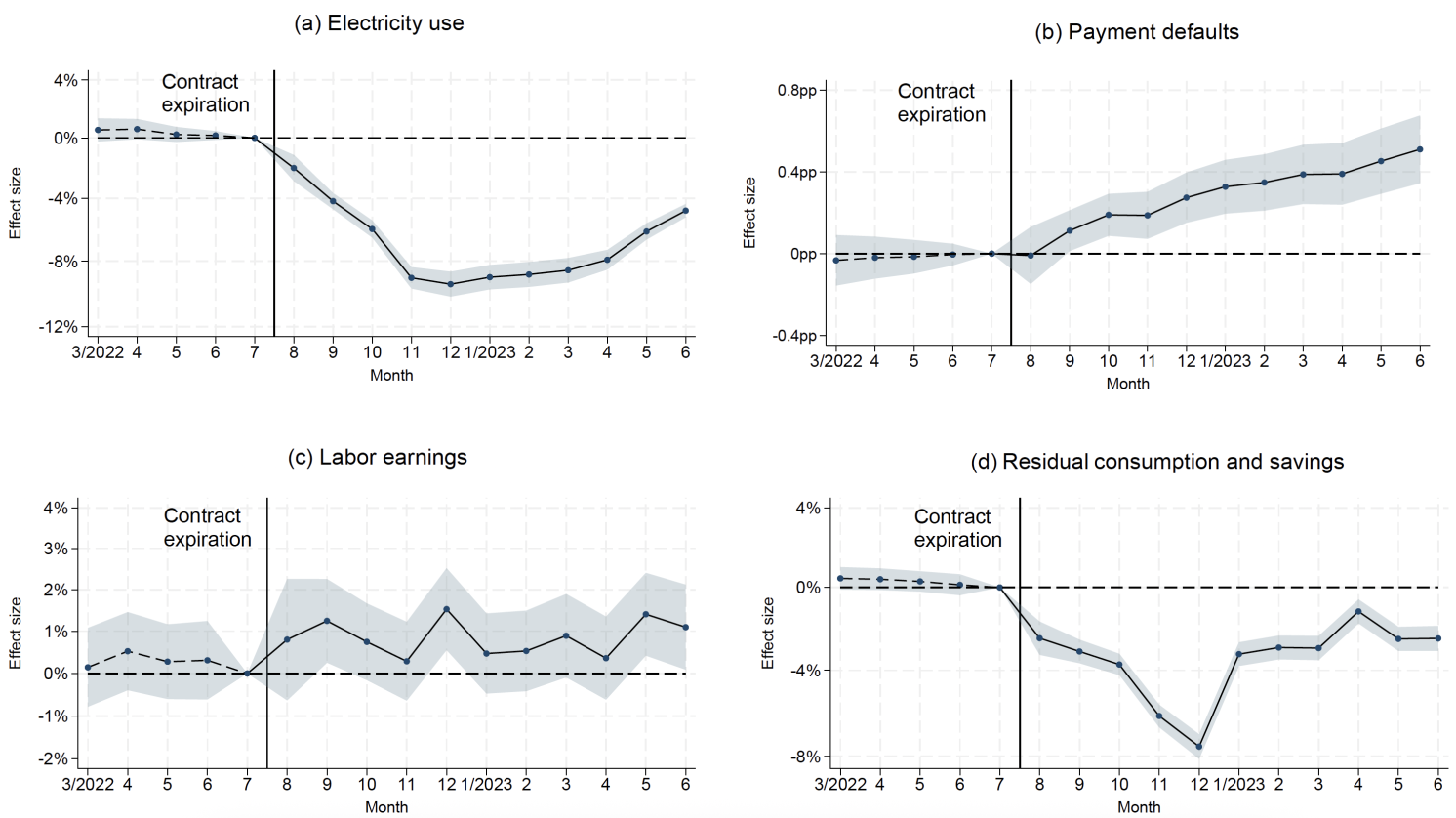
Three results stand out.
- Responses were heterogeneous. Figure 3 illustrates this heterogeneity by income groups. Higher-income households responded mainly by reducing electricity use, while lower-income households reduced it much less and were more likely to adjust through other margins instead. In particular, low-income households were more likely to increase labour earnings, accumulate payment defaults, and reduce other spending and savings. Among lower-income households, labour earnings per worker rose modestly, but there was no detectable increase in labour-force participation. This suggests that the earnings response came mainly from workers already in employment increasing their hours or effort, rather than from non-workers entering jobs.
Figure 3 Heterogeneous responses to the energy crisis, by income group
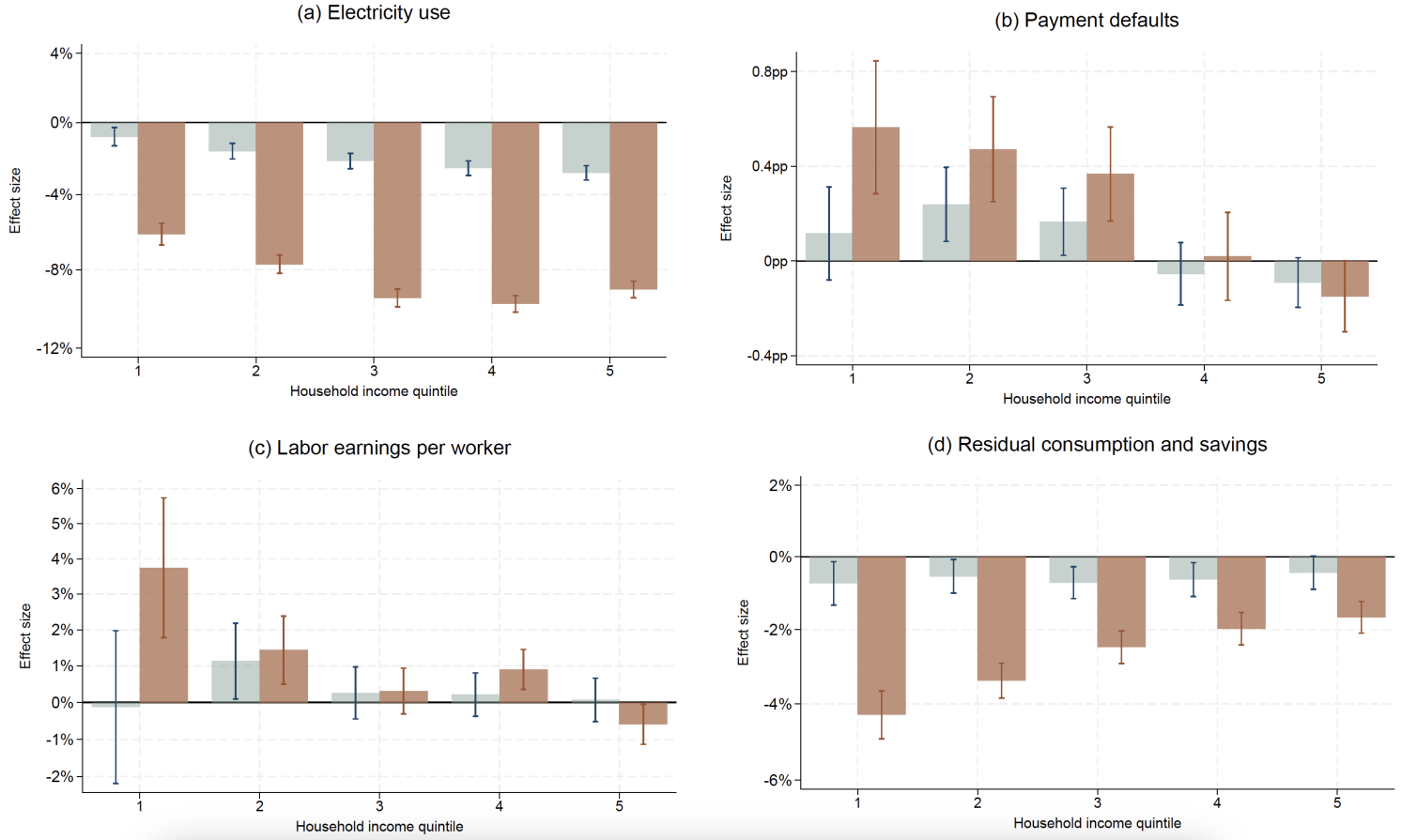
- Anticipation helped, but only partially. Those whose contracts expired later in the crisis began reducing electricity use before their contracts expired. On average, electricity use fell by 9%, and roughly one-quarter of the total reduction took place during the crisis, but in the months before contract expiration. This effect was larger for high-income households. Longer anticipation periods made adjustment easier, but did not fully eliminate the financial strain among more vulnerable households.
- Limited liquidity may explain the responses. Some middle-income households also had a rise in payment defaults, despite being less exposed than the lowest-income households. Especially those middle-income households that had a high debt-to-income ratio saw payment defaults rise, which is consistent with the idea of a liquidity-constrained middle class. Limited liquidity may partly explain the weaker response in electricity use among households at the bottom of the income distribution, as they may have had fewer opportunities to make energy-saving investments during the crisis than higher-income households.
What the Results Mean for Relief Policies
As governments responded to the energy crisis with packages combining lump-sum support and price-reducing measures, our results help clarify how such relief should be designed (e.g. Varga et al. 2022). The distributional and efficiency effects of subsidies, energy tax cuts, or targeted transfers depend on which households consume the subsidised goods and how they adjust to price changes. Classic public finance results imply that if adjustments to prices are similar across the income distribution, redistribution can be achieved through the tax-and-transfer system. If responses differ, commodity-specific interventions, such as targeted transfers and price caps, may be warranted. Our setting informs this distinction by estimating income-dependent adjustment responses.
Who bears the brunt of energy price shocks depends not only on who is most exposed, but also on who can adapt. Low-income households are doubly vulnerable, as they spend a larger share of their budgets on energy, but they are also less able to reduce electricity use. While labour income rose for those at work, we find no entry into the labour force among those whose income consists mainly of government benefits or pensions. This points to targeted relief rather than broad-based subsidies.
The results also suggest that compensating low-income households through subsidised prices need not come at a large efficiency cost. In our setting, these households reduced electricity use relatively little when prices rose, suggesting that the efficiency costs of targeted price support for low-income households may be smaller than is often feared.
See original post for references


The authors state, and I agree, that if adjustments or responses to the shock differ across the income distribution ladder, interventions must be commodity-specific such as “targeted transfers” and “price caps” might be warranted. I guess that targeted transfers means group-specific subsidies (in this case energy subsidies to the lower income groups avoiding defaults in other economic areas). That makes sense IMO. On the other hand “price caps” sounds to me like something applied all along the board to families of all percentiles and companies and would not result in a reduction of energy demand by the higher income families (and some companies) which is, IMO, a necessary adjustment when the commodity in question is limited. IMO YES to targeted transfers and NO to price caps.
‘rich administrative microdata from Finland allows us to directly observe household electricity use and to link it to earnings, benefits, and court-recorded payment defaults, making it possible to trace adjustment along several margins.’
I question this study. If I recall, Finland jumped aboard the Russian sanctions with both feet to stick it to Putin. But this also meant ending decades-long energy arrangements with the Russian Federation which was of important benefit to Finland. When those arrangements went away, Finland found itself with expensive energy bills causing different factories to close as no longer being financially viable due to energy costs. This study is all about Effect then but without going into Cause which I find a strange omission.
“You can’t just not buy energy…”
Oh, how I wish more people understood that. People don’t buy energy because they want it. They buy energy because they need it. And if they can’t buy it because it’s become unaffordable or otherwise unavailable, ugly things happen.
Perhaps this is a view from the weeds, and, because the generation that served as a bridge between me and my family’s rural roots has largely died out, it might not be as well founded as it was for say, the 1990s or earlier, but here goes:
If you drive West from Lincoln, Nebraska in the early morning hours, you will be familiar with an impressive traffic rush headed toward Lincoln and Omaha that remains dense until you get to Hastings, Nebraska, a hundred miles away from Lincoln, and after that, there is still a rush, but you think, maybe a lot of these people are headed to Hastings, or York, along the way to Lincoln. (That’s more likely true for men, but more of the women will continue to the East) The people in my family who do (did) this, were mostly wives, or members of the younger generation, still living on the farm or in a farming household in a small town. In my family, most of the jobs the women commuted for were in health care and education. Thost jobs have been essential for just hanging on to the farm and the house in bad farming years (which come more often than urban people understand) and for having some spending money and a modern household. But their real absolute CORE importance is in providing affordable medical insurance for the whole family. People will keep these jobs for a while after rising gas prices make them a financial sink, just to keep the insurance, and hoping that farm and local income will make that possible.
When I try to imagine what will happen when gas prices exceed say 5.00 a gallon, and this pattern of urban commuter jobs making it possible to live a middle class life in smaller town possible, breaks down, I don’t come up with a clear picture. Federal Reserve reports keep talking about a “low hiring, low firing” economic regime in the midwestern states. For these commuters there will be nowhere to turn if you can’t afford the gas to commute. I wouldn’t be surprised if more than 30% of the lower level employees at my local hospital commute more that 50 miles to work. That estimate is from talking to people, mostly nurses, in the early 2000s, when my mother had a long hospital stay for (hospital induced) pancreatitis.
Nebraska is not the only state with this pattern, I often spend a month or more in Minnesota, where the commute toward the Twin Cities begins 200 miles away by about 4:30 AM.
But I have just described one way of life–staying middle class in rural towns; but what will happen in inner cities when food prices skyrocket, or to the investments of retirees, or,,, or …. I can’t imagine.