Conor here:From the Mezosoic to the modern, the privatization of the commons accelerates. “Data is the new oil,” after all.
SAM ALTMAN: “WE SEE A FUTURE WHERE INTELLIGENCE IS A UTILITY, LIKE ELECTRICITY OR WATER, AND PEOPLE BUY IT FROM US ON A METER.” pic.twitter.com/AXnZ9zh0Ro
— Vivek Sen (@Vivek4real_) May 25, 2026
Kristi Curry Rogers, DeWitt Wallace Professor of Biology and Geology, Macalester College. Originally published at The Conversation.
On July 14, 2026, “Gus,” one of the most complete specimens of Tyrannosaurus rex, went to an as yet unidentified buyer for US$50.1 million. This auction at Sotheby’s set a record for most valuable fossil ever sold. Another dinosaur has entered the luxury collectibles market, a reminder that even Earth’s deepest history can be sold to the highest bidder.
To paleontologists like me, however, a fossil like “Gus” – excavated from the Hell Creek Formation in South Dakota over three years starting in 2021 by commercial collector Thomas Heitkamp and his team – is not a trophy or a work of art. It is an irreplaceable scientific archive. Fossils preserve evidence of evolution, extinction, growth, disease, injury and ancient ecosystems. They are finite, nonsubstitutable records of life’s history on Earth.
Science depends on independent verification of claims and healthy debate. Researchers must be able to revisit specimens, test earlier conclusions and ask new questions.
But once a scientifically important fossil enters a private collection, access for researchers is no longer guaranteed. Collectors typically sequester their fossils in their homes. Even when privately owned specimens are loaned to museums, the owners can change their minds, ending access at any time. This issue is especially of note when it comes to Tyrannosaurus rex; a 2025 study found that while there were 61 T. rex fossils in public trusts at that time, 71 were privately held.
That is why the Society of Vertebrate Paleontology, of which I’m a long-term memberand president-elect, has long argued that scientifically significant vertebrate fossils belong in the public trust, curated in museums and universities that preserve them permanently, make them available for research and share them with the public.
Finding a Fossil
Supporters of commercial fossil sales often argue that without sales to private collectors, specimens like “Gus” would remain buried or erode away. They’re right about one thing: Discovery matters. Many extraordinary fossils have been found by ranchers, hikers, amateur collectors and commercial excavators. Paleontology is accessible to everyone who has an eye for observing nature – you don’t need to be an expert with academic credentials to make an important discovery.
But discovery is only the beginning. A fossil’s scientific value depends on careful documentation of where it was found, the rocks surrounding it, and the plants and animals preserved alongside it. Those details allow scientists to reconstruct ancient ecosystems, understand how an animal lived and died, and interpret how its remains became fossilized. When that contextual information is incomplete or lost, much of the fossil’s scientific value is lost as well.
Yet even discovery, excavation and publication barely scratch the surface of a fossil’s scientific importance. The greatest scientific value of a specimen often comes decades later, when researchers ask new questions and apply new technologies that earlier generations never imagined. A specimen that seems fully studied today may yield surprising new information tomorrow, but only if it is still available for study.
Delayed Discoveries
Consider the iconic dinosaurs, including T. rex, Triceratops, Diplodocus and Stegosaurus, first collected more than a century ago. Early paleontologists could describe their shapes but had no way to dig deeper by peering inside the bones. Because those specimens were preserved in museum collections, later generations could revisit them with technologies that didn’t exist when they were discovered.
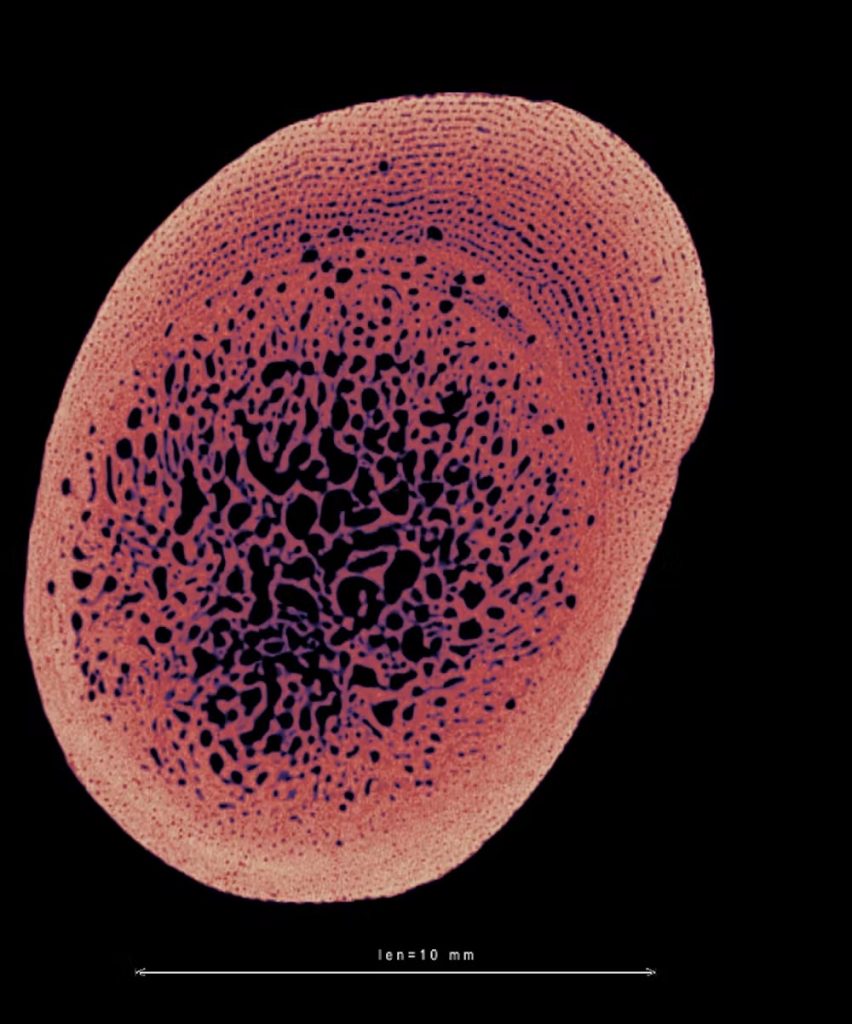
Nondestructive micro-CT scan of the fibula of a neonatal specimen of Rapetosaurus, a long-necked titanosaur. Kristina Curry Rogers
Paleontologist Larry Witmer and his collaborators at Ohio University started using CT imaging 20 years ago to reconstruct the internal anatomy of historic dinosaur fossils without damaging them, based on how X-rays travel through specimens. Brain cavities, inner ears, air spaces, nerves and blood vessels became visible for the first time, revealing how dinosaurs balanced, heard, smelled and perceived their world.
Henry Fricke, Thomas Cullen and other geochemists have used isotopic signatures preserved in fossil teeth and eggshells to reconstruct dinosaur diets, migration patterns and body temperatures. This research has revealed how dinosaurs lived: what they ate, how they moved through ancient landscapes, and even how warm their bodies were.
More recently, molecular paleontologist Jasmina Wiemann and her collaborators have identified chemical traces preserved in fossil bone, eggshell and skin that reveal aspects of dinosaur biology unimaginable even a generation ago. Until now, paleontologists had no way to know details about metabolic rates and reproduction or the colors of skin, feathers and eggs.
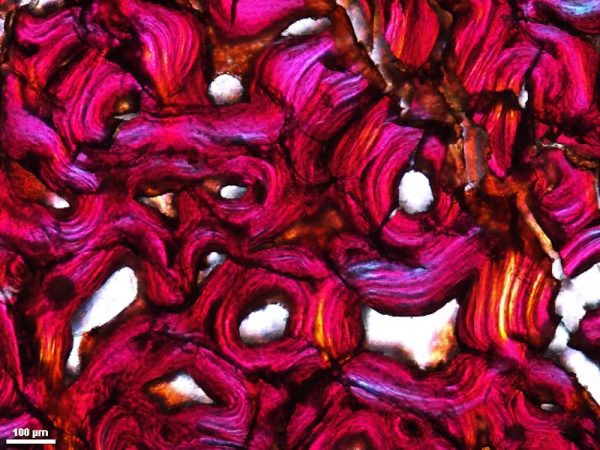
A thin section of a Diplodocus femur reveals the microscopic architecture of the bone, preserving a record of the animal’s growth and life history. Kristina Curry Rogers
In my own research I use microscopes to uncover the hidden stories preserved inside dinosaur bones and teeth. Thin sections of fossil bones reveal that dinosaurs grew more like mammals and birds than like oversized reptiles. Microscopic modifications to bones capture traces of ancient scavenging, and tiny signatures deep inside baby dinosaur bones indicate the moment of hatching.
None of these discoveries would have been possible if the original fossils had vanished into inaccessible private collections.
Shared Natural Heritage, on the Auction Block
Fossils are not static objects whose scientific value is exhausted once they are described. Their value grows as science advances, but only if future researchers can continue to examine the original specimens.
Of course, sometimes dinosaur fossils are rescued from obscurity through purchase and immediate deposition or donation to natural history museums. Some of the world’s most important dinosaur fossils are accessible today because individuals, companies or organizations with the means to acquire extraordinary specimens recognized that they belong where scientists can continue to study them and where future generations can learn from them.
Purchasing a fossil in order to place it permanently in the public trust is fundamentally different from acquiring it as a private collectible: One expands access, the other leaves access uncertain.
But as fossil prices rise into the millions, museums increasingly cannot compete. The most significant fossils are no longer reliably entering public collections. Instead, they are becoming luxury assets whose market value supersedes their scientific value.
Dinosaurs belong to our shared natural heritage. They inspire wonder because they connect all of us to a world unimaginably older than our own. For me, the question raised by auctions like the one on July 14 of “Gus” is not who can afford to own these relics of the past. It is whether future generations have the chance to study and learn from them.


Female T-Rex are thought to have grown larger, so Gus is probably short for Augusta in this case!
If you go to a paleontology fair you see lots and lots of wonderful fossils being sold to the highest bidder. In the past, that is how some of the pioneer paleontologists survived, like the impressive Mary Anning. One hopes the most important ones end up in responsible hands.
The Western US has always been rife with “rock hounds” since the erosion uncovers the past. Personally I’m not all that fascinated by the topic although it is a fave of shows on PBS’ Wednesday nature night.
That said the desire to monetize everything at those auction houses is rather disgusting. Knowledge wants to be free, not the “new oil.” It’s quite likely that the collectibles market like everything else these days is merely another Ponzi bubble.
Sorry, but the “Only we know how to keep this specimen safe and all specimens should be ours” litany of those with pieces of papers that claim they are “educated” in matters like this, is a trope that has seen its day.
The artifacts held by “science” are just as “lost” to the public as those held by private hands.
The book “Finders Keepers” is a good place to start to understand the nature of how both sides of this conversation have problems.
The answer, who knows.
But let us stop being held hostage by those who claim that only they have a divine right to access to history because, well, they say they are more entitled than others to it, as they have a document that shows they were subjected to indoctrination through “education”.
Yeah, that’s a really tough choice that. Have that T-Rex in a museum being intensively studied and enthralling tens of thousands of visitors annually – or have in sit in some millionaire’s backyard as a garden ornament so that he can boast to his buddies about it. As “Indiana” Jones would argue, ‘It belongs in a museum.’ I saw this T-Rex on the news last night and it was magnificent and I think that they had the whole skeleton. But I despise this age where everything has become a commodity – including love. Should not the State have the first buyer right on a find of exceptional importance? That happens with treasure in the UK. But now we will tolerate treasure hunters who will scavenge what they can and destroying the context that a find was located in while digging it out. Many years ago there were some dinosaur fossils that were on a coastline here in Oz. Then some crew crew in with jackhammers when nobody was looking and removed them. Where did they go? Not to some guy’s backyard but probably to some rich collector overseas.
Sorry, this is off topic, but your remark about the commodification of love reminded me of an interview with a radical sex worker i read years ago in an obscure political publication. When the subject was asked how she felt about participating in the commodification of love, she laughed, and pointed out that what she did had nothing to do with love, then observing that “if you want to talk about the commodification of love, talk to some therapists or counselors.”
This is probably the excuse governments use to steal treasure that hunters have spent their life to find. It does not matter how much capital and blood has been shed to use mental acuity to “discover” a lost treasure.
It belongs to us for the greater good.
This is also off subject, that is the same over reach nearly 90% of amriKKKans used when they wanted to punish those of us who did not want to take Trump’s vaccine in 2021 and 2022.
Again you should take the time to review “Finders Keepers” to understand this subject from both perspectives, OR,
just continue to know everything, …
Scientific finds are part of the “commons”. And as we know, the elites have been taking over the commons for centuries now. They could find a Neanderthal man encased in ice and completely intact which would prove to be a mother load of information. The find of the century to be truthful. That is until some billionaire snapped it up at auction for their sole possession. Finders, keepers?
But if it was a male Neanderthal, wouldn’t it be a “father lode” of information? Just wondering.
What’s happening here is a weird human psychology bit that I’ve never quite understood (more than usual, I mean – humans are generally a mystery to me). There is a huge swathe of humanity for whom it is more important to them that others “don’t have” than any real desire for them to “have,” other than as part of a game of Keep Away.
The coarsest form of this human is the destructive vandal. His pleasure comes from “No NOBODY gets to see/use/have the {fill in the blank} because I have destroyed it!!! I HAVE THE POWER!!!!” The public restroom. The artwork. The neat and clean property. Whatever is “nice” becomes the target for their destructive tendencies.
The vandal who just destroys the appearance of something is the milder version of this. To be fair, I’ve seen graffiti (as opposed to mere tagging) that’s pretty darned nice artwork and there ought to be a system in place to allow artists like that to express themselves appropriately.
The “acquire it and hide it away just for me” is the other end of that destructive spectrum. The ego of those acquisitors will not allow for replicas – it must be the original that’s sequestered so that nobody else can have access to it.
This is not limited to just the wealthy buying up T-Rex skeletons. How often do various other privileged groups get to see/use things that we the groundlings are prohibited from? Possibly for good reason, but nonetheless there feels like a certain braggadocio when they talk about the goodies that they and no one else has access to.
For instance, touring the Oregon Caves some decades ago, the guide was careful to point out that there were side chambers of extraordinary splendor – but that only certain select folks were allowed into them. “For preservation.” Quite likely true – but why did the guide feel a need to tell us that he had access that we didn’t?
“Mine, mine, MINE!!!” is human nature. Not sure how you’re going to win against that, whether a T. Rex skeleton or splendiferous cave spaces. Or anything else.
Now I understand your comment. You see yourself as libertarian. I was puzzled because I would not see Stephen Jay Gould (I assume that is the ‘Finders Keepers’ to which you refer) as supporting your argument. But you see “Government” (and apparently Education as its extension) as the Boogie Man.
Authentic liberty is certainly to be valued in this day and age. But the idea that *billionaires* will maximize “the greater good” in a system in which the most greedy and ruthlessly selfish are most rewarded is laughable. I’m not much of a fan of “governments” myself these days. The main problem is that they tend to be completely controlled by billionaires.
Gould was indeed a critic of entrenched academic dogma and a champion of independent seekers of truth. But I find the idea that he would approve of this purchase as absurd as the idea that our Billionaire Producers maximize the Greater Good – for us!
Thank you Rev. I’ll never understand people arguing for the commodification and sequestering of everything.
I think you have missed the main point of this piece. I have often criticized condescending claims by highly credentialed “experts” that only they possess Understanding on particular subjects. But that is not the issue here. Rather, the problem is the one captured by the opening Sam Altman quote. The purchase of “Gus” is yet another symbolic example of the New Feudalism toward which we are headed. Instead of Princes and Kings funding – and determining – what constitutes science, who gets to do it, and who gets to know it, that will be increasingly determined by our billionaire finance and tech lord masters. The issue is the disappearance of the public sphere in all areas, including science and knowledge. For all the faults and limitations of academia, especially as it emerged after WWII in the West, I’d take it in a second over control of knowledge by the billionaire class we have now.
I think regulation is the way forward: registering the fossils; clear conditions for accessing the fossil; etc.
The museum will certainly have better condition monitoring and preservation systems in place than a private collector.
Why am I so certain about this? The systems cost money to implement and operate, as well as requiring someone who knows what they’re doing to identify potential problems and implement solutions.
I sympathize with Rogers and do not want to detract from the urgency of her commentary, that is, keeping fossils and other scientific samples available to those who can study them.
Yet this is a slip in her argument: “To paleontologists like me, however, a fossil like “Gus” – excavated from the Hell Creek Formation in South Dakota over three years starting in 2021 by commercial collector Thomas Heitkamp and his team – is not a trophy or a work of art. It is an irreplaceable scientific archive. ”
There are plenty of missing works of art that would provide a great deal of valuable information. Here in Italy, there is a persistent, partially substantiated, story that there is a third Riace bronze. When the discovery was first made, those involved claim (or some claim) to have seen another statue. Most likely, the bronze disappeared into the private market. Art historians have used the statues to study technique and materials science, so the third bronze matters.
Likewise, in Southwest in the US of A, there have been stories for years of people digging up Indian pottery, which then disappeared.
There is a continuing scandal here in Torino of the Agnelli inheritance, in which some 400 paintings have disappeared. One of the stories that came out is of a Monet. The family had two copies made. At this point, it isn’t clear who has the original and who has a copy.
And manuscripts keep turning up — the discoveries in Pompei lately intrigue.
So access to fossils, samples, works of art, pots, and manuscripts would all add to human knowledge. Agreed.
All remaining species on earth really need Humans to make a significant Paradigm Shift.
Are the ‘Takers’ the unwashed, with their hands out, a percieved citicized inferior ability and/or interest to produce, or are the ‘Takers’ the monopolist oligarchs who grab anything they deem is ‘theirs for the taking’, with the implied superiority complex? (viz Elroy Mush, and lower earth orbit for his satellite system)
?
I must admit, I did not leave on the ground but pocketed a fossilized perfectly preserved thumb-tip possibly proto-Sequoia pine cone. Do I get style points if I gave it to my wife?
Fossils, archaeological finds, historical works of art after a certain period etc. must automatically become public property, with proper remuneration for whoever discovered them.