Category Archives: Politics

David Apgar: If You’re Out after Three Strikes, What Happens after Three Lies?

By David Apgar, the founder of ApgarPartners LLC, a firm that helps companies and development organizations learn by treating goals as assumptions to be tested by performance results. He blogs at www.relevancegap.blogspot.com.

Speaker Boehner made three points in his surprisingly combative reply to President Obama on debt ceiling legislation Monday night. Readers of this blog can help determine whether, as I believe, all three were lies despite the seriousness of the impasse on federal authority to continue borrowing.

Read more...
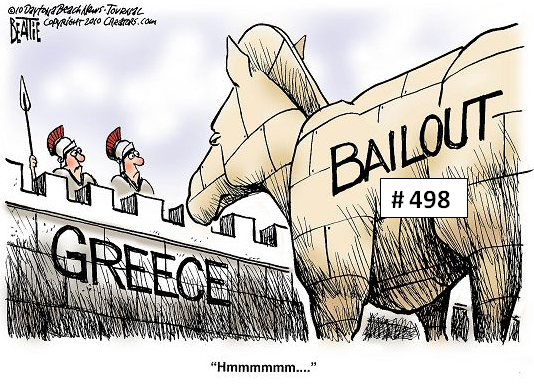

Alexander Gloy: Greece – Two Bail-outs and a Funeral

Yves here. Quite a few readers in comments expressed confusion over the announcement of the latest Greek bailout, and some of the details were admittedly a bit murky. This piece will hopefully help clear matters up.

By Alexander Gloy of Lighthouse Investment Management

Here we go again. Another bail-out. [Sigh.]

I’ll try to make this as entertaining and easily readable as possible – but first the details of the bail-out agreed on July 21st:

Read more...

More Shades of TARP: Latest Deficit Ceiling Plan to Establish Extra-Constitutional Legislative Process

We commented last night on the parallels between the pressure tactics used to railroad the passage of the TARP and our current contrived debt ceiling crisis. The similarities have increased in a predictably bad way. Even worse than the economic toll radical budget cutting will impose on ordinary Americans is the continued undermining of basic democratic processes.

Read more...

Get Ready for TARP 2.0

Washington DC appears to be readying itself for a repeat of the TARP, namely, the passage of unpopular legislation to appease the Market Gods (and transfer even more income from ordinary Americans to the Masters of the Universe). It isn’t yet clear whether this drama will be played out via generating bona fide financial market upheaval or mere threat-mongering (the Treasury market seems pretty confident that well-trained Congresscritters will fall into line). But unlike the TARP, which was a classic example of well-placed interests finding opportunity in the midst of upheaval, this reprise is a far more calculated affair.

Read more...

Should You Get Only $7000 if Wells Stole Your House?

If you are a too big to fail bank like Wells Fargo, the wages of crime look awfully good. RIp off as many as 10,000 people to the point where they lose their homes and your good friend the Fed will let you off the hook for somewhere between $1000 and $20,000 per house. And as we’ll discuss in due course, this deal isn’t just bad for the abused homeowners, it’s also bad for investors and sets a terrible precedent, which means its impact extends well beyond the perhaps 10,000 immediate casualties.

Oh, and how much does the Fed think you should be paid if you were foreclosed upon thanks to Wells?

Read more...

A Report from Greece

Via e-mail, a reading of public sentiment in Greece from reader Scott S, who is a TV/movie industry professional and did the trailer for ECONNED. I have gotten similar. albeit more brief accounts from other readers. One reader with contacts in Greece did stress that the protests, at least as of the end of June, were overwhelmingly peaceful and added:

Read more...

Matt Stoller: Dodd-Frank Made No Structural Changes to Banking System

By Matt Stoller, a Roosevelt Institute fellow (on Twitter at @matthewstoller). Cross posted from New Deal 2.0

A former Congressional staffer sees Dodd-Frank as a lost opportunity to rebuild a financial system in line with public needs.

I was a staffer on the Dodd-Frank legislative package, and the whole process seemed odd from the very beginning.

Read more...

So What Might Happen if We Get to August 3 With No Deficit Deal?

So they are now motivated to get something done.

A lot of Democrats, by contrast, are fiercely opposed to the pact under discussion, which consists of $3 trillion of cuts and no tax increases, or more accurately, an immediate commitment to cuts, and tax increases possibly coming via a to-be-brokered tax reform. The Democrats see the trap being laid for them; reform/increases later is likely to be no reform. (Separately, this package will kill the economy, a consideration that pretty much everyone is ignoring, proving Keynes correct: “Practical men, who believe themselves to be quite exempt from any intellectual influence, are usually the slaves of some defunct economist.”).

The latest update at the Wall Street Journal was cautious:

With prospects of a government default looming in early August, leaders on both sides denied Thursday that a deal was close…Both sides warned that an agreement is not near. “There is no deal,” Mr. Boehner told radio host Rush Limbaugh. White House spokesman Jay Carney used similar language. And White House officials said Mr. Obama has never considered an agreement that did not include revenue increases.

A good deal can change in the next few days, but the window of opportunity narrows as time passes. And that is why the Treasury’s apparent refusal to consider options for working around the debt ceiling looks colossally irresponsible. This is similar to the behavior of the financial regulators pre-Lehman: they placed all their chips on one outcome, that of a private sector bailout, and failed even to find out what a bankruptcy would look like (at a minimum, if Lehman had prepared a longer-form filing, the implosion would have been less disruptive).

But this “all in” strategy is by design. Obama has long wanted entitlement “reform,” as in gutting; Paul Jay of Real News Network pointed out to me today that Obama told conservatives at a dinner hosted by George Will in the first week after his inauguration that he planned to turn to it once he got the economy in better shape. So this is a variant of a negotiating strategy famously used by J.P. Morgan: lock people in a room until they come up with a deal. But the J.P. Morgan approach used time to his advantage; here the fixed time frame makes this more like a form of Russian roulette with more than one cylinder loaded.

It is also worth noting that what starts happening on August 3, assuming no deal, is “selective” default. It isn’t clear if and when Treasuries would be at risk of having payments skipped, and I would assume Social Security would also get high priority. But with Treasuries, the bigger risk is not a missed payment (which would certainly be made up later) but a downgrade, which is expected to force certain types of investors who are limited to AAA securities to dump their holdings.

A useful article in the Economist describes how Wall Street, which had heretofore assumed that there was no way the US would (effectively) voluntarily skip some interest payment, is now scrambling to figure out how to position themselves should such an event come to pass. Many observers had assumed that the repo market, on which dealers depend to fund themselves and collateralize derivatives positions, would go into chaos (the belief was that counterparties would demand bigger haircuts). But the Economist argues that does not appear to be the case:

SIFMA, a trade group for large banks and fund managers, recently gathered members together to discuss issues like how to rewire their systems to pass IOUs rather than actual interest payments to investors, should a default occur. “It’s one of those Murphy’s Law things. If we do it, it won’t prove necessary. If we don’t, we’ll be scrambling like crazy with a day to go,” says one participant.

But the moneymen hardly have all the bases covered. “I really thought I understood this market, until I tried to map all of the possible consequences of a breakdown,” sighs a bond-market veteran. That is hardly surprising, given that Treasury prices are used as the reference rate for most other credit markets. Moreover, some $4 trillion of Treasury debt—nearly half of the total—is used as collateral in futures, over-the-counter derivatives and the repurchase (repo) markets, a crucial source of short-term loans for financial firms, according to analysts at JPMorgan Chase.

Some fear that a default could cause a 2008-style crunch in repo markets, with the raising of “haircuts” on Treasuries leading to margin calls. The reality would be more complicated. For one thing, it’s not clear that there is a viable alternative as the “risk-free” benchmark. One banker jokes that AAA-rated Johnson & Johnson is “not quite as liquid”. In a flight to safety triggered by a default, much of the money bailing out of risky assets could end up in Treasury debt. Increased demand for collateral to secure loans could even push up its price.

Then there is the impact of a ratings downgrade. Money-market funds, which hold $684 billion of government and agency securities, are allowed to hold government paper that has been downgraded a notch. Other investors, such as some insurers, can only hold top-rated securities but their investment boards are likely to approve requests to rewrite their covenants, especially if a lower rating looks temporary. “It would be a full-employment act for lawyers,” says Lou Crandall of Wrightson ICAP, a research firm. There’s a surprise.

In other words, this event is focusing enough minds that a lot of parties are looking at ways to get waivers or other variances to allow them to continue to hold Treasuries even in the event of a downgrade or delayed payment. But a report from Reuters on the Fed’s contingency planning makes them sound markedly less creative than their private sector counterparts (but it is important to note that Charles Plosser of the Philadelphia Fed, the key source for his story, has been a critic of the Fed’s fancy footwork in the crisis. In fact, the New York Fed is the key actor, and it has been notably, um accommodating in the past).

In addition, the New York Times reported yesterday that some hedge funds are moving into cash to buy up Treasuries in case other investors dump them. I’ve even heard of retail investors planning the same move. That does not mean the volume of buyers will be enough to offset forced sales, but it does say that fundamentally oriented investors would see this event as an opportunity, not a cause for panic.

The financial system is so tightly coupled and there are so many potential points of failure that I’m hesitant to say that the consequences of a default may be far less serious than are widely imagined. But in the Y2K scare, the considerable panic about potential catastrophic outcomes led to a tremendous amount of remediation, which served to limit problems to a few hiccups. Unlike Y2K, the remediation efforts have started very late in the game, so their is a lot more potential for disruption.

But even so, why is the Administration so willing to engage in brinksmanship? S&P expects a 50 basis point rise on the short end of the Treasury yield curve and 100 basis points on the long end, which they expect to reverberate through dollar funding markets and cause all sorts of hell. Remember, we have both Geithner and Bernanke again in powerful positions, and both went to extreme efforts to prevent damage to the financial system. Why are they merely handwringing at such a critical juncture? Might they have a trick or two up their sleeve?

I can think of at least one. I was working for Sumitomo Bank (and the only gaijin hired into the Japanese hierarchy) and was in Japan during and shortly after the 1987 crash. Initially, the reaction in Japan was one of horrified fascination, of watching a neighbor’s house burn down. It then began to occur to them that their house might burn down too.

The volume of margin calls on Black Monday and Tuesday were putting serious pressure on the Treasury market, which was beginning to seize up. On top of that, bank were understandably loath to extend credit to clearinghouses and exchanges (as we’ve discussed elsewhere, the Merc almost failed to open and would have collapsed if the head of Continental Illinois had not approved an emergency extension of credit after a $400 million failure to pay by a major customer. Had the Merc failed, the NYSE would not have opened, and its then CEO John Phelan has said it too might have failed). So keeping the Treasury markets liquid was a key priority in stabilizing the markets.

Japan is a military protectorate of the US. The Fed called the Bank of Japan and told it to support the Treasury market. The BoJ called the Japanese banks and told them to buy Treasuries. Sumitomo and the other Japanese banks complied.

I could see the same phone call being made again in the event of a default or downgrade. First, the yen is already at 78 and change, which is nosebleed territory from the Japanese perspective. The BoJ intervened once in the recent past when the yen got slightly above this level. Purchases of Treasuries is a purchase of dollars, and done on big enough scale would help lower the yen. Second, if you buy the hedgie view, buying in the face of forced (as in AAA mandate driven) and not economically motivated selling means this trade would have near term upside.

Is this scenario likely? I have no idea. Is it possible? Absolutely.

Again, I would not bet on happy outcomes. As Cate Blanchette muttered in the movie Elizabeth, “I do not like wars. They have uncertain outcomes.” And while the negotiators finally seem to have awakened to the risk of entering uncharted territory, the old rule of dealmaking is if one side’s bid is below the other side’s offer, you can’t get to a resolution. That’s where the two sides appear to be now, and even though it would be rational for both to give a bit of ground, rationality has been missing in action on this front for quite some time.

Read more...

Calpers Waves Wet Noodle at Murdochs, While DoJ Appears to Be Sitting On Its Hands

It’s a bit curious that l’affaire Murdoch, which has dominated the news in England, has gotten some air time here, but not in proportion to its importance in the UK and potentially in the US. True, you have to know a bit of who has done what to whom over time, but stuff like hacking the voicemails of dead little girls and live major government officials, lying in Parliamentary investigations, paying hush money, and suborning the police isn’t that hard to explain. And it’s also hard to imagine that a culture that the US operations didn’t share at least some of the aggressive and reckless habits of its siblings across the pond.

At least one party, Calpers, which is the largest pension fund in the US, appears to have decided to use this revelation of the Murdochs’ feet of clay to open up an issue that was worth airing a long time ago: the hold the family maintains on News Corp.

Read more...

Scott Brown Beats Elizabeth Warren by 25 Points in Recent Poll

We argued yesterday that the Senate was not a good vehicle for advancing Elizabeth Warren’s aims of helping middle class families, since she would have no more, and arguably less power than she has now, and would be expected to defend Democrat/Obama policies, many of which are affirmatively destructive to middle class interests (just less so than what the Republicans would put in place).

A poll conducted in late June by Scott Brown and the Republican National Committee raises an even more basic question: whether she even has a shot at winning.

Read more...

“Trade Imbalances Lead to Debt Imbalances” or Why Mercantilist Nations Shouldn’t Beef About Their “Profligate” Customers

Michael Pettis, a respected economist and commentator on China, provides an important contribution on the global imbalances theme. Many observers have pointed fingers at debtor nations like Greece, Portugal, Spain, and the US and argue that they need to start consuming less. While narrowly there is some merit to that argument, Pettis points out that the trade deficit countries (the debtors) are not the ones in the driver’s seat and it it the trade surplus countries that must take the lead in making adjustments.

Read more...

Marshall Auerback: The European Monetary Union is the Titanic

By Marshall Auerback, a portfolio strategist and hedge fund manager. Cross posted from New Deal 2.0

The Iceberg Cometh: An economic and financial crisis will soon be brought about by the collapse of the European Monetary Union. And everyone goes down with the ship!

Read more...