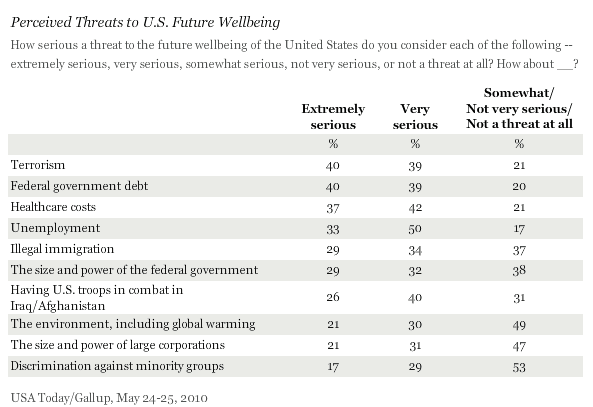
A fresh Gallup poll reports that Americans are most worried about….federal debts (hat tip Marshall Auerback via the Atlantic):
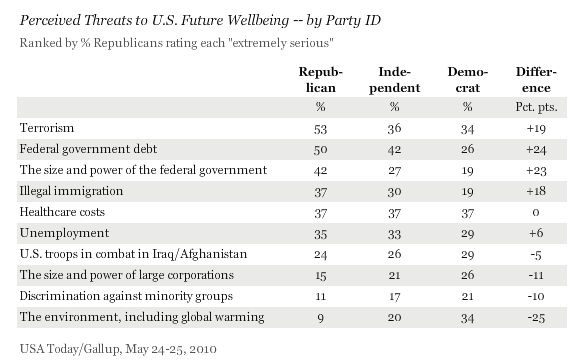
Gallup also provided a tally of how members of each party view the issue:
It would appear the ground has been laid rather effectively for (among other things) an assault on Social Security and Medicare. As we have pointed out before, Social Security is not under any immediate stress, and it would take only some minor tweaks to alleviate the (well off in the future) strains. And contrary to popular perception, the reason Medicare spending will get out of hand is due to projected medical cost escalation, not demographics. In other words, the “crisis” in Medicare is a symptom of our broken health care system, and not an entitlements problem per se. But in addition to the continued ability of Big Pharma and the health insurance industry’s ability to make a bad situation worse, as witness our healthcare “reform,” consumers have also been deeply conditioned to see more treatment as better. From both a cost and side effects perspective, this is simply not often the case. As reader Francois T stated apropos a New York Times article that caused consternation among people who know the terrain:
My oh my! One could write a volume or two about that. I’ll limit myself to the obvious, at the expense of the details.
Their [Abelson and Harris] article and the saga surrounding its writing:
http://www.healthbeatblog.com/2010/06/the-new-york-times-attacks-the-dartmouth-research-part-1.html
http://www.healthbeatblog.com/2010/06/yet-another-source-distressed-by-how-the-nyts-presented-its-data-in-a-story-about-the-dartmouth-rese.html
is a prime example of, when it comes to health care, Americans in general harbor very deeply rooted preconceived notions that pretty much preclude any meaningful and long-lasting reform.
The one operating in the minds of Abelson and Harris is the most toxic: More is always better. They cannot possibly bring themselves to admit, despite the overwhelming evidence of 30 years (!!) of solid, peer-reviewed research demonstrating there are ways to provide better health care outcomes while doing less, but in a SMARTER way. The evidence is crystal clear, but so are the prejudices. Since this is politics, prejudices win, hands down. Being journalists for the NYT, Abelson and Harris seem incapable of going beyond the vulgus populus.
It is important to note here that the attacks on the Dartmouth research were almost inexistent during the period post Clinton failure to reform health care…until Obama started his own attempt. A cursory Lexis-Nexis search is quite convincing in this respect. Those who stand to lose income or power during a health care reform will first and foremost attack it. Mind you, they have the tremendous advantage of playing on those preconceived notions I alluded to above.
So ingrained are these, that even senators and congresspersons who know the Dartmouth very well (yes, there are some that do) will never, ever tout the evidence publicly. Press them a bit about why they don’t, and one shall witness oratory escape maneuvers that would put Houdini to shame. It is just not (yet) “politically feasible”, as they say.
Apart from the Dartmouth research, there is another irrefutable piece of evidence that, when it comes to health care, smart beats more: The VA system.
http://www.washingtonmonthly.com/features/2005/0501.longman.html
Now, before everyone jump at my throat with the Walter Reed scandal, I would recommend reading Best Care Anywhere, by Philip Longman (updated edition 2010)
As per Maggie Mahar:
In the 2010 edition of Best Care Anywhere Longman also recounts how the Bush administration attempted to dismantle the open-source VistA software culture that Kizer had built, “doing its best to recreate the dysfunctional VA of the 1970s.” Meanwhile, as more vets turned to the VA for care (in part because the care was so much better than it had been in earlier years), the Bush administration failed to provide enough funding, leading to long lines and not a few complaints.
Fortunately for the veterans, the situation has dramatically improved since the change in Administration. (There is still a lot of work to be done, but the trend is toward improvement)
The bottom line is this: Since 1994, the turnaround of the VA system demonstrate it is possible to provide good outcomes with high patient satisfaction (except in psychiatric services, but this is another long and complex story) by following what the evidence provides, instead of being guided by which reimbursement schemes is the flavor du jour.
Similarly, the fear about rising deficits is misplaced right now. As George Soros pointed out in a speech today in Vienna, the action of righting an economy when it faces serious financial stresses is a lot like straightening out a car that has gone into a skid: you need to turn the wheels into the skid, which looks like taking it further off the track where you want it to go, until it regains traction and you can then steer it back to its proper path. In this case, we need an expansion of public debt to offset the needed contraction in private sector debt, and then to (Soros did point out that this was a tricky operation). Otherwise, a resumption of the crisis is in the cards.
There is considerable evidence that the deficit fears in general, and the attack on entitlements in particular, has been marketed actively. Our colleague Tom Ferguson explains below:


Tied with evil, wow!
And “those people” fall to 5th place!
existential threat and mushroom cloud is now #7. well well well…
After the creation of the welfare state, the Left has tended to like high government spending on the assumption taht most of it will wind up going to welfare programs. This is often the case if the spending is being financed through regressive taxation, or high debt levels.
But a combination of welfare spending plus high regressive taxation tends to be self-cancelling in terms of wealth redistribution. And high debt levels just means an increasing proportion of government spending will be devoted to paying off bondholders. Even if used to fund welfare programs, the effect will be to further concentrate income.
Since we have seen increasing concentration of wealth, especially in the U.S., people on the left should be asking whether the government is really their friend. It could be the net effect of all of this government spending in fact has been promoting income inequality. Historically (pre-World War I), a suspicious attitude towards government has been associated with the left, not the right as it is now; welfare state liberalism is an abberation.
Totally agree, but I think the problem goes beyond reason, so can’t be changed.
The socialist brain (the “left” chemistry) doesn’t “think” anymore than a fascist brain (the “right” chemistry) can think. Both are just reacting to simple emotions. The socialists want their smothering mommy to make all the bad things in life – the things that cause mommy so much guilt – to just go away. The fascist want their kick-ass daddy to make all the bad things in life – the things that cause daddy so much shame – to just go way. There’s a good reason males and females vote differently, but nobody is “thinking”.
Why a “thinking” liberal would want a national health care system created by (what passes for) a US government is beyond me. But, optimism is endemic to all human brains, regardless of the political philosophy.
Dude, the Cub are gonna win it, dude. Dude, totally.
The notion that Fascism is a Right Wing philosophy is nonsense. It is a just another branch on the left-wing (statist) tree.
Sorry Wilfred
Fascism has always been associated with “corporatism” and “nationalism”. Put down Jonah Goldbergs book and read some nonfiction.
Sorry Greg, but I have never read Jonah Goldberg. Fascism is National Socialism, which is another branch of Statism. The fact that you have bought into associations created by the leftist’s and statist’s indicates your inability to understand the difference between fiction and nonfiction.
Fascism is National Socialism, which is another branch of Statism.
And the German Democratic Republic was run by Democrats!
And the People’s Republic of China is a true Republic, just like Switzerland!
Yeah thats right, whatever something labels itself thats what it is. Sarah Palin followers are real Americans (cuz they say so).
Every govt system is a form of “statism”. That word is meaningless. Fascists have always used flags and guns……………….uhhhhhhh which American party does that sound like?? GEEE OHHHH PEEEEE
Jesus Christ doesn’t anybody know any real European history?
The English Civil War of 1660 set the stage for the American Revolution of 1776 and the combination of those two set the stage for the French Revolution of 1789. That in turn launched the set of Continental Wars whose final stages we know as the Napoleonic Wars. The end result of that was a political world divided between Revolutionaries and Reactionaries (the ‘Reaction’ being specifically against ‘Revolution’). In brief Revolutionaries were allied with ‘the People’ while Reactionaries remained firmly behind the principle of Hereditary Monarchy. Conservatism as it developed over the 18th century and matured in the years between the Congress of Vienna in 1815 and the events of 1848 was very consciously pro-Reaction, which is to say maintaining power structures how they had been before 1789, and so anti-Revolution.
Our modern terms Left and Right derive from party seating in the French Revolutionary Assembly where the parties most associated with pure democracy and redistribution sat on the left while the Monarchists and parties more committed to protecting the rights of landowners sat on the Right.
Nationalism was in origin a vehicle for Revolutionaries trying to break down a power structure built of dynastic lines under the concept of personal rule, the various Empires of Europe (Spain, Germany, Austria, Turkey, Russia and others from time to time) all had various states and nations under their control, the idea that Nations as such should control their destiny and not foreign Kings being at the center of Revolutionary thought. But over the course of the 100 years from 1815 to WWI in 1914, the forces of Reaction totally co-opted Nationalism (and along the way took in ‘Patriot’ itself in origin Revolutionary). The post-war Fascist movement simply saw the process of merging the concepts Nation and People with the forces of Reaction which were in broadest form the interests of Inheritance of both Property and Rank.
The notion that the political Right at any point in its development has been in any real sense anti-Statist is ahistorical nonsense, what mattered is who ruled that state: Rightful King or Rabble.
Fascism derived some of its conceptual imagery from Revolution ‘Nation’ ‘People’, but came to power promoting the economic and political theory of Reaction, which is to say protecting Property against the majority who were largely property less. But at no point in its history would Fascists ever have been seated on the Left side of the aisle of any assembly anywhere. They have always been on the far Right, outflanked only by certain absolutist leaning Monarchists.
This whole Fascists are really Leftists thing is simply a little update of Von Hayek, who was not only kind of the ur-Austrian Economist but also the promoter of the ideas outlined in the Road to Serfdom, themselves totally taken up by both that part of the Right that embrace Randism and Libertarianism and that part which gave birth to the more authoritarian Goldwater wing, the latter being the true American inheritor of Fascism (the Birchers and successor movements being thoroughly saturated with Nazi imagery and even Nazi like racial theory).
This used to be understood by anybody of any educational attainment at all. Nazi’s have always been servants of Reaction which is to say ultimately Property and Inheritence. They drew nothing from either 19th or 20th century liberalism (fantasies that we could have avoided the holocaust if Margaret Sanger had kept his mouth shut being simply that.)
Yeah, us Lefties can’t “think”. I guess that explanation works for you.
>> Since we have seen increasing concentration of wealth, especially in the U.S., people on the left should be asking whether the government is really their friend.
We had less concentration of wealth from FDR to Carter. What’s changed is that we stopped busting trusts and stopped taxing the rich at high incremental rates. What changed was: Americans voted for tax cuts without spending cuts, an attempt for a free lunch if there ever was one.
Re health care provided by government programs:
Every other developed country in the world provides health care to 100% of its population at much much lower cost than does the U.S. to perhaps 85% of its population. They also have superior health outcomes overall. It is obvious health care should be provided through a single payer public system. Only intense propaganda by beneficiaries of the truly bizarre current U.S. system and strange anti-government phobia prevents this from happening.
Pete Peterson and his vile ilk won a long time ago. How do we know this? There are a number of ways, which, include, the sort of press coverage his agenda has long since received, and, quite frankly, the fact that he is, essentially, part of the big bankster cadre whose “success” has been well nigh total.
So very true, Edward, so very true!
Pete Peterson, and his various propaganda-spewing organizations, Peterson Institute (leading the way to privatize everything), Concord Coalition, etc., (and probably his wife at Seseme Street, for christ’s sake!!), and through his Blackstone Group (offshoot: BlackRock), he has led the way in the closing down of refineries (boosting up that ole oil price, don’t ya know?), privatizing prisons (Super-rich Americans need all the prison slave labor they can get their malevolent claws on), spreading that dispersant (purchased Nalco, along with Goldman Sachs, BP) throughout the planet (and espcially the Gulf of Mexico), profiting from the destruction of the World Trade Center (on mulitple levels, not simply from managing that $1 billion captive insurance fund for the victim families – thanks to Bush’s FEMA largesse), and of course, after becoming a publicly-traded entity on the NYSE, still paying ONLY 15% capital gains insurance — cheating the public and the feds — thanks to the corrupt collusion of the US Congress — and NOT paying what should be the mandatory 35% corporate rate!!!
Interesting all those connections between the World Trade Center (New York, NY, USA) and the Blackstone Group: brokered the fastest and largest real estate deal in NYC business history, when they were involved with the WTC, the Teachers Union and Silverstein Properties, etc., etc., etc.
Peterson’s wet dream is to privatize Social Security, Medicare and all of public education.
Great post, BTW!!!
So very true, Edward, so very true!
Pete Peterson, and his various propaganda-spewing organizations, Peterson Institute (leading the way to privatize everything), Concord Coalition, etc., (and probably his wife at Seseme Street, for christ’s sake!!), and through his Blackstone Group (offshoot: BlackRock), he has led the way in the closing down of refineries (boosting up that ole oil price, don’t ya know?), privatizing prisons (Super-rich Americans need all the prison slave labor they can get their malevolent claws on), spreading that dispersant (purchased Nalco, along with Goldman Sachs, BP) throughout the planet (and espcially the Gulf of Mexico), profiting from the destruction of the World Trade Center (on mulitple levels, not simply from managing that $1 billion captive insurance fund for the victim families – thanks to Bush’s FEMA largesse), and of course, after becoming a publicly-traded entity on the NYSE, still paying ONLY 15% capital gains insurance — cheating the public and the feds — thanks to the corrupt collusion of the US Congress — and NOT paying what should be the mandatory 35% corporate rate!!!
Interesting all those connections between the World Trade Center (New York, NY, USA) and the Blackstone Group: brokered the fastest and largest real estate deal in NYC business history, when they were involved with the WTC, the Teachers Union and Silverstein Properties, etc., etc., etc.
Peterson’s wet dream is to privatize Social Security, Medicare and all of public education.
It seems to me that if aggregate debt increase out paces GDP growth then, at some point you will go insolvent. Just a basic mathematic reality.
The only question is whether or not we are in that position now. Can California pay back its existing debt? NJ? NY? Illinois? Greece?
If the market comes to the belief that future global GDP growth is insufficient to fund *current* debt levels than that is effectively game over, regardless of what the “proper” course of action in a recession may be.
One can NEVER go insolvent on debt issued in your own currency, NEVER!
The proposed MORE public debt to OFFSET less private debt: How has that strategy thus far worked in Japan? The only reason to take on more debt in the private sector is if you think that debt will be invested in an economic good that will pay off the interest AND the debt in the future and provide you with profits. The private sector doesn’t feel that’s going to happen.
On the contrary the public debt sector only has to justify that at some point in the future, some level of economic gain will be achieved that will hopefully provide enough to pay the interest but if it doesn’t, oh well. We plan on eventually paying off the debt, we’ve installed it in the equation but unfortunately we haven’t ever actually accomplished that. Thankfully we can ignore that forever because we kept it in the equation for future economic decisions.
My pet peeve. We are not Japan and will never experience what japan did in our luckiest day.
1. when japan start their “bail out everybody” move. they had a) gigantic budget surplus b) gigantic trade surplus. Every single Japanese doesn’t know what to do with their ever stronger cash. They were flush. Their bursting real estate bubble were moved to nikkei, then to japanese bond.
2. The yen is balance. it is not international reserve, nor does the japanese borrow from anybody except themselves.
contras this with current US
a) giant dependency on import (bad energy efficiency, consumer products, clothing, etc) Need foreign loan to buy all that.
b) domestic consumer is tapped out! Nobody has cash, nor able to buy bond. The super rich won’t be stupid enough to put their money in money loosing US bond. They buy gold, property and hard asset.
c) gigantic budget deficit, and going worst in down economy. US has to issue more bond than entire world combined next year. Nobody has that kind of money except asian central banks.
d) unfortunately/fortunately, US also cannot lower dollar rate. Because of role as reserve currency/currency with which commodity and product is priced in … entire asia/middle east is pegging their currency to dollar. and now euro is also pegging/soft pegging or doing competitive devaluation. and US has too little reserve to move euro/yuan/other money around. ($75B-ish)
US can’t do a thing except issue more bond, print more money, continue quantitative easing, go into bigger debt until china says stop when they complete internationalizing yuan.
The only hope for US left is to become TOO BIG TO FAIL for the world, that everybody will bail dollar out.
This is a good post. You’ve put your finger right into the wound. Asian central banks aren’t about to let the US fail, but they are going to make darn sure the US knows which banks are keeping the US afloat.
As you likely know, there’s a saying in Japan: free is always the most expensive.
The real cost to the US is in emerging markets in Africa, Asia, and South America. The US once might have used its military and economic clout to push China and Russia out of these future sources of wealth. Not with China paying the bills. We’ll see China’s economy grow as the US becomes increasingly stagnant and less and less a player in emerging markets. Eventually, China will be the top dog with some robust allies. India’s 1 billion plus consumers and China’s even greater number are gradually going to demand and produce enough well that a US failure will not be the catastrophe for international finance it would today.
Print more money, borrow more money. Extend UI and ‘take-on’ big oil. Where wealth creation fits in this loopy approach is beyond me.
Brilliant analogy by Soros. Perhaps people raised as Esperanto speakers………….
Mr. Peterson has been at this a long time. Liberal welfare states are a recent development but the true historical trend is monarchy.Still, an economy that self limits due to stagnant distribution of monies is not exactly great shakes. It is a systemic falure ala the Mayans.Quo bono ?
Look, Peterson has wanted to manufacture serfs starting in the early 80’s far as I remember. The public fear of debt is that they will have to pay it off from their own pockets. This is not the case since taxes do not fund debt. (IMHO) What they (we) really are terrified about is a falling standard of living due to compression of wages and benefits and more importantly an outsider position relative to participation in company gains. We are seeing an economic Stockholm Syndrome on a national basis. Right now I think I am having an aneurysm, so the only hope is a hard workout with the kettlebells. It seems some are trying to prove that civilazation may well be a temporary condition!!
George Soros obviously doesn’t drive. A key part of recovering from a skid is to LET OFF THE GAS until you have regained traction and the car has straightened out. You do NOT smash down the accelerator when steering into the skid or you go into a spin and crash anyway.
Caveat: didn’t see Soros’s speech, but what’s written above is that a skidding car is driven INTO the skid, not AGAINST the skid, as ‘intuition’ might dictate. That’s proper technique, so exactly what part of Soros’s analogy are you talking about? Or is this an attempt to twist what GS said?
I just love analogies and economics – as it shows how pointless economics really is.
But, I’m thinking more of the Titanic.
If liberals know that the system is as corrupt as it truly is, I’ve always wondered why they even suggest ways to “save” it. Is it to save the peasants? If you “save” the system the smart amoral scumbags will just continue to get more powerful. (Gee, I feel another analogy coming on: this is like the Matrix for liberals. Are you going to choose the reset door, or not?)
Ad hominem gibberish. FAIL even as agitprop.
I never realized until your comment that George Soros has the same initials as Goldman Sachs.
Actually, Nude, you need to look up lift-off oversteer. This is the recent problem with the Lexus SUVs that Consumer Reports found. I used to think the same thing (lift off the gas), but found out the hard way that if you have a rear-wheel drive vehicle with a somewhat light rear-end, letting up on the gas can send you off the side of the road or worse. Lifting off the gas distributes weight to the front end, making the light rear-end come unglued.
Maybe Soros drives rear-wheel drive sports cars.
very interesting article, I wasn’t aware of that about social security. I think people may be underestimating the impact of the sovereign debt crisis in Europe though and how it could spread to other parts of the world. If rates end up rising considerably in the U.S., the problems here would get a lot worse. I saw that George Soros had this to say about Europe’s problems today:
http://www.goldalert.com/stories/Gold-Price-Dips-but-Crisis-far-from-over
“I think people may be underestimating the impact of the sovereign debt crisis in Europe though and how it could spread to other parts of the world.”
Sorry, but your comment reveals a great depth of ignorance about global finance, and the connections between sovereign credit default swaps, CDSes in general and the leveraged speculation on Sovereign bonds which has precipitated this sham.
While the Soros driving metaphor is not bad, I would ask what good is regaining a sliding car when you are doing donuts in a parking lot 10 miles from the freeway when you need to be on the freeway.
“Replace Private Spending with Government Spending” sounds good but it does not answer was there too much spending in the first place?
This is the kind of crisis mode deal stop gap measures that impeded any long term progress.
Gallop Poll, while admirable in its attempt to attenuate the powerful with the voice of the public, seems to be echoing what I hear, even on my local fox news channel, not the cable version. Even the local PBS radio outlet, home of commie pinko broadcasting, makes a regular sport of disemboweling government, as the scourge of all things good and decent. Once all input by the public is taken down, and only God given property rights prevail, where will those with no net worth turn to, for anything, anything at all? Certainly, not the welfare state, now, the NEW PEONAGE STATE.
I think the NPR listening liberals are just getting depressed that – after spending so much money and time on the peasants, for years and years and years – they are still resented. Ya know, people are never satisfied (there’s a lesson, and perhaps even a few analogies in that).
I know I’d be depressed.
“I think the NPR listening liberals are …”
You’re with one of those NAM (National Association of manufacturers) call/spam centers, right?
You’ve never made a bit of sense to date. With the most prominent speakers on NPR being shills from the Heritage Foundation, the Cato Institute, the American Enterprise Institute, the Peterson Institute, etc., and with many of the shows underwritten by the Ford Foundation, the Starr Foundation, the John D. MacArthur Foundation, etc., and various other non-existintant-offices-tax dodge foundations, and the fact that 83% of their “guest speakers” belong to the Council on Foreign Relations, it hardly constitutes a “liberal” — and certain never a “progressive” nor truly democratic, network nor listening audience.
In point of fact, when I’ve bothered listening to NPR the usual charater who calls in would best be described as “free market cracker.” (Your crowd, I suspect….)
Isn’t it obvious that Peterson is doing what he is doing out of pure and unadulterated altruism?
No, you say? So, why? Is debt that bad, NOW?
I mean, even the Fed Chairman warned Congress yesterday to be very careful with stopping spending right now, “because, the recovery is still very fragile”. Which is an implicit admission that the stimulus, as much as it was not exactly optimal, did, and is helping the economy. He said that what Congress had to do is to plan a medium/long term reduction in spending.
Timing matters a lot here. Yet, this seems to be totally lost on many people.
When has debt ever been bad? Are you really saying that this time – if we have just a bit more debt (crack) then we’ll really stop and pay some of it back when things get “better”?
Man, one more hit man. Look, I mean it – this time is the last one. Serious, man. Just one more hit, man.
(My last reply to an obvious troll:)
You obviously don’t understand a single thing about economics, finance or basic arithmentic.
The debt comes from two principal sources: the private debt which was shifted onto the backs of the American taxpayer to be monetized as public debt.
Also the war profiteering and death profiteering from these two over wars (and plenty of covert wars) are counted as deficit spending as they go to the supplemental budget.
Get a clue, dood….
The best response for the least powerful members of society is exactly akin to the “skidding car” scenario in one key respect. To wit: act counterintuitively.
Do not seek the blandishments of government, broadly defined-by now it should be clear that there are precious few to be had for the restless many, especially compared to the insults and injury government doles out on a regular basis-but rather, as best as one can, DROP OUT!
Obviously “government” will do its level best to make that very difficult, but members of the restless many have something like an ace in the hole which is the relentless disintegration of “government” to the point that legitimacy is well on its way to being lost. The BP oil spill comes to mind as a critical event where that the loss of legitimacy is concerned.
In any case, though it likely seems relatively far away at this point, political collapse will evolve much like a share market crash tends to, a gradual and seemingly orderly slide suddenly accelerates into the abyss after a certain unknown-except in hindsight- point is reached.
We’ve had financial collapse, and are well into economic collapse, next will come a political debacle.
Well, thank God we somehow had $8 trillion to bailout Wall St in the last two years and $1 trillion to spend on wars we’re losing to guys that live in caves.
I’d sure hate to see what would happen if we spent that on improving American infrastructure, creating new industry and jobs, and really attacking the problem of outrageous healthcare costs.
Better drill, baby, drill to get the last of that EASY MONEY, the suckers that paid money into Social Security their whole working lives, thinking they would get it back.
If the current crop of smart amoral scumbags spent the 17 trillion on infrastructure – instead of the killing Al Kyda #2 500 times, do you THINK we’d have the world’s best high speed rail system OR 50 lane freeways punched through cities and every river in the country with a 50 story damn?
This is a trick question for most liberals.
Well, you lost me there –
Do you mean the smart amoral scumbags on Wall St that wrecked the world’s economy?
Or do you mean the smart amoral scumbags in DC that gave them all our money?
Assuming at this point that it’s pretty much all the same group of smart amoral scumbags, I’d just as soon fire the Wall St amoral scumbags since they tanked their companies, and vote out the DC amoral scumbags since they augured the government into the ground in collusion with the other group of smart amoral scumbags.
Quite honestly, dumping 17 trillion into the US even if we handed it out as cash and airplanes tickets to Vegas would have been better than how it was spent which was extend and pretend so that we get to wash, rinse, and repeat this crisis all over again.
Re: dumping 17 trillion into the US even if we handed it out as cash and airplanes tickets to Vegas would have been better than how it was spent which was extend and pretend so that we get to wash, rinse, and repeat this crisis all over again.
Yes, I 100% agree EXCEPT, in a socialist / fascist political system – which we do have – then all the loot will be “directed” by the smart amoral scumbags (who control the system) for the benefit of their buddies. What the liberals (apparently) can’t admit (comprehend?) is that ALL the people at the top (include the “Progressive” wing of the Republicrat Party) are smart amoral scumbags and ALL the loot that is distributed will be for the benefits of the kleptocracy. Ironically, this means the only by “staving the beast” can the liberals return the government “to the people” (which, personally I think is BS because I think the American dumbasses want a kloptocracy, which is WHY we have one now – but that’s a different argument)
Peterson may have a point about the perils of rising federal debt. A simple solution would be to raise Peterson’s taxes.
While some criticize his support of the carried interest rule, that’s a detail. A better approach is to eliminate capital gains rates, and tax them at the same rate as labor income. That would render the carried interest debate moot.
Great and intelligent point, alex, but even that wouldn’t suffice, as Peterson, thanks to all those SPEs, SPCs, SIVs, and SPACs (all offshore tax-avoidance vehicles), Peterson hardly even pays any taxes at the 15% rate.
Public Enemy Number One (and deserve of a number one enema) is Peter G. Peterson and company.
If you called for a market crash every day for 20 years and were wrong every one of those days, it doesn’t mean you won’t be right eventually. Just because Peterson has been wrong for decades doesn’t mean it won’t happen eventually. Many governments have defaulted on their debt because it great to excessive levels. Why is the US so out of the norm that it’s impossible here? Because we can always print more? That’s just a delay tactic – it doesn’t change the odds.
Keynesian Economists on the other hand have been selling an economics model as the end all be all for decades. We must follow the model at all times but we all realize only half of the model is being followed. We increase debt in the difficult times and we increase debt in the good times. The only question is how horrible is the economy and how aggressive do we need to be to save it?
Peterson hasn’t been wrong — far worse, he’s been unethical, amoral, sociopathic and psychopathic and as anti-American as they come.
But he does worship his mentor, David Rockefeller, though….
Ah, America! where everyone is a capitalist – even if they are getting a government handout – like, you know, the usual suspects: banks, homeowners, auto makers, farmers, military contractors, airlines, utilities, large corporations with offshore manufacturing facilities, SUV drivers, old people, sick people, poor people, etc, etc.
Everybody except “those people” who live off of the hard-working taxpayers that made this country great.
Hard-working taxpayers, not including corporations, which cannot vote, although they pay sometimeas taxes- and not forgetting the sick, elderly and young – who pay no taxes, but deserve to have their interests as m,embeer of society, respected.
People are “capitalist” because that is the system, by their lights, which provides the biggest hand-outs: just ask the “investment bankers”.
Assaulting Social security is what Obama was hired to do. He’s using the privatization of the public schools, via his extortionary race to the Top program, asa warm-up.
Years ago, some Big People pointed at Obama and nodded. He was seen as having the perfect combination of opacity, a character driven to always ingratiate himself to those who would promote him, and reliability in serving their interests on the big issues.
Hey, he’s just doing his job.
Thank you, Michael Fiorillo, my fellow analytical thinking person.
Obama, after years at the University of Chicago, where the droids are always chosen for their agenda, is finally noticed and handpicked as the next senator-to-president.
Ho hum…business as usual…..
It looks to me like they’re more worried about unemployment, depending on how you weight the difference between “extremely” and “very” serious.
Good point. I too had trouble understanding how strong a distinction there is “extremely” and “very” serious, as I imagine many of those polled did. Perhaps it’s just that the debt worriers are more hysterical and the unemployment worriers are more serious minded. Not that I’m injecting my own bias or anything.
Wow! That Pete Peterson is really powerful! He’s convinced the Europeans they can’t afford their wonderful welfare state adopting austerity.
good to see leslie sober for a change
Funny… The top 4 threats for the Republicans seem to be where Congress is focusing the most energy, even though the Democrats are supposedly the majority. One would think that Congress would instead focus on what their base desires!
This is why the Dems should not be surprised if they lose their majority in November.
I’m going out on a limb here – but I’m predicting a huge land-slide victory for the Republicrat Party this November. In the range of 95-97%. (Don’t forget, you heard it from me first!)
Unemployment is the number one concern of those surveyed. And of the three groups, democrats are least concerned about unemployment. That’s not just troubling, it’s criminal.
Dems are also least concerned about debt. It isn’t, imho, at all unreasonable to deduce that Dems aren’t as worried about unemployment because Dems figure the ‘government’ can always borrow more money and extend UI benefits.
Were Dems most concerned about unemployment and least concerned about debt, we might assume that Dems wanted the government to be much more directly involved in job creation. Dems aren’t. Dems aren’t as concerned about unemployment as the other two groups. Nor are they as concerned about debt.
Make UI a state responsibility. End pay-outs for banks and those whose UI benefits have run-out and put people back to work now.
Deficits and spending are only a problem if a Republican is in office according to the Krugmans of the world.
http://www.abc.net.au/lateline/content/2004/s1064193.htm
WHAT you spend on does matter. The level of spending, in and of itself, is meaningless.
If you simply tell me how much someone is spending and leave it at that I cant have any kind of informed opinion. Tell me what they’re income is and what they are buying and then I can have an informed opinion on their spending.
Any reductions in Social Security payouts amounts to defaulting on debt. The government borrowed -issued Treasury bonds- SS funds as they were collected. No mention by Peterson et al that SS dollars were collected from workers, and are not given to them; nor does he deal with military spending and other boondoggles and subsidies.
Most important, however, is this: How do you pay off debt if the economy is not growing but shrinking? Peak oil is upon us and it totally changes the paradigm. Welcome to the limits to growth, which most on the left and right find incomprehensible.
Who ever buys Pete Peterson Lies is DONE A SLAVE!
Just goes to show that 1) if an “idea” is given enough air time by the MSM and repeated it becomes the “ruling idea”; and 2) from Marx in The German Ideology:
“The ideas of the ruling class are in every epoch the ruling ideas, i.e. the class which is the ruling material force of society, is at the same time its ruling intellectual force. The class which has the means of material production at its disposal, has control at the same time over the means of mental production, so that thereby, generally speaking, the ideas of those who lack the means of mental production are subject to it. The ruling ideas are nothing more than the ideal expression of the dominant material relationships, the dominant material relationships grasped as ideas; hence of the relationships which make the one class the ruling one, therefore, the ideas of its dominance.”
And who controls/owns the MSM? Is it mere coincidence that the “federal deficit” looms on the horizon and is deemed unsustainable leading inexorably to much-needed “reforms” of “entitlement” programs with Social Security singled out? No connection between “starving the beast” so as to bankrupt the federal government via a long term strategy of tax cuts without reductions in expenditures to offset them and make “austerity” the only responsible choice. It’s not a conspiracy but rather a well-orchestrated plan set out by the likes of Grover Norquist, the CATO Institute, et al 30 years ago. Only now is it coming to fruition.
For those inclined to point out the “historical proof” that deficit spwnding and inflation are the ruin of many an empire, has it occurred to you that the historians recounting such stories are portraying the events from a particular ideological perspective? They too are “captured” by the dominant economic thinking of their time. Would it be surprising if a Marxist interpretation of these same events came up with an altogether different explanation? The only thing we “know” for certain is that Imperial Spain and Britain are no longer what they once appeared to be. But the reasons for each’s respective decline are subject to debate. Why is it that “deficit spending” and “inflation” are suddenly the orthodox explanation by the orthodox economists and their media syscophants? But what events are responsible for this deficit spending and subsequent inflation? Loss of productive capacity? But why did this happen? How many layers of the historical onion do you want to peal and where did you stop to begin your narrative? And why there and not somewhere else? Why do we believe what we believe when we want to and refuse to do so at other times?
Drowned out in this debate are the proponents of MMT – modern monetary theory – who suggest that the federal deficit is not the problem it is made out to be. Of course, one of the policy objectives of such proponents is FULL EMPLOYMENT – not 10% unemployment which is deflationary in itself from the standpoint of aggregate demand and government revenue. With full employment would the federal deficit be such a pressing concern and the proposed solutions to its reduction even have traction?
How does 10% official unemployment exert a “chilling downward effect” on the rest of US still “fortunate” to be employed vis-a-vis wages, benefits, cutback in hours worked., etc? Are you as prone to stir the pot at work, if ever, as you were before the “depression”? Who benefits from such high unemployment levels? Why isn’t unemployment viewed as one of the cruelest forms of AUSTERITY, not only economically but psychologically as well?
So long as the debt can be serviced it is not a problem as the “game” continues to go forward. That is the whole point anyways as stopping the game is not in the interest of the players, the fans, or the refs. Even the owners have an interest in keeping the game going. But AUSTERITY and its byproduct, controlled DEFLATION, that target deficit spending as the bogeyman are merely POLICY CHOICES with obvious winners and losers, transferring untold of wealth from one group to another. It takes me back to the discussion a few days back: Why any austerity at all and is it even necessary? If lenders are content to collect the interest on the debt and that interest is paid regularly why is said debt suddenly such a SIN?
Don’t kid yourselves, the “debate” and concerns about deficit spending are nothing more than AUSTERITY in another form. Why are so many of us such willing penitents?
SPENDING not spwnding and PEEL not peal…
Spelling corrections.
There will come a time when modern monetary theory will be demonstrated to be as innane a concept as the efficient market hypothesis.
The size of the federal deficit does matter and when it gets very large it matters greatly.
Debt for pure consumption is deadly. Debt for production is merely dangerous. Pernicious debasment of the currency creates very serious social problems and can lead to class warfare. As things stand today, we are threshold to class warfare or the bloody form as opposed to verbal brickbats.
The solution is simple, spend less than you earn. When you’re borrowing to fund debt service you are in the toilet. Swimming out is ugly.
What Peterson is railing about is a cheap shot. The problem is not the entitlements alone, its the entitlements plus the stimulus, plus Iraq, plus Afganistan, plus farm subsidies, plus bailing out people and institutions that were denied their absolute right to fail.
Carried interest in the financial services industry is ordinary income that results from the principal activity of its recipients; egro, tax it as ordinary income.
Repo105 was a loan that was reported as a sale. That’s a misrepresentation at the least. Everyone’s doing it isn’t a defense. When are the lead foots at the Department of Justice going to prosecute the laws on the books?
Siggy,
Are you serious when you state:
“Pernicious debasement of the currency creates very serious social problems and can lead to class warfare. As things stand today, we are threshold to class warfare or the bloody form as opposed to verbal brickbats.”
And the “reforms” of the past 30 years weren’t “class warfare from above” intended to benefit a certain segment of the population at the expense of the vast majority? Or is this just the way it’s always been and the “little people” have to accept their lot in life?
What you’re really lamenting is the specter of class warfare from below and pretending that the wealthy, ruling elites in this country are not class-conscious. The exclusivity of Palm Beach and the grittiness of West Palm Beach would suggest otherwise and many a city in this country exhibits this pattern. One big happy family. Why can’t we all just get along?
Such a lamenting of “class warfare” is ahistorical and fails to acknowledge the connection between past economic policies and present day realities. It is this kind of wishful thinking that explains why CLASS has become the dominant fault line in American politics. Perhaps it could have been avoided but now it will be much more difficult to put it back in that bottle of Merleau…
One experiment in debasement of the currency was Weimar Germany and what followed was certainly class-warfare, but it wasn’t from below was it? Indeed, can you give me one example of where such currency debasement has led to class-warfare from below that did not result in a subsequent reaction from above that brutally suppressed it? Chile, Argentina, Uruguay,…
Is that where you’re going because American elites will readily resort to violence when threatened by class warfare from below. They have in the past…
According to the Status Quo Lie “class war from above” is a nonsensical smear term for the normal, natural, non-political, non-ideological, “centrist” way of the universe.
It’s only when anyone criticizes this god-given order, let alone wants to join battle, that he’s radical, extreme, wanting to “politicize” things, being “ideological”, engaging in the atrocious, forbidden “class war”.
Siggy
Everyone cant spend less than they earn, someone has to spend more than they earn for it to net out.
If unspent earnings are invested in the means of production, then everyone can spend less than they earn. The savings become the society’s engine of growth. It’s a virtuous cycle.
Please demonstrate why it is an absolute that for every saver there must be a profligate spender.
Siggy said:
“If unspent earnings are invested in the means of production, then everyone can spend less than they earn.”
When do the products resulting from said investment get purchased and who buys them? The only answer that allows a universal surplus is that foreign countries buy nearly all of the production.
I’m surprised that the notion of surplus and deficit is not obvious. In order for someone to have a surplus, someone else must run a deficit. The only way for everyone in the private sector to have a surplus is to have foreign trade partners who choose to run a deficit or the federal government run a deficit. The surplus money being saved must come from somewhere.
I shall shake my head for weeks over this one.
“This whole Fascists are really Leftists thing is simply a little update of Von Hayek, who was not only kind of the ur-Austrian Economist but also the promoter of the ideas outlined in the Road to Serfdom, themselves totally taken up by both that part of the Right that embrace Randism and Libertarianism and that part which gave birth to the more authoritarian Goldwater wing, the latter being the true American inheritor of Fascism (the Birchers and successor movements being thoroughly saturated with Nazi imagery and even Nazi like racial theory).”
The notion that Goldwater was leader of the Fascist wing of the conservatives/Republicans is utterly head-shaking. I am not nor have i ever been a John Bircher, but the notion that the Bircher’s were just Nazi’s is just nonsense. The Bircher’s were staunch anti-communists, but to say they were basically neo-Nazi’s is stunningly vapid. I am utterly amazed that our education system can produce pseudo intellectuals that can actually believe such insipid, brainless, drivel.
Willy,
It’s irrelevant as to whether you were or are a John Bircher.
It’s irrelevant as to what Barry Goldwater believed and spoke to.
What’s relevant is that we have a fiat currency that was foisted on us by the Nixon administration. We adhere to fractional banking when the fact is that our fractional reserves are fiat dollars that have no intrinsic value other than the government fiat that they are legal tender for all debts public and private.
It’s relevant that missdirecting drivel as whether the class warfare that is developing finds its origin top-down or bottom up. The class warfare that is developing finds its origin in the demise of our middle class.
It’s all about the pernicious loss of purchsing power. It is no anomally that there has been a global housing bubble. It’s an asset, the first haven for savings when there is the persistent errosion of purchasing power. This global event is predicated on the fact that the US Dollar is the global fiat reserve currency.
Siggy,
Fractional reserve banking. Big deal.
Please reconcile your paranoia with the fact that several countries have a zero reserve requirement for their banks. You could change to full reserve banking today in the US, and all that would occur is that the Federal Reserve Bank would have to supply all of the reserves required to the banking system later tonight. It’s a case of the government creating money or the banks creating money. So what?
So what do you want? A hard money standard? Adopting a hard money standard is handing even more power to the wealthy. Are you really calling for this? This is a sure race to the bottom.
The loss of purchasing power you decry is actually a consequence of the failure to tax appropriately. By allowing private entities to capture “free lunch” rents, the government ensures nominal prices will rise.
But it isn’t nearly as horrible as you make out: nominal wages have risen too – maybe they haven’t kept up, but you wouldn’t be better off. Today under a hard money standard, you likely wouldn’t have a job at all. If I had lots of money, why would I risk it for any return when deflation ensured it was more valuable every day even while stuffed in a mattress?
The debates people here have over the deficit and debt are generally most unhelpful. What seems to have happened is that a host of other unclear ideas have got associated with various positions. Neither the ideas about debt and deficits nor these other ideas are at all well defined. But the other ideas attract great emotional rushes, and so we get people ranting about John Birch Society…..and so on.
It seems as if Rob Parenteau, Yves herself, and Marshal Auerback share a common point of view, itself not very clearly defined, that the correct thing for Western economies in general – and the US, Greece and the UK in particular – to do now is increase or maintain government spending. This means run government deficits, often fairly large, in excess of 10% of GDP, and it also implies allowing total government debt to rise, the implication being that it is ok if it rises well over 90% of GPD.
The argument appears to be that this government spending will keep economic production up, or else revive it, maintain employment, and that the private sector will then revive and we will have economic growth once more.
You can only assess this prescription in specific instances where you can see clearly what is involved, and what the assumptions are. Take the UK, for instance, where I visit and work regularly. Here the argument is for sure mistaken as it assumes something which is not true about the nature of the previous regime’s spending.
What the UK had under the previous regime is best described as public sector unionized looting. In the public sector in the UK there are armies of people and overlapping bodies doing nothing useful at all except get in the way of productive enterprise. Look at the UK spend on Quangos. Then ask yourself, in zero based budgeting, how many you would keep? Just about none, is the answer. If you abolished the various regional development agencies, how much development would you in fact lose? None. You would gain some. These people are all in the way of development, not helping it. If you cut local authority budgets by one half, how much services would you lose? Very little, because the local authorities have steadily moved away from providing services to implementing controls.
An interesting microcosm is shown by the voluntary sector in the UK. Increasingly, local authorities have stopped providing services, have however increased staffing, and have then recruited volunteers to do the work, and these volunteers are managed by expensively paid, expensed, and pensioned civil servants. They are increasingly revolting, and no wonder – they wonder why they should work for no pay in their retirements, for people who their taxes on their meager pensions are about to support in very comfortable circumstances in theirs.
You can look at the UK health service, where study after study shows that the proportion of ‘managers’ to working staff exceeds that of any other health organization in the world.
When the triad in these pages argues for the continuation of this idiocy, and attacks the ‘deficit hawks’, and argues for debt restructuring to make it possible, what we have is the underlying assumption that this is all positive stuff. It is not. It is actually funding a huge drag on the economy. This is what is wrong with the idea, and why in the UK, they need to cut government spending dramatically, including transfer payments.
The UK could probably afford to pay these civil servants to stay at home. What the UK and no-one else can afford is to pay them to come into the office and think up ‘services’ that we will then pay for. Services like, reduce garbage collections to every two weeks, and install microchips in all bins to test whether the wrong kind of garbage is being put in them…. Services like, to introduce a kind of literacy education which guarantees a third or more of children leaving school both illiterate and innumerate.
Its not correctly called Austerity. Its more like ordinary common sense, stop paying for stuff that does harm.