Escalation talk surrounding a potential U.S. bombing campaign against Iran rests on a familiar premise: that sufficient military bombardment can achieve decisive political outcomes. This article argues that bombing Iran is strategically unsound not merely because it is unlikely to collapse the Iranian regime, but because even the most extreme hypothetical “success” would fail to secure Israel’s future. The Middle East is not a two-player system. Without a clear political end goal, including permanent peace treaties with neighboring states, Israeli force substitutes for strategy, and every apparent success merely resets the system for the next round of fighting. The folly of bombing Iran is therefore nested within a larger folly: the pursuit of security through endless regional conflict without political closure.
Policy Concessions vs. Regime Collapse
Strategic debate frequently confuses two fundamentally different conflict outcomes. Policy concessions are limited, often reversible adjustments made under pressure. In contrast, regime collapse involves the destruction of leadership cohesion and the loss of a monopoly on organized force. These outcomes are governed by different mechanisms and should not be conflated. Although air power has sometimes succeeded in extracting concessions, it has a poor and inconsistent record of producing regime collapse. Treating concessions as evidence of collapse is an error that inflates expectations, obscures failure, and encourages repeated escalation.
What the historical record of air power efficacy shows
Across diverse cases of extreme aerial military punishment, a consistent pattern emerges: destruction accumulates without corresponding erosion of political authority. Regimes fall when control of force shifts on the ground or when elites defect en masse, not when cities and infrastructure are destroyed from the air. Here are major examples of this pattern.
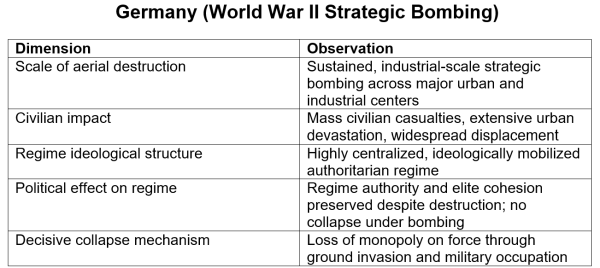
Germany (World War II)
Germany experienced the most prolonged and comprehensive industrial–urban bombing campaign in history. Allied air forces systematically targeted industrial centers, transportation networks, and urban populations. Civilian suffering was immense; entire cities were devastated and industrial capacity severely degraded. Yet the Nazi regime retained authority, administrative coherence, and coercive control until Allied ground forces crossed Germany’s borders and occupied its territory.
The decisive factor in Germany’s collapse was not aerial destruction but the physical elimination of the regime’s monopoly on force. Bombing weakened Germany’s capacity to fight, but it did not fracture elite cohesion or trigger internal overthrow. Authority collapsed only when ground invasion made continued control impossible. The lesson is stark: air power degraded capability, not rule.
Dresden, 1945 – A city once called Florence on the Elbe

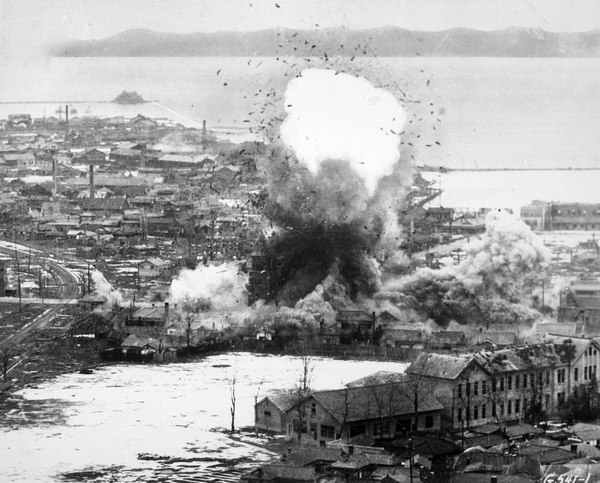
North Korea (Korean War)
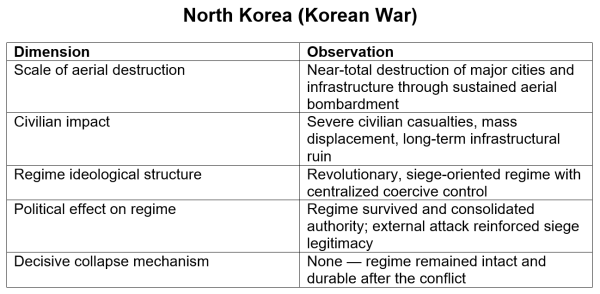
North Korea suffered near-total destruction during the Korean War. Major cities were flattened, infrastructure was annihilated, and civilian casualties were catastrophic. If sheer destruction were sufficient to collapse regimes, North Korea would have been a prime candidate. Instead, the regime survived and consolidated. External attack became the central legitimating narrative of a permanent siege state. The experience of devastation hardened political control and justified extreme internal repression. Rather than collapse, the regime emerged more durable and ideologically entrenched. Extreme punishment did not undermine authority; it became the foundation of it.
North Korean city of Wonsan under attack by B-26 bombers, 1951
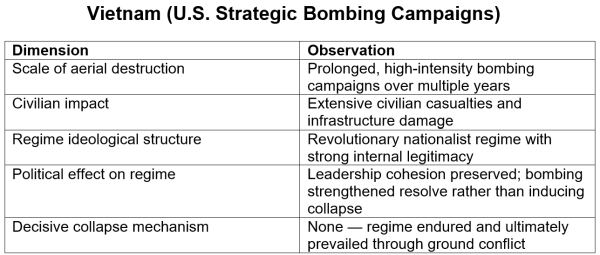
Vietnam
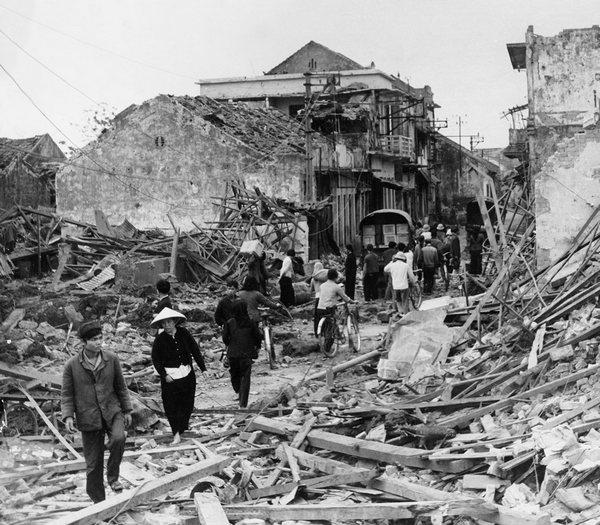
The U.S. bombing campaigns against North Vietnam were prolonged, intense, and technologically sophisticated. They were explicitly designed to coerce political compliance, fracture leadership resolve, and raise the costs of resistance beyond endurance. These objectives were not achieved. Leadership cohesion remained intact, popular resistance was sustained, and revolutionary legitimacy was reinforced. Bombing validated the regime’s narrative of national resistance and foreign aggression. The Vietnamese case illustrates a recurring pattern: aerial punishment often strengthens elite unity and ideological resolve in revolutionary or nationalist systems.
Kham Thien street in central Hanoi after American bombing in December, 1972
Gaza (contemporary)
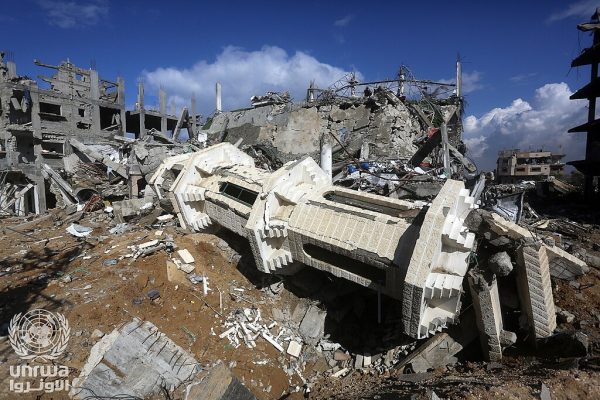
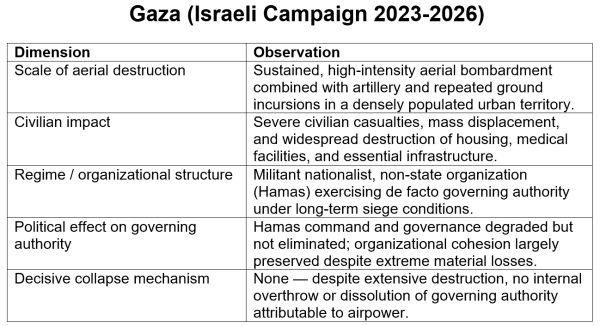
The devastation of Gaza demonstrates the same logic in recent events. Despite extraordinary levels of urban destruction, civilian suffering, and loss of life, Hamas has not disintegrated as a governing or military actor. Its coercive capacity has been degraded but not eliminated; its internal legitimacy among core constituencies persists. The Gaza case underscores a central point: even extreme destruction does not automatically translate into political collapse. Organizations structured for siege and resistance can survive levels of punishment that external observers assume to be decisive.
Aftermath of Israeli airstrike on area around Hassan el-Banna Mosque, Gaza Strip, 2025
Refuting the standard counter-examples
Advocates of coercive air power frequently invoke two cases to argue that bombing can collapse regimes. The most common are Serbia (1999) and Libya (2011). Neither supports the claim.
Serbia (1999): concession, not collapse
The NATO bombing campaign against Serbia is often cited as proof that air power can force decisive political outcomes. In reality, the campaign extracted a policy concession, the withdrawal of Serbian forces from Kosovo, not regime collapse. Slobodan Milošević remained in power for more than a year after the bombing ended. The regime fell only after an electoral defeat, mass protests, and elite defection within the security services. The decisive mechanisms were internal political dynamics, not aerial punishment. Treating Serbia as a regime-collapse case commits a category error by conflating territorial concession with political disintegration. Moreover, Serbia was politically brittle in ways Iran is not: fragmented elites, weak ideological legitimacy, and limited internal coercive depth. Serbia illustrates the limits of air power, not its decisiveness.
Libya (2011): air power as civil-war enabler
Libya is frequently misrepresented as a case of regime collapse through bombing. In fact, the Libyan regime fell because air power enabled a ground war. NATO strikes destroyed loyalist armor, provided intelligence and targeting, and functioned as de facto close air support for rebel forces who seized territory and eliminated the regime’s monopoly on force. This was not coercive collapse from the air; it was external intervention tipping a civil war. Libya’s institutions were thin, elites fragmented, and internal armed opposition already present. None of these conditions hold in Iran. Libya therefore demonstrates that regimes fall when organized ground forces take control, not when bombs fall.
Token concessions and narrative closure
Limited military strikes can produce claims of success. Token concessions, whether real, ambiguous, or rhetorically manufactured, offer face-saving closure without altering underlying adversary power structures. Leaders can declare victory, restore deterrence in narrative terms, and exit escalation without achieving strategic resolution. Such outcomes are politically convenient and strategically hollow; they reward the illusion that force has solved a problem it has merely deferred, encouraging repetition rather than reassessment. A similar dynamic has emerged in recent U.S. operations in Latin America, where narrative framing emphasized short-term tactical gains while leaving the underlying political and strategic dilemmas intact.
The Iran combined insurgency fantasy
Some bombing advocates imagine that air strikes in Iran would be amplified by simultaneous internal uprisings among Kurdish, Baluchi, or Azeri populations. This scenario is not credible. These groups lack heavy weaponry, formal military organization, unified command, logistics, and the capacity to seize and hold territory. Grievance does not substitute for force. Without organized ground power capable of surviving counterattack, localized unrest cannot become a decisive factor. Expecting otherwise is wishful thinking, not strategy.
Even maximal “success” would not secure Israel
Suppose, for the sake of argument, that massive attacks on Iran could collapse the regime and permanently neutralize Iran as a threat. Even this extreme hypothetical would not secure Israel’s future. The Middle East is not a two-player system. Iran is not the only consequential state in Israel’s strategic environment. Turkey, Egypt, Jordan, Saudi Arabia, the United Arab Emirates and other Gulf states, and Pakistan would remain, each with its own interests, capabilities, internal dynamics, and potential points of friction. Israel cannot bomb its way to a region without other powers, rivalries, or future adversaries. Without a politically defined end state, including permanent definition of borders, and durable peace treaties, military action cannot durably establish security for Israel. It can only manage it temporarily.
Conclusion
Bombing Iran is foolish not merely because it is unlikely to achieve its stated aims. It is a misguided action embedded in a deeper policy failure: the absence of a defined political end state capable of delivering regional security. Even maximal coercive success against Iran would leave Israel’s long-term strategic problem unresolved. Military superiority reduces Israel’s immediate danger but does not eliminate long-term exposure. A strategy premised on endless armed conflict with an unattainable end state is not a strategy at all; it is a perpetual warfare cycle in which cumulative risk guarantees failure.


https://www.cbsnews.com/news/us-shoots-down-iranian-drone-approached-us-aircraft-carrier-military-says/
It looks like the first stage of the escalation ladder is here now with the shooing down of the Iranian drone sent to supervise the fleet. Will Schryver has been posting on X that the US has its own drone doing surveillance and the Iranians will be happy to trade the Shahed shoot down for the MQ-4C flying around.
Can Trump still TACO?
Great work, HH! John Kenneth Galbraith was a member of the Strategic Bombing Survey after WWII. His conclusion was that strategic bombing had very little influence on the final outcome. He was correct. IIRC (going from memory after reading his memoir A Life in Our Times when it was published) the bombing of Hamburg had the opposite effect, as destruction of the city pushed displaced residents into wartime manufacturing. Galbraith’s view was naturally rejected, and the Wikipedia account is probably a perfect example of why Wikipedia remains the place for facts (US Open Golf Champion in 1930; structure and mechanism of a drug) but not for a nuanced understanding of anything.
So, going back to WWII, strategic bombing has never achieved its intended goal, much to Bomber Harris’s and Hap Arnold’s dismay from the afterlife.
Read Richard Overy’s magisterial The Bombing War for an up-to-date synthesis of the effect of strategic bombing throughout the War and its effects, making use of official records from different countries and decades of detailed research. Adam Tooze’s Wages of Destruction is very good on the economic effects off the bombing,
I think the consensus is that strategic bombing did have an effect on the outcome of the war, by forcing the Germans to devote considerable resources to air defence and to firefighting, emergency services and so forth. The question therefore is not whether it had any effect, but whether the same resources could have been better used elsewhere. This is not just an argument about war production: practically all aircrew were at least of NCO rank, and took a long time to train. The difficulty is that whist it’s easy to see theoretical better uses (tactical airpower for example) the British were shut out of Europe from 1940 to 1944, and apart from the Navy, they had no other way of directly striking the Reich. The fact that bombers were engaged over German cities was one way of convincing Stalin that the British were serious about staying in the War.
Strategic bombing was an untested theory, based on (some) experience of the First World War that populations would crack under the stress of bombing, and that the War would be over in weeks or even days, with relatively little loss of life. That turned out not to be the case in reality, but by then the British were committed. The later policy of bombing industrial targets did not work either, simply because until very late in the war there was no way of targeting precisely enough.
In the context of the article it’s also worth pointing out that the British were hoping for the same things as the US are now: a spontaneous uprising to overthrow the regime. But that was never possible in Nazi Germany, and there’s no reason to suppose it’s going to be any easier in Iran.
Thank you! Overy and Tooze are on the (long) list.
Both good books to read.
I’d suggest there has been an effort to rubbish the effectiveness of the bombing campaign that goes too far. Some thiughts I’ve had about it are .
1. The bombing campaign destroyed the Luftwaffe by breaking it down over time, and Germany not being able to effectively replace pilots. Yes they increased fighter production but those fighters were handled far less effectively as the war went on. From the Soviet point of view there were only two times they faced the bulk of the Luftwaffe. During Barbarossa and a last ditch bombing campaign towards the end of the war. That certainly helped the Woviets because they greatly struggled to improve the ability of their air force.
2. Massive resources were devoted to defending the Reich. Not just the aircraft. But tens of thousands of anti aircraft guns. Hundrers of thousands manning air defences. Millions of shells. One thing to remember is the germans had to reduce explosives and propellant in shells as the war went on. So they went further and had a smaller bang when they arrived. And artillery units started getting less and less shells to use. Would that have been avoided if the huge ampunt of anti aircraft shells were not required?
3. This one would be hard to measure. But think about a day at work. If you have a bad sleep the night before what is the quality of work the next day? It’s fair to say in general it is worse. It’s reasonable to assume people kept up all night due to bombing were not working overly effectivrly. Add in the stresses of wondering if your house will still be standing when you go home, will your family be alive. It would be a miracle if under those stresses there was not a massive decrease in quality of manufactured equipment. I think that would be an interesting study to perform.
4. Where could America and britain use these resources? They already had overwehlming tactical air power. To the extent that tactical air power were being sent on search and destroy bombing raids of trains, bridges, industrial sites. As were fighters. Coukd they have been used to equip more divisions for fighting through France? Well the allies already had problems with supplying front line units. They had the supplies but the infrastructure could not carry it all to the front. More divisions would only have made that situation worse.
In short, the bombing campaign was never as effective as pre war thinking thought they would be. But they were effective in many areas as part of the overall combined operations.
The post war studies of bombing of Germany focused entirely on the direct economic impact of the destruction. My understanding is that most modern historical economic analyses conclude that the real damage to Germany was the diversion of military expenditure to protecting the cities – this was the real gamechanging cost. Going from memory, one study indicated that something like 60% of German military expenditure in the latter part of the war went on urban air defences alone, in contrast to something like 8% on building tanks.
It’s still rounding error against the impact of the Red Army where Nazi Germany’s defeat was concerned, despite the best efforts of the usual revisionist suspects to downplay Soviet contributions to the war effort on behalf of the irredeemably Russophobic Anglosphere alphabet agencies.
To secure Israel’s future its past must be undone. Thus, to secure Palestine’s future.
The article is premised on an important assumption: That the US and/or Nato still possesses the capability and logistics to conduct (conventional) strategic bombing campaigns on the scale of WW2, Korea, or Vietnam. Leaving aside the sheer scale of Iran, there simply aren’t the number of aircraft, bombs, or pilots to conduct campaigns on those scales. Where once the US constructed thousands of bombers per year during WW2, today the US has less than 200 bombers in service. Airstrikes today are of the precision kind, and delivered by short range fighter jets.
Gaza is the obvious exception, but even leveling this small, densely populated sliver of land has lead to Nato TNT shortages. The reality is that armies today might have better tech, but they have nowhere near the volume of (conventional) firepower of their predecessor divisions from the second world war. A mass strategic bombing campaign of Iran is out of the question on a logistical basis for present Nato forces, who are more likely to end up totally exhausted after a month, if their supplies make it that far.
There will be at most precision strikes. The only mass terror on the population will be visited by the likes of the RSF and Isis, equipped with AKs, drones, and starlink and set loose to maul the civilian population. That is the kind of “strategic bombing” preferred by 21st century war planners.
> Gaza … this small, densely populated sliver of land … [emphasis added]
Thank you. This cannot be repeated too often as (1) a lot of online and/or mass-media maps nowadays omit the scale and (2) a lot of people nowadays are geographically challenged. Picture Brooklyn and Queens combined; the Gaza Strip would fit into that space, with (nearly) enough room left over to also add The Bronx. ilsm notes below that Israel is the size of New Jersey. Even so, it is over 60 times bigger than Gaza.
To a large extent a mass strategic bombing campaign is not necessary to destroy economic targets. Some of these large bombing raids with hundreds of bombers and dropping thousands of bombs ended up with not one bomb landing within a mile of the target. Precision munitions avoid that. However, there are two caveats. After the war it was found that even when bombs did hit a factory they often didn’t do much damage to the equipment inside. Precision weapons could still have that issue.
If by strategic bombing you mean terror bombing, then yes that probably does require large fleets of bombers dropping bombs around the clock, or nukes. Terror bombing never seems to have worked however. It will surprise most people that Bomber Harris thought terror bombing was a waste of time and he criticised the Americans for attempting it. This may seem surprising because the RAF bombing campaign was largrly directed against civilians. But that was because Harris wanted to destroy German industry and his voew was killing German workers was the best way to do that. But he was under no illusion it would lead to an uprising of Germans demanding peace.
Interesting case study is the strategic/terror bombing of Japan.
The B-29 was an innovation, very high-altitude long range, large bomb load. Flew so high very few fighters of the time could get at it. Japanese radar was not widely available or useful for anti-air artillery. The B-29 could fly with minimal losses!
The problem as you say accuracy and the weight of bombs doing enough damage.
The technical solution was the firebomb! Firebombs were intricate affairs, fused to burn at the best altitude to keep the “napalm” from dispersing too much.
Burned whole cities, the factory targets destroyed as collateral damage. The human damage was huge; a couple of firebomb raids killed more than the A bombs.
Standoff missile are not that large warhear…..
There were two advantages against Japan as well. Cuties that were largrly wooden went up a treat with fire bombs. They also had a lot of cottage industry. People making vital items in their homes that worked their way through the larger military industry. Destroying homes also destroyed that.
Of course the RAF did a lot of development of fire bombing in Germany. Mosquitoes would fly in low to perform precision bombing of key points to open gas mains and open up rubble that would burn easier. When the big bombers dropped the incendaries
Thanks for the analysis, I think it’s spot on.
However, I think that the factor(s) that will cause the US and/ or Israel to attack (or not) are almost entirely rooted in domestic politics combined with an overwhelming sense of impunity, rather than whatever srategery they may cook up.
Can’t wait to use this. Saved!
The truth of the matter is that Iran is in a special category. Countries like the US like bombing countries that have only a negligible air force or no air defenses and its like going “on safari”. Iran is one of those countries that can actually shoot back. Bringing in all those ships and aircraft means that they are in closer range of retaliation and you can bet that US bases like in Bahrain will be slammed. And this time it will not be a negotiated strike like last time but full on attacks where Iran will seek to blow up fuel bunkers, ammo depots, radar installations, etc. and they have the ballistic missiles to actually do it. And of course Israel does not get to skeet free after pushing for this war as they can get slammed to. You can say that a good rule of thumb is to not start anything unless you know how it is going to end.
You mention Bahrain home of US Fifth Fleet, a Shi’a majority country which suppresses the Shi’a majority.
Suppose Quds raises up the Bahraini Shi’a? Selfies in the Fleet conference room!
As to prospects of conquering or achieving a benefit from aerospace attack on Iran:
Iran has invested more in offensive aerospace power: drones, rockets, etc. than defenses. Makes sense Israel is size of New Jersey, Iran bigger than Texas with diverse terrain where terrain is worth defensive interceptors. US military targets in Syria, Iraq and Qatar are small sized, in range and many have Quds/PMF/Hizbolah nearby to hold bombed out ground. This strategy has been stated by the recent pronouncements from Iran leadership.
Iran has about 100 city/centers with more than 100,000 people. Israel has more densely populated centers and far fewer.
It makes sense for Iran to put higher estimated revenue product on investment in aerospace offense.
Makes sense for Israel to emphasize defense. Israel has the advantage that US has huge investment in offense bc lots of profit!
My observation is offense favors Iran!
What about USAF/USMC aerospace offensive.
It would require a lot of logistics to sustain US specified sortie rates on US’ older aircraft none of which maintain over 50% mission capable rates during training cycles! That is a lot of maintenance personnel, (a lot of contractors for F-35) support equipment and spare parts (supply chain many critical parts “out of manufacture”). Add to that the supply of ordnance, mostly standoff weapons. Then there is flowing a river of US MIL SPEC jet fuel to bases in Jordan, and where US can run offensive matters.
US would further wear out already sorely worn fighter airframes!
Iran side: dispersion, hardening and masking targets. SCUD hunting is no career for the US!
Iran is a much harder nut than North Vietnam/Laos/Cambodia! US is a shadow of its peak cold war aerospace force in 1965!
The Middle East wars in the later part of the 20th century were executed by the US on behalf of Israel, under pressure by the Lobby which now owns Congress and the White House. It’s not only that Israel has caused mass human displacement, but the number of killed humans, including US soldiers and civilians is untenable. Add the cost that comes close to a trillion dollars, all done on credit, which has destroyed this country. American citizens have been saddle with a life-long debt they don’t approve of. In a potential U.S. attack on Iran, it’s innocent civilians who’ll suffer. If Iranians grow tired of the Mullahs, they will find a way to change the system internally. Just think how Nicolae Ceaușescu ended.
On the Russian oil thing, India wants cheap and steady oil more than it wants Russian oil. Economics drives the decision more than politics. If stopping Russian oil purchases and buying Venezuelan oil sold by USA will keep Trump happy for a while, they will be willing to play along. Russia won’t be very happy, but they will probably not make a big issue out of it. Of course, carveouts and exceptions can always be negotiated later.
I am reminded of the short passage in Joseph Conrad’s Heart of Darkness depicting a French warship lobbing shells into the jungle from off the African coast:
“Once, I remember, we came upon a man-of-war anchored off the coast. There wasn’t even a shed there, and she was shelling the bush. It appears the French had one of their wars going on thereabouts. Her ensign dropped limp like a rag; the muzzles of the long six-inch guns stuck out all over the low hull; the greasy, slimy swell swung her up lazily and let her down, swaying her thin masts. In the empty immensity of earth, sky, and water, there she was, incomprehensible, firing into a continent. Pop, would go one of the six-inch guns; a small flame would dart and vanish, a little white smoke would disappear, a tiny projectile would give a feeble screech–and nothing happened. Nothing could happen. There was a touch of insanity in the proceeding, a sense of lugubrious drollery in the sight; and it was not dissipated by somebody on board assuring me earnestly there was a camp of natives–he called them enemies!– hidden out of sight somewhere.”
Or Biden’s response to a journalist’s query as to the efficacy of the initial American strikes on Ansarallah during Operation Prosperity Guardian (🙄):
“When you say working, are they stopping the Houthis?” Biden said in an exchange with reporters in Washington, D.C. “No. Are they going to continue? Yes.”
Mearsheimer has commented that the American public has a distorted (which is to say outsized) perception of the capacity of its military to achieve political outcomes. The triumph of hope over experience, I suppose?
Fools, all of them …
Just a couple of quick thoughts: 1) most of the examples give are of massive area bombing not of much more selective bombing; I doubt anyone is thinking of massive area bombing with lots of civilian casualties; that would strengthen the regime not weaken it; so I think the examples give are, mostly, irrelevant 2) whether it would be wise to undertake any sort of bombing of Iran, however selective, is I think an open question; 3) the mass of increasingly secular Iranians would, I think, welcome anything that brought down the regime which personally – my partner is Iranian – I consider an extremely retrograde misogynous sadistic and cruel regime that sponsors fanatical fundamentalist terrorism that is utterly counterproductive if one hopes for a better life for Palestinians, Lebanese, Syrians, and Israelis. 4) As for the bombing of Germany, the arguments are complex – the Allies’ aerial resources, it is often said, could have been used more effectively in other domains, say the Battle of the Atlantic – but, as several have mentioned, the Luftwaffe was largely diverted from the Eastern Front and largely destroyed in the air war over Germany, and, also, many other anti-aircraft and anti-tank resources, the famous 88m gun, were diverted from use on the Eastern front and in Normandy by the air war, and as for German war production, which continued to increase, we don’t know what levels it would have reached without the bombing. The once mighty Luftwaffe was mostly absent on D-Day and during the Normandy and French campaign, That said, the human cost of the air war was immense both for civilians on the ground and for allied air crews. 5) as for the idea that a “political solution” – regarding Israel – should be sought, well, what political solution? I don’t think Hamas, Hezbollah, Islamic Jihad, or the Iranian theocratic regime are interested in negotiations; these are religious fanatics not pragmatists – they have genocidal ambitions and a cult of martyrdom and death – and their interest in saving lives or promoting Palestinian freedom and flourishing is zero. Struggles are a means to an end and that end is not freedom or prosperity but some sort of idiotic Caliphate. That said, Israeli policies can be criticized on multiple levels. 6) if eventually Iran is to become once again a great nation and a great civilization, the mullahs must go, and if peace is to be at least a possibility in the Middle East, the mullahs must go, and if Iranians are able to join the modern world – however imperfect that world might be – and enjoy a modicum of freedom and prosperity and human rights, then the mullahs must go. The problem is that the mullahs have pulverized, as Communism in the USSR pulverized, all other forms of intermediate social organization and all forms of organized opposition, so if the mullahs do go, the prospects for a peaceful transition to a democratic regime will be questionable at best. it is a dire situation. Those who suffer most from the Iranian regime are Iranians. Left or Right-wing chatter in the West – such as my meandering here – is of limited use. As for Trump, he is not interested in the freedom of Iranians or the rights of Iranian women – so whatever he does (I suspect some sort of deal with the Iranian Regime) it will not be in anybody’s interest but only in service to his own ego and vanity, and the result may be, quite probably will be, to prolong the existence of the extraordinarily evil and incompetent and corrupt regime of the mullahs.
It seems your wife is likely to be one of those Iranians from a wealthy background whose family fled at the time of the Revolution.
Re misogynous, Professor Marandi has had more women than men bosses. Admittedly there is very fierce wage and hiring discrimination in industrial work.
Women are not well treated in most of the Arab world either. Women basically are wives, domestic workers, or whores.
I have read in several places that more science and engineering graduates in Iran are women than men, quite a bit better percentage than in the US. If the society is misogynous, it is doubtless based on the Abrahamic religions that gave rise to its current majority creeds. But you could say the same thing about the US and any number of its allies and the majority religions that their populations follow. Our veneer of sexual equality has always been paper thin despite two centuries of effort to make things fairer.
Hi Yves, I hardly know what to say: my companion – we are not married – left Iran three years ago; she comes from an extremely modest background – on the edge of poverty. She is young. I am old. I know many of her Iranian friends, men and women. She is a professional and already has a job. They are young like she is, and professionals. Toronto, where I live has a very large Iranian population, approaching 100,000, most quite recent arrivals, most are quite young and well educated. Whole areas of the city seem like suburbs of Tehran. As one young Iranian woman who runs a pharmacy said, “One of Iran’s biggest exports, I think, is women.” My friend is in frequent contact with her friends in Iran, so she is acutely aware of the situation. “Almost everybody knows somebody who has been killed.” As for Professor Marandi, perhaps the less said about that person the better. And, yes, women can be the bosses of men, though it is, I think, rare. I worked in Italy for 24 years – and very frequently my bosses were Italian women, sometimes, in the PR field in which I worked, the same woman would be my boss in one context and I would be hers in another. As for they mistreat women in other societies, so it is hunky-dory that women be mistreated – raped, murdered, and tortured (I know firsthand of women – not my partner – who witnessed their parents or friends being subjected to this sort of treatment) in Persia, well, dear Yves, I really do not know how to respond to that level of provincial complacency, arrogance, and ideological blindness. It is an interesting phenomenon how people must line up on one side or another and then become blind the the sins of the enemies of their enemies. Tragic, really. Or perhaps disgusting is more accurate. I am sending this in spite of my more cautious self telling me not to trust you. Cheers from Toronto.
So are you agitated about India, where burning and beating of wives deemed to be insubordinate is common? You accuse me of lack of interest in mistreatment of women and in being parochial, which looks like rank projection. Your ire is limited to Iran.
Dear Yves: Who said my ire is limited to Iran? The mistreatment of women – or anybody else for that matter – anywhere is a crime – but there is a small difference, in Iran the regime targets women specifically – rape is one instrument of theocratic power. The frequent rape and mistreatment of women in India is a crime and some of those crimes have been particularly horrendous. The limits on the freedom of women in Saudi Arabia are noxious. We could go on listing crimes for hours and hours. You are projecting thoughts or lack of thoughts onto me when you have no indication of what I think about any of those issues. We in Canada, for example, have a major problem regarding specifically the mistreatment and frequent murder of indigenous women. But governments do not sponsor this. We also had the case of a serial killer who was able to continue his activities for a long time because the police, in British Columbia, did not follow up cases of missing prostitutes, often native women, so that would be a case of official culpability. In southern Italy when I worked there – for six years in the 1970s – crimes of passion were fairly common, the victims were almost always women, and often the crimes went unpunished (a judge who prosecuted these cases told me that the priests would tell villagers not to testify). And what about the American “war on drugs” that has destroyed Latin American countries and has been weaponized to wreck Black communities in the US? And what about ICE? And what about … Vlad trying to freeze Kyiv into submission, eh? Well, we can’t talk about everything all at the same time! As for Iran, yes, there are positive things – women do become educated, women can drive cars, women can have careers. Still, in my modest opinion imposing a retrograde theocracy on a highly civilized people is a crime in itself; also killing thousands and perhaps tens of thousands of people is not a good thing whether it is Iran or Israel doing the killing. I do apologize for “parochial” – it was the wrong word. I think the problem is ideology, not parochialism. But this would take us into a discussion of political and economic philosophy which is beyond our scope here, I fear. That said, I think your book ECONned: How Unenlightened Self Interest Undermined Democracy and Corrupted Capitalism, was excellent – and articulated some things that I have firmly believed since neo-classical economics, the a priori models impervious to empiricism and promoting the unbridled supremacy of markets and greed, began to replace Keynes, in the 1970s. I worked at the OECD in the 1960s when de Gaulle – splendid profound personage – was at the height of his powers and just before the 1968-1969 crisis brought his reign to an end. “Neoliberalism” – a vast term – was, in many of its aspects, a very, very bad idea, though at the time I thought Margaret Thatcher, though bitter medicine, was necessary medicine (didn’t agree with everything she did of course). In Italy, though I didn’t share its ideology, I was quite close to Enrico Berlinguer’s Communist Party and knew some of its leaders; the world is complex, I think, shades of gray, not Manichaean black-and-white, ultimate values are often in conflict, are incommensurable, and frequently incompatible (freedom versus equality for example); there are no perfect solutions; there is no paradise Cheers!, Gilbert
I have difficulty with your claims because they are much more extreme than what the State Department has said, and State has no reason to candy coat the situation in Iran. For instance:
https://iranprimer.usip.org/index.php/blog/2024/apr/25/us-report-women%E2%80%99s-rights-violated-iran
Hi Yves, you are certainly passionate. That is admirable; but I’m not sure what you are talking about. The report you cite is from 2023. A few things have happened since then, including the 2026 revolt and demonstrations and the subsequent crackdown. In any case, “disproportionate punishment for crimes” – such as adultery – is a fun euphemism for state-sanctioned murder. Iran is I think the champion in putting women to death each year. In any case, I do not see why you are so intent on defending the Iranian Regime. Is it because it is an ally of Putin? Is it because the Iranian regime is opposed to Great Satan (the US) and Little Satan (Israel)? The enemy of my enemy must be my friend – and must be blameless – sort of logic. That sort of logic certainly lacks what one might call ethical lucidity and moral coherence. One side note: the fact that women enjoy certain rights and access to education owes much to the top-down reforms imposed by the late Shah an authoritarian modernizer (he had his own very cruel secret police and so on as we know). One little note: a young Iranian friend of mine – who now works as an expert in health care in Canada – told me several years ago how she was taken to the prison where her father was being held to watch him being tortured. This was to induce her father to confess to something. Ah, the wonders of the organized religion your professor friend Dr. Marandi likes to celebrate! (He also, I believe – correct me if I’m wrong – thought trying to kill Salman Rushdie was a fine thing ). As I said, there are lots of evil regimes in the world – one of them – a grandiose kleptocracy – presently resides in Washington. I’m not going to defend the policies of Israel or of the United States or of Canada for that matter unless I agree with those policies. Each thing is a thing in itself; each act is to judged on its merits or lack of merits. But it seems you are determined to give the Iranian regime a blank cheque. Why is that? By the way, my partner is absolutely apolitical, though she does have definite opinions about the regime, but she is not an activist, nor am I. It seems that 150,000 people demonstrated in Toronto against the Iranian regime. They were not old people. Of course, they were all agents of Israel, I am sure! Cheers Gilbert
https://www.iranhr.net/en/reports/42/
https://wncri.org/2024/10/09/execution-of-women-in-iran/
https://www.cbc.ca/news/canada/toronto/iran-protest-downtown-toronto-9.7070133#:~:text=In%20an%20update%20on%20X%2C%20formerly%20Twitter%2C%20on,and%20%22zero%20incidents%22%20at%20the%20protest%20on%20Sunday.
Your first report does not substantiate your claims about women. It says there were 975 executions with just over half for drug offenses. Relative to the population of 93 million, hat’s 0.001048387%
In Saudi Arabia, there were 325 executions. Its population is 35 million. That’s a bit lower but barely so at 0.000928571%
China is believed to execute at a higher rate.
Israel has executed FAR more women in Gaza. Vastly more on an absolute basis and even worse relative to the population
NCRI is not a credible source. It’s an Israeli-funded operation in the hit piece business: https://www.youtube.com/watch?v=OQNsug2SwtU
I am also a Torontonian. The Iranian community (like all diasporas) in Toronto has a particular political and socioeconomic character, and does not have access to some unbiased, universally-true understanding of world events. One must ask: who leaves, and why? And to whom does the Canadian government permit/forbid entry and residence? This necessarily shapes the local consciousness of Iran-related issues. As one illustrative example, count the Israeli flags at this Iranian regime change protest in downtown Toronto…
https://www.youtube.com/watch?v=_vZd1gaVQiI
The Israeli flags – the my enemy’s enemy is my enemy principle. As for the socio-economic quality of the Iranian diaspora, I guess people shouldn’t have a vote because they are educated and care about women’s rights. As for Israel, that is complicated but it seems that upwards of 70,000 Palestinians were killed. I would think that qualifies as a crime against humanity, edging towards genocide, so the present government of Israel should certainly be held accountable. But much of this is what the French call un dialogue de sourds – a dialogue of the deaf, so I will sign off now.
It’s over 600,000.
Hi Yves, I’m not sure where the 600,000 figure comes from. Hamas says and apparently the IDF accepts the figure of 70,000, perhaps plus 10,000 buried in rubble – so 80,000 Palestinian dead since October 7, And then “PCBS [ Palestinian Central Bureau of Statistics] reported that around 134,000–136,000 Palestinians and Arab people have been killed since 1948 in conflicts involving Israel.” Of course, one death is too many. So it would be ideal of a diplomatic solution could be found which would allow Israelis and Palestinians to live peacefully and prosper; but, with the two-state solution increasingly unrealistic, in particular because of Israeli expansionism in the West Bank, and given the maximalist demands – elimination of Israel – of many of the anti-Israel resistance groups, I do not see how such a solution can be brought about. Cheers! Gilbert
I am tired of this hasbara. I am disgusted at you going on about Iran and minimizing the genocide.
It was 680,000 as of LAST SEPTEMBER per the UN Special Rapporteur:
https://www.youtube.com/shorts/0547CTY7xj4
There has been cold, rain, more starvation, and more IDF killing since then.
Yes, I see Francesca Albanese’s report. Extraordinary and shocking and as you say ongoing. Thanks for sending me to it. That, said, two wrongs don’t make a right. Adieu.
“I don’t think Hamas, Hezbollah, Islamic Jihad, or the Iranian theocratic regime are interested in negotiatios; these are religious fanatics not pragmatists – they have genocidal ambitions and a cult of martyrdom and death”
I find it interesting that you list Hamas and Hezbollah as if they were the same as Islamic jihad and then go on to claim that all three have genocidal ambitions. I gather you omit a of mention Israel’s genocidal ambitions because they are proceeding successfully.
There is one country in the middle east constantly bombing their neighbors. Its also run by the most extreme religious fanatics on Earth. These lunatics riot when they are told they cannot rape.
Fun fact. One of the captured soldiers made up an obviously false allegation claiming that while imprisoned she was raped by a Palestinian. She had been constantly attacked online previously for admitting that her captors treated her fairly.
Wanna guess what happened a few months after she was released by Hamas?
An Israeli guy raped her. He was her personal trainer. According to recent polls, most Israeli men dont think date rape is wrong.
Perhaps when you have been getting what you thought was news in the past you were actually getting Israeli propaganda?
I consider an extremely retrograde misogynous sadistic and cruel regime that sponsors fanatical fundamentalist terrorism that is utterly counterproductive if one hopes for a better life for Palestinians, Lebanese, Syrians, and Israelis.
I’m sorry, but these three groups joining israel is ridiculous on it’s face and gives away the lie. In reality I believe that irani society is progressive compared to, say, KSA as one example. Yes Iran has a diverse society, no people aren’t always or partly in favor of the government, but I have the same view of the usa where my vote/opinion is completely immaterial.
The interesting parallel to me between the strategic bombing campaigns of World War II and the current mess is the executive and bureaucratic dysfunction that caused it:
Frustrated mid-level managers like Billy Mitchell took up the idea of strategic air power in the interwar period as a way of carving out a new bureaucratic fiefdom for themselves. ‘Talking their book,’ as Lambert would say, they came up with all sorts of theories about how air power could win wars all on its own, all superficial nonsense, but it was exactly what the people in power wanted to hear. When the bombs started falling in 1940, both the Germans and the British quickly realized that while air raids in direct support of ground forces was useful, the bombing un-engaged military units was largely pointless. IIRC, a German bomber crew got lost one night and accidentally bombed London, didn’t accomplish much militarily, but it made the news. The RAF retaliated by bombing German civilians, which I guess bucked up morale when the British Empire was completely impotent to wrest control of the continent away from the Germans.
Nothing’s really changed since. Dropping 2000lb bombs on Baghdad made for great TV back in 1991, shock-and-awe was a photo op in 2003, and now Trump wants his own Michael Bay spectacle of a ‘victory’ right before the midterms.
Now try to imagine the conversations going on in the bunker below the White House: USAF generals claiming they can bomb Iran back to the stone age, USN admirals claim they can do everything the Air Force can do, CIA claims they can topple the regime with a cheap color revolution, the Army generals are trying real hard not be noticed, and the State department is catatonic. Who is Trump going to listen to?