I generally refrain from reproducing significant parts of another commentator’s work, but a Paul Krugman post debunking the depiction of state and municipal employees as welfare queens merits more attention than a mere link.
Krugman points to a paper by Jonathan Schmidt, who has parsed the data on private v. public sector worker pay level, concludes that the factoid that critics like to point to, that public workers are on average, better paid (by 13%, to be exact), is misleading, Why? Government workers are older and better educated (how many government jobs are the analogous to minimum wage Wal-Mart greeters, for instance?). When you adjust for greater age and experience, public sector workers are lower paid than their private sector counterparts, by 4%.
Krugman notes:
I think the easy way to think about this is to realize that about half of state and local workers are teachers and academic administrators — which means that they’re college-educated, at minimum. And think about it: how many ambitious young people do you know saying, “My goal in life is to become a high school teacher — that would put me on easy street”?
Yes, firefighters and police get pretty generous pay packages; they also pull people from burning buildings.
Yves here. One possible legit beef is the proliferation of administrative positions in public schools, but that’s largely distinct from the level of pay.
Krugman also shreds the idea that pensions are breaking state and local budgets:
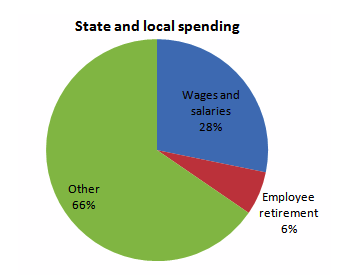
….even if you believe that the age-and-education-adjusted calculations are wrong, and public employees do get paid somewhat more than they “should”, how big a deal is that? I went to the Census state and local finance data, and got this picture of the composition of non-federal government spending:
A few percent either way in workers’ compensation would not make a big difference to state and local spending. This is a phony issue.
Of course, so were the welfare queens.
Update: A number of commenters have alluded to large unfunded pension liabilities. Two points: first, the fact that state and local governments haven’t been making large enough contributions to pension funds says nothing, one way or the other, about whether workers are overcompensated. Bear in mind that, as Cohn notes, many government employees don’t get Social Security. Second, a “trillion dollar liability” needs to be placed in context: state and local governments spend $2.8 trillion per year. Compare the pension liability with total spending over, say, the expected remaining lifetimes of those workers, and it’s a real problem but not inconsistent with my point that these compensation issues have been grossly overstated.
Yves again. In other words, pensions could still be a problem in particular cities and states, but these instances are being used to depict it as a widespread problem, when the evidence is that that just isn’t the case.


Yup!
Yet, one just can’t swing a dead cat without hitting a conservatard pundit (Mish, John Mauldin et al.) who will write with bathed breath about the huuuuuge problem the public workers unions represent to our economy.
Peterson Institute is doing a heck of a job, no?
As for the pension problem, which is very real, look at Nebraska v. their neighbors.
Nebraska fund their pensions EACH YEAR, at the beginning of the legislative session, no ifs, buts and see ya! It’s the law.
Guess what? They don’t have a pension problem.
“Nebraska fund their pensions EACH YEAR …”
The whole public vs. private sector compensation debate as a national issue is a crock because public sector compensation, and how responsibly pensions are funded, varies wildly from state to state, county to county and city to city. It varies far more than private sector pay across the country. In some places the public sector pays squat. $25k/yr for an experienced teacher in Las Vegas is a joke. OTOH here on Long Island we have some of the highest paid teachers and cops in the country.
I have no problem whatsoever with paying public employees well, particularly teachers if it is a good means tested performance-based pay. God forbid people actually have enough money to take care of their children and send them to college in America. Some state agencies, particularly the DOTs sometimes pay for themselves with registration and licensing fees.
There are some issues with hiring and firing, where employees with abyssmal performance cannot be fired. But, don’t think that this isn’t the same for individuals in private industry, particularly people in higher positions that have made it into the boys club/golf team. We have all seen quite a bit of failure amongst the CEOs recently and little on the part of punishment. Their terrible performance has generally been rewarded with large compensation packages as they make their way out the door. So I wouldn’t say that private enterprise employees are judged on such a largely different metric then public sector ones. Just ask some of my drunk private industry co-workers that go out for three hours during lunch.
I think one of the biggest issues is actually with our priorities. There is empirical evidence that increased investment in early intervention, nutrition programs, and other initiatives for poor children has the benefit of reducing potential utilization of welfare and incarceration. Eg pay a couple thousand a year now rather than tens of thousands a year later. I really can’t see why a “rational” person that wants policies pursuant to fiscal responsibility can’t see these benefits. Costs of incarceration are not only prison related but also wrapped in the whole instititional criminal justice system. That is judges salaries, district attorneys, police officers, and detectives. I would rather pay the salaries of qualified teachers, nutritionists, social workers, ect then for prison guards. It is also an investment in future productivity as these individuals end up not being supported by the system but generate wages instead. But, then we wouldn’t be a bunch of ‘tough on crime’ mavericks would we. You betcha…
In this country, the term union has become a four letters word. It’s mainly the result of incessant employers/MSM tirades against employees and their unions. If only they could bring slavery back, and include both Hispanic and whites in it, we would have the best economy on earth.
The reality is that Europe is heavily unionized, health care is universally available at half the cost, workers have thrice long vacations annually and the economies of countries such as Germany, France and Sweden (just arbitrary choice) are much more solid that ours.
We have a heavily supported industry and commerce with bottom of the barrel working conditions and still our economy gets worse continuously.
Amen. I have been a public sector employee for a long time. Five, ten, and fifteen years ago the attitude of many was that I was foolish for making the choice because I could make more money in the public sector. Now the attitude is that I am stealing.
Thanks, Yves. As a state worker myself, I have been trying to fight off the right-wing demonization of my family, co-workers and me as lazy, money-sucking leeches on the hard-working limbs of the body politic for some years now. The truth is that we work hard, spend our money in our neighborhoods and help keep local businesses alive, and pay taxes (yes, taxes!) that allow our non-government-worker neighbors to drive cars with subsidized gas on government maintained roads and bridges, educate their children, maintain fire and safety service, and haul their garbage away, to name just a few benefits we help make possible. I have watched us being painted as “union thugs”–we who are grandmothers and church deacons and suburban gardeners–have watched our hard-won pensions portrayed as undeserved pork, have gotten sick to my stomach as overpaid Neanderthals on TV point fingers at us, accusing us of being the soul of corruption, taking food out of the mouths of the babies of “real America”, and basically being everything that is wrong with the country.
It’s not our fault that for the last 35 years Americans have allowed their love affair with the rich to dictate the domestic policies that destroyed unions and transferred their wealth to those at the top. If they finally woke up one day and realized that everything turned to shit some time ago, and they haven’t had a real raise for most of their working lives, they need to look in the mirror and ask themselves where they were when Reagan destroyed the air traffic controllers’ union, when tax policy was changed to favor the FIRE sector over manufacturing, when the 401 (k) clause and the vagueries of the stock market were transformed into the only retirement option available for most, when the anti-trust laws were put into mothballs, when limited partnerships for corporations were given the green light, when TARP was engineered by Wall Street for Wall Street. While they were off railing against the taxes that paid for their decent standard of living, their feudal lords were cutting their economic legs out from under them. And now they wake up and want to blame me.
Too facile. What about the cost of employee healthcare, which in my school district is rising 13% a year? Couple that with declining state aid, and we have “structural” deficits each year of 15%. Contractual raises much be honored, and so must defined benefit pension plans. So what gets cut? Libraries, maintenance, and untenured (i.e., young and cheap) teachers.
The public sector has only just begun to address the bursting of the bubble economy. Unless you believe we’re reinflating the bubble, either the public sector must retrench, or you need a massive wealth redistribution from the top decile. That may be your prescription, but it’s too facile to say local taxpayers should just shut up and pay the defined benefit pensions and no-cost health benefits of their municipal employees — benefits that the private sector surrendered years ago.
surrendered
“What about the cost of employee healthcare, which in my school district is rising 13% a year?”
What about the cost of my individual health insurance which the provider wants to raise 20%. And that’s after reform!!!
“…it’s too facile to say local taxpayers should just shut up and pay the defined benefit pensions and no-cost health benefits of their municipal employees — benefits that the private sector surrendered years ago.”
Nowhere did I say the taxpayers (of whom I’m one) should just shut up. I did say that all this happened right under their noses with their complicity (either passive or active). Every time some ignorant yahoo went barnstorming across town or across the nation with a prescription of cutting taxes and privatizing the world, many of them jumped right on the bandwagon, consequences be damned. Not only did people feel un-inclined to pay for the services they still expected to get, but many times they raided those pension funds for more pressing matters, deliberately leaving them underfunded with some pie-in-the-sky self-delusion that they’d pay it back later. Well, guess what? Maybe the “private sector”–i.e., the CEOs with merger-mania on the brain and their own damned agendas–decided to dump the defined benefit pension, but I still haven’t met a single worker who wanted to do it. I sure didn’t sign on to it. If I had my way everyone in the country would have a decent pension to last them through their infirmity. And if you want to hold someone responsible and recoup some of the money pensions are going to need after decades of managerial abuse, get it from the managers. The working people who paid into it never ran a scam on the public, so why should we have to pay for the misconduct of those who did?
Another round of cramdown for the middle class is what this is. Anything to let the rich continue to syphon off as much of the public (and private) largesse as possible. In the last decade, pretty much the only decent jobs created were created by the government. Instead of asking why that is? Why aren’t better private jobs being created? Why have we allowed private employers to ship jobs overseas and gut their own retirement plans? The elite have decided to simply use the anger of people screwed by the labor policies of the last 30 years to screw more middle class Americans out of their decent paying jobs and retirement benefits.
As an added bonus, a lot of state and local retirement money was lost in the big crash thanks to fraud by a bunch of investment bankers. I think we all agree that instead of prosecuting those on Wall Street who stole it, we’d be better off to just cut benefits so the pensioners don’t need it any more. Hey, they have Social Security. Until, of course, Obama guts it in December.
More looting. That’s all this is.
“I think we all agree that instead of prosecuting those on Wall Street who stole it, we’d be better off to just cut benefits so the pensioners don’t need it any more.”
I’m all in favor of criminal prosecutions for Wall Street, but don’t pretend that they’ll bring back the money that evaporated (or never really existed in the first place).
What I and a lot of other people in the private sector resent is the idea that public sector employees should be protected from the vicissitudes of the economy in a way that private sector employees aren’t. While we’ve watched our 401k’s go to hell, and get a few sympathetic nods from the public sector employees, their real concern is that their pensions should be protected no matter what. In that sense, and because the power of taxation backs up those pensions, they are a privileged class.
Most public sector workers don’t get social security. Their pension is in lieu of social security.
Also, the idea of dragging someone down to lower level as a way to have equality really doesn’t lead anywhere. There is always someone lower.
“Most public sector workers don’t get social security. Their pension is in lieu of social security.”
Most public sector pensions are, and are intended to be, a lot more generous than Social Security, so the comparison doesn’t follow. Pensions vs. 401k’s is more apt.
Furthermore it’s often overlooked that because of the bend points in SocSec people who make, say $70k/yr, are subsidizing the retirment of those who made say $25k/yr. I’m fine with that, but it means that public sector employees who don’t pay FICA aren’t subsidizing the retirement of the low earners the way those in the private sector are.
“Also, the idea of dragging someone down to lower level as a way to have equality really doesn’t lead anywhere. There is always someone lower.”
There’s a limit to that. Taking the point to an absurd extreme for the sake of illustration, instead of complaining about overpaid CEO’s, why don’t we insist that everyone be compensated like CEO’s?
More realistically, why shouldn’t someone with comparable qualifications and responsibility in the private sector complain about cases where their public sector counterparts are compensated in a more generous and less volatile fashion?
Put the term “CEO” into union workers job titles. The Republicans will spin in circles and won’t be able to figure it out. When bankers’ salaries and benefits get cut, when there legislation against bankers and their families that deny them their lifestyles, then I’ll be worried about unions.
I agree with your update Yves. I followed your link on Sunday to Dean Baker’s post about public sector pensions and made similar comments there. The pension benefits promised to public sector employees were a key part of the compensation package that public sector workers accepted in return for their labour. These pensions may now look relatively generous, but the public sector employees’ work has been done and the size of the pension reflects the labour market conditions prevailing at the time. Any failure to adequately fund these public sector pension liabilities effectively amounts to hidden borrowing, and is the responsibility of the politicians then in office and the voters that elected them.
In view of the fact that this shortfall represents underpaid taxes that increased wealth, my solution to the public sector pension (and benefit) burden is to levy some kind of wealth (as opposed to income) tax, which is probably most straightforwardly done by increasing inheritance tax.
There is a reason that “union” has become a four letter word. For fifty years a ferocious propaganda war has been waged against unions. But this was rebutted and countered until 1968-72. Those two election cycles alienated a generation of Democrats and liberals from unions, dominated by hawkish, white ethnics, who outside of the UAW had rather tribal views on race. So the new, younger, Dems who came into the House and Senate after 1974 had no enthusiasm for the Union movement itself, seeing it only as an interest group to be placated while academics adopted neo-classical economics as their doctrine and unions once again became “economically” inefficient.
Further, the folks proposing these cuts, and scapegoating Federal, State, and local employees (along with (legal or illegal) immigrants, unions, hippies, old people collecting social security and medicare, and finally Black and Brown people in general are all about transferring even more wealth to the upper .5% of the population. As a general program, it has not done to well for our country the last 30 years, but it looks like after November we will have another go.
Wow, this post really brought out the economically illiterate idealogues! Wow. Yes, why of course nobel prize winning Krugman there is no recession, we will be o.k., print more money oh looks like things are bad (in 2010). Ah, yes those great federal state and local guys, who work at MMS, do a great job teaching, regulating financial markets, so what if some earn 800k or abuse their power for gain…..Ah, the dialectic of Ives posts. You made some of the Obama and Union people happy with this one! I deserve a raise! What prosecute Maddoff–no I have to surf internet porn! What regulate derivatives? What teach them to read? Yes, public servants underpaid and overperforming…….Yes the evidence is all around…..I can’t believe my lying eyes, Krugman and a couple of fellow travelers says its o.k……
They said…In view of the fact that this shortfall represents underpaid taxes that increased wealth, my solution to the public sector pension (and benefit) burden is to levy some kind of wealth (as opposed to income) tax, which is probably most straightforwardly done by increasing inheritance tax.
Yes, why of course tax wealth to fund pensions. Yes, let us tax everything that moves to benefit. Really, the shortfall due to unpaid taxes–wow. How about shorfall having to do with inel maangement of pensions and overpomising How about public servants sharing the pain experienced by the public they love o serve? Oh no, give him the pension so he can go to Florida, and we do this by taxing the savings of the dentist who worked all his live and well his kids have to do with less, but hey its o.k. they will be so happy to fund the double dipping 55 yo. government contractors. This country is doomed.
Re: This country is doomed.
The problem is that, over the last 40 years (or so), the entire economic system has turned into a battle-of-the-scams.
Like it or not, the entire country now realizes that if you’re not running a scam on somebody (or participating in one) you’re not going to make money.
What people are pissed off about is that they aren’t in on some scam. The nobility have their scam of owning the Federal Reserve (and control of the country’s currency); the public employee’s unions have a nice scam of being able to purchase politicians to increase their benefits; I’ve been participating in a great scam for 15 years working for a Bank which pimps loans to young people (the colleges employees are participating in the same scam); the military industrial complex is one of the original post ww2 scams; and so it goes…
Socialism (applied real-world socialism, not fantasy socialism) IS completely ONLY absolutely about using political influence to scam somebody. The system is working perfectly IF you happen to be in on a scam. Stop bitching, and find a good scam.
Moe green,
Public sector workers will share the pain, to the extent that they pay taxes themselves.
Actually, the trick is tax what does not move (ie to avoid deterring economic activity by taxing flows such as income).
Note that my opinion derives not from socialism but from conservatism – it is about honouring contracts and taking responsibility for our decisions. To me, one of the most appalling aspects of the financial crisis has been how so many self-styled believers in free markets cried for public bailouts when their assets and wealth was threatened.
“How about shorfall having to do with inel maangement of pensions and overpomising How about public servants sharing the pain experienced by the public they love o serve? Oh no, give him the pension so he can go to Florida, and we do this by taxing the blah blah blah”
I have to agree with the articulate thinking man Mr. Moe Green. I also think that richest man should be King with chain of command assigned by wealth rankings from say the wall street journal. Central government abolished. We should live by the whims of the new nobility. Free markets and social darwinism should rule the day.
As a public school teacher, let me be the first to admit it: it’s my fault.
It’s my fault the country de-industrialized.
It’s my fault that production was off-shored and outsourced.
It’s my fault income and capital gains taxes were cut, while war budgets kept increasing.
It’s my fault that an ever-increasing percentage of the economy is controlled by Finance and rentiers.
It’s my fault that income polarization is at such high levels.
It’s my fault that pensions weren’t funded, and that the funds themselves are treated like dumb money and rubes to be fleeced.
It’s my fault that state and local governments are broke.
Yes, it’s my fault, I accept full responsibility, and deserve the punishments that are forthcoming.
Americans already tore welfare queens to shreds in the 19080’s, they need some new bait for the lions.
When the ruling class is through there will be no one left who gives a damn about the country outside of their clan.
I don’t think we are far from a consistent flow of emigration for the first time in US history. It will first be young professionals.
Michael Fiorillo: “As a public school teacher, let me be the first to admit it: it’s my fault.”
As a private sector worker, let me assure you that it wasn’t my fault either. What’s your point, that as a public sector worker you should be protected from all the vicissitudes of the economy? Will you give a sympathetic nod that those of us in the private sector should enjoy the same protections, no matter how politically unrealistic, even absurd, that is? Should we enjoy the political reality of your protected status as a shining example of what we should all aspire to, just as those glorifying the rich say we should all be Horatio Alger?
Alex,
Your reply to me presupposes that I assume that I should be protected while private sector workers absorb the pain of our oligarch-induced crisis, and that because protections for private sector workers have been eviscerated, it must follow that the race to the bottom must continue with the sacrifice of public workers and public services.
Let me turn the question around on you: would you like a retirement without the specter of privation? Would you and other private sector workers like fair wages and some minimal job protections?
If the answer to any of these questions is yes, then do you really think you will gain them by having the attacks on public sector workers be successful?
Union wages and conditions function as a kind of invisible hand, raising the wages and living standards of even unorganized workers. Factory production wages traditionally tracked, even when lower, wages earned by workers represented by the UAW and USW. The same is true of union and non-union teachers.
By accepting the Austerity Party line that teachers, cops, firemen and other public workers are responsible for the financial crisis facing states and localities, you and others are speeding up the forced march to the 19th century.
The objective should be to defend the rights that organized workers have won, while struggling to raise the wages and working conditions of those yet to be organized. This, coupled with a wealth and financial transactions tax, would go a long way toward alleviating the pain people are feeling.
“Your reply to me presupposes that I assume that I should be protected while private sector workers absorb the pain of our oligarch-induced crisis, and that because protections for private sector workers have been eviscerated, it must follow that the race to the bottom must continue with the sacrifice of public workers and public services.”
Hmmm … just as I predicted in my original reply, you’re promising a pie-in-the-sky level of protection for private sector workers as an “alternative” to questioning some public sector perqs. You know, or should know, that private sector workers will never enjoy the same level of protection that the public sector does. That applies even in more civilized countries that embrace social democracy.
That’s not surprising, as the government is intrinsically different from private enterprise. Amongst other things it enjoys the power of taxation. Historically public sector employees had phenomenal job security in exchange for lower compensation (a category that includes pension and other benefits as well as base and supplemental pay). Even now with all the outrage over the layoffs of public sector workers, the odds of getting laid off in the public sector are no more than 1/7 the odds of getting laid off in the private sector. Curiously studies which claim that, after making the reasonable adjustments for education and so forth, public sector compensation is slightly less than private, fail to take this security into account. Would you expect treasuries to have as high a yield as corporate bonds?
I don’t know what your compensation is as I don’t know where you work and, as I noted @ 9:12 above, the whole public vs. private sector compensation debate as a national issue is nonsense because public sector compensation varies wildly from state to state, county to county and city to city. I can tell you though that here on Long Island the whole lower-pay/higher-security tradeoff has long been abandoned for “comparable” pay in the public sector combined with the same old high security.
“Union wages and conditions function as a kind of invisible hand, raising the wages and living standards of even unorganized workers. Factory production wages traditionally tracked, even when lower, wages earned by workers represented by the UAW and USW.”
Spare me the false class solidarity with the public sector, which is especially ironic with your use of the long debunked cliche of an “invisible hand”. You mentioned *private-sector* unions like the UAW and USW because historically many *private-sector* unions pushed for laws that benefited everybody, like the 40 hour week, or the unfortunately unsuccessful attempts by Walter Reuther of the UAW to get the Big Three to push for universal health care instead of just benefits for UAW members. When’s the last time you heard of anything like that, especially from a public sector union? It seems like your notion of class solidarity involves higher taxes in one direction but only tea and sympathy in the other.
“By accepting the Austerity Party line that teachers, cops, firemen and other public workers are responsible for the financial crisis facing states and localities …”
You’re ignoring that I said exactly the opposite, adding that most private sector workers weren’t responsible for it either. Yet somehow one class is more protected than the other.
Re: forced march to the 19th century
While this IS true (and inevitable) all the public sees is right-now (the present). We are talking about the American public here, so any concept of cause-and-effect (the future) or history (the past) will be very very limited.
What the public DOES understand is that public employee unions own politicians. American know (vaguely) that their political system is for sale to the highest bidder. So, like normal peasants, non-unionized people (the vast majority) resent OTHER peasants (the union members) having access to this political scam.
SO, your ideas of peasant solidarity might be sound great when you are talking with other liberal intellectuals but you really need to get-out and talking with the REAL peasants, the mean self-loathing peasantry that inhabit the real world.
Michael,
Thank you for your apology. It would be nice if more of you folks in academia came forth and admitted that you’ve been short changing our students.
My experience from grade school thru high school and on to college and university has been that most of my teachers and instructors were incompetent and disengaged from the task at hand. Now there were, indeed, a number of teachers, instructors and professors who I found to be very capable, engaging and caring and I number them fewer than 10 out of 100.
So, bite your tongue. Accept the pay you receive; or, go elsewhere to practice your particular form of incompetence.
Its Bushes fault!
Actually, we are all to one extent or another complicit in this. You, me, republican, democrat, north south, white black….
Yves-
I assume that, since you assert that the problem of underfunded state and local pensions has been grossly exaggerated, then you agree that under no circumstances should any federal money be used in any way to support/bailout those underfunded pension systems. Federal taxpayers should not bear the burden of some state and local governments choosing to underfund their promises, correct?
Too funny. Nice comment. Let’s keep this in mind with the federal government bails out state pensions.
I get a kick out of people like Moe when they, in their desire to defend the rich and powerful who drove this country into the ditch, accuse critics of “economic illiteracy”. That’s some kind of show stopping argument, yessirree.
And think about it: how many ambitious young people do you know saying, “My goal in life is to become a high school teacher — that would put me on easy street”?
Actually I know quite a lot of ppl nowadays who want to be a teacher
and even more people in their 30’s who wish they went down that route
Make state and local pensions subject to ERISA funding standards … THEN try to tell me that their employee retirement costs are only 6% of spending.
Cash basis accounting is ubiquitous in government, because it hides the ugly truth. Take a look at the annual Financial Report of the United States. It shows that the accrual-based Net Operating Cost has exceeded the cash-basis deficit for four of the past five years.
http://www.fms.treas.gov/frsummary/frsummary2009.pdf
Importantly, the ever-rising negative net worth of Medicare, Medicaid and Social Security is not included in the Net Operating Cost figures, since these politicized programs are non-contractual (as the Supreme Court ruled in 1960) and can be pared down or eliminated at any time (so much for ‘retirement security’).
When the deteriorating entitlements Ponzi schemes are included, Usgov’s negative net worth is escalating to the tune of around $3 trillion a year.
State and local governments don’t publish accrual-based accounting data. But one can assume that in relation to the fedgov, they function as ‘mini-Madoffs’ in terms of concealing their insolvency.
Krugman — long on ideology, short on basic competence. A remedial course in Accounting 101 would be a good start for rehabilitating this lost-puppy intellectual. As would digging ditches with his bare hands in a remote province.
Bingo! And since the Census Bureau numbers are from 2008, they even less useful as a proxy for the current reality. Does Krugman lose access to 30 IQ points when he blogs, or is he deliberately misleading?
I think he’s seldom worth reading.
If anything, his column and blog are an indicator of where self appointed important commentators are going in their idealogically logically lost meanderings.
Spot on. This analysis only looks at rates. Add duration of retirement into the mix and it really gets ugly. Fire and police officers retiring after 20 years, the net present value of retirement packages far exceeds, by factor of 10, what the most prudent private sector employees have socked away in their 401Ks. Look at the US average retirement savings, and the multiplier is north of 100 and close to 1000 (because those numbers are absolutely abysmal with 50% US citizens less than $10K in retirement savings).
Public sector workers are overhead, adding nothing to the wealth of this country except for the incremental bits that may occasionally accrue if students are educated properly (and they are not), or if taxpayers are protected properly (they are not). Our kids are not competitive with students of other lesser advanced nations, our police state apprehends and fines and incarcerates lots of people – except for the most dangerous (gang thugs, mass murderers, wall street and political kleptocrats). The public sector, I believe, could be halved, with no impact other than a step to solvency for this financially and morally bankrupt union that May Once have been of, by, and for the people. The self righteous job – for – lifers are not living in the real world.
Very well said! I think it was John Edwards that said, “There are two Americas, that of the Public Employee Perfumed Princes (an English writer called this group “The Party”), and the rest of us.
I quickly scanned the linked .pdf and it appears that the study compares hourly wages? What do the numbers look like if you account for benefits? Can you assign a worth to the power of public unions vs. their non-union counterparts?
Any comments on this report (http://www.ncpa.org/pdfs/st329.pdf) that claims the “unfunded liabilities for all benefit plans are an estimated $3.1 trillion — nearly three times higher than the plans report.” This is more than double the federal budget deficit!
Where is this money going to come from?
My husband became a Federal employee in 1978 because we knew that if he put in his time, we would have a good enough lifestyle that we could raise a family, I could be a stay-at-home mom & NOT PUT MY CHILDREN IN DAY CARE, & if we played the game right, we could even have a decent retirement. NOW WE ARE DUMPED ON because we have a pension check. HEY ! I CAN’T HELP IT IF ALL THE GOOD PRIVATE SECTOR JOBS ARE NO LONGER IN THIS COUNTRY, WHO ALLOWED AL GORE & CLINTON & ROBERT RUBIN TO GET AWAY WITH NAFTA ANYWAY !
you were smart.. now that no one is maknge millions from day trading internet IPO’s or flippin houses/RE agents/mortgage brokers, everyone is pissed off that they didnt take the less risky road and work for the govt
i dont think anyone would fault you or your husband, you played the game right.. they are just mad at the system
You didn’t ‘know’ that; you gambled that unfunded promises from the Federal Government would be kept. You gambled that when it came time for the government to give you the pension benefits you were promised, that the people in power in the government would raise taxes enough to do that along with everything else they want the government to do. Now, to keep those promises made by prior people in government, the people currently in power need to raise taxes or cut other government expenditures. If taxes are raised, they will be on people who in many cases were not eligible to vote for the people who made those promises to you, and chose not to fund them.
You may not have thought that you were taking this gamble, but it should be apparent to you now that you were.
I guess the old “sanctity of contracts” meme only selectively applies to rapacious capitalists then?
“My husband became a Federal employee in 1978 …”
Then he may still be under CSRS. However almost everyone hired since 1984 is under FERS which, while it does include some defined benefits, relies heavily on the 401k like TSP. Under FERS people also pay FICA and are eligible for Social Security.
I’d be fine if the state and local governments had a FERS like system. There’s a reason this thread is about state and local retirement plans, not federal.
P.S. THANK YOU, Ms. Yves Smith. Your website is wonderful, I look forward to it every day & am grateful there is someone like you speaking up for the average citizen and the general principal of TRUTH & RIGHT. Sincerely ……
I just read the pdf paper quickly and I have to say that at first glance it is not particularly convincing. It appears to be a comparison of base hourly wages. What about health and retirement benefits? Are the hourly wages adjusted for a teachers months off compared to say a full time private sector professional of the same education level?
This paper raises more questions that it answers.
The reality of the last 20 years or so is that much of the supposed wealth that has been created is nothing more than an illusion. It never really existed in the first place! As the real estate tax collections in many parts of the country decline schools and local governments will have to adjust just as the private sector has. While this happens on the local level when you add it all up it will present a very serious drag on the national economy.
We need to deal with these issues for the good of BOTH private and public sector workers. If we can not address these issues intelligently we are going to end up in a Lord of the Flies style free for all with public versus private workers fighting for the scraps. Meanwhile the elites will be laughing all the way to the bank.
Good Gawd. Take CA. Please. The state gov teat is filled by whom? The problem here is that too many vigourously sucking mouths feeding at the teat while ever increasing amounts of milk gets squeezed from the private udder when it’s essentially empty. Then they tell the broke indebted up to his lost home ass taxpayer pay up no matter what because it’s in the vigorously sucking mouth’s contract.
Does this remind anyone of the argument WS purveyed on the American public that retention of their people’s special irreplaceable ‘talent’ demanded they still got their bonuses even though they helped to vigorously destroy the economy?
How much more BS am I expected to swallow?
I am not American, but even I have heard of Proposition 13.
??????????……………
CA voted ( http://en.wikipedia.org/wiki/California_Proposition_13_(1978) ) to restrict the flow to the state gov teat, meaning that any shortage therein is as much a matter of will as means.
Krugman is ignoring the issue of service cuts. We are asked to pay more to get less. In Krugman’s hometown, NYC, spending on education is up y/o/y as hundreds of teachers are laid off. Transit workers are awarded 12% raises over 3 years as transit service is cut and workers are laid off. Annual guaranteed pension costs to NYC cops and fireman are approaching 50% of what is paid to current cops and fireman. They ask me to work until 68 to get my social security so the Govt workers can retire in their 40’s and 50’s. Sorry but this formula is not working.
A painter for Oakland city government is paid $68,000/year.
A cop’s salary+benefits averages $188,000.
An educrat for Oakland’s absolutely WONDERFUL school district will make >$100K.
Nope, not overpaid. Definitely worth it. Krugman’s a great economist right? So, tell me about supply and demand when one or two cop, fireman, misc. admin position openings in Oakland garner 1,000 or 2,000 or 8,000 applications? Might that mean wages & benefits are a little too rich relative to the alternatives?
Hmmm… Not defending the rich or powerful. Social and economic collapse is a overdtermined phenomenon. Pointing out the obvious with respect to much of the public sector and the concommitant excesses does not equate to support of wall street and the plutocracy (who depend to a large extent on the public sector to maintain their power via regulatory capture, political influence, writing the laws via K street and so forth). Similarly, if we were to take a conservative tact as suggested to honor the obligation of contracts there is always a forece majeur clause in contracts (explicit or tacit). Can taxes be raised from a declining economy with stagnating or decreasing real wages and not have an effect? Can ensuring the well being of public sector be done without major anger on the ever withering private sector? Can pension obligation be funded by unemployed workers? Many conceptions will evaporate but a sense of entitlement among GS 15’s who spend their day surfing the web or state workers shutting down the lemonade stands of 7 year old girls will be persistent. Economic, financial, physical realities have no ideological preference nor party affiliation. Maybe its all Rubins, Bush’s, Obamas fault. Maybe the fault lay with us all for being so easily seduced by false and unsustainable illusions–real estate always goes up, backed by the full faith and credit of the State of California, an amazing democracy, brave citizens, honest government……..
Third world is here…..
Yes, professionals are emigrating…….am among that group…
By the way. As a former economist, public sector workers are underpaid? How is the rate of pay determined? Quality of service? Sales? Value of product? If thats the case, the typical D.C. public school teacher or FEMA manager should be earning 10 cents per day. Oh its about “fairness”! Sorry I forgot!
The helpless middle class, with only college degrees and solid church attendance records to recommend them, is finding itself outflanked and cannibalizing its own political position. Government workers had the good sense to organize collective bargaining entities, as the countervailing organizations to limited liability corporations, that have been shooting, beating, stealing, raping, murdering and exploiting their employees since they were knee high to an indentured servant. While slavery may not come back, peonage is a reality. The most oppressive weapon against workers is now the credit report, the new McCarthy Blacklisting instrument of political control through discrimination against employment, housing, rental or ownership, insurance, and now, even BP will use credit scores to make sure they are not victimized by fraudulent scams in the form of claims against them. The attacks from the conservatives have been non stop since the country was founded. The New Deal, The Great Society, the Civil Rights movement and general cultural battles are the perpetual conflict that will outlast the war on terror and of course will always be waged against the people in America that take the freedom and justice stuff seriously, despite the oligarchic nature of the US Constitution and all state constitutions since the inception of the USA. Just read for laughs, the South Carolina state constitution out of the gate from after the Revolutionary War. It explains a lot.
Paul,
You are right on. Indeed peonage is here and people are in fact to a large extent ignoring that harsh reality. Credit reports are in fact a nasty tool that has been internalized to keep the lucky, well resourced in an advantaged position. Who among us is not but one layoff or a nasty divorce with crippling alimony and child support away from a FICO report that will exclude you from all but the most onerous employment and living conditions? What of most undocumented workers and their kids futures? No credit or less than stellar credit will kill their chances…And to this, I add the selective enforcement of norms undertaken by our vaunted public sector, go for the 7 year old kids lemenade stand not BP, arrest the unemplyed waitress for an unpaid $300.00 Visa Bill but hey Hillary made her 100k in futures legitly and well Timmy G will pay his 40K in taxes, sorry for the error. Black kid has 1 lid of pot–5 years. Congressman Rangel, sells influence gets yelled at and told to never do it again….Gotta love it……Oh, have to make sure the enforcers of this state of affairs get a good pension and pay.
In a number of the states the unfunded pension liablity exceeds the total outstanding amount of public bonds the citizens voted on as required by their states constitutions.
There was no vote of the state’s citizens on the unfunded pension debt. Nor should there have been if it had been properly funded each year.
The war on public employees has more to do with the future privatization of public services than a true concern of unfunded pension liabilities. Tough to get around the public sector unions and privatize without some major legal/political fallout. Of course if you convince the rest of us that these guys are bleeding us dry and the only answer is to disband the unions and privatize services, well, you have now redefined the problem.
Always remember that the profit motive will end up costing you more than those pensions ever would have, plus cutting costs through labor attrition is the first response to ensure profitability. Public services depend on proper staffing to perform adequately.
This is excellent news! When we lay off these appropriately paid public sector workers, they will easily be able to find equivalent paying private sector jobs. So the public sector won’t whine and scream about layoffs any more now that this study has come to light. Am I right?
Reagan’s private sector good government evil Manicheanism, which permeates both America and this comment thread, is one of the primary reasons we are where we are right now.
In a liberal democracy, hating one’s own government (and those whom it employs) is not productive and not rational. Trying to improve it is. We have gotten the politicians and regulators we deserve. And here we are.
Re: hating one’s own government (and those whom it employs) is not productive and not rational.
It is “rational” (on the assumption that humans can do rational things, which is debatable), but as posted (above):
There is a reason that “union” has become a four letter word. For fifty years a ferocious propaganda war has been waged against unions. But this was rebutted and countered until 1968-72. Those two election cycles alienated a generation of Democrats and liberals from unions, dominated by hawkish, white ethnics, who outside of the UAW had rather tribal views on race.
The history of hating government and unions is as simple as understanding the history of hating “those people”.
Here is the lesson:
Who get’s all your tax money? “those people”
Who keeps supporting those people? Liberals
Who else do liberals like? Unions
Want to get more bizarre on the relationships?
Who uses public transit? “those people”
Who supports public transit? Liberals
Why do you think liberals push public transit? To get YOU to ride the bus with “those people”.
The US political system was ruined with race. It’s perfectly rational: We need to ruin the government to save it from “those people”.
OK, here’s a news flash:
No one cares what some economics PhD scribbling for some left-wing “think tank” thinks about the public pay issue. Period.
Why?
Because what he thinks doesn’t mean anything. Especially because he’s an economics PhD, and we’ve seen just how skilled they are at seeing the elephant in the room during this melt-down. After all, economics PhD’s were all telling us that the sub-prime housing melt down would be ‘contained,’ right?
The taxpayer has a perception that public employees are living large at his/her expense because while the taxpayer’s comp packages are going down during this downturn, many public employees not only refuse to take cuts, some even have the balls to ask for higher comp packages. While the taxpayers are seeing retirement plans gutted, public employee retirement plans like CalPERS are coming to the CA legislature, asking for stopgap funding.
Taxpayers read about public employees with outlandish salaries (like those in Bell, CA) and the pension liabilities that they, the taxpayer, are going to have to make good and this just causes taxpayers to see red.
Age and education-corrected studies from a left wing economics PhD won’t amount to a belch in the hurricane of taxpayer anger.
The money to pay public employees doesn’t come out of some magic pot of money at the end of the rainbow. It comes from the taxpayer, and the taxpayer is getting hit from all sides these days: reduced pay, reduced retirement, a seriously corrupt investment environment, interest rates that penalize those who save, rising food prices, etc.
In this environment, such studies don’t amount to jack.
BTW — the “higher levels of education” of public employees is a canard. While the ranks of government employees might have a lot of PhD’s, many of those PhD’s are in fields as useless as things like economics, government, political science, etc.
We ran government more efficiently and cheaply before we had a cadre of supposed “experts” running the show. This is especially true for the school systems.
Nice bit of spin. Not many of your readers caught the “sometimes unionized” caveat. But of course not all public employees are unionized. For instance the largest category in state employees, with about 10%, is “postsecondary teacher”, meaning generally, college professor.
This, I think, illustrates the problem of adjusting the results to factor in education. When the majority of public employees are educators, the results will be skewed. Educators’s chief qualification is their academic resume, and I know several secondary teachers who have been required to pursue a masters in night school – paid for, of course, at the public expense.
And as it has been pointed out, “wages” is a narrow category. It’s difficult to tell just how narrow from the study, which tells us little about its method, and looks to be nothing more than agitprop from a leftist think-tank — which is exactly what it is. Regardless, it is almost always the pension plans that attract the largest cross-hairs from critics. Simply pointing out, as Krugman does, that states have so far managed to avoid paying into these pensions – this tells us nothing. How do the benefits compare? The retirement age? What about health packages?
Several states have severely underfunded pensions. This is only factual, mathematical.
Among them, for instance, Illinois, Oklahoma, etc.
As I see it, these states have chosen, by the will of their voters, over time, not to fully fund their pensions.
Now the recession/depression has revealed this reality more starkly, and undeniably.
But…I suspect that popular anger at the reality, across the nation, of public employees generally having vastly superior pensions/retirement benefits vs. the average of working Americans is only getting started.
I think this is going to be politically explosive, far bigger than many would guess.
We’re going to have anger on a level and degree of intensity that we haven’t seen for decades.
Sometimes people discussing this issue of public pensions vs. reality of underfunded systems by the will of voters get caught in little logical loops on seemingly decisive facts.
e.g.– contracts — we have contracts! ; “war on public employees” (it’s only politics); it’s in our state consitution! ; etc.
But this is exactly like arguing about repainting a house, just as a massive mudslide (political anger) is starting on the hill right above the house. Guess what happens next as you argue about paint color….
Dear Ms. Smith !! Look at all the comments !! YOU HAVE A PLATFORM !! all we have is one vote each that evidently, counts for nothing. Ms. Smith, you have a platform & you are a truth-talker / please speak up for us average citizens who are downright scared, espcially those like me / older, female ….. i fear for my elder years & for my adult children who cannot find gainful employment. Even my 32 year old daughter, who is an excellent nurse, has had her hours cut & now cannot meet her obligations. Sincerely …..
“Government workers are older and better educated (how many government jobs are the analogous to minimum wage Wal-Mart greeters, for instance?).”
DMV? They make a heck of a lot more than minimum wage and are probably even less productive than Wal-Mart greeters.
I’m afraid this kind of thing IS actually a problem:
http://www.nj.com/news/jjournal/bayonne/index.ssf?/base/news-6/1281422454152150.xml&coll=3
Public pensions have problems, and circling the wagons and saying there is not a problem here is not going to work when pensions are inflated by last year of service being the base line, above inflation cost of living adjustments, and retirement at 55.
There is a real problem here – in the past 10-20 years, as the private sector was having their retirement benefits destroyed and nobody in power cared, the public sector mainly unionized workforce was having their pensions bloated by legislatures – at least here in the Northeast. It was classic unfunded promises made for votes.
Just a heads up- the paper Krugman referred to and you linked to is by John Schmitt
Does it take a degree to be a government meeter and greeter compared with a private sector one? Rather than an age and qualification (which may have no bearing on the job) comparison, I’d like to see a job-by-job comparison.
See reply below
Yves,
You and Paul Krugman are ignoring implications of both lost generation a la Japan and right after that the brown generation.
If pensions need to be paid later and rely on these two stunted stools to prop them up, too much.
This reminds me of that 60’s adage, “If you call police are pigs, next time you’re in trouble, call a hippie.”
“If you categorize government workers as ‘meeters and greeters, next time there’s an emergency…CALL GOLDMAN.”
rrrrrrrrrrr, matey, one too many ‘ares.’
The thing that Krugman and others are ignoring is the level of productivity of the workers. Education means nothing without productivity. That, and the fact that these workers are unionized does sit well with the public- what is the purpose of the union in this case? Historically unions protect laborers from being exploited, it just doesn’t apply in the current environment.
*does not sit well
Folks tend to not be too concerned about high CEO salaries or large profits. Even though there is often a lot of envy, there is an awareness that private companies generally get their money from voluntary contributions. One is usually not forced to purchase their products. (of course one exception is the the government licensed medical industry)
Tax payers are forced at the point of a gun to fund these government employees and their excessive benefits though. This was not too bad when there was some parity in incomes and benefits between public and private, but the situation has changed.
My psychology prof made a pretty strong case for losing what one had relative to others being much worse than never having it in the first place.
Comparing salary levels between private and government jobs is idiotic. To determine if someone or a group is over/under paid, look at whether they choose to stay at their employer. If the pay for that position isn’t enough, people will leave. So, the valuable study would be whether turnover (by choice) is greater in the private sector or the public sector. I know exactly where I’d put my money on that one.
I have a decent amount of experience in state government. I can tell you that there are _many_ attributes about those jobs other than pay (and pensions) that make them preferable for some people.
For example, I have a friend who has worked at the same job for 9 years, yet he claims he isn’t paid enough. Does he leave? No. Will he ever? No chance in hell. He knows the private sector is a dirty hard dogfight that he wants nothing of. He likes the security his job offers. The fact he hasn’t left for almost a decade tells the story completely.