Yves here. This post from MacroBusiness points to a development that has (predictably) gone largely unreported in America, namely, that life expectancy is declining. The article discusses some of the probable causes and implications. It interestingly omits rising income disparity as a culprit. We quoted Michael Prowse on this topic in early 2007:
Those who would deny a link between health and inequality must first grapple with the following paradox. There is a strong relationship between income and health within countries. In any nation you will find that people on high incomes tend to live longer and have fewer chronic illnesses than people on low incomes.
Yet, if you look for differences between countries, the relationship between income and health largely disintegrates. Rich Americans, for instance, are healthier on average than poor Americans, as measured by life expectancy. But, although the US is a much richer country than, say, Greece, Americans on average have a lower life expectancy than Greeks. More income, it seems, gives you a health advantage with respect to your fellow citizens, but not with respect to people living in other countries….
Once a floor standard of living is attained, people tend to be healthier when three conditions hold: they are valued and respected by others; they feel ‘in control’ in their work and home lives; and they enjoy a dense network of social contacts. Economically unequal societies tend to do poorly in all three respects: they tend to be characterised by big status differences, by big differences in people’s sense of control and by low levels of civic participation….
Unequal societies, in other words, will remain unhealthy societies – and also unhappy societies – no matter how wealthy they become. Their advocates – those who see no reason whatever to curb ever-widening income differentials – have a lot of explaining to do.
It was also striking that the author was unaware of how big a role infant and childhood mortality plays in life expectancy. I mentioned my father’s genealogy yesterday. He found that his 18th century ancestors lived on average well into their 80s. It seems that if you made it to, say, 10, you had very good odds back then of living to a ripe old age. Curiously, in the 19th century, the lifespans in his gene pool fell. He didn’t have a theory as to why that took place.
By Cameron Murray, a professional economist with a background in property development, environmental economics research and economic regulation. Cross posted from MacroBusiness
Life expectancy has peaked in some US States according to recent research. This follows research published in 2005 that suggests current living children may not outlive their parents, and that peak life expectancy in the US may be reached between 2030 and 2040. Mostly, this is attributed to the massive spike in childhood obesity which typically results in lifelong obesity and associated health problems.
In coming decades, as obese children carry their elevated risks of death and disease into older age, average life spans could fall by two to five years.
The map below shows areas of the US where life expectancy fell between 1987 and 2007 (in red). At first glance it seems that rural areas are overrepresented in falling life expectancy. There is usually is typically a strong inverse correlation between obesity and income, which would appear consistent, but also one could guess that more automation of rural jobs, and greater propensity of sedentary recreation activities (the internet etc), may be a contributing factor.
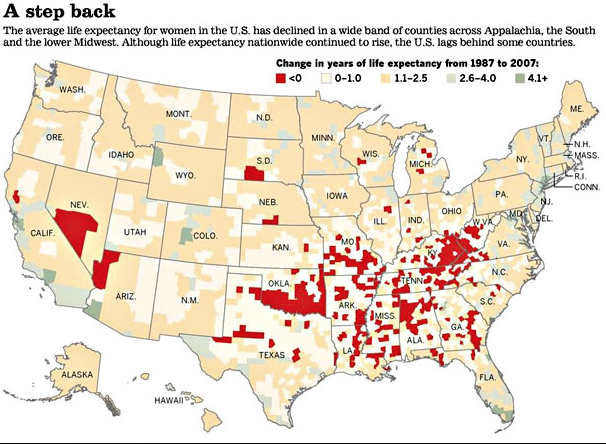
Since then more evidence of decreasing life expectancy is dripping into the debate, especially in the US. One recent study suggests that based on data from 2008, the latest available, life expectancy in the U.S. fell 36.5 days from 2007 to 77.8 years.
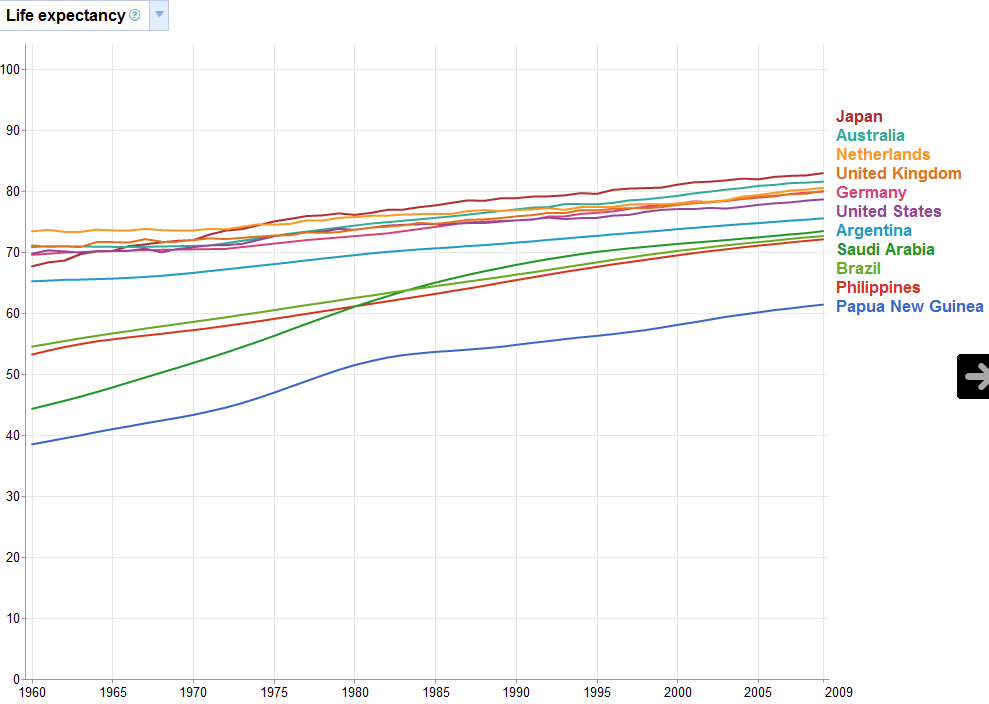
But the overall picture still looks very good. The below graph compares the growth in life expectancy in a selection of countries.
In Australia, life expectancy continues to grow, but there appears to be no similar geographical disaggregation studies showing the divergence between urban and rural life expectancy. The data below shows that men have gained 3.1 year of life expectancy at birth in the past decade, while women have gained 2.1 years
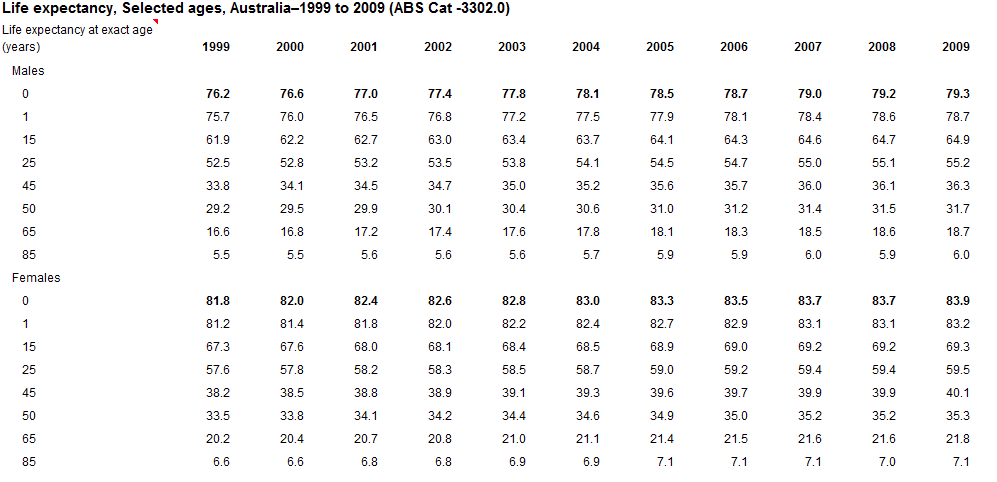
For me, the surprising thing in these data tables is that our life expectancy at birth is rising mostly due to the prevention of death earlier in life, not the extension of old age. If you make it to 85, you have only gained six months of extra life expectancy over the decade – around a quarter of what you gained at birth (one fifth for men).
The other trend of note is that men are catching up to women in the life expectancy at birth. Again, this concurs with the observation that early preventable deaths are being reduced, as risk taking behaviour is disproportionally male.
A couple of questions spring to mind. First, will the rising trend in life expectance continue in the rest of the world? And is it possible that people compensating for improved medical care by being less vigilant about their health or taking more health risks?
When I watch extreme sports I often think that it could be a sign that we as a society have made life so risk-free that people need to compensate by pushing themselves near the limit. I would classify this type of risk as low probability but high impact. Usually, we tightly regulate these types of risks, with seatbelts, helmets, fire alarms and other safety guidelines.
My suspicion is we have removed many high impact low probability risks only to compensated this loss of risk by taking on another type of risk with high probability, but low, or distant, impacts (in addition to the extreme sports variety of compensation).
Poor diet, bad exercise habits, and exempts of this second type of risk. Smoking laws in Australia are probably the stand out example of regulation in this area, but even with all the well intentioned rules, they are the easiest risks to substitute for others. For example, a former smoker might find that chomping down a bit of chocolate is a good substitute for their addictive habit.
As a general trend we might be avoiding high impact risks by unknowingly substituting for low impact risks. Parents need to be especially aware of this. For example, cycling appears to be dangerous because of the need to wear helmets, so parent might be less inclined to encourage cycling. The same goes with sports where there is a perception of high risk, such as rugby or Aussie rules football. Even the most basic of actions such as walking to school is often seen through the high risk lens (due to the low probability of abduction) and a generation used to being dropped at the gate may be less likely to walk later in life, which is a risk itself.
I have no definitive answer to either question. My gut feeling is that medical breakthroughs will stay one step ahead of any compensatory behaviour, and that life expectancy will creep up ever so slowly. I also feel that life expectancies between countries will continue to converge. But I will be on the lookout for more evidence of a peak in life expectancy elsewhere, and should we see this case arising more frequently, I believe that the theory of compensatory behaviour will need serious investigation.


Given that the US life expectancy is well below everybody else in the OECD, this seems like a reasonable explanation.
Biotech, biotech, biotech, will keep us on the way up, albeit more slowly with increasing inequality, etc.
I think a lot of America’s health, social and political problems result directly and indirectly from being so dependent on automobiles and the fact that most people live far from the place they work, shop, recreate and have social interaction. Car ownership is a must for most Americans, those without cars in many areas are second class citizens incapable of fully functioning in or taking advantage of society. This is especially true of older people, kids and people who cannot afford cars. Solve this problem, and people’s health would improve. More likely, the price of oil will “solve” the problem anyway whether Americans want it or not.
Absolutely. When you consider a pack of cigarettes weights a couple of ounces, but a tank of gas a couple hundred pounds, then you wonder why the oil companies and car manufacturer’s aren’t hit with lawsuits the the tobacco companies.
It’s not like it’s all filtered out… the car doesn’t gain weight. Some is catylized but the cause of that black snow you see on the side of the road is present even when it’s not snowing.
What this shows is that countries which have increased access to affordable healthcare have increased their life expectancies.
The US medical system is among the most expensive in the world, therefore less people are able to afford access to it, therefore more of them die untreated.
Control your doctors and hospitals, and life expectancy will magically rise.
Yes and no. Health care access is one of many factors. Nutrition matters, environmental toxins matter etc.
However articles like this are mostly worthless and laughably misleading because they make a common and very big mistake: they talk about «life expectancy» as if it was a well defined and useful singular concept.
Instead it is not. So by default they talk about one specific but by itself not very useful concept, which is expected (average) years to death at AGE ZERO. There are some big problems with this concept:
* Age zero average remaining lifetime is dominated by infant mortality rates. Because death has 2-3 peaks (ages 0-4, ages 16-22, ages 60 and above).
* Averages are as a rule a not very useful summary of a distribution unless it is single-peak quasi-normal, and age of death is not like that. The median is a much better guide.
* It is far more useful to talks separate about the first 2-3 peaks ages of death after age zero, age 16 and age 60.
In particular most people implicitly consider age of death after 60 as “average life length”, because most people see most other people live until 60, that is “adult” mortality rates.
What really is affected by health care access are infant mortality rates, because birth complications are fairly frequent.
The lowered «life expectancy» in several areas of the USA is due mostly to higher and increasing infant mortality rates (both at birth and the years thereafter) areas where there is a high density of poor minorities.
In practice there are largish stains of third world throughout the USA. In the USA winners WIN, losers LOSE (usually well beyond the seventh generation).
PS A good proxy for post-childhood general health is height. There is a historian who has done very extensive work on this subject, which is very enlightening (can’t remember the name).
BTW YvesS’ comments as to this:
«It was also striking that the author was unaware of how big a role infant and childhood mortality plays in life expectancy. I mentioned my father’s genealogy yesterday. He found that his 18th century ancestors lived on average well into their 80s. It seems that if you made it to, say, 10, you had very good odds back then of living to a ripe old age.»
should have been much more emphatic because an article about demographics that does not take into account infant mortality rates seems to me mostly useless or misleading.
Again, the big story about the areas highlighted above is that there are several areas in the USA with third-world infant mortality rates, and things are getting worse. Let’s see if I can find a link.
Found several, the highly sanitized executive summary is here:
http://www.cdc.gov/nchs/data/databriefs/db09.htm
The translation is simply that in the USA there are WINNERS who matter and LOSERS that don’t matter.
It is the Southern plantation model, the Brazil model, the headquarterization model, that are endorsed by most Real American voters (who think they will be plantation masters, not plantation serfs).
I’ve mentioned this before, but for more about the relationships between socio-economic status (differences), stress, and longevity, see Sapolsky’s Why Zebras don’t get Ulcers or Michael Marmot’s The Status Syndrome: How Social Standing Affects Our Health and Longevity. Both are quite readable, as well as very worthwhile.
To quote a bit from the descriptions, which are fairly informative:
But they do not have, as the Whitehall II studies demonstrated, control over their lives — the power to live as they want. The lower that people stand in the hierarchy, the less they have a sense of controlling their own destiny.
Bingo! Once the poor at least had their farms to fall back on but now what? A shrinking public commons? A safety net the bankers are busy trying to destroy?
And yet the rich proceed in their self-righteousness convinced that (admittedly flawed) attempts to help the poor are the problem instead of systematic oppression (mostly via banking).
Some of that stress is due very specifically to the fear of no health-expenses coverage if one suffers high health-care expenses. Medicare lowers that fear for people who live long enough to reach Medicare. Obama very specifically conspired against any form of “public option”, let alone a genuine personal free-choice medicare-buy-in at any age precisely in order to keep people in that state of fear. His “forced mandate” is designed to trap millions of people into forced-premium-servitude for no-guarantee-of-genuine-coverage-whatsoever on the Private Insurance Plantation. Furthermore, Obama wants to destroy Medicare as a safe harbor we can hope to age into. That is why he unilaterally offered to raise the eligibility age in his conspiratorial “negotiations” with his social class comrade Boehner. It was his hoped-for first step in his long-range plan to destroy Medicare enough that his Republican co-conspirators can then privatise and profitise the wreckage and we can all pay the forced mandate slavery-premiums till we die. Probably through refusal-of-coverage by the same insurance companies Obama conspired to put into such a total position of life-and-death power.
This phenomenon is illustrated in a National Geographic episode, “Stress:Portrait of a Killer” which is available on Netflix instant. The special shows that social hierarchy dictates well-being even among primates, with very dramatic and compelling information.
it is primarily Dr Sapolsky’s work that is featured, but he mentions Marmot’s also.
The whole anti-obesity meme really bugs me and I regret seeing it here. A variety of things are behind it, such as the ever-fattening diet industry (which would go out of business if their recommendations actually worked), the fact that it is taboo to consider that higher weight can be anything but bad (in fact it is protective in many health-risk scenarios, but not all of them), and also a powerful societal scapegoat. Additionally it is a gun aimed almost exclusively at the lower classes. Thinness is glorified but in fact underweight has a much more negative health impact than overweight… Yet that is never mentioned. “The Diet Myth” by Paul Campos is just one excellent book that puts the lie to the anti-obesity marketing. And yes, it is just marketing.
Wendy I couldn’t agree more with you. I would also add that we are being slowing poisoned by PhRMA. And the biggest one that is getting absolutely no press is gadolinium based contrasting agents(GBCAs) used for MRIs, MRAs and sometimes CT scans. Over 300 million doses of this highly toxic metal has been injected in the population and it is being found in all tissue and organs of those that have died from the new man-made disease. And it’s being found in the brain tumors of those exposed to GBCAs and in the reproductive organs of women of childbearing years. GE’s and Bayer’s products are the worst and they knew this stuff was toxic before it was approved by the FDA in 1993 and 1988 respectively. I think when exposed to these environmental toxins the body gets fat to protect the organs for being harmed.
«I think when exposed to these environmental toxins the body gets fat to protect the organs for being harmed.»
That’s an interesting idea.
BTW as to becoming fatter there is a fantastic natural experiment that has been happening since around 1990: second-world populations used to be on average quite slim, even if nobody starved.
Then after the fall of the USSR they have steadily become fatter, to the point that the Russian Federation government has been running campaigns about it.
It would be interesting to know if anybody has had a long look at the pre-1990 and post-1990 situations and figured what triggered the fattening of Russian Federation citizens.
There are also a number of non-starving, yet thin-body countries still around the world, it would be interesting to figure out what’s the difference there.
I personally favour stress leading to emotional eating as the most common cause (and additives and chemicals as the second), but time (for the USSR) and country comparative studies would be interesting to see.
This may be a bit personal but after losing 25lbs during and after I became severely disabled. The abnormal fat cells (IMO) were releasing gadolinium stored in them. I’m totally disabled now and even though I’ve gained the weight back I’m totally disabled and may die from this disease as it continues to progress so yes from experience I would say that toxins are stored in fat cells and that the fat protects the organs by keeping them stored. I’m sick now but have been undergoing heavy metal chelation but I have been diagnosed with systemic fibrosis which is very serious.
If I Recall Sapolsky correctly, there is a fairly even tripartite split between people who eat more while stressed, less while stressed, and people who eat the same. It could hold for the subset, though. ;)
As to what happened in the first-world and is happening in the second-world that triggered an obesity epidemic:
http://www.bakadesuyo.com/whats-the-cause-of-the-american-obesity-epide
The argument is that it is prepared food. For whatever reason, the continuous availability of ready-made food means that people just eat more.
Wow. I am so sorry to hear your story and wish you the best in managing your health.
I hear you about PHRMA and the developments coming out about so much liver damage risk are alarming to me, but I have never heard of gadolinium or GBCA’s. How was it that you were able to learn of this and pinpoint it as the cause of your illness?
If one has to get such imaging for genuine unavoidable medical reasons, could one lower the gadolinium load in one’s body if one immediately took a round of chelation therapy?
I had written a reporter about proteomics as a diagnostic tool and how it was being suppressed. I’m high risk for breast and ovarian cancer and there was a new test called Ovacheck that was effectively suppressed by the FDA and the NIH as well as Congressional testimony regarding conflicts of interest at the NIH.
http://www.correlogic.com/newsandevents/congressional.php
He had written the story about GE’s product Omniscan and I had had several MRIs with GBCAs. It causes a new man-made disease called nephrogenic systemic fibrosis but the kidney don’t cause it gadolinium does. I was having trouble walking at the time and mentioned that in my email (muscle weakness and stiffness is a classic sign) and he kept writing back and writing back so I went to check on the type used for me and it was Omniscan. I read the articles again and again and at that point I knew I had the disease but was denied medical care or a diagnosis because they said it could only happen if you had kidney disease which I did not. It’s unfortunately the way they PhRMA gets away with mass poisoning with impunity. They say you don’t have it, call it something else or refuse a diagnosis but I was persistent. Below are two links to rulings by the judge in the now stalled MDL 1909. Although written in legalese they offer the best explanation about what is going on. Keep in mind that you do not need to have kidney disease to get this disease and of each dose 1% stays in the body. You only need one dose to get the disease but the accumulation of gadolinium is also worrisome. It is nephrotoxic, neurotoxic and a known carcinogen and why it was ever put on the market is beyond comprehensible.
Judge Polster’s ruling on expert witness testimony
http://www.propublica.org/documents/item/ohio-judges-ruling-on-ge-omniscan-evidence
Robbie Booker v. GEHC motion for punitive damages
http://www.propublica.org/documents/item/robbie-booker-v-general-electric-041510#document/p4/a2
Rumor has it that GE is lowballing all the plaintiffs cases brought against them and the judge is refusing to remand any of the cases back to state court for trial where GE would have a lot of explaining to do. The victims and their families will have to settle for less than what it has already cost them and many have died waiting for settlements. The fatal outcome in most of these cases ensures that GE will get away with murder. The FDA has issued a black box warning on all of the GBCAs but this stuff is still on the market and people are still getting injured.
different clue I am trying clelation however they haven’t found a strong enough clelator for gadolinium. Some of the chelates have a preference for zinc and iron.
Incidentally this is why some became very ill rather quickly because the chelate used for Bayer’s product Magnevist and GE’s product Omniscan had a preference for iron and zinc and would leave the gadolinium and bind to the iron and zinc leaving the gadolinium in the body in its free state which is toxic.
Sharon,
Thanks for that warning wrt gadolinium and I am sorry about your condition. I pray a safe way will be found to remove it or at least detoxify it.
Sometimes I think Americans (the non-rich ones that is) are mostly experimental subjects (at their own expense) to advance medical knowledge for the benefit of those who have many reasons to fear death.
I feared cancer and for that I am sorry. I had a Cadillac healthcare plan and was not poor so a likely target of the predatory healthcare paradigm.
What I would like to know is:
1. Who is responsible for paying for the negative externalities of PhRMA?
2. Health insurance companies can’t kick the sick and dying off their rolls, can’t deny you a policy for pre-existing conditions and can’t limit your lifetime benefits so how will they remain an on-going concern?
3. Will policy holders have to pick up the cost through ever increasing health insurance premiums?
4. How will companies that self-insure manage the high cost of PhRMA’s mistakes or for that matter the healthcare fallout from GMOs?
But yes you are correct the poor are used as guinea pigs.
As to “stress” a certain bearded German philosopher economist wrote a lot about “alienation”, but that guy has become the one whose name must never be said…
As to obesity it may not have particularly bad direct health effects with respect to “average”, but it is still a terrible idea, as it leads to a pretty miserable life. Also being thin seems to lead to better health than being “average” or obese.
Obesity should not be encouraged or condoned, any more than alcoholism or lack of education should. They are all lifestyle alternatives, and anybody can choose what they want, but broadly speaking they are not positive.
To quote a little bit from David Graeber’s upcoming Revolutions in Reverse:
+1000. Awesome quote, awesome foreshadowing, particularly as we find ourselves in the grip of inhuman forces, and those wo have sold themselves to those forces.
Blissex, I enjoyed reading your obviously informed comments above about death rates and ages, but this comment is just not accurate.
Contrary to your suggestion, optimal health is not found in “thin” people, it is actually found in those deemed “overweight” by BMI charts. “Thin” people (by BMI measures) have worse health – not only more disease, but worse outcomes as compared to average and overweight disease-sufferers. It only “seems” (your term) that being thin leads to better health, because that is the constant propaganda we are exposed to. There is a current but illegitimate moral panic about obesity.
Your suggestion that obesity is a “terrible idea” is a bit insensitive. Believe me, no one has the idea to go out and be obese. It is highly stigmatized in this culture; people pay dearly for being heavy. But, there is literally no known way to safely reduce from obese to non-obese, permanently or even long-term. Intentional weight reduction fails 95-99% of the time. Additionally, health conditions are worsened by regaining lost weight, than in those who never lost weight. Weight regain occurs 95-99% 0f the time. So recommending intentional weight loss for health reasons is recommending doing something that is 95-99% likely to WORSEN those health conditions. That is what not should not be condoned.
I don’t disagree that obesity should not be encouraged, that’s fair enough, but it should also not be shamed. In fact the encouragement should be towards better HEALTH, regardless of weight. We can be healthy, and healthier, at more than one magical weight number. The choices that get us healthier are what should be encouraged, and choices that lead to poor health discouraged, but not particular weights.
If you look at weight charts for the US population, they’ve moved upwards over the decades. And I mean in terms of what is considered “normal” and “healthy.
We now have an epidemic of diabetes. That is due to a combination of overeating and overconsumption of high glycemic index foods.
BMI measures do not differentiate between a person who is heavy because he is muscular versus fat. I suspect there is a difference in terms of health outcomes.
And you have quality of life issues. Overweight people are loading their joints more and therefore will have more and more severe orthopedic problems, for instance.
Your assertion also does not square with a large number of animal studies, which find that severe calorie restriction (60% of “normal” calorie consumption) produces healthy animals who age much more slowly than their peers. They are in fact MORE lively and score better on health indicators than their better fed peers.
Wendy, I’m sorry, but obesity leads to a shorter, unheathier life. It’s just an fact. It doesn’t care whether you believe it or not, or whether or not you fiind it inconvenient.
There is a very interesting “dissident theory” to the effect that obesity is caused by chronic overexposure to carbohydrates specifically. I have read some interesting-seeming books about this though I don’t have the scientific background to know whether “seeming plausible” makes them true and useful. So I would just say they are worth reading
and might be worth experimentally applying for a while in one’s own life. One such book is “Good Calories Bad Calories” by Gary Taubes. http://www.amazon.com/Good-Calories-Bad-Challenging-Conventional/dp/1400040787
Here is another called Why We Get Fat And What To Do About It. http://www.amazon.com/Why-We-Get-Fat-About/dp/0307272702
I would note that some “unplanned” experiments have been run on some of America’s Captive Nations . . . Pima, Hawaiian, others. After Conquest and Dominant Society Control; they were taken off their traditional high fiber/ high-protein-I-believe/ lowish carbohydrate diets and put on a diet of high or very high starch and sugar inputs. And they have some of the world’s highest obesity and diabetes rates today. I believe I also read that the Yemeni Jews in Yemen had very low rates of obesity/diabetes but when they went to Israel their rates of obesity/diabetes have gone up. If my memory is correct on that then there is a lesson somewhere in that on the obesigenic/diabetegenic nature of high “gigl” (glycemic index-glycemic load) food intake.
Obesity may be a symptom of multi-hormonal-system derangement produced by the modern industrial shitfood diet.
YS: the Nurses Health Study showed extremely high morbidity in the underweight group (BMI<18). I agree with you that BMI is not reliable but this is the only weight/leanness measure used. Lowest morbidity was seen in the normal (BMI 20-25) and overweight (BMI 26-30) groups.
This has been observed elsewhere. See, e.g., http://www.nutritionj.com/content/10/1/9. It is even sometimes referred to as the obesity paradox – overweight and obese persons have better survival of many diseases.
Type 2 Diabetes… has increased over decades but is pretty stable in the US over the past 20 years, ranging from 8.2%-8.6% (up AND down) over this period. Incidence of this disease is 70% attributable to aging according to the NIH. It is also a largely hereditary disease. Obesity may be an early symptom, and/or may reflect poor diet and sedentary lifestyle which may themselves be causes.
There are numerous reports of higher health-risk and mortality among lower BMI persons. I recognize that this conflicts with the animal studies to which you refer, but there are no studies with those results for humans. The CRON camp is essentially running its own non-scientific study. The NIH recently sponsored a study of the effects of CRON, however it will not be available for at least another year, and then would only be preliminary. Even so, it will be interesting to see what it shows. I have seen it suggested that low food intake may trigger animal activity designed to find food. This would explain liveliness.
Sock Puppet, please cite a fact in support of your statement. The data shows otherwise.
Wendy, thank you for writing that. You saved me from having to make the same points, but not as well.
One thing I’d add: I think there is a big difference between how men and women are affected by “excess” weight. Although I read loads of Science Daily articles re weight and health, this is anecdotal: from what I see, skinny men live long, and chubby women live long. Perhaps it is hormonal. Perhaps it is because the skinny men were never fat (and so never lost fat, and thereby released stored toxins into their bloodstreams).
When I look at photos of my female forebears, I see a lot of Yankee and E. European dumplings. they lived long lives, and none of them developed osteoporosis. They were physically active, and I think that mattered most of all.
Yves: one problem with those animal sutdies is that the animals aren’t really doing all that much. Sure, hamsters and mice run in wheels a lot, but that’s hardly comparable to normal functioning, since they are basically also leading sedentary lives.
Wendy, here’s just one of dozens: http://www.lancet.com/journals/lancet/article/PIIS0140-6736(09)60318-4/fulltext
Wendy,
I read both the links you posted. I couldn’t see where either link said that being overweight, much less obese, led to healthier outcomes. Granted, the Nurses Study cited an increased mortality at BMI < 18, but do you realize just how thin this is? And a BMI < 18 might include BMI = 17 or a BMI = 14, which might found in somebody who was anorexic or malnourished. For point of reference of BMI < 18, that would equate to less than 110 lbs. at 5'5" or less than 135 lbs. at 6'0". "Overweight" refers to those who have a BMI between 25 and 30, which would be a weight of less than 180 at 5'5" and 220 at 6'0". Weight distribution is also important, those who carry their weight around their middle are more likely to develop cardiovascular and diabetic disease. The second study only pointed out that it was less healthy to lose and regain weight, which as another poster mentioned is what most often happens, than to maintain current weight. It was not stating that a person with excess weight was healthier that somebody without.
I understand this is a sensitive subject and I hope I'm not sounding moralistic, that isn't my intent. I understand that weight control for some people is a real uphill challenge and I'm not being judgmental or making light of that. Nobody would choose a condition that causes the kind of negative reactions that obesity does. I only think that it is important not to spread misinformation. I have worked in nursing for over 30 years and both watched people struggle with their weight, typically unsuccessfully (though not always) as well as deal with the medical problems associated with the weight. I think that you would be hardpressed to find anyone in the medical profession who would say that being overweight confers benefits to one's health, or deny that when those who are obese have more difficult recoveries when they become seriously ill or require major surgery. In addition, I've known patients who have lost weight and kept it off who have been able to reverse diabetes type II, hypertension, and hyperlipidemia, including hypercholesterolemia, and no longer need medication.
Sharon,
Has EDTA chelation been effective in getting rid of the gadolinium?
If the efficacy of EDTA has plateaued, which I suspect may be the case, then I may have something that may work. you can get hold of me clonalantibody at gmail
Thanks I’ll try and email. I’m doing a multi-pronged approach.
Also anyone wanting more information can reach me at shha2002 at yahoo.com
You will also enjoy: “Rethinking Aging”, by Nortin Hadler if you aren’t already familiar with him.
I suspect that one could construct a pretty good formula expressing life expectancy as a function of real GDP/cap and the Gini index, with an additional variable from a constant ‘base’ level of wealth. The US’ high Gini would explain its lagging position in the OECD; I believe Greece has a lower Gini.
Being healthy in our society is expensive. You need a good health insurance, you have to exercise, you have to eat a health diet and need a job that doesn’t damage your health.
With 40-50 million people uninsured, our very high unemployment and underemployment exercise gyms are way too expensive and require certain state of mind, our eating habit are improving but are still terrible. Most of us have short vacations, work uncompensated long hours in a stress filled work place.
It’s not just childhood obesity.
I disagree. Health is cheap, relative health care.
“Being healthy in this society is expensive ”
Still cheaper than being sick.
But emergency care is still free. Preventive care (and this includes a healthy diet) is obviously preferable, but unaffordable for many.
So are cigarettes, booze, and lottery tickets
Sorry, but how is that comparable to paying 800+$/mo in hc premiums?
I agree that health care is expensive. Relatively speaking, healthy living is cheap.
I’ve always wondered about the historical figures once you strip out infant mortality.
I often come across assertions that living to, say, fifty years made you an old man in the 16th century. But the wealthy commonly hit their 70s and 80s.
I often come across assertions that living to, say, fifty years made you an old man in the 16th century. But the wealthy commonly hit their 70s and 80s. shtove
That sounds true. The wealthy have the luxury of deciding if, when, where, how and for how long they will work. I imagine that makes them very efficient at preserving their health.
But even a poor, hardworking farmer might have a long life because of the dignity of being his own master.
The LORD enters into judgment with the elders and princes of His people, “It is you who have devoured the vineyard; the plunder of the poor is in your houses. What do you mean by crushing My people and grinding the face of the poor?”
Declares the Lord GOD of hosts. Isaiah 3:14-16 New American Standard Bible (NASB)
Too bad Progressives don’t know the Bible; they could throw the “Book” at the “Religious” Right.
I guess the problem is the further back you go the more the data are confined to the wealthy.
You might have sample bias (Mozart was buried in a pauper’s grave) but you would be surprised what you can learn from church records.
In the UK deaths and births have been required to be registered since 1837. in the US its typically from teh 1870s on depending on the state. If one wanders over to genealogy sites much info is available there ranging from census records since 1790 in the US. Further of course are church records. This type of work involves lots of reading microfiche and microfilms, and IMHO could provide work for high school students. So the information is there its just not been put in nice bundle.
The main thing it would show is the decline in infection disease even in adults (for example 1 great grandfather died in 1916 at about 50 of scarlet fever).
Actually, many progressive/liberal/commie people know the Bible.
Unlike conservatives, however, we seem a great deal more reluctant than to claim to know the mind of God, and use the Bible as a weapon to thump other people with.
Also unlike conservatives, our inspiration is taken from the teachings of Jesus, rather than the apocalyptic writings of the Old Testament and Revelations.
You neglect that Jesus firmly upheld the authority of the Old Testament while also claiming authority to interpret it properly.
Yes, Jesus fulfilled the Old Testament Law and we (Christians) are no longer under it but under Grace. Still, the Old Testament remains a guide for what is right and wrong. That has not changed.
No disagreement here.
I was just pointing out that conservative Christians have a tendency to obsess on the apocalyptic portions of the Bible, while blithely footnoting the teachings of the Messiah. I work with a couple and I know where their minds and souls are.
The failure is not in Christianity, but in Christians.
OK, I see your point. They are gazing up at the sky ala Acts 1:11 when they should be concerned with justice, kindness and walking humbly before the Lord (Micah 6:8).
Very true.
Idaho Spud, I’ll have to take your word for the claim that there are progressive/commie types that know the bible. I’ve never met one who did, and I’m around loads of them. Perhaps it’s a regional thing.
I was raised by liberals who snickered at religion, so (although I’m an atheist) I’m now trying to learn a bit.
«living to, say, fifty years made you an old man in the 16th century. But the wealthy commonly hit their 70s and 80s.»
The issue as per my earlier comment is that the notion of «life expectancy» as commonly misunderstood and misused is heavily influenced by infant mortality rates as it is an average on a multimodal distribution of ages of death.
So in the 16th century a «life expectancy» of 50 almost entirely meant that lots of children died. Indeed it was common to see women have 10-15 pregnancies, with some miscarriages, 8-12 children born live, and 30-50% of them dead before 20, with only 4-8 of the 10-25 pregnancies resulting in live adults. Who then often lived well beyond 50.
In centuries past the rich did not live much longer than the poor, but were much taller. The guy who did human height historical studies reports that in the 18th century English army officers (from rich families) were at 6 feet around 1-2 feet taller than soldiers (from poor familiar) who were mostly 4-5 feet tall. This was not mostly because of genetics. Just like current Japanese and Korean and Chinese young people being on average much taller than their parents or grandparents.
The enormous decrease in infant mortality rates in the past 50-100 years (and accompanying expansion of the fertile period of women) is one of the 2-3 most profound changes in human history, with vast consequences like like making first stage feminism possible, and is widely underestimated.
Among the British at least the differences in size and strength between the middle/upper classes and the poor may have persisted long after the 18th century. You can read WW I accounts of enlisted men hanging on to officers in order to finish long marches, and officers being sent out to carry in enlisted men who had collapsed along the way. Some of that may have resulted from the heavy loads enlisted men carried but it seems as though the officers had superior endurance.
My long lived ancestors weren’t wealthy. In fact, they did pretty hard physical work (remember, housekeeping back then was hard, imagine how much effort it took to curn your own butter or clean clothes with no washing machines) until they were pretty old. And they lived to be quite old.
I once read that pretty much all of the increase in lifespan could be attributed to better hygiene and diet. Someone living in coastal Maine would have a good diet by modern standards. Of course, America was the wealthiest of the British colonies and (ex slavery) less class stratified. So the disparity between the diets of the rich and poor was probably less marked here.
In the past diet disparity between rich and poor in first-world nations did not make the rich healthier, but taller and sicker.
The greater use of status foods like red meat and white flour by the rich implied more protein boosting height in adolescence and poorer nutrition during middle age leading to epidemics of gout and apoplexy in old age.
“Public health has had a greater impact than medicine on the health of populations. For example, since the turn of the 20th century, the average life expectancy of Americans has increased by 30 years from 47.3 to 77.3 years. Of this increase, 25 years can be attributed to improvements in public health and only five years can be attributed to improvements in the medical care system.” (Aschengrau & Seage III, Essentials of Epidemiology, Jones and Bartlett Publishers, 2008) These authors base their claim for years attributable to public health versus medicine on research by Bunker, JP, Frazier, HS, Mosteller F. Improving health: measuring effects of medical care. MilbankQ. 1994; 72:225-258.
Public health has to do with disease and health determinants in human populations and not clinical procedures on an individual per se.
Assuming these authors to be right, maybe what we’re overdue to recognize is that extending life and greater health really isn’t simply about insurance for all and access to the medical care system (because afterall hospitals DO screw up many procedures and make people worse off with regularity even supposing well-intentioned staff). What we require is protecting the population from unhealthy exposures and giving babies, children, adults the maximum opportunity to be well. This would include ability to control environment better, not being victimized by inequality. It would mean protecting from undue takeover, captivity or influence. It would allow comparative effectiveness research and dissemination to the public.
The reason for your ancestor’s longevity was probably clean water supply. The early mortality in VA was huge, especially in newly arrived indentured servants, due to swampy conditions and contaminated water.
One corollary is the enormous alcohol intake per capita for all the colonies. I don’t remember the source, but I’ve seen a quantitative estimate that implies they got a little tipsy every day. There’s a passage in one of Wm Byrd’s diaries describing a visit to one of the Randolph plantations. He implies in his uniquely condescending way that the hostess was somewhat disorganized because she had run out of wine, and they were forced to drink water with the meal.
A related factoid is that London was a sink for population before the 19th Cent and depended on migration to keep the numbers up. The Broad Street Pump episode is the beginning of epidemiology, and that was in the 1850’s. It depended on a smart doc noticing that a cholera epidemic centered on a public pump, inferring that water was the problem and tracking down the cases to show that they were all exposed.
Most of the increased life expectancy in the West has been from public health measures. Only about 10-20% from medical advances. Flexner guessed that only around 1900 die an average patient with an average complaint seeing an average physician have a greater than 50% chance of being helped.
what else would you expect, with the earths air and water being used as test tubes for admixtures of thousands of man-made chemicals, including over 3000 known carcinogens…
Oh those chemicals are much worse than you think. A friend who worked in agricultural research once told me she had seen that toxic pesticides used on apple tree are absorbed into the flesh of apples down to 1/2-1 inch, so washing them and peeling them helps but only partially.
Never mind as you say airborne and waterborne contaminants, and our general lack of resistance to man-made contaminants because we haven’t evolved yet.
But there is a much worse point, and it is about models of population dynamics. Most of them erroneously are based on simple minded prey-predator (people-food) mathematics, where the population has an S-shaped trajectory where the flattening happens when prey (food) capacity is reached.
But these models are wrong, because there are two limits to population growth, one being food production, and the other being waste production, as the population not only consumes food but also produces waste, something which is non negligible in closed systems. Most waste being useless or toxic and persistent, that is it accumulates.
Eventually waste accumulation leads not to an S-curve trend with a flattening after the peak, but to a precipitous decline of population after the peak, as the waste released into the environment by the population kills it off directly by poisoning its members or indirectly by poisoning or displacing food sources.
There is a crude qualitative description here:
http://en.wikipedia.org/wiki/Bacterial_growth
Note that population-food-waste models apply generally, and probably describe also what has happened to the financial system in the past 30 years: population being property speculators, food being credit, and waste being unrepayable debt (appropriately called “toxic”).
The drop in early mortality has changed the composition of who has kids (people who would have died earlier now live to grow up and have kids). In effect we have almost stopped selection as a tool of evolution (everyone survives). While this does bring more diversity to the gene pool, one can argue that this may also be weakening the gene pool, with an impact on overall mortality over time.
Some of the areas in which “life expectancy fell” seem to correspond with Indian reservations, but that’s just a guess.
Anyway, this would indicate that there are certain areas that are unhealthy to live in and living there leads to a shorter life expectancy.
This doesn’t seem to break the overall trend of an increasing live expectancy, though.
But this might be more due to the progress made in medicine. Nowadays, many illnesses are treatable that would have led to certain death a century ago.
So people don’t actually live longer, it’s just the average that’s moving higher.
Also, illnesses that involve dementia are on the rise, which also would indicate, that the human body has somehow reached the peak of how old it can get.
Of course, the insurance industry will continue to claim otherwise.
I was wondering about the red block in southwestern South Dakota. Then the above comment on Indian reservations explained it. It’s the Pine Ridge Reservation, the poorest county in the US.
Estimates suggest that about 3/4 of deaths are preventable through diet. A low calorie nutrient dense diet can not only raise average lifespan, but max lifespan as well (see google scholar for Calorie Restriction with Optimal Nutrition).
One wonders how much government subsidies of various sorts are inadvertently leading to premature deaths. If you can eat as much as you want and have someone else pay for the consequences, you will be less likely to take responsibility for your health. Farm subsidies make high fructose corn syrup and other processed food cheaper relative to whole foods.
DNA is vastly over rated as a factor, especially when compared to lifestyle choices. Unfortunately, those who believe people just “are the way they are” and impervient to incentives, keep trotting out more studies pointing to DNA, implying people to be incapable of determining the course of their lives and thus in need of a government parent.
Gene therapies will probably be very successful in the coming years and should bring the cost of therapy down. Especially stem cells. That’s the good part. But DNA is unpredictable and that’s the bad part. Sorry no cite except PBS special maybe 2 years ago: The Danes did a genealogical study over 3 or 4 generations to see what effect diet, either abundance or deprivation, had on the onset of diabetes. It turns out abundance wasn’t so hot. They found something happening akin to Lamarck and they concluded that the genes of the children in the abundant times immediately tried to adjust to their abundant wheat year by a small partial change in one specific chromosome which then caused significantly more diabetes in the generation of the grandchildren of the children who ate too much good bread. And pesticides were not a factor bec it was in the 1800s. Complex.
Quibble: Why call them lifestyle “choices”? They really aren’t for an enormous subset of people.
How so?
Well, for one thing, kids don’t get to choose what they eat, usually. I had a friend in high school (in the 70s) whose parents bought and fed her and her four siblings, nothing but junk food. I presume it primed their bodies in interesting ways.
Seeing their household, and how unhealthy everyone looked (the boys were actually stunted) made junk food rather less desirable to me.
But the parents could choose. Not trying to be facetious, but this is not getting fixed from the top down.
It is quite astonishing to see how unrealistic people get as soon as you trot out a topic in which “personal responsibility” might play a role..
If we want people to be able to buy high quality nutri-dense shinolafood, we have to get them enough money to buy it one way or another. Those people who only have enough money to buy high-GIGL (high Glycemic Index Glycemic Load) shitfood will buy that because that is all they have enough money to buy. Lecturing them about their bad choices is Marie Antoinettish, to say the least; and probably psycho-torturously sadistic as well.
” although the US is a much richer country than, say, Greece, Americans on average have a lower life expectancy than Greeks.” That’s the price you chaps pay for excessive dental treatment.
Slide show obesity with time by state http://www.cdc.gov/obesity/data/trends.html
County data maps life expectancy pretty well
http://apps.nccd.cdc.gov/DDT_STRS2/NationalDiabetesPrevalenceEstimates.aspx?mode=OBS
Food stamp map tracks well too
http://www.nytimes.com/interactive/2009/11/28/us/20091128-foodstamps.html
Here’s a great source of demographic maps:
http://www.censusscope.org/us/map_common_race.html
For anyone who hasn’t seen it yet, this is a very clear TED talk on the relationship between inequality and health:
http://www.ted.com/talks/richard_wilkinson.html
Hi Yves:
We do wear out after a period of time. I suspect how quickly we wear out could be based upon life style, income, and diet. To answer your first statement, obesity in the is generation of children has led to an expected lowering of longevity in the US. This is the first time that one US generation will not out live the preceding generation. Diabetes is one of the fastest growing disorder plaguing the population of the US. Why???
Saletan at Slate had argued against the a law being passed in LA which had restricted the numbers of fast food restaurants in one section of the city. Never mind there was a fast food restaurant within walking distance for the residents of this particular section of LA or that there was one fast food restaurant for every 1300 residents. Cheaper, fattier, and less healthier foods are more readily available today and/or in lower income areas than ever before and this trend is growing overseas as well. The convenience of fast food impacts not only low income; but, it has also becomes a matter of convenience for high incomes as well. Quality of food and the availability of quality food are issues.
We walk less and do less manual labor than our babyboomer predecessors. With the advent of suburbs outside of the cities and the two income families to make ends meet, we find ourselves driving more than we do taking busses, trains, or walking to work. People and industry moved out of the cities. The work level for many of us confines us to our desks for numerous hours. At the other end of the spectrum the lower incomes still face long and hard hours doing manual labor in order to meet the needs of a family. Income has stagnated for much of the population requiring a two earner income. The numbers of people within the Civilian Labor Force has decreased with the shift of emphasis from labor intensive investments to investments that are little more than gambling producing greater gains. Productivity gains have shifted away from labor to capital since the eighties
The healthcare model is still services for fees which is heavily skewed towards specialties rather than preventative care. This has to be changed to a better outcomes for fees with a heavy emphasis on preventative healthcare. While the ACA is not the shining beacon we could have had, it is a start in the right direction. The access to healthcare is still limited to those who have jobs and who also can afford it.
Briefly, all three of these factors are having an impact on the health of the population. Sorry for the rambling, I am on the way to China again and had little time.
Gee wiz folks, the problem is poverty and the stress that goes with it. Instead, you do the PTB a favor by blaming everything else from chemicals to diet and who knows what else.
Being poor is expensive and to one’s health too.
And now folks can no longer claim that poverty in the US is only “relative”. It is literally killing people.
The United States has the highest obesity rate in the world, and the worst health. Within the most obese country, the poor have the highest obesity rate, yet the worst health. The US is the only country where the “poor” are obese. Btw, the poor in the US are in the top 5% of world wide income, so the argument fact that people are dying over the stress is beyond weak.
One commenter here a while back made the observation that all of the chemical tricks we use to beef up beef and pork up pork and maximize corn and soybean yields are also fattening us up on a metabolic level. And in addition, I have always thought that breathing polluted air also contributed to obesity because it certainly interacts with a body’s metabolic functions. I think it is perfectly reasonable to think that environmental pollutants are making us fat. One thing to remember is that the body stores toxins in the fat. So it is logical to assume that the more toxins there are, the fatter we are. There have been warnings over the years not to lose weight too fast because you can get liver damage.
so the argument fact that people are dying over the stress is beyond weak. HistorySquared
Baloney. Ever been poor yourself? Ever had to sleep in a car? Under a bridge? Think that that is not stressful in the US where being poor is virtually a crime?
If I had to be dirt poor, I would choose somewhere else other than the US.
Btw, the poor in the US are in the top 5% of world wide income, HistorySquared
And are their costs not also proportionally higher except for stuff imported from poor countries?
People try to judge poverty by comparing $ income levels – which is an incorrect comparison.
Let us take 2009 US poverty thresholds and look at how that income would be allocated to the various expenditures necessary to keep together the thread of life.
Note that these are threshold levels and poverty is below this threshold. So the money available for all the poor is at or below this level.
Single (below 65) – $11,000
family of 4 – $ 22,000
Take out $1500 in taxes for the single person, and $3000 in taxes for the family. Shelter is the first expense, that will take away at least $6000 for a single person, and $12,000 for the family (and these expenditures are more or less legislated into place!). Next transportation will take away $2000 for the single person, and $4000 for the family (this is assuming a vehicle plus public transit.) That leaves $1500 for the single person, and $3000 for the family to meet all the other expense. Assume no medical insurance for either.
No medical insurance generally means minor illnesses not taken care of, and/or treatment delayed for serious matters.
When you live hand to mouth like this, your stress levels are very high, especially when there are no emotional support systems in place.
Taking these factors into consideration, the assumption that The US poor are at the top 5% of world income levels is totally incorrect.
Let’s say most of the US population is corrupt and stupid. Well how did they get that way? Hmmm?
But blame the victims and ignore root causes, Mr. HistorySquared.
Right, Real Americans voters are not concerned with what happens to losers in Somalia, and being fair they are not concerned with what happens to losers in the USA either.
Or perhaps they are concerned, but in the same way the English were concerned about Irish losers in centuries past.
Here is an interesting gallery of cartoons about the English view of the Irish as exploitative and parasitical losers that summarizes current Real American voter attitudes:
http://irishstereotype.blogspot.com/2010/01/racism-anti-irish-cartoons.html
Note how most cartoons depict the Irish as obese lazy parasites who enjoy lavish party lifestyles by screwing tax money out of serious productive English workers.
There is an interesting set of quotations about English attitudes to the Irish here:
http://personal.georgiasouthern.edu/~jpellegr/teaching/irishhistory/02-angortamor.html
They are the same glorious attitudes of today’s Ronpaulistas and their friends in the Tea Party lobby. Some of them are of Irish descent.
Real Americans voters are not concerned with what happens to losers in Somalia, Blissex
You mean besides not envying them in some regards? Example: I have a nagging cough. It has lingered for weeks. In the past I could get 8 oz of Tussenex and refill it twice. That enabled my throat to heal.
But now it is difficult to get 1 oz out of doctors because they are scared to death of the DEA. Who caused that? Progressives?
Think I could not go to a drug store in Somalia and buy all the cough medicine I need without a prescription?
The “”war on drugs” caused that. Take your pick.
If your doctor is so afraid of the DEA he won’t write prescriptions for cough syrup, you need a new doctor. Or being will to accept that you have a doctor who will not give you narcotics under any circumstances. The problem isn’t physicians indiscriminately writing 100 prescriptions every day for cough syrup. It’s physicians who write 100 prescriptions for Oxycontin or Dilaudid the DEA is looking for.
If your doctor is so afraid of the DEA he won’t write prescriptions for cough syrup, you need a new doctor. LucyLulu
I’ve tried several. They are really very reluctant (but not to charge me for virtually no relief). Next time I will be very blunt if there is a next time
It’s physicians who write 100 prescriptions for Oxycontin … LucyLulu
Speaking of which, a friend of my brother’s died in agony from cancer because his doctor was being investigated by the DEA and was afraid to prescribe for him.
I have a solution. You reach 21 and you are considered an adult and for better or worse are allowed to make your own decisions wrt substances.
English -> Irish = Germans -> Greeks = Americans -> Blacks/mexicans/native americans/poor whites/muslims/1% or 99%, depending which you are
There is no moral high ground here.
I have read somewhere that constant stress induces the adrenal glands to secrete a constant surplus of cortisol, the so-called “stress hormone”. If the body marinates in a constant surplus of stress-induced excess cortisol, carbo-conversion to fat is increased and fat-storage is increased.
I can’t remember where I read that, but if it is correct, then the “steady stress kills over time” argument may in fact be rather strong.
Interesting. Re, the life expectancy map: looks like the so-called “Red States” are firmly in the red again, with blue collar Oklahoma appearing to lead the way (maybe all that youth football ain’t so good for you after all). What a coincidence. With respect to voting staunchly GOP and presumably in support of private sector solutions to public problems, I guess the old biblical admonition to “ask and you shall receive” applies here. Although, apparently one should be careful what one asks for as well.
The map actually shows three pretty obvious areas:
* red skin loser reservations in the west.
* dark skin loser reservations (rural areas) in the south.
* dark skin loser ghettos (urban areas) in the great lakes.
* light skin loser reservations (Appalachia) in the east.
Dark skin concentrations in urban areas outside the great lakes states are too small and too near to rich areas to show up on the map.
I wonder about the red spot in California. By location it seems a light skin loser reservation.
In all these “red” spots (and the wider “white” regions surrounding them where “life expectancy” has not improved) the story is the declinet of birth and pediatric care in poor areas.
The red spot in California would represent the Pomo Indian reservations in that area.
I imagine an income relatively poor person living in the jungles of Africa or Brazil might be quite happy living in a grass hut with others, and live a long healthy life. A better diet, community support, spirtual fullfillment etc.. compared to a city ghetto dweller living in relative inequality as the author states.
might be quite happy living in a grass hut with others, Dan G
I’ve heard otherwise. Apparently women EVERYWHERE including the Amazon jungle love washing machines. However, I did know a quaint gal from Indiana who preferred to hand wash dishes and use her dishwasher to store dry goods!
Several years ago I went with a group of students from Andrews University (a Seventh Day Adventist university) in Berrien County, Michigan on their Spring Break educational trip to an eco-tourism facility in upper Amazonian Peru. You can see/learn very little in just a week. But I did see that little village-loads of people were living up and down all the rivers, a little way up from the banks, growing their own food plus some food to sell in nearby market towns, etc. Nobody appeared to be starving or even malnourished. But the diet was fairly predictable . . . fish/ locally growable fruits-roots-tubers-leaves-stems.
On our last day out we spent a couple hours in Iquitos, including looking out from a high bluff out over the river.
Iquitos “proper” was behind and around us, and a huge vast floating slum village of shacks and shanties on rafts was spreading all over that part of the river. All those people had come in out of the riverside villages, enduring desperate slum poverty in Iquitos rather than admitting defeat and going back to the sufficiently fed boredom and changeless lives of the riverside villages. Or so it looked to me.
Genetically Modified Organisms (GMO’s) are not a choice for consumers in the US of Corporate America, high-fructose corn syrup is horrific, and Monsanto’s stranglehold and manipulation(GMO) of our food selections; mono-culture produce has impacted our lives. Unfortunately, Corporate America has selected our choices/diet. Including the abusive and inhumane treatment of corporatism livestock, undoubtedly translates into eating highly-stressed animals whose bio-chemical stressors probably is infused into the meat eaten. And impacting human bio-chemicals. Plus the feed of these animals is -ta da- GMO grains. You are what you eat; bio-chemical toxic-waste stressed meat.
Many countries refuse GMO products.
and we should too before we all get frankenfooded
Boulder, CO just banned them. I totally agree, GMO are bad for us. It’s my understand that Monsanto has GM their seed to make it resistant to RoundUp Ready herbicide and then the corporations spray the heck out of it and we injest the herbicide. This makes sense to me as to the “why” it’s not good for us.
Here is a site called GMO Watch. I haven’t looked deeply into it yet, but it may try keeping track of which foods are already Frankentaminated, and which foods are not yet Frankentaminated yet.
http://www.gmo-watch.com/
It is very interesting to see that the red zone in the center of the map corresponds to the “Trail of Tears that ended on the Oklahoma Texas border. Also it appears that many of the remaining red spots correspond to “Native Reservations.”
There are few histories of horror and vileness worse than the treatment inflicted to the red skinned “untermensch” who used to squat on the properties of USA taxpayers. However bad the dark skinned “untermensch” have had it, the red skins had it much worse, and unlike the dark skinned ones they are mostly forgotten. The consequences of the past viciousness against them still afflict both.
Australia has what is often referred to as the best health care system in the world. What distinguishes it from most others is that is is highly evidence-based. In other words, only practices that have proven benefits are utilized. However, it should be mentioned that in recent years Australia’s health insurance policies have been under pressure from the US State Department to lower its standards, this in order for American drug companies to be able to sell their useless drugs in the Australian market.
Regarding the declining life expectancy in the US, we all need to expect a lot more of that as neo-liberal policies continue to be implemented. This is similar to what occurred in Russia after the collapse of the Soviet Union, where similar post 1990 neo-liberal policies led to a dramatic drop in life expectancy.
For example, between 1926 and 1990, life expectancy for Russian males rose from 39 to 63 years. Between the same period, life expectancy for Russian females rose from 45 to 72 years. Interestingly, in 1966, for brief period Russian female life expectancy surpassed that of American females. However, as mentioned, immediately after 1990, life expectancy for Russians dropped precipitously, by almost 10 years.
So, my fellow Americans, now that your own neo-liberalism has been unleashed upon the homeland of the “free and the brave”, prepare yourselves for a similar outcome to that experienced by the Russians. But by all means, you just go right ahead and keep cheering “USA, USA, USA!”, as more of your friends and relatives lose their jobs, health insurance, and union membership. Repeat after me: “USA, USA, USA!” Keep repeating that. Practice makes it perfect!
In the above I forgot to provide a good link about the Russian health care system:
http://missinglink.ucsf.edu/lm/russia_guide/Russianhealth2.htm
It would be interesting to see how the poverty levels, life expectancy and medical care coverage stack up when comparing “native Australians” to the white population.
Canada appears to reflect the US in this regard.
Great point. I guess even Australia remains, at its core, the progeny of the British colonial system, built on oppressing and stealing from others.
They’re terrible. The aborigines only get money from the govt as long as they stay in the reservations, and get nothing as soon as they leave and try to integrate into the white society (for which they are woefully unprepared). As such, they can pick between subsidized alcoholism inside the camps (since there are no opportunities whatsoever near those things, given that they’re in the middle of nowhere), in they can become a poorer alcoholic/social pariah outside them.
Forcing Aussies to buy US Big PhRMA’s drugs?
Maybe that’s why Obama is going base all those US military personnel in Australia…. (Seriously, why the hell is he doing that? It’s so far from China it cannot be considered a message to that nation. Why?)
Australia is way closer to China than America is to China.
And Australia is right next to countries which are right next to China.
So perhaps our placement of marines in Northern Australia really is geo-strategic, at least at the visible message display level.
I was going to say: I wonder whether Yves Smith might invite Mark Ames to write something about the engineered reduction of life expectancy/ life span in late Soviet/post Soviet USSR-zone countries; and what light that might be shed on the engineered-lifespan-reduction stealth-effort currently under silent sneaky way here in this country. But you have partway beaten me to it.
The answer is really quite easy : the FDA kills US Citizens by the 100s of 1000s every year, and 10s of 1,000,000s around the world.
Most people now die of one of :
“Yes, research has found drugs for your disease and the 5 Big Pharmas all have drugs working through the FDA’s process, but it will be 10 years before the drugs hit the market. Hope you can wait”
“Yes, research has found drugs for your disease, but so few people have your disease that no company can afford the $200M cost of clinical trials, so too bad for you.”
“Yes, there are several natural substances that have been shown to cure your disease, and there are good reasons to believe several of them are synergistic, but a) natural substances can’t be patented so no drug company can afford to support the clinical trials and b) the FDA is biased against multi-drug treatments. Thus, your MD will never hear about the treatments.”
This should not surprise anyone : it is completely normal for regulatory agencies to produce the exact opposite of their charter. The FDA now kills many more people via obstructing the development and use of drugs than it saves via safe medicines. The Education establishment has adopted pedagogical methods and policies that cause 1/3rd of students to drop out of high school and to hate education, producing more permanent illiteracy than any group in history. The Fed was supposed to moderate the business cycle, …
Minimum government worked. Nothing but minimum government has worked over 50+ years.
We need to get back to the best technology of government yet invented, and to fix the Constitution to make it much harder for the gov to escape the Constitution in the future.
There is a lot of truth in what you say however it is more obvious than even you imagine. Take for example the fact that gadolinium bases contrasting agents (GBCA) are causing a new man-made disease called nephrogenic systemic fibrosis or more appropriately called gadolinium associated systemic fibrosis and over 300 million doses of this highly toxic heavy metal have been administered. And even though it causes death and dibilitating disease it is still on the market. The doctors refuse to diagnosis now saying that they have totally cleared up any new cases but I can assure you there are thousands if not millions of us out here that already are sick with very few understanding why. I call the FDA the Fatal Drug Approvers. I don’t think I believe in less regulation but I do believe that the government (us) needs to be cleaned up before they kill us all.
Sharon, everything from a MEDICAL website that I read says that this is only an issue if you were on dialysis or should have been before the MRI. Everything else is from a website run by a LAW FIRM. Just suggesting you do a little more googling before you sign anything.
>> “Yes, research has found drugs for your disease and the 5 Big Pharmas all have drugs working through the FDA’s process, but it will be 10 years before the drugs hit the market. Hope you can wait”
Astonishing claims. There are drugs to cure cancer and diabetes that the FDA is holding back? Links, please.
>> Minimum government worked. Nothing but minimum government has worked over 50+ years.
Please stop with the 19th century romanticism. How did the 1800’s work for anyone who wasn’t a white male robber baron?
Are you NUTS? Google “Eben Byers” and “Radithor” and we might have an intelligent conversation. Or read this:
http://www.cultofweird.com/medical/eben-byers-radithor-poisoning/
For profit healthcare -> poorer outcomes. It’s just a fact. It doesn’t care whether it fits with your ideolgy.
If one were forced to summarize in one sentence, what you said would cover much of the issue at hand today.
The good life isn’t measured by years.
Amen! How true. But only partly true. For a good life is lower stress/higher satisfaction, which is a healthier life, leading to a longer life. Conversely, a miserable life is likely to be shorter. Alas, we have all had to deal with curmudgeonly exceptions to this trend.
After reading a Mark Ames bit where he examined the use of the political phrase “tehnocrat”, and found it was a somewhat bland desciptor for the tainted phrase “Nazi” i forgot about it until i read this:
http://www.slate.com/articles/news_and_politics/politics/2011/11/pontiac_mich_can_a_technocrat_succeed_where_democracy_failed_.html
Im sure im behind the curve WRT austerity fascism, obviously the people of Michigan know all about this , but this looks like the future to me. Gaulieters from “freemarket” think tanks appointed to rule over us because “Democracy has failed”.
There is a good book that that deals with inequality and it’s effect on health and other issues as well.
The Spirit Level by Richard Wilkinson and Kate Pickett, a book published in hardback by Penguin in March 2009 and paperback in February 2010. An updated paperback version was published in November 2010.
The Spirit Level: Why Equality is Better for Everyone
There is an interesting site and blog that also addresses these issues I think thhe Spirit Level authors are involved with it as well
http://www.equalitytrust.org.uk/blog
http://www.equalitytrust.org.uk/why
A couple of random comments on your excellent post.
1. My Geneaology is relatively complete back to the 1600’s and is 100% localized to NH, ME, and MA. I had also found a high number of people living into their 80s and past 100. I also have an ancestor who lost 8 of his 12 children before adulthood.
2. New england is a little unusual, as there was good nutrition and few sanitation issues from within a generation or two of arrival from Europe.
3. My father was a family historian, and I disagree that current risk behavior (football, etc.) is particularly new. Fist fights were, for example, a common form of high risk behavior.
4. the 19th century in New England had two issues unique to the health of that century: In the 18th century we were densely populated along a slim strip of the coast. The 19th century was much more labor intensive as we cleared large amounts of land quickly. The labor shortage also induced a bulge of extraordinarily large families. A second issue with the 19th century was a bubble in alcohol consumption. I think we consume 10%-20% of what our ancestors in that century did.
5. There are two diseases that I have worked with that we are on the verge of clearing in 10-20 years: Sleep Apnea and Vector (tick, bug, rat) diseases (Lyme, MS, schitzophrenia, ALS, Lupus) That each can be attributed to something like 2 years of life expectency. It is not hard to extrapolate from that good progress on life expectency with improvements in cancer, heart, diabetes and cognitive diseases.
Yves, we can think of this current peak as a “local maximum”, because within 40 years immortality will be a science.
Very funny!
It will probably End before then. Mankind started with a life span of over 900 years but it turned out he could not be trusted with it so it was cut back to 120 max.
@wunsacon:
To paraphrase Will Durant: “We achieved immortality, but we paid for it with our lives.”
On an individual level, living longer, safer, and better is of course a good thing. We should all be thankful for advances in medicine and technology that allow this to happen.
On a society level, it’s not clear whether higher life expectancy beyond a point is good. It just leads to more and more people needing healthcare and assistance, many of them with dementia or disability that renders them fairly dysfunctional even when it comes to basic household tasks. This adds to the public debt and healthcare costs, and perhaps even reduces opportunities for young people. The best example of this phenomenon being Japan, but Europe is going down that route as we speak.
Am I a monster advocating euthanasia of the elderly? Of course not. But this is an economics blog, after all. And in the economic sense, very long life expectancies may be counterproductive.
Especially that we seem to be the midst of a human population bubble.
And in the economic sense, very long life expectancies may be counterproductive. S P
Who said the Germans lost but the Nazis won? George Carlin?
It’s becoming clear to me that God does not need to destroy the world; He merely has to quit saving it and we’ll do the rest.
Has it occurred to many that is literally a Miracle that the H-Bomb was invented 60 years but has never been used in anger?
“The arms of the Third Reich were broken and conquered … but in the ideological dialogue … Roosevelt lost the war, the real winner was Hitler.” Juan José Arévalo ( http://en.wikipedia.org/wiki/Juan_José_Arévalo ) in 1951. I’ve often thought that that is the real question behind everything since then: was Arevalo right?
If there are aged populations with very low percent occurrence of these health destroying chronic problems, then those populations would serve as a valuable counter-example to this belief. And they would be worth studying as to how they stay self-propelled and relatively healthy till within the last year of life, if indeed they really do.
I’m with George Calin. He said “These health nuts are going to feel really stupid when they are 90 and they are dying of absolutely nothing.”
Too many comments to read all, so hope I’m not too repetitive:
1) The great bulk of life expectancy gains came from sanitation and adequate nutrition. So in the US, that was for most by the end of the 19th century. Note that in the City of London pre-sewer and sanitation, the life expectancy was 35.
2) 80% of the money spent on health care is spent on those with less than a year to live.
3) Our obsession with, really fear of, Death has led to an unbelievable amount of power handed to the medical profession, particularly in our society of worship of Self. That has empowered both Health Nazis (“You MUST not smoke, or drink. You MUST not eat junk”) and wildly excessive testing and medication. The Health Care Industry and Big Pharma are totally out of control, to the point where even though it is KNOWN by the FDA that the medication in question is no more effective than placebo, it rakes in billions annually. However, it’s perfectly acceptable to poison the planet, ship the kids off to war, build cars with twice the needed horsepower/speed and umpty other contradictions.
4) None of us has an open-ended claim to “life”, yet all told we have spent trillions in the quest for immortality rather than on a model that aims medicine at alleviating pain and suffering. As a result, global population is now undergoing a second boom, even as birth rates have stabilized in at least the rich countries.
A huge crunch is coming. It behooves our leaders to start preparing populations for the idea that we don’t have unlimited resources for people who are near death, nor is it morally acceptable to keep extending OUR life spans, and consuming all the resources that go with it, essentially stealing from most of the global population now alive, and of course, all future generations. We need to finally GROW UP.
We need to finally GROW UP. Fiver
So what’s the rest of the Solar System for?
I would quit worrying about trying to play God since if He does not exist then we are doomed anyway via wandering black holes, gamma ray bursters, nearby supernova, killer asteroids, super-volcanoes or if we don’t reform it, the banking and money model.
FB,
We only know for certain that this planet has life. Everywhere else is at this point pure conjecture. I personally believe that life is both abundant and diverse, but I do not know. That makes every existing living thing and species, and every bit of all that went before, all of life as a whole on this planet of immense value – including the stored energy we consume as if all the beings of which it was made over 2 billion years devoted their bodies specifically for US and ONLY US to consume in a geologic microsecond. I, on the other hand, figure our bioshphere is far, far more valuable than humanity as a whole. There could be a 100 species in every way superior to us with an opportunity to evolve if we don’t destroy the place first.
2) There is no assurance whatever we will ever make it off Earth in any meaningful way, even as in a viable colony. I rather suspect surviving on one with a dead earth would be something less than uplifting.
3) We have no more idea whether God exists than we do that we have free will. On the latter, we nonetheless tend to behave as if we do, which means we have apparent choices. And apparent or not, if someone says something like “Let’s pretend we can’t see the horror that is happening in front of our eyes” and I can perhaps bring that somebody to a more engaged view, I am going to try and do so.
4) The West for the last couple of centuries has come to believe it CAN BECOME God. If there’s anything I am certain of, it’s that we are nowhere near fit for the task, and if fact, every increase in our power for at least a century has brought as much or more misery as benefit, and taken together, have set us on a suicidal path which jeopardizes not only humanity, but every species on this (until we know differently)infinitely precious orb.
Well said, sir.
Skippy…Beard why did you change your handle on ZH, it has your old avatar yet?
El Yunque
El Yunque’s picture
11 million in a sea of 310 million.
Kind of like spending a dollar chasing a dime.
Biography
The Anvil: used to having horse shoe bent over my head; usually regarded as the dumbest fucker in the room.
Liberal Keynesian, with a shitty attitude, cynic and skeptic, not to mention caustic, and a large pain in the ass to all of my Friedman “everyone sucks but me” friends.
Enjoy that fucking shell game, fucktard.
I live in West Texas. Full of righty tighty stupid shit.
nwaaa nwaa nwaa.
Now that is what we call discourse in Mayaguez, PR.
Don’t worry about life on Earth, bacteria has survived asteroid collisions that not only boiled off the oceans but also the ocean sediments. They survived deep underground. See http://www.youtube.com/watch?v=hTKau14cvQ4
Mankind cannot destroy life on Earth but he can destroy himself.
fiver:
This statement by you;
“80% of the money spent on health care is spent on those with less than a year to live.”
is not true.
At the worst, it is 10%. Even the people beyond 65 do not absorb that much of the healthcare expenditure. Think about it . . .
“only 10 percent of our medical-care dollars are spent in the last year of life. And, although spending per patient increases as death approaches, we certainly do not spend most of our medical dollars in the last six months.” http://www.governing.com/topics/health-human-services/The-Economics-of-Dying.html “The Economics of Dying”
Sorry. Should be last years, as in elderly:
http://healthcarecostmonitor.thehastingscenter.org/kimberlyswartz/projected-costs-of-chronic-diseases/
Last year costs are 5 times average annual costs (and let’s remember that people who are well spend little or nothing) at minimum 30%, and increasing all the time:
https://www.cms.gov/ActuarialStudies/downloads/Last_Year_of_Life.pdf
In any case, even if was 10%, I have to ask whether that money would not have been better spent saving scores of lives in poorer countries, or many lives in our own, if directed at those who are young, with the prospect of many years if ONLY they got help NOW. On any given day we have tens of thousands of people with NO chance of real recovery or any real life kept alive because we’ve completely lost our connection to the world – which takes a certain amount of courage.
In what way were (are) people who grew up different, in your opinion ?
Read pretty much any of the greats before asking me what full maturity entails. But for my part, I’ll just suggest mature adults refuse to believe in the tooth fairy no matter what form it takes, are able to view another’s, even a stranger’s life as every bit as valuable as their own, and have a sense of responsibility not just for We Today, but Them Today AND Tomorrow.
And they accept aging and death as a natural part of life – and that they don’t OWN this earth or anything on it and have a duty to act in a manner more befitting stewards than locusts.
Another aspect: city life is good for you. The urban consistently live longer than surbuban. It’s probably the exercise: you can 2x obese in the city but you’ve got to exercise to get around.
Want low cast excellent Health Insurance?
Become a vegetarian!
Sorry, don’t have the link available, but it should be available via Google. A Deutsche Bank Economic Report about three to four months ago had that life expectancy issue included. It’s main message, world population to peak sometime before 2020. Life expectancy in the developed world, demand-driven food markets lowering birth rates and life expectancy in the developing world, etc.
Thought, it was a nice piece of analysis, it very much contradicted the everlasting growth paradigm for the world economy, if you read between the lines. Maybe that’s why it wasn’t found in mainstream.
http://globalpublicsquare.blogs.cnn.com/2011/10/31/the-end-of-population-growth/
Just found a reference, but not the original piece.
If you want some dire but semi-plausible calculations about future population, the main factor is peak oil. A lot of oil goes into food production and distribution, both for producing chemicals and for powering machines. Here is a link:
http://www.paulchefurka.ca/Population.html
Both Saudi Arabia and Kuwait have announced plans to invest massively in nuclear power and renewables (because they have a bigger problem than food: they need energy to produce water).
Umm, I’ve not read all the comments but skimmed them. No one seems to know the economic history here, or the fact that R.W. Fogel has been working on this problem for much of the last 30+ years. The observation that life expectancy increases due primarily to a reduction in infant mortality is a finding that’s about 25 years old by now. NBER was filled with his reports of similar vintage, and those of his students. So there’s plenty of good solid work on the basic demography and economic history here, worldwide too. See John Komlos on that score too. Cheers, ‘VJ’/JMP
I think 80 already is pretty old. Why should humans get much older anyway???