Yves here. I sometimes have lucid dreams, but not as often as I would like. Typically I have a conversation with myself, “This must be a dream” and then start flying to prove it is a dream, and then argue with myself as to why I can’t do that while awake. I also sometimes rewind the dream to revisit or revise a section I like.
By Emily Cataneo, a writer and journalist from New England whose work has appeared in Slate, NPR, the Baffler, and Atlas Obscura, among other publications. Originally published at Undark
Imagine having a dream that you are trapped in a room with five rabid tigers. No matter how hard you try, you can’t escape. The tigers are screeching and thrashing and you’re terrified.
Now imagine repurposing this dream. Imagine it from the perspective of one of the tigers. Now, you realize that the animals are panicking only because they want to escape. You open the door, inviting them to freedom, and they lie down, docile. Suddenly, the dream has become peaceful and calm, not terrifying and chaotic.
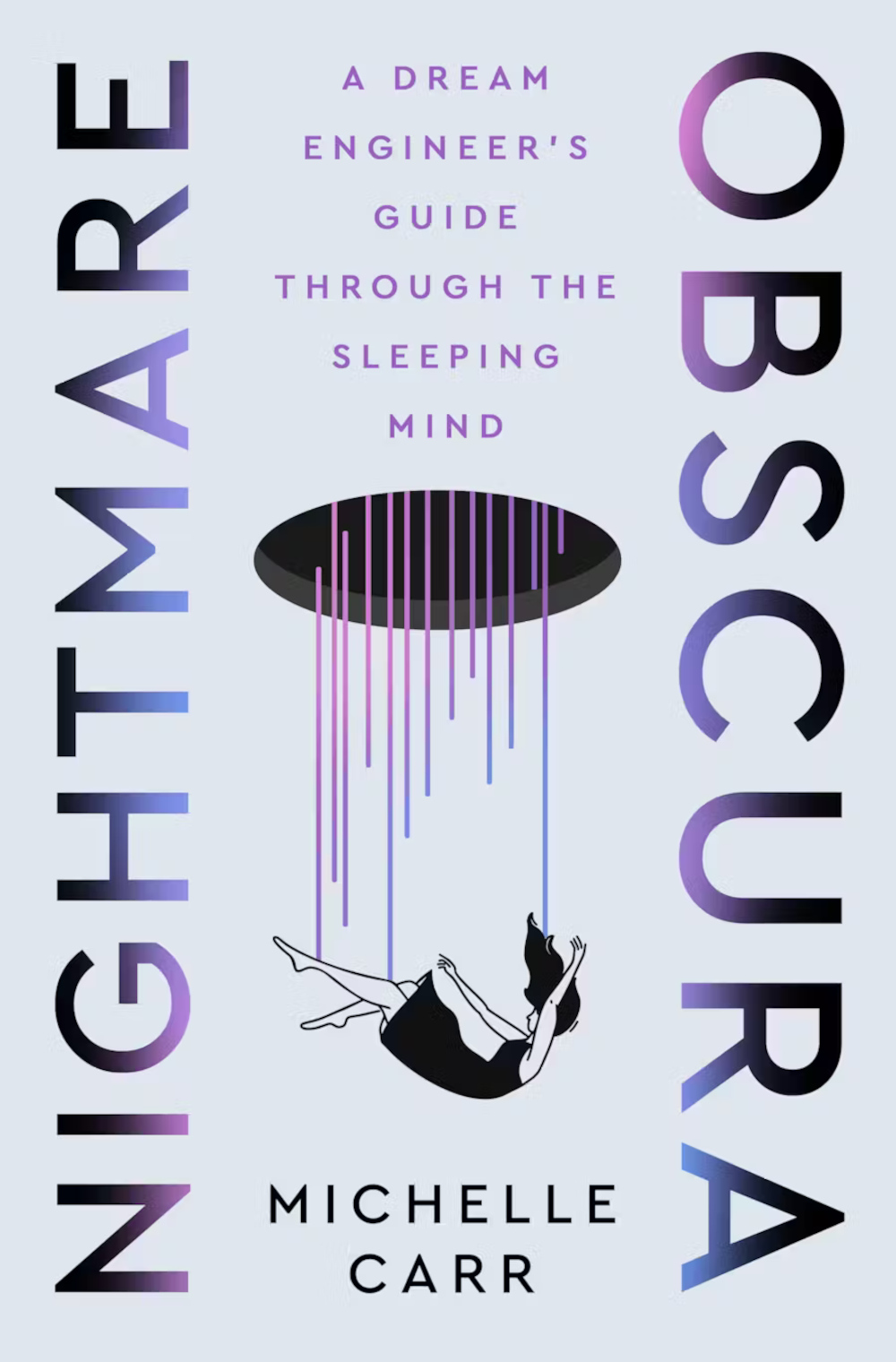
BOOK REVIEW — “Nightmare Obscura: A Dream Engineer’s Guide Through the Sleeping Mind,” by Michelle Carr (Henry Holt and Co., 272 pages).
Freud might have had a field day with this dream, but thanks in part to psychoanalysis’ fall from grace over the last century, medical professionals no longer put much stock in our minds’ nighttime wanderings as markers of either physical or mental health. That’s what dream scientist Michelle Carr aims to change. Carr, who serves as director of the Dream Engineering Laboratory in the Center for Advanced Research in Sleep Medicine in Montreal, has spent two decades gathering data on people like the tiger dreamer: She’s spent countless nights in labs watching people sleep, probing why we dream, why we have bad dreams, and how studying and even manipulating dreams can improve mental and physical health.
In “Nightmare Obscura: A Dream Engineer’s Guide Through the Sleeping Mind,” Carr makes a passionate case for why the answers to these questions matter, deeply, especially for sufferers of trauma and suicidal ideation. What emerges is a passionate case for why dreams and nightmares are not just “random electrophysiological noise produced by the brain during sleep,” as scientists believed for many years, but rather a nightly exercise in “revising the shape of our autobiography.” In other words, Carr argues, our dreamscapes are essential pillars of who we are.
She spends the first half of her narrative establishing a detailed but essential framework for what, exactly, dreams are and why we have them. During the roughly one-third of our lives we spend sleeping, our minds go on “astonishing” journeys, she writes: We subconsciously synthesize memories, sensations, preexisting knowledge, and expectations to create our dreamscape, with up to 75 percent of us experiencing recurring dreams that can follow us throughout our lives.
In this section, Carr reveals several intriguing ideas about dreams. She argues that dreams don’t simply stem from processes in the brain, but from experiences of the physical body, too. For example, those pesky anxiety dreams about our teeth falling out? Carr hypothesizes that they have their root in nighttime tooth grinding. Equally intriguing: Daydreams and nighttime dreams are likely not a binary, as scientists long believed. Recent EEG studies show very similar neural processes during these two activities, leading Carr to hypothesize that “dreaming is like an intensified form of mind wandering, and both are derived from the same neural substrates.”
But Carr’s purpose isn’t simply to educate us about recent scientific revelations about the dreaming process. Rather, she wants to convince us that dreams matter, for health, for wellness, for the human experience. Dreams have a variety of essential functions. They allow us to rehearse for waking life, as in a study by a Harvard sleep researcher who asked subjects to navigate a virtual maze before and then after a daytime nap. The students who dreamed about the maze during the nap navigated it 10 times better than those who didn’t, which, Carr says, implies that their dreams helped them accomplish their task more effectively.
Certain stages of sleep act as a “system reset,” Carr writes. Throughout the night, dreams are the brain’s way of processing everything that happened that day, assimilating it into the dreamer’s personal narrative and sense of self, marking the important lessons learned, and dulling the intense feelings associated with embarrassing, frightening, or traumatic experiences. Carr theorizes that our brains couldn’t perform these functions subconsciously; we must experience the emotions attached to our dreams in order to learn. As Carr puts it, “dreaming is functional in the same ways that feeling is functional in waking life.”
So if dreaming is a method for humans to synthesize, learn, and reset during sleep, then “why are some of us forced to relive again and again the full force of our deepest fears, sorrows, and furies, in the form of recurring nightmares?” Researchers believe that nightmare sufferers’ brains are attempting to break down a trauma and synthesize it as in the normal dreaming process — but the ingredients of the dream are too painful, too raw, and the process goes awry. This has stark implications for mental health: Carr cites a researcher who’s shown in repeated studies that nightmares, far more than anxiety, depression, or insomnia, are a predictor of suicide risk.
Carr makes no secret of her frustration with the medical establishment’s attitude toward dreams and nightmares, writing, “the fact that this facet of a person’s life is not currently used in diagnosing or treating most mental health conditions is a stark reminder of how far medicine has to go.”
But on the bright side, researchers like Carr who do understand the importance of dreams and nightmares are developing truly innovative treatments, both for nightmares and their underlying causes. Some of Carr’s methods are easy to try at home: She coaches patients like the tiger dreamer to grapple with their nightmare while awake, rescripting and rehearsing a new version until it trickles into their sleeping mind.
Some of Carr’s methods are more novel, like lucid dreaming, when patients learn to control their dreams; she excitedly recalls her first lucid dreaming study, when her sleeping patient moved her eyes three times in response to a series of beeps, indicating that she knew she was dreaming and was responding to the researchers’ communication.
Other techniques, like dream engineering, seem downright science fictional. Dream engineers use stimuli like clicking sounds, puffs of pressurized air, or particular smells with the goal of manipulating sleeping minds. Carr likens the process to the “ambient elements of a cinematic production, how the lighting, the musical score, the pace, and the action guide the meaning of a film.”
For example, researchers might spray a pleasant perfume while encouraging a patient to recall a positive memory, then, once the patient falls asleep, spray the perfume again, ideally creating a Pavlovian connection in the dreamer’s mind. This Pavlovian relationship can work the other way, too, through what Carr calls “targeted forgetting”: She cites an Israeli study where researchers sprayed the smells of rotten eggs and cigarette smoke onto a group of sleeping smokers. The smokers were less likely to pick up a cigarette in the days following the study.
“Nightmare Obscura” could have benefitted from more characters and personal stories: I found myself wishing that each chapter opened with an anecdote about some nightmare sufferer’s wild path to recovery. But Carr’s book is well worth reading, not just because of its fascinating facts about dreams and the glimpse it offers into the “Inception”-like future of dream engineering, but also because of Carr’s central thesis.
Studies show that taking control over nightmares through the techniques laid out in Carr’s book can be a powerful tool for treating PTSD. And early work shows some promise for treating nightmares and reducing other symptoms in those with borderline personality disorder as well. Carr doesn’t provide as much evidence that they could be used to treat mental illnesses like bipolar disorder or schizophrenia, but she argues that we should certainly try.
She makes a powerful case for dreams and nightmares as an overlooked indicator of mental health and exhorts the medical establishment to catch up with what sleep researchers have known for decades: Dreams are “an essential and uniquely informative component of sleep, physical health, and mental health across the lifespan.”
This will be a captivating read for anyone who’s ever been interested in dreams, and an essential one for nightmare sufferers who just might find relief through Carr’s methods.


I don’t mind research into dreams just so long as they don’t try to work out a way to insert adverts into them. I always understood dreams to be the way that the human brain processes all the junk that it sops up in the course of a day and perhaps this is so. But perhaps it is a capital mistake to assume that there is only one sort of dreams/nightmares. There is the run of the mill sort that you only seem to remember when you wake up in the middle of one. Then there is as our hostess has mentioned lucid dreaming which should be a major study in itself. Then there are the sort of dreams that give spark to creative ideas or those that resolve a problem that the person has not been able to solve in their waking moments. In short, perhaps there is not just “dreams” but that is only a blanket term for a variety of phenomena that takes place in a person’s sleeping moments. We just don’t know enough about dreaming to work out the different sorts-
https://en.wikipedia.org/wiki/List_of_works_based_on_dreams
Nice! Just pondering about an idea about dreams and a dream police…
While doing work about p.analysis in the early era it was interesting to find the same dreams interpreted very differently by each of the luminaries back then. Which would beg the question how are you gonna treat the patient.
That there is a hidden “power” to all this comes to bear when thinking about Max Eitington who after studying with Freud probably became involved with NKVD. He went to Paris and there it seems spied on the rich Whites who had fled but not given up on overthrowing Stalin. He became privy to some secrets which he relayed to secret intelligence. Fascinating dark stuff.
I love flying dreams.
I got my start with a book called “Creative Dreaming” by Patricia Garfield, 1976
https://archive.org/details/creativedreaming0000phdp
That was a sort of how-to book, IIRC. The key take-away for me was auto-suggestion. If I want lucid dreams, I think about having one for several successive nights while falling asleep. Just be careful what you auto-suggest for and get some experience with it before asking for anything more than a chance to fly in solitude with plenty of open space below to land safely in.
Keeping a ‘dream journal’ beside your bed was another helpful hint from that book, I think. Write your dream details down after you have one and before you forget. It’s quite fascinating to read later what your own brain was doing while you were semi- or hemi- conscious.
In my experience, I am really the only one who can ‘interpret’ or make sense of some of my own dreams. I know best what went into making the dream, so I do better listening to my own intuition about what the ‘meaning’ of a dream is, if it means anything at all.
Auto-suggestion, and directed dreaming, two mainstays of my sleep regimen for decades.
“The only person in Germany who still leads a private life is the person who sleeps.”
Robert Ley, Ministry for Reichspropaganda (1890-1945).
See also Charlotte Beradt´s “THE THIRD REICH OF DREAMS, The Nightmares of a Nation 1933-1939”.
Bad dreams come when I have a problem to solve. For instance, when learning to fly small airplanes, I had many dreams that ended in crashing small airplanes. There was never a cause for these accidents, but they suggested that I had a lot to learn about flying. BTW, if you are not obsessed with flying don’t do it, especially if you have any suicidal risk.
Another time I had several nights of uneasy sleep and bad dreams while preparing an oral argument for a hearing at the federal patent appeals court (CAFC). One morning I got up and thought that I was not going to sleep for the next week if I couldn’t come up with a persuasive argument, so I did it. Right then. Slept fine after that and won the case.
I am getting a sense of inventing the wheel. The review never mentions C.G. Jung, and mentions Freud and analysis only to dismiss old Sigmund. But sometimes an analyst is an analyst is an analyst.
Many of the ideas about problem-solving and repair are straight out of Jung, as is the idea that dreams indicate physical and mental health. What’s missing is Jung’s attention to dreams as a kind of internal dialogue, the self reflecting the self to resolve emotional and moral struggle. Jung even had a patient who, he realized, was dreaming her own death. And she died young shortly thereafter.
The dreams that I remember most are what might be said to be nightmares. I’m sitting in the violin section of an orchestra and I’m no longer capable of keeping up. Well, in life at my long past sell by date as a musician that is true enough, so…
Fascinating subject Yves. As noted by DJG, I was surprised there was no mention of Jung. I became interested in dream work through a Jungian oriented series of conferences mostly held in an Episcopal retreat camp outside Hendersonville, NC, Journey into Wholeness. A group of four couples formed a “dream group” as an offspring of the conferences and we met at least quarterly for over ten years to discuss our dreams. The group’s backgrounds included Vietnam War vets, a priest/professor, a protestant minister, former stock brokers, a physician, an archaeologist, an artist–all retirees. I spent several years seeing two Jungian analysts who were a four to six hour drive away. The subject of many of my dreams were snakes, alive and sometimes appearing dead. At one point I did a series of “active imaginations with a snake named “Joe” which was fascinating. Of the original eight in the “dream group” six have died in their 80’s and the two living are in their mid 80’s. Of all the dreams discussed the one best remembered was the following: …am looking through the scope of a sniper rifle and see the Buddha, smiling.