Yves here. It seems that due climate change signs coming in generally at the bad end of the range of forecasts, the timing for reaching various tipping points is coming sooner than earlier warnings indicated. One example is the slowdown of the Atlantic Meridional Overturning Circulation, which could kick in as soon as ten years from now.
By Thomas Neuburger. Originally published at God’s Spies

We will probably pass the tipping point for an AMOC shutdown in the next ten to twenty years or so.
—Climate scientist Stefan Rahmstorf
Does death make our lives less sweet? For most of us, no.
—Yours truly
Time for a climate update. Tipping points are approaching. To present this information this systematically, consider the following:
• Bad things are already happening, and they’ll continue.
• Over not much time, the bad things will also get worse.
• Then tipping points will be reached, after which the worst is baked in.
• Some years after that, the worst arrives in full.
This process is true in a great many areas: sea level rise, for example, and coastal destruction.
The seas are already rising, due partly to ocean expansion (warm water takes up more space than cold water), but due mainly to melting ice in Greenland and Antarctica. Once the tipping point for glacial melt has been reached, all ice will be guaranteed gone at some future time, and a full sea level rise disaster is bound to occur.
What will that look like? Greenland ice melt will cause 24 feet of sea level rise; Antarctica ice melt, 230 feet. The world’s coastal cities, where 15% of world population lives, will erode with the shores and be drowned. In the U.S., 45% of GDP will be lost.
The point to remember: this all occurs in stages. First, pain. Then greater pain. Then a tipping point, which may not be marked by an event, but which nonetheless guarantees, at some future time, complete collapse of the system under discussion.
For most of our systems, we’re at the first point now, or possibly the second — a point of considerable pain. Yet tipping points silently lurk, some quite nearby.
The ‘AMOC’, Europe’s Personal Heat Pump
With that, let’s look at one system under threat, the system of oceanic Atlantic currents that keeps northern Europe from freezing like Canada.
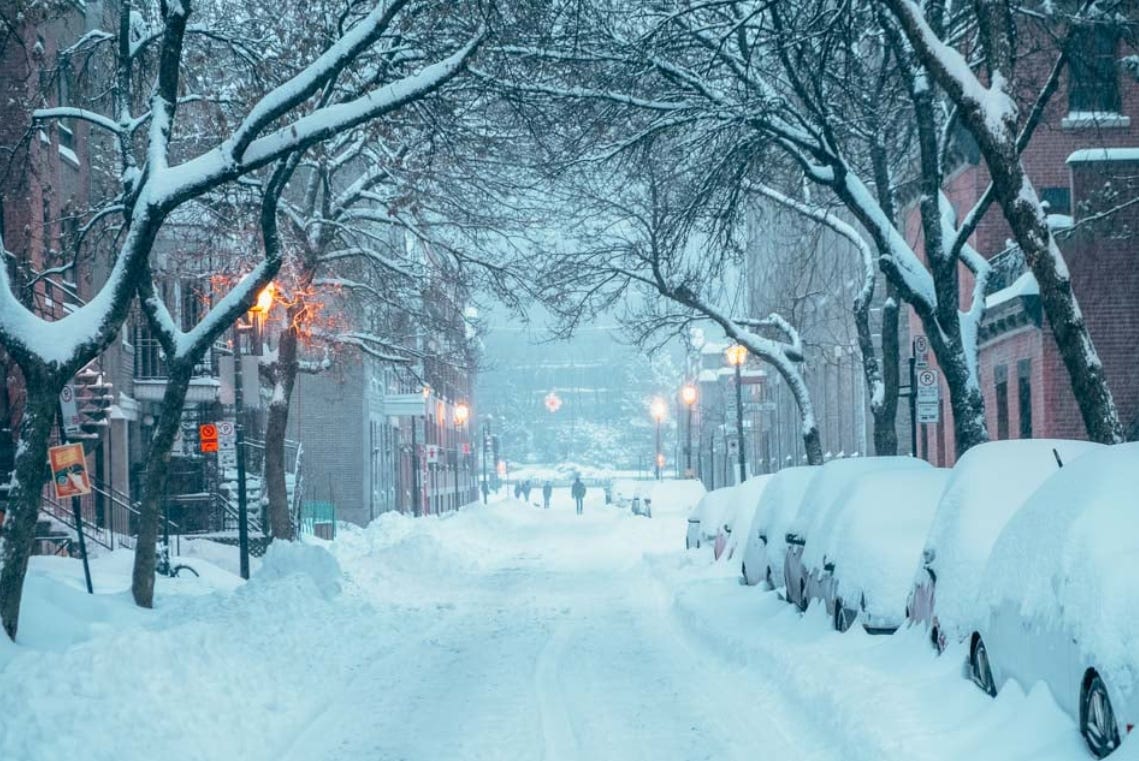
Winter in Montreal (source)
Europe’s personal heat pump is the Atlantic Meridional Overturning Circulation, or AMOC — what most of us call the “Gulf Stream,” though those two are not quite the same. The AMOC is part of the world-ocean circulatory system that takes warm water from Equatorial zones and moves it across oceanic surfaces to the north and south, where it cools and sinks, then returns as deep water currents (see image above).
The part Europeans care about is the part that runs from the Gulf of Mexico to very near Scotland. Paris, for example is three degrees latitude closer to the North Pole than Montreal, and Scotland is closer still. Yet northern Europe is warmed by the AMOC, while Canada is not.
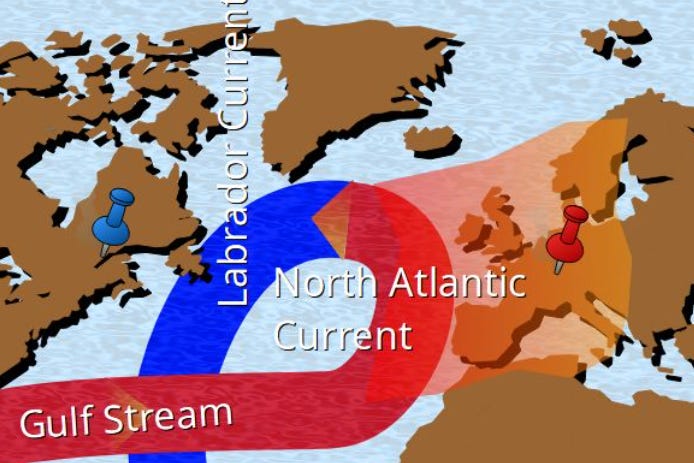
Northern Europe is warmed by the AMOC, while Canada is not. The two pins above are cities on the same latitude line. (Image source)
Now consider the video below. In it, notable (very notable) climate physicist Stefan Rahmstorf discusses in scientific terms the future of AMOC. The whole thing is just 15 minutes, but you can start, if you like, at 12:43 to hear his tipping point prediction.
Rahmstorf’s bottom line: “We will probably pass the tipping point for an AMOC shutdown in the next ten to twenty years or so.” In other words, sometime between 2035 (ish) and 2050.
We won’t see it happen, most likely, that tipping point passed. But it will be passed nonetheless.
A Note for Skeptics
I understand that some readers here are climate skeptics. These are, after all, projections, and models can err. (Most of our climate models, in fact, have erred already, but on the side of complacence.)
These doubts don’t trouble me. No one’s optimism will change the future; nor will anyone’s doubt. Things will be what they are — decent or rough — regardless of anyone’s thoughts.
I will say this briefly, though, to the skeptically inclined: Watch your local environment for signs of increasing pain: diminishing water supplies; long and deep droughts; more costly insurance; bigger, more frequent hurricanes, storms and fires; fewer insects (sorry, that’s already here); more frequently canceled sporting events perhaps.
If you see these signs, prepare, regardless of what you believe to be the cause. Protect yourself. And if it turns out you’re right after all, I’ll be among the first to celebrate with you.
A Note for Believers
It’s easy to look at all this and become depressed. After all, this represents a kind of death, if not of ourselves as individuals, of the future the stories we constantly tell ourselves is certain to come — a future that’s somehow continuous with our own.
Consider our films and novels. Most stories that are set ahead some number of years ignore the climate and focus on new technology. Makes for a great film. But the climate — whose kingship is certain so long as we’re ruled by our current pathological lords — will kill off our tech. The wave of smart-phone delights that has given such joy is due to recede, and won’t return, perhaps, for a thousand years.
The way to stay centered is this: We all understand we will die, a personal destruction, yet most live unbowed by that weight — we eat, watch sports, fall in love, mourn losses, cheer gains, hug children, meet friends; in general we still attempt to live happy lives.
Does death make our lives less sweet? For most of us, no. Though death can’t be stopped; we don’t let it drag us down.
Same here. If you think the destruction of our climate and way of life, which the arrogant and greedy are dead-on determined to cause, can’t be stopped, then think of it as you do your personal future loss, and try to live well anyway. That choice is no different than the one you faced yesterday.
And if you think of a way to stop those pathological souls, those less-than-a-thousand folks who have charge of our lives, then do it. There’s joy in that too.


Big changes are coming, and if I was 24 i’d feel slighted by being shortchanged of a future, but i’m not and its utterly fascinating to watch it all unfold in front of my very eyes…
Remember not that long ago when perceived areas of safety from the ravages of climate change were bandied about?
…nobody talks about that anymore
Audience participation is mandatory. It’s an all-play!
It seems as if you always here how the halting of the AMOC will make Europe colder, but that current is pumping heat out of the Caribbean basin as well. If it stops the Gulf of Mexico & the Caribbean Sea will get hotter – just what hurricane season doesn’t need.
Adam,
The fear regarding the AMOC is that heat will be pumped out of the Caribbean, etc., but won’t reach Europe because of the fresh water melt from glaciers near Greenland. Fresh water will dissipate the surface current by desalinization. That’s the concern anyway.
Thomas
Also, the fresh water from melt will dilute the more dense brackish water, preventing ir from sinking and moving back South, thus disrupting the AMOC and resulting in a radically colder Europe.
Not made clear in that presentation is the effect on weather in Europe and the UK. That heat from the tropics is carried north and as that current dives deeper in the northern latitudes, that heat is radiated into the atmosphere. As the prevailing winds blow towards the east, that means that that heat is blown towards the UK and Europe giving it its mild climate. Without it, then the climate for this region would resemble more Siberia. Growing crops in this region would be a whole lot tougher I would think for a start as well as any other economic activity. But then you get to the question of keeping some 800 million plus people warm in the winter, especially as the EU/UK is determined to cut themselves off all that cheap, reliable Russian gas. Put all their trust in the US and Qatar supplying their needs? Good luck with that. If it gets bad enough we may see a mass of people slowly fleeing Europe – and crossing into Africa for survival.
True. I’m wondering if the slowing/cessation of AMOC will increase regional energy imbalances leading to increases in severity and frequency of unsettled weather.
Not really. According to the latest models, only the late winters would be colder and only in the regions in proximity of the North-Atlantic or the Arctic Ocean.
It’s a very complex system, but it seems that the dominant factor in winter temperatures in Northwestern Europe is the extent of the Arctic ice pack, and as it is, the same cause (global warming) that slows down the AMOC circulation is also keeping the ice packs in the north. Only at the very extent of the sea-ice (late February-March) would the cold be amplified.
Actually, AMOC does not merely keep Europe warm, it moderates the temperatures in the West and Northwestern Europe, so if it slows down, that will cause the summer temperatures to go up.
All and all, more extremes, more volatility, more storms. But no, Europe will not turn into Siberia.
Don’t forget that maritime winds blowing off a cold ocean are still maritime winds. The Canada that England will resemble is coastal BC.
Thanks for this post, particularly the words of encouragement at the end. I’m concerned for the collective mental well-being of humanity as the consequences of our behavior become more and more visible. I’m struggling with depression these days. It’s alright. I’m not about to jump off the nearest bridge, but what makes me nervous is how angry I’ve become. This is the part that worries me, this anger, likely contagious.
What a beautiful photo of a snowbound street in Montreal. Makes me want to be there.
As to our ‘collective mental well being,’ I can attest to Pharma making a killing on anti-anxiety meds.
At a recent family gathering, there was a quick discussion on what to do when one of the adults unexpectedly ran out of anti-anxiety meds. He is an adult with autism, so everyone there was involved.
Turns out, no problem, from grandparents, through adult children and young adult grandchildren, all were on the same anti-anxiety med. They were all willing to share.
I rely on the (legal) plant-based stuff.
The choice between passive fatalism and active resistance is exactly what Tim Winton examines in his book Juice.
https://en.wikipedia.org/wiki/Juice_(novel)
If today’s Crimes Against Life are so heinous that even fictional future generations would prosecute oligarchical ancestry, why should Nuremburg style trials for Exon’s executives et al. wait for tomorrow?
“After all, this represents a kind of death, if not of ourselves as individuals, of the future the stories we constantly tell ourselves is certain to come — a future that’s somehow continuous with our own.”
I prefer the “hopeful” idea that it’s not the death of civilization but the beginning of a journey home. The human species has eaten a barrel full of apples and embarked on a journey to be gods. Now we have a portion of society, not the “deviants” or the dirty hippies but the tiny slice of society made up of the richest, most powerful people in society, talking about bodily immortality, geoforming planets and building “god.” Every day, the power to render the planet close to lifeless resides in the hands of another tiny slice seemingly bent on constantly putting us all at risk of such a catastrophe. And so as not put the blame for all this entirely on the elites, as Thomas points out so well, our very style of existing day-to-day in the rich countries is radically changing the nurturing Holocene that has made our drive down the Highway to Hell possible into an Anthropocene in which Gaia vents her fury in a million different ways.
So I’m holding onto hope that humans survive this disaster we have made, but not the bulk of our civilization. Included in this hope is what amounts to a prayer that the survivors mark those entry points to the God Trip as taboo and instead embark on a journey to rediscover what all our fellow animals seem to understand about how to fit into the biosphere rather than consume or destroy it.
HMP I look forward to reading your insightful and uplifting thoughts, and then thinking you are still doing well
I thought it a different autumn up your way and now I see winter has landed with both feet so take care
Regarding the Hope that you referred to, I found this a very buoyant read in today’s links:
https://jasonhickel.substack.com/p/how-popular-is-ecosocialist-transformation?
N=5,000 so there is weight in the results.
3,750 support the 5 listed concepts of Degrowth If they are explained.
Clearly framed, popular sentiment is with a different economic and societal course.
Stay steady/happy holiday
Appreciate the kind thoughts. Hickel is still trying to get through to people. There are a lot of things blocking the message though.
As the planet’s ill-considered fling with multi-cellular life slouches to its ignominious end, I, for one, welcome our new amoebic overlords.
I think it entirely possible that talking apes make it through the current mass extinction, but writing and typing apes do not. If that happens, writing will probably develop again, but technological civilization is a lot less likely to return – metals and ways to melt them will be less available.
I am not sure that our fellow animals understand better than we do how to fit into the biosphere – the universal will to become, for us animals, means “eat” and “have offspring” and we tend to do that. The balancing comes from a having a variety of eaters up and down the food chain.
These studies always use unrealistic scenarios like RCP 8.5 that requires emissions to be 3 times higher than today, and burn more coal that is currently known to exist in the world.
And a recent one used RCP 4.5 but then had this novel innovation:
“However, Jon Robson, a professor of climate science with National Centre for Atmospheric Science at the University of Reading, U.K. who was not involved in the research, warned against using the study’s theoretical results to predict future climates. “To get the AMOC to ‘collapse’ in this particular model, the authors need to add huge amounts of additional freshwater into the North Atlantic [and] that is not realistic,” he told Live Science. “But it could be taken as a warning about what might be possible under the rather extreme scenario of an AMOC ‘collapse’.”
https://www.livescience.com/planet-earth/rivers-oceans/collapse-of-key-atlantic-current-could-bring-extreme-drought-to-europe-for-hundreds-of-years-study-finds
Dave Borlace, British presenter of the YouTube Channel “Just Have a Think”, devoted his most recent episode to the National Emergency Briefing, an initiative organized by UK scientists, economists, and civil society leaders to urge the British government and public service broadcasters (like the BBC) to treat the climate and nature crisis as a genuine national emergency on the scale of World War II.
https://www.youtube.com/watch?v=8sa7uh192r0&t=145s
https://www.patreon.com/cw/justhaveathink
Rosa Luxembourg reportedly said, “The choice is between socialism and barbarism.” That was some years ago and now we need to refine our choice as that of the rent-seeking financial West versus the entire rest of the world. The capitalist countries reject climate science and proceed with a status quo which exacerbates the problem, which essentially is a war on the World; likewise, they make war on Russia, Palestine, China, and now Venezuela, not to speak of countless other countries that defy Western hegemony.
Could be related to fresh water pooling up in the Russian Arctic. Diverting water from some of those rivers could restore balance to the ecosystem, although I do not see how international cooperation is feasible anymore.
What about Russia, China, Brazil, India, Japan establishments? Indonesia, Philippines, Australia?
What about BRICS on this?
Does Russian progress in nuclear reactor tech mitigate anything?
And how about the Chinese fusion thingy. I am aware it´s very tiny steps that were made.
What are any of these societies´ plans, assessments?
I don´t know anything about their real internal/domestic discussions and threat analyses.
I find the above suggestions not very soothing:
“If you see these signs, prepare, regardless of what you believe to be the cause. Protect yourself. And if it turns out you’re right after all, I’ll be among the first to celebrate with you.”
That doesn´t sound like a political constructive agenda in a, well, socialist, showing solidarity tradition but more like a Roland Emmerich movie. Every man for himself?
We have to be able to come up with something better, don´t we?
Speaking only w.r.t. Japan, AFAICT the establishment plan is nothing serious.
It’s the usual mix of half-measures: carbon neutrality by 2050, aim for “structural changes in energy and industry”, etc. There was a goal for 2030 to reduce emissions 46% below 2013 levels, but Japan is not on track to reach that target. And now, there are even more ambitious goals for 2035 and 2040, e.g., the “GX” (Green Transformation) policy, for economic growth along with decarbonization, phasing out new coal plant construction, etc. Japanese automakers have also been notoriously slow to convert to EV production.
In other words, the can is being kicked.
Japan’s plan to build out renewable energy sources has been mixed. It seems to depend on the region. Kyushu has been very successful, but other parts of the country less so. At least in Kanto, the solar subsidies were not sufficient to entice many homeowners and failed to meet projected goals. Anecdotal, but one person I know who investigated this was discouraged by several contractors, and instead of solar panels she ended up getting a fuel cell cogeneration unit that generates power from the city gas supply to the house. The nuclear village and Keidanren (Japan Business Federation, i.e. Japan’s most powerful business lobby) have worked against renewable policies, tho they say in public that they support “sustainable growth”. Everywhere in Japan, the rhetoric is all about “sustainability”.
Recently, there has been a lot of conflict about the construction of large solar farms (e.g., the Kushiro Marsh Mega Solar Project in Hokkaido), because of concerns about environmental impact (e.g., the 2021 giant mudslide that wiped out part of Atami city and killed 20), and that these projects are not themselves really profitable but instead make money from solar subsidies.
The Takaichi administration has not spoken out about this “solar bashing” as the policy has been to support the automakers current plans, reducing/eliminating their tax burden instead of allowing market forces to compel them to embrace EV production. Takaichi is not talking about climate or energy with any urgency, but instead talking up increased defense spending because China, and how all Japanese should work themselves to the bone because that’s how it was in the good ole days of Shôwa, etc. etc.
There are Japanese intellectuals like Saito Kohei who have written books on degrowth (Saito: “SDGs are the opiate of the masses”), but his views are considered “extreme Marxist” and AFAICT not reflected anywhere in actual govt. policy.
A lot of words the describe the cyclical events for Pole Shift, smaller per 6,000 years, larger per 12,000.
Spaceweathernews is the best source I have seen on the cause and effects. For disclosure have no personal financial interest in that site/content.