The US’ gold holdings, allegedly the largest on the planet, have not been subjected to a comprehensive audit since the 1950s.
To begin with, a couple of important caveats. First, Naked Capitalism is not a platform for gold bugs. As Yves noted in the preamble to an April 2022 cross-posted article by The Saker, The Importance of Custody, Or NATO’s Internal Gold War, “even mentioning gold on this site makes [her] nervous, since it brings forth all the gold bugs and other super-hard currency fans”:
Repeat after me: Japan created money supply like a drunken sailor for the better part of two decades and still barely prevented deflation. William Jennings Bryan’s “Cross of gold” speech came about because the gold standard in the latter 1800s produced the so-called “Long Depression” that hit farmers hard.
Even though this post is about not taking proper care of one’s gold, as in poor custody practices, we suspect some readers will use it as an excuse to talk up a gold standard. Please don’t. Read this instead:
Why a gold standard is a very bad idea
Second, there is a huge amount of chatter, in both social and financial media, that the recent price surges are being driven by central bank buying. We’re not convinced. While central banks are certainly buying more of the yellow metal, it is retail, and to a lesser extent, institutional buying, that are the main catalysts here, as Robin J Brooks lays out in his latest substack:
The chart below shows IMF data on gold buying for all emerging markets. Four points are worth noting. First, there is no acceleration of gold buying after Feb. ‘22, which is when Russia invaded Ukraine and the sanctions onslaught began. Second, central banks are certainly buying gold, but they’re doing so at a slow and steady pace. They’re not in a buying frenzy that explains the massive rise in gold prices underway. Third, it’s possible that countries are hiding their gold purchases. China is almost surely doing that. After all, it conceals its intervention in foreign exchange markets via state banks, so what’s to prevent it from hiding gold purchases? But – again – this is unlikely to be happening with the kind of frenzy that can explain the current run-up. Fourth, even if foreign central banks are buying gold, they’re not also buying silver, platinum or palladium.
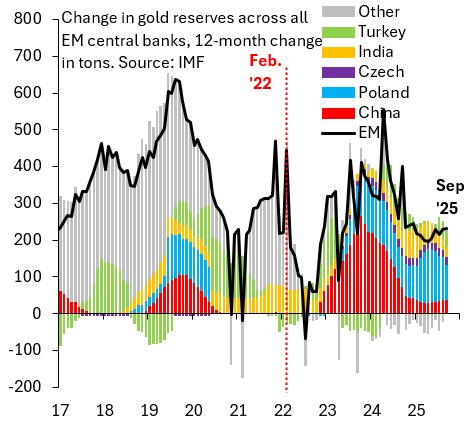
[NC: It would be nice to know what central bank buying was like before 2017, given that was the year that gold was reclassified from a Tier 3 to a Tier 1 asset under the Basel III banking reforms, turning gold into a more effective backstop for debt, currencies and bank capital.]
At the root of the surging retail and institutional demand for gold is a generalised fear about unsustainable fiscal policy and dollar debasement, says Brooks:
The Dollar was stable in the second half of 2025, even as gold prices and the debasement trade got going. That is changing. As the chart below shows, the Dollar had a very bad start to 2026, in line with my call that Dollar weakness will resume after the hiatus of H2 2025. A falling Dollar will super-charge the rise in gold prices and the debasement trade because it boosts the purchasing power of non-Dollar buyers. The trajectory is thus for the debasement trade to accelerate as Dollar weakness resumes.
Goldman Sachs has already revamped its 2026 price target for gold, arguing that investors are treating gold as an insurance against long-term risks, including soaring debt levels, rising risks in the bond markets, and growing uncertainty over central bank independence. That’s not to mention the growing fears of a collapse in the AI bubble.
And there you have it: Gold is officially trading above $5,000.
About a year ago, I stated that I felt we’d hit this milestone by the end of 2025—so we are a month behind where I thought we would be,
Next stop?
We are likely to see $6,000 in 2026, though I expect the climb to be… pic.twitter.com/DbqVwCkYib— Mohamed A. El-Erian (@elerianm) January 26, 2026
The Role of Price Manipulation
What rarely gets mentioned in mainstream media coverage is the historic role played by price manipulation, not just in the gold market but also in the silver, platinum and palladium markets. One of the most notorious cases involved JPMorgan Chase, which in 2020 was found guilty of spoofing silver and gold prices through illegal trading practices. The Wall Street lender ended up paying a $920 million fine.
In total, eight banks paid fines of $1.3 billion for decades of manipulation — just a minor cost of doing business. Since then the manipulation has tailed off, as JP Morgan has shifted from a massive net short position in silver to massive net long, allowing true price discovery (or at least something resembling it) to take place. As Michael Hudson explained in an interview on CTGN Europe’s The Agenda, the Fed is also similarly restrained in its ability to keep down gold prices:
So for the last few decades, the Federal Reserve and the U.S. Treasury have been trying to hold down the price of gold to make sure that it wouldn’t appear as an alternative investment. And it’s been selling gold forward or it’s been leasing its gold, not only from Fort Knox, but apparently from the Federal Reserve, to gold dealers, and selling gold short on the Comex Exchange. And by selling gold short, that prevents any opportunity for the price of gold really going up.
Well, finally, as you pointed out, in the last few years, it’s leased so much gold that it’s reached the end of its ability to hold it down. And now, for the first time, we’re having a real market developing in gold. And all that’s gone hand in hand with the desire of a number of governments to say they want to de-dollarize. And from the idea of people that, well, maybe we need to diversify out of the dollar, now that the political and military situation[s] are changing. So all of that has led to increased speculation of gold.

China’s opening of its own precious metal exchanges in recent years has also played a key part in muting the ability of US and UK authorities and Western bullion banks to engage in price manipulation of the metals markets.
IMO the real gold action started when CNY oil contract started in March 2018, because "The Law of One Price" tells us you cannot have 2 different Gold/Oil Ratios in 2 different currencies (USD GoR v. CNY GoR).
This is what those saying "CNY oil was a nothingburger" missed. https://t.co/n1jtOQ4tyU
— Luke Gromen (@LukeGromen) January 22, 2026
According to global markets expert Kathleen Turner, China, unlike the US and the UK, is banning High Frequency Execution server co-location at exchanges in order to prevent banks from “spoofing” markets.
This is exactly why China is banning High Frequency Execution server co-location at exchanges. Chinese supervisors aren’t bought to look the other way while price discovery is mutated into price manipulation.
— Kathleen Tyson (@Kathleen_Tyson_) January 27, 2026
Now, to the main story: the growing jitters in Germany about having so much of its gold reserves stored at the US Federal Reserve, especially given the Trump administration’s near-total disregard for a) international law; b) central bank independence, and c) the property rights of other nation states (c.f. Venezuelan oil and gold, Russian assets held in the West, Greenland).
German economists and politicians are once again calling for the full repatriation of Germany’s gold — understandable given the yellow metal just crossed the $5,000 per ounce threshold for the first time ever while concerns about sovereign bond markets continue to grow. According to official records, Germany has the second largest gold reserves in the world, totalling around 3,550 tons, of which roughly half are stored abroad.
The lion’s share (1,236 tons) are held at the Federal Reserve Bank in New York while another 405 tons are held at the Bank of England. This was a holdover from the Cold War, when Western Europe’s gold bullion was moved for “safe keeping” to London and New York, far away from the former Soviet Union and Josef Stalin.
German economists are now beginning to express concerns about how just safe that gold is, reports Tagesschau (machine translated):
Gold [held in the US] was considered safe for years. This is because central banks are usually independent and have a great deal of trust in each other. But US President Donald Trump is trying to change that. In recent months, he has increasingly launched attacks with the aim of undermining the Fed’s independence. Most recently, he threatened Federal Reserve Chairman Jerome Powell with charges in connection with the renovation of Fed buildings. Powell himself sees this as just a pretext to exert pressure.
Previously, Trump had already tried to fire Fed Governor Lisa Cook. The case is currently before the Supreme Court. For months, Trump has been urging Fed Chairman Powell to cut interest rates faster and more extensively, often with insulting posts on his Truth Social platform.
“Of course, the more central banks come under political pressure — and we are currently experiencing this in the USA — the more difficult it will be to maintain this basis of trust,” said gold expert Wolfgang Wrzesniok-Roßbach of Fragold in Frankfurt. One must closely observe how Trump continues to deal with the Fed and how independent it will be in the future.”
This account leaves out two key points: first, as Satyajit Das argued in a post last week for Naked Capitalism, central bank independence is a relatively recent phenomenon, dating back to the 1990s, and is not all it’s cracked up to be; and second, Germany has been seeking to repatriate its gold held overseas for over a decade, and has so far only managed to claw back 300 of the more than 1,500 tons held overseas.
What’s more, as the aforementioned The Saker article notes, Berlin had to wait five long years to repatriate that small portion of its gold from the BoE. Plus, it never got back any of the gold bars originally deposited, which clearly explains the delay. This raises some key questions:
(a) does the BoE still have all of the EU´s gold bullion… or has it been sold off or loaned out as many experts insist ?
(b) is the BoE willing and able to immediately return the EU gold it may still have left to legitimate owners, if any ?
(c) who are the legitimate owners of BoE-vaulted gold after decades of European reshuffling of political borders ?
(d) would the ECJ decide gold ownership… or the British Judiciary… or the BoE ? On what basis, exactly ?
(e) has the BoE lent, swapped, re-hypothecated, leased, leveraged or encumbered such bullion now lien with other many alleged legitimate claimees also standing in line with ´fractional un-allocated synthetic´ bullion custodies unfit-for-purpose per “Digital Derivative Pricing Schemes“ thru which no one can know who owns what where (if anything) ?
Audit the Fed?
All of these questions could just as easily be asked about the gold held at the Federal Reserve. After all, the US’ gold holdings, allegedly the largest on the planet, which include the gold holdings of dozens of other countries held in custody by the US Federal Reserve, have not been subjected to a comprehensive audit since the 1950s.
Last year, four members of Congress, led by Thomas Massie, introduced a bill to initiate the first full assay, inventory, and audit of all United States gold holdings in decades. Now, the whipsaw whims of Trump 2.0 pose an additional risk factor, notes the Tagesschau piece:
“The gold reserves are currently safe in the USA. But tomorrow it could be the case that suddenly the American government says: ‘We are now keeping the gold reserves as a bargaining chip’,” says [gold expert Wolfgang] Wrzesniok-Roßbach. The Donald Trump risk factor is great. “At the moment, the US is not a reliable partner of the EU,” the president of the Centre for European Economic Research (ZEW), Achim Wambach, told Reuters news agency.
Emanuel Mönch, a former head of research at the Bundesbank, called for the gold to be brought home, saying it was too “risky” for it to be kept in the US under the current administration.
“Given the current geopolitical situation, it seems risky to store so much gold in the US,” Mönch told Handelsblatt. “In the interest of greater strategic independence from the US, the Bundesbank would therefore be well advised to consider repatriating the gold.”
For the moment, Berlin is not looking to go there, says Stefan Kornelius, the spokesperson for Friedrich Merz’s coalition government. But calls are rising for the government to take action, including among some politicians. Meanwhile, nearly three-quarters of the German public now see the US as an unreliable partner, according to the most recent ARD-Deutschland trend poll.
Michael Jäger, the head of the Association of German Taxpayers, warns that the US’s stated ambition to seize Greenland should concentrate minds:
Trump is unpredictable and he does everything to generate revenue. That’s why our gold is no longer safe in the Fed’s vaults. What happens if the Greenland provocation continues? … The risk is increasing that the German Bundesbank will no longer be able to access its gold. Therefore, it should repatriate its reserves.
A Colossal Loss of Trust
Western central bankers are also up in arms about Trump’s recent moves against the Federal Reserve. It’s no coincidence that it was Mark Carney who called time on the rules based order from Davos last week. Carney may currently be prime minister of Canada but he is first and foremost a central banker.
Indeed, Carney is the only person ever to have run two different central banks: the Bank of Canada (2008-2013) and the Bank of England (2013-2020). As such, his speech was primarily on behalf of his constituents in Wall Street and the City of London.
The money quote: “compliance will not buy safety”.
In a June 2025 article about a new gold rush causing (potentially) irreversible damage in the Amazon rainforest, we noted that one of the main reasons for gold’s spectacular bull run was a generalised breakdown in trust and confidence in the dollar-based financial system:
In recent years, the US and the UK, the two main custodians of gold, have engaged in actions that have seriously eroded investors’ trust in their capacity as custodians, not only of gold but also of other key financial assets, including US treasury bills. And in a global fiat-based currency order, trust is everything.
In 2019, the British government recognised Juan Guaidó as Venezuelan president, and supported his legal battle to seize roughly $2 billion of Venezuelan gold held in the Bank of England. From that point on, the gold Venezuela holds in the UK has essentially been confiscated.
Although Guaidó was ultimately unable to get his greedy little mittens on the gold due to legal appeals launched by Venezuela’s real government in Caracas, Venezuela’s gold still sits frozen in the Bank of England’s vaults (or does it?) — more than a year after Venezuela’s leading opposition parties voted to oust Guaidó as “interim president.” The damage this has done to the City of London’s standing as a global financial centre is no doubt considerable, noted UK Declassified in 2023:
“[W]hatever happens next, this case sets a precedent which could have far-reaching consequences: the UK’s coup weapons now include asset stripping a foreign state, and transferring those assets to political actors engaged in regime change. This will surely serve as a warning to any state which plans to store its gold in the Bank of England.”
Even before the UK decided to confiscate Venezuela’s gold, governments around the world, particularly in Central and Eastern Europe were already getting antsy about entrusting their gold deposits to the Bank of England or US Federal Reserve. The fact that Germany had to wait five long years (2013-18) to repatriate only a portion of its gold from the BoE and never got back any of the gold bars originally deposited was not exactly confidence inspiring.
Over the past decade or so, the countries (that we know of) that have repatriated their gold from the BoE and/or the US Fed, or at least plan to, include the Netherlands, Poland, which has been one of the biggest buyers of gold in recent years and now has bigger reserves (509 t) than even the European Central Bank (507 t), Romania, Türkiye, India, Nigeria, Ghana, Senegal and Cameroon.
The US, by using the dollar and the dollar-based financial system to punish countries it considers adversaries, from Russia to Venezuela, to Iran, has weakened its position financially and geopolitically. If the UK’s seizure of Venezuela’s gold was a warning, the collective West’s decision in February 2022 to freeze almost half of Russia’s $640 billion of gold and forex reserves in response to its invasion of Ukraine was a watershed moment.
While that decision was taken under Biden’s watch (though he wasn’t doing much actual watching), Trump’s return to the White House has further intensified fears about US misuse and abuse of its exorbitant privilege. Just last week, Treasury Secretary Scott Bessent bragged on air how his department’s “economic statecraft” had triggered a collapse in Iran’s currency, in turn sparked the collapse of an Iranian bank as well as nationwide protests and deadly riots.
The endgame was regime change and the weapons of choice were financial and economic warfare followed by Mossad and CIA-instigated riots. That didn’t work, so the US Treasury Department is now intensifying its sanctions on Iranian oil.
Weeks earlier, the US invaded Venezuela, kidnapped President Nicolás Maduro and claimed control of Venezuelan oil. The Trump administration is now talking about sending armies of mercenaries to protect key oil installations, reports Le Grand Continent. It is also pursuing regime change in Cuba by imposing a total blockade on the island nation’s oil imports — a blockade that will kill yet more Cuban civilians.
Over the weekend, Trump threatened to slap a 100% tariff on Canada if it went ahead with a trade agreement with China, just days after publicly condoning the deal.
Trump one week ago: "It's a good thing for him [Carney] to sign a trade deal. If he can get a deal with China, he should do that."
Trump today: "If Canada makes a deal with China, it will immediately be hit with a 100% Tariff against all Canadian goods and products". pic.twitter.com/wakc1hPMkW
— Adam Schwarz (@AdamJSchwarz) January 24, 2026
Trump has also threatened to impose 200% tariffs on French wines and champagne, purportedly to strongarm Macron into signing on to his Board of Peace initiative, as well as 25% tariffs on any country that continues to trade with Iran.
Against such a backdrop, is it any wonder that the US is suffering a colossal loss of trust, even among its closest (vass)allies, while the price of gold surges to record highs on a near-daily basis?


Interesting guest piece on Ian Welsh’s site by Sean Kelley on silver
https://www.ianwelsh.net/just-how-high-can-silver-really-go/
Thanks Tim.
Silver is different from gold because its primary use (60% or so) is industrial with a lot of the newer technologies making up the demand (EVs, solar panels, compute, etc.)
Don’t think we can say much about gold using silver or vice versa.
Yeah, what the hell is gold good for anyway besides jewelry?
You can use it to feed Ba’als.
Suspect a non-trivial amount of gold required in AI compute centers.
Gold is used in a lot of keypads and switches because it is corrosion resistant.
When a keypad/switch is open, that allows oxygen to corrode the contact, and gold plating is used as a consequence.
As I recall 40 microinches of gold plating is frequently specified for keypads, but my experience is more than 10 years old.
Gold is good for wire bonds in integrated circuits.
There are industrial uses for gold.
Let me try an answer on that one. National currencies have a counterparty risk. My grandfather who went through 5 currency wipeouts including one hyperinflation would probably not have asked your question. In contrast to silver, it does not corrode and is a lot of value per volume i.e. you can hide it and transport it easily. As opposed to bank accounts and stock holdings it can’t be easily seized or sanctioned. It doesn’t need electricity or a complex infrastructure. I think poor people in the third world, refugees, political dissidents and our filthy rich elites trying to get their wealth past the tax man strangely seem to get “what it is good for.”. My grandfather was too poor to own any gold so he banked and got rich in the other crises proof currency: a vast network of friendships and having spread around a lot of kindness that could be called on.
I was kind of being facetious but it is humans who put the value on it – because why? It is rare-ish and not radioactive? Just trying to be logical.
Diamonds are only valuable because the majority of them are hoarded by a few companies but at least they have massive industrial uses, like silver. If all diamonds mined were released on the open market, they would literally be dime a dozen.
The author undercuts his perceived expertise when he claims silver “it is not as conductive as some”.
Silver is the best conducting metal on a volume basis, followed by copper, gold, aluminum.
Silver is used in lead free solder, for example, SAC 305 solder is 3% silver, 0.5% copper, and the remainder tin.
But if one gets desperate, with government approval, manufacturers could roll back to the old tin-lead 63% tin/37% lead solder that was used before the change over to lead free.
It is a lot less expensive than SAC 305 as silver is not used and lead is less costly than tin. About $1(lead) vs $25 (tin) per pound.
As the old tin/lead solder melts at a lower temperature than lead free solder, it may be easy to substitute.
But the governments that required the removal of lead would have to change laws.
Thank you, Nick.
One has to ask what took Germany and others so long. When that wise fellow Charles de Gaulle ordered repatriation, others should have taken notice. If not then, from 2008 onwards.
I would agree about retail and financial institutions buying gold in larger quantities than central banks.
As what became known Basel 3 got going, the World Gold Council visited my manager and me at City’s main trade body and asked for our support for an upgrade in classification. We were happy to and tagged along with them to Brussels and Basel.
At HSBC at the turn of the century, I was often invited by Rothschilds to the fixing ceremony at their stately office on King William Street.
The part that confuses me here is why only these commodities? If this is profitable, why isn’t it being done everywhere? Is it something which must have political support? The “meta” game of this is not clear to me beyond trying to uphold the dollar, if that is even the strategy, assuming there is even a strategy. Why keep gold down but allow China et al to buy it all up?
This is the single most persuasive cautionary tale I have ever read for not getting into this market.
So where do people flee to if not to precious metals? Land? Luxuries? Lunar shares? Dispute all my reservations, it’s hard to say the goldbugs are wrong today.
You don’t need to be a goldbug, i.e. a believer in its mystical monetary powers, to buy gold; it can simply be seen as a hedge/non-expiring put option against currency and debt debasement, no? In a system collapsing partially due to (often justified) lack of trust, the apparent immutability of gold seems to inspire some confidence.
As for silver, that seems to be a whole other thing: industrial demand, combined with physical-based markets in China (and the general movement of wealth to the East) is sending it skyward. Add in its echoes as a monetary metal, and we get the craziness we’re currently seeing.
“Craziness” is the right term to use when referring to the silver markets. Whip sawing is the present status of trading the commodity.
As I have observed before, the silver trade is the poster child for market manipulation. Thus, my remark; Fear not the VIX.
As you mentioned, the so-called precious metals, “My Precious!” are really a hedge against loss of purchasing power of the “standard” means of exchange.
The un-remarked snag with “stacking” metals is that there is still a counter-party risk of sorts. Roughly, how convertible to ‘money’ are they and over what time period? It’s not as if one could take some coin down to their local bank and say that they want to cash it in at spot.
Stay safe.
Terrific piece. I think it is highly unlikely that Germany will be able to repatriate their gold from the NY FED. Considerations-
1. Germany and much of the EU function as US vassals, taking their marching orders from Washinton. Public complaints about Trump notwithstanding, the EU continues to support US foreign policy regarding Ukraine, Iran, Israel, etc.
See: Canada-Greenland & Beyond: Ignoring Political Theater as the US Consolidates Control Over the West The New Atlas Sun, Jan 25, 2026; https://www.youtube.com/watch?v=yVDjotust3k
2. Trump confronts an economy whose decline is accelerating, vividly seen with the explosion of debt. US govt debt has grown > $2 trillion since Trump began has 2nd rodeo; currently > $38.6 trillion/ growing circa $1 trillion/100 days. The dollar was anointed global reserve currency status @ Bretton Woods Conference (1944); this status is being undermined by US policies.
To quote Larry Johnson:
‘The dollar’s reserve status is an exorbitant privilege. It lowers our borrowing costs, expands our fiscal room, and lets us export risk and import goods on uniquely favorable terms. But privileges are not entitlements. They are conditional. And they come with responsibilities. A reserve currency must satisfy three conditions. Liquidity, stability, and neutrality. The United States has always provided the first two. The third was assumed. It is no longer assumed.’
See: Losing Dollar Supremacy… The Savage Consequences of Weaponizing the Dollar as a Political Cudgel. by Larry C. Johnson Sun, Jan 25, 2026; https://sonar21.com/losing-dollar-supremacy-the-savage-consequences-of-weaponizing-the-dollar-as-a-political-cudgel/
3. The Trump Administration functions as a de facto crime syndicate; his policies are always directed at increasing the wealth of his family & wealthy backers. Indeed, Trump’s wealth has increased from $3 billion when he entered office to > $7 billion (Bloomberg/Forbes). No doubt, Trump considers Germany’s gold @ the NY FED the property of the US.
Germany could ask for, say, 1% of it back – not enough to have any macroeconomic impact, but enough to send a message, and also to test whether they would actually receive it. I suspect they might be afraid to find out the answer.
Acting President Delcy Rodriguez asked the Brits for 1.4 million Sterling to be repatriated – did not go well –
https://www.theguardian.com/business/2026/jan/06/bank-of-england-venezuelan-gold-nicolas-maduro-us-uk
hopefully the Venezuelan $5.2 billion in Swiss vaults is accessible to Rodriguez –
https://www.reuters.com/business/finance/venezuela-under-maduro-shipped-gold-worth-52-billion-switzerland-2026-01-06/
I suppose that there are many countries that regard gold as a sort of insurance policy as historically it is the only form of currency whose value has never gone to zero. Regardless, this lack of trust has been building up for years now. When the Bank of England seized Venezuela’s gold on deposit a threshold was crossed. It takes decades to build up financial trust if not centuries but with that decision – ratified by UK’s courts of course – that trust went to zero. I cannot understand why Germany feels the need to have so much gold in the Bank of England after trying to repatriate their gold several years ago. Then again, Australia apparently has gold there too for some reason.
I would expect Trump to try to force Germany to leave their gold in America and threaten them with 200% tariffs or something if they even dare try. The truth of the matter is that when countries pull their gold out of the US because of a lack of trust, I do not think that you would have to wait long to see countries getting rid of US treasuries and bring that money back home. That would be the real worry for the Trump White House. Where will those countries get better returns instead? They could invest that money into the infrastructure of their country which will generate long term benefits. Yeah, I know. Crazy stuff. But make no mistake. By trashing the structures of international relations and trade, every country will try to save themselves which includes their money held overseas. Just ask the Russians.
Massie wants to have a full audit of al physical gold extant in all US institutions?
We’ll get to that after we finish with the Department of War/ Pentagon audit, and finish redacting releasing the Epstein files.
It makes my head spin and brain hurt to sort through this, but my cynical mind distills it to:
Full faith and credit in (fill in the blank)
Too much (fill in the blank) racing around the world at the speed of light, due to clever ‘creation tools/ schemes’
All driving up prices of (fill in the blank) asset classes… due to greed and a steadfast universal adherence to systems based on R O I.
I, investments, really should always be in Quotes (“investments”) .
Of course the entire thing takes place with a delightful toe-tapping up-tempo musical score playing in the background, and there are a few million chairs at the table for the 8 billions of US.
And the band plays on…. nothing new under the sun.
Reading Richard Leakey’s Sixth Extinction. (1995) .. surprisingly approachable, very interesting, and thought -provoking. I can’t wait to see his conclusions–
https://www.goodreads.com/book/show/17910054-the-sixth-extinction
Crud! Linked the wrong book. Apologies!
https://www.goodreads.com/en/book/show/225971.The_Sixth_Extinction
I have indeed been talking about the manipulation of the gold market for many years. But as you point out, the technique of selling gold short – promising to sell gold at a low price – is not understood by most people. When the Fed offers to sell gold at a low price at some future date, that prevents the current price of gold from rising – because people can always by it “cheaper” in the future from the short-seller. So prices don’t rise.
The people who DO understand this are the large institutional investors. They saw about half a year ago that so much gold had been sold short or leased to gold dealers (on buyback agreements) to keep the price of gold down, that the Fed and other central banks joining its price manipulation have no more gold to pledge.
This is what has led the investors to join in bidding up the price of gold. I’ve been called by numerous German and other European reporters to discuss this – but they have never put this discussion into print. I assume that is because of government pressure not to inflame public discussion of this fact.
So the problem here is not being a gold bug itself. It’s recognizing the market manipulation has failed to keep down the price of gold. That aim was sponsored by the U.S. Government so as to discourage gold being viewed as an alternative to the dollar (as I’ve discussed in Super Imperialism).
Thanks, Michael, for the added detail. It really doesn’t surprise me that the interviews you did with European journalists didn’t make it into print — the last thing governments in Europe want is for even more public attention to be brought to bear on this topic.
Excellent as always Nick.
I can’t help but wonder what the Germans will do if the US refuses to give back das rheingold. Their economy isn’t doing so hot from what I gather and their military isn’t particularly threatening.
Perhaps they will don the spear and magic helmet in an attempt to liberate it from that wascally orange coiffed wabbit. Maybe call in some valkyries?
All I know is that gold has been one of the best investments I ever made, I started buying it 15 years ago and am very glad I did.
As a “resident gold bug,” I just wanted to take a moment to scuttle by and wave my antennae in thanks for a great article, along with the usual great comments!
Thanks Nick, et. al.!!
“scuttle by and wave my antennae”
Love it. Me Too!
Trump and his TV-educated allies have come to the conclusion that force is all that matters in the end.
That’s how it works in Hollywood! Look at Iron Man!
That’s how it works in kinetic conflicts! Look at Iraq!
And that’s how it works in the business world: the guy with the most money wins. Look at Larry Ellison!
Trust is what tenants experience when they sign a lease. If you operate on trust, you must be a tenant – not an owner – in Donald Trump’s eyes.
Y’all need to wake up. Fort Knox is empty. Duh!
Let us be honest! The United States government has been infested with criminals for decades. The state governments are no better. The county governments are teeming with parasites and predators. There are more laws and regulations than can be enforced – lawyers and legislators produce them faster than anyone can read them.
It is simply not possible that the store of gold in Fort Knox could survive for seventy-five years, un-meddled with and un-pilfered, surrounded by knaves such as these.
It’s gone. Probably in Switzerland, now. Or Israel. Or China – lol.
If you are looking for true wealth, try investing in education, tooling and infrastructure. Then you can build spacecraft and go mine the !@#$ asteroids and find all the gold you want.
But you’ll probably find the asteroids teeming with Chinese, and Russians, when you get there. They invested in education, tooling and infrastructure. See how that works?
Copper has also gone up – I bought Southern Copper this summer and it’s increased by 78% since.
Conclusions?
Gold or other commodities can be an alternate basket to save value.
Gold or other physical backing to currency, however, means central bankers have less flexibility in crisis, leading to long depression and recessions.
Some sort of fiat currency is thus preferable.
However, using the currency of any one country leads to many unfair advantages for that country, and when the Gov’t of the fiat country inevitably, eventually, becomes corrupt, the world’s currency of use becomes unstable, unreliable and undesirable. Which is where the world certainly appears to be at present.
In the short term some central banks appear to have increased holdings of gold and likely other non-USD assets.
In the long term some sort of agreement among nations is needed to create a fiat currency that can be used by all countries and individuals with confidence and without fear of piracy.
I imagine some international organization could set a currency up, but it would have to be one, unlike the UN, that does not allow a few large countries to veto any propsals.
Hehehe…
Soon enough European countries will have to hold their money with the NY Feds, like the Iraqi government, and only spend on what the US approves…
As for the gold, fugget about it.
If one wants a view on gold from economist Willem Buiter
https://willembuiter.com/gold2.pdf
In this he writes “It has no significant remaining uses as a producer good – equivalent or superior alternatives exist for all its industrial uses.”
This is from 2014 and I recall reading it about the time I was specifying gold plating on some printed circuit boards.
And for another task, a vendor experimented with a high temperature Pb (lead) free solder which was a tin-gold alloy.
I suppose I should have asked Buiter what is the “equivalent or superior alternative” to gold in my apparently misguided usage applications..
You’d think there would be a race to invest in somebody else’s fiat currency, in order to divest from the crumbling west and the USA in particular, but its not happening, is it?
We’ve gotten used to heavy inflation over our lifetimes, as it only came in dribs and drabs prior to say Covid calling, with a heavy emphasis on housing. My parents bought their first home in LA for $12k in 1960, and now its worth 90x that amount. They sold it in 1968 for a $400 profit, to give you an idea of how little appreciation homes had back in the day.
A candy bar was a Nickel when I was a kid, now more like a buck fifty.
Aside from the hyperinflation in Continental Currency and Assignats in 1790’s France, there are no hyperinflationary periods until 1919 in Austria, and then about 100 since then.
This corresponds perfectly with the WW1 combatants having sold off their vaults down to the walls in order to finance the war, with most of it headed to the USA.
Before the war, Belgium, France, Germany, Italy & Russia all had monetized gold coins in circulation, but none after. November 1918 was the effective end of the Au standard, killed off by fiat raids in the 1930’s on the few remaining players.