Yves here. I am running this article as a conversation-stimulator and a critical thinking exercise. I must confess to not being a fan of Rousseau-ist romanticization of pre-modern living conditions. Hobbes had it right in depicting the life for humans until recently as “nasty, brutish, and short”. The sad fact is that better standard of living requires the accumulation of surplus. That in turn requires some level of formalization of how this surplus is held and used. The result is something like a state.
I do not mean to sound harsh, but the underlying logic strikes me as a Manichean fallacy: because the evolution of civilization has produced what look like bad outcomes, particularly in terms of equity, the opposite would be better. IMHO, history is path dependent. There were lots of other possible results that were possible.
Even though Neuburger has his own particular concerns, the general tendency of his thinking aligns with what G. Elliott Morris describes as the new swing voter in the US, those with anti-system stances. From a fresh post:
In 2016 and 2024, Donald Trump won so-called “anti-system” voters — including a lot who held progressive beliefs. So say political scientists Christopher Williams and Leon Kockaya in a new working paper comparing the role of anti-system beliefs to policy preferences in explaining Trump’s two victories, and his 2020 loss. Using survey data, Williams and Kockaya identify a key bloc of swing voters who distrust both parties, believe elites are corrupt, and think the political system is rigged against people like them.
In both of the years he won, anti-system attitudes were a powerful driver of support for Trump. Figuring out where these voters go in 2026 and 2028 will be key to understanding the outcomes of those elections.
Now to the main event.
By Thomas Neuburger. Originally published at God’s Spies

I’ve been writing a lot about the political organization called “the state” lately, offering comments on its nature, formation and goals. These have been spread among pieces as diverse as our Book Club discussions of Graeber and Wengrow’s The Dawn of Everything and James Scott’s Against the Grain.
The story in simple is this. In one of those pieces, I wrote:
Humans, for millions of years, lived in tribal communities. These groups, like all human groups, had structure, but nothing dramatic, nothing like masters and slaves or workers and kings. Nothing systemically coercive. This hierarchy was mostly benign because people could walk away, take family and cousins and leave. Social life depended more on agreement than force. There were no coercive states with their monopolies on violence.
For thousands of years, humans lived with agriculture and without kings and a state. States only emerged when certain, narrow circumstances offered conditions for the emergence of states, circumstances that allowed a few (we’ll call them “the Few” for now) to control the work of the Many for their personal benefit.
The History of States
This is a story of human governance, how humans organize themselves socially. The timeline looks roughly like this:
- Two million years ago — Homo habilis and especially Homo erectus lived tribal lives with a variety of governance structures derived from the social lives of various great-ape primates, but with the addition, in the case of Homo erectus, of much greater intelligence. Homo erectus, for example, was a master of fire and used it to remake the world to better himself. You could argue that the Anthropocene starts with Homo erectus and fire.
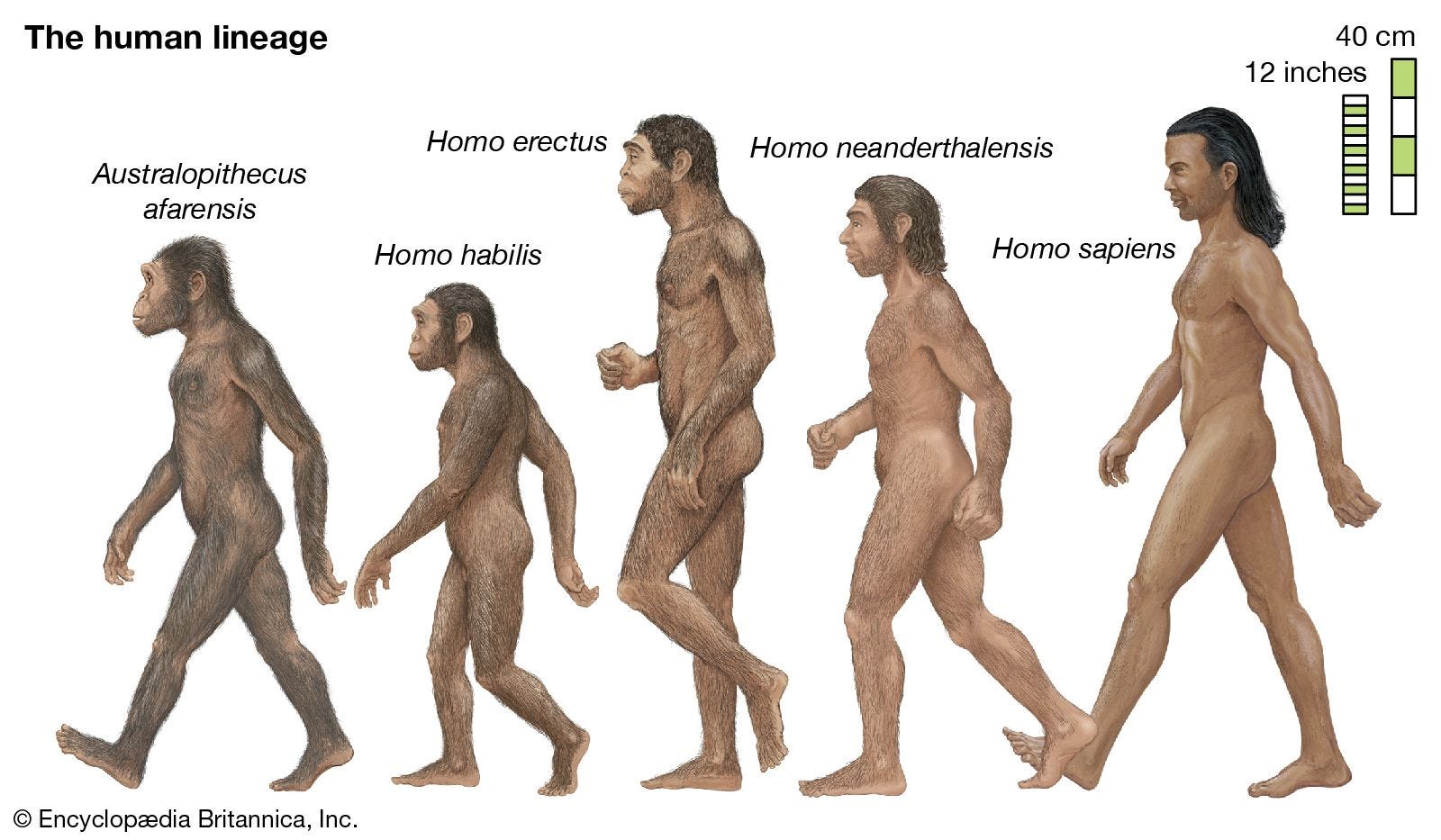
(Source: Britannica.com) - 300-200,000 years ago — Homo sapiens emerges alongside other hominins. Life in tribes and similar communities continues. Anthropologists like David Graeber discuss life in those tribes (see The Dawn of Everything), much of it deduced from a) life in the tribe groups that remain today, and b) descriptions of non-European life encountered by European “explorers.”
- 12,000 years ago — Groups of humans in unique and favorable regions (primarily near wetlands formed by large river deltas) begin to find that they can sustain themselves through a kind of natural agriculture, not fixed-field agriculture per se, but by settling near areas where food naturally reproduces itself. The lifestyle includes some hunting, some gathering, but not much moving around. This settled lifestyle occurs at various times in various parts of the world. In Mesopotamia, settlements like these begin to appear around 10,000 BCE.
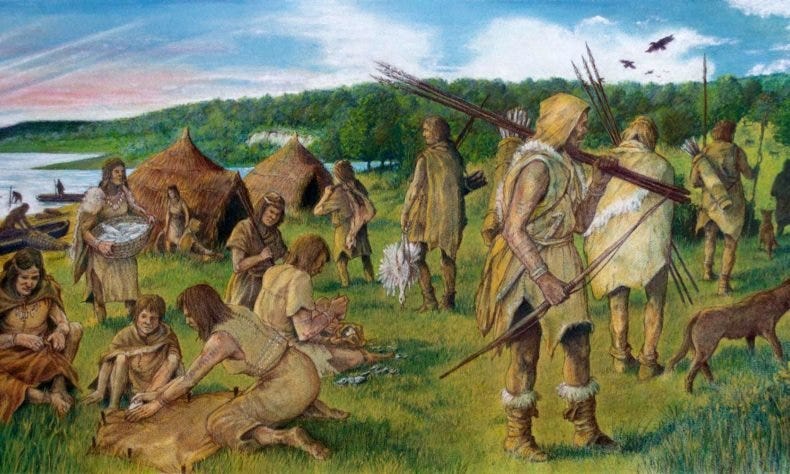
Pre-state life — artist’s rendering (source) - For the next few thousands of years, small villages or towns emerged in these settled areas, governed without rulers or kings; no states, no dynasties, no conquest of land.
- 3,000 BCE (5,000 years ago) and later — Finally, dynastic regions appear in Egypt, Sumeria, India, America and China. That is, in a few of these settled regions — not all, just a few — states and kings emerged. It took special conditions, detailed in Against the Grain, for the egalitarian power of tribal and small-village life to be converted to rule by the Few, to the power balance we know today as the State.
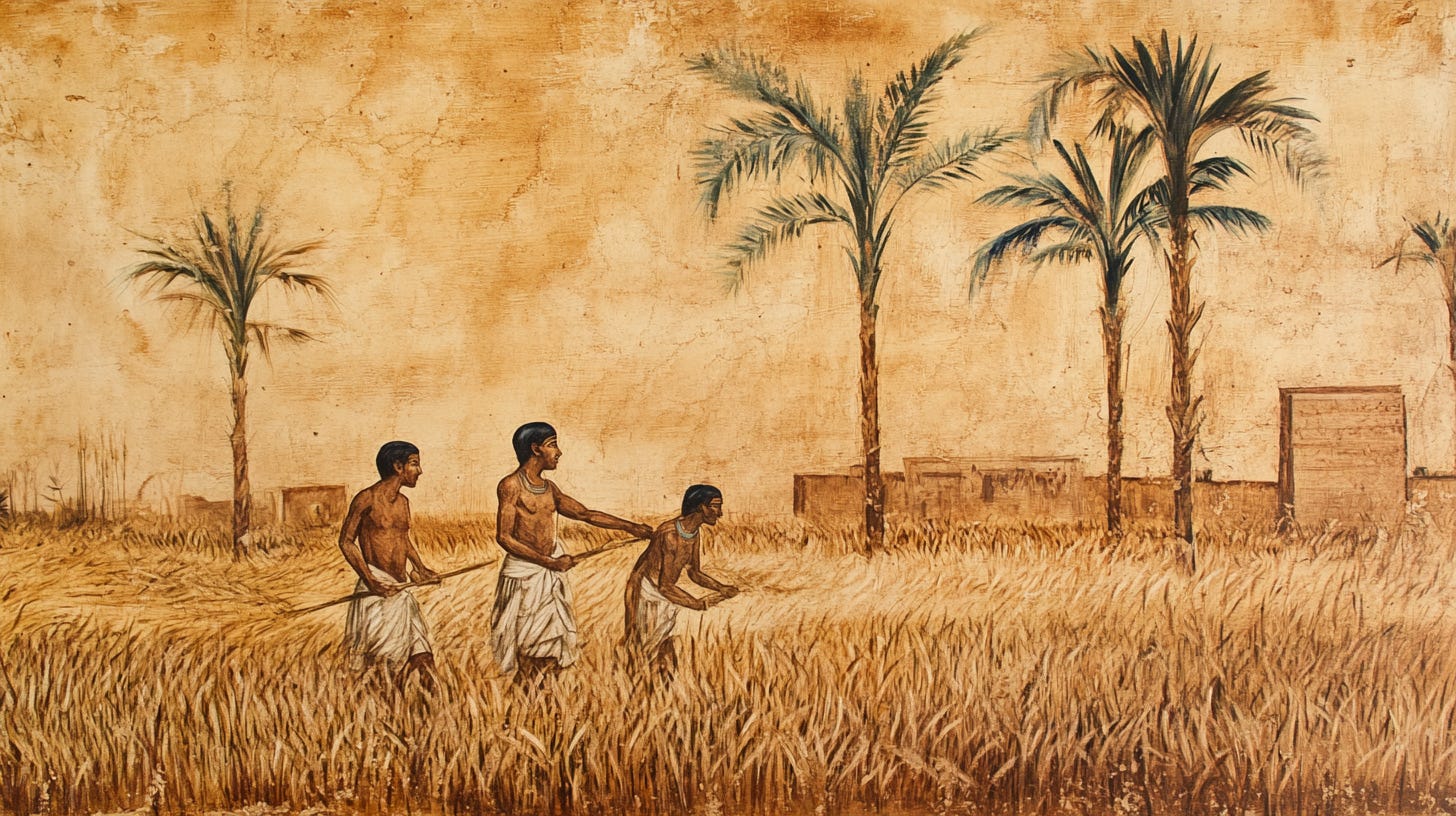 Post-state life: Peasants harvesting the Pharaoh’s grain in Ancient Egypt (source)
Conclusions:
- States do not represent inevitable and forward progress due to agriculture.They emerged only when conditions were ripe for the Few to take control of the Many, often by controlling the food that the Many depended on. A king can take over a town, for example, if the town depends on grain, an easily stored and hoarded food source. You can’t to the same if the primary food is yams, which resist storage and hoarding.
- States and kings aren’t the only way to organize large groups. The Iroquois Federation, for example, never had kings.
- Non-state societies don’t exist to enrich the Few, but to benefit the Many to the extent circumstances allow. States do the opposite.
- The natural state of humans is not life in states. We humans have lived in states for just one-eighth of one percent (0.125%) of our whole time on earth.
Democracy: Gift of the State or the Way We Began?
These thoughts lead in several directions. One is the nature of “democracy” as we know it today. Is “democracy” a structure like that which emerged in Athens, an Empire State? Or is “democracy” not a structure at all — not some kind of state — but a style, a way for groups to decide together? These aren’t the same thing.
Here’s David Graeber in his provocative essay, “There Never Was a West”:
I began this essay by suggesting that one can write the history of democracy in two very different ways. Either one can write a history of the word “democracy,” beginning with ancient Athens, or one can write a history of the sort of egalitarian decision-making procedures that in Athens came to be referred to as “democratic.”
Normally, we tend to assume the two are effectively identical … [T]his seems an odd assertion. Egalitarian communities have existed throughout human history—many of them far more egalitarian than fifth-century Athens—and they each had some kind of procedure for coming to decisions in matters of collective importance.
Which society is actually democratic, a group within the Iroquois Federation, where people decide together how resources are used — or a state where millions starve to death each year and the choices for king are a wealth-backed Democrat or a wealth-backed Republican?
Which group would you rather live in if you found yourself starving and outside the wealth of Few?
Rubio’s March of the ‘Free’ and ‘Dominant’ West
Another direction this line of thinking takes us is Secretary of State Marco Rubio’s recent speech at the Munich “security conference,” where he touted “freedom” and “liberal democracy” as Europe’s gift to the world:
It was here in Europe where the ideas that planted the seeds of liberty that changed the world were born.
But is the mission of “the West” really to bring freedom to all?
For five centuries, before the end of the Second World War, the West had been expanding – its missionaries, its pilgrims, its soldiers, its explorers pouring out from its shores to cross oceans, settle new continents, build vast empires extending out across the globe.
Missionaries, soldiers, vast empires, extending across the globe. A good thing according to Rubio, until things started to change.
But in 1945, for the first time since the age of Columbus, [the West] was contracting. … Against that backdrop, then, as now, many came to believe that the West’s age of dominance had come to an end and that our future was destined to be a faint and feeble echo of our past.
The “West’s age of dominance” indeed. See how “democracy” in that State-sanctioned, Ancient Greek sense gets confused for actual freedom?
Not Libertarian Freedom, But Freedom Itself
A final note: This, what I write, is not a libertarian screed. Every “libertarian” I know wants authoritarian rule the first minute she or he can lay hands on it. Freedom is code for power to people like these.
Instead I write in defense of community life — communist, socialist life, but without the State. No kings. No gods. No masters. Just people in self-loving groups deciding their lives.
Can we have this and still have a State? Many say yes, but I agree with Graeber; I don’t think we can.

50 comments

I think you need to to study paeloanthropology a big more. Human beings did not live in “tribal” groups until the neolithic. We lived in foraging “bands”, which were very small, less than 50 people, conforming to Dunbar numbers. “Reverse dominance” cultures. Tribes are much larger in number and usually have hierarchies of one kind or another. Do your homework, please.
Would like to focus on this. History, and many other things, are indeed path-dependent and that is too often missed. The somewhat higher-level term is ergodicity – the notion that a system/process will visit all its possible states eventually. A lot (most?) of our usual intuition about random/complex processes has the assumption of ergodicity, which in many cases is just false.
My pet case here is the fact that any real total civilization collapse means _no rebuilding_, because all the energy sources a man could get with “two arms and a heavy stick” have already been dug out and burnt, and there is no “state jump” that could change this.
Historical choices not merely choose a path, but actively prune out of existence other possibilities.
Graebers the dawn of everything is a masterful work, and this brief simplification does it no justice. I think the original material aptly avoids the Rousseauian trap you note, as well as the Manichean logic perceived within this article.
That’s said, this particular piece is nearly insulting in its poor use of Graebers ideas, and as rightly noted above, transparently hyperbolic as well.
I encourage everyone at NC to read the dawn of everything (or, as I did, listen to the audio). There are multiple excellent threads of critique within, and it truly is a masterpiece of contemporary anarchism.
+1 on this. Credit were due, Graeber had a coauthor, archeologist David Wengrow. Dawn of Everything is also a very entertaining read.
I think that Against the Grain provides some complementary information to the Dawn, explayning some material causes/levers used. In the Fertile Crescent, agriculture was not only imposed but ultimately sought, because of reduction in wildlife for hunting, which was less the case for North/South America, where human occupation was quite recent. People could really move away and live of the land…
>path dependent
If the natural barriers in northern China weren’t given away at the end of the Tang dynasty so that the Song dynasty could develop without the Mongols bearing down, I wonder if we might have seen a different model of industrialization as they had made some progress before being rather rudely interrupted.
what you and graeber kinda miss is those 5 century of western ‘expansion’ weren’t done in a vacuum.
while the spanish/portugese enslaved the new world for example the ottomans conducted slave taking expeditions in the balkans, the north africans preyed on maritime traffic etc.
there is nothing the west done that wasn’t done by others before or it wasn’t done to them.
while i acknowledge the need to atone for past mistakes i really don’t think that making the west the scapegoat of history is productive.
and yes, there were myriads of ‘egalitarian’ societies but guess what, the west is one of the very few, maybe the only, that had the optimum combination of violence and idealism to survive AND ‘perpetuate'(in a memetic sense); with all due respect for china they still had slavery as an institution in the 20th century.
This is a fair criticism of the dawn of everything. I would appreciate more inclusion of eastern history, but given it’s mass I understand the exclusion. I think the conclusions without the global reference are nonetheless valuable, and the analytical framework a tool worthy of wide thought experimentation
i am not happy with their analysis of state as something imposed on society tbh.
i believe that the first ‘we’ that didn’t mean the immediate blood-relations is in fact the germ of the ‘state’ and we shouldn’t do away with it but reclaim it as the ‘vessel’ that contains the ‘we’ and take proper steps to make hijacking of it by sub-groups impossible.
RE: state imposed on society
The hard part is that today the state is all there is and none of us were there previously to know how things came into being. Scott has another really interesting book – The Art of Not Being Governed: An Anarchist History of Upland Southeast Asia Here he argues that a lot of ethnic groups took to the hills in SE Asia throughout history in order to escape the states that developed and put restrictions on freedoms. He also argues that that is no longer possible due to modern communication and transportation making it possible for the taxman to find you pretty much anywhere.
I enjoyed Dawn of Everything but their was quite a bit of handwaving in their analyses not backed up by anything concrete. But it does speak to Graeber’s strong belief that another world is possible, and that was my main takeaway from the book. Perhaps one of those possibilities is for people to choose to have a benevolent state. The one DJG mentions below – a folk culture more attuned to the natural world, but with modern plumbing – sounds pretty nice to me.
The west engaged in chattel slavery, a marked difference from other types of slavery or indentured survitude. There is no precedent for what the West engaged in, Ive never heard of North Africans or Balkans having breeding plantations. The descendants of the formerly enslaved in the West face systemic obstacles and racism that is not present in the same form in the rest of the world as evidenced by regimes throughout history taking tips from Western slave countries on how to oppress their populations.
The Dawn doesn’t shy away of sensitive topics (slavery). In fact it has quite an expansive section dedicated to the Pacific NW societies and the demarcation line somewhere in Oregon, between “libertarians/individualistic” societies in the south and “aristocratic/sclavagist” societies in the north.
But I guess it is easy to forget, because in the Dawn, the two Davids ultimately insist on the smorgarboard of organizational types that humans have developed. That was their greatest point. Societies are human construct and the diversity of them was as great as the folk costumes around the world.
The west deserves all of the “scapegoating” it gets, and more, as a counterweight against the egregious amount of propaganda it has generated across the centuries in order to minimize and justify its global depredations.
> where millions starve to death each year
Millions? Really?
According to the link in the article, yearly starvation deaths in the US are 0.89/100000 inhabitants, which comes down to some 3100 deaths per year.
I saw this: 0.89/100.000
Thanks for the note. That paragraph was revised at the source:
https://neuburger.substack.com/p/the-myth-of-the-west-democracy-and
Unfortunately, the emailed version contained the unrevised passage.
Thomas
The correction is appropriate but we have to remember that death of starvation is the tip of the iceberg. Look bellow and you’ll see what chronic malnutrition does with the body and the mind and the life expectancy… And in badly organized and run societies, actual death through starvation can reach millions: Ireland, China, India are well documented in modern times…
About the same risk as dying of asthma, drowning, or in a fire (https://theworlddata.com/death-statistics-in-the-us/)
I am not a fan of Rubio’s, but I mean, come on.
May I suggest that those interested in an extended argument that human societies did not (and perhaps, do not) inevitably face a binary decision between humane, personally fulfilling ways of life, and authoritarian rule by malignant narcissists should check out “The Dawn of Everything” by David Graeber and David Wengrow.
Neuberger’s link to the LA Review of Books article is valuable: I’m not sure that I agree with everything Sartwell writes, either.
The great dilemma is embodied in Yves Smith’s headnote and Neuberger’s main text: The folk tradition versus the clear-cutting that is modern industrial organization. Years back, I read an essay by an anthropologist also of the Sahlins tradition. He ended his essay by writing that he would prefer to live in a folk culture (with its seasonal rhythms, festivals, customs, feasting and fasting) so long as he could import modern plumbing.
This same dilemma is exemplified by the destruction of public-health measures in the US of A, which Naked Capitalism has had to document in great detail these past five years. Nasty, brutish, and short? Bring back measles, cholera, diphtheria, child-birth fever through lack of vaccination and lack of due care. This is what we should note about earlier times — the endless miscarriages, the deaths of women after deliveries, the high mortality rates among children.
The dilemma also becomes: What happens when the many are indeed Many? There has been plenty of speculation that the first governments and city-states arose in response to water management. Mesopotamia and Egypt are obvious cases, as is China, as is Angkor Wat and Cambodia.
Here in the Chocolate City, this last, water, has been impressed on me: The Valley of the Po gets a tremendous amount of rain. Further, I discovered that its volume of water is “outsized” for the relatively small area of the Pianura Padana. Consequently water management has been, errrr, an issue, and not just in Venice.
At various points in history, too, much of Italy was city-states. Were they the largest viable state? The Etruscan twelve-city league endured — and lost out to Roma.
But back to folk / industrial culture. Something else impressed on me in Italy is that Italian “conservatism,” which is more curatorship that reaction. One must not diddle too much with grandmas’s recipes. In our town, these are the Christmas specialties. In the spring, the primizie (first fruits) and various greens arrive — part of the rhythm of life, but also part of sustenance and plain scrounging for food. Luckily, I am the beneficiary in that the pink radicchio (gorgeous) is still in season and the barbabuc (one of the first roots to seek out in spring) is now arriving.
In short: The Anglo-American world, but particularly the U S of A, destroyed its folk culture. Disney bought out Snow White. Overly sweet tomatoes are available all year. Black Friday is a holiday. So the options are closed off in the U S of A. Or are they?
“…sustenance and scrounging for food…”
Our daughter was in School Year Abroad in Viterbo, west/northwest of Rome. We went over to visit for Christmas, relieve her host family. In Torino, I found an english-language book on the history of Italian cuisine, my curiosity whetted by multiple visits to the sprawling former Fiat warehouse complex “Eataly”- imagine five costcos teeming with fantastic foodstuffs.
According to the book’s author, Italian Cuisine and celebratory food culture really came into force after WW2 and re-industrialization/ modernity from rebuild of war’s devastation.
I had no idea how persistent and widespread food shortages and foraging played a role in Italian history (possibly all older “civilized” nation-states. I’m pretty naive!!)
Folks literally were forced to eat micro-seeds, forbs, shoots… really jaw-droppingly nasty, brutish, and short. No dogs present for a dog-eat-dog world. They apparently had been extirpated!
Interesting times? We ain’t seen nuthin’, yet!
History is path dependent- so why not our future? The analogy that works for my simple mind is the Lemming over the brink paradigm to which we put all our energy and time- cradle-to grave.
Why not stand up on a tall bolder and get out of the teeming stream of rat-racers?
Better yet, lets all us take a hard ninety degree turn and avoid the brink? Divided, we fall.
We? Us? This collective sense needs to be re-discovered and cultivated.
Resist. Eschew. Espit out. Self-restrain. Withhold dollars and consent.
Demand concessions from power for people: no more private socializing for tech broligarchs and well-paid executives and managers grifting from byzantine layers of extractive businesses.
Maybe we are pruning paths, precluding sustainable futures… I’d say that is not ‘we’, but the abusive power people and institutions– like Nation-States. Our my cute local City government!
The other maddening notion that bangs around my head is , “unrealized potential”
Boy are we knee deep in that Big Muddy as a species on an amazing finite world!
Italy now has Black Friday too…
gk:
Don’t get me going. Walking down the block and around the corner in the morning to the edicola for the daily Fatto Quotidiano, I have been treated to signs such as
Black Friday Weekend
Black Week
I keep trying to explain that these signs come off as the titles of slasher/psycho movies.
I won’t even mention the weird use of the U.S.-imported term “uomini bianchi.”
Lucky for me (?), I keep getting confirmation that U.S. influence on Italian economic thinking and culture is pernicious.
It’s the 21st century yet with his invocation of the Iroquois Federation, it is the Myth of the Nobel Savage all over again. Can we get real here? The Iroquois Federation had a population of maybe 80,000 people. The present day population of the US is about 335 million people. You cannot run a country of this size on the principles of an 18th century tribal association. In fact, population is what it is all about. When you get a critical mass of people you need to have some sort of recognized leadership for things like coordination and allocation of resources. You can have different people trying to persuade the populace of measures that needed to be done but you still need a leadership to carry them out and over a period of time. Speaking of ancient times from this article, you cannot build a dam or a drainage system or defend the people of a region from external force unless you have a leadership in place and god forbid that you have a committee running a government. Otherwise it would be like a government run by the “People’s Front of Judea”-
https://www.youtube.com/watch?v=YawagQ6lLrA (1:41 mins)
I think the People’s Front of Judea defines the approach of the West’s current leadership whether in form of the financialised electoral corruption of the US, the liberal totalitarianism of the unelected officials EU and NATO officials fantasising about the maintenance of Western hegemony, or that secreted from the curdling stews and dives of the UK parliamentary system, and that is the problem. A vote without representation and the absolute unwillingness to accept accountability for any decision however f*cked up the consequences.
Don’t know if you are or are not familiar with any of the more recent writing / history of the Haudenosaunee (Iroquois) which addresses some of the social & political structure (I’ve heard more than one chief or clan mother say “the fledgling United States got it’s ideas about confederation from us, but you got it wrong with the idea of separating church and state”), but here are three books I think are well worth the time:
1. “Basic Call to Consciousness” (Akwasasnee Notes, 1991) https://www.bookpubco.com/native-voices-books/p/basic-call-to-consciousness
2. “Sisters In Spirit: Haudenosaunee (Iroquois) Influence on Early American Feminists“ by Sally Roesch Wagner (Native Voices, 2001) https://www.bookpubco.com/native-voices-books/p/sisters-in-spirit
3. “ The Mohawk Warrior Society: A Handbook on Sovereignty and Survival” by Louis Karoniaktajeh Hall (PM Press, 2023) https://pmpress.org/index.php?l=product_detail&p=1266
All deeply interesting with the third book on the Warrior Society perhaps the most controversial as it documents an ideological split within the Confederacy which at some point blames the early leadership of the Confederacy for the failure to defend against the first waves of North American colonialism because they legislated against full membership for any tribes who weren’t part of the original founding five. If historically accurate, the claim is that while the Confederacy at its height spanned a geography reaching north, south, and west — the lack of full, decision-making membership made it easier for the Dutch / French / English and eventually Americans to play off social divisions within the larger network of tribes to weaken what could have been a massive unified force defending against encroachment.
I highly recommend Tom Murphy’s blog Do The Math for anyone interested in this topic!
And a good place to start is Murphy’s multi-part series on Daniel Quinn’s Ishmael. The Taker/Leaver distinction is a valuable one.
I’ve just started a new book on the same topic: “Goliath’s Curse” by Luke Kemp. My sense is it offers a more nuanced, and perhaps pessimistic view of human history than Graeber and Wengrow do. It’s subtitled “The History and Future of Societal Collapse”. Recommended.
I like Kemp’s characterization of the State as a criminal gang, extorting its population with offers they can’t refuse. Here’s a good teaser for the book: Nate Hagens interviews Luke Kemp.
I liked ‘The Dawn of Everything’. As I remember European contact with North American natives sparked thoughts on how people were governed. The French priests reported extensively on the cultures they encountered. Montesquieu was one political theorist which ‘The Dawn of Everything’ attempted to show his thoughts were stimulated by the cultures of governance in North America. Locke was also aware of the same information.
1650 -1750 were the years of great debate on The Social Contract. Outside information provided a perspective on alternative ways of doing things.
The ‘anti-system’ voter has been around for a long time. Certainly Obama was the promise to many of being another FDR for example – anti the system of neoliberalism.
Historically, I had an epiphany when I learned the ante-bellum South Carolina was the richest state in the Union. I think there were a bunch of rich people who always got their way and it logically lead them to secession. Our current society is run by a bunch of rich people who want to secede – Freedom Cities. Trump is one of them.
Today, post Russian revolution, TINA rules. No alternative way of doing things is allowed to exist and provide perspective. It is obvious the current “leaders” of ‘western’ society is not providing for their citizens. Personally my rule of thumb is: “when the tribe is Hungary so is the chief.”
The
…can we talk about the 38 trillion pound gorilla in the closet?
We are all on the fiat system, every last country in the world.
Its the only thing anybody alive can remember in terms of money, and i’m cool with it continuing apace, gimme another 20 years of what amounts to Money Tree economics, before I check out.
We have a mad man who is pushing the rest of the world against us, and quite gleefully too.
Comeuppance see me sometime~
Everything in Money Tree economics revolves around the almighty buck, take that away as the underpinning pivot, and what replaces it?
That’s how the curtain call comes down on the Golden Billion, a role reversal for the west.
a demobracy, if you can keep it.
I appreciate that its a very brief overview of a complex topic, but there has been an overwhelming amount of recent scholarship indicating that many societies we previously thought to be relatively peace loving and benign were anything but. We know of massacres dating back to the paleolithic and there is no shortage of evidence of brutality, slavery and genocide on every continent and every time period up to the present.
Of course, everything is relative – many societies survived and thrived for long periods without being ‘relatively’ war-loving or brutal – just as some early societies had a level of sociopathy that makes some modern day slaughters look positively minor. There seems little doubt that evolution selected for a percentage of the population to thrive through psychopathic behavior, and group dynamics have often selected for especially aggressive tribes/nations/peoples. Even when historically some societies worked very hard at building peaceful, relatively harmonious cultures (for example, Edo period Japan), it was often at the expense of something else – either aggression across borders or rigidly and brutally enforced codes to suppress dissent. The Iroquois Federation, to address the example given, was very admirable and successful in enforcing peace between the membership tribes, but one of its first acts was to use its unified status to attack and steal the land from neighbouring peoples.
If there is any lesson from history and pre-history it is that ‘relatively’ peaceful societies are possible, but they are exceptionally hard to create, and even harder to maintain in the long term. History is a constant dynamic between the human desire for a safe, peaceful life, and the desire for land, material goods, glory and revenge for real or perceived slights. Those dynamics are inside each one of us, within each family, within each tribe, clan, nation and confederacy.
Yes. The confirmation bias of educated academics – or famous social philosophers – is much more highly developed and influential than that of the less educated “deplorables” we often criticize. We become skilled in choosing the examples to “prove” what we want to believe.
As an undergraduate (long, long ago) I had an anthropology professor make this point by having us compare the views of human nature and early tribal society expressed in two famous books: ‘The Forest People’ by Colin Turnbull, and ‘The Yanomamo’ by Napoleon Chagnon. Those familiar with these works will already get the point. Turnbull’s was the story of a gentle egalitarian tribe (the Mbuti pygmies) who were in harmony with nature and each other. Chagnon’s was of a violent and warlike tribe that illustrated Hobbes’ perspective quite well. The two authors tended to draw opposite lessons about our “natural” state based on their experiences. My professor’s points were (1) there is not one “state of nature,” but a wide variety of examples shaped by different histories, geographies, access to resources, interactions with other cultures, etc. And (2) beware of confirmation bias by academics! He also shared some “inside anthropology” stories on the relative personalities of these two researchers that he felt shaped their respective views on human nature and choice of research subjects.
I think your last paragraph is an excellent summary statement. Constructing a social or political system that balances these forces is one of our highest, and perhaps rarest, achievements.
At this point in time the majority of the world population is domesticated, only with the elites affording to be baying for blood and send people to death protected by their positions…
Lots of chatter about Graeber. My best friend is an enthusiast. He loaned me Toward an Anthropological Theory of Value. My initial excitement faded after the first chapter as I got lost in the weeds.
Somehow I can’t get past Polanyi’s theory of reciprocity and redistribution being embedded in social relations, and how hyper-market economies crush these social relations. Well, we had the Potlach. I say “we” because it really wasn’t that long ago. Anyway, the missionaries put paid to that, which tells you all you need to know about spreading the “true faith.”
Any pol that would seriously propose such heretical ideas would have to wear a strong suit of armor to avoid being damaged by the exploding heads.
The logic of civilization, as we understand that word now, is the logic of cancer. On its own terms it is highly successful at growing, making use of more and more resources, being more efficient at what it does, having a simplified agenda that doesn’t have to recognize the needs of other entities, maximizing the returns it gets on what it expends energetically. And high modernism has been the perfection of the civilization project because it goes all in on efficiency, simplification, and maximization as guiding principles. Hierarchy at the scale of sizable populations is an exemplar of those three principles. However, the logic of cancer leads to death for its host and for itself, and civilization (as we understand that word now) will eventually lead to the death of its host, the biosphere we depend on. The dreams of Musk and those other tech bro idiots for seeding humanity on other planets is a tacit admission on their part that they follow the logic of what is going on and accept that the host can certainly die as long as they don’t die too. The question, as always, is how can you devise a system that can compete with an opponent that follows the logic of cancer? That can be flexible rather than simplifying, sustainable rather than maximizing, and resilient rather than efficient, and still overcome the remorseless logic of the opponent?
The biggest exception that I take to the elimination of the state is that currently 58% of the world’s population are city dwellers (81 percent “urbanized” in cities or towns), expected to rise to 68% (83% “urbanized” in cities or towns) by 2050. It requires elaborate organization to feed this significant majority for whom it is impossible to access clean water or gather food on their own.
If you’ve ever raised children you have seen that Freud’s elaboration of the progression from id to ego to superego is pretty spot-on. It seems to me that when social structures that channel our natural greed into empathy are weakened or eliminated, then we devolve into the elite hoarding and rationing of goods that characterize the “bad” state.
In the current state of world affairs, Xi Jinping and Donald Trump stand at opposing ends of this spectrum.
I would not be so hard on Thomas as some of the comments because I appreciate that he has tackled this topic. Moreover, I think he’s headed in the right direction even if there are some issues along the way.
What Neuburger is engaged in here is mythmaking. That’s not a criticism, just the opposite. We’re in desperate need of new myths to replace the pernicious myth of “progress” that is driving the Sixth Mass Extinction. The projects deemed “progress” by our Modernist myth, from the pyramids to AI gods, would never have been possible without organizing large numbers of humans beings and gathering massive amounts of resources using a State apparatus. Bands under Dunbar’s number are never going to build an Apollo Project.
These projects, while they may have temporarily elevated the status of some Pharaoh or made a nation state the most powerful collection of humans on the planet for a while, always come with a heavy cost for the masses in that society, but more importantly in the long run, they have degraded the Earth and its ability to support life. If we discard our immoral human exceptionalism for a while (physicist Tom Murphy, cited above, is good on this), it seems clear that staying under Dunbar’s number is the only sure way that humans can restrain ourselves from reaching a point where we’re dropping H-bombs or geoengineering the Earth to the detriment of all. Elephants and gorillas have the good sense not to build skyscrapers and GPUs, but Homo faber does not.
Now does such an observation have any current political relevance? Of course not. We may not be such enthusiastic defenders of the Conquistador worldview as Marco Rubio, but no one is going to vote for doing what Timothy Leary advocated in the Houseboat Summit: breaking into small bands and returning to the land. Chris Smaje gets attacked for just advocating a return to subsistence farming as an alternative to Big Ag.
I’m sorry to say–especially since I have grandchildren I love–that I regard politics as moot at this point. There are too many crises and too awful a leadership elite to escape disaster. For me, the question is what will a human remnant, if Gaia grants such a thing, believe about what happened to humanity and the planet that formed and nurtured it? Will that remnant double down on the Conquistador worldview and rape and pillage Mad Max style? Will it devour the apple a second time and head off to mass organize to build new pyramids and H-bombs? Or will humanity learn its lesson, one taught by Wendell Berry, that what is good for the Earth is good for us? If we can “advance” that far, a sort of going forward to the past, maybe we can learn how to corral our genetic impulses to acquire “stuff” and power and live in harmony with the life that shares this planet, but until that humanity has gained that wisdom, any human remnant should consider it taboo to increase the size of any band or tribe beyond Dunbar’s number.
I don’t think the Graeber and Wengrow team understands how social determinism works. An agricultural surpluses creates the means to raise armies, not the inevitability. However, once you have horse mounted warriors and mines productive enough to make a lot of weapons, your pockets of peace loving, yam eating, egalitarian, stateless peasants are going to be under threat to the point of reaching marginality. That’s why feudalism spread everywhere sufficiently developed. Capitalist democracy, imperfect as it is, was a big improvement and distinct from the sorts of marginal situations that interest these types of anarchists.
i’d have to sort through Greaber / Wengrow and a couple other books to find the source, but according to my memory, “An agricultural surpluses creates the means to raise armies, not the inevitability,” is directly addressed with the point that once a peaceful society is confronted by a warring society and finds themselves forced to use surplus to create a defensive military, the process will likely unfold over one or two generations at which point the social divisions are in place with “no going back.” I’m paraphrasing from memory, but having come up politically around quakers and pacifists during the Persian Gulf War, the topic of nonviolence was in hot debate, along with utopianism.
For me this took place in Syracuse, NY (a city leasing it’s land on 99-year rotation from the Onondaga Nation), where the Iroquois — in particular Onondaga, Mohawk, and Oneida — have at least tangental local political and social influence.
I don’t mean to disparage that sort of utopian and community based experimentation. The point I was trying to make is that mass democracy is something historically distinct and related to the historical conditions that allow the populace to set themself free of feudal warlords (I have Beethoven’s Eroica playing in my head). If our counter-examples is the Iroquois Confederation (what happened to them? Not sure I’d want to follow their example!), it seems like a case that disproves the rule G&W want to establish.
Yes, sorry, I’m not sure I’m articulating the point I’m trying to make — I’m not talking about utopian / community-based experimentation (a reference I made specially because upstate NY did host utopian experiments like the 19th century Oneida Community).
Instead I’m responding to language like “what happened to them?” that past-tenses Indigenous communities domestically especially, but also internationally, while there are a plentitude of examples of how living Indigenous scholarship and activism is enacting real-world changes.
In a comment above to The Rev Kev, I link to three books including the Akwesasne Notes published, “Basic Call to Consciousness” which documents mid-20th century Iroquois activism that resulted in bringing international attention to US genocide of Native peoples in the wake of WWII war crimes prosecution.
And within the Iroquois Confederacy, the Onondaga people are the only tribe who never accepted support from the US gov’t beyond the agreements set out in the 1794 Treaty of Canandaigua, which arguably makes them the only legally recognized non-US nation within in the borders of the contiguous US (to the point that there’s still an annual delivery of salt and cloth to the Confederacy). This status has allowed them to claim non-nation status at the UN and allows them to travel internationally on their own passports.
The recognition of their sovereign status and it’s use as legal precedent by other global and domestic indigenous communities is too long and complex to comment on here, but I think it’s safe to say that ongoing, global recognition of indigenous sovereignty is one of the things that “happened to them” in recent decades.
Another excellent but out of print book (I’m sure available through the library) is called, “Treaty of Canandaigua 1794: 200 Years of Treaty Relations Between the Iroquois Confederacy and the United States” by editors G. Peter Jemison, Anna M. Schein, Irving Powles) (Clear Light Pub, 2000) that leans into Quaker and Dutch historical documents to shed light on the societies encountered by early contact by colonial forces.
But my first impulse to comment came from The Rev Kev’s ascribing the references to the Iroquois as “the Myth of the Nobel Savage all over again.” There’s plenty of that around in popular new age self help bullshit and fiction, but there are also living, active communities impacting how environmental, land-rights, and sovereignty are respected in the global legal framework and that’s what I’ve read into this author’s (or G&W’s) “invocation of the Iroquois Federation.”
“The Myth of the West: Democracy and the State” isn’t a perfect article but I think there’s a lot in it that makes for a good thought and conversation generator.
Rather than the too-common tendency to look at the ever-shifting wisps of anthropological speculation that too-often get treated as hard science—however fascinating–I find more value in trusting the words and works of living Indigenous communities and their struggles — and the documented impact they have on US politics.
Apologies in advance for the length of this comment but honestly it’s rare I find non-Native people who’ve dug into this literature, even among people who might call themselves anti-colonialists—an experience which reminds me of how as a young white activist during the 80s/90s in my 20s it was uncommon — myself included — for men to read women authors, or white people to read authors of color. That feels like somewhere we’ve experienced a sea change for the better now, and I genuinely hope the same will be eventually true for recognition of living Indigeneity scholarship and history here in the US.
I appreciate the comments, all.
As to my defense of the “noble savage”, that’s an interpolation. My focus is not the mythical and absolute goodness of non-state life — that’s truly a myth — but on the clear and definite badness of state life wrt coercion. That’s really my main point.
Graeber makes it clear — and he’s obviously right — that non-state groups are organized in a vast variety of ways, some warlike, some awful, some peaceful, and some just idiosyncratic and strange. The key for him (and me) is their variety. My focus is not on them; it’s on the State and its nature, the uniqueness of its coercion and the way decisions are made — totally top-down. In my view, we need to recognize the State for what it is. Thus my focus.
What’s obscures this discussion, understandably, is that in the West, we had relatively recent socialist and semi-socialist states, some in response to the 30s and the Great Depression (the US), or, in the 50s, in response to WWII (UK, etc.). This brings more people within the circle of protection enjoyed by the Very Few and obscures the coercion — for them.
This larger middle class is quickly disappearing, especially in the UK and the US, but memory persist. The modern, temporarily enlarged middle class is an historical aberration, at least in my view. No one replanted among the masses in New York in 1900 would love the State.
And type reverts to type even after coercion relaxes: The Few inevitably (in my view) recapture the State, if the apparatus of coercion remains, and carry on as before. In states, the Few always exist, and state capture is always their goal. (Examples of states not persisting: Mycenaean Greece, which disappeared. Examples of states recovering and carrying on: Post-Carter America and the deteriorating lives today.)
Anyway, glad as always to read the discussion.
Thomas
What a fun discussion your article set off. I think it’s a topic people need to talk about.
Very relevant to your piece is the Youtube “Frankly” published by Nate Hagens today. It’s titled, “Humanity as Dr. Jekkyl and Mr Hyde; the Symptoms, Patterns, and Drivers.”
Hagens identifies human aggregations beyond Dunbar’s number as undergoing a “phase shift” that turns traits useful when we were hunting as bands into characteristics that are destructive to ourselves and the rest of life on the planet. I had to laugh that my out-of-left-field comment above was partially echoed by Hagens on his Youtube today.
Much is said here about humans and what humans did thousands of years ago and eventually bringing us to Rubio’s remark, “It was here in Europe where the ideas that planted the seeds of liberty that changed the world were born.” It was also in Europe where the industrial and scientific revolutions began. As far as I’m concerned, that doesn’t mean Europeans are special, it means, imo, unlike everybody else, they were more lucky.
My experience with farming is limited but I know it’s hard work. Preindustrial agriculture in general, on family farms, was a struggle. What we don’t appreciate is the existence of grass feeding animals. Unlike, meat eating predators, like wolves, lions, bears, etc., which you will never domesticate, grass feeding animals: cattle, horses, sheep, goats, chickens, camels, etc. were domesticated.
Plowing a field by yourself with hand tools is hard work; there is only so much you can do. An ox is a castrated male cattle, strong, mild temperament, and capable of being trained to work. Later came the domesticated horse, donkey, and mule. A mule is stronger and more sure footed than a horse. And put to work these animals massively increased the productivity of agriculture. The horse, being more versatile also provided rapid transportation.
Together with the above animals, raising sheep, goats, chickens or whatever provided nutritious milk, cheese, butter, meat.
These animals originate from the levant and West Asia, and spread to Europe and East Asia. They did not exist in sub-Saharan Africa or North and South America but were brought there by European explorers.
The bison in North America could not be domesticated. In an age of wooden spears and stone tools a hunting party to kill a bison for food but capturing and containing it was impossible; the bison was too powerful. In South America the llama was domesticated and did some work but not nearly as flexible as the horse.
Domesticated animals freed Europeans and Asians to spend time exploring what else life might have to offer.
And I thought that the wolf (dog) was the first domesticated animal…
The issue is not which came first. Dogs descended from wolves but their impact on agriculture productivity does not compare to cattle and horses. Whether pulling a plow or a wagon filled with lumber, oxen and horses dramatically improved human living standards.
Thomas, I am in sympathy with your goal (the clear and definite badness of state life with coercion), but I would argue that the apparent methodological individualism of both you and Graeber also cause a different set of problems.
Homo sapien hunter-gatherers seemed to exist first as groups and never only as individuals. It is inside the group that strict notions of equality and inequality gradually develop. A wonderful tautology.
The group seems to hold together because it pre-exists differentiation and individuality. They are neither egalitarian or inegalitarian, neither patrilineal or matrilineal.
The hypothesis of an inequality that emerges as an expression of a tendency of the individual seems unrealistic and perhaps logically impossible especially if we think/believe there is no rich man without a poor man or master without a slave, or superior individual without reference to a group. (See anthropological writings of Emmanuel Todd)
It is the collective that allows for inequality not the individual.
> Instead I write in defense of community life — communist, socialist life, but without the State.
Thanks so much for posting this today Yves. It is an encapsulation of something I’ve been feeling lately – a void. Something is missing in all this western belligerence and the tepid, restrained reaction to it by states ostensibly against it.
The excerpt above speaks to it … and iI believe that it … is solidarity.
Where is the solidarity?!
I wrote the following in a tweet that is now protected (no longer public) to articulate the emptiness in calls for unity by the liberal political establishment, and to emphasize the better choice:
[Un*x edit: s/America/The World/]
During the Cold War, there was a sense of solidarity among Socialist and Communists states and their peoples. This is sadly eroded IMO. I think that international solidarity needs to be rebuilt in a way that either subsumes or circumvents “states”.