Yves here. Richard Murphy contends that stock prices could fall by 50%. That may seem a bit extreme until you look at how badly overvalued AI shares are. From a recent post, Bank of International Settlements Warns That AI Crash Could Produce Investment Drought, Economic Contraction and Even a Crisis:
We have embedded the germane section of the BIS Annual Economic Report at the end of this post. The Financial Times made it their lead story:
And the money chart from their write-up:
Note this graphic plots only tech-related bubbles and not real estate ones, which are represent a very large component of collective wealth and are levered on top of that, so that a big fall in value is deflationary. Even so, note how tame the dot-com bubble looks even thought, at the time, its magnitude compared to post-Depression levels was worrisome, even before getting to proof-of-mania practices like valuing companies based on eyeballs. But as you can see, the 1920 boom was even worse. In addition to its its much greater severity, its use of leverage was the reason the bust blew back so hard to the economy. High levels of margin debt wound up generating large losses to banks. The stock market then also had leveraged structures, such as trust of trusts and trust of trusts of trust, that were a lot like the crisis-era collateralized debt obligations.
Even though strict securities laws limit margin debt, the current level is flashing red:
There hasn’t been a better time in a long while to review the quality of your portfolio.
History offers a clear verdict on rising margin debt.
Don’t let FOMO sway you. https://t.co/plx60LYayI pic.twitter.com/q0JXa7VvVE
— Thierry from arvy 🇨🇭 (@ThierryBorgeat) June 27, 2026


The fact that the AI mania makes the dot-com era look tame should focus some minds.
By Richard Murphy, Emeritus Professor of Accounting Practice at Sheffield University Management School and a director of Tax Research LLP. Originally published at Funding the Future
Stock markets in the United States and the United Kingdom are flashing increasingly serious warning signs. Share prices are at extreme valuations, confidence is weakening, and the artificial intelligence boom is beginning to look much less convincing than investors expected.
In this video, I explain why these risks are reinforcing each other and why the consequences could extend far beyond those who directly own shares.
Robert Shiller’s cyclically adjusted price-to-earnings ratio, commonly known as the CAPE ratio, is now close to levels previously associated with the Wall Street crash of 1929 and the dot-com bubble of 2000. History does not tell us exactly when markets will fall, but it does tell us that valuations of this kind cannot be assumed to continue indefinitely.
The danger is not confined to the stock market. Banks and shadow banks have lent vast sums against inflated financial assets. A sharp fall in share prices could therefore spread through the financial system, threaten pensions, undermine lending and create a wider economic crisis.
AI may provide the trigger. The technology is expensive, unreliable and taking longer to implement than many forecasts assumed. If expected profits fail to materialise, the companies supporting today’s extraordinary market valuations could fall sharply.
Is Andy Burnham’s government prepared for that possibility? There is little evidence that it is.
This is the audio version:
The Debate Ammunition for this video is available here.
This is the transcript:
I know I keep on saying that stock markets in the UK and in the USA might crash sometime soon, and I’m going to say it again in this video. Sometime soon I think we’re going to see them topple over the edge, and the value of stock markets is going to tumble. By how much? Well, if we follow the precedents, by up to 50%. That’s what the data tells me, but this video is about more than data.
There are a number of factors which are coming together now to suggest we are facing a crisis, and I’m not now the only person saying it. Martin Wolf in the Financial Times is saying things like this. We are seeing the financial warnings growing. It is time to take them seriously. It is time for our government to take them seriously. This is a crisis of this moment, and it’s one that’s going to happen during the premiership of Andy Burnham. Is he prepared for it? That’s my question.
The warning signs within our economy are now becoming very much harder to ignore. I think there are three of them.
The first is that confidence is weakening right across our society.
The second is that the AI boom is showing serious signs of weakness right now, and I think that’s going to get worse.
And the third is that share prices have reached extreme valuations.
All of these risks reinforce each other. They compound, and they could spill over into other parts of the economy as well, and that’s what I’m worried about.
Let’s look at the first. Alienation is growing within our society. People are feeling alienated from politics and from public life at present. I’m sensing it everywhere. People I talk to. People are turning off from this news channel. People are turning off from the media generally. UK politics feels detached from reality, and people are also alienated by the behaviour of people like Donald Trump. US politics appears increasingly destructive, and that trait is transferring into the UK. People are choosing ignorance as a coping strategy in the face of this. Time and again, people are telling me they’re turning off their social media. They don’t read newspapers anymore. They don’t watch the news. That loss of engagement matters economically.
People are withdrawing because they feel overwhelmed, but that sense of being overwhelmed has a consequence. Markets depend upon confident and informed people. Both of them are disappearing simultaneously. The same people, in fact, are suffering both conditions, and the consequence is a reduction in people’s willingness to spend. That is going to help drive down the economy.
And at the same time, AI is beginning to unravel. We are seeing this, again, everywhere. The people I talk to are all saying, “I’m trying this. I’m getting better at it, and it isn’t really working for me.” AI is not delivering what investors expected. Seven AI companies we know dominate US stock market valuations. They now represent 40% of the extraordinary values that underpin the US stock market. But the reality is that AI is not keeping up with its own hype.
AI is encountering serious commercial problems. We’re even seeing companies like Facebook telling its staff not to use AI as much as they previously did because it’s too expensive. And AI is also proving expensive to implement, and it’s not answering all the problems people expect it to tackle. Bugs are being found in software written by AI. It is not reliable. It often fails to repeat itself, even when undertaking routine tasks, and people are getting frustrated and time is being wasted. Instead of saving labour energy, AI is actually absorbing it.
That means adoption may be much slower than forecast at present, and this is unsurprising. I remember the dot-com bubble. I was involved in the dot-com bubble. I ran a dot-com company at one point. And people were saying the rise of the internet was going to sweep away jobs in a way that didn’t happen. Why? Because implementation took a great deal longer than anyone expected, because people had to adapt to what was going on. And the same is true with AI. The process of adaptation is going to be much slower than people have expected. And as a consequence, AI companies are not going to make the money they have forecast.
There’s also another problem with AI. The public backlash to AI is now very strong. It’s obviously happening. AI-generated content is, for example, widely disliked on social media. People are avoiding it. YouTube is even delisting it, and that’s true of some other channels as well. And automated customer services are often alienating people with whom they interact.
You think you’re getting a great service and then you realise it’s a machine. This has happened to me, and I felt really annoyed when these responses were repeated time and again, and I realised that the company didn’t actually care about me at all. It was just a computer talking to me. Companies may lose goodwill as a result. Replacing people is going to have a real cost. AI profits may fail to meet expectations, but other companies may also see their profits fall if they overly rely on AI as well. And at the same time, social tensions are rising because people are losing their incomes to AI for the time being, and all of that is creating stress.
And then we have to talk about the share valuations that are being driven by AI. We know that this is the major driver of the extraordinary valuation of shares on the US stock market at present. Issues are not as significant in the UK because we do not have a major AI presence on the London Stock Exchange. But when the US stock markets rise, so do those around the world, and we are seeing the same phenomenon in the FTSE 100 to some extent.
This then brings me to the third point. US stock market valuations are extraordinarily high. We know this because we can look at this chart.
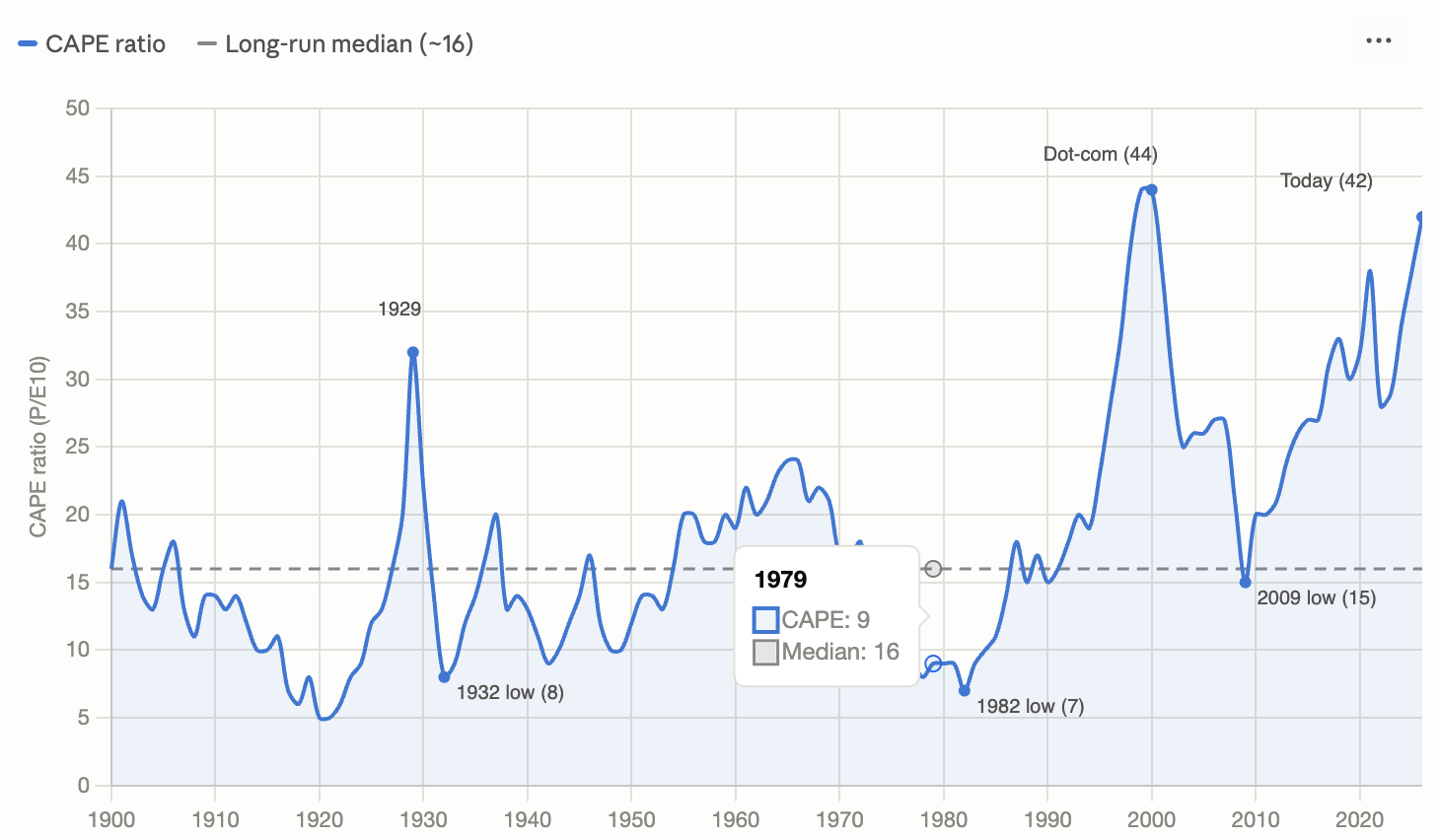
It shows Robert Shiller’s Cyclically Adjusted Price-to-Earnings Ratio, in short terms, called the CAPE ratio. And that indicates measures of long-term valuation of shares quoted on US stock markets. In essence, it compares prices with the last 10 years of real earnings in the companies in question, and the long-term average ratio was about 16. In other words, people bought shares on average at about 16 times the average earnings of a company at the point in time that they bought them.
Today that ratio is around 42, over two and a half times more than the average. The chart on the screen now shows how unusual current valuations are. There are three peaks on this chart, and the chart runs from 1900 right through to the present. As you can see, the first peak was in 1929, and we all know what happened then. The second peak was during the dot-com era in around 2000, and we all know what happened next. The third peak, just below that of the dot-com era, is today.
The dot-com era had a peak of 44. Today we have a peak of 42, and after the dot-com era was over, the ratio fell to 15, a massive fall in value, which did admittedly happen in two stages, the second stage being precipitated by the global financial crisis of 2008.
I don’t know what’s going to happen, but I can tell you there’s a pattern in here and that pattern looks to be very uncomfortable. The fact is, markets look incredibly expensive at this point in time. When people are buying shares on the US stock exchange, they’re doing so at a price that represents 42 years’ earnings of the companies whose shares they’re buying. And that is an extraordinarily low rate of real return on the investment that they’re making. And that is something which normally gives rise to a major stock market valuation adjustment, as we saw in 1929, as we saw in 2000, and as we might see again. My point is the market says “this time it is different”, but they always say that, and history says it never is.
There are several risks that could trigger a market fall; of course, the economic, social, and political confidence I’ve already talked about is one of them. Another is war, and Donald Trump is creating growing global uncertainty about the war in the Gulf. And climate costs are also being ignored, and the world now knows they’re real after the summer we are suffering, which is worse in many countries than it is here. Political instability is also spreading. And amongst all of this, AI companies do appear overvalued, and as I’ve already mentioned, the hype appears to be over.
That means that there looks to be a situation where the bubble might burst. I can’t pretend otherwise. Once confidence breaks, prices can fall quickly. The chart shows that. The collapse in 1929 was very rapid. The collapse in 2000 was very rapid, but not quite as fast as 1929. The collapse now could be as strong, and the fall in valuations could be as big as it was on those occasions, which means that share prices might halve.
These things are all now possible, and the probability of that correction happening is increasing. As I say, even the Financial Times is talking about it as though it is almost a certainty and they’re doing so regularly.
The risk is that a crash would spread beyond stock markets. If the crash was just within stock markets, the question would be: so what? It would have a bit of a risk with regard to some people’s prospects with regard to their retirement, and I don’t take that lightly, but the fact is that the stock market crash will not be contained only within that market.
Banks have lent heavily against inflated share prices, and in the shadow banking sector, it’s thought highly likely that trillions of dollars could be involved in this lending process. Financial stability could therefore be seriously threatened if the shadow banking sector comes under risk, and that is translated into the mainstream banking sector as a consequence.
The Bank of England thinks these risks are real. I’m not talking here about something which I’m making up. This is a mainstream concern. The Bank of England think that’s how the contagion will spread. This would then become an economy-wide problem. This would impact government. This is going to be the biggest threat that Andy Burnham might face during his Prime Ministership. This could all happen well and truly before 2029. And ignoring these political risks is utterly irresponsible. Yet that is what our politicians are doing.
They keep talking about growth as if it’s the only credible strategy for their economic policy, but governments should be preparing for financial disruption instead. Failing to plan for that disruption could destroy Andy Burnham’s premiership long before he gets to a 2029 general election, but we’ve not heard him say a word about this risk, and that is what worries me.


I don’t think 50% would be extreme at all, given the valuations and the debt implosion that is likely to happen. Hussman has interesting models based on historical valuations and outcomes, and this suggested that even 70% off wouldn’t be outlandish.
In a real crash, stocks don’t merely revert to fair value; they tend to overshoot to deeply undervalued. Although that never happened in 2008/2009. At the bottom stocks became somewhat cheap but never ridiculously cheap, due to all government and central bank interventions and also China counterbalancing the debt implosion in the West.
The question is if such interventions would be possible this time, with bloated central bank balance sheets, governments deep in debt and China now having its own debt problems. Everybody expects a central bank “put option” to be able to contain such a crash, but what if the central bank itself is in trouble? With high inflation due to real physical constraints, can/ should you sacrifice the currency to save the stock market?