Yves here. Some of the mill towns, or towns in which I lived that had mills as significant employers, have shrunk even though they are not yet ghost towns. Escanaba, MI had a population of over 15,000 in the 1970s and is now below 13,000. Chillicothe, Ohio had a population of 29,000 in the 1970s and is now under 22,000. And as for aging, it is hard to beat Bailey Island, Maine, where my father’s family lived from when it was first settled. The median age is 59. Cranky Yankees!
By Elisa Giannone, Junior Researcher Center for Research in International Economics (CREi): Yuhei Miyauchi, Assistant Professor of Economics Boston University; Xinle Pang, Assistant Professor of Economics University At Buffalo; Yuta Suzuki, Antai College of Economics and Management Shanghai Jiao Tong University; and Nuno Miguel Marques da Paixao, Senior Economist Bank of Canada. Originally published at VoxEU
Policy debates about aging and shrinking populations often treat the problem as a national one. This column presents evidence from Japan showing that it is also profoundly spatial: aging and depopulation hit rural regions first. Outmigration from shrinking regions today reduces births tomorrow, which makes the origin region older still. However, policies that reduce spatial inequality also reduce aggregate efficiency, presenting a trade-off that leaves policymakers with the challenge of choosing among different goals.
Governments are again asking how much to invest in places that are aging, shrinking, and losing young people. Japan has restarted its regional revitalisation agenda, explicitly linking regional policy to low fertility and population aging (Cabinet Secretariat of Japan 2024). Spain has mobilised more than €10 billion across 130 measures to address the ‘demographic challenge’ (Government of Spain 2021). Italy’s National Strategy for Inner Areas (OpenCoesione 2026) and the European Commission’s long-term vision for rural areas (European Commission 2021) similarly put essential services, connectivity, and local development at the centre of policy.
The central question is not simply whether shrinking places deserve support, but what such support can achieve and at what cost. Economists warned that shrinking municipalities can face declining amenities because public services exhibit scale economies (Heinemann et al. 2007), and that population aging can weigh on growth (Kotschy and Bloom 2023). The missing link is geography: who leaves, who stays, and how these choices reshape the fiscal and economic base of local communities.
In Giannone et al. (2026), we study this question using Japan as a laboratory. Japan is useful not only because it is one of the world’s oldest and fastest-shrinking countries, but also because its demographic future foreshadows problems already visible in parts of Europe and East Asia. By 2015, 26% of Japan’s population was aged 65 or older, and the share is projected to reach 37% by 2050. Japan’s age wave can be considered a warning case for the social and fiscal pressures associated with population aging (Stawasz et al. 2018). But these national figures hide a striking spatial pattern. Some rural municipalities already have elderly shares close to 50%, while large metropolitan areas remain younger and denser.
The first fact is simple but important: depopulation and aging are not evenly spread across space. Between 1980 and 2010, Japanese municipalities that were already relatively old lost population and aged faster. Municipalities that were younger in 1980 tended to grow and remain younger. Figure 1 makes this historical divergence visible.
Figure 1 Historical demographic divergence across Japanese municipalities between 1980 and 2010
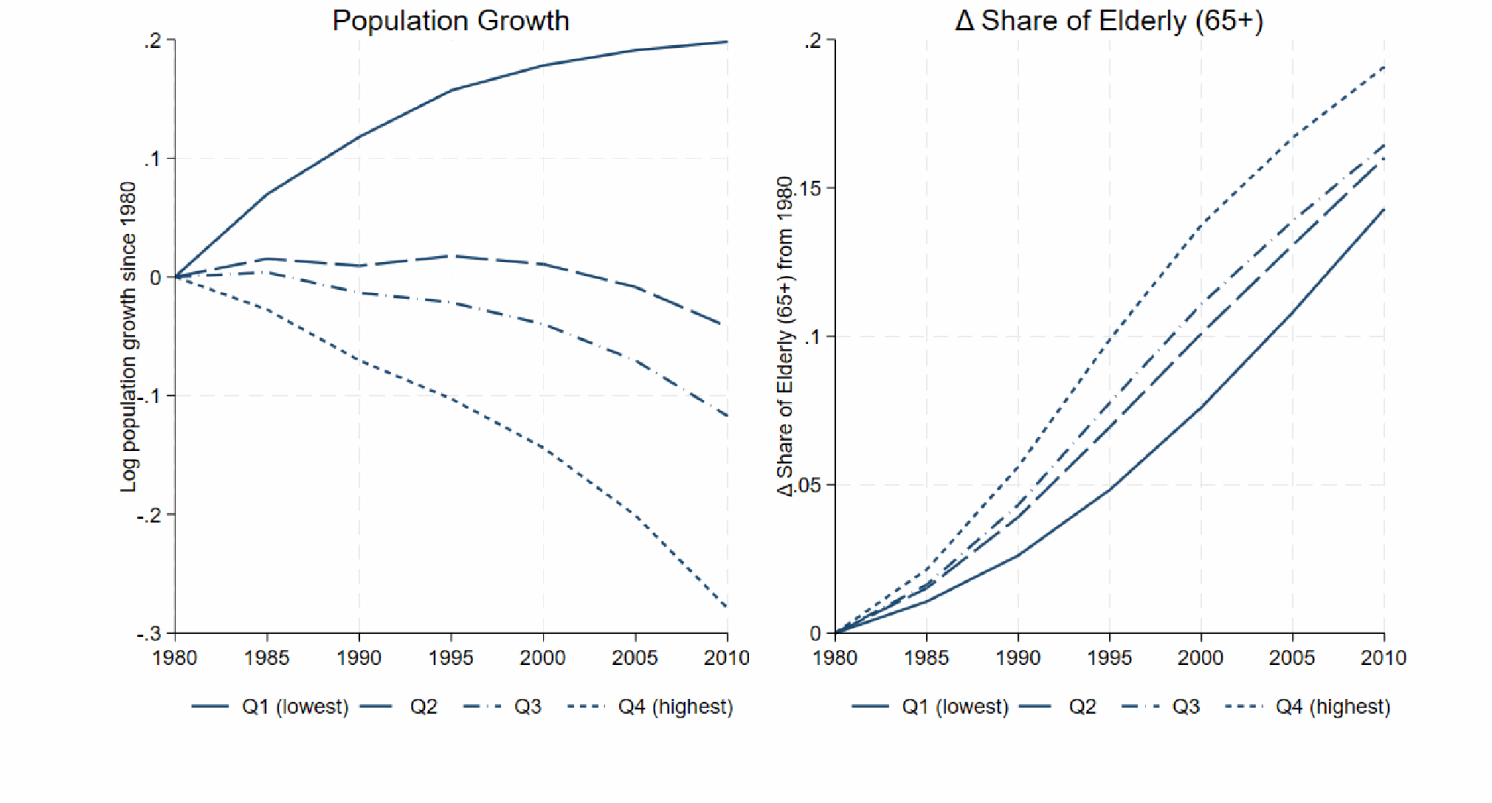
Notes: Older municipalities in 1980 lost population and aged further, while younger municipalities tended to grow and remain younger.
Source: Giannone et al. (2026), Figure 4.
It also highlights an important timing point: Japan’s aggregate population decline begins only around 2010, but the regional divergence in aging and depopulation was already well underway long before then. This divergence is not just a story of different fertility rates across places. It is also a migration story. Young adults continue to move toward large cities, especially Tokyo, and their children are then born there rather than in the places their parents left. The result is a cumulative demographic mechanism: outmigration today reduces births tomorrow, which makes the origin region older still.
This mechanism matters because local economies are built around local scale. Shops, clinics, schools, childcare providers, public transport, and municipal offices all depend on enough users and taxpayers to remain viable. Using municipality-level data and an instrumental-variable strategy based on historical migration links, we find that areas losing working-age population experience declines in several measures of local amenities, including retail and medical services. At the same time, the per-person cost of local public spending rises. A road network, a school building, or a municipal office does not become proportionally cheaper when the population falls. This is the fiscal arithmetic of the ghost town: fewer residents, fewer workers, fewer children, and higher costs per person.
To study where these forces may lead, we build a dynamic spatial model in which people of different ages choose where to live, taking into account wages, housing costs, amenities, migration costs, pensions, and taxes. Wages and amenities can rise with local population because dense places support productivity and services; housing costs rise when many people want to live in the same place; and local public-service costs are higher per person in smaller places. The model is calibrated to Japanese data and then used to project future regional outcomes.
The baseline projection is sobering. Tokyo’s share of Japan’s population rises from about 10% in 2015 to roughly 26% over the next two centuries. The combined population share of the five oldest prefectures – Kochi, Shimane, Tokushima, Tottori, and Yamagata – falls from about 3% to below 1%. Their elderly share approaches 60%, while Tokyo’s remains close to one-third. When we shut down internal migration or hold fixed the spatial distribution of newborns at its 2015 level, much of this regional divergence disappears. In other words, the future geography of aging is not determined mechanically by national fertility and mortality alone. It depends critically on the spatial choices of younger cohorts and on where the next generation is born.
Figure 2 Projected population shares and elderly shares for Tokyo and the five oldest prefectures
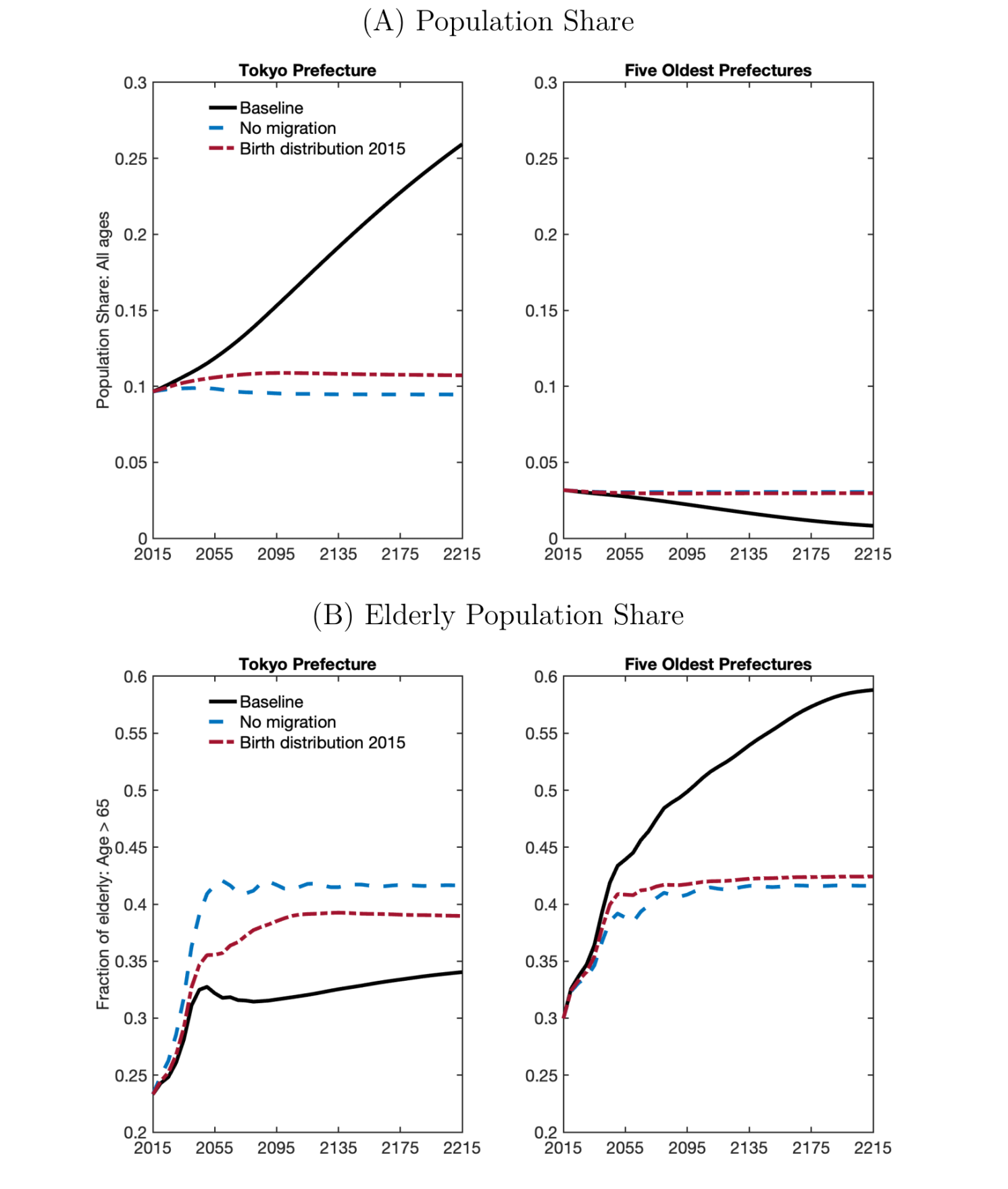
Source: Giannone et al. (2026), Figure 9.
This finding connects aging to a broader urban-economics literature on agglomeration and regional divergence (Moretti 2012, Diamond 2016). Large cities can offer higher productivity and more amenities, but also higher housing costs. In our simulations, the productivity and amenity advantages of Tokyo dominate the congestion effect from housing. As more people concentrate there, the city becomes relatively more attractive, while declining regions lose scale. This reinforces regional inequality in flow utility, especially for working-age residents. The elderly are partly insulated by pensions, which are national rather than local, but they still depend on local services and amenities.
There is, however, a difficult twist. The same reallocation that worsens spatial inequality can raise aggregate efficiency. Concentrating more people in high-productivity, lower-cost locations raises average labour income and reduces the national fiscal burden of providing local public services. Preventing migration, or implicitly freezing the geography of births, keeps more people in smaller and less productive regions where public services are more costly per person. The policy problem is therefore not a simple choice between ‘good’ support for declining regions and ‘bad’ laissez-faire abandonment. It is an equity-efficiency trade-off.
Place-based policies sit exactly on this margin. Recent work on place-based industrial policy shows that subsidies may have important spillovers and only modest effects on regional inequality (Atalay et al. 2023). Another recent study shows that retiree mobility in France can bring economic gains to poorer and more rural areas (Badilla-Maroto et al. 2026), reminding us that not all migration flows reinforce metropolitan concentration. In aging Japan, however, the central force is the movement of young workers and future parents away from already old regions.
We simulate one transparent policy: transfers to residents of the five oldest prefectures, financed by taxes on Tokyo residents. This is not meant to replicate a particular programme; it is a benchmark for understanding the economic forces behind regional revitalisation policies. Policy duration matters in this setting because migration, births, and local-scale effects unfold slowly. A temporary subsidy may cushion decline for a while, but a long-lived policy changes expectations about where it is worth living, working, and raising children.
A transfer equal to 5% of income, maintained for 100 years, therefore has large effects. By 2065, it nearly doubles the population of the five oldest prefectures relative to the baseline and reduces their elderly share from about 45% to roughly one-third. The gain in local real income is larger than the transfer itself because more residents raise productivity and amenities through local scale.
But the policy is not free. The same 5% transfer lowers aggregate labour income per capita by more than 1% and raises aggregate fiscal spending per capita by about 0.5%. These costs arise because the transfer keeps more people in places where productivity is lower and public services are more expensive to provide. The policy reduces spatial inequality, but it also reduces aggregate efficiency.
Figure 3 Effects of transfers to the five oldest prefectures on population shares and elderly shares in 2065
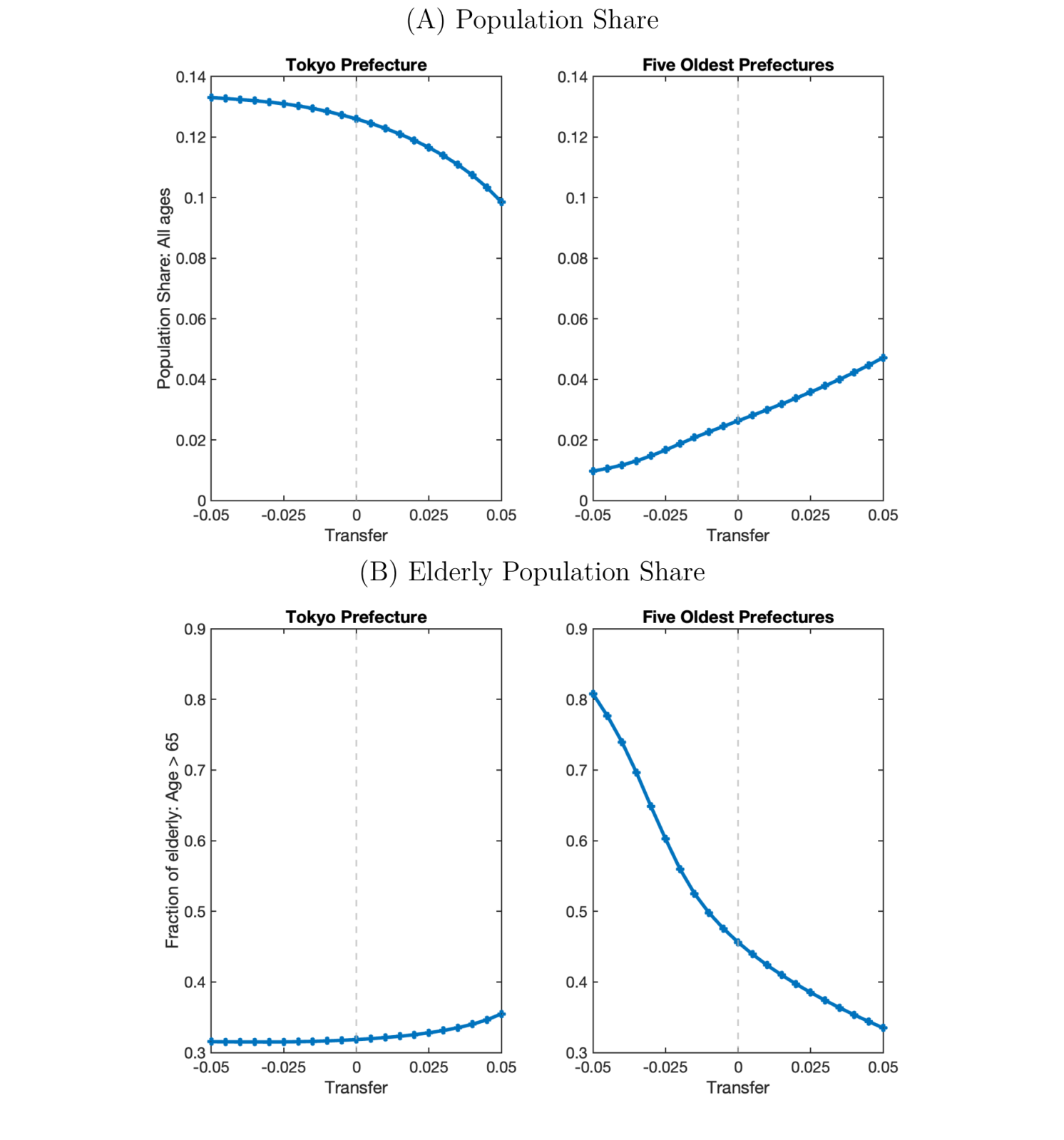
Source: Giannone et al. (2026), Figure 13.
The main implication is that national debates about aging and depopulation need a spatial lens. A country can shrink while its largest city gains population share. An aging society can become regionally more unequal even as people rationally move toward opportunity. Subsidies can slow the hollowing-out of rural regions, but they also reshape where people live, work, and have children. That means their benefits and costs accumulate over decades.
For policymakers, the relevant question is not whether every village can or should be restored to its past population. It is how to choose among different goals: protecting access to essential services, preserving communities, supporting mobility, encouraging birth and settlement in declining regions, and maintaining aggregate productivity. Our results suggest that these goals cannot all be maximised at once. Living in a ghost town is not only a demographic concern. It is a spatial economic problem – and it requires policy to confront the geography of aging directly.
See original post for references


As a fan of rails to trails, I have really enjoyed passing through towns that were once thriving. Highly recommend exploring them
Interesting. I wonder about a few counter-trends and why they don’t seem to be in play.
Having babies in big cities, for one. I see a lot of young couples maybe starting their family in the city, but then moving out for more space at lower cost by the time of a second child. Maybe my vision is skewed because my big city is New York, and it’s different if it’s Paris or Indianapolis, but those moves seem to be driven by a need for more space — larger (but still affordable) living quarters and space for kids to play.
Secondly, Covid combined with the capacity for remote work drove something of an out-city migration. Did that reverse itself? Could that not be encouraged as a way of combating the tendency to converge? Or is that type of movement too narrowly confined to the PMC to move the needle?
Last, it seems pretty clear by now that efficiency is over-rated, or at least over-emphasized in our governance, and that it’s less essential to human happiness than a lot of other things. A straight paved road is more efficient than a rambling forest path, but both should have space in our communities.
This study would be more persuasive if it didn’t presuppose that Japanese policymakers actually care about this issue. They really don’t.
Moreover, there are a variety of reasons for rural depopulation not mentioned here. If you watch Yanagimachi Mitsuo’s film Himatsuri, or Tsuta Tetsuichiro’s Iya monogatari, some of these may become clearer.
The article stresses that cities with a larger and denser population are more “productive”.
What it fails to consider is whether there are diminishing returns to large cities. After all, those dense cities do not just have higher housing costs; beyond a certain size, they notably entail large travelling expenses, as dwellings, workplaces, administrations, etc, are usually not located close to each other, with distances and trafic congestion imposing a severe “time tax” on inhabitants.
A more complete analysis may well rebalance the trade-off between regional inequality and national productivity.
If economic “productivity” is largely produced as a consequence of a tremendous expenditure of hydrocarbon energy and embedded energy in machines, infrastructure and human lifestyle, maybe climate change concerns should drive the world to seek a lower human “productivity”.
I tend to view economists as “bring it on” climate change cheerleaders, hoping that a technological climate change solution rabbit will be pulled out of the hat as they cheer their GDP numbers that are well correlated with energy expenditure.
The industrial world actually changing behavior enough to lessen climate change effects, while not impossible, seems implausible.
Japan is interesting in this context as to some extent it is ahead of the curve (although many countries are joining it), but its still not clear whether the trends that are observed there are applicable elsewhere. Even with Japan, there are contradictory trends visible – while Tokyo is becoming more and more the focus for population and productivity, there is anecdotal and (some) objective evidence of younger people looking for alternatives – although the winners in this are likely to be smaller towns and rural areas with a perception of being good places to live. But in Japan the work culture and relatively poor rural internet does provide an obstacle to remote working. A particular complication with Japan is that much local infrastructure is still being paid for by local governments who in many cases grossly overspent before and after the boom years in gold plated and often quite silly schemes. The old Spike Japan website has a fascinating overview of some of these. Any discussion on how to wind down service/infrastructure investment in any country has to address who pays for it – the viewpoint from a central government may be very different than from a prefecture, county or city government. In reality, infrastructure is rarely shut down – its allowed to decline down gently (this is clearly visible to anyone who goes off the main highway in Japan – I’ve cycled on mountain roads in Shikoku that literally just disappeared into scrub and jungle).
But even with a significant demographic drop its never certain that urban areas will somehow run down – history is full of examples of towns and cities that have survived and somethings thrived despite large scale economic and demographic changes that should have doomed them. Medieval bastides designed for the defence of long forgotten boundaries are still thriving, many 19th Century cities built on coal are still there long after the coal has been mined out and so on. The bigger threat may be, as the article implies, not population falls, but demographic changes leaving some areas almost entirely dependent on pensions and social welfare. This isn’t always a bad thing (once dirt poor coastal fringes of Spain and Portugal thrive on this spending), but if the population is to be allowed drop rapidly, then the only thing that will maintain prosperity is rising productivity. And in most cases, the drivers of productivity increases are almost always the large cities, and this only occurs when there is a constant infusion of younger workers.
Two most developmental things you can introduce to underutilized localities: high speed public transportation; high quality educational institutions.
I don’t see how this trend can be reversed. For young people that want a job to pay for a family and a life, they have to go to the city to find work. In fact, conservatives will demand that young people “just move” to a different area or State. Then you have the Neoliberal trend of infrastructure being stripped from country regions such as banks, police stations, railway lines, doctors, bus routes, hospitals, etc. that use to at least employ some people and provided local services. It’s worse for old people as they need medical services more so now they have to go on very long trips to get them as their local hospital was shut down. In a town near where I live there use to be a local hospital but it was shut down, eventually bulldozed and now has a chemist located there.
Just in passing, as Spain was mentioned having this problem to I looked up a video I saw a long time ago about a guy seeing what the local situation is like there. It is called “3000 Spanish Villages are uninhabited – I drove deep into “Empty Spain”-
https://www.youtube.com/watch?v=3oKc_3eXHRM (16:37 mins)
I first encountered the spatial dimensions of inequality and poverty (which are obviously implicated in demographics) in Danny Dorling’s work on the UK, which is excellent
https://www.dannydorling.org/
Prevailing trends in industrialization/de-industrialization, supply chains and trade have massive implications for regional disparities within nations. Governments which aren’t attentive to the consequences of their participation in these international arrangements face serious long term risks to resilience, often due to a foolish prioritization of short term “efficiency.”
My suspicion is that such attitudes are as much as anything due to an over reliance on economics (obsessed as it is with dodgy math and models) and prevailing ignorance of biology — too late apparently we discover that we’re still animals, eh?
What about the effects of the mentioned demographic shifts and “rural deservicing” on mortality and lifespans?
As a long time cynic, I note that those exact trends are optimal for a speeding up of Neoliberal Rule #2: Go die! An emphasis on “efficiency” and “productivity” suggests an allied emphasis on Social Darwinism. Lowered public services in the regions where the older cohorts of the population congregate reinforces the “primitive accumulation” of societal resources into the hands of the Neoliberal Elites. A New Enclosure Movement is going on. See the “laying the groundwork” going on now in the American Information sphere for a reduction in Social Security payments, much of which goes to the elderly in the society. Precisely those who are at the bottom of the Social Darwinian Hierarchy, the old and the infirm, will be ‘culled’ earlier than would otherwise be the case as a result of this policy alone. Take note that this diminution of the Social Security “Safety Blanket” is being framed in purely financial terms. No real debate is going on concerning the social policy dimensions of the proposed cuts.
Another dimension of the problem are the differences in the social ‘systems’ between Japan and the West. I read that the Japanese have a stronger regard for their elderly than do the other western societies. (Correct me if I am wrong.) Thus, the more communal orientation of Japanese society would produce different outcomes from the more “ruggedly individualistic” social myths of the West, especially America. Doing for yourself can only accomplish so much when physical and mental capabilities are diminishing as you age.
We are faced with a descent back into savagery in our societies. I do not think that the Neoliberal Elites have thought this all the way out.
Stay safe.
With climate change I wonder if it will become necessary to do away with big cities and concentrated populations, if these smaller cities, towns and communities might become of necessity the solution, a way of dispersing populations. Large cities are huge areas paved over with concrete and asphalt, which generates heat and diverts water away from landmass while polluting it, but there is an obvious need to regreen the world to bring it back into balance, and smaller towns are obviously more green and with lifestyles more consistent with live where you work, work where you live.
What’s interesting is that this is a very timeless thing. If you’re into social cycle theories, it’s one of the claims that’s very consistent: the cities & finally the one imperial metropole vacuum up population from the countryside until the whole organism is hollowed out.
You also always see something functionally similar to modern industrial farming as a result. The analogue of capital (the means of production as cumulative social organization) is injected into the countryside to keep food on the shelves.
So for the late Romans (where capital = slavery), you get latifundia. In first-wave imperial China (where state bureaucracy is key), you get an ever evolving system of taxes, regulations, & incentives to keep peasants in the fields.
Amidst all the discussion of efficiencies and concentration of services in cities, lack of reproduction etc, are not rural areas also where the food production is located. If the rural population declines as much as is supposed, what do states do about food production. Subsidies for people willing to engage in agriculture and horticulture? Hope for robot farms? Or do we just assume that food production can be urbanized as well?
Way to leave out the massive component of depopulation which is the force of taxation and ‘inflation’. Families get postponed, smaller or put off altogether due to the crisis of affordability. Notice how Japan tops the list, no coincidence that their rates of money printing and inflation are also extraordinarily high. Naturally, rural areas are the most obviously affected by this deliberate impoverishment, while urban areas appear to hold out longer due to the proximity of job sources.
50 years ago, a single income could support an American family in a lifestyle that two incomes cannot currently achieve; but you completely ignore this obvious causal chain.
Why?
This is complete ideology-driven bullshit. Japan has been in DEFLATION for 30 years. Housing prices have been falling.
It seems not to occur to you that having babies is a bad deal (in terms of risk and return) and more and more women have worked that out. More and more do not want to have babies and for those that do, in many cases it due to parental pressure or cultural indoctrination. A lot of body fluids and stress. Childcare duties always fall on the woman; the husband has an option to get involved if he wants to which he typically does not exercise. And if you get divorced, in the US, the bankruptcy rate among single mothers is 1 in 7. And Japan has weaker social safety nets.
The reason for low birth rates are social, due to gender roles where marriage is pretty unappealing to many women. Women no longer have to get married to survive; they can work instead. But men have not changed their behavior to reflect that, in terms of being willing to preform more housework and take more of the childcare load.
Japan’s birth rate started dropping in 1970: https://www.macrotrends.net/global-metrics/countries/jpn/japan/birth-rate. It continued to fall in the 1980s as women were getting even better access to top level professional jobs and were no longer relegated to being tea ladies.
Now in Southeast Asia, in a country with low inflation, I have had women taxi drivers volunteer to me that being married sucks, they have no intention of getting married or having kids.
In more traditional communities, having babies was as less bad arrangement because couples lived in family compounds and so grannies and aunties and cousins assisted in the child-rearing, reducing stress on the mother.