David Dayen: Productivity Rose 7.7% Post-Great Recession; Workers Have Seen None of It
I’ve said this before in other venues, but this really is the chart that explains modern America:
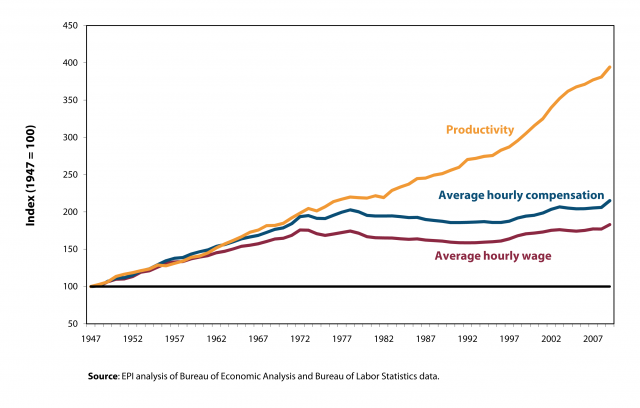
I’ve said this before in other venues, but this really is the chart that explains modern America:
The latest Fed confab at Jackson Hole is demonstrating that central bankers were so keen to avoid taking much blame for the global financial crisis that they also failed to learn critical lessons from it. That lapse in turn is directly related to the present emerging markets upheaval that has the potential to morph into something worse.
Read more...By Raúl Ilargi Meijer, editor-in-chief of The Automatic Earth, Cross posted from Automatic Earth
No, I wasn’t going to write a third article on shale in 2 weeks, absolutely not. But what I’ve read these past few days doesn’t leave me much choice.
Read more...By Patrick Durusau. Cross posted from Another Word for It
Just in case you missed it, Groklaw has gone dark.
In Forced Exposure, Pamela Jones outlines why Groklaw cannot continue when all email is subject to constant monitoring by the government.
Read more...Yesterday, we ran a post by Bill McKibben on leadership in social change movements. McKibben argued for a “small l” leader model versus a “big L” leader, which readers debated. Some argued that the Leader model was really code for “Great Man” that was a less viable approach than it once was due to assassinations. Others were struck by the emphasis on distributed leadership, which is an obvious analogy to modern computer and communications networks, and how political commentators to frame their ideas of social order in terms of the technology of the day. Some pointed out that the idea of minimal oversight and control of communities was a long-stading Utopian line of thought, often espoused by people who wound up implementing the exact opposite.
However, I was particularly struck by Dan Kervick’s remark, which came late in the thread:
Read more...The big banks are desperate to prevent Janet Yellen from being appointed as Bernanke’s successor to run the Fed. Their sexist attacks have backfired.
Read more...Yves here. The 50th anniversary of Martin Luther King’s “I Have a Dream” speech is ten days away. Brace yourself for the reminisces, most of which will be genuine, heartfelt, and insightful, while others which will treat the occasion as an opportunity for brand identification.
McKibben, a well-known and effective climate change activist, raises the question of leadership in movements to promote social change. He argues that the charismatic chieftain is out, and the model now is that of distributed leadership, with lower level “leaders” being more critical to movement success than ever before.
Read more...Yves here. This is the latest installment of Bill Black’s forensic work into why the FBI, which had in the past been a critically important working oar in investigating banking industry frauds, was nowhere to be found before and after the global financial crisis. This post, on how the Mortgage Bankers’ Association, succeeded in getting the FBI focused solely on frauds made on banks, as opposed to by banks, is an ugly and critical bit of the story.
Read more...Yves here. Bill Black continues his forensic work about the dogs that didn’t bark in both the runup to and the aftermath of the crisis.
Read more...Perhaps I’m just having a bad month, but I wonder if other readers sense what I’m detecting. I fancy if someone did a Google frequency search on the right terms, they might pick up tangible indicators of what I’m sensing (as in I’m also a believer that what people attribute to gut feeling is actually pattern recognition).
The feeling I have is that of heightened generalized tension, the social/political equivalent of the sort of disturbance that animals detect in advance of earthquakes or volcanic eruptions, of pressure building up along major fault lines.
Read more...Yves here. We’ve written from time time about the latest plans underway to further degrade the lives of ordinary citizens in order to fatten the bottom lines of major multinationals, namely, two major US-led international trade pacts. Even though the US media has given these pending deals scant attention, they represent a far-reaching effort to restructure basic legal and regulatory frameworks.
Read more...Yves here. Black has written the sort of post I particularly like. He’s given a close reading of the FBI’s latest (and tellingly, not all that recent) mortgage fraud report and parses what its use of language and its omissions say about its assumptions and priorities.
Read more...Philip Mirowski is the Carl Koch Professor of Economics and the History and Philosophy of Science University of Notre Dame. Professor Mirowski’s latest book is Never Let a Serious Crisis Go to Waste: How Neoliberalism Survived the Financial Meltdown
The interview was conducted by Nathan Tankus, a student and research assistant at the University of Ottawa. He is currently a Visiting Researcher at the Fields Institute
Read more...Even now, years after the subprime market’s death in 2007, new stories of mortgage chicanery or accounts providing more evidence of known abuses keep surfacing.
Read more...By Bill Black, the author of The Best Way to Rob a Bank is to Own One and an associate professor of economics and law at the University of Missouri-Kansas City. Cross posed from New Economic Perspectives
This article discusses a simmering feud among five of the most prominent economists in the world (two of them Nobel Laureates).
Read more...