Former central banker Willem Buiter once remarked that the Federal Reserve’s “unusual and exigent circumstances” clause, which enables it to lend to “any individual, partnership or corporation” if it can’t get the dough from other banks, allows the Fed to lend against a dead dog if it so chooses.
It looks like the US central bank did precisely that.
Readers no doubt know that Bloomberg entered into a hard-fought battle over its Freedom of Information Act request to compel the Fed to release the details of its various lending programs during the crisis to the public. The banking regulator used the patently bogus excuse that revealing that information could damage the competitive positions of firms that had received the loans. That was patently bogus since all the major recipients are in the market on an ongoing basis and rejiggering their exposures based on market opportunities.
The only party at risk at this juncture was the Fed, since it would have its decisions scrutinized. And in a democracy, it is of vital public interest that an organization as influential as the Fed, which committed large amounts of funding outside Constitutionally-mandated budget processes, be held accountable for its actions.
The information was released yesterday and Bloomberg has provided a first cut on a small but juicy portion of it, the Primary Dealer Credit Facility. From a risk standpoint, the loans mace under this program violated the central bank guideline known as the Bagehot rule: “Lend freely, against good collateral, at penalty rates”. That is the prescription if the borrower is facing a bank run, meaning a liquidity crisis. The fact that 72% of the Fed’s loans on September 29 from the Primary Dealer Credit Facility were junk or equivalent (defaulted and unrated securities or equity) is further proof that many financial firms were facing a solvency, not a liquidity, crisis. The breakdown:
Equities comprised $71.7 billion, or 43.6 percent of the total. High- yield debt, including the defaulted issues, accounted for $18.4 billion, or 11.2 percent. Collateral of unknown rating was $28 billion, or 17 percent…..The U.S. central bank allowed borrowers to use $929 million in market-valued debt that had gone into default, rated D, as collateral on that day, 2008, more than the $905.5 million in Treasuries that were pledged…
And the haircuts were so low that the ideas that these were collateralized loans is a joke. The “collateralization” was a necessary legal fiction for throwing cash at anyone who thought they needed it:
The Fed loans on Sept. 29, 2008, represented a 5.49 percent “collateral cushion,” the amount by which the pledged assets exceeded the loan value….
To put things in perspective, the market haircut on most debt securities during the period of the crisis starting in September 2008 was above 40 percent,” [Craig] Pirrong [a finance professor at the University of Houston} said….The cushion “was far too small for the risk of the underlying collateral,” Pirrong said. “Collateral that’s junk or defaulted debt and equities at a time when market volatility was huge is pretty eye opening.”
It wasn’t just “most debt securities” that had tanked in value. Consider the fate of AAA rated ABS CDOs, which were one of the most serious black holes at virtually all of the dealer banks. We reproduced this chart on repo haircuts in ECONNED:
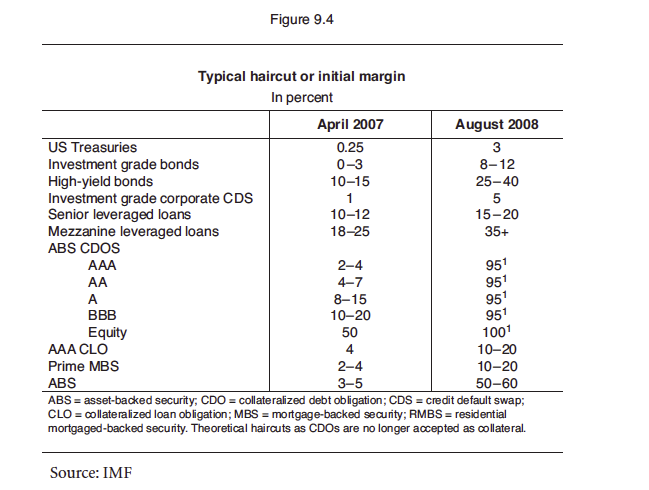
Note these prices were as of August; things were clearly even worse post Lehman. A 95% haircut on AAA rated ABS CDOs means the paper was effectively worthless.
This first cut by Bloomberg also shows that Morgan Stanley was the biggest user of the facility, receiving $61.3 billion of funds for securities “worth” $66.5 billion, 71.6% of which was junk or unrated. As eye-popping as those numbers are, the funds received are less than half the fall in Morgan Stanley’s liquidity pool in the two weeks after the Lehman failure, per Economics of Contempt. Merrill Lynch was second, getting $36.3 billion in funding for $39.1 billion of collateral, 83.4% of which was junk or unrated.
A separate Bloomberg story on the discount window operations found that 70% of the credit extended, including four of the five biggest users during the peak usage week, in October 2008, were foreign. More high (or more accurately, low) points:
U.S. Federal Reserve Chairman Ben S. Bernanke’s two-year fight to shield crisis-squeezed banks from the stigma of revealing their public loans protected a lender to local governments in Belgium, a Japanese fishing-cooperative financier and a company part-owned by the Central Bank of Libya.
Dexia SA, based in Brussels and Paris, borrowed as much as $33.5 billion through its New York branch from the Fed’s “discount window” lending program, according to Fed documents released yesterday in response to a Freedom of Information Act request. Dublin-based Depfa Bank Plc, taken over in 2007 by a German real-estate lender later seized by the German government, drew $24.5 billion…
“What in the world are we doing thinking we can pass out tens of billions of dollars to banks that are overseas?” said [Ron] Paul, who has advocated abolishing the Fed. “We have problems here at home with people not being able to pay their mortgages, and they’re losing their homes.”
Expect some fun Congressional hearings in the not-too-distant future.
A further remark: the fact that Bloomberg can say anything intelligent at this juncture is a testament to the cleverness of its reporters. The central bank quite deliberately responded to the request by providing the information in the most disaggregated, difficult to work with form imaginable. The central bank did a version of the same trick with its data on Maiden Lane II. The holdings of that asset management vehicle were various real estate exposures, some of which were hedged. The hedges were reported separately from the bonds and loans. Clearly, Blackrock, the asset manager, had far more useful and understandable reports that they used internally and provided to the New York Fed, but those were withheld. This data will presumably be as enticing as the Wikileaks cables, so enough eyeballs on it will eventually overcome the Fed’s efforts to hinder analysis.
Given the voluminous amount of information provided, future FOIA requests may need to explicitly include that the relevant government body provide information in the form in which it is used internally, including any higher level aggregations, to prevent future “fuck yous” in the form of technically permissible but nevertheless obstructionist compliance.


Thank you Yves and Bloomberg. You guys deserve Medals of Freedom.
I don’t deserve any credit on this topic, this was Bloomberg’s show, but I’ll happily take praise on other ones!
Thank you for the useful post,
How can one still imagine that those rules edicted in a wealthy XIXth century Britain can apply to the current situation?
Of course Bagehot has a recipe for central banking activity in a globally sound and sane financial environment. Mind you, the current sitution is the one where the public authorities in charge are, of course, bankrupt. At all levels.
You just cannot be a tough central banker when you run 50% deficit on your federal accounts on top of a massive pre-existing debts to be refinance on a daily basis on int’l markets. That’s “Mission impossible”. Bernanke is no Tom Cruise. He is only buying time. Not a good idea by the way.
re: allowing the Fed “to lend against a dead dog if it so chooses.”
It seems to me that lending in such manner might not be the most prudent or efficient use of our nation’s money supply.
Giggle. Hey, let’s call it what is is, a crime. The Fed is shoveling the nation’s most valuable resource, its sovereign fiat currency, into the vaults of criminal organizations.
What’s even bigger crime, though, in my opinion, the Fed is shoveling American currency into criminal organizations that, despite the free billions, can’t manage to — somehow — stay solvent.
What the hell is wrong with our criminal organizations these days? They’ve become as damnably inept as everyone else.
> The Fed is shoveling the nation’s most valuable resource, its sovereign fiat currency, into the vaults of criminal organizations.
Of course money isn’t literally a resource. It’s valuable only insofar as it enables financial transactions, and for that purpose it can be created at will.
But the banks/wall street paid back their tarp money, right? So what’s the problem?
Just joking,
Z
This must be part of that “outstanding” … and “brilliant” … and “excellent” job that bernanke did in “stabilizing” the economy that was used to justify his re-up by folks like obama and krugman. HA HA HA … what a joke that always was, all he basically did was fork over cash … in exchange for garbage … until wall street got bailed out of their bad bets … their damn near economy-destroying bets … and then some extra for some of the folks most responsible for it.
This is brilliance? No! It’s not even that complicated. It’s disgusting corruption … that’s what it is. And one the fed was damn driven to keep from us.
Z
Wizard of Oz. So liquidity disappeared. The Fed stepped in to provide cash for junk. And then liquidity returned. It seems that one could create a rough estimate as to how much junk remains.
I wonder if the taxpayer paid for data to be formatted inconveniently.
The US peoples are likely to have to eat all the losses like Ireland and continue to compensate the banksters for their grand expertise. The perfect crime.
Allen,
Your ? is the real deal IMO-“how much junk is still on their
(second set of) books?!?
Especially after we KNOW from “ECONned” what-how, and from
Robert Johnson, apprx. how much:
http://www.newdeal20.org/wp-content/uploads/2009/10/raj-revised-testimony1.pdf
Thanks for reporting on the most recent revelation of the murder of our democracy. While millions are unemployed, thrown out of homes and graduating college students join the unemployed, we still have Morgan Stanley and Merrill Lynch safe and sound as if we cannot do quite nicely without them.
Libya’s central bank donation from the Fed really takes the cake.
Honor to Yves for keeping the high beams on this. While it is doubtful the nation can be saved, the honest effort to do so is noble.
We are all Indonesians now. On Dealbreaker thanks to MaxKaiser’s blog
“Citi Employees Allegedly Kill Customer Over Bill Complaints”
By Bess Levin
Supposedly the three Citi officials were “angered” by the customer contesting his credit card bill.
Three Citibank debt collectors allegedly killed Irzen Octa, 50, secretary general of the National Unity Party (PPB), on Tuesday after he protested an increased credit card bill, the police said on Thursday. “The motive of the murder is due to debt [issues], a credit card bill that didn’t fit [the formerly-given figure],” South Jakarta Police chief detective Adj. Sr. Comr. Budi Irawan said on Thursday.
“A further remark: the fact that Bloomberg can say anything intelligent at this juncture is a testament to the cleverness of its reporters. The central bank quite deliberately responded to the request by providing the information in the most disaggregated, difficult to work with form imaginable. ”
If this is true, the Fed might come to regret its decision. Instead of one bad week of scandal, the information might dribble out for over a month. How many bad headlines can a truly hated central bank deal with over a prolonged period?
Not to worry……the WSJ tells us today that the subprime mortgage bond market is back and the Fed has rejected AIG’s offer to buy back mortgage backed holdings, and is going to let investors bid for pools of bonds and individual securities “so the central bank can maximize its profits”. Duh….just how does that compute……maybe more like “so the central bank can minimize its draconian losses that will never be anything but just that?”
I would love Yves to comment on this. A month or two back the Fed made a little accounting change. Rather than holding losses on its books – as in losses on its Maiden Lane portfolio, the Fed would simply charge those losses against its Treasury payments. That is, not to worry about the Fed’s losses, they’re YOURS.
Pardon my saying so, but taking in dead dogs as collateral at its loan windows, even dead Libyan dogs, doesn’t set my blood to boiling the way the blatantly illegal purchases of dead-dog CDOs they pulled for AIG do – and now they seek to pawn-off any losses on that portfolio on us. Outrageous. To further vent my spleen, IF THE U.S. TREASURY TRULY SERVES THE PUBLIC, THEY WOULD SUE THE FED FOR ITS TRANSFER OF RISK TO THE TREASURY. IN MY VIEW, IF MAIDEN LANE LOSSES A SINGLE DIME, THOSE LOSSES SHOULD BE EATEN BY THE FED’S PARENT BANKS AND THEIR OWNERS, NOT THE AMERICAN PUBLIC!
SHHHH ! The Power Elite who own the private banks of the FED doesn’t want folks to think the FED is not part of the gov’t … That’s why they named it The FEDERAL Reserve (a.k.a banking cartel’s PRIVATE Central Bank) /sarcasm off
END the FED, put them out of our misery.
One thing I dont understand. A lot of PDLF (primary dealer loan facility) overnight loans shows up in BoNY Mellon’s name with a note saying PDLF Goldman Sachs, or PDLF Goldman Sachs (London) or PDLF Morgan Stanley.
So are these loans to BoNY or to GS/MS ? If the latter, GS certainly obtained loans far more than 5 times. (Only once according to Gary Cohn’s testimony to FCIC, wasn’t he under oath at the time?)
The actions of the FED, Congress and the President(s) over this period haven’t really been about protecting a broader American ‘system’ afflicted by some mysterious, unforeseeable ‘Act of God’…
Nor have they been about protecting some sacred precepts of banking threatened by millions of corrupt homebuyers attempting to exploit the sad tragedy of the poor banker’s naivete and good corporate citizenship…
The actions are about a class (corporatists straddling a revolving door between government and those corporations) protecting the myths that have allowed it to strangle the productive economy for the last few decades.
While timing is difficult… the outcome will ultimately be a failure of the paradigm.
Being anti-corporatist, btw, is NOT about being anti-business, nor even anti all big business… nor is it about being PRO big government.
For me… it’s really about pragmatism. This model is already problematic and it isn’t going to work out by doing more of it.
Dear Mr. Stumpf…
Try not to be such an idiot! No offense.
As a fellow baby-boomer, one really very, very ashamed of the poor job our generation is doing and has done…
What do ya’ say about me and you getting together and writing up some kind of note of apology! I have alot of free time right now and you’re not doing anything constructive so what d’ya say?
Your Pal,
Tom
P.S. I hope you’re not involved in this stupid ICE/Nasdaq leveraged offer for NYSE! Seems like just another gift to the dealmakers.
thanks, Tom,
for stating how so many of us-generation feel..BTW, our generation is definately in the process of being scapegoated
blame-gamed. Obama will undoubtedly use this excuse to devolve Social Security, as he pulls his own W-W=”Wisconsin
Walker” trick.
Blame individuals not “generations” .
Blaming “Boomers” is collectivist thinking and intellectualy lazy or dishonest.
Well, you have to wonder what would happen if Europe were to have another crisis (acute, rather than the prolonged agony of the Irish and Portuguese).
Would the Fed dare to lend a bunch of money to a Belgian bank again? Aren’t we all curious to know whether Dexia asked the ECB for the money first and were refused? And why did the Libyans need the money in the first place if they are in such good shape financially?
I think we all know that Morgan Stanley and Merrill were in terrible shape. No news there. But the foreign intrigue is really juicy. If Dexia had gone down, it might have taken Europe with it. Did the ECB ask the Fed for help with Dexia?
Steve,
the GREENS would take over-an idea pertinent here also:
http://www.spiegel.de/international/germany/0,1518,753503,00.html
Don’t forget TBTF includes Too Interconnected Too Fail,
one needs to dig into which US TBTF banks were counter parties to the foreign grifters (I suspect all the of em).
With all of the $T’s flying around, with crap collateral, one has to really ask how much H. Paulson and Bernake really hated Dick Fuld. Not saying LEH shouldn’t have been bankrupted, but they should have been in the company of many more; and Madoff should be eating meals with a whole bunch of wall street banksters.
Thank you for this post – great analysis. I look forward to reading more on this as more eyeballs pore over the information.
Kris
Boy, I sure wish the I could go to the fed and get dollars in exchange for my collection of bottle caps and pocket lint like the bankers did.
Is it possible that the FED violated the Trading with Enemies act/sanctions by bailing out a Libyan firm?
Yves,
Great post. However, I have a couple of nitpicks.
First, the fact that the AAA-rated tranches of a CDO had a 95% haircut does not mean they were worthless. It is confirmation of the fact that the opacity of these securities made them impossible to value.
Second, the banks definitely had a liquidity problem and probably had a solvency problem. We know they had a liquidity problem because they went from being able to fund CDOs and the like in the repo market to having to fund them internally.
As for solvency, despite all the spin coming out of Washington, we are still guessing as to whether the banks are solvent or not.
Richard
During the FCIC hearings it was either H. Paulson or J. Dimon that said “There is no liquidity problem if a bank is solvent, as they can use their asset as collateral”. It comes down to prudent capital ratio’s and capital at risk (hey guys don’t forget the counter party risk… oops).
With all of the banks turning to the FED to access the lender of LAST resort d-window, it is very clear they all had solvency issues.
Dodd-Frank amended section 13(3) of the Federal Reserve Act to prevent this sort of nonsense (and the individualized assistance to AIG and Bear). It will take lots of transparency and public pressure to make it work, but at least there are SOME statutory controls now.
The fed has released its data of what they did to avoid a financial meltdown.
Here is my quick impression.
We find out that banks and everyone’s dog were given access to newly printed money to meet their cash flow. Some put up collateral, some put up dubious collateral or no collateral.
It did not matter because all collateral were impaired and could not be liquidated to raise cash.
It was not just real estate collateral that was bad. It was the stock market and everything else.
Funds had to be found to pay off the people that were screaming for cash to meet their cash out flow.
This is where the fed came in and printed money to meet those demands.
Those dogs that were doing leveraged, printing money, making loans, as part of their business model were finding that their income streams were drying up. It did not matter if they were leveraged 10, 20, 40, or 80 times. I would think that those leveraged at 80 times were feeling it first and faster than those leveraged at lower numbers.
The only solution was to go and get new dollar bills from the fed for up to 90 days and pray that their cash flow would restart and that they would be able to repay the fed and continues doing business as usual.
It worked. In fact it worked so well that the fed has been continuing to give out money and now its called QEII.
We are into a whole new system of leveraging, printing money, and making loans.
I await eagerly for the analysis of the data.
jal
Yves, I have read over 380 blog postings today and yours is the best April Fools one yet. To try to suggest that that Sweet Benny Bernanke would do such a silly thing to just help his good friends, the Banksters, why it defies common sense.
Move over Madoff.