Even though it turns out that Eskimos (Inuit) don’t have as a rich vocabulary of words for snow as urban legend would have you believe, the Welsh do have a plethora of expressions for various types of rainfall.
Since corruption is becoming as rich, complex, and important a topic as precipitation apparently is in Wales, the time has arrived for devising more nuanced ways to describe its many manifestations. And it’s always preferable to take advantage of established terminology.
So to encourage the revival of the Johnson Administration coinage, “credibility gap,” we’ll discuss a prime example: Iowa attorney general Tom Miller’s conduct in his role as head of the 50 state attorney general mortgage “settlement”. His latest claims, contained in a letter defending his ouster of New York attorney general Eric Schneiderman from the executive committee of the 50 state AG efforts, is more than a tad disingenuous, but that simply makes them par for the course for Miller.
The term “credibility gap” came into use in the days when most people trusted authority and the media was protective of political leaders unless they became tainted by a fairly serious scandal (JFK’s affairs were kept under wraps, for instance). But Johnson and his staffers made such unabashed misrepresentations about the undeclared war in Vietnam that the press broke out of its usual military conflict role of respectful stenography.
I have no idea how truthful Miller is on a routine basis. But he has told so many whoppers as well as carefully crafted exercises in truthiness that I now assume that whatever he says about the mortgage settlement talks is the opposite of what is actually happening. Maybe not the polar opposite, but at least 120 degrees away from reality.
Let’s do a quick recap:
1. Shortly after the 50 state effort begins, Miller promised to put people in jail, them quickly distanced himself from that claim. We argued there was a path to prosecution, starting with the foreclosure mills. Matt Taibbi later divulges that Miller
raised $261,445 from finance, insurance and real estate contributors since he announced that he was going to be coordinating the investigation into improper foreclosure practices. That is 88 times as much as they gave him not over last year, but over the previous decade…
Miller’s office argued those donations don’t mean what they seem to mean, they were from long-standing supporters or not the banks involved in the settlement discussions.
2. Various critics, including yours truly, took MIller and Federal banking regulators to task for having not done any meaningful investigation of mortgage abuses prior to entering into settlement talks (there was an 8 week Federal sham effort that made the stress tests look good). The whole premise of a settlement discussion is that the reason for the other side to entertain signing an agreement, coughing up dough and maybe also agreeing to changes in behavior is that you have a credible threat, meaning a big, costly lawsuit that you are prepared to drop on their head. No investigation means it is bloomin’ obvious all you have is bluster.
We’ve since had our dim views confirmed, as someone working for one of the Federal banking regulators and was involved in the negotiations has confirmed that the 50 AGs didn’t even do document discovery. Yet his office tried to claim otherwise Per the New York Times:
Mr. Miller declined to be interviewed about the proposal. But Geoff Greenwood, his spokesman, disputed the notion that the attorneys general have done no investigation. “We have dealt with this issue for some three and a half years on a day-to-day, front-line basis with consumers,” he said. “We know what the problems are, and we know what needs to change.”
So Miller’s minion tried to claim that their knowledge of the terrain was a sufficient basis for negotiating a settlement. If that was the case, pray tell why had no state taken action?
3. After New York attorney general Eric Schneiderman filed his motion objecting to the so-called $8.5 billion Bank of America settlement, Miller dismissed Schneiderman from the executive committee of the attorneys general mortgage settlement group. Whether it was a show of pique, a desire to keep Schneiderman away from the most influential AGs, or perhaps a request of the Administration (the news that Team Obama had been pressuring Schneiderman had also broken recently), isn’t clear, but Miller did not offer terribly convincing responses when New York Congressmen complained about his action.
Miller’s letter accuses Schneiderman of “walking away from the negotiations” and asserts that he was not dismissed to “quash dissent” yet states later in the same letter:
Attorney General Schneiderman was removed from the executive because he has, over the last several months, undermine our efforts to reach an agreement. In (pursuing a different path) Mr. Schneiderman and his staff have sought to undermine our settlement efforts through strategic statements outside of the multistate framework and encouraging groups to oppose our settlement negotiations among other efforts.
Schneiderman made a point of avoiding the media, but it appears the remark that got him on Miller’s bad side was a simple statement in June of the obvious: that there had been no investigation, which meant the AG group had no leverage, and he was not going to condone it. Via Dave Dayen at FireDogLake:
New York Attorney General Eric Schneiderman expects to lead opposition to what he called a “quick, cheap settlement” of a 50-state investigation into foreclosure practices. Schneiderman put the monetary settlement being discussed with the largest U.S. mortgage servicers at $20 billion to $25 billion and said he will take “the hardest line” against it.
The probe began in October. New York launched its own investigation two months ago and, Schneiderman said, has found the problem is much deeper. He said he was “stunned” to find the multi-state probe so lacking that no documents or witness depositions had been obtained.
“We have no leverage,” Schneiderman said during a meeting Monday with the Democrat and Chronicle editorial board.
In other words, an attorney general that wants to do his job and investigate and if the facts warrant, prosecute cases is not what the “50 state” settlement is supposed to be about. And contrary to Miller’s claim, dissent is an excommunicable offense.
4. Marcy Wheeler has done an admirable job of shredding another MIller piece of artwork. He suddenly claims that he can sorta pretend to have done an investigation, since HUD has provided the executive committee (notice the group from which Schneiderman was just banned) with a copy of a report on robosigining! Wowiee!
Marcy notes that the HUD study is not complete and that the story at Housing Wire came entirely from Miller’s’ office. I must add: robosigning isn’t worth the amount the AGs are seeking in a settlement. The banks, as we have stressed repeatedly, are out to get a much broader waiver on the cheap. So some additional information on robosigining is worth bupkis.
In addition, and more important, the negotiations are too far advanced to incorporate major new information if the AGs somehow put themselves in the position to obtain it. They presented an outline of terms back in March, for Chrissakes. If they were to somehow find major new liability, they’d have to go back to the drawing board, when all of the messaging from Miller’s camp since January has been that the intent is to get a deal (meaning any deal with enough zeros attached to it to mask the fact that it is a sell out) as soon as is humanely possible.
5. Housing Wire, which as reliable defender of bank interests, is now a Miller cheerleader, managed to craft a second story out of Miller’s letter to the New York Congressmen. Its headline highlights the fact that any settlement allegedly won’t forestall criminal prosecutions. But have a look at the Milller letter:
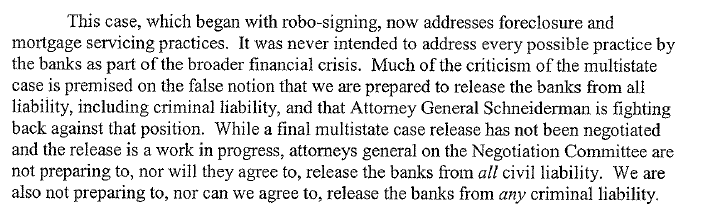
This sounds like a big deal, right? Not really. First, there is a LOT of straw mannning in this section. The letter asserts that critics have said that the state/Federal effort is out to give the banks a waiver of all mortgage-related liability. The Congressmen did not make that argument, nor have any critics I am aware of said that. What they have said is the AGs are likely to give an overly broad release way too cheaply, particularly if chain of title issues are included.
Similarly, the Congressmen did not mention criminal prosecutions. And Milller is merely reiterating his ongoing stance, per Bloomberg in January:
The group isn’t pursuing a criminal investigation, Miller said. “Our focus is to reform the servicing process and that’s inherently civil, not criminal,” he said.
Per Miller, a settlement, assuming that there ever is one, will not forestall criminal prosecutions. But the reality is if state AG’s can’t launch civil cases (because they’ve settled civil liability) they are effectively precluded from developing criminal cases. Why? State AGs are resource constrained. If they launch an investigation, they typically look to see if they can build a civil case, and as discovery proceeds, they can up the ante to criminal charges if they think the facts merit it. To set the bar for litigation at criminal charges will make pursuing this area a non-starter.
Finally, Miller disingenuously points out that Schneiderman is always free to opt out and go his own way. Duh.
Miller’s increasingly defensive responses to well deserved criticism suggest that he really does not understand that he has aligned himself with a bad cause. If so, that makes him a very valuable human shield for the Administration.


it also should be added that Miller was one of the first in Iowa to publicly out himself as a Barack supporter in 2007.
I’m sure that Miller feels like the big man on campus whenever Air Force One rolls into Iowa and Miller gets to stand at the greeting line on the tarmac—-no way he’s going to burn that bridge.
This isn’t Miller’s 1st settlement rodeo . . .
“After more than 18 months, Ameriquest Mortgage Co. is finally close to a settlement of predatory lending charges, a deal that would clear the way for the company’s founder, Roland Arnall, to become U.S. ambassador to the Netherlands.
“It’s finally getting close, and I think we’ll conclude it in mid-to-late January,” says Iowa Attorney General Tom Miller, the leader of a task force of AGs from 33 states and the District of Columbia that has been probing the company. Ameriquest is expected to pay as much as $325 million to put the matter to rest.” January 13, 2006
http://www.institutionalinvestor.com/Popups/PrintArticle.aspx?ArticleID=1025813
Well, we know how that one worked out.
“We know what the problems are, and we know what needs to change.”
You are assuming that the issue he talks about is the same you do.
I bet they know what the problem is, and know the solution they would like. The problem might even be the same as you think, but “what needs to change” can be diametrically opposed. You’re looking for a brave new world, they for status quo ante bellum.
How is he going to prosecute anyone?
Most of the State Attorney Generals can only bring civil actions. New York’s Attorney General is one of the few that can.
The problem, IMO, is that the State AGs have a strong tendency to view every problem as one where you collect money from the bad guys, and then distribute the money (as far as it will go) to the injured parties. A not insignificant portion would also be used to pay for the salaries of the State AG personnel involved in the case.
So while there is a mechanism to get the 50 State AGs to go with civil charges, there is not any for criminal charges. The criminal charges would likely be brought by various low level DAs all over the country. That number of course runs into the 1000s. Obviously Obama and the AGs could show more leadership here, but that tends not to be the way they think.
The State AGs I gather have viewed New York as representing the bond holders, not the home owners. Many States handle security issues through their Secretary of State, so it is not even an area that they can touch. The NY AG is wired into the media, and were viewed as leaking information like a sieve. I don’t really have a particular problem with the route that NY is going, but it is fairly obvious that they probably never belonged in the 50 State group. Their resources, and capabilities (they can file criminal charges and attack securities issues) means that they likely were going to be more limited, then helped by participation with the group.
*They’re not trying to release from “all civil liability.”
Yes, just all the most important systemic liability. But if JPMorgan doesn’t spread salt on its icy sidewalk and someone slips, they’ll still be liable.
*They’re not trying to release from criminal liability.
I reckon if prosecution is in the hands of the likes of Eric Holder and Tom Miller, the criminals have nothing to worry about.
The statute of limitations for securities fraud is 5 years, or 2 years after discovery of the fraud. Might be hard to argue six years from now that investors weren’t on notice of the MBS fraud at a much earlier point or couldn’t act to discover it.
I bet, within the next 6 years, those bankers will be made personally accountable; anyone going after them has got the popular vote now as people start to realize and understand the extent of their failures and their theft.
Hmm, not much mention of the FHFA’s attack on the Banking mafia – such a delightful turn of events when the rich and famous start throwing down amongst themselves. Both groups could care less about the US borrower, dead bodies from US aggression in foreigh lands, the poor riff-raff and other assorted untouchables – Miller unfortunately is just caught between the shouting matches of the elite. Bribes are just silly allegations amongst royalty.
Easy there tiger – it’s well understood constant worry about employment and housing bring out the worst in the human bein’, we know this because it runs in the human family. Basic needs are still sacrificed in the machine of profit takin’, the world is a laboratory filled with the worst but above it all, cling to hope.
What can you say about the state of a republic when policemen team up with criminals ..
In his own mind, Miller probably decided that there is some big picture noble good for the long term viability of housing and the US economy. Of course this has been tainted by self interest and FIRE “contributions”. His stance is really just another vote for capitalism run amuk by the overleveraged banks, destruction of currency and a widening gap between the haves in the FIRE industries and the middle and lower classes.
Does Yves thinks there continues to be a reasonable likelihood of the 50 states attorney generals reaching a settlement with the banks? It seems to me that her recent posts on the topic have suggested that the banks aren’t likely to get a sufficiently broad settlement to make it worthwhile for them to give up anything in turn. On top of that, we have seen the effective death-by-a-thousand-interventions in the BofA $8.5 billion settlement, as well as the FHFA lawsuits. If there isn’t going to be a settlement, I think we can afford to ignore Miller’s buffoonery. On the other hand, if a settlement is likely or imminent, I’d be interested in knowing.
I still think the odds favor there being no settlement. All the stories trying to claim the discussions are making progress reveal big time problems and bad negotiating strategy (bad in terms of reaching any deal).
But Miller carrying on still offends me.
Meantime, what are the rest of the “50” doing
(besides NY, MA, NV and the other naysayers)?
Surely there are other AG’s whose noses aren’t
firmly buried up the banks’ butts, or who aren’t
either Republicans or “center-right” Democrats.
It seems to me that a “task force” is an excuse
for an AG who joins it to do nothing, but say
s/he’s doing something.
My state (TN) has one of the slackest AG’s in
the history of civilization when it comes to
protecting consumers (e.g., their big push now
is against the unauthorized practice of law—WOW).
When there’s a “task force,” our AG usually
has to be dragged, kicking and screaming, to
join it. It wouldn’t surprise me in the least
if the TN AG, far from breaking out of the task
force because he doesn’t think the settlement
terms are stringent enough, breaks out of it
because he thinks the terms are TOO stringent.
TN is a finance-friendly state. We’re a hotbed for
the payday loan business, and, worst of all,
we’re one of the states that still allows
foreclosure to take place without requiring any
judicial scrutiny. So, I hold out no hope that our
AG will do ANYTHING to rock Miller’s boat, much
less actually protect Tennessee’s consumers.
The team-player AGs should be frantically contriving legalese to formulate a definition of a legal cure for a defective chain of title and a missing note. Or a copy of a note with several missing endorsements. Once these pesky “robosigning” things are out of the way, the banks are home free. I mean what was that amendment about affidavits across state lines that Obama pocket vetoed? That was an attempt by Congress to smooth the way without letting on how huge the underlying problems were. The AGs aren’t going to put too fine a point on thigs – just enough to sidetrack civil suits. They also need to somehow find a way to imply that although the PSAs might never have been followed, the banks intended to securitize the mortgages. So the AGs will probably also come up with that legalese too – it was the banks’ good-faith intent to securitize. Like a serial murder’s intent to expedite his victims into heaven. And nevermind entirely that these banks took the world economy over a cliff with their remiss and inept business practices, if not their fraud.
Credibility Chasm.
Thank you for attending to the deficiencies of our language, Yves. I think there is more power in the control of language than even in the control of money creation. If we could control the language of the debate, we could change how money is created. Let us not be dumbed (literally) by technocratic newspeak and MSM coloquial newspeak.