One of our big beefs about the pending mortgage settlement has been the failure of prosecutors and regulators to do anything remotely resembling serious investigations. You don’t settle on known, easy to prove abuses (particularly when you choose not to know their extent) and leave yourself with a grab bag of mainly more difficult to ferret out ones to consider going after later.
We’ve seen repeatedly that small scale investigations in the servicing and foreclosure arena have found widespread problems. For instance, one by Abigail Field of foreclosures in two counties in New York found a complete fail by Countrywide of transferring notes to trusts in its own securitizations. Registers of deeds Jeff Thigpen in Guiford County, North Carolina found widespread evidence of robosigning. John O’Brien of Southern Essex County, Massachusetts, conducted an audit and found, per Dave Dayen:
‘• Only 16% of assignments of mortgage are valid
• 75% of assignments of mortgage are invalid.
• 9% of assignments of mortgage are questionable
• 27% of the invalid assignments are fraudulent, 35% are “robo-signed” and 10% violate the Massachusetts Mortgage Fraud Statute.
• The identity of financial institutions that are current owners of the mortgages could only be determined for 287 out of 473 (60%)
• There are 683 missing assignments for the 287 traced mortgages, representing approximately $180,000 in lost recording fees per 1,000 mortgages whose current ownership can be traced.
So the latest report from San Francisco county should come as no surprise. From Gretchen Morgenson of the New York Times, emphasis ours:
An audit by San Francisco county officials of about 400 recent foreclosures there determined that almost all involved either legal violations or suspicious documentation, according to a report released Wednesday….
The improprieties range from the basic — a failure to warn borrowers that they were in default on their loans as required by law — to the arcane. For example, transfers of many loans in the foreclosure files were made by entities that had no right to assign them and institutions took back properties in auctions even though they had not proved ownership.
Yves here. I wish Morgenson had not deemed the latter abuses as “arcane”. They are actually pretty basic to lawyers – you can’t assign rights you don’t possess or sell what you don’t own. And these are concepts that laypeople can grasp readily. Back to the article, which makes clear the state attorney general Kamala Harris, who was doing a victory lap over the mortgage settlement, had nothing to do with this probe:
Commissioned by Phil Ting, the San Francisco assessor-recorder, the report examined files of properties subject to foreclosure sales in the county from January 2009 to November 2011. About 84 percent of the files contained what appear to be clear violations of law, it said, and fully two-thirds had at least four violations or irregularities…
As the San Francisco analysis points out, “the settlement does not resolve most of the issues this report identifies nor immunizes lenders and servicers from a host of potential liabilities.” For example, it is a felony to knowingly file false documents with any public office in California.
In an interview late Tuesday, Mr. Ting said he would forward his findings and foreclosure files to the attorney general’s office and to local law enforcement officials. Kamala D. Harris, the California attorney general, announced a joint investigation into foreclosure abuses last December with the Nevada attorney general, Catherine Cortez Masto. The joint investigation spans both civil and criminal matters.
The depth of the problem raises questions about whether at least some foreclosures should be considered void, Mr. Ting said. “We’re not saying that every consumer should not have been foreclosed on or every lender is a bad actor, but there are significant and troubling issues,” he said…
In a significant number of cases — 85 percent — documents recording the transfer of a defaulted property to a new trustee were not filed properly or on time, the report found. And in 45 percent of the foreclosures, properties were sold at auction to entities improperly claiming to be the beneficiary of the deeds of trust. In other words, the report said, “a ‘stranger’ to the deed of trust,” gained ownership of the property; as a result, the sale may be invalid, it said.
In 6 percent of cases, the same deed of trust to a property was assigned to two or more different entities, raising questions about which of them actually had the right to foreclose. Many of the foreclosures that were scrutinized showed gaps in the chain of title, the report said, indicating that written transfers from the original owner to the entity currently claiming to own the deed of trust have disappeared.
While Phil Ting is optimistic that there will be follow through and action, one can easily reach the opposite conclusion. First, the intent of the settlement is to collect money, impose new servicing standards, which like past servicing standards will not be met, and also go after some additional cases with great fanfare to create the impression that the officialdom is Doing Something. The goal is to preserve the system, based on the deeply flawed premise that all that is needed is yet another consent decree and more serious looking fines and servicers will toe the line.
But look at the report findings. Almost no foreclosures were conducted properly. One cause is the issue we have been writing about for nearly two years: the failure of the parties to the original securitization to convey notes properly to the securitization trusts. That failure can’t be remedied at this late date, so the only way to create the appearance that the trust has the right to foreclose is either by filing improper documents and hoping no one notices, or document fabrication and forgeries.
The second is that servicers can’t afford to meet the servicing standards set forth in the consent decrees. They’d go bankrupt. Various regulators have been promulgating the same standards since the FTC consent decree with Fairbanks in 2003, and the industry has NEVER been able to meet them. Enforcement is lax, and violations are simply rolled into new consent decrees. See this, for example, this announcement from the Office of the Comptroller of the Currency last week:
In the agreements in principle struck by the OCC with these mortgage servicers, the servicers do not contest the OCC’s ability to impose penalties aggregating $394 million, and the OCC agrees to hold in abeyance imposition of such penalties provided the servicers make payments and take other actions under the federal-state settlement with a value equal to at least the penalty amounts that each servicer acknowledges that the OCC could impose.
I also have to note that Paul Jackson of Housing Wire has attacked the Morgenson piece on Twitter, attempting to smear the authors of the underlying report and accusing Morgenson of sloppy fact checking. Jackson (pjackson) has put up a manic 17 tweets. That’s a cowardly way to take issue with a piece, but this approach allows him to make various ad hominem salvos when a putting them in a more conventional format would expose that he has no substantive argument. His efforts to attack the report’s authors don’t really land a blow. This section gives you an idea of how desperate Jackson’s efforts are:

I’m sure most of Jackson’s readers are savvy enough to know that loan screening has nothing to do with failure to comply with the transfer procedures set forth in pooling and servicing agreements, or fraudulent servicing and foreclosure practices, which is what the San Francisco investigation looked at. But Jackson is presumably hoping to sway journalists who don’t know the terrain.
Yet amusingly, Jackson’s own reporter, Jon Prior, who is full time on the housing beat and is generally even-handed, obviously thought the San Francisco report had merit. He wrote an article that was posted on Housing Wire apparently before Jackson got wind of it and yanked it. From my RSS reader and Twitter:
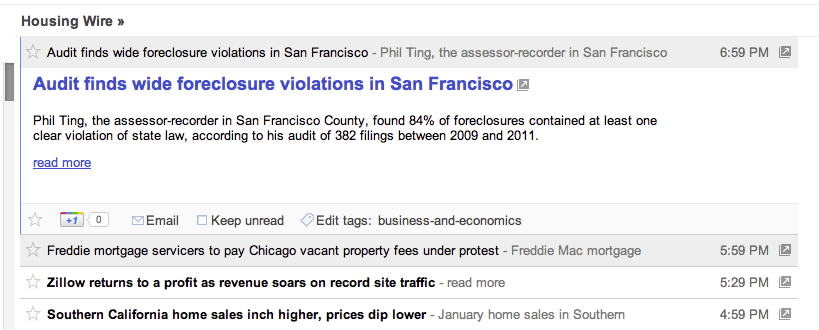

If you click on either link, this is what you get:

It’s remarkable that Jackson has the temerity to talk about conflicts of interest. The biggest advertiser on his site has been Lender Processing Services, which along with MERS was singled out for particularly harsh treatment in the OCC consent decrees last year. LPS is also the target of numerous lawsuits, including a case by Nevada’s attorney general that is outside the mortgage settlement. Moreover, as Dave Dayen pointed out, one of the major backers of Housing Wire is Richard Bitner, who has depicted himself as the analogue to a drug dealer for the subprime industry.
So Jackson appears to be defending his meal tickets, and in a classic example of projection, accuses others who appear to be blameless (his Twitter argument, despite all the links, does not hang together) of the type of conduct he regularly engages in.
This isn’t the first time Jackson has engaged in mudslinging. He’s made scurrilous attacks on pioneering foreclosure defense attorney Nick Wooten, misrepresented decisions that have been unfavorable to his backers (not just our view, but also that of law professor and securitization expert Adam Levitin), and relied heavily on anonymous and dubious-sounding sources. He has even tried insinuating that critics of the now-shuttered foreclosure document fabrication subsidiary of LPS, DocX, such as Congresswoman Maxine Waters, consumer groups, and yours truly, were engaged in “lying and fraud.” From the close of Richard Smith’s evisceration of Jackson’s shameless defense of DocX:
In the end, Jackson’s piss-poor journalism, and his imperilled credibility as a pundit, do turn out to have a great big ethical implication. The people he is speaking up for, and the stand he is taking, are profoundly antisocial. Denying, and thus, tolerating, this fraud involves even more collateral damage than a blogger’s standing, more even than abused mortgage holders, clouded title and a stalled housing market. The ultimate destination would be capitalist society without contract law: impossible. Says Tom Adams:
To date, courts have consistently sided with servicers and trustees because of the power dynamics (big banks vs. borrowers in default). With all of the recent news, I suspect many judges are reconsidering this, especially in light of the significant case law history which would be unsympathetic to the position of the servicers/trustees. To consistently hold for the servicer/trustee with poorly documented or protected collateral rights would create a very problematic set of precedents for other types of notes and contracts. This is why attorney generals and judges should be very considered about the current state of mortgage industry. It is a disaster for the rest of the legal world and no judge wants a collection of precedents set in their state where they have to ignore the UCC, prior precedents and common sense, in order to find for the servicer/trustee. It is truly a terrifying issue.
And as we’ve seen again and again, it is also an issue that Jackson and the industry would rather obfuscate because they are utterly unable to address it openly and honestly. Transparency would expose many key players to be in need of such deep seated changes as to put them out of business.
Update: Adam Levitin makes the critical point that this review make a mockery of the soi-disant investigations to date and proposed exams. Read his post in full. Key extracts:
The San Francisco City Assessor’s audit also serves as a benchmark for evaluating the Federal-State servicing settlement. The San Francisco City Assessor managed to accomplish in a few months what the Federal government and state Attorneys General weren’t able to do in nearly a year and a half with far greater resources at their disposal: perform a credible investigation of foreclosure documentation with serious implications about the securitization process in general. That’s a lot of egg on the face of Shaun Donovan, Eric Holder, Tom Miller, et al. The SF City Assessor report shows that it really wasn’t so hard for a motivated party to undertake a serious investigation. And that raises the question of why the largest consumer fraud settlement in history proceeded with virtually no investigation.
The lack of investigation was the compelling criticism that led the NY and DE AGs to stay out of the settlement for quite a while. I’ve never heard an answer as to why no serious investigation. As the SF City Assessor’s audit shows, the documentation is all a matter of public record. It’s not that hard to do, especially if you have the resources of the federal government. So the resources were there. The capability was there. So why no investigation? The answer has to lie with lack of motivation. Were the Feds and AGs scared of what they would find if they delved too deeply into the issue?


“Audit finds wide foreclosure violations in San Francisco”
Cached.
http://74.6.238.254/search/srpcache?ei=UTF-8&p=%22Audit+finds+wide+foreclosure+violations+in+San+Francisco%22&fr=moz35&u=http://cc.bingj.com/cache.aspx?q=%22Audit+finds+wide+foreclosure+violations+in+San+Francisco%22&d=347648446759&mkt=en-US&setlang=en-US&w=9e7bdebf,c0b5f514&icp=1&.intl=us&sig=vgkFq2egm1xFhTcbNWgqCw–
Cool, thanks! I will have to learn how to look for that sort of thing.
I assume the same way I find FT articles without signing up for subscription: google the exact title.
Let’s just say most search engines ‘lost’ the link. But not all of them. And there are a lot of search engines.
Forbes is trying to discredit the report. With a mild diss of Yves.
Mortgage-Audit Firm — Surprise! — Finds Lots of Errors in Foreclosures
http://www.forbes.com/sites/danielfisher/2012/02/16/mortgage-audit-firm-surprise-finds-lots-of-errors-in-foreclosures/
“Aequitas earns its keep by finding errors in mortgage paperwork for lawyers and regulators. It also has a unit that does court- or regulator-appointed compliance monitoring of lending institutions”
“Does it affect in any way the rights of the homeowner who isn’t paying his mortgage? The only way I can think of is if the homeowner wants to delay the foreclosure by asserting legal errors in the process.”
And as an FYI, Gretchen talks about the piece on ‘Business Day Live’ at the Times site.
Phil Ting is a nondescript seat warmer who is looking to make the jump into the state Assembly. The guy took public financing dollars to not run for Mayor last year, instead spending those dollars to get his name out to west side voters. If past is prologue, then Ting will go through the motions of pretending to care, only to use threat of changing the law to shake contributions from Wall Street and to immunize them legislatively once elected.
Nah, it’s Ting-sanity!
As for Kamala, what can we say? She who cut her political chops bouncing on Brown’s Willie and sluiced into the DA slot under a persistent ethical cloud is Obamaesque in her ability to present the optics that appeal to liberal white guilt but which only disguises the seething opportunism beneath.
Faux populism when out of her natural habitat, and that gets dropped when her patrons hup her to.
Can any authority other than Harris do something in response to this? I.e. could say the California Court system begin disbarment or the San Francisco county-level law enforcement agencies act?
Since she began her public trumpeting of a not-yet-written settlement that looks like it will do things she said it wouldn’t, I’ve lost most of my faith in Kamala D. Harris.
I feel kind of the same way, Harris did hold out for a while, but eventually caved.
FWIW, for those of you not familiar with SF politics, Harris was the SF DA before being elected to statewide office. She knows Phil Ting, who IMHO is a honest public figure.
Funny how this was at Housing Wire………….
Will Kamala Harris be the next Supreme Court nominee?
http://www.housingwire.com/blog/will-kamala-harris-be-next-supreme-court-nominee
(Jessia Huseman, quoting Tom Goldstein of SCOTUSBlog:)
“She’s female, she’s a minority, she’ll be about the right age at the time of the potential nomination (she’ll be 50 in 2015), and she doesn’t send out alarm bells for left-leaning ideology the GOP would hate.”
That’s really appalling. So that’s what Obama dangled? Just… Ugh. A Supreme Court Justice-ship as a reward for destroying the rule of law. How meta. Of course, Scalia did the same thing, so there you go.
What does this mean for insurance? Mortgage? Title? Home?
And I’ve been amazed at how placid institutional investors have been. I had thought that their fiduciary obligation would cause them to seek put-backs. Will they do so as evidence like this comes to the fore?
I noticed Jackson’s own article on HousingWire, advancing how much more the banks have given up than anybody wants to give them credit for. One of the two items is the ability for private litigants to use any material obtained by the AG’s through discovery, in their investigations in the course of the mortgage settlement. Any clues as to what kind of material the attorneys general might have? How will private litigants know what they have? Will the attorneys general publish the results of their investigation? More interesting each day.
http://www.housingwire.com/blog/parsing-reality-multistate-ag-settlement
Brian, in theory I agree with our permise and think it is a very serious issue that is one of the reasons there has been such a weak push for investigations. The chain of title isues could be enormous……if and only if the current laws are followed. However, it seems that their is more likely a greater push for inacting new laws to clear title to property with a swoop of the pen by some politician.
I have mentioned to most people that buying a property in cash still may not mean you are the actually owner unless the laws are changed. This is something that was done by the banks that has the entire system turned upside down and now the administration is trying to put the genie back in the bottle at the expense of the american people.
So, Yves or others, is this a worst-case scenario? Does everyone buying any property that’s touched the securitization world have to worry that it might not really be their house after they plunk down the money?
Mortgage satisfactions may be meaningless if ownership of the promissory note is unclear. In other words, even if a homeowner has made all payments under the promissory note to a servicer and the mortgage is marked satisfied in public land records, it is possible that the owner of the note didn’t receive all payments due and may challenge the mortgage satisfaction.
FYI, where I live, in NC, many of the satisfactions filed are also “robosigned”. The lenders’ response is that it doesn’t matter, as homeowners would have no reason to file objections. They apparently disregard the fact that lenders themselves have been known to come back and argue the satisfactions they filed were invalid. In one case, Wells argued that the signature of their employee had been forged, and the employee testified to that effect. Fortunately for the homeowner, the judge rejected the argument because Wells failed to provide supporting (or any) evidence from the notary who stamped the satisfaction. In another, it was later argued that MERS and the servicer, BAC, lacked standing, over a year after a short sale had been approved and the new owner had taken possession. If somebody has faithfully made their payments on a note for 30 years, or followed the terms of their mortgage loan for any length of time, you’d think they at least deserve a legally valid satisfaction. Lenders do not allow borrowers to deviate from the terms of their security contract. Lenders should be held to the same standard they impose on their customers.
Yves – Thank you for your common sense response to Mr. Jackson’s attack. You make the correct point. I was formerly CEO of Mavent Inc., a company that provided regulatory risk management reviews relating to federal and multi-state laws respecting the origination of loans. Our client is the industry and the results of those reviews and the names of our clients shall remain confidential. The San Francisco report, which can be downloaded at http://www.sfassessor.org/modules/showdocument.aspx?documentid=1018, focuses on laws relating to statutory foreclosure in California. One has nothing to do with the other, so I’m not sure where Mr. Jackson sees a conflict. Furthermore, the report provides a detailed application of California law to publicly available information. It is very transparent. Our main thesis is not that the industry is collectively guilty of defrauding homeowners, but rather that California’s century-old non-judicial foreclosure law is poorly suited for today’s modern mortgage market. Clean title and the integrity of the public land records should be cause as important to industry as it is to property owners. Given that the report provides much explanation for its conclusions, and further given that all the underlying data is public, I’d prefer Mr. Jackson criticize specific statements in the report than attack my integrity. This seems more a case of killing the messenger than robust debate.
Lou, maybe I am misunstanding what you are saying but your point seems to be that your clients are breaking the law and the problem as you see it is that the laws need to be changed to suit them. Am I missing something here?
Here’s a cut and paste from the Mavent web site:
“PLEASANTON, CA—December 16, 2009—Ellie Mae®, the software and services provider for banks, mortgage banks, credit unions and mortgage brokers, announced today it has acquired Mavent Inc., a provider of automated compliance solutions for the mortgage industry. Mavent’s technology is currently in use by many of the country’s leading investors, Fannie Mae, and over 100 lending institutions, including five of the ten largest mortgage lenders in the United States.
“Ellie Mae and Mavent share a commitment to helping mortgage institutions profitably grow their businesses while cost-effectively managing regulatory and secondary market risks,” said Louis Pizante, chief executive officer for Mavent. “New and particularly complex regulation is impacting all facets of the mortgage production chain, making sophisticated and integrated compliance solutions a business requirement. Joining Ellie Mae will better position Mavent to help mortgage businesses of all types navigate the dramatic regulatory and market changes ahead.”
I guess that client list isn’t such a big secret after all Lou.
One last thing, I promise. I’m also confused about the integrity thing you mentioned. I think maybe our concepts of the term differ slightly. care to elaborate?
“Our main thesis is not that the industry is collectively guilty of defrauding homeowners, but rather that California’s century-old non-judicial foreclosure law is poorly suited for today’s modern mortgage market.”
84% of foreclosures showing fraud and there’s no collective guilt? That the industry is “collectively guilty of defrauding homeowners” seems blatantly obvious. If the current laws are poorly suited for the modern mortgage market, why didn’t the industry get them changed? Outdated or not the law is the law, and finding a law inconvenient to follow does not excuse one for violating it.
“Clean title and the integrity of the public land records should be cause as important to industry as it is to property owners.”
Should be and is, just so long as the industry gets to dictate what constitutes “clean title” and how and where public land records are kept/transfered.
““Ellie Mae and Mavent share a commitment to helping mortgage institutions profitably grow their businesses while cost-effectively managing regulatory and secondary market risks,” said Louis Pizante, chief executive officer for Mavent.”
I assume cost-effectively managing regulatory risk includes advocating for laws to be changed that will help extract your clients from this lovely pickle they’ve created, no?
I fail to see how the industry is not a cartel.
Sometime in the late 90s, under the direction of attorneys like Eric Holder, the industry decided to collude to avoid state recording laws and recording fees.
They purposely decided to jump over the cliff as an industry and dared the regulators to stop them.
And since they put their potential co-conspirators in office, and the regulators have been captured, they think they got away with it.
And they have got away with it. There are so many crimes and legal violations here it isn’t even funny. The only defense left is the “everyone did it” defense and “it’s better if we just put this behind us and move forward” defense.
This defense would never work if one was a brown or black or poor person. If you’re one of those people you have to be locked up in a cage when you commit similar crimes.
Levitin closes with “thus far, the settlement seems an awful lot like Swiss cheese–it’s got plenty of wholes and smells ever worse with time.”
Amen.
I am distressed but not surprised that Morgenson describes the deal as a “settlement”, rather than using a more accurate term like “proposed settlement” or “settlement in principle” or “settlement outline”. She is stuck, since her paper described the press release last week as an actual “settlement’, so she can’t walk that back without breaking ranks with her employer. This language issue is not an arcane point but goes to the heart of her article. If this audit in SF shows that the situation is much worse than the states (and Kamala Harris in CA) thought, they can still back out of the proposed settlement, and the public can demand that they do so.
A “settlement” involves representatives of the injured parties.
What we have here is a division of the loot, after
a successful Con.
It’s like Jeopardy: Answer: “Because they’re all thieves.”
“What is the reason the SF Assessor’s Office can do in a few months what Obama and Holder couldn’t do in several years?”
Inestigation Negotiation
Two thoughts:
1.) Of course the settlement does little to clear things up because there’s really no way of going back in time and getting the assignments and other required paperwork to foreclose EXCEPT by comitting fraud. So indeminity for past actions won’t do anything to unscrew that pooch.
2.) Does failure of assignment create a cause of action for OTHER creditors to the defaulter? After all, if the mortgage lender hasn’t complied with the legal requirements to foreclose, ISTM that they have to stand in line with OTHER non-secured creditors, some of whom might actually have debts senior to theirs. So could the other lenders sue the mortgage lender for the fraud because their interests have been adversely affected by a wrongful foreclosure? At the pennies on the dollar that distressed debts are sold for, this could be a worthwhile case to make, especially because somebody could create their own “class action” by purchasing a large ammount of senior unsecured debt from those who have been forclosed upon fraudulently.
Jim A,
Yours is a really interesting idea; I have to let it sink in a bit.
If your idea worked, I even like it for the sake of a possible unintended consequence–lots of folks snooping through the county land records for fraudulent documents.
Like gold prospectors at Sutter’s Mill–folks would come from everywhere–mining through data for nuggets of fraud. A modern day gold rush–at Foreclosure’s Mill! The Fraud Rush is on–thar’s gold in them thar bills!
(BTW, if this is the case, I would like to stake my claim to the fraudulent records in GA–which I have been mining for some time now.) ;-)
You are on to something here — judges are very comfortable ignoring the rights of the obviously blameworthy borrowers, but they might feel compelled to glance at the law if the dispute is between competing lenders.
Doesn’t even have to be a class action — an individual with a few bucks could easily buy up a bunch of foreclosed-out seconds for next to nothing. If said individual happened to be a litigator who could do the legal work him or herself, the whole thing could be done on the cheap.
Well what I was trying to say is that since you can pick and choose which debt to buy, you don’t have to get certification as a class action to build up enough to make sueing worthwhile. I don’t think that second mortgages would be helpful though. Whether or not anybody has the right to foreclose I would think that they are still subordinate to firsts. But CC debts that pre-existed the last refi and were purchased by a litigant before the FB got foreclosed upon are arguably senior to the mortgage and would be adversely impacted by a fraudulent foreclosure. It’s a novel, high risk gambit, but so was the tobacco settlement. And you’re right, it’s about presenting somebody sympathetic ,with “clean hands,” to a judge.
2little2late–The failure of the lender to properly file the paperwork enabling them to foreclose, or to properly convey it to a trust, or their contracts to forward payments to any of a series of other entities or bondholders does nothing by itself negate the original promise by the borrower to repay the loan.
Yes, but criminally fraudulent mortgage assignments such as are mentioned in Yves piece above and like I have recorded against my mortgage (two banks claiming ownership) can unsecure an obligation in a hurry.
Jim A, you are correct in that there is no abrogation of the underlying debt that the homeowner agreed IF: all the parties to the obligation were properly named, IF: there was no negligent or intentional misrepresentation, IF: The note and DOT were properly transferred into the trust and NOT used as collateral for other transactions, IF: the underwriting and appraisal standards were per the prospectuses, PSAs and not wildly inflated, IF: Borrowers incomes were intentionally misrepresented by the originators. There may be a few other IFs also that I’m not covering here. Point is, if the originators/lenders did none of those things, then yes, the debt is unscathed.
But if any one or all of those things were present, as most major investors/certificate holders on the RMBS side have averred in lawsuits, then homeowner suits for damages that exeed or counterbalance any asserted debt can cause the debt to be “suspended” until litgation is prosecuted, which is what I would recommend any/all homeowners to examine.
“Does failure of assignment create a cause of action for OTHER creditors to the defaulter?”
What defaulter? How in the hell can anyone default when multiple unknown entities have passed the note around like shine at a barbeque?
It’s way passed time for everyone to stop paying these pretend debts. Bring it down.
As suggested by the results of this audit, when are the homeowners who are current on their mortgage going to wake up to the realization that their servicer may be forwarding their payments to an entity that does not have the right to foreclose on their property? They may be unaware that their servicer can’t or won’t even tell them who does have that right? So what redress does the paying homeowner have under the settlement to address this issue? The Obama Mod settlement should be getting the attention of far more than delinquent and foreclosed borrowers.
Bravo, as someone of the mind of Judge Rakoff has suggested, the person in the house should *stand pat* and make the bank/sheriff PRODUCE the PROOF of ownership of the property which entitles the bank to foreclose hence the sheriff to evict.
Of course, a good lawyer worthy of trust by the person living in the house would have to be ready to review the claim to ownership. Who can afford that? Gotcha!
I came across this unsettling bit in a NYT article, see here
…Lou Pizante, a partner at Aequitas who worked on the audit, pointed to documents that banks now require buyers to sign holding the institution harmless if questions arise about the validity of the foreclosure sale.
Yves, anyone, Is that legal? Can the banks actually get away with it?
In the case of a deed, probably yes. There are different types of deeds that convey varying types of title. Quitclaim deeds, for example, that make no assurances about the quality of title have been used for a long time. Title insurance is supposed to mitigate these risks, but title companies are inserting all sorts of interesting language into policies these days. Purchasers don’t stand a chance if they aren’t aware of what the legalese means. One way around this imbalance of power/outright deception is to hire competent counsel to review title commitment and deed and let him/her negotiate removing the harmful language. If the bank or title company won’t compromise, the buyer should be prepared to walk away from the deal. It’s a whole lot easier to get the language right from the beginning than it is to wage a battle in court after the fact.
Practically speaking, is it even possible to get language in the agreement modified? I thought all the lenders used standard (typically Frannie) templates and if borrowers wanted the money, they had to sign as presented.
True, it’s extremely difficult to negotiate anything when it’s an REO property because the seller (bank) insists that the buyer use its agreement of sale and won’t accept changes. It’s take it or leave it. I have had more luck getting the title company to remove exceptions from the policy commitment–the “free ” title policy that the REO seller frequently offers as part of the deal–although it’s a battle. After going through it a few times, I caution clients who want to buy an REO property that they are rarely a bargain when you figure in the additional title risk.
Oops, I didn’t respond to your question in terms of indemnification agreements that banks may ask purchasers of REO properties to sign. It’s not hard to imagine judges finding that purchasers knowingly agreed to the terms of an indemnification agreement containing such language. There are countless decisions in predatory lending cases where the borrower thrown out of court because they “knowingly” signed the promissory note that wasn’t reviewed by counsel (not required under the law)while under all kinds of pressure (closings held at the buyer’s home, at odd hours, under intense time pressure, etc.) If courts have routinely upheld the terms of those kinds of predatory loans, why should it be any different for indemnification agreements such as this one?
PL, you answered my question quite well both times. Thanks!
Right, YVES, why is this not considered signing *UNDER DURESS*, hence not binding?
You can be assured that any homeowner accepting an Obama Mod will be required to sign similar documents.
meanwhile obama is in sf today for political fundraising
think anyone will ask him about this? LOL
but you can be assured kamala will be there
smiling and shaking hands and laying the groundwork to run for governor
lots of happy small talk will ensue
and the band played on
justice for sale
No one’s paying any attention to this boring mortgage stuff, anyway. All eyes are trained on the contraception farce–either how Obama is making war on religion, or how brilliantly he played the bishops, depending on your point of view.
Coincidence? You be the judge…
Since the AG agreement has never been signed, doesn’t this due diligence put significant pressure on the AGs not to sign? After all, they were relying on the banks’ representation that servicing problems were few and far between.
The wrench this throws into the Pamela Harris victory lap is pretty substantial.
Nah. The San Francisco Chronicle ran a puff piece yesterday about Harris and how awesome she was in getting a lot of money for the Bay Area–the Chronicle is beyond worthless.
Sure, they may be reporting the study today but the sheer volume of propaganda and diversionary issues will push it to the back burner.
There is no justice. Crooks like Harris and Obama will only be rewarded for their crimes (and indeed, they are now complicit in a cover up of the biggest crime in a century).
WWM, what every American pol knows: elected Office is the road to riches.
Re: chain of title problems – I theorize that these could be resolved by a property owner/buyer filing a quiet-title action. This would be a suit, naming as defendants all prior mortgagees of record (meaning there is some document filed at the county RE office), and servicers – basically everyone that filed records suggest might have an interest in the property, or know who does. The burden is then on them to come forward with proof of their interest in the property, in a limited time period. I theorize that they would not come forward, and that with this 3-6 month legal proceeding you could clear title to your property. No?
Wendy – You are theoretically correct. In California quiet title actions are generally a quick and efficient means to clear historical clouds on title. Unfortunataly, also in California, the legal system is subject to massive abuse by those who can pay to “work” the sytem (Bankers, ya think?) The droll comedian, Stephen Wright, certainly had California in mind when he said “99 percent of lawyers give the rest a bad name”.
Not to be flip, but if we can’t beat them, shouldn’t we join them? If they are well known users/abuses of such a system, judges are that much less likely to consider them victims and be unwilling to grant the requested relief.
Anyway this is really my own brainstorm for a possible niche practice for myself or to file if I ever buy a REO.
Um, Wendy, if you’re the party filing a quiet title action then the burden of proof is on you, not the defendant. You can seek discovery from prior mortgagees and servicers named as defendants, but it will be yeoman’s work to get it out of them. Not impossible but very hard work.
This never was the case in Louisiana, where you can buy/sell property with a cloud on the title, but that cloud remains with the title forever. The cloud may affect the price of the property, but it does not prevent the legal transfer of it through an Act of Sale.
Here’s the money finding for California counties found on page 12 of the report:
“For 45% of the subject loans, …a ‘stranger’ to the Deed of Trust purported to be the foreclosing Beneficiary of the subject property and was granted ownership of said property at the Trustee’s Sale. …Further, only foreclosing beneficiaries have the right to be exempt from the payment of transfer taxes charged by government agencies. If the foreclosing party was not, in fact, the foreclosing beneficiary then the transaction may involve the unlawful evasion of taxes.” Lots of county recorders should could be pursuing lost revenue.
I am interested in the back story here. Those county folks had to have know for years now that they were not getting the recording fees like before. I find it hard to believe that none said anything about the missing county income before now.
Why did it not become an issue before now? How long have the counties around the country not been getting recording fees for changes to titles?
If we free all the pot smokers from prison we would have enough room for the perps from the mortgage and financial industry…..just sayin.
I’ve wondered that too. And how did the local governments not notice the revenue drop either?
Although total recording fees for mortgage assignments may have decreased after MERS was created, the volume of sales increased at the same time as credit standards were lowered, more people qualified for mortgage financing and bought houses. So while counties may have noticed fewer recording fees from assignments, they were probably pretty darn happy with increased real estate transfer taxes as the real estate bubble expanded. That said, its also entirely possible that recording fees from mortgage assignments didn’t decrease very much after after MERS. Prior to MERS, promissory notes weren’t being sold and mortgages weren’t assigned so freely. After MERS came into being, it may have masked increasing purchases of notes in the secondary market from county officials who, therefore, weren’t expecting increased mortgage assignments.
They still got the recording fees whenever a home was sold to a new homeowner, just as before. It was only when loans were sold to different institutions, during the securitization process, that they lost revenue. Before the advent of MERS, securitizations weren’t nearly as common………mostly only at Frannie.
You’re correct LucyLulu, I overlooked fees to record mortgages and deeds when properties are sold. Revenues from those fees should have increased during the real estate bubble, as well as transfer taxes.
A great write up. Thanks Yves. Adam Levitin was also killer. When he says “it’s a political problem” he is clearly right but a situation this serious overwhelms the political system when the law is simply ignored. I can’t be the only one thinking that 20 million foreclosures will be achieved illegally before any sort of behavior is prosecuted. Taking such action requires naming the fraud which in turn requires using the law. As Levitin says “MERS is a self privatization of a part of a real property title system.” You can also read this as MERS is a self privatization of the law. A little treason here, a little treason there, pretty soon you are talkin real treason.
“Self-privatization” as a euphemism for theft. I love it! Kleptocrats rejoice!
Susan, yes, *real treason*–in addition to theft, as Lambert avers.
Levitin cuts to the chase and makes the argument I’ve been making; why is it so difficult to prosecute the biggest crimes in a century? Especially since the foot soldiers are so easy to prosecute.
It’s a matter of will rather than practicality.
Sure, it would be nice to have someone like Bill Black prosecuting a bunch of high level federal crimes with a huge budget under an accounting fraud theory, but there are also much simpler theories that can be pursued.
Heck, I bet if someone important wore a wire he or she could get a lot of incriminating evidence. They would certainly wiretap lessor people under similar circumstances.
Also, I’m sure they even wrote memos justifying the whole set-up of MERS. Why isn’t that a conspiracy to avoid the recording laws? How is that complicated?
This ethical lapses of this whole situation are so brazen it’s hard to even get a handle on it. Our leaders are openly committing massive theft and crimes. Impeach these bastards! Put Obama in prison!
This period in history is going to go down as “The Great Land Grab”
indio007: “Lebensraum” without the military. See Michael Hudson’s latest at http://www.therealnews.com with regard to how this works in *Europe*! You see, its *universal* Lebensraum, and all at once: the *tell* of an organized conspiracy of the .01%: the Fourth Reich perfection of the Third via .01% Lebensraum around the globe at the same time. This is no “coincidence.”
“But look at the report findings. Almost no foreclosures were conducted properly. One cause is the issue we have been writing about for nearly two years: the failure of the parties to the original securitization to convey notes properly to the securitization trusts. That failure can’t be remedied at this late date, so the only way to create the appearance that the trust has the right to foreclose is either by filing improper documents and hoping no one notices, or document fabrication and forgeries.”
Sigh. That’s just not accurate. The failure can be remedied in any one of several ways. True, the efforts to remedy thus far have consisted of all sorts of scurrilous behavior, robosigning, wrongful foreclosures, etc., etc. But, if the buyer is in default, remains in default, and is unable or unwilling to cure the default, the lender/investor in most circumstances will be able to redo the assignments properly. Botched foreclosures can also be redone.
The buyer/borrower is not a party to the PSA agreement, and most courts are not going to allow the buyer/borrower to assert the provisions of a PSA as a defense to foreclosure. The failure to properly and timely assign the mortgages and notes to the trusts is an issue between the parties to the PSA. It might be used as an issue to kick the assets back to the originator, or the investors my find it advantageous to waive the defects. However they choose to resolve the issue, it presents no legal impediment to legally and properly, under applicable state laws of long standing, redoing assignments and reforeclosing botched foreclosures.
The redo process would, of course, present buyers/borrowers who are able and willing to cure their default with the opportunity to do so. And the sheer, overwhelming volume of files to be redone presents defaulting buyers/borrowers with some pretty powerful negotiating leverage, particularly as regards getting rid of the deficiency, and avoiding dings to their credit. My guess is the solution will be deeds in lieu of foreclosure, cooperative short sales, and/or legislation enabling a streamlining of the whole process.
Lots of assertions Bridget, sigh. But you’re right probably right about most courts. ‘Dings to their credit’ – that’s pretty funny, thanks.
What’s do you think about defrauding borrowers?
A trust does not equal a contract. It can not be simply amended by the beneficiary. Not to mention a waiver of defect doesn’t change the IRS regulations stipulating 100% taxation.
Nor can a non-existent company redo an assignment.
You offered more problems than solutions.
Many of the existing lenders are still in existence. Others who have been purchased or gone into bankruptcy will have have legal successors in interest. And, of course, for those that are totally and completely defunct, closed up shop and vanished, that is where well designed legislation would contribute to a solution.
Contracts generally cannot be unilaterally amended by either party, but both parties can amend a contract, and a there is no reason why one party cannot waive contractual rights. Invidious, why do you say that a trust is not a contract?
Sheesh, that should say I’m curious, not Invidious. I hate autocorrect.
Breach of contract, ie. deception.
Breach of contract: failure to deliver/perform according to the contract’s stipulations.
A contract needs a meeting of the minds and a consideration. A trust only needs one mind. Neither the beneficiary or the trustee need to put up any consideration. In a contract, no consideration from a party voids the contract.
A trust is a devise, like a will or charter.
The Original Act of Sale was the first CONTRACT, the Bank *First Mortgage Contract was the second Contract. After that, who knows: what MERS facilitated was OFF THE RECORD at the Conveyor’s Office: the *transfer* of *naked liens* through *naked derivatives* of the mortgage took place to the nth degree, facilitated by bogus ROBOT *signatures*. This was a criminal RACKET.
Bring RICO.
Don’t forget what I’ve told Yves, and know for a fact: An Old Line *reputable* bank SOLD the mortgage on a house to an Ohio slice&dice bank BEFORE the ACT OF SALE on the property was signed.
Bridget,
You are dead wrong on this one
You can’t fix this retroactively. I’ve written numerous posts on this (circa fall 2010-early in the year 2011) as has Levitin.
Most of these securitizations were done electing New York law as governing law for the trust. New York law (both statute and over 100 years of rulings) does not allow the trust to deviate from explicit instructions. Any deviation is a void act and has no legal force.
The trusts were set up to be passive in accordance with REMIC, as well as rigid (Levitin and others describe them as immutable contracts).
The loans were required both by the PSA and by REMIC to be in the trust as of a date certain. You cannot put in a non-performing asset under REMIC. Delinquent and defaulted loans are non-perfroming loans. REMIC violations are subject to a tax of 150% of the prohibited act. Nor does the PSA allow for it, so it is also a void act under NY law.
You are FURTHER wrong about “borrower asserting rights under the PSA.” The borrowers is NOT asserting rights. The PSA defines what had to take place for the trust to be the owner of the note. The PSA defines a conveyance process under Article 1 of the UCC (which allows parties to contract out of the UCC as long as certain conditions are met). You thus need to look to the PSA’s requirements to determine if the trust indeed has standing. Standing is a threshold issue in litigation. If a party does not have standing, it cannot proceed with a legal action.
Don’t come here and make shit up and confuse readers. You’ve done this repeatedly. I have no tolerance for active disinformation on this blog.
If someone wants to THANK PHIL TING for his responsible investigation and excellent report, here is the contact:
Phil Ting
assessor@sfgov.org
http://www.sfassessor.org/
The problem with residential real estate in California is that everyone depends on the title and escrow company to provide a legal service. No doubt they have inserted many weasel clauses in their documents due to the massive mortgage problem. The best source of legal opinion for me was the California Association of Realtors who had excellent legal advice for us as agents. We do not have a supply of attorneys familiar with residential real estate to double-check title company documents. The other problem is that California Law and Wall Street Law are two different items. During the time of most mortgage fraud, the lenders were often found on the internet and not in California. One could fill out a mortgage application on-line and receive the money quickly. On my street all but 3 homes were using their home equity as an ATM, including me. Were any records kept of these loans? I am in the central valley and our real estate conformed with the rest of the US unlike San Francisco with high prices and jumbo non-conforming loans.
We are also at the epicenter of being under-water with massive numbers of foreclosures.
Realtors are not permitted to give legal opinions about title, or anything else for that matter. If they did, they could be sued for practicing law without a license. Licensing aside, Realtors are not competent to give legal advice and they know it. I used to represent real estate agents of a large brokerage when they were sued by purchasers who discovered title problems after closing. The first thing a real estate agent says in his/her defense is “I don’t review the title report and I don’t give opinions on title to buyers.” I’ve heard it many times. Any buyer of real estate who doesn’t take the time to hire an attorney to review title prior to closing is taking a huge risk.
One of the administration’s greatest failure was to smother cramdown legislation. The resistance was stiff enough that traditional enemies became friends, to keep underwater victims in a state of hell.
YVES, great take-down of Jackson. You may be Clarence Darrow for the Prosecution. What clarity and precision you have. You and William K. Black should work as a Special Prosecutor team for We the People NOW.
BILL BLACK/YVES SMITH 2012: JUSTICE NOW OR NEVER!
Bridget:
“The buyer/borrower is not a party to the PSA agreement, and most courts are not going to allow the buyer/borrower to assert the provisions of a PSA as a defense to foreclosure”. Fair enough, but what about the borrower who is paying to a servicer who is forwarding his monies to a party that does not have legal right to it and someone shows up on his doorstep with a note long after he thought he had paid it off? Isn’t that what a quiet title action would be all about preventing?
Bravo, I would agree with you that something must be done about the issue you raise, although I suspect that it’s a small percentage of cases. From a purely practical standpoint, in those situations in which the borrower’s money is not being properly submitted to the proper holder of the note and lien, the actual proper holder is going to begin sending overdue notices, threats of foreclosure, etc. etc. long before the debt is paid off. The borrower will be made aware fairly quickly that there is a problem. Which doesn’t mean it will be an easy thing, especially for an unsophisticated borrower, to straighten the problem out.
I have thought for some time that it would be best for the states to draft legislation that would address correction of all of these “bad document, bad process” issues, including the one you raise. It doesn’t just benefit the lenders, in fact, a lot of them belong in jail as far as I am concerned. But the beneficiaries would be the investors in the securitized loans (pension holders, fixed income investors, taxpayers, all of us), the borrowers you are talking about, innocent purchasers of foreclosed properties, the real estate market. There’s really to much at stake to leave it to the court system and the parties to work out on their own….to unpredictible, too expensive, too cumbersome. But we’ll see.
Bravo,
She’s wrong on this and if she gives one iota more of inaccurate information here she is getting banned. She has done this repeatedly. See my comment above:
http://www.nakedcapitalism.com/2012/02/quelle-surprise-san-francisco-assessor-finds-pervasive-fraud-in-foreclosure-exam-and-paul-jackson-defends-his-meal-tickets-yet-again.html#comment-634433
Levitin quotes:
“Chain of title doesn’t affect whether homeowners are in default on their loans. The loans’ validity is not in question because of chain of title. But chain of title does affect who has the right to foreclose. At the very least, if there is a chain of title problem, it means lots of foreclosures cannot properly proceed because of lack of standing.”
I don’t disagree with any of this. He simply does not address the issue of curability of chain of title. Worst case scenario, if the chain of title is too screwed up to be cured, is that the loans are put back to the original lender. Somebody does have the right to foreclose.
“More generally, if there is a widespread securitization fail, it means that there will have to be a legislative solution to the problem, which might facilitate real loan modifications”
Pretty much exactly what I have been saying.
Bravo,
IIRC, RESPA requires that borrowers be notified by new owners of loans in a timely manner of any servicer changes and where to send payments. My hunch is that as long as a borrower has complied with sending payments to the servicer per notifications, the borrower would, or should (since the law is now optional for bankers), be held harmless, although I can’t say that with absolute certainty.
Shahien Nasiripour notes in the Financial TImes…
The banks will be allowed to use HAMP funds in the settlement.
“But in allowing the banks to use taxpayer-funded Hamp to meet their obligations under the settlement, the government presented the banks with an opportunity to reduce their losses, experts said.
“If the banks are doing something under this settlement, and cash flows from taxpayers to the banks, that is fundamentally an upside-down result,” said Neil Barofsky, a former special inspector-general of the troubled asset relief program.”
A total outrage:
US taxpayers to subsidise $40bn housing settlement
By Shahien Nasiripour in Washington
http://www.ft.com/intl/cms/s/0/29834f52-582b-11e1-bf61-00144feabdc0.html#axzz1mapqql74
Schneiderman and every one of the other “hold out” AGs should be tarred and feathered for caving in on this theft from the taxpayers.
Thanks Yves!
This is far more widespread than the media has been reporting. There’s just no “big picture” thinking on what’s going on here. It’s a disaster trifecta: personal, fiscal and societal.
Citizens in San Francisco (and many other communities) have been trying to get the attention of the DA and City Attorney’s offices since 2007 but they wouldn’t touch these cases with a 10-foot pole. It didn’t matter if it was an elderly widow scammed into a reverse mortgage by a drug-addled grandchild, ending in foreclosure; or seniors who were told by financial institutions to stop paying their mortgage to qualify for a “modification” plan, then got fast-tracked into foreclosure.
Not only is there a massive injustice in how these citizens have been defrauded, but taxpayers are going to be saddled with a massive bill to house and care for frail seniors that had been managing independently at home. Now, after typically losing everything but their SSA and meager savings, they have little alternative other than Medicaid and subsidized housing — or worse, a state-operated skilled nursing facility.
“they wouldn’t touch these cases with a 10-foot pole”
But why? I haven’t seen this story covered at all anywhere.
@Lambert Strether: Why wouldn’t they touch the cases? You’d have to ask them to know their mind. Just know that the wolves are at the door and there’s no cavalry riding to the rescue… unless you’re a banker.
Because they are elected politicians and don’t want to take on campaign donors with deep pockets????
I don’t know, but the judges have been hearing these cases for three-four years now and how often do we hear of a homeowner winning their case? None of what they found in SF is unique to that area or is a recent change. The few successes we hear about are almost invariably in the judicial states. Does anybody, including the DA’s and judges, think it’s better in the non-judicial states where there is no judicial oversight and borrowers rarely have legal representation. Of course not. Guaranteed it’s worse. Judges don’t want to take on the lenders either.
I can’t believe that after all this time, the problem of who owns legal title to much of the property in this country still has yet to be addressed. If we all cover our eyes and stick ourr fingers in our ears long enough, will the bogeymen all go away?
Thank you for clarifying, Yves. I then second Susan the Other’s call for State Title Courts for all!
Someone got embarassed.
Felt they had to act.
Otherwise they might be called
a caver or a hack.
shoo be doo be doo….
Calif. AG to review findings on SF foreclosures
http://www.sfgate.com/cgi-bin/article.cgi?f=/n/a/2012/02/16/state/n174042S58.DTL&type=business