Yves here. The Biden era practice of allowing a large increase in undocumented migrants, as well as being what critics saw as unduly permissive towards those who started the process of regularizing their status, was one of the issues that propelled Trump into office. But voters have recoiled now that they have seen the thuggish methods the Administration is using to crack down. One development that has not gotten the attention it warrants is the plan to greatly restrict grants of asylum, and the treatment of applicants now in the pipeline.
The article below describes how the Administration is seeking to implement a scheme by which asylum seekers who come to the US are foisted on other countries, similar to the way Israel has repeatedly tried to eject Palestinians from Gaza and get Egypt, Jordan, and other countries to agree to take them. The analogy is not exact since the Palestinians do have the right to stay in Gaza….but not according to Zionists. However, Team Trump is not seeking to bar asylum seekers to prevent economic migrants from getting in on false pretexts, but because, as it has repeatedly made clear, it does not like brown and black people.
A particularly nasty element is that the Administration wants to eject the asylum seekers as fast as possible, which includes having their cases heard not in the US, but in states that have agreed to take them like Uganda. Anyone on American soil has due process rights under the Fifth and Fourteenth amendments to the Constitution. It is hard to see how that can be outsourced. But one wonders how long it would take for serious court challenges to be filed.
I did not succeed on a quick search in finding out which countries were the top sources of asylum applicants. But the number of successful applicants has risen sharply in recent years, per DocketWise:
2022: 39,023
2023: 54,659
2024: 100,394
And the countries of origin where applicants had the highest success rate:
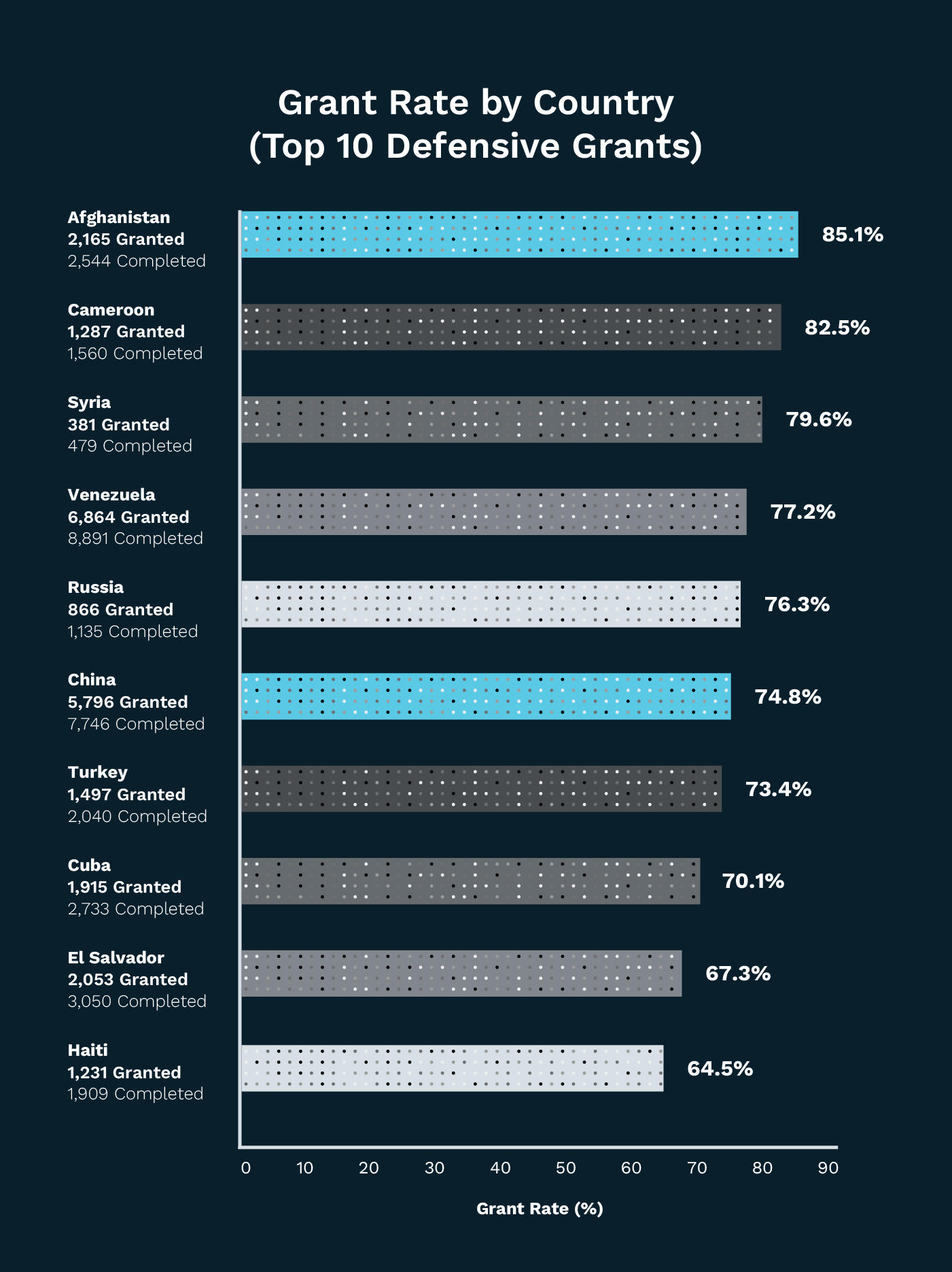
Notice the overlap between that list and the countries whose citizens had been eligible for Temporary Protected Status. Informed readers please pipe up, but I would assume some (many?) in the TPS program were in queue for asylum applications:
- Burma (Myanmar)
- El Salvador
- Ethiopia
- Haiti
- Lebanon
- Somalia
- South Sudan
- Sudan
- Syria
- Ukraine
- Venezuela
- Yemen
However, the Department of Homeland Security is ending TPS programs for Burma (Myanmar), Ethiopia, Haiti, South Sudan, and Venezuela.
Now to the latest information on this eviction program.
By Gwynne Hogan. Originally published at THE CITY on December 18, 2025

The Department of Homeland Security’s attorneys inside New York’s immigration courts are moving to close asylum claims en masse, arguing that people in deportation proceedings have no right to seek asylum in the United States because they’re eligible to do so in three other countries with which the U.S. has recent agreements: Honduras, Ecuador and Uganda.
Word spread of the new Trump administration tactic among the city’s immigration attorneys in recent weeks, as it’s been rolled out inside immigration courts in San Francisco, according to local media there. In New York City’s immigration courthouses, the novel strategy kicked off in full steam over the last two weeks inside, observers told THE CITY. Hellgate earlier reported on the new Trump administration tactic, which sets the stage for potential third-country removals on a large scale in the coming months.
THE CITY watched a Department of Homeland lawyer make a motion to “pretermit” asylum claims inside the courtroom of Immigration Judge Tiesha Peal in case after case on Thursday morning. The request to “pretermit” the asylum claim is an effort to toss a person’s asylum claim, leaving them defenseless against deportation to a country they are not from and may have never even entered before.
“The Department is moving to pretermit the respondent’s asylum application,” the Trump administration attorney said. “The respondent is subject to three cooperative agreements, Ecuador, Honduras, Uganda,” he went on. “And because of that, the respondent is barred from seeking asylum in the U.S.”
Peal gave people in her courtroom until Jan. 22 to respond to the motion in writing and then set another court date for early February where she would rule on it.
“Do you understand,” Judge Peal asked an Ecuadorean woman sitting before her who’d been told she would have to apply for asylum in Uganda or Honduras. “What that means is the government is saying you are not eligible for asylum here.”
“Yes,” the woman replied, bursting into tears as soon as she made it out the courtroom door moments later. “It’s so unjust,” the woman said in Spanish, asking to be identified by only her first name, Narcisa.
Another immigrant named Darlene emerged moments later also in tears. “I’m terrified,” the 33-year-old said in Spanish, adding “it’s my first court date.”
Benjamin Remy, an immigration attorney with the New York Legal Assistance Group, tried to console the women offering information about how to reply in writing.
“It’s not an order of deportation,” he told them in Spanish. “You have a chance to respond.”
It’s not yet clear if the Department of Homeland Security plans to roll the motions to pretermit across the board or target specific groups of asylum seekers.
In a written statement sent to THE CITY, DHS said it was “working to get illegal aliens out of our country as quickly as possible while ensuring they receive all available legal process, including a hearing before an immigration judge.”
“Asylum Cooperative Agreements are lawful bilateral arrangements that allow illegal aliens seeking asylum in the United States to pursue protection in a partner country that has agreed to fairly adjudicate their claims,” the statement read. “DHS is using every lawful tool available to address the backlog and abuse of the asylum system.”
In June, the U.S. Supreme Court cleared the way for the Trump administration to ramp up third-country removals, granting a stay of a lower court’s order requiring advanced written warning and a chance to provide a defense against removal to that country, but thus far the practice has not been used on a large scale.
Earlier this month, THE CITY reported between the start of the year and mid-October, just 62 people from New York had been deported to countries different from their country of origin. That figure seems poised to increase in the coming months.
Now, in order to keep their asylum claims alive, people will have to submit a written motion to the court. But exactly what to say in that motion to convince an immigration judge to keep their claim open is anyone’s guess, even for savvy immigration attorneys, let alone recent immigrants who don’t speak English and can’t afford lawyers, like many of the people in deportation proceedings.
“We have no case law,” Remy said. “We have nothing but the statute.”
The Board of Immigration Appeals, which sets precedent in the nation’s immigration courts, decided a similar case in October, finding immigration judges should grant motions to permit asylum claims unless the person could “establish by a preponderance of the evidence that he or she will more likely than not be persecuted on account of a protected ground,” in that third country.
Remy called the latest Trump administration tactic “a slaughter,” saying it’s even worse than the masked federal agents stalking immigration court hallways arresting people seemingly at random.
At least then, Remy said, “theoretically, you could still win. You could still have your final hearing, you could still be granted asylum. Now you’ve just seen asylum be completely cut off.”
The jury is still out on how immigration judges will rule on the motions to pretermit asylum claims. Most judges have been giving people between 10 and 30 days to reply in writing before ruling on the motions, so the impact of these motions on people’s asylum cases will become clearer in the coming weeks.
The move to pretermit asylum claims is the latest shake up for the nation’s immigration courts, which are part of the Executive Branch under the Department of Justice, and have been under immense pressure from the Trump administration, with waves of firings of tenured judges in New York City and across the country, particularly of those with the highest asylum grant rates.
Volunteer courtwatchers spoke to THE CITY in hushed tones in the hallway Thursday morning as they shuffled between courtrooms trying to console people and explain what steps they should take.
“I can’t tell you how many people are asking me, ‘Where is Uganda?’” one courtwatcher said, who declined to provide their full name.
“I’ve never felt this sick in here,” another added, also declining to be named.


While some sort of fair and reasonable immigration policy is desirable, the policies of both the previous and current US regimes are anything but.
This all makes for effective domestic politics as it provides an emotional media spectacle and gives the appearance that the current regime is doing something substantive to get rid of the “illegals” from “shithole” countries like Somalia where the people are “garbage”. The DT2 regime appears to be all about show, and little substance, as is often the case.
Scapegoating the Internal Other is not honest, but good politics: it helps mobilize domestic support among the so-called base and others, while the govt. can project all of our ills on the “illegals”. Unemployment, drugs/mental health/acts of despair, declining standards of living, lack of health care etc. Even educated, informed folks sometimes fall for the emotional appeal of scapegoating. Who wants to admit that decades of institutional corruption and rot, has produced our problems? Who wants to admit that they may have supported politicians who are responsible for this? Not our fault, it’s THEIR fault. It is often easier, and less emotionally disturbing to blame it on the Other.
I don’t see how the US govt. has the resources to round up the “illegals” or “undocumented” to round up millions of people and deport them. So far, this appears to be for media spectacle and to show the “base” that they are doing something, as well as distract from scandals, wars, broken promises etc.
Sadly, most US folks don’t care, they are not informed by our public or private institutions, the mass media, etc, but rather misinformed. This also fits in nicely with demonizing Venezuelans, and other purported enemies of the US govt.
With that said, deporting people to third countries and subjected to ill-treatment is not justice either. It looks like they want to make a public example
Well, I gotta say it: I can’t get past the words “ethnic cleansing” in the headline. That’s what happening in Gaza and now in the West Bank: leave or be killed.
What T is doing is standard discrimination based on national origin. He’s not removing people from their original homeland or mass slaughtering them. / my 2 cents
Ethnic cleansing is expulsion of a population based on ethnic attributes. It does not require murder or complete removal. The failure to observe due process makes this action qualify.
The UK was trying to do this with Rwanda and then Albania.
The scheme has been abandoned even though we don’t have a Constitution and the government in power is Keir Starmer’s….
I am intrigued: there must have been truly powerful reasons for the scheme to have failed. Do you know what they were? Some fundamental legal obstacle? Rwanda and Albania abandoned the scheme? Intractable logistical issues? Cost?
Unexpectedly, Labour party distaste, a degree of popular unease and an immense incompatibility with international treaties (European Convention on Human Rights, UN treaty re treatment of refugees etc). Every proposed flight had been cancelled or suspended by the courts in judicial review.
There is a tight link between senior labour circle and human rights lawyers in the chattering class. Except when it’s Israel because that intersection are nearly all Zionists. The decision is entirely driven by professional reputation (not wanting to reduce accrued human rights) and Remainer shibboleths about belonging to “Europe”. UK constitutional propriety or morality did not figure.
The Tories spent a fortune on this policy. £370m paid to Rwanda upfront and then huge payments per returnee. But we never returned one!
https://www.ippr.org/media-office/hidden-costs-of-rwanda-scheme-revealed-to-be-in-the-billions-finds-ippr
Reminds me of a chat I had with an Rwanda old coms guy …. went on to build satellites for the anglophone … funny world mate …
Notice the overlap between desperate refugees and the countries the US has destroyed
Will someone please answer this question:
If immigrants arrive in the U.S. and claim asylum, are they not here LEGALLY while they go through the LEGAL process?
These kangaroo courts reek of Florida’s Rocket Docket that defrauded thousands out of their homes. Both presided over by Pam Bondi.
I began working with members of refugee communities during the Vietnamese diaspora of the 1980’s and did a lot of work on disproportionate minority contact with the criminal justice system over the next 30-plus years. This is an extremely complex issue that is only going to become more thorny as climate change makes vast swathes of our planet less habitable.
There is a big difference between “seeking a better life” and “imminently thrown into a Gulag” that Americans seem incapable of acknowledging. Asylum concepts and legal processes that made sense with a global population of 2.5 billion are overwhelmed in a world of 8.25 billion.
Neither the shambling incompetence of the Biden administration nor the wanton racism of the Trump camp are alleviating the suffering in other parts of the world that is the root cause of mass migration. I have nothing but empathy for migrants but I’m also concerned that every day I used to have to drive past a 300-tent encampment of U.S.-born unhoused persons who I knew were being fed fentanyl by migrants working for the cartels.
Trump’s immigration policies ad procedure are harming the US economy. The worker pools for ag, construction, health care , hospitality have taken real hits.
Native-born workers are not filling labor shortages in these areas. Unemployment is growing.
The MMT mantra about the USs sovereign debt being addressable by printing money is beguilingly attractive. Yes, the US could pay it’s debt. That contributes shoddy public debt management with the illusion that doing so would address the issues involved. The country would be awash with inflation. Purchasing power would be reduced to turds in in purses and pocketbooks. Inequality would be exacerbated. The US would lose whatever grip it has on other countries. (It would not, for example, be able to maintain its sprawling military deployments. The US world-wide military does need to be reduced; collapsing is the least best way to do it.) Besides, who’d want to be paid in the worthless dollars spawned by debt liquidation?
Such an escape hatch fosters poor debt management. That’s a big part of why the rich keep being so and getting more so. Another part is continually stimulating increased private debt by keeping wages low enough to require swiping the card. And from time-to-time lowering mortgage rates to entice “home-owners” to refinance; they never really build equity but are always paying interest. As the founders have been alleged to say: those who own the country should run it.