Yves here. It should not be hard to see by now that regime change means that the US would rather see a country become a failed state or otherwise impaired by internal division than succeed with someone we don’t like in charge. But an awful lot of people seem to have salaries that depend on not understanding that.
The last time the Trump Administration tried to impose regime change in Venezuela, Tulsi Gabbard could not have been more adamant in her denunciation of the policy
Here she is in May 2019, rejecting that the US should have any role in ousting Maduro, as this would only bring… pic.twitter.com/nK7q5KIso6
— Michael Tracey (@mtracey) October 16, 2025
By Medea Benjamin and Nicolas J. S. Davies, the authors of War In Ukraine: Making Sense of a Senseless Conflict, now in a revised, updated 2nd edition. Medea Benjamin is the cofounder of CODEPINK for Peace, and the author of several books, including Inside Iran: The Real History and Politics of the Islamic Republic of Iran. Nicolas J. S. Davies is an independent journalist, a researcher for CODEPINK and the author of Blood on Our Hands: The American Invasion and Destruction of Iraq
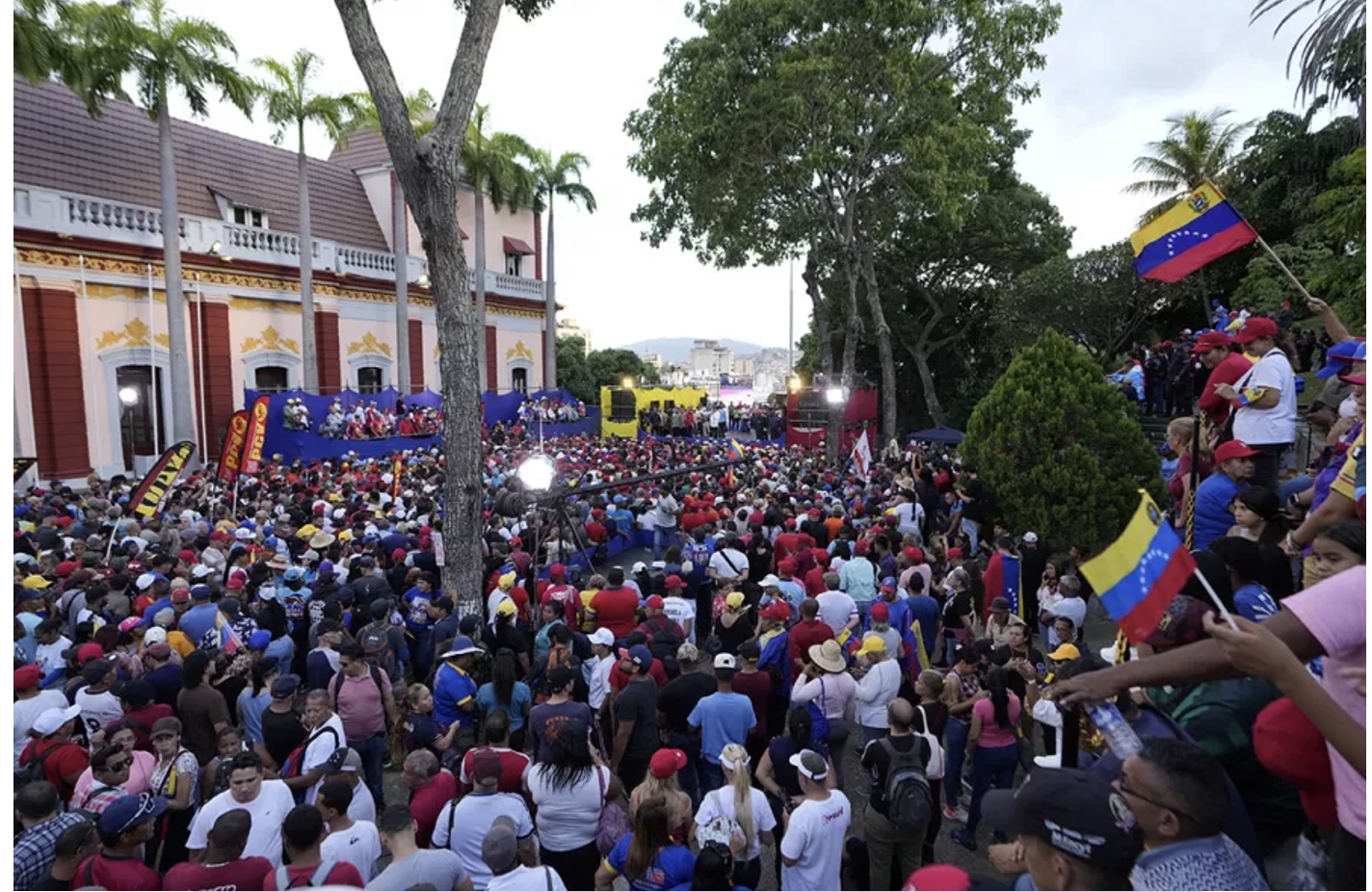 A United Socialist Party rally in Caracas, August 3, 2024. Photo: Morning Star
For decades, Washington has sold the world a deadly lie: that “regime change” brings freedom, that U.S. bombs and blockades can somehow deliver democracy. But every country that has lived through this euphemism knows the truth—it instead brings death, dismemberment, and despair. Now that the same playbook is being dusted off for Venezuela, the parallels with Iraq and other U.S. interventions are an ominous warning of what could follow.
As a U.S. armada gathers off Venezuela, a U.S. special operations aviation unit aboard one of the warships has been flying helicopter patrols along the coast. This is the 160th Special Operations Aviation Regiment (SOAR) — the “Nightstalkers” — the same unit that, in U.S.-occupied Iraq, worked with the Wolf Brigade, the most feared Interior Ministry death squad.
Western media portray the 160th SOAR as an elite helicopter force for covert missions. But in 2005 an officer in the regiment blogged about joint operations with the Wolf Brigade as they swept Baghdad detaining civilians. On November 10, 2005, he described a “battalion-sized joint operation” in southern Baghdad and boasted, “As we passed vehicle after vehicle full of blindfolded detainees, my face stretched into a long wolfish smile.”
Many people seized by the Wolf Brigade and other U.S.-trained Special Police Commandos were never seen again; others turned up in mass graves or morgues, often far from where they’d been taken. Bodies of people detained in Baghdad were found in mass graves near Badra, 70 miles away — but that was well within the combat range of the Nightstalkers’ MH-47 Chinook helicopters.
This was how the Bush–Cheney administration responded to Iraqi resistance to an illegal invasion: catastrophic assaults on Fallujah and Najaf, followed by the training and unleashing of death squads to terrorize civilians and ethnically cleanse Baghdad. The UN reported over 34,000 civilians killed in 2006 alone, and epidemiological studies estimate roughly a million Iraqis died overall.
Iraq has never fully recovered—and the U.S. never reaped the spoils it sought. The exiles Washington installed to rule Iraq stole at least $150 billion from its oil revenues, but the Iraqi parliament rejected U.S.-backed efforts to grant shares of the oil industry to Western companies. Today, Iraq’s largest trading partners are China, India, the UAE, and Turkey—not the United States.
The neocon dream of “regime change” has a long, bloody history, its methods ranging from coups to full-scale invasions. But “regime change” is a euphemism: the word “change” implies improvement. A more honest term would be “government removal”—or simply the destruction of a country or society.
A coup usually involves less immediate violence than a full-scale invasion, but they pose the same question: who or what replaces the ousted government? Time after time, U.S.-backed coups and invasions have installed rulers who enrich themselves through embezzlement, corruption, or drug trafficking—while making life worse for ordinary people.
These so-called “military solutions” rarely resolve problems, real or imaginary, as their proponents promise. They more often leave countries plagued by decades of division, instability, and suffering.
Kosovo was carved out of Serbia by an illegal US-led war in 1999, but it is still not recognized by many nations and remains one of the poorest countries in Europe. The main U.S. ally in the war, Hashim Thaçi, now sits in a cell at the Hague, charged with horrific crimes committed under cover of NATO’s bombing.
In Afghanistan, after 20 years of bloody war and occupation, the United States was eventually defeated by the Taliban—the very force it had invaded the country to remove.
In Haiti, the CIA and U.S. Marines toppled the popular democratic government of Jean-Bertrand Aristide in 2004, plunging the country into an ongoing crisis of corruption, gang rule, and despair that continues to this day.
In 2006, the U.S. militarily supported an Ethiopian invasion of Somalia to install a new government—an intervention that gave rise to Al Shabab, an Islamic resistance group that still controls large swaths of the country. U.S. AFRICOM has conducted 89 airstrikes in Al Shabab-held territory in 2025 alone.
In Honduras, the military removed its president, Mel Zelaya, in a coup in 2009, and the U.S. supported an election to replace him. The U.S.-backed president Juan Orlando Hernandez turned Honduras into a narco-state, fueling mass emigration—until Xiomara Castro, Zelaya’s wife, was elected to lead a new progressive government in 2021.
Libya, a country with vast oil wealth, has never recovered from the U.S. and allied invasion in 2011, which led to years of militia rule, the return of slave markets, the destabilizing of neighboring countries and a 45% reduction in oil exports.
Also in 2011, the U.S. and its allies escalated a protest movement in Syria into an armed rebellion and civil war. That spawned ISIS, which in turn led to the U.S.-led massacres that destroyed Mosul in Iraq and Raqqa in Syria in 2017. Turkish-backed, Al Qaeda-linked rebels finally seized the capital in 2024 and formed a transitional government, but Israel, Turkey, and the U.S. still militarily occupy other parts of the country.
The U.S.-backed overthrow of Ukraine’s elected government in 2014 brought in a pro-Western leadership that only half the population recognized as a legitimate government. That drove Crimea and Donbas to secede and put Ukraine on a collision course with Russia, setting the stage for the Russian invasion in 2022 and the wider, still-escalating conflict between NATO and Russia.
In 2015, when the Ansar Allah (Houthi) movement assumed power in Yemen after the resignation of a U.S.-backed transitional government, the U.S. joined a Saudi-led air war and blockade that caused a humanitarian crisis and killedhundreds of thousands of Yemenis—yet did not defeat the Houthis.
That brings us to Venezuela. Ever since Hugo Chavez was elected in 1998, the U.S. has been trying to overthrow the government. There was the failed 2002 coup; crippling unilateral economic sanctions; the farcical recognition of Juan Guaido as a wannabe president; and the 2020 “Bay of Piglets” mercenary fiasco.
But even if “regime change” in Venezuela were achievable, it would still be illegal under the UN Charter. U.S. presidents are not emperors, and leaders of other sovereign nations do not serve “at the emperor’s pleasure” as if Latin America were still a continent of colonial outposts.
In Venezuela today, Trump’s opening shots—attacks on small civilian boats in the Caribbean—have been condemned as flagrantly illegal, even by U.S. senators who routinely support America’s illegal wars.
Yet Trump still claims to be “ending the era of endless wars.” His most loyal supporters insist he means it—and that he was sabotaged in his first term by the “deep state.” This time, he has surrounded himself with loyalists and sacked National Security Council staffers he identified as neocons or warhawks, but he has still not ended America’s wars.
Alongside Trump’s piracy in the Caribbean, he is a full partner in Israel’s genocide in Gaza and the bombing of Iran. He has maintained the global empire of U.S. military bases and deployments, and supercharged the U.S. war machine with a trillion dollar war chest—draining desperately needed resources out of a looted domestic economy.
Trump’s appointment of Marco Rubio as Secretary of State and National Security Advisor was an incendiary choice for Latin America, given Rubio’s open hostility to Cuba and Venezuela.
Brazilian President Lula made that clear when he met Trump in Malaysia at the ASEAN conference, saying: “There will be no advances in negotiations with the United States if Marco Rubio is part of the team. He opposes our allies in Venezuela, Cuba, and Argentina.” At Lula’s insistence, Rubio was excluded from talks over U.S. investments in Brazil’s rare earth metals industry, the world’s second largest after China’s.
Cuba-bashing may have served Rubio well in domestic politics, but as Secretary of State it renders him incapable of responsibly managing U.S. relations with the rest of the world. Trump will have to decide whether to pursue constructive engagement with Latin America or let Rubio corner him into new conflicts with our neighbors. Rubio’s threats of sanctions against countries that welcome Cuban doctors are already alienating governments across the globe.
Trump’s manufactured crisis with Venezuela exposes the deep contradictions at the heart of his foreign policy: his disastrous choice of advisers; his conflicting ambitions to be both a war leader and a peacemaker; his worship of the military; and his surrender to the same war machine that ensnares every American president.
If there is one lesson from the long history of U.S. interventions, it’s that “regime change” doesn’t bring democracy or stability. As the United States threatens Venezuela with the same arrogance that has wrecked so many other countries, this is the moment to end this cycle of imperial U.S. violence once and for all.


Brilliant piece
Agreed. Benjamin’s tenacity is admirable and she’s one of the few public activists whose positions are consistent no matter who is president at the time.
Here’s an excellent article on the situation on the ground in Venezuela. Turns out their military will be able to put up a good fight and their economy isn’t as bad as corporate media claims. Venezuela is producing 97 per cent of the food it consumes.
https://venezuelanalysis.com/opinion/millions-of-venezuelans-join-volunteer-militias-as-us-attacks-continue/
This exercise in gunboat diplomacy still sounds like a giant bluff to me. He wants Maduro and his buddies to flee so that ‘fire-sale” Machado can be put in charge. But Maduro is standing firm. Trump could bomb the ports and airfields but once he does that, then Venezuela has the right to hit back at those US warships. Trump is by nature a bully and having somebody defy him is something that he is not use to. So now he is stuck.
I agree with you – TACO – particularly as the tenor has dropped since 1. Russia said it is open to giving Venezuela hypersonic missiles, and 2. reports (by Doug MacGregor in an interview that has been hard to confirm) that two Russian ships (with their targeting radar) showed up in-theater.
Perhaps the USA foreign policy is nothing but attempted bald resource grab.
If a foreign government seems about to control/price their natural resources against USA interests, the USA attempts to topple the government and install a cooperative elite governing class dependent on the USA for its wealth and safety.
As far as oil is concerned, here is a recent estimate of oil reserves in countries that have had USA political/military interest:
Venezuela at 300.0Gbbl
Iraq at 142.5Gbbl
Iran at 158.4Gbbl
Russia at 80Gbbl
Libya at 48.4Gbbl
Nigeria at 37.1 Gbbl
The USA has oil reserves of 36.5 Gbbl.
One can wonder how the USA would be perceived if all the USA human talent consumed in the NSA, CIA and USA military actions had been directed toward fundamental research and USA infrastructure.
Perhaps the world would truly view the USA as Peggy Noonan’s “thousand points of light”.
VIPS MEMO: What Wider War in Venezuela Would Bring
November 5, 2025
Russia, and possibly even China, would feel obligated to enhance military support in response to a missile, air, or even drone strike on sovereign Venezuelan territory. Escalation would be almost inevitable
https://consortiumnews.com/2025/11/05/vips-memo-what-wider-war-in-venezuela-would-bring/
I share Mark Sleboda´s much more sober view that power projection of RU/CHINA reaches only so far and neither would risk anything seriously.
Besides I still assume Venezuela is way more stable than most in the NATO states acknowledge.
I remember how much disregard I encountered in the late 2000s when trying to set up a project about Venezuela and Bolivia. ZERO interest even by the Rosa-Luxemburg Foundation. With friends like these…
As the Houthis showed, it only takes a few dozen missiles to deny US maritime access, a few more and regional US airbases for fighter planes would be useless, leaving only slow, lumbering, no longer very stealthy B2s. Yes, the US could run an inland route – with what army over the objections of the locals in jungles!
It seems to me a perfect US Thucydides trap, advantage Russia and China (and the entire global south), as the US cannot replace any of its overpriced, underperforming, running short weapons without rare earths from China, shipments of which remain restricted from the MICC, and production run times are decadal.
Besides the A/D missile priority is not defending US ships, but defending Tel Aviv! And what is the thalassocratic empire if its navy (also termed targets) is sunk?
I’m sure no one in the 5-sided building would ever think of parking an SSGN somewhere offshore.
A little Russian ISR help might not be out of line.
“For decades, Washington has sold the world a deadly lie: that “regime change” brings freedom, that U.S. bombs and blockades can somehow deliver democracy.”
The goal is not to sell this to the world, as nobody in the non-west believes this. This is aimed almost entirely at NYT reading elites who need to know the right lines to fall into the right line and the everyday american who really doesnt follow any of this and can be reassured s/he need not follow it too carefully as it is just USA being righteous and good. In short, the rhetoric is all for domestic consumption. What the piece shows is how resistant to facts our self deception is. How the US managed to devise such an effective home propaganda system, one beyond the wildest hopes of the nastiest dictatorships, awaits explanation. Herman and Chomsky provided an outline of how this effected. But I suspect even they are awed by how effective this has been.
Calling to mind this classic bit of satire from Caitlin Johnstone:
https://caitlinjohnstone.com/2019/02/25/if-every-debate-about-us-interventionism-was-about-godzilla-instead/