Trump’s poll results continue to fall. Since Trump watch Fox News regularly, its findings that even working class white voters are now disenchanted with him has likely penetrated his bubble. On top of that, other polls find that approval of his program stands at only 27%. Note that, as we’ll unpack soon, Trump’s approval ratings are higher than for his policies. This sort of disconnect is not unusual but the relative level is.
First from Washington Monthly, in Trump Is Losing the White Working-Class:
The latest poll from Fox News shows President Donald Trump’s job approval among white voters without college degrees is underwater: 49 percent approve, and 51 percent disapprove.
It’s just one pollster, and subgroup data has high margins of error. But working-class whites are the load-bearing pillar of the Republican Party’s MAGA era. Among all the race-and-education-level voter subgroups in the 2024 presidential election, non-college whites were the only ones who gave majority support to Trump. And not by a small amount, but by a nearly 2-1 margin. The Fox News data may not be precise—a new Pew Research Center poll has Trump’s approve-disapprove among non-college whites just slightly above water at 51-48—any softness among Trump’s most reliable bloc should send shivers down GOP spines.
Moreover, the Fox poll is not the only data point that warrants panic among Republicans. Trump’s relatively broad (winning 30 states) yet thin (with only 49 percent of the vote) 2024 victory was buoyed by inroads among people of color and voters under 30. I recently covered how, over the past year, as reflected in several polls and election returns, Trump and his party have frittered away those Latino gains. (The new Pew poll has Trump’s Hispanic approve-disapprove at an abysmal 26-71.) This week, the Wall Street Journal reported that Trump’s approval rating among young voters, as measured by the Cook Political Report aggregates from the top of March to the top of January, has sunk about 8 points, from 44.4 to 32.6 percent.
The story points out that Trump approval was decaying even before the two ICE murders in Minneapolis, with law enforcement officers all over the US decrying both executions as unwarranted, as well as the bad look of Minneapolis police calling out unjustifiable ICE harassment of off-duty members for the crime of not being white.
Other takes:
NEW Pew Research poll: Donald Trump’s approval
Approve: 37%
Disapprove: 61%And yes, 37% is still way too high. pic.twitter.com/uYBWoJBpLj
— Republicans against Trump (@RpsAgainstTrump) January 29, 2026
Also keep in mind that this erosion in seeming opposition to the James Carville dictum, “It’s the economy, stupid.” GDP growth has been strong, as Trading Economics shows:

The stock market keeps hitting new highs. Despite scary headlines about some large layoffs at big employers, and the drumbeat of “AI is coming for your job,” jobless claims are moderate, headline unemployment at 4.4%, is tame, with experts depicting the labor market as “resilient”.
Of course, it’s not hard to depict the economic picture as “gloss is more than half empty” for most. Trump has realized that he can’t talk his way out of the affordability crisis, and has thrown out a hodge-podge of schemes, most of which wont’ get done and won’t make much difference even if they do. He’s punted on a train wreck coming for many household budgets, that of big increases in health insurance costs. particularly for former Obamacare enhanced subsidy recipients. And remember, these result are occurring even as the Administration is running the economy hot, with a $2 trillion deficit forecast for fiscal 2026
And in the “more inconvenient news” category:
Trump : "My tariffs will reduce the US trade deficit"
The US trade deficit soared 94% in November, 𝒉𝒊𝒈𝒉𝒆𝒓 𝒕𝒉𝒂𝒏 𝒂 𝒚𝒆𝒂𝒓 𝒂𝒈𝒐, widening by the most in nearly 34 years
Seems all those 𝐭𝐚𝐫𝐢𝐟𝐟 𝐭𝐞𝐦𝐩𝐞𝐫 𝐭𝐚𝐧𝐭𝐫𝐮𝐦𝐬 are having the opposite effect 🤡 pic.twitter.com/wL4BRaA8WF
— Alex Taylor (@AlexTaylorNews) January 30, 2026
How does this jive with Trump “selling” how great we are doing!!! With Trump’s stupid tariffs our trade deficit has in fact increased 95%!! We all must wake it up!! Prices will rise and rise and we are letting it happen! Stop Trumper! pic.twitter.com/rK8y2pCyFV
— Dr Bob Smith (@DrBobSmith1533) January 30, 2026
Evidence across many sectors showing how the uber-rich are benefitting from Trump’s economy while everyone else gets screwed. pic.twitter.com/9l6aYk1jIc
— Ron Filipkowski (@RonFilipkowski) January 29, 2026
To accomplish this Trump will need:
Interest rates to fall to zero percent
With no unemployment
$7T in stimulus
Low inflation
2.65% mortgage ratesGood luck piece of shit https://t.co/TjegLlkK6u
— Darth Powell (@VladTheInflator) January 29, 2026
US dollar has lost nearly 11% since Trump took office. America First puts America last on the global stage. As the world divests from US holdings it cripples our economy. How much more of a beating will moneyed interests take before they too revolt against this administration? pic.twitter.com/LA7jCdZh7R
— Fuck You I Quit (@fuckyouiquit) January 27, 2026
Even with Twitter having a right wing skew, searching on “Trump economy” produced far more critical than positive tweets.
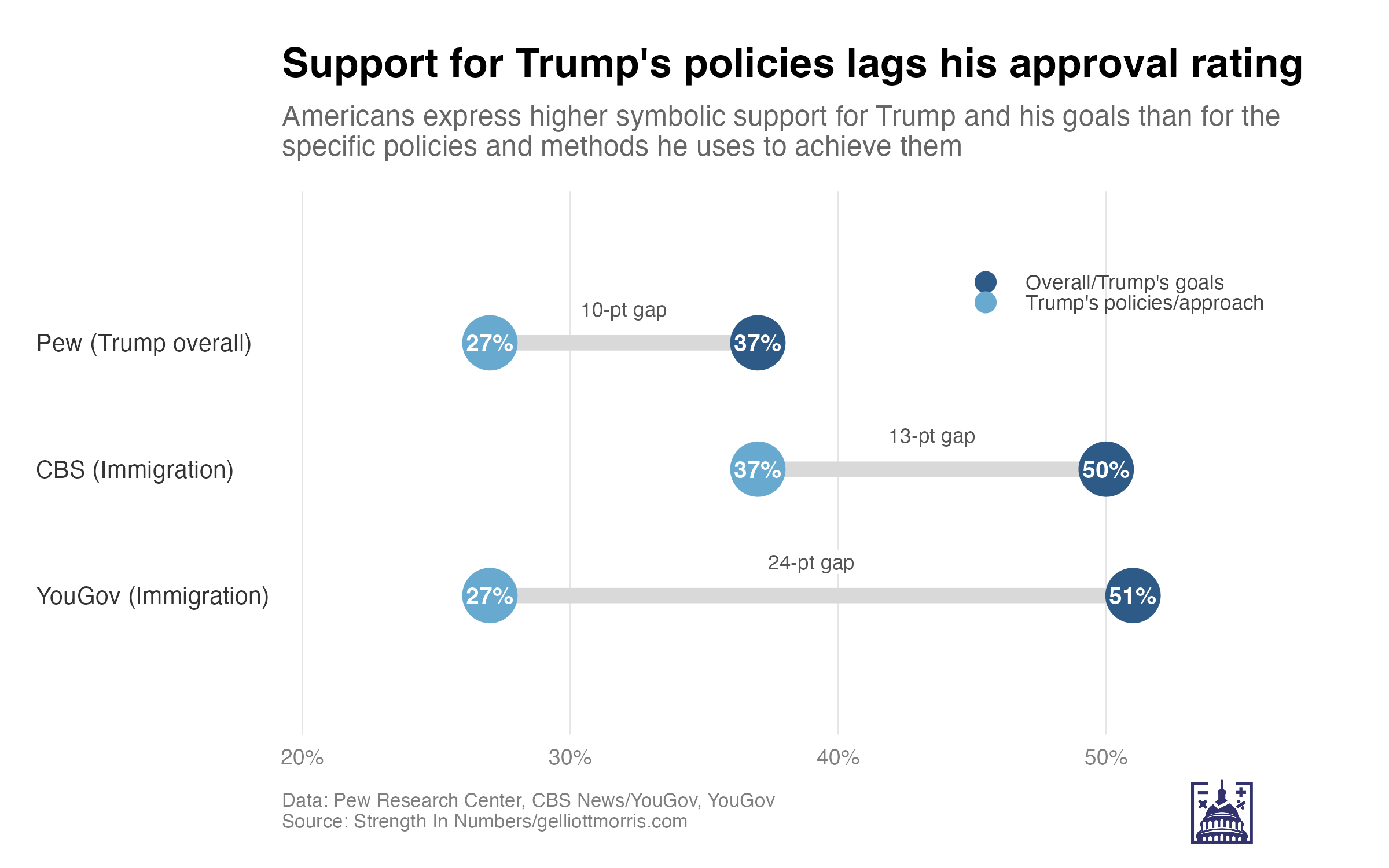
In his latest post. G. Elliott Morris discusses the gap between Trump’s falling approval ratings and the even-sorrier state of approval for Trump policies:
Pew is not the only pollster to find a difference between support for Trump in general and support for his policies. Earlier this month, CBS News found that 50% of adults say they approve of what Trump is “trying to accomplish” on immigration, while only 37% approve of “how he’s going about it” (a 13-point gap). YouGov this week found the same pattern: 51% say they support Trump’s goals on immigration policy, but only 27% support both the goals and his implementation (a 24-point gap)….
Across polls, there is a notable difference between what Americans say they support in general and what they support in practice. Historically, political scientists have noticed a similar gap between an individual’s “symbolic” and “operational” ideology.
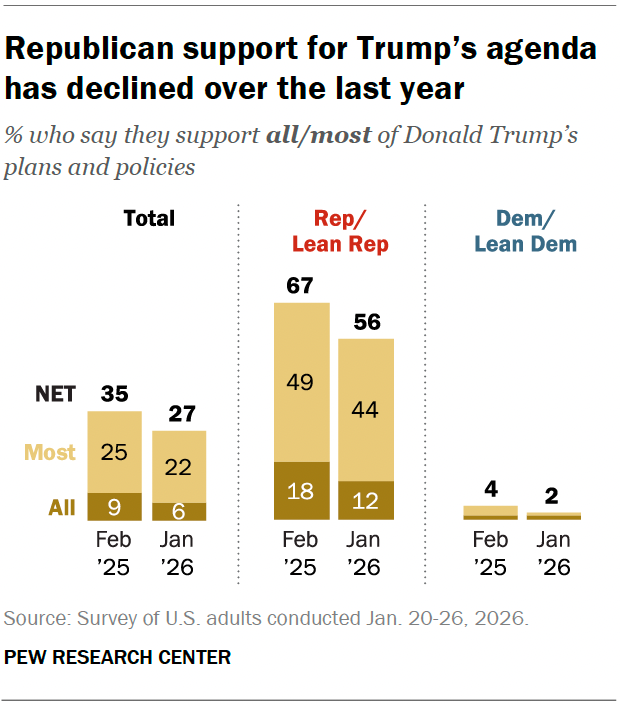
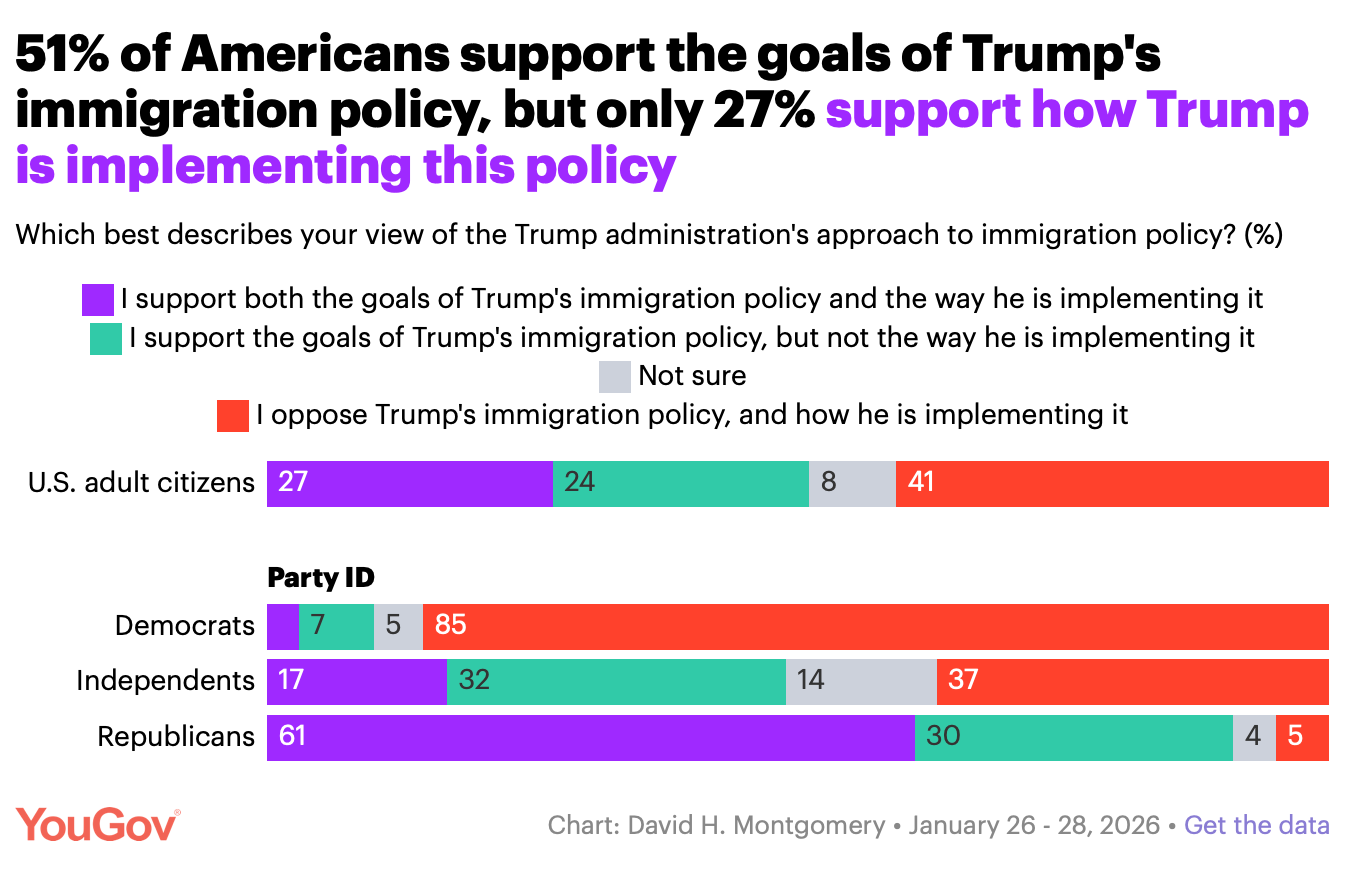
Let’s stop for a second because this is a key issue. We have pointed out repeatedly that polls show anywhere from big majority to at the worst solid plurality support for all sorts of policies misleadingly labeled as left wing, from strengthening Social Security and Medicare to taxing the rich to cutting military spending to spending more on education. Yet many of those respondents will identify themselves as centrist or even conservative despite holding “progressive” stances on all the big issues in a “progressive” platform.
Morris confirms this tendency:
Christopher Ellis and James Stimso..in their 2012 book Ideology in America…find Americans like the idea of limited government, law and order, traditional values, etc. But when you ask about specific programs and policies, they generally want the government to do more, not less, and lean more to the left than the right.
In other words, decades of libererian/neoliberal propaganda penetrated, as the moving forces behind the Powell Memorandum sought. Later in Morris’ post:
To be clear, there is utility in being the party with a symbolic edge on the issues. A new poll from Reuters/Ipsos found this week that 37% of adults prefer Republicans on immigration, vs. 32% for Democrats, even while Trump’s immigration enforcement policies are severely unpopular.
But when voters encounter a policy they don’t approve of in the real world, that provides an opportunity for the other party to reduce their advantage.
On immigration, it was obvious from early in Trump’s presidency that his unpopular policies would drag down his approval and trust metrics over time. Every video of dozens of agents swarming an apartment building, every citizen wrongly detained or legal resident wrongly deported, every lie about a shooting caught on camera reinforces the reality of an issue.
And this has been the reality for Trump since 2015. As soon as he implements a policy from his campaign, voters balk. Americans like the idea of Trump’s agenda more than the reality of it. The border wall was exciting until it meant seizing ranchers’ land. “Drain the swamp” resonated until it meant firing inspectors general. “America First” sounded strong until allies started hedging and supply chains fractured.
This is the fundamental paradox of Trumpism: it is a governing philosophy built entirely on symbols, confronting a world that runs on policy. Trump won in 2024 not because Americans wanted what he was selling, but because voters wanted what they thought he was selling — lower prices, a “secure border,” a harm-free return for manufacturing jobs.
But you can’t govern on vibes forever. Eventually, you have to implement policies. And when the policies are significantly less popular than the symbols, the average Trump voter discovers they were never really on board with MAGA after all.
Another factor to keep in mind: this sharp and continuing slide in approval is coming despite Trump’s frenetic shifts from one big splashy attention-grabbing gambit to the next, from Caracas to Greenland to Iran to threatening Powell with criminal charges to his latest fights with universities and the science establishment to his Peace Board grift. These distraction and exhaustion efforts are not arresting the decay in his support. To the extent that US voter care, they may be making it worse:
Wanna know how poorly Trump buying Greenland polls? Worse than the Epstein files.
Seriously, Trump's net approval rating on any attempt to buy Greenland (-40 pts) is lower than his net approval on the Epstein files (-38 pts).
Greenland is arguably Trump's worst polling issue. pic.twitter.com/WXPk7qfBUi
— (((Harry Enten))) (@ForecasterEnten) January 21, 2026
It may be that Trump is incapable of checking his intense need to dominate, and made sure to surround himself with toadies and enablers. Or it may simply be, as Trump clearly said in a New York Times interview, that he believe there are no limits to his power, and he is in the process of clearing obstacles to his authoritarian rule. The test will be whether we have midterm elections.


It seems it does not matter, even to the 2025 group. They are speeding along to get their agenda fixed in stone before the gas escapes the balloon. This is an example that we don’t have a President, but a consultancy focus and capital mafia projecting it.
Which would change the world firmly for worse, except 2025 is a grab bag of contradictory goodies for competing oligarchs.
With any luck it’ll get them at each other’s throats and we can enjoy a Civil War of the 0.01%!
One can dream.
Another possibility is that voters support the policy goals but are concerned that the actual program goals (to implement the policy) differ from the advertised goals.
Is the point of Trump’s immigration policy the introduction of an El Salvadoran solution – a federal, immunized, loyal, paramilitary force, with immigration a side feature?
—
first paragraph, last sentence just drops off, and I can’t suss where it was going….
I’m guessing “notable”
Abject apologies. Fixed.
Seems there was an editing error, the first paragraph ends abruptly with “This sort of disconnect is no”. I assume it was going to say that individuals tended to poll higher than policy, so that there’s a disconnect isn’t a surprise, but the scale and speed of change may be?
Re: > $10M housing surging.
I recently re-watched Adam Curtis’ “Hypernormalisation” documentary (for the first time since 2016, right after trump won his first term), and was reminded that the very first introduction of trump in the show is in the context of (paraphrasing): “trump was among the first of a newly emerging american elite to go ‘why are we doing literally anything for the country’s disadvantaged?! They don’t have any goddamn money!'”
Regarding this stuff in this post, I don’t see a great difference between Trump and every one of his forebears in the White House. Every president has campaign promises, and every president has to actually do things once they are in office either to pay back their contributors or to realize their actual intentions. Telling the average American that the president didn’t follow through on his campaign promises will generally get you a smirk, to the effect that you are a fool to think he actually would follow through.
You can argue that Trump has more of an ideological tilt to his campaign promises than most, and you would probably be right. But on the question of whether and how much he followed through on those promises I think he’s very much in the norm.
In fact, one of the things that worried me about the Bernie Sanders presidential campaign was that if he were elected, he too would find it impossible to follow through on his beautiful campaign promises. For better or worse, we were spared that bitter disappointment.
The threshold Trump crossed wasn’t the end of the Republic, that ended around 46 with “official secrets”.
The threshold Trump crossed was out of the narrative control to manage the manufacturing of consent.
The ugly reality of US Foreign Policy post Polk (the journalist) assassination was evident to the rest of the world and when the Gipper (with Bush & Casey) brought it home people started feeling it here. But the duopoly duet these last 45 years has been about tying exploitation here and abroad onto a comforting narrative, told to the tunes of Frank Wisner’s Mighty Wurlitzer. The Donroe Mocktrine is blowing blowing it all apart.
Rather, Trump has crossed the threshold of morality. Excellent post, Yves. Thank you.
Trump is different from every one of his forebears in his grotesque ignorance and corruption. I don’t know enough about the Harding administration to make any comparison, but Nixon was a paragon of virtue by comparison.
The opportunity for transformation does not exist when people are reasonably comfortable. That was not the case in 1930 or in 2008. One president with an unlikely background took advantage of that opportunity, the other pissed on it. Sanders would not have had that possibility in 2016 or 2020, but he could have pushed back and given people something to hope for. Trump did that too, but he is the consummate con man. He did nothing but recognize the grievances of his constituency and convince them to celebrate their ignorance.
Sanders had no large contributors to pay back with taxpayer money.
We don’t know what Sanders would have/could have done. I tend to think he believed what he preached. But in most cases what is promised on the campaign trail is just a tailored message that the elected politician never cared about implementing in the first place.
Harding, himself, was not involved in the corruption.
He was quoted to the effect that he could handle his enemies, his friends kept him up at night.
When Harding died, the nation mourned, as he was well liked.
The corruption charges against his “friends” largely surfaced later.
In my view, Bush the lesser, Obama, Trump and Biden all did much more harm to the world and USA than Harding.
Yet historians always mention Harding as a failed President.
And financial self dealing by elected officials is, seemingly, accepted now.
Cancelling mid-term elections. OK, he might try. Wouldn’t this have potential for many “unintended” consequences? Not only for Trump but for those who support him. I’m talking about consequences in the US and abroad. It is risky. What about wildly manipulated midterms?
I don’t think Trump will cancel the mid-terms. He is still consolidating power and couldn’t take the hit to legitimacy that out-and-out cancellation would entail. Remember even Augustus Caesar kept all the outward forms of the Republic. And he doesn’t have enough ICE troops at the moment to attack more than one blue city at a time. Manipulating the elections is much easier. All he needs to do is put a few ICE officers in blue precincts to “check only citizens are voting.” Between intimidation and slow-walking checking papers, lines would easily be 6 to 8 hours long. Meanwhile red precincts vote as usual. Between that and gerrymandering, Trump wins a comfortable victory.
Just wait until you see a bill in Indiana that created a military police force that the Gov can call in for whatever reason he deems it.
I wonder if things like this are rolling through other red states – creating a militarized police force that can be deployed whenever the admin requests (specifically in Indiana, Gov. Braun is literally just a Trump puppet)
Agree on the likelihood of interfering in elections, rather than canceling (which is far harder to deny).
Possibly there might also be, in addition to the long lines and voter challenging/ intimidation in blue districts, some miss-counting. We may also see challenging the validity of voters (especially of color). I suspect this is what is behind all the demands for voter rolls in blue battleground states.
Agree. And guess who owns the voting machine companies now?
One also wonders about the roughly one third of USians who vote by mail too. That seems to be an old saw of Trump’s he can pull off the shelf in order to escalate his election fraud scheme.
In 2020&24 elections I found Emerson to be most accurate, off favoring dems only 0.5-1%, and was the basis for predicting trump would carry all the swings. Ipsos #2. Most other polls biased up to 4% one way or the other.
Trump having nose rubbed in bad polls on fox imo pushes us towards war with Iran, he likely thinks he needs a big win to overshadow all the bad news. And if it lasts and/or goes badly for us it could be the trigger for people to take profits, in which case the market crashes and economy shifts into recession, maybe deep. Polls would be least of trump’s problems.
Or it may be he is senile or incapable and has saturated his cabinet with psychopaths, oligarchs, foreign interests and criminals, and is now a crude mirror of Yelstin.
It is frustrating to watch a now feckless political class actively steer the ship onto the rocks, fighting off all chances of escape or reform at gunpoint.Of course the voters are running for the lifeboats.
“Of course the voters are running for the lifeboats”
What “lifeboats”, pray tell? Are there any viable candidates not beholden to “oligarchs, foreign interests and criminals” ? Perhaps we could construct some lifeboats IF they would let us, but I doubt it.
People don’t vote for candidates they perceive as non-viable because people don’t vote for those candidates. You see the issue.
Voters appear to prefer candidates they think can win over those whose policies they prefer. As long as this thinking persists, third party candidates can never win in the US.
And the only way the thinking will cease to persist is if more people start voting third party.
Third parties will probably be gamed by the duoply.
A Dem/Republican strategist might throw money into a third party candidate if they can siphon enough votes from their opponent.
In the last CA US Senate election, Adam Schiff threw millions into supporting a lame Republican, Steve Garvey, to keep from facing fellow Democrat Katie Porter in the Senate race.
And it worked.
The parties may only crash because their utility to donors plummets, not from third party alternatives.
Saw an article on this group. One of their projects is they hope to use analysis of big data to find a dozen or so Congressional districts where people hate both parties so much that a good independent can actually get elected. If a small group of these independents could form a caucus in Congress, like the Tea Party, which would have the power to affect legislation with the power of ‘no’, then we could start to get somewhere. Naturally no one has even heard about this.
https://ivn.us/
Whoops, wrong link, I lost the original link, I think it was Independence Project. My apologies.
So much of Trump’s agenda is just performative garbage, to make things look like he’s delivering his supporters wins, when in reality the only people getting wins are the zio/billionaire/techbro overlords. Very much a mirror to the Democrats, who will wax eloquent for days for the latest LatinX/Asian/PoC/tranny/gay/etc person to be appointed CEO somewhere, but will never ever ever give their voters concrete material benefits. Heavens no!
This is becoming increasingly obvious amongst the MAGA base. You can only paper over the fact that Obama had bigger deportation #’s than Trump for so long before people conclude Trump is full of s**t. Or that Trump is Israel’s doormat. Or that prices keep shooting upwards. Or etc etc. Even basic stuff that could be fixed overnight continues because the Donor class benefits and demands it, like Amazon firing American workers in favour of H1B’s instead . There is an entire genre of meme on twitter, the “fell for it again” meme, that is directed at Trump voters (twitter link or xcancel link for those without accounts) and other righties when they post about the latest Trump admin humiliations of them. You see endless variations of it pop up constantly. Trump’s base are well aware of the betrayals, at least the loudest online ones are.
I’m guessing this is setting us up for a demonstration of why people’s ideas about FPTP electoral system and the two party system are wrong–in a sense, this has been underway for decades.
The lack of popularity for Trump will only be partly reflected to the unpopularity of the Republicans and the advantage for the Democrats–he is, after all, not on the ballot himself. Furthermore, even if the Republicans, whether because of Trump or independent of him, becomes increasingly unpopular, there is no guarantee that that would translate to a(n absolute) increase in support for the Democrats who are themselves deeply unpopular.
In a sense, this has always been the case: US has always had a 3 party system, at least since modern D and R/Whig parties came to be: D vs. R/W vs. neither, with neither often constituting the plurality. The catch is that the “neither” party has always been inchoate, heterogeneous, and lacked leadership (or, in other words, no one did, or, really, was allowed to effectively organize them–political organization takes time and effort, especially when the “raw material” you are trying to cultivate are not in a meaningful sense homogeneous in some fashion, in terms of being responsive to your appeals.) However, successful transformation of the remaining two parties often depended on making inroads into the “neither” party, by breaking from the conventional leadership of the existing party organizations and adding to your existing coalitions. WJ Bryan did it for the Democrats: even if he himself was ultimately unsuccessful, he laid the coalitional foundation for the New Deal decades later. In a sense, Trump did it for the Republicans: even if his coalition is seemingly falling apart for now, there is no reason that someone in the future will be able to piece things together over next few decades the way FDR did for the Democrats. Or, the incumbent party or parties may crumble and the pieces may join together with the “neither” party and reconstitute themselves as a new party–much the way how the Republican Party was born in 1850s (and, in a way, how the PCP fell apart and the new Canadian Tories reconstituted itself after 1993–although Canada already had a more complex party system than just a two party setup, notwithstanding FPTP).
Things are shifting in unpredictable ways. This may be an ooportunity for the Dems, but not if they stick to the old ways.
Did you mean “glass is more than half empty” ? Although the economy losing its ‘gloss’ also provides some vivid imagery.
Both Jacob Frey and Nicholas J. Fuentes would disagree with Trump’s immigration policy, if polled “yes or no”. What conclusion may be drawn there?
The final paragraph is money.
Trump quite obviously doesn’t give a rat’s a** about polls — all that he cares about are eyeballs. In our tabloid/television culture “fame” and “notoriety” are the only coin that matters — it’s just fine to be “notorious” so long as one’s existence is notable.
Trump knows that he’s getting too old to act as caudillo much longer. His only worry is that his successors leave him alone when he leaves office. This was abundantly clear when he whinged to the GOP that if they lose the mid-terms he’s going to be impeached again. I agree with the posters above that the mid-terms will take place but that the Tonton Macoutes will be hanging around polling places and that the lines will be so long that many won’t make it into the voting booth.
This basically squares my thoughts on Trump – https://x.com/wbmosler/status/2017306149708591608/photo/1
>>>It may be that Trump is incapable of checking his intense need to dominate, and made sure to surround himself with toadies and enablers.
reminds me about IMDoc’s observations about ITA (stealth strokes)….
view many things through the lens of Trump(and McConnell, and many >70Dems, too) has a brain
littered with the (metaphorical) craters of transient stroke events, it all makes sense….tropish senior, “bull in the china shop” behavior
and Trump’s “aides” are either hubristic grifters, or yes-women, yes-men retards.
don’t know if this makes a difference and may be illustrating my economics ignorance, but when determining the current unemployment it would seem that in Table A-15. Alternative measures of labor underutilization at the Bureau of Labor Statistics, the U-6 data is more relevant and shows unemployment to be 8.2-8.4% of the total workforce – am i wrong??
https://www.bls.gov/news.release/empsit.t15.htm