For thirty years, American foreign policy has been guided by a ghost. It went by different names like primacy, unipolarity, the rules-based order, but its doctrinal core was always the same: Full Spectrum Dominance (FSD), the belief that the United States must remain militarily superior in every domain, in every region, against every competitor, indefinitely. It was never debated openly because it was seldom declared honestly. The Pentagon said it outright only once, in a 2000-era Joint Vision document, before the phrase was quietly retired. But the idea continued to shape budgets, basing, and grand strategy long after public rhetoric grew bashful about it.
The newly released 2025 National Security Strategy (NSS) finally closes the coffin on FSD. Beneath its triumphant tone and standard claims of American resurgence, the document performs the quiet interment of a doctrine that Washington has been reluctant to admit was dying. For the first time since the end of the Cold War, an official U.S. strategy rejects the premise that America can, should, or will dominate the globe across every domain of power. The text condemns past efforts to pursue “permanent American domination of the entire world” (NSS 2025, p. 1), admits that the United States lacks the resources to sustain such an ambition, and proposes a strategic architecture that only makes sense for a country preparing to shrink its sphere of responsibility, not expand it.
The mainstream coverage of the 2025 National Security Strategy has focused on its political messaging, its break with climate priorities, and its sharp language toward allies and rivals alike. But what the press has largely missed is the structural confession embedded in the text: the United States no longer possesses the military, industrial, or fiscal capacity to enforce the strategic worldview that governed the last three decades. The NSS is not simply a political signal; it is the first formal admission that the unipolar assumptions underwriting U.S. grand strategy have collapsed.
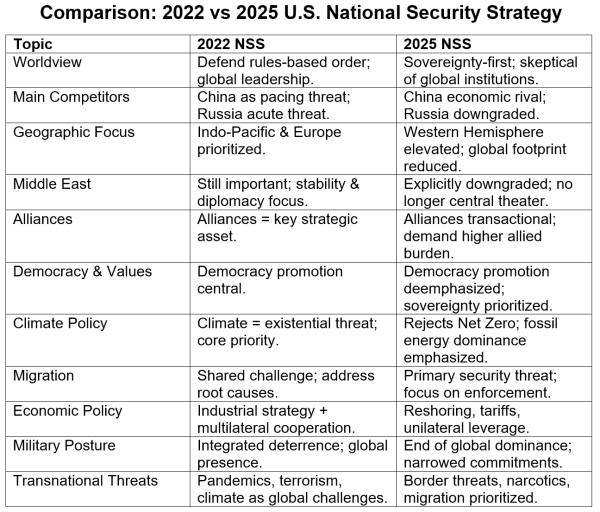
The key story in the NSS is not rhetorical surprises. It is the acknowledgment of constraint. The U.S. has performed poorly in sustaining two proxy conflicts, replenishing basic munitions, maintaining naval shipbuilding schedules, and raising enough recruits for a peacetime force. These failures, rarely mentioned in mainstream analysis of the NSS, are the arithmetic that killed Full Spectrum Dominance. The chart below shows the differences between the latest NSS and the previous 2022 NSS. The following discussion details the indications in the NSS of an historic shift in strategy.
The NSS explicitly condemns the pursuit of global domination
The heart of Full Spectrum Dominance was the belief that American primacy must be total — geographic, technological, and ideological. The 2025 NSS rejects this logic outright: “After the end of the Cold War, American foreign policy elites convinced themselves that permanent American domination of the entire world was in the best interests of our country.” (p. 1)
This is more than an ideological shift; it is a recognition that the United States could not perform global domination even if it wished to. The NSS language reflects a structural truth that has been visible for years in production lines, budgets, and battlefield attrition data — none of which appear in press coverage that treats this repudiation as merely political.
Prioritization replaces omnipresence
Full Spectrum Dominance rested on the idea of simultaneity: the United States must retain the ability to deter or defeat threats in multiple theaters at once. Prioritization was an admission of weakness. Yet the 2025 NSS states bluntly: “A strategy must evaluate, sort, and prioritize. Not every country, region, issue, or cause… can be the focus of American strategy.” (p. 1)
The effective abandonment of the longstanding doctrine that the U.S. must be able to fight and win two major wars at once is arguably the most important shift in the entire document. The NSS does not announce this explicitly, but its logic collapses without it. This acknowledgment of constrained military power has received surprisingly little attention from major outlets, despite the two-war standard being the cornerstone of the post–Cold War force-planning construct.
These statements contradict 30 years of strategic guidance built on the assumption that the U.S. could act everywhere at once. A strategy built on triage signals a military and political system running into constraints it can no longer ignore.
The “Atlas” passage ends the fantasy of global stewardship
No line in the NSS has attracted more attention — or deserves to: “The days of the United States propping up the entire world order like Atlas are over.” (p. 11)
Press coverage has fixated on the theatrical quality of the ‘Atlas’ line. But the deeper meaning lies in the institutional implications: a country that no longer intends to underwrite the global security system is a country that cannot sustain the industrial and logistical architecture that system requires — carrier strike groups, forward bases, constant deployments, and the munitions to support them.
This is not messaging; it is admission. A country that declares it will no longer hold up the world is a country that no longer intends to dominate it. Full Spectrum Dominance was the strength of Atlas: the global network of bases, alliances, carrier groups, intelligence platforms, sanctions regimes, and intervention forces. The NSS declares the end of that burdensome role.
Burden-shifting replaces burden-sharing
For decades, Washington urged allies to spend more while promising to remain the ultimate guarantor of their security. The 2025 NSS crosses a new threshold: it openly aims to export security obligations that the United States can no longer afford. As the strategy puts it, “The United States will organize a burden-sharing and burden-shifting network, with our government as convener and supporter.” (p. 11)
The meaning becomes clearer when paired with an impossible demand: “President Trump has set a new global standard with the Hague Commitment, which pledges NATO countries to spend 5 percent of GDP on defense.” (p. 11) No major NATO member can meet this target, and the NSS does not expect them to. The point is not burden-sharing. It is burden-shedding: using inevitable noncompliance as justification for reducing the U.S. financial commitment to European defense.
The press has treated the 5 percent figure as performative or punitive, but its strategic function is more fundamental: Washington is signaling that it will not fund the military-industrial base required to sustain hegemony. A hegemon builds alliances it can direct. A retrenching power builds alliances it can offload.
Hemispheric consolidation replaces global reach
Instead of treating Europe, the Middle East, and East Asia as co-equal theaters — the triad through which the U.S. enforced global primacy — the NSS elevates the Western Hemisphere as the center of gravity: “We will assert and enforce a Trump Corollary to the Monroe Doctrine.” (p. 15)
This is followed by: “The United States must reconsider our military presence in the Western Hemisphere.” (p. 16) This quiet hemispheric pivot is one of the clearest indicators of retrenchment. A hegemon builds an expeditionary force optimized for distant theaters. A state securing only its own hemisphere abandons the central mechanism of Full Spectrum Dominance: permanent forward presence.
Full Spectrum Dominance required forward presence in every region. A strategy whose focal point is the hemisphere is a strategy contracting into defensible geographic space. This is the opposite of imperial ambition; it is the map of a nation acknowledging limits.
The U.S. abandons regime change ambitions
If Full Spectrum Dominance had an ethos, it was the belief that the world could, and should, be reshaped by American political, economic, and military power. This worldview united liberal internationalists and neoconservatives alike, who treated global democratization as the moral aspect of American hegemony.
The 2025 NSS discards that logic: “A predisposition to non-interventionism… should set a high bar for what constitutes a justified intervention.” (p. 9)
And: “We seek good relations… without imposing on them democratic or other social change.” (p. 9)
This is not a pivot. It is a surrender of a core ideological pillar of U.S. foreign policy.
The NSS admits the U.S. no longer possesses the means of global supremacy
The fatal blow to Full Spectrum Dominance is found on page 1: American elites
“overestimated America’s ability to fund, simultaneously, a massive welfare-regulatory-administrative state alongside a massive military, diplomatic, intelligence, and foreign aid complex.”
These words, almost entirely overlooked in mainstream reporting, are the single most important doctrinal statement in the document. Strategy documents rarely confess resource insufficiency. When they do, it signals not a policy choice but a strategic constraint. This sentence ends the unipolar era, which assumed that the U.S. had the military, industrial, fiscal, and political capacity to sustain global supremacy indefinitely. The NSS says plainly, it does not.
Climate leadership reversed
Where the 2022 NSS called climate change an “existential threat,” the 2025 strategy rejects the entire framework: “We reject the disastrous ‘climate change’ and ‘Net Zero’ ideologies…” (p. 14) The abandonment of climate diplomacy is better understood not as ideological deviation but as a withdrawal from global-system stewardship more broadly.
Migration becomes the central national security threat
“The era of mass migration is over.” (p. 12)
In previous strategies, the central threats were terrorism, great-power competition, or the defense of the “rules-based order.” The 2025 NSS names none of these as the primary danger. Instead, it elevates migration to the center of national security — a framing that only makes sense for a state turning inward.
A global hegemon manages instability abroad. A nation in retrenchment manages its borders. The NSS treats migration not as a humanitarian or economic issue, but as a strategic threat that eclipses the external missions that once justified America’s global posture. This reframing signals a shift from expeditionary problem-solving to territorial defense, a move historically associated with declining empires, not confident superpowers.
Press analysis has treated the migration passages as Trumpist bargaining rhetoric or domestic political theater. But a deeper explanation is simpler: projecting power outward is expensive. Alliances are expensive. The infrastructure of hegemony — forward bases, foreign aid, stabilization missions, training programs — depends on the same budget resources now being redirected toward domestic enforcement. The NSS elevates migration as a primary security threat because it quietly abandons the idea that the United States can still shape international conditions in ways that once limited migration at its source.
Middle East downgraded in strategic priority
A region that depleted U.S. military power over two decades is reclassified as no longer a dominant concern.
“But the days in which the Middle East dominated American foreign policy in both long-term planning and day-to-day execution are thankfully over—not because the Middle East no longer matters, but because it is no longer the constant irritant, and potential source of imminent catastrophe, that it once was.” (p. 29)
Washington’s exhaustion in the region reflects material overstretch more than ideological shift. Lengthy Mideast wars diminished readiness and deferred modernization, costs the NSS now implicitly acknowledges.
Conclusion
The 2025 NSS announces itself as a revival of American strength, but the text tells a different story. Its rhetoric is muscular, but its structure is confessional. The United States is no longer planning to dominate every region, deter every adversary, stabilize every crisis, and redesign every political system. It is no longer willing or able to act as Atlas, shouldering the burden of all global problems with its enormous strength.
Full Spectrum Dominance was not just a military doctrine; it was the enforcement mechanism of American hegemony, the architecture of military power that made the post–Cold War unipolar order possible. And it was that order that made neoconservative foreign policy seem plausible, even inevitable. The death of Full Spectrum Dominance therefore portends the end of neoconservative foreign policy, because the military dominance that once enforced its worldview no longer exists. It is the end of the strategic model that the American elite supported for three decades. The NSS does not inaugurate a new era; it acknowledges that one has already arrived.


Maybe not quite 30? Seems like it was a Rumsfeld term. It has his flavor of management speak.
Of course this latest bit of Trumpiana may also be heated air as he waves around a stick as big as a nuclear aircraft carrier. We are no more entitled to dominate this hemisphere than the other one.
The explanations by Haig Hovaness are enlightening. I am still uncertain about a couple of issues though:
1) How much does the NSS correspond to what the USA are actually intent on doing? Where previous NSS coherent with the policies followed under Clinton/Bush/Obama/Trump 1/Biden, or where they some kind of “discussion paper” put forth as a basis for internal (internecine?) tussles between multiple factions and fiefdoms within the governmental apparatus?
2) How does the process compare with what happened to the British empire? The UK once had forward bases and important forces all over the world, was a dominant (then no longer dominant but major) economic and industrial power, was financially leading (with the Pound and the gold standard); just like the USA had a policy of being able to wage two wars against peer adversaries simultaneously, the UK had a policy of being able to fight the two other strongest navies in the world simultaneously.
The retrenchment of the UK after WWII took a very concrete form — possessions were abandoned and far-away bases vacated (for some time, giving up everything “East of Suez” was the guideline). Have the USA taken any comparable measures already?
Something that “stuck out” for me is the reversal of prior concern about consequences of climate disruption. This does not seem to me to be a stance that will persist through future changes of party control of the Executive branch. Perhaps other aspects of this policy should similarly be considered “subject to future revision.”
My hunch is ghat, even if the conyents of NSS might be more than mere messaging, NSS itself is just messaging, from the current “in” group to other elites. How much to make of its contents depends, I think, on the broader lay of politics.
I don’t think US is at the post WW2 UK moment yet–more analogous to post WW1 version, perhaps. So we are building up, say, the Singapore base without having a fleet to station there and such. Unfortunately, we fon’t have a Washington Treaty to provide the necessary fig leaf, though…
vao:
I tend to agree with you. Haig Hovaness has shed light on some of the decision making, but there are still some gaps and leaps to be analyzed:
–How much of the East of Atlantic drawdown is fakery? How much will the U S of A continue its proxy wars in Europe and Asia? How much will the U S of A continue to rely on mad-dog states like Israel and the UAE to act as enforcers?
–How much of this Neo Monroe Doctrine is just a racket, casting around for some “shitty little countries” to suck dry? I wonder how much of backstage Washington was shocked to watch the Iranians hand the Israelis’ asses to them. But the fantasies of D.C. likely don’t account for Mexico being the largest Spanish-speaking country in the world with a big economy, nor Brazil being the largest Portuguese-speaking country, also with a giant economy. The U S of A and its alpha males like J.D. Vance, Alex Karp, Rahm Emanuel, and Ted Cruz may be in for some surprises.
–Or is this all a continuation of Gen. Laura Richardson’s wandering around southern South America, trying to foist the U S of A into the lithium deposits? More gunboat diplomacy.
–Has the U S of A cut loose the Five Eyes? I suspect that the U.S. military is more than happy to keep England as an attack poodle.
Color me skeptical.
“Color me skeptical.”
Me too, for the reasons everyone has mentioned so far. I agree that this is “messaging” from the current “in group,” as hk says. But Trump and his administration full of amateurs do not constitute the National Security Establishment, the “Blob” or “Deep State” or whatever you want to call them. I do think they represent a potential threat to the agenda of its Atlanticist-first faction. But that group still has considerable power and representation within the permanent shadow government (to use yet another euphemism) – and their perspective is completely dominant among our allies. Further, the originators of the “full spectrum dominance” agenda – the neocons – are still well-represented in both the administration (starting with Trump’s Secretary of State) and the larger foreign policy establishment. We’ll see what actually gets done, as compared to the rhetoric of this policy statement. Some of us welcome the apparent climb-down with regard to the Ukraine conflict (and NATO in general?), just because we are so starved for anything positive. But I’ll have to see some real results before I do any celebrating.
On the other hand, as Haig makes clear, there is much to worry about in this document as well. Indeed it seems to be a rorschach test, with each group seeing what they want to see. In addition to the Atlanticist worries noted above, liberals and many “progressives” have labeled it a declaration of global “white supremacy,” mainly for its condemnation of immigration policies (and immigrants) and repression of right-wing political parties in Europe. Those on the left are understandably worried about the new “Monroe doctrine” emphasis on Latin America. For me, the brief statement on the Middle East is laughable; does anyone really think that its major tensions or “immanent catastrophes” are in the past, or that our involvement in this strategically critical region will be phased out?
My view is that whatever happens in the various strategic theaters mentioned (or ignored) in this document will ultimately depend on the degree of consensus among the various factions and interests of the elite. If a critical mass decides that it is time to cut our losses in Ukraine, we will. If it is determined that provoking China or our complete devotion to the Zionist project fatally threatens enough of these interests, then perhaps policy will change. But I don’t believe what Trump or any advisors loyal to him think will be the determining factor.
I think that you nailed it, especially in your first paragraph. The Neocons will never accept some of the tenets of the NSS but will continue their old ways. So no overseas bases will close, regime change is still on the menu as we are seeing in South America, China and Russia are still priority targets, Israel’s interests will continue to be put forward to those of the US and in a few years time the NSS will be quietly scrapped as trump leaves the stage.
I agree about it being a rorschach test. For example, the article states that the NSS says the US is giving up on regime change, but I don’t see any indication that this is happening or that the NSS doc even says this. The US is giving up the ideological justification of pushing democracy on others, but Trump is currently working to do regime change in Venezuela so I see no sign that regime change is out the window.
“Full spectrum dominance” started making the rounds in the early ’90s, I remember seeing it mostly in requirements documents and puff pieces in the defense magazines. It seemed like an attempt to counteract the ‘peace dividend’ expectations after the fall of the Berlin wall and justify continuing to spend mountains of cash on equipment R&D. I remember it was met with a fair bit of eye rolling, but apparently people that grew up hearing the term internalized it and started believing it, seeing as it morphed into strategic thinking. Good riddance if it’s finally put to rest.
DJG: the Five Eyes predate any of this by a *long* margin, and are pretty much an orthogonal thing to the purely military budget oriented NSS. Us ordinary people will never see any of the guidance documents in that sphere – assuming there are any in the first place.
And what about the new US military bases, or access to military bases, in Norway, Sweden, and Finland? Establishing FSD in the Arctic and hoping no one will notice?
vao: How does the process compare with what happened to the British empire?
Next year we are to bring all the soldiers home
For lack of money, and it is all right.
Places they guarded, or kept orderly,
We want the money for ourselves at home
Instead of working. And this is all right.
It’s hard to say who wanted it to happen,
But now it’s been decided nobody minds.
The places are a long way off, not here,
Which is all right, and from what we hear
The soldiers there only made trouble happen.
Next year we shall be easier in our minds.
Next year we shall be living in a country
That brought its soldiers home for lack of money.
The statues will be standing in the same
Tree-muffled squares, and look nearly the same.
Our children will not know it’s a different country.
All we can hope to leave them now is money.
–Philip Larkin
Pretty much like that. I wouldn’t expect things to go that well for the US.
We’ll get to our Truss/Starmer moments a lot quicker.
A poem which applies great technique to clarify and simplify a policy which so many people found desirable after the Second War. And then along Thatcher to turn a golden opportunity to dreck, and now only a few can ever have hope of leaving their children with anything other than an undertaker’s bill.
Hard to fund an empire when so many billions of dollars are in private hands, no?
Brian Berletic disagrees that this new document represents a change in fundamental strategy.
It acknowledges certain constraints on US ‘s actions, and is a change in tactics to achieve the same end, global domination.
https://youtu.be/IBny7B–uE0?si=i6zVsIVUeuo-0gaj
I am still working my way through his video, and then I want to read the strategy document myself.
He presents a detailed parsing of the document and is worth listening to.
As are his recent videos on similar topics explaining his concept of “continuity of agenda”.
I am coming to more and more agree with his point of view.
The start of a long effort to separate Russia and China, a tempter for anyone who finds sovereignty all too hard. It gives the appearance of accepting reality but they are far from giving up. I wonder whom the CIA thinks will take over after Mr Putin ?
It is a financial empire now that has lost a lot of its ability to project power. You will know when they have given up, there will be an official devaluation of the US dollar.
The UK is still running on the fumes of its vanished empire, so yes the U.S. will keep huffing and puffing and beating its chest for decades, but there will be no more trillion dollar Afghanistan style idiocy. We just won’t have the resources.
Thanks for linking the Berletic video. I have spent a couple of hours taking notes on the NSS for some ungodly reason, making it only a quarter of the way through in any detail (getting old and slow) — and this presentation has basically rendered that effort moot.
Still, I will offer some observations/interpretations for anyone who might enjoy them.
>>>
National: “Hurray for America!” (Likely no different than any previous administration.)
Administration: “Hurray for Trump!” (Hardly out of character.)
Foreign Policy (FP): We get to play in your backyard; you don’t get to play in ours. (But we promise to play a bit less loudly.)
FP: We’re sovereign, and you’re sovereign – but we’re more sovereign than you are. But that’s not hypocritical!
FP: We will only interfere in the affairs of other countries if it is in our interest to do so (provided that they are weaker than we are).
FP: The problem with the world is transnational institutions.
Domestic (+FP): The problems with America are regulation and DEI (and “anti-American” transnational institutions, and economic predator meanies).
NATO: Atlas is ready to shrug (or at least lay down for a snooze).
NATO: We will convene and support a burden-sharing network, in order to share burdens, through targeted partnerships which use economic tools for burden-sharing (and incentive aligning, and reform-insisting) purposes.
NATO: We have great deals on weapons! We’re ready to help!
Re-industrialization: Military-Keynesianism on steroids, FTW!
Same centuries old biases.
For comparison maybe this:
NYT “leaking” the essence of the 1992 US Strategy “Defense Planning Guidance” draft under a then SoD Cheney:
U.S. STRATEGY PLAN CALLS FOR INSURING NO RIVALS DEVELOP
By Patrick E. Tyler
March 8, 1992
https://archive.is/CyLfQ
Everything that was attempted since is in this text.
And all the ideology too.
a few quotes:
-Nuclear proliferation, if unchecked by superpower action, could tempt Germany, Japan and other industrial powers to acquire nuclear weapons to deter attack from regional foes. This could start them down the road to global competition with the United States and, in a crisis over national interests, military rivalry.
-scenarios, issued separately to the military services on Feb. 4, were detailed in a New York Times article last month. They postulated regional wars against Iraq and North Korea, as well as a Russian assault on Lithuania and smaller military contingencies that United States forces might confront in the future.
-For the first time since the Defense Planning Guidance process was initiated to shape national security policy, the new draft states that the fragmentation of the former Soviet military establishment has eliminated the capacity for any successor power to wage global conventional war.
-But the document qualifies its assessment, saying, “we do not dismiss the risks to stability in Europe from a nationalist backlash in Russia or effort to re-incorporate into Russia the newly independent republics of Ukraine, Belarus and possibly others.”
-Bush Administration officials have been saying publicly for some time that they were willing to work within the framework of the United Nations, but that they reserve the option to act unilaterally or through selective coalitions, if necessary, to protect vital American interests.
My favourite part:
-Until such time as the Russian nuclear arsenal has been rendered harmless
(…)
we must seek to prevent the emergence of European-only security arrangements which would undermine NATO.
This latest 2025 NSS would thus be the first document to cease with the claim for world domination articulated in 1992.
Even if much of this NSS remains only rhetoric for some time (empires mostly don´t fall apart over night) the admissions as per above text highlighted cannot be denied or taken back now.
Little surprise that no German outlet (MSM or altern.) has covered this document so far.
Some will follow with some delay I am sure.
I would suggest this article to every non-NC reader who seriously argues that the US is a benign power that seeks to do good in the world and acts as an honest cop who sometimes steps over some borders because the bad nature of the world and her enemies force her to do so.
p.s. The US is no ATLAS. In fact I am not sure any Greek god would be appropriate since those always have to yield or share power at some point. A lesson which it seems despite all their fancy ivy league courses the US strategists never seem to have grasped unlike the Greek – until they themselves did not…
Instead Cronos? Or just one of those monsters which are however being killed off at some point by some demi-god or human hero.
I believe it’s a nod and wink: Much recent U.S. foreign policy activity, in the Western Pacific especially, reminds one of Hercules and the Titan Atlas conning and then re-conning each other into the burden of world-support (or heavens-) under the original guise of giving Atlas a short break.
Thanks Haig,
Great job on the post
This is an excellent analysis.
I will list a few quibbles, but those do not lessen my opinion of the writing.
Two Simultaneous Wars:
Actually the Rummy Donald Rumsfeld guy when he first took office said he wanted to remove the requirement to fight a two-front war; the 2001 QDR(1) Quadrennial Defense Review had been written by the Clinton Administration (Cohen), Rumsfeld was re-writing it, then the terrorist attack happened, but then in year 2005 when it was time for the 2006 QDR Rumsfeld again made noise about removing the two-front war requirement.
The quoted page 1 “overestimated America’s ability to fund, simultaneously” is a re-hash of “Guns and Butter” from my high school history class about the Johnson administration … so it does not sound new to my ears, although even harsh lessons can be forgotten quickly.
Given the people, the reference to Atlas certainly echoes the Ayn Rand ethos.
The CIA and Dick Cheney were fond of saying “we fight them over there so we don’t have to fight them over here”, which sounded good at the time, and I admit it worked … until it doesn’t … and the chickens which come home to roost are not benevolent conquerers.
Calling Migration a security threat fails to understand most of the important reasons people migrate: they like us better than their native country. Not only are migrants beneficial economically, they are cannon fodder for the next war, especially if they are low wage or low skilled workers. So if we are saying we need to bulk up to protect the Western Hemisphere, we should get the Western Hemisphere on board. Although Venezuela has a lot of darn oil doesn’t it, oil we would need for a war.
note (1): so I guess the QDR became the NDS National Defense Strategy; the NSS National Security Strategy here is written by the White House, then the DoD takes it and writes the NDS for public consumption, and then takes that and makes the internal-only NMS National Military Strategy with the service-level details? So this NSS is the first carcass thrown over the transom, now the DoD services fight over the dollars.
… Then there was the NIE National Intelligence Estimate, which for eighteen years has had the same phrase “Iran suspended its nuclear weapons program”, and we saw what effect that had on The Deciders in Chief (Obama with the Stuxnet attack, Trump fulfilling John McCain’s campaign promise “Bomb, Bomb, BombBomb Iran”), so a policy paper might be just paper.
Needless to say, China poses the greatest threat to the United States today. However, direct confrontation with China would put the U.S. at a disadvantage, both militarily and economically. Therefore, the U.S. could benefit from having puppet states, such as Japan and Taiwan, fight on its behalf. The war in Ukraine has weakened Russia and Western European nations. America’s new strategy is to pit its rivals against each other while sitting back and watching from a distance.
There is little evidence that Russia has been weakened. Would Russia’s economy and society be better off had this war never have happened, and ties with Europe not been severed? Of course. But Russia’s military is now the premier fighting force on land, and its missile capability negates our naval superiority. Russia’s ties with China have been strengthened, as has the entire BRICS enterprise, in response to both Project Ukraine and revulsion at what is being done in Gaza. And Europe is self-destructing under the leadership of Atlanticist stooges. Meanwhile, back in the New World, the Shining City on a Hill is stuck between the new nihilists who want to gobble up resources and break things fast, because they can, and the old order in the deep state, who take a longer view, and believe the entire planet is still ours for the taking.
ciroc, see my reply to AG above re: Atlas! :-)
Force projection over distance has become increasingly difficult if your
aim is controlling territory rather than simply destroying structures and killing a lot of people. The latter is still possible, with nuclear weapons being the ultimate exemplar, but due to changes in weapons technology (ever cheaper drones and area denial missiles) the former is getting more difficult all the time, viz Ansarallah (aka “the Houthis”).
This for me is the reality that is rudely making a mockery of liberal internationalism and its associated pieties. Good riddance, really.
Unfortunately it’s not being replaced by anything positive. Out of the frying pan, and into the fire …
Note the trillion dollar National Defense Authorization Act went to congress last Friday!
Does not look like the strategy will cause any decline in MIC profit.
“The era of mass migration is over.”
Now, that’s scary. Mass immigration (voluntary or not) has been the source of cheap labor since the colonies were established.
That labor might have been working in the mills or digging the marble quarries and canals, or enduring Nebraska’s bitter winters and scorching summers to secure a homestead (later scooped up by giant corporate entities), plus killing a few Indigenous inhabitants on the side.
Feels like the cheap labor is now going to be us. Picking strawberries on corporate farms, hacking up frozen animal corpses in corporate slaughter houses, cleaning the toilets at Goldman Sachs, doing the jobs that AI can’t. The ‘dignity of work’ and all that.