Yves here. Mamdani even though young, regularly exhibits political genius, such as turning up at City Hall one day and offering to officiate at marriages. Assisting New York City residents with pet affordability would seem to be a no-brainer…except for the wee matter of costs when budget stresses are already high. Even though one can finger wag that people should not have pets if they can’t pay for them. But the flip side is many are hit with short term money crunches, and having the city mitigate then would allow more to keep their beasties rather than turn them.
Another impediment the article does not mentions is private equity rentierism, which has extended to the pet industry. They have gotten enough market power in not just vet services but also food and veterinary supplies and tests so as to raise the cost of pet ownership. Admittedly, private equity has also targeted vet chains, so finding a way to lower the cost of spay and neuter and perhaps other veterinary care would help pet owners. But the impact will be blunted the scope of rentierism.
From American Economic Liberties in 2024:
Economic Liberties’ comment focuses on the alarming consolidation of the veterinary industry by corporations and private equity firms, which now control somewhere between 30 to 50 percent of all veterinary clinics in the U.S, up from less than ten percent a little more than a decade ago. This rapid “roll-up” strategy, where smaller clinics are quietly purchased by large corporate groups, has resulted in significant price hikes for routine veterinary services—up to 100% in some cases—while reducing competition and service quality. Corporate and private equity-backed chains are also employing non-compete agreements to restrict veterinarians’ ability to practice freely, contributing to a national shortage of veterinary professionals and leaving pet owners with fewer options and higher bills.
Private equity and venture capital investments in the pet care, food and supplies sector surged 659% year over year in 2023, with the value of announced transactions reaching $2.89 billion, the highest annual value since 2019, according to S&P Global Market Intelligence data.

And private equity is still bullish on pets. From Capstone in 2025:
Pet humanization trends and demographic tailwinds have continued to prop up spending in the Pet sector. Premiumization has remained present as pet owners have increasingly opted for higher-quality goods and services that mirror their own consumption habits. Additionally, younger consumers have displayed a higher propensity to spend on their animal companions. Generation Z (aged 13 to 28) reported spending $6,103 on average annually, according to The Harris Poll.1 Millennials (aged 29 to 44) followed with $5,150 in average annual spending, trailing the top spending age group by $953. The two older generations lagged Gen Z materially, with Gen X (aged 45 to 60) averaging $3,878 in annual pet spend and Boomers (aged 61 to 79) averaging $2,454. Sector demand is expected to structurally expand due to the younger generation’s willingness to spend, buoying customer lifetime value across the space.
Admittedly, one can argue that dogs and cats, as meat-eaters, are environmentally costly and that argues against the push in New York City to help owners out.
By Katie Honan a reporter for THE CITY and co-host of FAQ NYC podcast. Originally published at THE CITY on February 25, 2026
Mayor Zohran Mamdani’s broad affordability agenda should extend to four-legged New Yorkers, with funding for low-cost veterinarian services that could help overloaded shelters, a new proposal from animal welfare advocates says.
Voters for Animal Rights and Flatbush Cats, a non-profit that also provides low-cost vet care, last month released a policy proposal for the new administration focused on ways to better care for pawed New Yorkers.
Their pitch comes as the Mayor’s Office of Animal Welfare has been without a leader – or anyone else working in its tiny office – since the beginning of the year.
>Allie Taylor, the founder of VFAR, has pushed in the past for many animal-welfare bills in the City Council, including successfully banning the sale of guinea pigs at pet stores. Her focus now, under a new administration, is on affordability – and the ways the city can help preventively and save money on its shelters.
“You have to have a lot of money to have a cat, a dog, a rabbit,” Taylor told THE CITY.
While their proposal doesn’t cite a dollar figure, the advocates pointed out that other city governments spend more per resident on pet care than New York City, and that most of that money goes to its shelters.
Their pitch is for the city to fund spay and neuter surgeries as well as low-cost veterinary clinics in every borough. They also want to add city-funded pop-up pet food pantries.
Both Taylor and Will Zweigart, executive director of Flatbush Cats, urged the Mamdani administration to appoint someone to lead the Mayor’s Office of Animal Welfare to figure out more ways to protect animals. The small office has a budget of $100,000 just to pay for its director, according to City & State.
“Put leaders in place to understand they have a job to do, and have them to enforce the laws we already have,” Zweigart said.
A spokeswoman for the mayor, Dora Pekec, said they’ll be appointing someone for the office “soon.” (There are other outstanding vacancies within city agencies, including Administration for Children’s Services, Department of Social Services, and Department of Cultural Affairs.)
Preventative measures that help keep pets with their owners could help the overburdened animal shelter system, Zweigart and Taylor said.
The city contracts with Animal Care Centers to operate the three shelters currently open in Queens, Manhattan and Staten Island. The Bronx and Brooklyn locations are under renovation or new construction, which has put a strain on the open shelters.
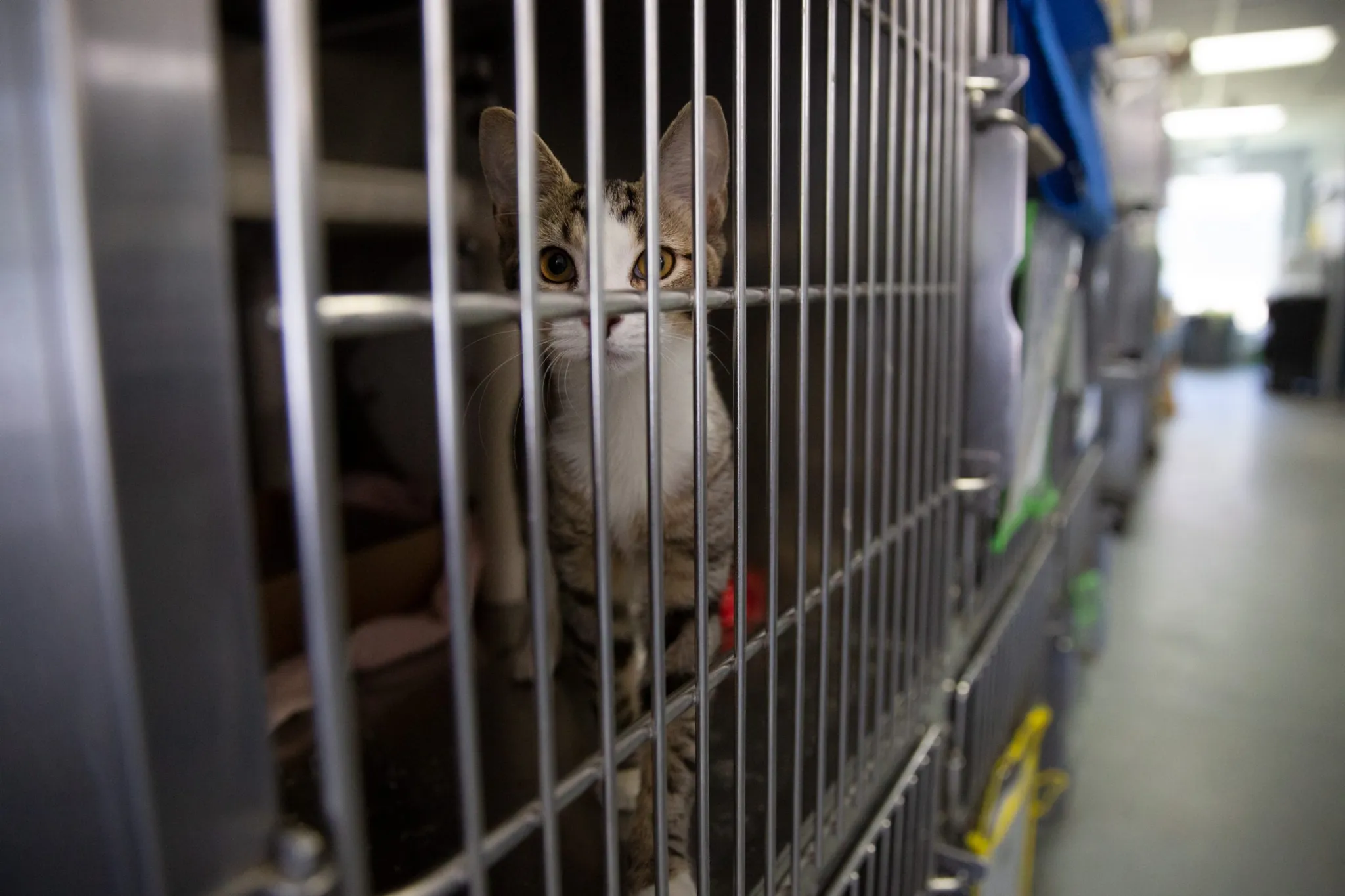
Last year, ACC shelters took in more than 9,700 stray animals — dogs, cats, rabbits, and guinea pigs — and more than 6,530 were relinquished by owners. The city’s shelters frequently are at capacity.
One in three dog surrenders was due to housing insecurity, and most cat surrenders were housing insecurity or personal health issues, according to ACC’s 2025 data.
Zweigart launched a low-cost veterinary office with Flatbush Cats in Brooklyn, providing spay/neuter services and other care that could keep some pets in their homes.
“A shelter is always going to be a bottomless pit,” he said. “Your goal is to reduce demand on the shelter. What if we just kept pets with their families?”
Last September, the City Council approved $500,000 in the budget to expand affordable spay and neuter services for cats through Flatbush Cats, supporting 3,500 surgeries.
But that’s just around 2% of the annual need, Zweigart said. Around 190,000 cats would need to be spayed and neutered to get ahead of the city’s stray cat problem.
“The model that we’re talking about is scalable and a lot of what we’re bringing the mayor and the administration is bringing a solution,” he said.
Having pop-up food pantries can also help owners keep their pets, he said. Former Councilmember Bob Holden, a Democrat, introduced a pet food pantry bill last year, but it was never voted on and has not been reintroduced this session.
“Your budget ebbs and flows,” Zweigart said. “To be able to give people something simple like pet food for a few months could be the difference between keeping their pet with them.”


This hits home as pet-ownership has become a concern of mine.
I inherited a small dog after my stepmother passed and my father was moved to assisted living. Due to lack of care (both dog-parents had dementia and couldn’t care for their selves let alone a pet) the dog basically became a feral mess– unsociable and unhousebroken. It took some effort, a lot of effort, (and I got bit (once) during some old-school, Texas-style potty-training (it worked, and she quickly corrected the errors of her ways)) but these issues have been remedied and she has become a super-friendly, outgoing, and housebroken mutt– great with kids, other animals, and people.
I have been able to give time to this dog because of an incredibly messed-up legal and financial mess my elders let behind, and I have been working from their home. But this is coming to an end, and I must return to my profession– that includes extensive travel and work away from home. I also know that for a period of time– likely several months– that I’ll be financially strapped: I am not and won’t be in a position to be a pet-owner for some time (at least a responsible one).
She’s a middle-aged dog, but a healthy one. While she’s loved by many and will crawl into anyone’s lap in exchange for pets, she is another mouth to feed and I haven’t yet found anyone willing to adopt her.
The time is coming where I’ll be forced to make another difficult decision… soon.
Thanks for putting in the rehab work, LawnDart. A healthy well-behaved middle-aged dog is highly desirable, second only to a new puppy in popularity. Have you been advertising in all your social medias? (Hah! The presumption. My social medias are no more than NC, a music forum and another for sound.)
Rescue organizations are often able to place small healthy dogs quickly. If your pup is a breed or breed adjacent, breed rescues can be a good option rather than a public shelter. They are often able to arrange transport to pick up animals some distance away. You can find them online or, if your local shelter is a good one, they may be able to direct you to an appropriate rescue. Our area in central Virginia has a very active rescue community with many reputable groups fostering, transporting, and offering medical and pet food support to low-income families. Sadly, there are also people purporting to be rescues who end up hoarding and neglecting animals, so you do have to make sure the rescue you are working with is legitimate.
Props to you for all you have done to care for her and make her adoptable. Fingers crossed she will find a good home soon.
Maybe Mamdani could reach out to one of his opponents for mayor as Curtis Sliwa is a noted animal lover who has 6 cats.
great idea! and a nice bipartisan gesture to reach out to Sliwa:
“Both Taylor and Will Zweigart, executive director of Flatbush Cats, urged the Mamdani administration to appoint someone to lead the Mayor’s Office of Animal Welfare to figure out more ways to protect animals. The small office has a budget of $100,000 just to pay for its director, according to City & State.”
also thank you Yves for this post
More funds for spay-neuter would go far to relieve stresses on everyone, and yes pushing back on private equity predations across the board
$100k just for the director? Do you know how many dogs can be well-cared for at a humane shelter for that much every year? 75-100 minimum.
A good start is ban selling dogs/cats in pet stores, at least until shelters are under 25% capacity. Palm Beach County passed just such a law almost 10 years ago and it has indeed helped.
Agreed, salary too high given the circumstances, smh
on a brighter note, some good news for a change:
NY pet stores banned from selling dogs, cats, rabbits effective Dec. 15, 2024
https://www.qgazette.com/articles/state-law-bans-pet-stores-from-selling-dogs-cats-rabbits/
I’m a fan of cats and dogs as pets, and live in NYC where I see a terrific amount of pet & owner behavior, covering the full spectrum of acceptability. But I really have to wonder: maybe the correct solution for the city is to significantly reduce pet ownership, not encourage it through subsidies (e.g., pet food pantries and mandated low-cost vet services, as noted in the article). How about mandatory licensing of all pets with associated fees (let’s say $500/yr), mandatory owner training, mandatory neutering programs, and a shelter management agenda that is a little less focused on placing those rounded up or dropped off. I think we’ve gone a bit overboard toward treating our pets like people, and would like to see a little less focus in NYC on middle-class problems of luxury when there are much more pressing problems. I know this is not a popular position, but there are more critical concerns in NYC at the moment.
the fact that “business” has over shadowed the human habit of co-habitation with animals, is another glaring example of how neo liberalism is ruining all of our lives. Whether people have pets or not, we all live in the same place. Just like we don’t all have kids. We don’t all have elderly relatives to care for. We don’t all have family or friends who are struggling with medical problems. We don’t all have someone who needs psychiatric care.
What we all do have, is that our society is made up of everyone.
The fact that neoliberalism, has ruined our lives by making all the things that make life good: worse, is a big deal.
When we let go of the idea that we as a society ought to be striving to be taking care of ourselves, because we let some monied interests decide we are supposed to pay them first, last and in perpetuity… we are as screwed as we are right now.
To let ourselves lose our humanity. To allow the type of people who think we as a society should give up on good things for: war, scarcity, enshittification, immigration raids, bullying, abandonment of the bill of rights, and even having a planet that is as habitable as it was when we were born… is just to admit defeat.
These people who want to oppress us…. they require us to give them our approval, because they are relatively few. We are many. And we don’t have to become as depraved as they are.
And those animals who we care for, are as important as all the other animals we care for… 2 legs…. 4 legs… what ever.
The vet services around me have gone from having a vet who cared as good as resources would allow.. to being more of a mob type protection racket. Pay up or else….
And as far as new york city is concerned. they spend @ 10 billion dollars per year for the police.
With @ 5 1/2 billion of that in up front payments.. the rest for “the system”…
We can spare a dime to offer animal control. My county offers great services for pet adopters/ shelter animals…. and we don’t have nyc’s pocketbook, and more wild life. So people need to stop pretending we don’t have the money.
The costs have risen a lot in recent years and budgets for many people have not. For many what’s left after housing, utilities and food is diminishing. In and around Boston landlords get more picky. So I agree that the question of how to keep pets in their homes is important.
Keeping pets out of the shelters is important for their welfare. The shelters environment harms some of them. Not all, thankfully. But often the people need their pets too. Some are lonely and the pet their only companion. Others have that one good friend in an otherwise unfriendly life. Often these go together with not being affluent. Separating pets from keepers for reason of inability to pay for something is neoliberal in Strether’s Two Rules sense.
Here in New Mexico, the state levies a small tax on pet food for spay/neuter services. Just this week, a local nonprofit animal shelter opened a new clinic offering those services to any NM resident free of charge.