Turkish Treasury and Finance Minister Mehmet Şimşek said last week that the war crime-filled aggression against Iran is going to create opportunities for Türkiye by forcing supply chains to diversify and opening new trade corridors.
What an odd statement. Not only does the war against Iran have enormous risks for Türkiye —economic devastation, domestic unrest, a major refugee crisis, and the empowerment of Kurdish groups along its borders— but it is also laying bare the fragility of all the West Asia trade corridors.
The obvious chokepoints that are strangling the world economy are the Strait of Hormuz with the Bab el Mandeb potentially playing a large role again. Yet there are multiple other logistics routes through the region and its periphery, which have received so much attention and investment in recent years and in some cases were supposed to function as backup plans to the main arteries, They are effectively dead or under serious threat and it could be many years before they are discussed seriously again—if ever.
As Persian Gulf states begin discussing new pipeline corridors that avoid the Strait of Hormuz, even routes not directly impacted by the war against Iran are under severe strain as an arc of conflict and destabilization runs from the Baltic to the shores of India.
Let’s look at a few of them and how they’re being affected by the war and other global instability.
Middle Corridor
Şimşek referenced this route as an “important opportunity” in his recent remarks.
The Middle Corridor runs from China to Europe through Central Asia, across the Caspian, the Caucasus, and Türkiye. The “middle” refers to its positioning between the northern route through Russia, which is on the back burners due to sanctions, and the maritime passage through the Suez Canal, which increasingly faces conflict restraints.

The map shows two routes through the Caucasus, and a third arrived on the scene last year with the Trump Route for International Peace and Prosperity (TRIPP) that aims to cut across a narrow strip of southern Armenia along its border with Iran. TRIPP will connect Azerbaijan with its exclave, the Nakhchivan Autonomous Republic, and Türkiye.
Azerbaijan is the key node, where the East-West axis (China-EU), the potential North-South axis (Russia-Iran-India), and energy connections to the Black Sea converge. With those connections also comes increased risks.
Surprisingly it has not (yet) been the recipient of any Iran retaliation despite the widely known secret that Israel has a heavy presence there and the country is used as a launching pad for drones against both Iran and Russia.
The attacks on Iranian Caspian infrastructure likely involved Azerbaijan and yet still no response from Tehran like the Persian Gulf countries that host and aid the Americans and Israelis.Why exactly the Iranians (and Russians) have given Azerbaijan such a long rope is an open question.
Is Tehran worried it would cause internal destabilization with the sizeable Azeri population within its own borders?An attack on Azerbaijan could draw Türkiye, which acts as a big brother to Baku, more directly into the conflict.Perhaps China, which has invested a lot of time and money in Azerbaijan, has requested patience.
TRIPP injects even more instability into the route and highlights how it is now part of the broader competition between Beijing and Washington. The US will no doubt attempt to ensure that TRIPP becomes the route through the Caucasus, and to that point, there is increasing talk of Washington of sanctions, sanctions, and more sanctions—plus “other measures”—against Georgia for its failure to toe the line.
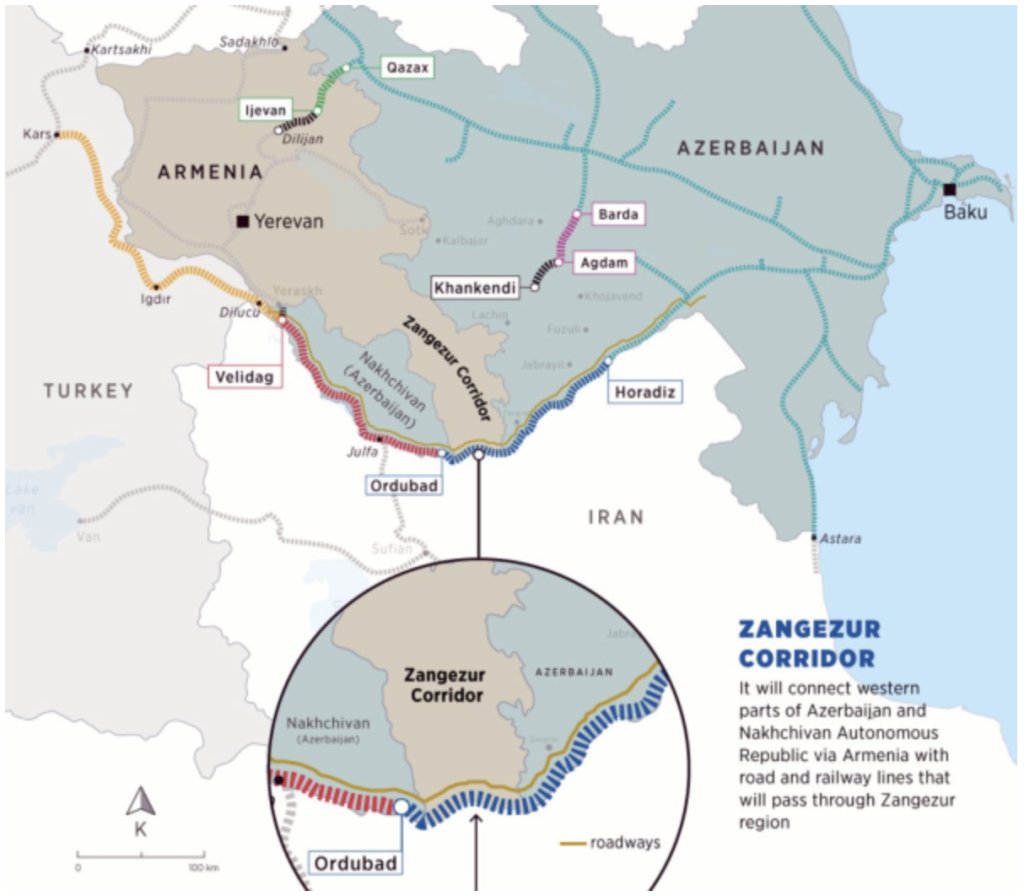
TRIPP, also referred to as the Zangezur Corridor in Türkiye and Azerbaijan.
Meanwhile, the US is talking about sucking out critical minerals from Central Asia and expanding its security footprint to do so. There are fears in both Moscow and Tehran that the route is part of a Washington-Ankara plan to spread Turkish influence into Central Asia at the expense of Russia and Iran, and countries like Azerbaijan and Kazakhstan have indeed been cozying up to NATO. The US-EU has successfully pulled Armenia from Russia’s orbit—geopolitically, not economically where it is still dependent on Russia—and should the US fail in its Middle Corridor competition with China, as it is likely to, one should expect the usual fallback option.
Aside from the risk that the Middle Corridor goes up in flames there are logistical and economic constraints.
Kazakhstan requires significant investment in its railways in order to support the proposed increase in volume. China is a major investor in the expansion of Azerbaijan’s Alat International Sea Trade Port, which handles Caspian cargo as a key hub in the Middle Corridor, which overlaps/collides with TRIPP. But infrastructure is still in short supply. Azerbaijan just announced that it plans to put 10 new Roll-on/Roll-off vessels into the Caspian by the end of the year, a major jump from its current 15, but a demonstration in how far the route has to go.
The Middle Corridor still is the most expensive option due to its mixture of road, rail, and sea links. It currently costs between $3,500–4,500 per 40-foot equivalent unit, compared with $2,800–3,200 via the northern route through Russia and Belarus, and $1,500 to $2,000 by sea through the Suez.
According to Organization of Turkic States Secretary-General Kubanychbek Omuraliev, freight volume on the Middle Corridor reached 4.7 million tons in 2025 and is expected to grow by 10 percent this year. For comparison, a net tonnage of 56 million tons has passed through the 2026 Red Sea and Suez Canal already this year, and that total is still down as carriers are reluctant to resume transits despite the 2025 US ceasefire with the Houthis.
International North-South Transport Corridor
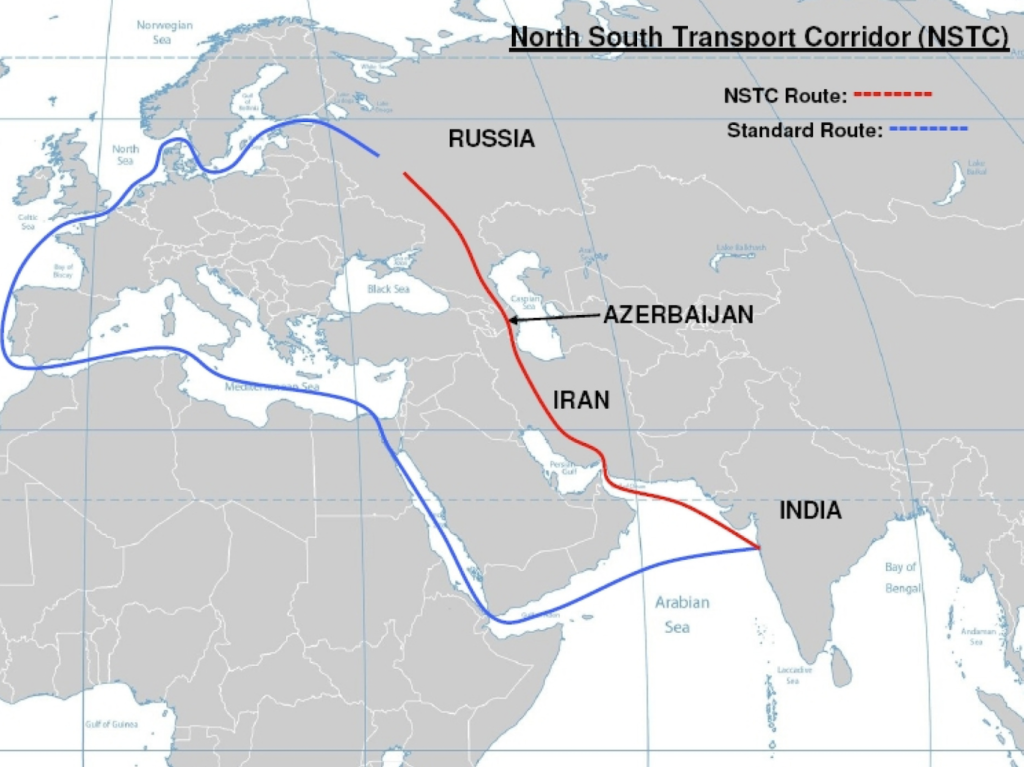
CEO of Russian Railways Oleg Belozerov says that traffic on the International North-South Transport Corridor (INSTC), which runs between Russia and Iran via Azerbaijan or the Caspian Sea and then onto the Persian Gulf, India or elsewhere, reached 11,000 containers in 2025. That’s compared to 5.57 million through the Suez Canal.
The INSTC already faced several challenges, including infrastructure in Iran, sanctions, the West trying to create chokepoints in the Caucasus and Central Asia, and relentless pressure on New Delhi from the Five Eyes. With the US and Israel attempting a campaign of destruction across Iran, including bombs approaching Chabahar Port, which is critical to the INSTC, the route will likely be set back a good deal in a best case scenario for Iran.
Iran’s B1 bridge that Trump gloated about wrecking just happens to be on the International North-South Transport Corridor (INSTC) spanning Russia to India.
The bridge was intended to upgrade a major commercial artery and speed up trade and economic development in Iran and along… pic.twitter.com/H4CvNJSh0C
— Chebureki Man (@CheburekiMan) April 4, 2026
Iran-China Railway
This route garners much less attention than the others on this list, but is perhaps the most important, at least from the Iranian perspective.

In June of last year, the first delivery via this new rail corridor arrived in Iran. The primary route connects Western Chinese cities like Xi’an and Urumqi to dry ports near Tehran after passing more than 10,000 kilometers through Kazakhstan, Turkmenistan, and Uzbekistan. It is shorter by rail (~two weeks) than by sea (~30-plus days), but faces the usual challenges that slow its implementation, such as different gauges in the Central Asia states, cost, administrative burdens, and electrification differences. Still, it holds major importance for both Tehran and Beijing—and causes concern in Washington. From The Asia Cable:
For Iran, the overland route means facilitating the export of Iranian oil to China, offering a vital means to bypass existing U.S. economic sanctions. For China, it is a crucial component of the BRI, which aims to connect Asia to Europe via a transcontinental rail network. For both, its development is a significant geopolitical move as it strengthens the China-Iran nexus and has the potential, in theory, to shift global power dynamics by reducing reliance on Western-controlled maritime trade routes such as the Strait of Malacca, which is a chokepoint and is subject to U.S. naval presence. This provides China and Iran with a more secure and less vulnerable trade pathway.
It could also provide a Russian-free rail option to Europe that is not blocked by the Caspian Sea.
Tehran and Beijing have continued efforts to expand the rail network since the first shipment last summer, and should Iran survive the current onslaught of war crimes perpetuated by the US and Israel, one should expect Tehran and Beijing to double down:
If Iran gets through this war in tact, China will be investing serious amount of money in Iran to build up its role in BRI rail network. It will want to have a way to access Gulf energy product thru pipeline and rail if sea lane gets chocked off. Iran is center of that effort.
— tphuang (@tphuang) April 3, 2026
India-Middle East-Europe Corridor
First introduced at the September 2023 G20 Summit in New Delhi, the network of railroads, ship-to-rail, road transport routes, energy pipelines and high-speed data cables connecting South Asia, the Gulf and Europe was in theory supposed to be some sort of answer to China’s Belt and Road Initiative (BRI). It never made much sense as a logistics corridor as it involves moving cargo via ships from India to the UAE, putting them onto trains going through the UAE, Saudi Arabia, Jordan and Israel, and then back onto ships to go from Israel to Europe.
Uneconomical and seemingly pretty inefficient. And enters Europe via a Chinese operated port. https://t.co/befYuMQ9ox
— Evan A. Feigenbaum (@EvanFeigenbaum) September 11, 2023
It looked like IMEC, like so many responses to the BRI, was going to fast fade into obscurity, but the Trump “America First” administration enthusiastically backed it with Donald calling it calling it the “‘greatest trade routes in all of history.”
Yet the new administration shifted the focus away from a logistics corridor to more of a digital cesspit of corruption with each pole of IMEC fortifying a lucrative new pole of American hegemony with Israel playing a lead role. It was an AI superiority invitation from Europe to India written in the blood of genocide, but it’s collapsing now as the Persian Gulf, which the “plan” depended on, goes up in flames.
There are efforts to take the IMEC model global. In December the US State Department unveiled Pax Silica, an effort to form a political-economic alliance in the field of AI and its supply chains and counts Japan, South Korea, India, Singapore, the Netherlands, the UK, Israel, the UAE, and Australia as participants. What are a few of the key tenets of the IMEC model?
Israel provides an AI lab to surveil, control, and murder human beings, constantly tested and fine tuned on Palestinians and others. The US shared tech with Gulf countries like Saudia Arabia and the UAE in return for a guarantee that AI-enabled exports generated using American chips will be invoiced and settled in dollars—or dollar-backed stablecoins. The Persian Gulf provides capital, land, and loads of power for data centers and American compute power flowing outwards from the oil monarchies, as well as billions in corrupt payoffs to the Trumps, other American officials, and help keep the bubble inflated.
Those Middle East data centers, as well as the desalination plants they relied on for water and the gas for power, are going up in flames.
At least the Trumps and friends got while the getting was good. As the New York Times reported last year, “digital assets are one of the single biggest, if not the single biggest,” money streams for the Trump family. Eric Trump’s World Liberty Financial has a $2 billion deal with the UAE state-owned AI investment firm MGX, which has rights to the Trump stablecoin USD1. MGX uses it for billions in transactions on Binance, the exchange constantly on the wrong side of what used to be the law and whose founder, Changpeng Zhao, received a pardon from Trump in October after pleading guilty to failing to prevent money laundering in 2023.
As the Trump regime collected billions in stablecoin “investments” from the Gulf countries, likely included in these payoffs were handshakes on defense and potentially a change of government in Tehran. Will they return the money if they’re unable to deliver?


Recently, NakedCapitalism provided a link to an article describing how the Caspian sea is following the fate of the Aral sea and the Chad lake — losing water, getting smaller and shallower, receding coasts leaving former harbours on dry land.
There is a map in this article showing the current state of the Caspian sea. Its shrinking has been observed for at least 20 years, and has accelerated in the past 5 years.
Given the time frames involved, I have the feeling that investments in the “middle corridor” and in the “Southern route” may end up being a stupendous capital misallocation since they all depend on large transport ships sailing over a stable, deep Caspian sea. The Northern route, the NTSC, and the Iran-China railway, on the other hand, are unaffected by that ecological disaster.
Great point that. At some point the ports in use right now will be stranded a long way from the water rendering them useless. I still find it freaky to see films of fishing boats being tossed on a stormy sea in what is now the Aral Sea and realize that it is all dust now. And that the Caspian sea is following the same path. So much for maritime transport corridors here.
Thanks Conor – another excellent post.
It would behoove the USian elites who think they should control the world, to take out a map of Eurasia and notice that the US is not on it. One hopes that this weekend’s debacle in Iran might help get some minds right about the US ability to project hard power anywhere it likes. Maybe it’s time to try some cooperation before all those GCC data centers go up in smoke.
a couple of Kazakh railway items in recent years. Kazakhstan is a broad gauge Soviet system, but seems to have gone all-in on Wabtec (former GE) locomotives and rebuilds, not Russian. wondering about kill switches from either US or Russian vendors!
Wabtec lands record locomotive and service order from Kazakhstan Trains 2025
Wabtec today announced its largest-ever locomotive agreement, a $4.2 billion deal to deliver Evolution Series locomotives and provide long-term service support to the national railway of Kazakhstan.
Wabtec signs deal for FLXdrive locomotives, LNG conversions in Kazakhstan Trains 2022
The most logical and high capacity overland route is obviously through Russia and Ukraine. The more southern routes will require massive capital and engineering to be viable options. The gauge changes between standard 1435mm in China and Europe and 1520 mm Russian requires transloading containers twice. The Caspian route requires even more handling on ships. Unlike the US container trains these China-EU trains are not double stacked and the handle fewer cars.
I guess China is forced into multiple hedging transit options on land and sea.
I don’t see anyone looking at the economic/demographic profile of EU in the next 25-50 years. Are all these long term investments waranted?
Well, Europeans will need to have a way out to search for employment opportunities and a standard of living higher than subsistence level so they could be considered acts of charitable humanitarianism on the part of the donors.