[Today’s Iran war post is launching less fleshed out than I would like because reasons. That means it might not be final until 8:30 AM EDT. Please return or refresh this page then for the completed version]
Even though the US spin, which the Western press duly amplifying, is is that the US pushed back the start of the Iran war talks in Switzerland, we had cited Iran media reports in comments yesterday that Iran had suspended the talks over Israel’s continued attacks in Lebanon. Professor Marandi, in a talk yesterday with Judge Napolitano, said that Iran had prepared strikes (this was before the announcement that Iran was not going to Switzerland) but apparently decided to try non-kinetic measures first.
In addition to this apparent breakdown over Israel insubordination, which may not be resolved quickly if at all, other looming problems are that the US cannot deliver on at least one deal term that the Iran regards as important, the $300 billion de facto reparations fund. JD Vance has attempted to clarify this fuzzy promise by describing it as Gulf States making individual investments in Iran. Note that I see no motion toward trying to get BlackRock or equivalent to saddle up to raise a fund, which got nowhere in Ukraine when Ukraine would be giving ownership interests in Ukraine assets, something Iran has not and would never agree to do.
Aurelien has also pointed out that the US committed to across-the-board sanctions relief, including of the disputed UN “snapback” sanctions triggered by the so-called E-3 (Russia and China are not honoring them because they see them as procedurally invalid). So will the US succeed in getting the UK, France and Germany to agree? My guess is that the will but at some (probably well-buried) cost to the US.
Where this all winds up is too bushy (in decision tree terms) to come up with likely outcomes if the talks fail, which seems likely. The MOU document made big concessions to Iran, but Vance’s patter to reporters say the US expects Iran to take action before the US delivers on key commitments, such as the release of frozen assets and sanctions relief.1 Iran has repeatedly stressed that its distrust is so high that the US needs to take concrete steps first. This is a procedural outtrade even before getting to substance.
However (and readers are encouraged to speculate), there are potentially at least two general types of fallbacks. One is that the US uses the failure of talks to walk away, and tries to depict that as better than a “deal”. Iran does not get sanctions relief, does not get much or any of its frozen assets, keeps its nuclear program as is, and the US leaves Israel and Iran to fight with each other. The wee problem with that is that Iran is not likely to accept no sanctions relief. It would at least want waivers on sales of its oil. So does it shut the Strait again?
The second is a narrower agreement than the one contemplated in the MOU, with some items removed (like the undeliverable $300 billion fund) in return to other concessions by the US, like greatly reducing its military footprint in the Middle East.
Keep in mind that it is hard to see how the status of Iran and the Strait of Hormuz can remain unsettled for all that long. In the Vietnam War took a very long time to reach a settlement, and that was with highly competent negotiators on the US side. With Iran willing and able to close the Strait of Hormuz when oil reserves are approaching critically low levels , there is no luxury of time.
If I were Iran, at a minimum, I would get as many of my tankers past the US blockade as possible. Then I might consider threatening to close the Strait again. That alone would rattle the nerves of risk-averse vessel operators.
First on the Iran cancellation, via Al Mayadeen:
The Iranian negotiating delegation had earlier postponed its trip to Switzerland due to the ongoing Israeli aggression on southern Lebanon, an informed source told Al Mayadeen on Thursday.
According to the source, the delegation had already been preparing to depart Iran and launch the first round of negotiations, scheduled to span 60 days, before the decision to suspend the trip was made.
Tehran had previously informed both Washington and the mediators that the Lebanon file remains a central component of the negotiations and will directly influence whether the talks proceed, the source stated, citing Iranian warnings that continued Israeli aggression extending up to 10 kilometers deep inside Lebanese territory constitutes a clear violation of the first clause of the Memorandum of Understanding and the framework agreement.
Later, from International Business Times in Iran-US Negotiations Collapse Before They Begin as Lebanon Strikes Spark Diplomatic Crisis (hat tip Ann):
A fragile 60‑day push to restart high‑stakes Iran–US talks has reportedly collapsed before it even began, with Tehran suspending its delegation’s planned trip to Switzerland in protest at Israeli strikes in southern Lebanon that it claims breach a key clause of a new memorandum of understanding.
According to reports from Iranian and regional outlets, including Fars and Al‑Mayadeen, Iran has halted preparations for its delegation’s trip to Switzerland, where the first round of indirect talks with US officials was expected to begin. They claimed that the situation on the ground has already rendered the process ‘void.’
The US State Department has not commented on the matter.
And the Iran threat to exit the “deal” looks serious. From Larry Johnson in US and Iran will not Meet in Switzerland… Israel Derails the Negotiation:
Israel ignored Donald Trump’s request that it halt military operations in Lebanon and chose instead to escalate its attacks south of the Litani river. Intense clashes are taking place on the outskirts of Nabatieh, Lebanon, between Hezbollah and Israeli forces. …Trump has the power to force Netanyahu to submit by cutting off or delaying the delivery of critical military aid and by withdrawing US air defense assets, i.e., the Patriot and the THAAD.
Iran’s Supreme National Security Council issued a statement late on Thursday regarding the MoU:
“With careful supervision of the negotiation process, if any violation or breach occurs by the American side, according to the predetermined plan, a countermeasure will be taken.”
The statement emphasizes “complete distrust of the treacherous and treaty-breaking enemy” and readiness to respond.
And Iran’s semi-official Fars News Agency reported that:
The Iranian delegation’s meeting with the U.S. in Geneva is postponed, until there is a ceasefire in Lebanon. Until that time, Iran will not unilaterally implement its committments of the MoU—until the U.S. does the same.
The Middle East Spectator reports that if Israel does not implement an immediate ceasefire in Lebanon and stop its advances along all sectors, Iran will consider withdrawing from the Memorandum of Understanding
Yet Bloomberg continues with its disgraceful practice of misinformative headline to keep Mr. Market happy:

The article proper, however, did flag the wee matter of Israel attacks:
Iran has insisted on a ceasefire in Lebanon as part of the interim peace deal finalized with the US this week, and didn’t send a delegation to the talks as a result of the fresh hostilities. There’s as yet no indication of a new start date for the discussions….
It’s not yet clear if the developments will affect the strait, where maritime traffic has picked up since Trump and Iranian counterpart Masoud Pezeshkian signed the agreement. Traffic through the waterway — critical for global energy supplies —- appeared to thin early Friday, a day after a surge in renewed oil flows as the two countries vowed to lift a dual blockade.
While we are on the topic of Strait of Hormuz transits, while Iran has had tankers passing the US blockade line in the Sea of Oman, not much else seems to be moving. In yesterday’s post, we quoted the full text of this tweet:
PetroChina couldn't find a tanker.
Neither could Indian Oil.
Here's what actually happened this week:
PetroChina tried to hire a Very Large Crude Carrier a ship that holds 2 million barrels to load Iraqi crude between June 25-30.
Got 6 offers.
All at freight rates nearly… pic.twitter.com/NcYpIgZir0— Jack Prandelli (@jackprandelli) June 18, 2026
More on doubts about traffic levels not recovering:
Verified crossings still at historic lows
As of 17 June, Kpler observed six verified crossings across the monitored zone. Traffic was weighted east to west, and most vessels followed established Iranian coastal passage routes. One sanctioned vessel, Ostria, was identified… pic.twitter.com/SBo6tF7sFP
— Kpler (@Kpler) June 18, 2026
And from Shanaka Anslem Perera:
Trump signed the Iran peace at Versailles two days ago. The White House published the text. And today the deal is already suspended. A country put its name to a ceasefire and walked away from it inside 48 hours…
The water saw this before the diplomats did. The US navy has pulled back and the strait is open on paper, yet only 17 to 29 tankers a day are crossing, a fraction of the 100 to 140 a normal day carried, and trackers undercount because the brave ones are running dark. The few supertankers that crossed switched their transponders off through the strait and turned them back on only once they were safely out the far side.
That is the whole signal. You do not run a ship dark through water you trust. Sailors priced this peace before the leaders finished signing it, and they priced it as fear. Goldman says traffic claws back to 70 percent at best, and not before the end of next month.
A war that opened by killing Iran’s supreme leader was supposed to close with a signature. It got two signatures and a suspension in the same week. The map says peace. The captains, still sailing blacked out, say wait.
On Israel’s continued defiance, from Antiwar in Netanyahu Reaffirms Israel Won’t Withdraw From Lebanon Despite US-Iran MoU (hat tip Kevin W):
Israeli Prime Minister Benjamin Netanyahu on Thursday reaffirmed his position that Israel won’t withdraw from southern Lebanon and end its war in the country despite the US-Iran Memorandum of Understanding that calls for an end to the conflict.
“We will restore security and prosperity to northern towns,” Netanyahu said. “That requires maintaining the security zone in southern Lebanon; it requires that we not leave there, as long as Israel’s security needs require it.”
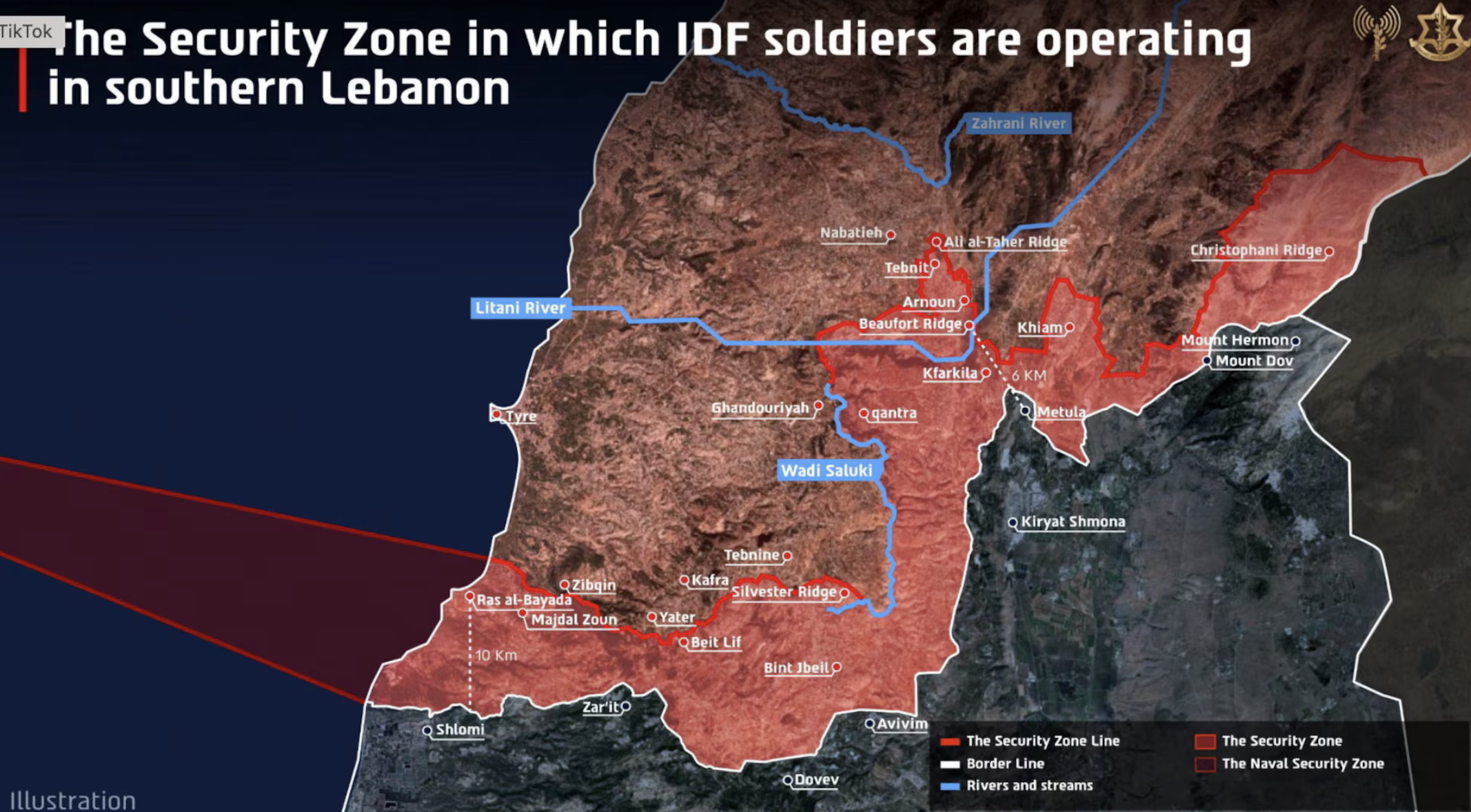
The Israeli military on Thursday also made clear it was not withdrawing from Lebanon and published a new map showing an expanded occupation zone…..
Israel Hayom reported that Netanyahu is bracing for pressure from President Trump over the war in Lebanon, but that there is currently no US demand for the withdrawal of Israeli troops from the country.
Israel Hayom reported that Netanyahu is bracing for pressure from President Trump over the war in Lebanon, but that there is currently no US demand for the withdrawal of Israeli troops from the country.
The aforementioned map, as reproduced by Reuters, in Israel demarcates expanded Lebanon occupation zone, challenging US-Iran pact:
The military, which in April published a map marking its so-called buffer zone in southern Lebanon, released a new map that shows its troops are operating several kilometres deeper into the country, including near the Hezbollah stronghold of Nabatieh north of the Litani River.
Israeli troops have been operating in some of those areas for several weeks, but the military had not yet published a map showing the expanded zone of control, which it marked in dark red in the map published on Thursday.
An Israeli military official said the military “will continue to remove threats (to) soldiers and the civilians of the State of Israel that are identified beyond the security zone,” in effect saying it could carry out attacks deeper into Lebanon.
Israel has intensified its attacks into Lebanon:
Israel is bombing the south of Lebanon and the Bekaa Valley: no condemnation from the president Joseph Aoun or the prime minister Nawaf salam and no change of plans regarding the meeting with Israeli terrorists in Washington.
— Elijah J. Magnier 🇪🇺 (@ejmalrai) June 19, 2026
Ben-Gvir’s bloodlust is chilling, if also not surprising:
⭕️ Israel’s far right National Security Minister Itamar Ben Gvir responds to Vice President JD Vance: “For every tear shed by an Israeli mother, a thousand Lebanese mothers should cry. All of Lebanon should burn.”
He writes:
“With all due respect to the Americans, Israel must… pic.twitter.com/C99u8JrhJl
— Drop Site (@DropSiteNews) June 19, 2026
But Hezbollah is hitting back hard:
An IDF tank was totally destroyed by Hezbollah killing four soldiers. Here is what we know and what it means:
1) Early reports were that an anti-tank guided missile was behind the damage. It is now believed to be a suspected drone or ATGM.
2) Kfar Tebnit where this happened,…
— Shaiel Ben-Ephraim (@academic_la) June 19, 2026
⭕️ 'Difficult incident' reported in southern Lebanon, israeli soldiers' casualties confirmed. – Israeli sources.
— MenchOsint (@MenchOsint) June 19, 2026
Israel is doubling down on staying in Lebanon. From Aljazeera’s live feed:
Israel’s defence minister reiterates plan for military to stay in Lebanon
Israel’s Defence Minister Israel Katz has said Israeli troops will remain in a so-called “security zone” in southern Lebanon, extending from “the coastline to the heights of Beaufort”.
In a post on X paying tribute to four Israeli soldiers recently killed in combat in southern Lebanon, Katz said, “We will not allow harm to our soldiers and citizens, and any violation of the ceasefire by Hezbollah will be met with great force.”
And:
Netanyahu says Israeli army will stay in Lebanon ‘as long as necessary’
Israeli troops will stay in Lebanon “as long as necessary”, says Prime Minister Benjamin Netanyahu, promising to make Hezbollah pay a “heavy price” for its attacks.
“Israel will not tolerate attacks on our soldiers or our territory, and it will exact a very heavy price from Hezbollah for these attacks,” Netanyahu said in a statement on social media, after the military announced the deaths of four Israeli soldiers in Lebanon.
“Israel will remain in the security zone in southern Lebanon for as long as necessary for the protection of the communities of the north,” he added.
Big if true:
Iran’s Islamic Revolutionary Guard Corps Navy (IRGC-N) has once again closed the Strait of Hormuz, warning all vessels to not attempt to cross, following Israel’s refusal to withdraw from and strikes this morning on Southern Lebanon, with the following message being broadcast on… pic.twitter.com/MPcDbzDvp9
— OSINTdefender (@sentdefender) June 19, 2026
I can’t get to Tasnim now, but this may be reporting as opposed to advocacy:
Block Strait of Hormuz Until Full Israeli Withdrawal from Lebanon, Cancel All Future Negotiations
Israel’s brutal aggression in southern Lebanon has intensified significantly over the past 24 hours.
— Tasnim News Agency (@Tasnimnews_EN) June 19, 2026
So Israel looks to be betting on a Trump TACO in its favor. Note that Israelis recognize the risk that the US could cut off weapons supplies (hat tip @DMichaelTripi):

In comments yesterday, reader Earl described how Eisenhower brought Israel to heel in the Suez Crisis, mainly using financial tools:
Israeli’s defiance of the MOU requirement for it to leave Lebanon recalls its attempts to retain Sinai after occupying it in the 1956 Suez Crisis. Eisenhower forced Israel to leave Sinai through a combination of economic and diplomatic pressure. Economic pressure included threats to cut off all economic assistance including tax deductible donations, bond purchases and military assistance. Ike bypassed the UN Security Council with veto equipped Britain and France by obtaining a Geneal Assembly resolution calling for withdrawal. Recommended is You Tube video What Eisenhower Did When Israel Refused to Give Back Land After Winning War by Best WW2 Archives
Sam Husseini, in When Presidents Clashed with Imperial Israel, made a key point:
Eisenhower forced Israel’s withdrawal (along with Britain and France) from Sinai and Gaza using the Uniting for Peace mechanism at the United Nations in 1956. Eisenhower doing this probably led to Israel’s decision to get a nuclear bomb, so it could effectively threaten the US.
Before the negotiation rupture, Daniel Davis focused on ambiguities in the MOU and the implications of the US trying to impose obligations to co-combatant Israel when it was frozen out of the talks. Davis gives some useful specifics about how the US and Iran still seem to have sharp differences over what the “deal” amounts to:
Mario Nawfal interviewed Douglas Macgregor just after the news of the suspension of talks broke. Macgregor discussed the pressure that would be brought to bear on Trump, including impeachment and criminal investigations of relatives. He even discussed Trump resigning but hoped he would do so only after he had cleaned up the Iran mess:
On the domestic (and Israel-enlisted) knives coming out, e-mailed headlines from The Hill yesterday tell a tale:
Cruz: ‘Giving billions of dollars to lunatics’ in Iran ‘is not a good idea’
Trump defends Iran deal amid criticism: 5 takeaways
Senate Republicans raise alarm over Trump’s deal with Iran
The Memo: Hawks lament ‘disaster’ on Iran as Trump strains to sell deal
The Memo: Vance tries to sell Iran deal as skeptics get loud
Vance hits back at Iran deal critics in GOP, Israel: 5 takeaways
Live updates: Vance calls Iran deal a ‘win-win’ even as Trump’s MOU draws heat
Janta Ka’s update includes an important clip of remarks by the Saudi Foreign Minister, effectively throwing cold water on the richest GCC country being willing to pony up funds for Iran. He stressed that the limited trust that was being built with Iran before the war was shattered by the Iran’s attacks, and it would take a lot of work to get relations back on the semblance of an even keel.
More on Gulf state unhappiness:
The Gulf State leaders are happy the war is ending. But are deeply unhappy with the MOU. This is why:
1) The MOU is silent on the only weapons that ever hit the Gulf. Iran's nuclear program never cratered an Emirati airport. Its missiles and drones did. Iran now holds them…
— Shaiel Ben-Ephraim (@academic_la) June 19, 2026
Note this section:
7) Watch whether the Gulf gets written into the next round over the coming 60 days. The real demand was always a seat, not just missile caps. If not involved, this will have long-term implications for US-Gulf relations.
Done for now! Hopefully I will not see you until Monday….
___
1 From CNBC in Vance says U.S. isn’t giving Iran ‘a cent’ as he defends Trump peace deal (hat tip Ann):
Vice President JD Vance defended President Donald Trump’s interim peace deal on Thursday, insisting that the United States is not paying the Islamic Republic and that any economic benefits for Iran depend on full compliance with the agreement.
“The United States isn’t giving up a cent of money to Iran,” Vance said…
“The only way the Iranians get any of these resources … is if they comply fully” with the terms of the deal.


One thing that Trump could do to put pressure on the Israelis for a start would be to order the bulk majority of aerial refueling aircraft out of Ben Gurion airport and fly them back to Europe and the US for down time and needed maintenance. Any long distance strikes for the Israelis would then be mostly out of the question and it would reassure the Iranians that long distance strikes on them by the US are over. You have to admire the Iranians. They have now got the US into a situation where they may have to face off with Israel and remind them who the super power actually is. Vance did not actually say so but hinted that gratitude is not an Israeli thing.
That does not affect Israel’s ability to do mayhem in Lebanon, which is their “leverage,” though.
It presumably affects Israel’s ability to strike Iran if they decide they have enough of the Lebanon mayhem and fire couple of missiles at Tel Aviv.
No, but it is a shot across their bow without halting the delivery of military equipment, ammo and intel which would involve fights with the Israel Firsters in DC. Anyway, Trump would be doing them a favour. The Israelis have been bitching for a while that they cannot use Ben Gurion much because of all those tankers.
Another idea would be slowing down traffic through the Strait. It would be a real shame if some mines “fell off the back of the boat.” Or, during inspections, Iran found too many barnacles on that tanker. Gotta scrape those off before you can pass.
They are the ones that are chosen. We are the ones who should be grateful for the opportunity to assist.
It all sounds a bit nutty but the above–so I read–is what Israelis are taught from an early age. Also everyone is jealous of their chosen-ness and constantly want to destroy them. Of course we Americans live in our own reality denial bubbles which makes some of us more inclined to embrace those of others. Bribes and threats help this along.
Scheerpost had a good article about the alternative attitudes that many Jewish people had before Zionism entered the picture.
https://scheerpost.com/2026/06/04/the-future-zionism-buried-how-anti-zionist-jews-once-fought-oppression-without-colonizing-another-people/
It reinforces the belief many of us have that the Jews (if one may make a broad brush pronouncement) were great and helpful outsiders back in the Gentleman’s Agreement era but have become terrible insiders in the Netanyahu era. In a planet struggling against inequality and possible destruction the last thing we need is a group superstitiously believing in their own elite inevitability up to and including Armageddon.
> the Jews (if one may make a broad brush pronouncement)
False attribution. My daughter-in-law is Jewish, her daughter dates a young man with ICE concerns, and their solidarity is with refugees. Another friend with contact this year is doing his best to remain apolitical. It is a smear to paint ‘the’ Jews with the bloody brush. Israel, Israelites, and Zionists, lack the labelling tar of attributing actions to particular genetic groups.
I agree with all else you say, and believe in your good spirit. But that broad brush pronouncement is dangerous and exactly wrong. Government legitimacy in the US has been severely undermined, and blame-cannons turned on AIPAC and the Epstein class would be a convenient deflection from the Powell Memo and Citizens United. And could get my friends hurt.
Well if you’ve read my previous comments here you know that I think the “bund” spirit still exists and that, as many Jewish people say, Zionism is an aberration first thought up by Christian Zionists and later embraced by the most successful Jews among the Gentiles in order to help the sun over the British Empire never set. Many of the latter claimed to be atheists and, at first, socialists.
It’s a big topic and comments are always a bit broad brush.
And as many of us here have said Israel is the last gasp of settler colonialism even as non Europeans in Iran show that colonialism’s former charges are on the rise. What I would ask though is why Jewish people in the USA don’t do a lot more objecting to that which is being done and claimed to being done in their name. It would help for them to loudly state that the Zionist claim is false.
> a lot more objecting
I agree, but my apolitical friend does not. I suggested he move elsewhere, he’s got skills, but he wanted to remain near family. Qui tacet consentire videtur, say the oppressors. “We don’t want to die for Israel” is visceral. Iran sez Tik Tok and speeds up the timeline. If the economy is stone cold dead by November, citizens will be looking to blame someone. Let us speak for those who may must be silent, and not ‘the’, ‘they’, or ‘thou’ them.
Norman Finkelstein, Max Blumenthal, Aaron Maté, Corey Robin… Even Noam Chomsky, whatever he was thinking in his old age when he let Epstein arrange friendly chats between himself and Ehud Barak, has nevertheless written very detailed denunciations of Zionism and has thus objectively contributed a lot to the anti-Zionist movement. And these are only some of the prominent names that come to mind. A large number of the pro-Palestine student activists that were brutalised and persecuted by the US government were Jewish themselves. Some highly conservative religious Jewish groups that opposed the foundation of Israel for doctrinal reasons have been a salient presence at many demonstrations. In addition, I have been mentioning only American Jews – I could have listed many other notable examples outside of America (for one thing, Alon Mizrahi is regularly featured on this site). If anything, my impression is that Jews are represented in a proportion higher than average among anti-Zionist activists. And it should be kept in mind that not everyone can be an activist, let alone a prominent one, whatever their views. So yes, there is a lot of Jewish anti-Zionism – if you want to see it.
Still, if memory serves, out of approximately 3800 congregations in the US, I believe only two have expressly spoken out in opposition to the genocide in Gaza. The fact of an uneasy silence existing among the “progressive” and centrist Jews I know speaks to the hold that Zionist hasbara taught in temple Sunday schools since Israel’s founding still has on many US Jews, who would otherwise be speaking out.
American Jews can be quite anti-Zionist (I’m one); most of those I’ve protested against Israel with are Jewish, and this group has done great stuff: https://www.jewishvoiceforpeace.org/nobombs/?form=donate&sourceid=1004180#donate
What is the ratio of Catholic priests? American Jews have no more responsibility than anyone else unless they are holes.
I love my Torah Jews!
Things are getting a bit sticky these days. I see a certain circling of the wagons, even among critics of the Israeli genocide like Finklestein and Naomi Klein, who are warning us about finding common cause with Carlson and other MAGA-ites unhappy with Israel and their U.S. supporters.
The problem, which is the core of Carolinian’s comment, is this idea of the “chosen people,” an idea found in older, henotheistic texts of the Hebrew bible, and loudly amplified by later Jewish writings. As I’ve pointed out on a few occasions, the “chosen people” meme fits comfortably in the henotheistic worldview common in the ancient Near East. People were not monotheists; they acknowledged the existence of many gods. But nations and gods were paired off, a little like the 8th grade dance. Babylon had Marduk, Assyria had Assur, Judah had YHWH. The problem for Judah arose when Nebuchadnezzar conquered Jerusalem, destroyed YHWH’s house/temple, and took the Judah political and religious elites into exile. In the henotheistic worldview, that wasn’t just the end of Judah; it was the end of YHWH.
It was the exilic prophets who resurrected YHWH. First, Ezekiel had a vision of YHWH’s Shekinah departing the temple prior to its destruction. (Ezekiel 9) Next, Second Isaiah made the remarkable claim that YHWH was not a dead, defeated, loser god, but was the only God, the creator of the universe. (Isaiah 44:6) The problem arises when Ezra and the boys return to Jerusalem from exile to get the YHWH cult going again, and they create the Torah and the histories from earlier texts and oral traditions. Ezra adopts Second Isaiah’s monotheism, but he retains the “chosen people” meme. This turns the Jews from just another tribe/nation with their own god into a people “chosen” by the God of the cosmos. Later Jewish writings only amplified Ezra’s move and gave birth to the curse of Jewish supremacism.
In this ancient history lies the answer to how Jewish supremacy, which oozes from the Epstein files, has arrived in the 21st century to be expressed by Itamar Ben-Gvir in today’s links. One Jewish life, Gvir says, is worth a thousand lives of the goyim. Some of us have had the experience of having young Jewish friends who confided that they were troubled by what they had been taught in Hebrew school and by older relatives about goys and how they should relate to them. To deny that Jewish supremacism, promoted through the Jewish community at large, is not a huge issue in today’s world, is to deny reality.
At least since 9/11, Muslims have been constantly challenged by Westerners, perhaps especially by Jewish Westerners, to reform their religion to rid it of what was claimed to be its endemic violence. Now is a time when many will be demanding that Jews rid Judaism of its ancient, inherent Jewish supremacy that began as a cope after 586 BCE and developed into a worldview that justifies the sniper-killling of toddlers.
For those interested in the full, complicated tale of how the henotheistic YHWH cult became Judaism, here is a Youtube interview of John Collins, professor emeritus at Yale Divinity School and my former advisor when he was at the University of Chicago Div School, talking about Second Temple Judaism.
There is nothing special about ethnocentrism in Judaism. In Navajo, Dine means “people” and “Navajo,” e.g. the tribe is the people. Pretty common in pre-Axial Age religion and hunter gatherer groups. Axial Age religions with a more universalistic view historically appear with the emergence of Empires. Buddhism was the religion of Asoka’s Empire in India, Christianity was the religion of the Roman Imperium, Islam was the religion of the Caliphate, etc. Judaism has never been the religion of an Empire and couldn’t be without gutting the ethnocentrism.
Empires require conquest by Group A of Groups B, C, D, and E, ad. infinitum, and creates the political problem of integration of conquered peoples into an Imperium, which isn’t going to work so well if you de-humanize outsiders. These Empires were NOT egalitarian by any stretch of the imagination, but like any complex society, there is a constant negotiation of standing between groups (whether labor/capital or ethnicities). There can be no basis for any such social compact when the first principle is that I am of the true tribe beloved by God, you are a sub-human fit only to serve as my slave. Or worse, Amalek. . .
If anything, Judaism as a historical religion emerged as a form of resistance against attempts of Roman integration, as a means of maintaining a particularized and separate identity from the Empire. Its a great means of maintaining identity in diaspora, but in power, creates a serious mess as Zionism is proving.
Zionism, of course, not being synonymous with Judaism, but as a secularized “political theology” emerging from Judaism, in the same way that the liberal republican separation-of-powers conception is a secularization of the Trinity.
In the history of Judaism, there was an option. While it was Second Isaiah who turned a henotheistic YHWH cult into a monotheistic religion, it was Third Isaiah, another returnee from exile like Ezra, who argued for universalizing the new monotheistic religion. While clearly a monotheist, Third Isaiah prophesied against Ezra’s ethnocentrism (Ezra 9) and for a universal religion based on profession of faith rather than ethnicity:
Isaiah 56:6-7 (NRSVU)
Those who like to make connections between the Greek and Hebrew bibles will note that Jesus is portrayed in the Synoptics as taking on his lips Third Isaiah’s call for universalism when he cleanses the temple. The Mishnah and Talmud, however, follow Ezra’s ethnically based formulation.
I largely agree with you. In the Collins video I linked above, he argues that Judaism really didn’t get going in Jerusalem until the Seleucids tried to tax the temple with the resulting Maccabee revolt.
Don’t overlook the author of the Book of Ruth, written about the same time as the Third Isaiah, who also opposed Ezra’s ethnocentrism by claiming King David was descended from a woman from Moab–one of Israel’s traditional enemies.
That said, I think Zionism has more to do with 19th century European ethnic nationalism than anything in the Hebrew Scriptures.
Is it possible that if we search for the “root” of 19th century European ethnic nationalism, it might be informed by the Old Testament histories? And was Jerusalem builded here, among these dark Satanic Mills?
Thanks Henry for the vocabulary lesson for today. I don’t recall coming across the term”henotheism” before…
I had to look that one up.
Some might consider it an “angels on the head of a pin” distinction that only social scientists and theologians would care about, but the long ago transition of a henotheistic cult to a monotheistic religion has had ramifications over the course of more than two millennia, far beyond the “rivers of Babylon” to the ends of the Earth.
Thanks HMP. Gore Vidal wrote Julian about the emperor who wanted to return to paganism and perhaps we’d all be better off if everybody did still have their own god and warfare would be more honestly about territory and resources and goods rather than pretending it is about religion.
While raised Southern Baptist I’m not particularly religious myself but do believe religion serves not just a personal spiritual purpose but also a social purpose if the doctrines adhere to the realities of human existence. And that reality is that we all evolved from the same ancestors and some of us didn’t just appear as pets and servants to a jealous god. Those Jewish fundies in Israel might as well put up a Creationism museum next to their Holocaust museums since both form the basis for their actions. Red Heifers may be prominently featured.
“warfare would be more honestly about territory and resources and goods rather than pretending it is about religion.”
Add revenge to that. Nobody likes to admit or talk about that aspect when it arises. Too “non-technocratic”…
Thanks HMP, I appreciate you taking the time to write that up.
Finkelstein himself says he’s glad that Carlson, Owens, Kelley, et al are speaking up against Zionist barbarism. His warning is that the existing void created by the lack of a viable (anti-Zionist/Imperialist) Left will be filled by Anti-Semites (and he’s right).
Remember how there was talk among many on the Left during the Woke/#McResistance years of common cause among Right and Left over “free speech?” How’d that work out for us?
‘They are the ones that are chosen. We are the ones who should be grateful for the opportunity to assist. … It all sounds a bit nutty but the above–so I read–is what Israelis are taught from an early age.’
Where exactly do you read that? This sounds like a conflation of Zionism with the Jewish religion (I’ve already addressed a similar claim by Tom Stone in detail to argue that it contradicts the facts, so I won’t repeat myself). Even worse, your comment seems to assume that all Jews today are Zionists, which is obviously far from being true. Both of these notions go beyond anti-Zionism and get dangerously close to genuine anti-Semitism.
What Vance said, and what others are beginning to echo, is that Israel is only allowed to exist in its current arrangement because it has powerful friends. Now that its attacking those friends, what is the plan?
I don’t think the current oil supply situation will give the zionists enough time to properly process their grief over this turn of events. I also don’t this mess is going to resolve cleanly. Polls and interviews and news articles keep showing that a strong majority of Israelis (~80% or more) agree with what their leadership is trying to do against Iran and Lebanon. Is the US really saying they’re going to push back against the entire unified country? I can’t see that happening. But the US and others can’t continue to support Israel to the extent needed to preserve this current arrangement. Something has got to give.
My estimate is that we see a huge response from Iran over either a false flag or an atrocity in Lebanon. At that point, Israel is gagged and bound. The Gulf States would comply too, lest they experience the same treatment. I don’t see this ending without Iran using excessive force to make their point clear. Mainly because the people who keep pushing this war are too stupid to understand anything except force.
Isn’t Iran free to attack Israel? The latter did not sign the MOU.
I sort of assumed that the US was cutting Israel loose by this arrangement.
I think the Iranians want to make Trump (the U.S.) rein in Israel, force them to stop what they’re doing in Lebanon and Gaza. As long as the U.S. keeps supporting Israel with weapons and money, Israel will keep on committing genocide. I’ve been amazed that the turn of American opinion against Israel has been so slow. They’re killing children, every day, for dog’s sake, and there are Americans who think that’s right!
Aside from certain cultural issues, support for Israel has always been about US intervention in the ME. The biggest intimidation in the US holster has probably been the nuclear capabilities of Israel. They could always let that dog loose. Now that the dog is not just foaming at the mouth but growling at its owner, the strongest message, and retribution for the Liberty, would be to defang Israel’s nucs. The US knows where they are and probably has keys.
I think that this is all good cop/bad cop game by USrael and one must never forget that the current US admin is agreement incapable. They are testing which MoU points make Iran hold fast and which can be bent. At some point they will realise that Iran will stay firm in most of it. Maybe the 300 billion fund is the weakest part as it has mostly symbolic importance for Iran. What these idiots (Trumptanyahoo) will try as the oil cliff approaches is something yet to be seen though I believe they still will wind up their game because, to be honest, i think this game will test to what extent they show to be amoral.
The US is of many minds. The kind of scenario I propose above has, historically, been executed by a faction. It does not have to be a popular idea. It just has to be a group with the means and determination. The only reason we went to war with Iran is because a, possibly, minority faction had the means and determination. That faction has now proven to be incompetent. Probably what is keeping them in the command is loyalists who do not want to go down with the ship. That includes congressional enablers. They are all down to hail Mary moves to try and save their skin. They are dangerous cornered animals. Trump just tried rolling over and playing dead but it is not working. Possibly the one thing that would facilitate a resolution is sufficient global disapproval. That is difficult because there are too many countries in compromised positions
Slight correction: it’s not just the current administration that is agreement incapable. The US has been, at best, agreement fluid when it suits the needs of the empire for a very long time. The Trump administration only dumped the niceties and pretense of acting in good faith.
The US has been, at best, agreement fluid when it suits the needs of the empire for a very long time.
Pre-Columbian locals enter the chat and nod in full agreement.
“good cop/bad cop game by USrael ”
But it’s not Iran who’s in custody. ;)
Monday is last trade day for July WTI
Macro Alpha
@MacroAlphaHQ
🚨 The paper energy market is about to experience a violent collision with physical reality.
Everyone on this app is hyperventilating over AI chip earnings while Cushing is quietly hitting operational tank bottoms.
We are at 20 million barrels at the primary
$WTI
pricing hub.
That is less than two days of domestic production before you start sucking up water, sludge, and sediment.
You cannot magically pump vapor when the physical pressure drops below engineering thresholds.
Meanwhile the SPR is sitting at 1983 levels because politicians drained the strategic buffer to suppress retail gas prices for an election cycle.
There is no emergency valve left to pull when the next geopolitical supply shock hits the market.
Retail traders are blindly shorting energy futures because they think a macro slowdown guarantees zero demand.
They do not understand that paper contracts are entirely useless if the delivery mechanism physically cannot extract the underlying collateral.
The commercial commodity desks know exactly how structurally tight this is getting.
They are positioning to squeeze the absolute life out of the paper shorts who think crude is just a ticker symbol.
You are about to learn the severe difference between financialized assets and actual molecules.
FarmBoy,
Many thanks for your well-thought out and accurate comments on this topic.
BTW, did you really grow up on a farm? I did. Trades usually start work two hours after real farmers. Those folks know reality and deserve utmost respect.
It took months of straight closure for Iran to build the current economic pressure on the US and the world through the depletion of world oil reserves. If they let the straight stay open for months while this kind of disingenuous back and forth happens, they play in the hands of their adversaries by giving up their real leverage for nothing, but some oil sales of their own and the crippling of some US bases. The fundamentals remain in place. Maybe their economy is suffering way more than they let on, but that would seem like a loss to me. Especially if they continue to refrain from punishing Israel for its cleansing in Lebanon. We will see what happens, but it is starting to look like the Iranians will snatch defeat from the jaws of victory. If pain in the Iranian economy is indeed forcing this behavior, it would behoove China and Russia to provide significant economic aid if they truly wish to transition to a multipolar world.
I mean, given that the talks are delayed now because of Israeli bombings, it seems like the Iranians intended to let trump and Vance look foolish for drafting an agreement full of weak spots
In 2022 over the Russian invasion, US drew down the SPR more than 170 million barrels. Negligible refill!
The draw down to hold prices since March 2026 is over 70 million barrels.
US did not restore SPR since 2022. US will likely have trouble finding crude to restore SPR now, no matter high price!
I am not sure the SOH running 40% will provide significant surplus over normal demand crude.
US vulnerable until it gets fill into SPR.
This is probably correct. But, I still don’t understand why Iran would release the pressure for what looks like nothing (the MOU is a bunch of empty promises and Iran has to know that), unless things are much more dire in Iran than the alt news media thinks. Maybe, there are some hidden money transfers. There are some indications of US military withdrawal. Maybe that was enough? There has to be other hidden machinations, otherwise they are releasing their biggest leverage for what looks like very little. Just another Minsk lie. They have to know this by now.
Use Alon Mitzrahi’s interpretation of Irans strategy in fighting this war as a guide and it will answer your question. To paraphrase, “Iran is fighting 3 wars simultaneously. Iran vs USA, Iran vs the Gulf States and Iran vs Israel”. Each war requires a different strategy.
I interpret Iran’s current actions as a strategy in the Iran vs Israel war. Iran can’t just bomb itself to victory currently since Israel has nukes, full western backing and an overwhelming ability to control the narrative. Iran has to try and pin a global economic catastrophe on Israel, vs blaming the US or Iran, so as to sow a wedge between the Israeli state and its western backers. Difficult.
This makes sense to me. They will close it quickly again after Israel obviously sabotages the deal and convince more to blame Israel.
Will the SOH running at 40% provide any surplus over normal demand without drawdowns? 40% probably means at least 8 million barrels down from pre-war.
You are not looking at the relevant data
The SPR was at about 340 million barrels at June 12. Drawdown is 8-9 million barrels a week.
The minimum operating level is 270 to 300 million barrels. No one is sure but go below whatever that levels is and the walls of the salt caves collapse
So we are probably at ~332 barrels now.
Trump’s forecast of four weeks to a crisis is a match.
I do not like to seem harsh, but you do not seem to have been paying attention. Traffic will not normalize in 60 days. Tankers won’t be able to get to the Gulf, load, and get to their destinations in that time. The world will STILL be drawing on oil inventories even in a “things move along pretty well” scenario, which is unlikely. The only relief will be the tankers now trapped in the Gulf, as in already loaded, going to their ports, but that is only a week or so of gap-filling, not sustained relief.
It will take a least 8 months to get to normal and it probably won’t even then, Kpler’s forecast, assuming the Strait opens more or less now, is for traffic to be at 45% of the old normal by mid 2027.
So Iran has INCREASING leverage during the negotiations, and it won’t diminish until conditions are very well regularized.
Yes, I agree largely with Art Berman’s analysis, but those issues are out of Iran’s control so their leverage is gone in that domain. And I suspect when the world is really backed up against the energy cliff issues like barnacles and insurance will be expedited. Use the unmined portion and pay the toll. More norms will be shed. Now, ships being misplaced and the time needed to transport is something we will suffer. But, those are outside of Iran’s control, so once the straight is open the leverage is gone and misplaced market optimism increases. When that pain manifests, I guess they will close it again to regain leverage. But, this supposed understanding and opening just delays the price spike. The price manipulation just delays adaptation and the pressure to do a real deal. We are all going to suffer way more because the ability to deny reality with the futures manipulation riding on the back of a false dawn. It seems better for both Iran and the world to force the change as soon as possible.
This is not Art Berman. This is Jeff Currie and top execs at Exxon and Chevron.
And you are talking over and ignoring what I said. The leverage is NOT gone when the Strait opens, FFS. Iran can shut it any damned time it pleases. Shipping will not be normalized in 8 manths, likely not even a year. Rebuilding inventories is the last, not the first, thing that happens. Steve Hanke, who has advise the UAE. thinks shipping volumes will only as high as 50% of the old normal. Eventually, pipelines to circumvent the Strait will be built but that will take many years.
No, insurers will not risk a $5 billion loss on a ship. Only a state can take that risk and Trump’s insurance scheme never got off the ground.
Banking systems are essential for payments and regularly get into trouble, so backstop mechanisms. Energy and shipping have ever been on their own.
No, insurers will not risk a $5 billion loss on a ship.
And does that five billion magic up a new ship immediately? I do believe we’ve heard a version of that problem in other scenarios.
All done! If you arrived before the time of this comment, please refresh this page and re-skim. Reports that Iran has closed the Strait of Hormuz , based on Iran media sightings, started posting on Twitter after this update first went live.
Thanks, Yves. Have a nice weekend.
Thank you!
Vance is going to burn what little political capital he had on this. Why they even put in writing that the Lebanon front is part of the USIran conflict is beyond me. Just setting yourself up for failure.
I lived in Egypt briefly in 2006 during the big dust up between Israel and Hezballah. It’s been twenty years, there’s no way Israel is going to hang up their weapons and sit tight with Iranian allies on their border.
Oh well, at least the guns were briefly quieted
Because Iran wanted it to be there spelled out explicitly?
It got us to friday…
Because market manipulation.
Alternative wording:
“… there’s no way Iran and its ally Hezbollah are going to hang up their weapons and sit tight with Israel blowing s**t up *within* the borders of southern Lebanon.”
So they insisted on including Lebanon in the “deal.” The ball is now in the US court.
Alternatively, his sudden growth of a spine might buy him new political capital. If so, will it be more than he burns?
Because Iran holds the whip.
Has the US considered what would happen if the US empties the reserve.
In Never let a Crisis go to Wasteland the elect would rather reign in hell rather than serve in heaven.
I’m not as impressed as some here by the alternatives. Reign or serve we’re still in Hell.
Has Israel considered what would happen if the US empties the reserve?
Why either country believe they will get a better deal a few weeks out is beyond me–my guess is that Israel is just trying to test its limits and will soon back down, given that the alternative for it is catastrophic.
But then, I also thought that Iran would run a large missile attack on Israel tonight, and the complete lack of preparations for one suggest that isn’t happening either, so I am hardly a star analyst…
Israel doesn’t care if the oil markets blow up. They are fighting for the supremacy of Israel in the Middle East, and if Iran succeeds, Israel will diminish and ultimately either disappear or evolve into something unrecognizable to its current leadership. If you are in a knife fight with an opponent intent on killing you, you don’t stop to check how your stock portfolio is performing. (This is the same reason Iran probably doesn’t care if the oil markets blow up, and America does, because America has no real national stake in whether Iran or Israel prevails. Yeah, if Iran wins, America looks stupid & weak and maybe oil costs an additional $1 a barrel, but that’s less than the mark up you’ll see on Windows 12.)
Thanks for the reply, and sorry, but I was too busy being glib to express myself clearly. I should have written, “Has Israel considered what would happen if it pushes the US to the point that the US cannot defend Israel, even if it wants to?” Because if the US truly gets pushed to that point, both US and Israel will have lost all leverage after having lost all goodwill, trust, and even the bare minimum amount of respect, and the end result will be catastrophic for both. Meanwhile, the upside for what it is currently doing in Lebanon is minimal. The risk/reward is heavily lopsided against it (and just to be clear, this has nothing to do with what I think should happen–I am trying to analyze dispassionately).
And then the key part of my post: I was even more certain that Iran would tonight actually launch a large (mid double-digit) set of missile attacks tonight aiming in particular at US and Israeli bases, the remaining radar, and any of the early warning systems that are along the main paths. This is clearly not going to happen based on the lack of indicators so far, so take my above analysis with a huge grain of salt.
Just to maybe belabor the point a bit: Israel has largely acted as if it doesn’t need to deal with the consequences of its actions, and over the past couple of decades, it really didn’t need to do so.
Now it should be, I think, very clear that it will need to bear at least some adverse consequences, and this should have changed its actions–if not after True Promise 1, then definitely after True Promise 2. Even if it wasn’t obvious at that point, then the events of March and April should have really clarified things: the US can abet Israel and even blunt some attacks, but it cannot do much more.
And so driving the US to the point that it cannot even deter Iran or reduce the effectiveness of Iranian attacks is not some brilliant Israeli strategy, it is outright suicide–and to pursue a suicidal policy to look tough or to grab a bit of unnecessary land at a time that your own army is saying that this is untenable is nuts.
Ha! The US never considers bad things happening until they happen!
I was born a Cassandra. What am I seeing? I am seeing a low interest rates that will need to be raised, an oil crisis we have never seen before, and a climate shift that will cause billions in economic damage and death this year.
I am just waiting for the socialism that arises after we go through all the hardship.
And I pray for all the people we let die because Trump is a cuck to Nutenyahooo.
I suspect that a major reason why Israel does not want to desert those security zones is because being in their possession, they will be able to divert the waters of those rivers in those zones – like the Litani river – towards Israel which will become more important due to climate change. I seem to recall that Israel was doing this when they occupied southern Lebanon before Hezbollah kicked them out at the turn of the century. I recall too that during the 2006 war, Netanyahu sent the IDF to that river to try to make some sort of territorial claim on it but which never worked.
Another major reason is control of the Qana offshore gas field:
Israel Moves to Take Control of Lebanon’s Offshore Gas Dream
Gaza also has an offshore oil field. What a coincidence.
So in fact a resource war.
And a chance to test autonomous systems. Don’t know but assume the tech oligarchs are well versed on a jackpot and everything from data centers (per NC) to MIC disruption to widespread testing – at least, attempts at widespread testing – of facial recognition via consumer products to remarkable increases in ICE budgets are all in the line of how do we maintain our position when things break. And they will need massive amounts of energy to power the system.
Can you really trust your security detail? That sort of thing could drive a lot of energy and capital.
Anyway, would make the election of someone like Platner a big issue, as the infrastructure isn’t all in place yet.
Well, stretched my legs a bit on this one. A resource war, maybe stop there.
So in fact a resource war.
No, organized banditry. Steal the land, steal the resources, and kill or forcible remove the inhabitants.
Now that we are at the point of meaningful negotiations to end this war, I think it’s worth going beyond Israel’s intransigence over Lebanon and complete the picture.
Israel started the June 2025 war and it initiated the war on Feb 28, 2026, as well as assassinated 52 top Iranian leaders. Moreover, Israel has had its hands around Iran’s throat for decades. It sabotaged the JCPOA, spread lies about Iran’s imminent nuke, pushed for sanctions, and for decades pushed for war against Iran. Meanwhile, however you characterize Hezbollah, it doesn’t compare to the Israel’s genocide.
Demanding Israel pull back within its borders is hardly a big ask coming from Iran. If anything Israel should be on the hook for reparations to Iran. Numerous Zionist billionaires support Israel’s aggressive policies, the Friends of the IDF organization, AIPAC, and politicians like Netanyahu, etc.
Major Israel donor Larry Ellison is worth more than $200 billion. If Israel is handed a reparations bill, he and a few others could handle most of it seeing that they support Israel’s wars and genocide.
Trump has made it clear he understands the economic disaster facing the global economy, and that there is no military solution. He only needs to read the riot act to Netanyahu and get him in line.
@ripplebrain has a plausible interpretation of what’s going on that might be worth considering:
https://nitter.poast.org/ripplebrain/status/2067925556226638066
“Option 1: The Trump admin (Vance has been chosen for this) came out swinging against the Israelis because they need to present a credible threat that they’ll punish them for refusing to play ball and adhere to the ceasefire in Lebanon
Option 2: It’s all one big coordinated plan to give the Israeli government someone to blame (Trump) for withdrawing from Lebanon rather than admit failure
Option 3: It’s a coordinated effort between anti-Likud factions within Israel and the Trump admin to pin Israeli failures on Netanyahu and remove him
In Option 2 they’ll need to performatively refuse to adhere to the ceasefire for a week or two before pretending like Trump gave them no choice
All three options could involve the cooperation of Zionist elements both in the US and Israel. The Iran/Lebanon strategy has been a failure and even the Zionists should be able to see this. Doubling down will just do more damage to Israel at this point, though they have to keep demanding more violence to satiate the bloodlust of their domestic audience”
Now which of these is the most likely scenario? That remains to be seen
Option 4: It was an Iranian demand and they’re holding the whip.
Haha, see my similar comment above!
Reading the riot act will not work. There has to be a concrete demonstration of intent.
Maybe some other big countries should join in on pressure on Israel? Some added weight.
USA isn’t their only trading partner.
This weakens Trump domestically as well, the attacks will be coming both from the Zionists and a Legal establishment that has been sharpening their knives since Trump started dismantling the Rule of Law.
And the reality of Iran having the World Economy by the throat is not something these factions can ignore for long.
Bet on stupidity winning out.
It’s going to be a lively Summer.
If Trump really is terrified of being blamed (now and by history) for causing a global economic collapse–as a severe narcissist might be, if humiliation is worse than death for those types–then outsourcing the dirty work with Israel to Vance is probably a good move–Vance presumably does not know or much care what Kompromat Israel has on Trump. I have a hard time seeing Trump actually cutting off actual support for Israel, but Vance might.
Or they can both stand back and point at Israel for causing a global crash–i.e., “we did our part with the MOU, this is now Israel causing the collapse”. I have been suggesting we call the inflation, present and incoming, the “Israel Tax”, cuz that’s what it is.
Rinsing and repeating the good cop bad cop theme.
It’s minsk all over again where all olive branches are simply to buy time.
Usrael is agreement incapable and Iran will be blamed.
We often reflect on Mark Twain’s observation that: “History doesn’t repeat itself but it often rhymes”. What do we know for certain from studying history. We compare the current war with Iran to Vietnam. A quagmire with certain other similarities, but with one huge difference. The Vietnam war lasted from 1954 until 1975 before it was finally resolved. The war with Iran is now what, on again and off again, for a year. The Vietnamese did finally enter into negotiations for peace, but never were there any discussions of a ceasefire. The fighting continued until the war was ended. Same with Afghanistan for about the same period of time. Two historical examples of how to win a war with the US. The question of the day now is why doesn’t Iran see what you so clearly see. This is Trump USA rope a dope and nothing more – minsk all over as you call it. So the bottom line is that we need to get over it – there will be no negotiated settlement…period! Iran leadership is either very foolish (they feel they can become stronger by playing this game) or very foolish (if they want it to go on for as long as my two examples). I have no idea what the outcome will be but I think we are looking at a much longer conflict than anyone is penciling in right now. Personally I think the Iran leadership knows what I say is true and are merely hoping that jawboning now will get them at least one valuable benefit (some cash and/or whatever sanctions relief they can) while they prepare to fight again until the end. Unfortunately, discussions of an actual path to peace is merely Kabuki.
What’s foolish though? Iran can reach for the whip at any time. If it gets what it wants by negotiation, so much the better, as Iran is not being bombed. If not, they can reach out and touch Israel, American forces, and the Gulf countries quite effectively.
How dire our future is revolves around when and whether Trump can leash Netanyahu. And I guess this means I’ll ultimately be forced to memorize how to spell his name, sigh.
To what end? Blowing your own brains out so that you can blame your ex is not a winning strategy. It isn’t even a consolation prize.
Vance being Israel-unfriendly is probably Trump’s greatest protection against a Mossad-concocted assassination attempt. Let’s just hope Vance’s Secret Service detail is competent. The imagination quails to think of who Trump might pick if a replacement VP is needed.
If you want Johnson both have to go.
That’s a frightening, but plausible, thought.
It is 78 years late for the US to stop supporting the genocidal, terrorist, thieving, lying state of Israel. Tell Israel goodbye and withdraw all our troops, other personnel and assets from the Middle East. If Israel wants to continue to wage war against its neighbors, it can do so without US support of and kind – no financial support, no military support, no political support, no diplomatic support. Let Israel learn the hard way that its ability to fight is much smaller than the big mouths of its leaders.
According to Track AIPAC, Trump has received more than $230 million in campaign contributions from pro-Israel groups. This is the only explanation I can give for his unwillingness to cut off military aid to Israel. I find it odd that for all his bluster Trump stays bought, even at the cost of wrecking not just the U.S. but the global economy.
https://www.trackaipac.com/states/archives?rq=trump
A good politician is one who stays bought.
And if they don’t stay bought…..?
Then there’s Bibi’s gift to T of a golden pager. Not a threat or anything like that. / ;)
https://www.timesofisrael.com/pms-office-confirms-netanyahu-gifted-trump-a-golden-pager-at-white-house-meeting/
In reading Sam Husseini’s brief post on ‘When Presidents Clashed with Imperial Israel,’ a few thoughts struck me. First, he left out the very relevant example of Reagan’s clash with Begin over Lebanon in 1982, which has often been cited to illustrate what a President *could* do to contain Israel if he wanted. But I am also impressed – and not in a good way – with the degree of open resistance to Trump by the shills for Zionism in his own party and in the conservative media. These are people (Graham, Cruz, etc.) who are scared sh**tless of challenging Trump on any other issue. To me, it seems today that as the views of Israel have become increasingly negative among the majority, the power of the Israel Lobby has never been greater among political and media elites.
Guess we will have to send them a message.
Trump on Iran’s missiles:
turning Israel’s insistence on nuclear as the pretext for war against them.
Israel will not leave Lebanon until compelled to do so. How that is to happen, if it is to happen at all, is in the hands of Iran and the US. Should Israel be forced to retreat to its borders, then what? Peace and brotherhood? As it stands, is Hormuz closed? Open? Neither one nor the other? The clock ticks as the last of the oil reserves drain away. The MOU was signed with a view to avert the economic consequences of reducing the lifeblood of the world economy to a trickle. Looks to me that Israel swatted the ball right back to Trump and Iran. (Only a little repentant about the mixed metaphors.) Iran can let the missiles fly and may well do so. Trump?
And if they are compelled, who will they assassinate and who will be blamed for doing it?
It is interesting to read Wikipedia’s description of Israel’s borders.
The borders are “flexibly” defined in many cases.
https://en.wikipedia.org/wiki/Borders_of_Israel
“Only two of Israel’s five total potential land borders are internationally recognized and uncontested, while the other three remain disputed; the majority of its border disputes are rooted in territorial changes that came about as a result of the 1967 Arab–Israeli War,”
So having Israel “retreat to its borders” is not without ambiguity.
Fresh news says another Lebanon ceasefire has been announced.
https://www.ft.com/content/ad95de96-4849-479e-b4e5-c5f15fcad581
And, per Nawfal, broken five minutes it went into effect.
Ugh, can’t write today. Five minutes after it went into effect.
Another ceasefire with Israeli characteristics. “A cease fire does not mean ceasing fire, it means not escalating the attacks.”
As the saying goes, ceasefire with Israel means you cease and Israel fires.
Its funny but Israel’s government put out a statement literally saying a cease fire does not mean that they cease fire, but rather that they do not escalate!
Southern Lebanon hit by at least 12 Israeli strikes since ceasefire
Yep. Sounds like an Israeli ceasefire to me.
Sadly predictable. As Chas Freeman says: “a ceasefire with Israeli characteristics”
“I do not think [that word] means what you think it means!”
“US official……”
Explain when Israel began talking to terrorists!
“. . .Israel began talking to terrorists!” when it included them in its government.
Israel’s far right National Security Minister Itamar Ben Gvir responds to Vice President JD Vance: “For every tear shed by an Israeli mother, a thousand Lebanese mothers should cry. All of Lebanon should burn.”
Isr is so high on its own supply it’s convinced itself it can force the US and the EU to always do its bidding no matter what, imo. There’s a Wile E. Coyote moment ahead.
Tucker and Piers Morgan:
Trump Finally Puts Bibi in His Place & Neocons Cry Over Peace in Iran. Tucker & Piers Morgan React.
https://youtu.be/kpKQKOHzPLU?t=3720
Hubris is a helluva drug.
Thanks.
Morgan fiercely disagrees with current Israeli gov but either doesn’t know (really?) that 80% of Israeli pop agree with their gov actions.
I’ve read a million Israelis have left. If those leaving are unhappy with Israeli policies then the fraction approving them will continuously increase.
Isr is so high on its own supply it’s convinced itself it can force the US and the EU to always do its bidding no matter what, imo
And has it been proven wrong anytime recently? ;-)
No, not recently. However, this moment wrt US public opinion about Isr feels very like the swing in US public opinion against Cuban expats in Florida and elsewhere running US foreign policy wrt Cube. The Elian Gonzales fiasco was a final straw for middle America accepting Cuban expats should always have the last or most important say in US Cuba policies. This famous picture from the WaPo of little terrified Elian is worth a thousand words.
https://www.washingtonpost.com/lifestyle/magazine/the-fight-over-elian-gonzalez-erupted-17-years-ago/2016/11/16/eb9bdb0a-9236-11e6-a6a3-d50061aa9fae_story.htmls
This moment feels like that, imo. Alistair Crooke is right: Isr has lost middle America.
an aside: Little Marco is living in the past. He’s 30 years out of date, imo.
Working photo link.
https://www.yahoo.com/news/eli-n-gonz-lez-known-202955742.html
I’ve never watched Nick Fuentes before so I was unprepared for the clip features by Janta Ka Reporter. Oh boy. Nasty.
If the world (and the economy) is ever to know any peace, something has to be done about Israel which has transgressed every norm possible (outside of nuclear weapons, thus far). Credit to Iran for the stand it has taken.
And many, many thanks to Yves for not only these pieces but also her updates within the comments.
0705 PDT
Strait Of Hormuz Shut Again: Iran’s Navy Issues Warning After Israeli Strikes On Lebanon
https://www.news18.com/amp/world/strait-of-hormuz-shut-again-irans-navy-issues-warning-after-israeli-strikes-on-lebanon-ws-l-10161429.html
Israeli, Hezbollah agree to ceasefire starting on Friday -U.S. official
https://www.reuters.com/world/middle-east/israeli-hezbollah-agree-ceasefire-starting-friday-us-official-2026-06-19/
Iran’s Revolutionary Guards set up covert Iraqi cells to attack Gulf neighbors
https://www.reuters.com/world/middle-east/irans-revolutionary-guards-set-up-covert-iraqi-cells-attack-gulf-neighbors-2026-06-19/
Lebanon says Israeli strikes kill 18 as Israel says four soldiers killed by Hezbollah
https://bbc.com/news/articles/c23ymz1n9rmo
French Foreign Minister says France will not agree to lift UN Security Council sanctions on Iran unless it is satisfied by the terms of a final accord on Tehran’s nuclear programme
https://www.rfi.fr/en/france/20260619-no-lifting-of-un-sanctions-on-iran-without-france-s-approval-foreign-minister-jean-noel-barrot-says
US issues new sanctions against Lebanese officials, companies aligned with Hezbollah
https://www.jpost.com/international/article-899909
From Useful Idiots:
Even Hillary Clinton is Turning On Israel
https://www.youtube.com/watch?v=F4bTMN1-5BQ
From their substack:
“When you’ve even got arch-Zionist Hillary Clinton making fun of you and throwing you under the bus, the ride is over.
“This week marked a historic moment as Trump finally struck a peace deal with Iran in which the US gives up a whole lot more than it gets in an apparent admission of losing the war they started. But somehow even more striking has been the turn against Israel.
https://www.usefulidiotspodcast.com/p/even-hillary-clinton-is-turning-on
Seconding the thanks to Yves, and all you knowledgeable commenters.
Has no one else remarked on how Trump looked at the G7?
His whole face sagged, he looks completely drained.
The situation is overly dynamic, what happens if Trump is called to Heaven to sit at Jesus’ right hand in the next day or two?
Vance knows his career is dead, will that increase or decrease the hold Bloodbags Thiel has over him?
The World Economy is right on the edge of collapsing and Mr Market looks like he could use a stiff drink to calm the jitters…
The clock is ticking.
It’s going to be a lively Summer.
Maybe YHWH will send chariots of fire to pick up Trump like he did with Elijah. (2 Kings 2) On the 4th of July, perhaps? It would make quite a show.
He looked like shit. He looked like he was wrestling someone before he walked into the room. His hair was fucked up and his face was bloated like he was hungover.
I can’t imagine what cocktail of substances they have been feeding him to keep him upright.
I pulled up a clip on YouTube.
Boy are you right.
There is only one good thing about all of this. The United States is Israel’s last ally of any note in the entire world. In the not too distant future, the support of Israel will become far too toxic for any American politician to embrace. Hopefully, that will bring an end to this.
Keep an eye on the Maine general Senate race – Collins vs Platner – and the NY 15th Congressional District primary race. From Due Dissidence about the NY primary race:
Jose Vega in HOME STRETCH Of PRIMARY Against AIPAC Darling
https://www.youtube.com/watch?v=sndmddm06wM
I have no dog in this fight, but the Platner ads I’ve seen online (either created by his campaign or by his fans) have been, I think, among the most effective I have seen in a very long time.
Someone deserves a raise just for the creativity.
(sorry, all, for the tangent–won’t happen again…)
Nothing against Platner, but around here, we remember another Dem Senate candidate whose very clever Twitter and online team covered up the fact that the candidate had suffered serious damage from a stroke. During the campaign, he couldn’t speak coherently. After being elected, he can’t think coherently.
I also remember another Dem candidate, already a Senator, whose campaign team won an advertising award. The candidate, once elected, did a fine job of standing between the bankers and the people to the benefit of the bankers, with the dedicated assistance of former radical, Barney the Frankfurter.
Other than “hope and change,” you can’t point to Obama getting close to the rhetoric and specifics of Planter or even AOC. Obama was always a vapid charlatan. There is a reason he isn’t quoted.
I don’t think it’s fair to say this was inevitable, but it was highly likely, for the reason that, as I’ve discussed, Israel was not included in the deal, not was there any mechanism included for the US to influence them. Thus, since it’s not the US attacking Lebanon, the terms of the “deal” have not been violated. What has been triggered is the unilateral Iranian demand that Israel not attack Hezbollah. This leaves the US in a deeply uncomfortable position: the only way its can keep the MoU alive is to rein in Israel. It wouldn’t surprise me if part of the Iranian thinking was to create a crisis between the US and Israel, such that the strategic alliance would be permanently damaged. As it is the US is anyway being damaged by being held vicariously responsible for something over which it has very little control. And meanwhile the clock is ticking.
Interpret how IDF in Lebanon is consistent with the “territorial integrity of Lebanon”. Hezbollah is a militia of Lebanese protecting the area where Shi’a dwell.
MOU is not enforceable as long as IDF is armed by US.
Because the only agents named in the dog’s breakfast that is Paragraph 1 are the US and Iran. Although “their allies” are mentioned, these allies are not signatories, and since they have not “signed the MoU,” which words are explicitly used, they have no obligations under it. As you know, MoUs are by their very nature not enforceable anyway.
I will correct my last sentence:
The MOU is not enforceable.
What will open SOH?
That’s up to Tehran, but I assume they will want something that looks like at least the beginning of a withdrawal from Lebanon, bearing in mind that the border isn’t itself properly defined. They will also want a halt to the bombing of buildings in Beirut which the Israelis claim are linked to Hezbollah. After that, I think they would be happy to return to the previous status quo: exchanges of fire across the border, the odd rocket etc. because as long as there is a potential threat from Israel, Hezbollah can be argued to be indispensable, and this gives Iran a major continuing influence in Lebanon.
It wouldn’t surprise me if part of the Iranian thinking was to create a crisis between the US and Israel, such that the strategic alliance would be permanently damaged.
I was thinking that this is Israel’s way to extract maximum concessions from the US for “allowing” the deal to proceed.
If so, I think it will turn out to be a miscalculation because I don’t think Iran is in the mood for continuing these games, and it has a much stronger hand to play (although it could experience *a lot* of pain, it seems willing to do so–I don’t think the US is willing to accept a commensurate amount)
Incidentally, thank you for all your responses yesterday!
I think it was a wise choice not to specify any mechanism. Sometimes more is learned if instead of simply presenting the solution in the text, it’s left as an exercise for the reader.
What’s lacking isn’t the ability but the will. If it seems otherwise, that speaks to a failure of imagination. Free the will and the imagination will follow; once the US is sufficiently motivated all sorts of possibilities for “influence” will present themselves.
That’s obviously true in the same sense as that if we had the will, we could bring an end to world hunger by next week. The real question is whether the nature and personalities of the US political system will allow what is necessary to happen, bearing in mind that enormous and sustained pressure will have to be put on Israel to leave Lebanon, and not to continue to attack from across the border. As a matter of practical politics, and given personalities, power relationships, delaying tactics and obstruction, I’m bound to say (though speaking as a non-Murkin) that I think we are at the boundaries of what the US system is practically capable of doing. After all, a defeat for Israel is a defeat for the US as well.
I think it is important to bear in mind that in the minds of many Americans, particularly young ones, a defeat for Israel is not a defeat for the US as well.
Quite true. The US is well able to rack up its own defeats without the help of anyone else.
Yes we can, we’re number one!
I imagine a fair share of young Americans will view an Israeli defat as a victory for humanity.
Well, then it’s also almost impossible for Iran to let Israel occupy Lebanon and genocide its Shia population. So I guess it will be decided on the battlefield which one is more impossible.
The project of ending the Iran war has tremendous momentum now for the reasons we are all familiar with. This is a good time to try to save the MOU rapidly and with imagination, since any half-acceptable ideas are likely to get a good hearing and be given the benefit of the doubt.
I like your second option better than the first since it is more likely to keep Iran on board and keep the US, with its waning but still considerable power and money, as a player.
As you say, one big issue is how to fund a $300 billion dollar reparations fund. (As an aside, recall that Trump was going to add $500 billion dollars to the annual US military budget and no one blinked an eye.) I think one place to start thinking about is the parties who have made trillions of dollars over the last few decades from Middle East oil. They have amassed a huge karmic debt and huge piles of money; who better to contribute to a reparations fund? I am obviously thinking of Gulf States, sovereign wealth funds, incredibly wealthy individuals, and of course the oil industry. It would be complicated to figure out the details, but by spreading the responsibility very wide, individual contributions might be kept tolerable.
Another possibility might be to look to the “resort fee” that Iran and Oman will be charging ship traffic, and see if that could be cranked up to provide reparations-type amounts in a reasonable period of time. It would then be up to oil companies and shippers to obtain reimbursement from whoever seems appropriate. I can think of a few cases in the US where bridge construction was funded by bridge tolls, which were reduced or eliminated once the needed money had been amassed. The Strait of Hormuz doesn’t seem too different from this except for the amounts involved. This approach would have the additional advantage of making Iran a player in keeping the Strait of Hormuz open as opposed to now where their incentive is to close it periodically.
I would add parenthetically that I really like the idea that the attackers in a war should pay for the war damage afterwards. If we could get the idea into decision-makers heads that every bomb dropped and every missile fired is going to become a future budget item for them, this would be a worthwhile improvement to the society.
Using tolls to provide Iran 300b…
$1/barrel toll on 10 million/day earns 3.65b/year, or about 1% interest on a 300b debt.
$10/barrel generates 36b/year a reasonable sum to amortize the debt over a reasonable period.
Shipowner pays toll but passes it on to buyer. Who pays in the end?
Imo:
OPEC tries to price oil at the max price the world can pay without going into recession.
If this has been correctly set, then the price can’t rise and the gulf exporters will have to accept a lower net price for their product, actual world price remains the same. Of course, opec member outside the gulf won’t care if world price remains the same.
If us and gulf states have reached this conclusion they both know who is paying the piper. Granted, those gulf states were us Allie’s in the war. As has been said, it can be deadly to be a us friend.
Iran seems to be waging war on three fronts: 1) It seems well on its way to securing the Arabian Pennisula; 2) It seems to have made headway regarding its objectives in the court of US public opinion: a) Trump is beginning to seem more and more openly imblanced , b) Regard for Israel is cratering, & c) Support for a conflict is non existant., 3) The Lebanon/Israeli front is in hot dispute. For Iran to achieve ‘security’ in the Gulf, logic indicates that the Israeli Army would have to be defeated on the ground. The questions of interest are: a) Can this be done? & b) How would it be accomplished? Note: Consider, if the US can be strategically defeated, so can Israel. As long as Trump has no coherent plan, the proverbial ball remains in Iran’s hands.
0834 PDT
Iran imposes mandatory insurance on ships transiting Strait of Hormuz, with fees likely to follow
https://www.lloydslist.com/LL1157571/Iran-imposes-mandatory-insurance-on-ships-transiting-Strait-of-Hormuz-with-fees-likely-to-follow
Iran is paying tribute to President Obama, on the occasion of the opening of the Obama Presidential Center, with an individual mandate of its own.
Oh, a genius move. The US negotiators will be beside themselves.
0835 PDT
Israel Asked Facebook to Censor Iran War Content, Internal Documents Show
https://theintercept.com/2026/06/18/israel-facebook-censor-content-moderation-iran-war/
I love how political leaders in Iran pepper their pronouncements with gracious phrases of solidarity like these. I don’t know how they are taken in Iran but if a US president said something like this he would be classed as one of the highest and best oratorical figures in US history.
Leaders have tremendous ability to pull the people they lead into a consolidated body filled with good will and dedicated to a single purpose. In the US (at least) they rarely take advantage of this and indeed seem to constantly treat the people they are leading as subordinates and inferiors. Are they trying to prop up a deficient sense of self? Or are they just patterning their behavior on what they have seen from their own mentors?
Hopefully we can all learn this good habit.
Dear XXYY,
In this century US leaders have treated their citizens as enemies. Not all, only the the ones who belong to the other party and the poors in general are enemies. The Republicans seem to be the worst at this, but I believe it started with the Democratic candidate in 2016, Hillary Clinton, who talked about the people who supported Trump as “deplorables” .
And no, it’s not based on their mentors either, because their mentors are from the previous century generally where there was more courtesy. What is the motivation? I agree with the many people who say that it is to keep the people divided. To turn their voters against those who voted for the other party, and vice versa. This is because they don’t want the people to unite against their donors, especially the wealthiest 1%. Both parties have the same donors.
Also, this maybe less common in countries that have more than two political parties, because they wouldn’t want to unite the other parties against themselves. But when a country only has two parties then this becomes a strategy.
I agree with you on the Elegance exhibited by the Iranian leadership, thank you for pointing that out.
The efficacy of the MOU is being demonstrated in real time.
0910 PDT
ASEAN uses Russia summit to boost energy ties
https://asia.nikkei.com/politics/international-relations/asean-uses-russia-summit-to-boost-energy-ties
US issues new sanctions against Lebanese officials, companies aligned with Hezbollah
https://www.jpost.com/international/article-899909
0920 PDT
Trump says there are ‘no limits’ to his power
https://thehill.com/homenews/administration/5931777-trump-iran-war-power/
So, if he doesn’t restrain Israel, it can only mean that he is unwilling to.
Shades of Britain in the ME back in the day:
Britain Sold Palestine to Pay Its WWI Debt. The Balfour Declaration Was a Banking Deal!
https://youtu.be/35SygAiylHw?si=Qc2fbZsngV-zc2F1
27:12
VIDEO: 23:57
Let’s not be deceived that this Pact of Idiocy will be restrained by reality. These fools in Israel and Washington do not believe in reality, as Cheney said they believe in their own ability to make reality. They’re wrong, of course, and we ordinary people are the quail in the Bush.
It seems to me the best analogy is some kind of winter reality show where Trump thought himself the hunter and found himself in a leg trap of his own making, and now Trump is bleeding alone in the wilderness without a satellite phone.
The leg trap is, of course, Israel.
But the American people are going to pay the ultimate price, in a Great Depression.
Politically, by polls it appears most Americans know Israel for the culprit it is, but the Washington “cognoscenti” (if one may use that word for a pack of clowns, dupes and fools) continues to have this fantasy that Israel is America’s “ally” against the evil Iranians and Arabs, and not its parasite.
The only real hope for the U.S. is to abandon the Israel project and let Americans cheer while it sinks under the massive weight of its own hubris. But that will take the ejection of the Israel hasbara and control apparatus within the U.S., and there is no sign of that happening.
So, Great Depression it is. And Israel will be at the center of it. How long it will take for the Epstein/Washington/Corporate Media class to realize it, is anyone’s guess.
Revolution is the best (and in my view, only) alternative. It’s stupid to think the Washington class will ever wake up.
DESTROY THE EPSTEIN CLASS!
AMERICAN REVOLUTION 2!
I realized when I couldn’t sleep for a bit last night that the solution to this is for the United States and GCC countries to switch sides and attack Israel until they withdraw from Lebanon.
Are you sure you weren’t sleeping and that was a beautiful dream?
What if all the countries (or at least the biggest) that trade with Israel start making some demands?
Think that might have an effect?
There’s no need to attack, Israel is dependent on the world for everything from weapons to fuel and food. Just the threat of sanctions would be enough, maybe actually ratify that if the Chosen Ones can’t get it through their thick skulls.
I agree. More war isn’t the answer. Just a thought I had though.
Fallout
Our Allies Are Wondering Whether Supporting the American War Machine Is Worth It (NY Times)
Perception? They straight up withdrew the majority of people stationed at these bases before they started the war and had some of the remnants put on civilian clothes and hide in hotels until they could be evacuated. Meanwhile the bases, along with the parts of the host country hosting the base and soldiers who filmed their locations from hotel rooms, were just bombed with totally ineffectual air defense. The fleet won’t come anywhere near the Persian Gulf. Now everyone knows these bases just paint a huge target on your back and you will be abandoned to fend for yourself when the US uses your territory to launch attacks and retaliation comes in
There are controlling interests that are invested most in keeping governments of the world spending on surveillance, weapons, and “security” – wherever it comes from and goes.
That’s an overall “operating system” more so than the USA being considered a hegemon…along with economics being oriented to the neoliberal model.
Ganz, with likely a common sentiment around here:
https://www.unpopularfront.news/p/the-dumbest-war-in-american-history
and Iran has had enough pussy-footing around, aparrently:
https://www.dropsitenews.com/p/iran-trump-lebanon-israel-war-mou
I keep remembering that an Israeli official expressed how Iran retaliating for attacks on Lebanon changed the equation for expectations more so than many other events.
That’s when this current version of “let’s make a (faux) deal” began in earnest, with money being dangled in front of Iran. USA and associates had already had energy company executives and experts on speed dial about effects on the global economy.
As a result, more attention needs to be given to Lebanon and surrounding areas. Is something bigger brewing?
Israel has seriously tarnished its Brand over the last few years and I think a name change is in order (Is “Karen” already taken?), along with an appropriate advertising jingle.
Something cheerful and upbeat, I’m sure the Commentariat of NC could come up with something…
Repurpose an oldie but goody: “Victory Djinn.”
1340 PDT
President Lee: “Trump Asked If Korea Could Quickly Build 10 U.S. Naval Ships”
https://www.asiae.co.kr/en/article/2026061916014638865
Norway plans to ban trade with Israeli settlements in Palestinian territories
https://www.reuters.com/world/middle-east/norway-plans-ban-trade-with-israeli-settlements-palestinian-territories-2026-06-19/
Trump has one chance to save face: Resign now
https://www.salon.com/2026/06/19/trump-has-one-chance-to-save-face-resign-now/
Fuming Trump, 80, Melts Down as His Surrender Unravels
https://www.thedailybeast.com/fuming-trump-80-melts-down-as-his-iran-surrender-unravels/
If US does not stop Israel, this will end the de-escalation framework Conflict Forum, Crooke and Nima
Crooke has many interesting things to say… the big one is 56 central banks have clearing of trade through the Chinese system. Transactions are invisible to the dollar based system.
A reminder that this isn’t the only instance of US belligerence:
https://www.laprogressive.com/foreign-policy/bipartisan-war-on-venezuela
https://worldlinesletter.substack.com/p/planning-not-masterplans/
The opening:
“As a geographer and sociologist, I have spent years studying regional planning and policy development and implementation, from evaluating local refugee policies to observing the strategizing phases of intercultural laws in Mexico City. What you learn very quickly in this field is that the concept of a flawless, omnipotent “Masterplan” is a complete myth.
Take the territorial zoning of a single street. You cannot simply draw a line on a map and declare it transformed. A street is already a living organism with its own material reality and history. Before a single policy changes, planners have to study the pedestrian frequency. They have to count every building, assess how it is currently used, identify the most frequented spaces, talk with pedestrians and residents, and engage in endless, repetitive talks with local “stakeholders.” Then come the whitepapers, the budgeting constraints, the implementation plans, and the consecutive evaluations. And just when the plan is set, a new administration comes in, or the material conditions change, and the entire process must iterate and adapt. And let’s not forget, in reality there are also planning cultures, and historical periods and visions of planning that influence this process, too.
If it takes this much bureaucratic friction, iteration, and socialization to change the trajectory of one single street, why do so many geopolitical analysts assume the most heavily resourced empire in human history operates through the incoherent decisions of a group of politicians? Or likewise assume that it operates via a flawless, omniscient Masterplan hatched in a single smoke-filled room?
When we look at global geopolitics today—specifically the U.S.-led imperial core’s actions against countries like China, Russia, or Iran—much of the alternative media space suffers from a cartoonish misunderstanding of how complex institutions and organizations work. If a U.S. military operation fails to achieve its maximalist goal, commentators immediately declare the empire “defeated” or incompetent.
But empires, like city governments, do not surrender when a policy fails. They evaluate, they consult their stakeholders, they conduct studies, and they adapt. To think that there is a grand masterplan or likewise to insist that there is no plan at all, are assumptions with political consequences. I want to explain why, from the perspective of someone who has spent years studying planning…”
And…a stellar comments section with replies from the author.
from the comments: All very true, but there is a difference between making a plan, and having the competence at all required levels to successfully carry it out. The US military and even more so many complete European governments appear to have lost this ability. The US educational system has been extensively downgraded and technically trained workers are at a premium, while industrial capability in the US has been vastly reduced. A plan is all very well, but if you don’t have the capability it’s difficult to implement any plan.
Was waiting for exactly that kind of reply.
She addresses such sentiments. Read the entire post.
And….
Bonilla’s reply to a similar sentiment:
“…First, we need to decouple planning from utopian outcomes. Planning is simply an activity that societies, organizations, and institutions engage in to manage complexity, resources, and tasks, and to project into the future. From the Babylonians and the very first emergence of cities, every society across the globe has engaged in it. Every era and region develops its own specific ‘planning culture’ that evolves over time. Planning is a universal organizational activity. So when I say “the empire plans,” I am not saying “the West is uniquely good at planning.” I am saying: look at the planning culture it has, and recognize it for what it is. That’s simply a descriptive claim.
Second, and this is the crucial point: why things are going down is actually explained by my Bunker State framework, which is the larger argument this essay slots into. During the Cold War, Western planning culture had a specific goal—improving social welfare, raising living standards, building infrastructure for the common good. This wasn’t out of benevolence. It was forced by systemic competition with the socialist bloc, which had exactly that planning goal and was visibly achieving it. The West had to offer something, or it would lose legitimacy.
What I argue in the Bunker State thesis is that we are living through a shift in planning culture. With the socialist alternative gone, the goal of planning in the US-led imperial core is no longer the improvement of society. It is the maintenance of imperial hierarchy. In practice, this means everything is subordinated to hybrid warfare. Infrastructure is repurposed for dual use. Citizens become objects of security rather than bearers of rights. Their wellbeing is no longer the metric of success. A great deal of suffering is imposed—not as an intended outcome, but as an acceptable externality of keeping the militarized machine growing and containing the Global Majority.
So when you see things crumbling—crumbling public services, unaffordable housing, energy poverty, political polarization—you are seeing the content of the current plan. The goal is the survival of the imperial apparatus. And from that standpoint, a deindustrialized, immiserated, polarized population that is too exhausted to organize is a managed and welcome condition.
That is the grim part. The hopeful part—if there is one—is that planning cultures can shift again. They shifted once, under Cold War pressure. They can shift again, under different pressure. But only if we understand the machinery well enough to contest it.”
re: “And from that standpoint, a deindustrialized, immiserated, polarized population that is too exhausted to organize is a managed and welcome condition”
Excellent recipe for a societal explosion. Has happened before, and will happen again. The end of those who think they can control such forces have not been pretty, and I do not recall any exceptions, even in the medium term. Do you?
Here is a nice song from early 1980s, “I Am The Common Man“…
“Read the entire post.” Meaning this is part of a series of posts. “Bunker State” ..etc
At your leisure…
I was able to reach Tasnim and see a longer form version of the article. It’s an opinion piece, i.e., advocacy. The thrust was that Hormuz remaining open while Israel continued to occupy part of Lebanon was an unacceptable situation, and Iran should not countenance it.
That does not preclude the possibility that the Strait is actually closed or closing, but doesn’t constitute evidence itself.
Judge Napolitano and Prof. Mearsheimer.
Prof. John Mearsheimer : Israel Undermining US/Iran Deal
https://www.youtube.com/watch?v=YNME3CUvYpk
Did Trump really believe Jewish owned US media would let him get away with it ?
…….
Keep an eye on JD Vance – positioning himself…
I like the way Iran refers to ‘any violations and breaches on THE AMERICAN SIDE.’
Meanwhile, while Trump’s political survival may depend on dampening the fires
in the Middle East (aka – West Asia), Zelensky is hankering to start another fire,
in Belarus:
https://simplicius76.substack.com/p/zelensky-gives-belarus-7-day-ultimatum
2015 PDT
Turns Out, There Really Is a Cabal of Elite Crazies Trying to Control the World
https://www.esquire.com/news-politics/politics/a71619211/peter-thiel-dialog-club-wired-report/
U.S. intelligence warns Israel is likely to undermine Iran peace deal, officials say
https://wapo.st/4oE6GE0
Trump Surrenders to Iran on Virtually Every Point
https://www.techdirt.com/2026/06/18/trump-surrenders-to-iran-on-virtually-every-point/
Trump says Iran is ‘FINISHED’ after cancelled negotiations — as Israeli attacks threaten deal
https://www.forbes.com/sites/saradorn/2026/06/19/trump-says-iran-is-finished-after-cancelled-negotiations—as-israeli-attacks-threaten-deal/
Carney government passes law allowing authorization of banned pesticides
https://www.cbc.ca/news/politics/bill-c-30-changes-pesticide-use-pest-control-products-act-9.7240832