[Today’s Iran war post launched before complete. Please return at 8:00 AM EDT for the final version]
The “deal” talks are already coming apart if the public disputes between the US and Iran are more than posturing. Iran and the US are already having dustups over what was allegedly agreed in Switzerland. With negotiators from two countries present, there are witnesses to what was actually said. On the issue about which the US has made the boldest claim, that Iran agreed to allow IAEA inspectors to return immediately, that is at odds with Iran’s long standing position, that no nuclear-related issues would be settled in the first phase, and that phasing is reflected in the MOU. Right after the meetings, Foreign Ministry spokesman Baghaei mentioned in a clip that I cannot locate again that the only discussion of the nuclear issue was both sides briefly stating their positions.
Following the first day of talks with the US in Switzerland, Esmail Baghaei, spokesperson for Iran's foreign ministry, said the negotiations only focused on the implementation of MoU and that the next phase would take place once the Americans fulfil their obligations, including… pic.twitter.com/u6QbnLhy2O
— Paddystinian (@Paddystinian) June 22, 2026
Baghaei below explains that Iran does allow the IAEA to inspect its Bushear site:
Iran's Foreign Ministry Spokesperson Esmail Baghaei has pushed back on claims that the Switzerland talks produced new nuclear or IAEA-related commitments from Iran.
He says Iran did not negotiate the nuclear file during the 18-hour talks and accepted no new obligations.… pic.twitter.com/6ZKV5K9UFK
— Sina Toossi (@SinaToossi) June 23, 2026
After JD Vance maintained that the Iran had agreed to let the IAEA inspectors return, Iran’s Foreign Ministry spokesman quickly corrected him:
BREAKING 🔴
Iranian Foreign Ministry spokesman Esmail Baghaei openly contradicts Vice President Vance:
“Iran has no plans to allow IAEA inspectors to enter nuclear sites that were damaged during the war.” pic.twitter.com/tX3dS1En6O
— Open Source Intel (@Osint613) June 23, 2026
Vance also loudly and repeatedly claimed that Iran’s frozen funds would be used to buy American soyabeans and other food products so as to help farmers and keep those evil Iranians from making more weapons. Again, Iran quickly weighted in:
⚡️BREAKING
Iran's Foreign Ministry rejects the idea of Purchasing U.S. Agricultural products with frozen funds:
"We find it interesting that the goal of the war, which was announced as the destruction of Iranian civilization, has been reduced to enriching American farmers… pic.twitter.com/dcifaZXIfS
— Iran Observer (@IranObserver0) June 23, 2026
Iran denied yet another US claim, that it could receive oil in any currency it elected. From Aljzaeera’s live feed:
Iran’s central bank governor says Iran can receive payment for oil exports in any currency it chooses
Iran’s central bank Governor Abdolnaser Hemmati has highlighted new details emerging from recent negotiations with the US, including on the reported release of $12bn in Iranian assets and the waiving of sanctions on Iranian oil.
In a video message shared by Ali Ahmadnia, head of the Iranian government’s information office, Hemmati said that Iran has no obligation to use the funds to buy US agricultural products, as claimed by US officials, but that it is not opposed to doing so if the US products are competitive.
Regarding Iranian oil exports, Hemmati emphasised flexibility in how Iran can transport the oil and receive payments, saying funds can be accepted in any currency Iran chooses, not only dollars.
On the agricultural products front, there may be more here than meets the eye. Professor Marandi said that Iran had authorized Qatar to buy US foods apparently out of sensitivity to US pressure on Qatar. However, he said Qatar had a shopping list with prices, so the buys may fall short of Team Trump hopes due to the prices being deemed to be uncompetitive (very possible with the dollar so high now). Marandi pointed out, as did others on Twitter and YouTube, that Iran intelligence assessed the massive LNG explosion in Qatar (which Qatar depicted as an accident) as the work of Israel to punish Qatar. That would account for particular Iran concern about not putting Qatar in the position of pissing off important parties any more than necessary.
If Iran buys any US farm products, you can be sure Team Trump will bray that from the rooftops, no matter how small the actual amount.
More on the narrative struggle:1
⭕️ Drop Site’s Jeremy Scahill:
“Trump is in catastrophically bad narrative trouble because the Iranians won’t throw him a single bone. They will not go along with any of his lies, and it’s causing panic on Trump’s part…
I think the Iranians see him as the president who cried… https://t.co/CxmbqrFF3Y pic.twitter.com/atg09TtFDt
— Drop Site (@DropSiteNews) June 24, 2026
And Iran keeps rubbing it in, as shown on the Aljazeera landing page:

We now have a third example of senior officials in Pakistan Making Shit Up to support Trump claims.2 So anything coming from Pakistan has to be taken with a fistful of salt:
BREAKING: Iran's negotiating team strongly rejects Pakistan PM Shahbaz Sharif's claim today that Iran-US talks will discuss ballistic missiles as "completely wrong" and "stemming from pure ignorance," with Iran emphasizing that the missile issue is "fundamentally not on the…
— The Hormuz Letter (@HormuzLetter) June 23, 2026
Iran and Oman are moving forward on formalizing management of the Strait of Hormuz:
Iran-Oman joint statement on the future of the Strait of Hormuz. Note the wording about “services” and “costs” pic.twitter.com/9ml4ulx9eV
— Javier Blas (@JavierBlas) June 23, 2026
The Oman Maritime Security Center also announced on Twitter that it is providing a shipping transit corridor through the Strait of Hormuz.
However, shippers are mighty unhappy about the incoming regime. Douglas Macgregor reported on Daniel Davis that Turkiye is increasing its Dardanelles fees by 15%. There is noise about finding ways around transit chokepoints. But a scheme proposed multiple times in Thailand, for a canal or a train route to cut from the Gulf of Thailand to the Indian Ocean to bypass the Strait of Malacca was again nixed due to local opposition. Sea transit is the most cost-efficient method of long-distance transport. And the pipeline that can be built fastest and most readily maintained, the above-ground sort, are vulnerable to attack. Nevertheless, some key points from Hormuz closure strands almost 1,200 cargo ships with $125bn worth of goods in the Financial Times:
The closure of the Strait of Hormuz has stranded more than 1,200 cargo ships carrying goods worth an estimated $125bn, according to new data, demonstrating the vulnerability of global commerce to a handful of strategic maritime chokepoints…
Allianz said the “unprecedented” closure of the strait raised “concerns about the future of global maritime trade”.
Justus Heinrich, head of marine underwriting at Allianz, told the FT the closure of the strait had changed the perception of risk in chokepoints for insurers…
But despite the slow return of more ships to the waterway, shipping and logistics companies have said that they expect alternative routes into the Gulf, either via ports facing into the Gulf of Oman or Red Sea, or via land to become a more permanent fixture.
Several shipping executives have said they were likely to invest more in alternative routes into the Gulf now that Iran has demonstrated its ability to exert control over Hormuz.
Michael Aldwell, executive vice-president for sea logistics at Kuehne+Nagel, the world’s largest freight forwarder by volume, said that K+N estimated that around 300,000 twenty-foot equivalent containers, the standard measure of container freight, were still stuck in the Gulf and that land routes in and out of the region were “under a lot of strain”….
Rahul Khanna, head of marine risk consulting at Allianz, said the insurer had already seen claims related to loss and damage to ships that had been hit by drones or missiles during the conflict and there could also be claims coming from cargoes of pharmaceuticals or frozen food that had perished…
“The shipping industry will struggle to retain and recruit seafarers at a time of growing demand for skilled workers, driven by automation and green transitions, ultimately threatening the sector’s resilience and global supply chain stability,” the [Allianz] report said.
On the kinetic war front, Lebanon continues to be quiet. Again from the Aljazeera live feed:
Ceasefire in Lebanon continues to hold
For another night here in Lebanon, there has been very little to report in the way of military exchanges.
There have been reports during nighttime hours here of military activity, down towards the city of Tyre, of Israeli vehicles on the move, and also reports of gunfire, but we are waiting to see more details of that.
That seems to be one of the very few incidents overnight.
However, Israeli devastation has been considerable:
🇱🇧 UN: More Than 11,000 Homes “Completely Destroyed” in South Lebanon
More than 11,000 residential buildings in southern Lebanon were completely destroyed in the recent fighting, with another 2,200 partially damaged, UN spokesperson Stephane Dujarric said, citing a new… https://t.co/gnbZOiv28F
— Drop Site (@DropSiteNews) June 24, 2026
Keep in mind that the now-largely-pointless negotiations between the sellout Lebanese government and Israel as still underway. And Israel doubles down on its fabrications:
🇱🇧 UN: More Than 11,000 Homes “Completely Destroyed” in South Lebanon
More than 11,000 residential buildings in southern Lebanon were completely destroyed in the recent fighting, with another 2,200 partially damaged, UN spokesperson Stephane Dujarric said, citing a new… https://t.co/gnbZOiv28F
— Drop Site (@DropSiteNews) June 24, 2026
From the body of the tweet:
We hope the MOU will succeed, and we support President Trump’s vision to ensure that Iran will not have nuclear abilities, ballistic missiles, or the ability to direct funds to its proxies, to intimidate its neighbours and to establish regional hegemony.
But I am concerned that the concept of deconfliction is misplaced.
Israel is not in conflict with Lebanon, therefore deconfliction is not the issue. All that’s required is coordination with Lebanon.
On can argue that Israel is technically correct since the official government is standing aside as Israel invades, occupies, and slaughters.
An important tidbit on the kinetic war front:
A US pilot rescued after being shot down over Iran described a shocking sight before ejecting from his aircraft: multiple Iranian drones hovering in the air, moving as one, in a formation that resembled a jellyfish.
If the airman really saw what he described — a formation moving…
— Trita Parsi (@tparsi) June 23, 2026
Forgive me for largely skipping over the Senate vote on a resolution calling on the Administration to bring troops in the Iran theater home, following a similar measure passed in the House. This is merely a rebuke since resolutions do not have the force of law. But it does show how US opinion against the war is hardening:
Here’s why the Senate War Powers vote is important: the four senators who put the vote over the finish line were essentially swing votes. These are not strongly ideological people. They usually are much more sensitive to shifts in power and perceptions of where the power either…
— Brandon Weichert (@WeTheBrandon) June 24, 2026
On the energy front, more and more experts are warning that the energy cliff is approaching, with any “opening” of the Strait of Hormuz likely to be too little, too late to do more than blunt the impact. It certainly is not high enough to make a dent, despite Trump hyperventilation about oil gushers:
With all due respect, but whoever claims that the traffic in the Strait of Hormuz is back to normal needs a eye check (and maybe a brain check too) pic.twitter.com/EcP1uYoCR8
— JustDario (@DarioCpx) June 24, 2026
One of the key issues driving arguments at the margin among experts is the question of how much more can come from the US Strategic Petroleum Reserve. It is unquestionably less than one would believe if you relied on official blather, that the SPR’s operating minimum is 20% of its official level.4 It’s clearly higher, which translates into lower amounts available to keep users supplied. Brandon Weichert, in a new talk with Mario Nawfal, explained more about uncertainty about how much more could be removed from the SPR:
Another issue to watch is how long it takes to empty the filled storage tanks across the Middle East; that will play into how quickly (or not) major players restart output:
🚨 The Hormuz crisis isn't over because ships are moving again.
The hard part is clearing the backlog.
Phillips 66 CEO Mark Lashier said Tuesday it will take time for crude to clear the Strait of Hormuz, even as limited passage resumes and prices ease lower.
Between 90… pic.twitter.com/GHR4WesE05
— Jack Prandelli (@jackprandelli) June 23, 2026
From a lightly-edited machine transcript:
In the report that I wrote [for the National Security Journal], the people that I spoke to said it will be quote weeks, probably closer to months before any of those oil production and natural gas production facilities in the Gulf Arab states are fully restored to what they were before the war. and they can’t get fully restored unless they can move the oil and natural gas out of the region the way they were before February 28th…
At my website at at wikert.substack.com, substack.com I have right now, it’s gone viral, an essay I did a breakdown…Basically it’s not 340 million barrels left in the Strategic Petroleum Reserve it’s actually, the usable sources of oil are closer to a 100 million. I talked to Gary Voggler briefly about this. He’s a oil expert and he mentioned that, you know, he dealt a lot with salt caverns being used as storage for the petroleum reserve.
And as he put it, the best engineers in the world cannot calculate accurately um how much oil is stored in those salt caverns because of the volume and because of the viscosity. And he went into the whole thing. He told me over Twitter, he said that in fact one of the salt caverns he dealt with for years when they drained it, they ended up being wildly off with their calculation. They they said there was more than there really was in that in that cavern. And he suspected that that is what’s replicating throughout the entire US SPR.
Dan Dicker explained long form on Bloomberg why Trump’s successful oil market manipulation has resulted in traders who would otherwise go long sitting on the sidelines:
The talk below takes some patience because the speaker are low bit-rate transmitters and also devote too much time to stock-touting. Nevertheless, it not only describes how US diesel inventories are critically low (only 20 days!) but even more worrisome, how AI datacenter demand for diesel for generator backups will wind up taking priority over other uses due to the way datacenter power agreements are constructed. It also contained factoids new to me, such as that diesel goes bad:
John Dizard, one of our favorite commentators in the runup to the crisis (his Financial Times column then regularly provided early, in-depth, and accurate warnings on critical topics oddly missed by the mainstream press) has weighed in with an eye-popping interview with Chris Whalen of Institutional Risk Analyst. Dizard focuses on soon-to-manifest diesel and lubricant shortages. Do read John Dizard: Energy Shortages Loom Despite Peace Deal in full. Key snippets:
The IRA: How do you assess things, you know, almost two months since we did our last interview?
Dizard: A complete lack of preparation by the government as a whole for what we’re going to face. Cluelessness. I think that the Trump Administration and the rest of society are living on hope. Commercial people and corporations, even energy companies, have just accepted the government’s guidance that this will be settled soon. What else can they say? So as a consequence, unlike, say, in Japan or Korea, certainly in China or even India, there just haven’t been any preparations for actual supply shortages. We already have diesel prices that are going to be going up. If not hyperbolically, you know, very, very aggressively. And in the case of the Group III lubricants and even Group II lubricants that I’ve been obsessing about, we have an availability problem starting now…
Consider high-end lubricating oil. You take what’s called a base oil, which comes from a refinery, and then you put in additives for, say, winter or to avoid corrosion and oxidation. But they’re simply not there. The shortages are hitting the formulators, the blenders right now. They just simply can’t get supplies of high-end lubricating oil. It’ll hit consumers over a lack of availability by the end of this month or beginning of next month. Group III base oil is already, when you can get it, it’s at least $10 a gallon, but really, it’s on allocation. In other words, if you have a special arrangement with refiners, for example if you’re an auto OEM— original equipment manufacturer of autos or trucks— you’ll get some factory fill supply. But retail gasoline or retail diesel distributors just won’t have what they need. Now, this means that the auto and truck manufacturers are already saying to customers, “Well, you can stretch out your oil changes.”…
The IRA: So my idiot light goes on and I go to my auto parts store or dealer for five quarts of synthetic. What happens?
Dizard: They’re not going to be able to get it. If you run synthetic in a truck or a car, you’re basically SOL. That’s a problem. The U. S. has become highly dependent on imported lubricants. For the higher end lubricants, Group III. as they’re called, or Group IV, the U. S. imports about 70% of its requirements. Of that. 40%, between 40 and 50% has come—- until March—- from the Gulf, from refiners in the Gulf, and about 30% has come from South Korea. Neither of them are shipping product to the United States now. The Koreans have redirected their production to either domestic use and domestic OEMs, or maybe to some Korean OEM assemblers in the States….
You’d feel the shortage of diesel or gasoline, petrol immediately, whereas you might be able to postpone the lubricant use, but not forever. The immediate headline issue was a shortage of diesel. It’s life-threatening in Africa, of course, and in Asia, too. But the lubricant shortage now compounds that because you you’re going to see a tradeoff between diesel supply and the slightly heavier lubricant supply required for most trucks.
Trust me, there is a great deal more detail in this important piece, so either take a detour now or be sure to return to read it in full
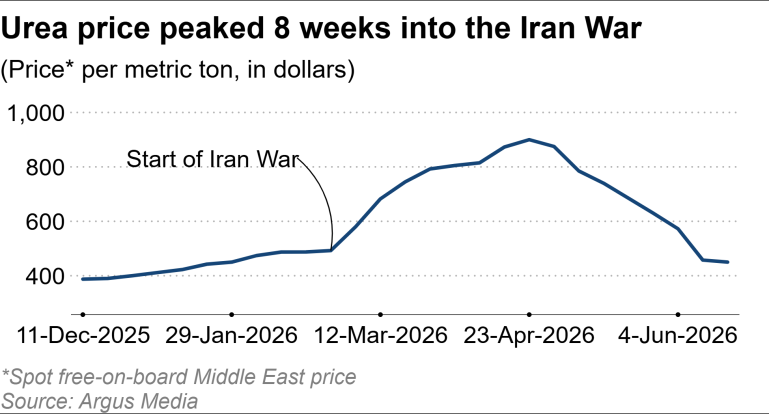
One bit of good news is sadly not as good as it appears. Nikkei reports that fertilizer prices have fallen, which would seem to give farmer more ability to make sufficient purchase to treat their fields. But that decline is in large measure due to demand destruction. For instance, we cited a Washington Post article that did extensive on-the-ground fact-finding in Thailand, where fertilizer use is high due to policy decisions to promote the production of rice strains that need heavy dose. They found most farmers were leaving their fields fallow. A local contact said some were flooding rice fields to farm fish.
Note that a price fall may not result in all that many farmers returning to their old level of production. First, high diesel prices have also made growing crops untenable for many. Second, the coming Super El Nino is likely to require super-normal fertilizer applications to produce normal yields, since both high heat and heavy rains reduce output.
And let us not forget that we are past the spring planting season, so lower harvests are baked in.
From Nikkei in Fertilizer prices fall on slow demand, Chinese exports and Iran:
Fertilizer prices have fallen sharply since the end of April, providing relief for farmers battered by spikes following the outbreak of the Iran War. However, some industry insiders have warned that the market could remain turbulent for months…
Farmers, particularly in many Asian countries, scaled back their use of fertilizer or held off planting out of fear they would only harvest financial losses due to increased prices for fertilizer, fuel and other inputs and warnings about the looming El Nino weather phenomenon.
But prices then started dropping, reaching prewar levels in the first week of June, before the ceasefire was announced.
Several factors are behind the downtrend, with lower demand, the result of the higher prices, and China’s authorization of new exports in late May being the main catalysts, experts told Nikkei Asia….
“The primary driver for the recent ‘free fall’ in the urea prices has been the lack of demand,” said Pranshi Goyal, senior urea analyst at commodity consultancy CRU Group. “May is a seasonally slow month. Moreover, poor affordability has deferred stocking up decisions, and buyers [are sitting still] in the hope that a resolution in the Middle East is reached soon.
“In June, price declines have extended further with the return of China, a key exporter, which had restricted its exports since the beginning of the year.”
The Chinese government has not publicly announced an easing of export curbs. However, Reuters reported in late May that it had issued fresh export quotas.
Analysts said the apparent move was in response to weaker domestic demand….
Analysts are divided on where prices are likely to go next. “The market is now watching how China acts in terms of its return to the export market,” Harry Minihan, head of nitrogen pricing at Argus Media, told Nikkei Asia. “That behavior will be one of the top drivers for price direction in the months ahead….
Other factors are also at play, according to Harri Kiiski, CEO of Brunei Fertilizer Industries. “The European and Australian [planting] seasons are over, in two months [prices] will start increasing again,” he told Nikkei Asia via text, responding to questions before the U.S.-Iran ceasefire was announced. “Demand is also dropping as farmers cannot afford [fertilizer], next step yields drop and crop prices start increasing.”
____
1 Note that on TRT, Trita Parsi seemed almost annoyed at the Iran denials that it had agreed to let the IAEA return to the former regime of extensive inspections, since he argued they would wind up conceding that. But this ignores that Iran is holding the line not just on substance but also process, that it is insisting that issues be settled in the manner stipulated in the MOU and not out of order. Iran is not prepared to entertain nuclear matters until a whole host of preliminaries have been resolved.
A further issue is that what the Pakistani negotiators say cannot be taken at face value. They have now twice, and highly visibly, been caught out over their skis, first in taking up the false Trump claim that the MOU was to be signed in 24 hours, as in on or right before Trump’s birthday. Now see:
Iran directly rejects Pakistan’s claim that Tehran agreed to lower its enriched uranium stockpile.
Source: Fars News / Writer: Samuel pic.twitter.com/xl44b0IFI8
— Dr Tariq Tramboo (@tariqtramboo) June 21, 2026
A single source in Pakistan also provided Larry Johnson with the allegation that Iran sent a note to the US through the intermediaries that it would obtain a nuclear weapon and make a demonstration explosion if the US did not shape up. Experts on that beat who are at least friendly with Larry and some who even call him a friend such as Professor Marandi carefully but also strongly disputed his contention (Marandi at least twice and on the later one I saw, more firmly).
And now we know why we are seeing so many fabrications from top Pakistan officials. Recall that Miller is a former negotiator with Middle East experience:
Refreshing to hear this honesty from the Iranian negotiators.
As I've said before, the Pakistani Zionist junta — which in no way represents the noble people of Pakistan — has nothing to do with these negotiations. Their only contribution has been to lie consistently to all the… https://t.co/dHoGhMaL29
— David Miller (@Tracking_Power) June 23, 2026
I had seen the nuclear weapon story from Pakistan via Johnson as pro-Israel, as meant to substantiate Iran’s bad intent and capabilities. Fortunately it did not wind up being received that way.
3 A detailed and even-handed effort to make sense of competing claims. This is very solid but IMHO does not sufficiently allow for the US having been less truthful through this process (Twitterati even point out they regard Tasnim as more reliable than the US press, which is largely dependent on claims by Trump and his officials):
Iran and the US are both making wildly diverging claims about negotiations and how they are going. It can be very difficult to disentangle but I did my best:
1) Nuclear inspections. US says Iran agreed to invite IAEA inspectors this week. Iran says no such commitment was made.…
— Shaiel Ben-Ephraim (@academic_la) June 23, 2026
4 The big reason for the disparity and resulting uncertainty is the age of the salt caves (they have been in service far longer than intended when created in the early 1980s) plus poor management practices. As we wrote recently in comments:
The U.S. Strategic Petroleum Reserve (SPR) is facing significant challenges related to the storage and availability of its crude oil resources. Approved for construction by the 1975 Energy Policy and Conservation Act (EPCA), the storage sites were envisioned to be needed for 25 years and are subject to an estimated five drawdown cycles (Shages, 2014). In retrospect, the design has not matched actual use, and this has led to degradation of the SPR and impacted its ability to perform its function.
The SPR stores crude oil (either sweet or sour) in 62 underground salt caverns located at four different sites in Texas and Louisiana. The official storage capacity is 727 million barrels, based on sonic measurements. A 2010 study concluded there was a significant mismatch in design and use of the storage caverns. Instead of the initial estimated five large drawdown cycles, a large number of small drawdowns occurred over the previous 20 years. From 1996 through 2014, there were 14 instances of oil removals less than 10 million barrels. These multiple drawdowns have caused cavern deformation, salt falls and other damage to the cavern integrity. In addition, these underground salt caverns are shrinking due to tectonic stresses. The cavern shrinkage (aka closure) is estimated to be approximately two million barrels per year – but may be significantly higher.
Done for today! See you tomorrow!


‘Nevertheless, it not only describes how US diesel inventories are critically low (only 20 days!) but even more worrisome, how AI datacenter demand for diesel for generator backups will wind up taking priority over other uses due to the way datacenter power agreements are constructed.’
Wait a minute, wait a minute. Are they talking about taking diesel out of general supply to keep AI data centers running? And away from more mundane uses such as diesel for trucks to restock supermarkets and diesel for emergency services? If supply gets really, really tight, I can see some of those data center being attacked by some very hangry people.
Thank you for calling that out. Yes, that is correct. Listen to the talk. The data center deals provide for extremely high penalties in the case of outages, as in backup generators out of diesel. So if the data centers are at risk of that, they will outbid all other users to get supplies.
I’m not familiar with all national regulatory requirements, but in the regulatory contexts I’m familiar with (i.e. in the EU) the requirement is that the backup diesel must be pre-purchased and stored on site – usually at least a weeks worth. It is the back up to the primary back up (i.e. diesel as back up to natural gas, which is the peak period back-up to grid supply), so it would take a very unusual set of circumstances for this to be a significant element of diesel demand. In reality there would be a force majeure clause in the event of a crisis.
Incidentally, on the subject of fertilizer demand, the impact on crop outputs tend to be longer term. Depending on multiple variables (primarily soil structure), it is usual that a failure to fertilize will result in around a 20% drop in primary crop output if the farmer has sufficient warning to adjust their crop management, but this will increase over every year of low or non-application if there is a failure to adopt. Farmers opting not to plant is likely to be a much more important reason for rising food prices than an a single years reduction in fertilizer usage.
A supply of back up on site of distillate/diesel is recommended/required by FERC region in Northeast US for use during extended cold snaps where natural gas for electricity is diverted to home and industry heating.
I do not know of other US region regulation.
there will be great variability to higher fertilizer prices and limited avaliablity, corn yields will suffer the most since corn has been bred to be very efficient user of nitrogen. the Green Revolution was driven by plant genetics and more nitrogen. Red Winter Wheat (Russia, US, China) can withstand fertilizer limits since it has nearly a year to compensate and late season applications can be more efficient. Spring wheat (Dakotas,China) needs adequate nitrogen to make protein so bread wheat quality will suffer. White wheat (Europe, PNW, Australia) yields will take a hit but not quality. Soybeans will be interesting to watch since they are a nitrogen fixer. Rice is highly sensitive to nitrogen deficiencies and will be the first casualty.
I’m a real fan of the ‘famboy’. Nitrogen fixing plants will become a greater part of a farmers crop rotation as the fertilizer famine continues.
Here’s a readable discussion on legumes and the complex interaction of nitrogen fixers. The website is for gardeners, but we may all be planting for food soon…
https://www.ruralsprout.com/nitrogen-fixing-plants/
The issue would be a potential problem if a long duration power outage occurred over an area impacting many large data centers. Most data centers only store enough diesel for 1 to 3 days of continuous operation and larger sites are probably limited to the lower end because of the volume of diesel that they would need to store and not be able to consume during testing cycles in a stable fuel period (max 24 months). It’s probably not a diesel demand issue for the typical enterprise data center, but the large AI data centers need to power 100MW or more of electricity. That’s about 7,000 gallons of diesel per hour consumed or 168,000 gallons a day. A large highway tanker truck holds somewhere around 10,000 gallons so that’s 17 trucks a day per large AI data center. The US consumes about 160M gallons of diesel per day. One large AI data center with a power outage would consume about 1/10 of 1%, so if you have an outage regionally large enough you could easily start moving demand by a few percentage points at a time when inventories are very very low.
The talk discussed a >24 hour outage in Loudon County, the biggest AI using county in the US. So I infer the typical generator reserves are for 24 hours. Speakers said this was obviously in tail risk terrain but as with many tail risk, outcomes would be very nasty.
The sneaky problem with datacenter “backup” generators is that, per the permitting process (which quite I’m familiar with), they are for backup use. However the reality is that the diesel “backup” generators are run full time as primary or supplemental power supplies. Often the local power companies are unable to complete the transmission capacity to the datacenter sites before the datacenter enters service (or at all), or lack the generation capacity altogether. Both generation and transmission capacity take a long time to build out, longer than it takes to build a datacenter, so the “backup” generators power the facility until the power infrastructure catches up (if it ever happens).
So yeah, datacenter use of diesel and lubricants is about to screw us over big time.
recently listening to jaw-flapping at a local hardware store about the Saline, MI data center and disappointment of elected officials caving so fast and not putting up any fight….comments made that there were ‘other ways’ to deal with this problem – not just hangry folks RK, but folks pissed about being steamrolled – the truck traffic on US12 is hideous and destroying the road surface – just wait till the water table starts dropping and the noise and lights of the center ruin a quality of life people enjoy being taken from them – it can get ugly –
I hear you JB! But wait, just wait, the utubes ads for the BARN as the fair maiden announcer so cheerily puts it saying they will pay all their energy bills themselves. Of course they will, and we will pay ours, which will be jacked up by their demands. And yes, they say the water will be no problem, ¡no hay problema! donchaknow. I have a bridge…
The township caved because a population of ca 4k could not fight the fat cats in court. It’s the American way. As I was reading Yves’ account I was imagining some of those other solutions. We are in dark times and I’ve been doing a lot of that, untrue to my own mild manners. Not that I could ever follow through, but I could cheer. :-/
ahem…https://en.wikipedia.org/wiki/Caltrop
i quietly introduced things like this to the locals when we were all fighting against a sand plant going in over yonder hill….just in case the court and regulatory fight failed(ended up, the market changed, and they decided that all the sand out there in the permian would do just fine, and they didnt need “Brady Brown”). sand plant would have been akin to a data center, re: noise, water pollution, water draw, but add in silicosis for every living thing within miles and miles.(turns out its sometimes useful to have an actual anarchist as a neighbor.
https://en.wikipedia.org/wiki/Direct_action
I’m still trying to get the resolve to get up on my roof and trim my old tree (nearly as old as yours truly) branches which are up against it and liable to cause more trouble than they already have. We are in a surveillance state which won’t do me any good if I fall off my ladder, and certainly to anyone who attempts something like what you have posited, though they might be effective in a very short run. My musings are much more far fetched and improbable, but colorful in my own mind (am I losing it?). Remember, Texas just convicted and sentenced some to long prison terms for wearing black, or moving zines. :-/
OT, and forgive my presumption, but might I suggest you NOT climb on your roof for tree trimming unless you are well used to this activity? Roofs, ladders, trees, and chainsaws, singly and severally, can be quite hazardous to human health and well-being, as you probably well know. Please stay on the ground, get some young one do the job and keep commenting here.
i was gonna say the same thing, RC,lol.
us ancients dont belong on roofs and ladders and such.
that kinda work is for the younger set, who can jump, etc.
i’ll do a pole saw for that specific kinda thang, if possible…have a lot of that to do around here, this winter.
but i’ve a job inside that involves a ladder and a scaffold that i have been putting off fr 2 years, because i am alone, and how long would it take someone to find me if i fell off?(almost 57, but my skeleton is closer to 90)
and fixing the roof on the old boy’s wing of the house?
lol…first, it must stop raining…so i gotta wait for la nina.
then i gotta have $ for helpers. getting the Big Greenhouse done is much more important, even if i end up dismantling the boys wing.
77 here, my frame is still pretty good (if not my appearance or circumstances). We carry on, or not. Just watching UK net where London has hit 100°F, poor babies.
78 this year and echo the concern of the others – be very careful – in good shape but my mind sometimes believes i’m younger and still able, but the little things get you – eyesight not as good – misjudge distance – do the stupid – getting a buckthorn surgically removed from my left forefinger because i thought why put on a pair of gloves if just going to help once – the stupid was not going to Dr immediately and instead letting it swell till couldn’t make a chord – Dr called me stupid not seeing him immediately – not as strong as younger but still believe you are – and living on my own means sometimes ya have to do it alone – roofs especially, ladders too – as they say, it ain’t the fall that hurts, it’s what stops you – be careful Ax –
Thank you so much! We (mostly) mean to survive (I’m up for that). I’ve just watched a vid on getting on a roof. I can’t afford to have someone do it for me so… The trimming would be simple with a lopper (I have a good one with a force multiplier, which is a must for weakling me) if I could get at it, which I can’t unless I get up there.
As for changing the world, my class are all weaklings unless we unite. ¡Unidad!
If the longer the strait of H is closed the more likely a depression becomes isn’t it in Israel’s best interest to NOT impede the ‘deal’ and hopefully forestall a depression? Otherwise a depression would disable the US’s ability to make armament’s and get them to Israel. Wouldn’t that leave Israel almost completely defenseless.
We know that Iranians are thorough long-range planners and have marshaled their resources so they could confidently attack Israel.
There is the American view of military Keynesianism!
The last “rough time” for MIC was the peace dividend, 1992.
US will build more PAC-3 missiles as jobs program.
Israel has enormous faith that Yahweh will make it right. See various talks by Alistair Crooke about the eschatological nature of the wars and genocides. They also expect US to go hungry if needed to supply food and whatnot to Israel. Given the corruption evident, they may be right on the last point.
More specifically, logic cannot be applied to understand the conflict.
My sense, informed largely by listening to interviews of Alastair Crooke (particularly his distillation of voices in the Hebrew language press), Chas Freeman, Patrick Henningsen, and others linked by Yves, is that Israel is currently in a crisis of denial and grief at the failure of their project. Short term, Netanyahu is struggling with plummeting popularity due to his catastrophically bad decisions, the potential that he will lose the fall elections, and thus have difficulty avoiding prison. Longer term thinkers in the country are grappling with the uncertainty of what path Israel should now take, given its historical record of involvement in wars of aggression and genocide that have not benefited the country as a whole. This militaristic expansion has made it a global pariah, and left it surrounded by enemies against which it cannot defend itself absent huge US support in terms of weapons and cash. But the current population has difficulty imagining itself without US support, and of reconciling the reality that Iran, and not Israel, are the real regional power. And despite much publically showcased spats between Trump and Netanyahu, there has been no reduction in military aid to Israel. Given the recent legislative moves, highlighted on NC, to essentially integrate US and Israeli military structures, the problem will become worse.
Crooke thinks, if I am recalling him correctly, that this uncertainty on Israel’s part of what its new path forward should be will persist for some time. US has the same problem in coming to terms with emergent realities.
Things are changing, obviously, and both countries have yet to develop realistic long term strategies.
I seem to remember an interview with Prof. Marandi stating that one of the goals with starting negotiations was to demonstrate to the rest of the world that Iran is not responsible for the coming crash and depression, that they want to negotiate a peace and re-open the straits. I’ll have to say that when I watch how this is proceeding that as Yves stated it sure does look like Iran and it’s backers are playing chess while America and Isr are playing bingo.
I just don’t see American elites getting serious about this until tank bottom in America has smacked them in the face. The fact that tank bottom can can even happen is just barely starting to get mentioned in the American MSM. And while we all marvel at how on one particular day Trump can drop truth bomb after truth bomb like he reads NC, he quickly starts saying something else when responding to critics so it gets written off as Trump just saying whatever pops into his head on any given day.
Re. the observations by the shot down US airman; I believe that Stephenson in his novel “The Diamond Age” described Mr. Lee’s Greater Hong Kong as utilizing exactly such a “drone swarm” as its primary physical defensive tool. The physical boundaries of the Honk Kong ‘burbclave’ of Mr. Lee’s Greater Hong Kong were described as being patrolled by ever moving and shifting “clouds” of mini drones. A functionality imagined by art is becoming ‘real’ life? A cynic might ask: What came first? The explosion or the hand grenade?
Stay safe. Avoid residing on databases.
Reading the CNN article cited by Parsi, it sounded like some of the “US intelligence officials” mentioned were skeptical about what the pilot saw, or at least were providing excuses for why he might have been mistaken. Perhaps they don’t want to admit that Iran might have such capabilities. Or maybe it really was “real alien sh*t”. After all, such UFO (sorry, “UAP”) phenomena have often been associated with military activity going back to the foo fighters of WWII. Maybe the aliens were worried that things were getting a little out of hand and were checking things out again. Or maybe they just don’t like Trump or Israel.
Are you conflating Diamond Age & Snow Crash?
Mr. Lee’s Greater Hong Kong is indeed from “Snow Crash.” The “defensive” nanobots are from “The Diamond Age.” The franchise of Mr. Lee’s Greater Hong Kong in “Snow Crash” uses semi-autonomous robot guard dogs (“rat things”) for their security. I have conflated the two works. Apologies.
First as art… fireworks in ancient China anyone?
https://youtu.be/9Va8XmyB7jg?si=dHFWuG8empvGOWkB
For some months now Martyanov has been reporting on drone swarming capabilities the Russians have been developing. My impression is that single tier communication within a swarm, with drones informing each other about targets, may already be available. I’ve seen references to hierarchical arrangements, with a main drone somehow acting as a primary coordinator, though it wasn’t clear how far along they are in development. That Iran might have similar capabilities would make sense given the high level of cooperation Iran and Russia have achieved in this area, starting with Shahed.
Some of the modern ‘fireworks’ displays on holidays now are done via swarms of hundreds of drones with various colored lights. So militarizing that capability would seem not to be a big step. Now if one could mount command detonated explosives (aka some version of a claymore full of many hundreds of ball bearings) on each drone and trigger them simultaneously it would create a pretty dangerous situation for a fighter jet moving at 4-5 hundred miles an hour. It would be like a modern version of the bomber runs into Germany during WWII.
Done for today! Please refresh this page and re-skim if you were an early arrival. We have important last-minute additions, an interview with John Dizard and updates from Lebanon.
Howdy. Looks like the Dropsite “More than 11,000 homes…” twit is duplicated. (Following “And Israel doubles down on its fabrications:” appears to be the duplicate.) Just a heads up and thanks for the awesome links and news as always.
Thanks but , a later Dropsite with different text links to an earlier one, so that duplication is in a single tweet.
The Trump regime keeps on making up all these bs stories about what the Iranians agreed upon, aided and abetted by the Pakistani regime. One of note that came out of the blue was about the Iranian ballistic missile program. That was never talked about and is not even in the MoU. This is an Israeli demand this that they got the US to slip in. I think that it was Pezeshkian that pointed out that without their ballistic missiles, that the US and Israel would have turned the whole of Iran into a new Gaza and I think that he is right. Having to fight a country with the ability to shoot back is real off-putting it seems.
Trump (USA) is seeking an accommodation with Iran…
It will result in a new area-wide security arrangement (excluding USA)…
Result: USA proxy Israel will have to give up its Grater Israel ambitions,
will be corralled within its own borders (Maybe even the UN’s 1967 border,
and, ‘The Right of Return’ Israel will have to resolve)…
…….
Making out that Iran’s the one being an arsehole is Trump/Vance playing
to the US electorate… It implicitly makes the MoU “A Great Decision” by
Trump… So, when the energy shortages hit it will be easy for the electorate
to believe Iran’s ‘intransigence’ is to blame…
Trump can try that but the US public knows the war was Trump’s doing so he is responsible for this mess. And the press is no longer falling in much with him either. We pointed to the War Powers resolution. The fact that even the Israel Lobby captured Congress has gotten out of bed to administer this wet-noodle lashing says they can see the unhappiness in the body politic. And after Trump has been saying oil is now gushing through the Strait of Hormuz, pray tell how can he scapegoat Iran about the energy cliff? The media will play his recent claims about higher than evah oil transits.
I watched “The Five” on FoxNews yesterday and even those weirdos were trying to work through the up and downsides of possible agreement or back to conflict scenarios in their inimitable FoxNews way. I didn’t watch Newsmax to go full MAGA, but the temperature has shifted across even the solid nationalist USA right wing. Of course the Hezbollah blaming nonsense was on full display. They’ll abandon Israel like Charlton Heston his rifle.
I was at a gas pump recently and someone had put a sticker below the price display with a picture of Trump pointing up and a caption saying I did this. Coming to many places soon, one could imagine. Priceless!
‘The US public knows…….” What ?
“Most people cant remember what made the news a few minutes after it was screened, yet networks are dishing out more and more” – the sub-heading of an article about studies carried out San Francisco etc, published in ‘The Bulletin’ 6 July 1993 **…
That “news” is wall-to-wall coverage in 2026, compared to 1993, really makes little difference – when you considerer most have / take only a superficial interest in Politics (and Wars)… The media knows this, and thus ‘News” of any event is made up of 30-60 second ‘soundbites’…
The corporate propaganda media (msm) creates impressions, shapes perception…
During the 60 day Pause, the media, the uncritical media, will assist Trump with whatever re-framing of events they intend. At the moment my feeling is They’ll reframe the MoU as The Right Decision (pivot to deal with the looming energy crisis on the home front), and will portray Iran as spoiler, will deflect anger onto Iran because as it is being portrayed as not helping Trump ‘solve’ the problem…
The masses may know USrael started the war, but they are always pressed to focus on the problems of their everyday lives… Who to blame ? or How to deflect the blame ? is Trump’s
pressing problem…
……. My gripe with economic articles is that the authors always assume every reader has studied Economics…
** No longer published Australian weekly magazine…
I would like them to return to the 1947 borders and conditions where they had legal title to 8% of the land. Everything else since then has been stolen, it should be returned to the rightful owners.
More realistically, Israel would be far safer and more useful in the American Southwest. Say, take parts of Utah, Nevada and Arizona. Naturally, Las Vegas would be the capitol of the new State. Following tradition, Mz Addleson would be the first State Governor.
nah. too close to Texas.
would need to impose strict Amish Style tech prohibitions.
and prolly a triple tall fence system with landmines, etc.
better to let them have South Georgia Island and burn the ships.
South Georgia Island? That’s right next to Neuschwabenland. Don’t even think of the Old Reich with their Glockes and Alien Tech linking up with the New Reich with their Depraved Human Tech.
You do have a point though. I hadn’t considered that this New State would be right next to a major oil and gas producing region. History would repeat itself and the New State would soon be sponsoring “filibusters” against the Republic of Texas, the Republic of California and the Republic of New Acadia.
I was just musing that the Southwest State would be perfect for the reunion of the original Tribes of Israel: the Tribes of present day Israel, the tribes of the Latter Day Saints, and the true “Lost Tribe,” the Sasquatch. It feels almost preordained.
Get ready. Hard Times ahead.
I seem to recall that there was a (pre-ww2 ?) offer to the European Jews to a large area of the north-west of Australia (in Western Australia)… Had they taken up the offer, undoubtedly they’d be conducting Wars of Expansion against all states of Australia, if they hadnt already
subordinated the Federal Government…
I’d say that everything they have is stolen, full stop. The 1947 partition plan gave official sanction to the establishment of a state in a certain territory against the wishes of the majority of the population of that territory. I don’t see this as a legitimate thing to do for anyone, including the UN. I can see backing the two-state solution as an attempt at a realistic compromise (except that it is, unfortunately, no longer realistic due to Israel’s having done everything to make it impossible), but not as an expression of consistent justice.
UN General Assembly Resolution 181, November 1947 was a proposition (I’ve read it, egregious as it was, it was a colonialist dominated assembly after all). It bore only a resemblance and a touchstone for what actually happened in 1948 (the Nakba). It was not taken up by the Security Council and thus was not binding, presumably and correctly that there was no authority under the charter to give away someone else’s land. Instead what occurred was the Zionist Plan Dalet, which intended to entirely ethnically cleanse the land of the Palestinians. The Zionist lacked the capacity to complete it in 1948 but have working to do so every since.
Israel should not have been admitted to the U.N., but as has been noted, history is just one damn thing after another.
Agreed. These facts, too, favour the position that everything they have is stolen.
I stand to be corrected, but Israel was the last colonization project to be admitted to said world body. Maybe the first and last.
The energy cliff is still invisible in the main stream media – spouse and self very occasionally see a bit of the network news – streaming services, not the broadcast/cable channels, which we dropped. I am reminded of the parable of the wise and foolish virgins waiting with their lamps for the groom’s late arrival – the latter ran out of oil, and when they went to get more missed their chance to enter the party (Matthew 25 i-xiii). Meanwhile the gasoline price per gallon is going down.
‘Drop Site
@DropSiteNews
⭕️ Drop Site’s Jeremy Scahill:
“Trump is in catastrophically bad narrative trouble because the Iranians won’t throw him a single bone. They will not go along with any of his lies, and it’s causing panic on Trump’s part…’
I think that for the Iranians, that it is vital that they establish the fact that they won this war with most Americans. If they let Trump get away with the narrative that it was in fact the US that won this war, then it could easily happen that in a year or two’s time that Trump & Israel will have another run at Iran. And as that happens, Trump will tell people that Iran admitted that the US won the 2026 war so this time it will be a matter of “finishing the job”. So much harder to sell a new war when you lost the previous one.
I don’t think that’s necessarily true: losing a war can lead to calls for revenge, for example. While it’s hard to tell because US never “officially” lost any war, losing a war merely on “points” seems unlike to bring “finality.” See the last Versailles, for example.
Not in this case. The US was so unambiguously responsible for starting the war that there can be no desire for “revenge” here. Were it not for the fact that we have unavoidable crushing losses ahead, I would add that unlike the parties at the first Versailles we have suffered few painful losses. But still, it was our fault.
In the USA, 9/11 for example, the USA promoted the Afghan war as partly as revenge for the deaths of those in the twin towers.
In this war, the USA deaths have been few, mainly Iran has destroyed US military hardware.
The USA and Israel have killed far more Iranians.
Here is a web summary “In the US-Iran conflict, the U.S. military has confirmed 16 combat and non-combat deaths and 543 military personnel wounded. By comparison, Iranian health authorities report over 3,460 people killed and more than 26,500 injured”
I don’t know if the public will support a war to revenge the higher fuel prices brought on by evil Iran.
It might be very difficult for Trump to promote an Operation Iran Liberation (OIL) war.
But the acronym works for me.
Stephen Semler has compiled statistics indicating that US citizens regard Trump’s war of choice as the most unpopular war ever, worse than Vietnam, Iraq, Afghanistan. Trump can apply as much lipstick to this pig as he wants — the American public will put him on the hook for the resulting inflation and skyrocketing CoL. He must at some level realize what a catastrophe this has been (for which he will blame others), and it’s difficult for me to see how (or why) Trump, even given his addled emotional state and cabinet of sycophants, would risk re-entry.
It’s misleading to say the US lost the war. The US was not invaded, no US city was bombed, and there will not be a US surrender under Iranian terms.
What the Iranians accomplished was defeating US hegemony by redefining the nature of warfare and making it nearly impossible for the US to project its power. Suddenly, US overseas basis seem useless against waves of drones and missiles which are precision guided and affordable to manufacture.
US aircraft carriers, for example, did not get within 500 miles of Iran. Thus, how can they defend Taiwan or US bases in Japan and South Korea against China which is orders of magnitude more powerful than Iran.
This is a turning point. Iran might very well have ended the nature of US global power.
HUH? The US lost the war in Vietnam FFS. This is a more catastrophic defeat.
A bloody nose and broken jaw usually mean you lost the fight . . . even if you’re still breathing and the other guy didn’t burn your house down.
American colonel, Harry G. Summers Jr., said: “You know you never defeated us on the battlefield.” His North Vietnamese counterpart, Colonel Tu, paused a moment, then replied: “That may be so, but it is also irrelevant.”
OUP
The troops left and then the corporations eventually arrived.
This has been the first war in my lifetime that Americans did not support, it has been amazing watching it. It does give me a little spark of hope that maybe the tide is starting to turn. 7rump (lol) has managed to break Amnerika’s War Fever?
Latest regarding nuclear inspections (from Al Jazeera):
= =
Essentially: NO INSPECTIONS if a final agreement is not reached. And, as Yves pointed out, it was always clear that the nuclear issue would not be considered at this time.
The forced purchases of US farm goods, ostensibly to prevent $ going to “terrorist proxies”, is also nonsensical. Removing sanctions means that Iran can make plenty of money available to do with as they wish.
So what is Trump up to?
My guess is all such “frictions” are related to the effort to allow Israel to remain in Lebanon.
Rafael Grossi has not so much been requesting but demanding that Iran give the IAEA total and full access to all of Iran’s nuclear sites. If I were the Iranians, I would say hell no but maybe they would allow a delegation from the Russian Federation or from China in when all negotiations have concluded successfully. But of course that is a long time from now, if ever. In the meantime, they should ignore Rafael Grossi. The guy is ‘damaged goods.’
Iran can be “diplomatic” and make it conditional on Israel denuclearization and submitting itself to Iranian (not IAEA) inspections.
Iran could ask Grossi to provide a list of Israeli nuclear physicist and the exact coordinates of the Israeli nuclear sites upon entering Iran. Isn’t that IAEA’s modus operandi?
My guess is all such actions are to keep control of, at least, the senate in the midterms.
“solely be examined and resolved within the framework of a final agreement”
I would note that the lawyers in my family would point out that the title of the link is making an assumption which is not backed up by the text in quotes. Saying that the issue will be ‘examined’ in no way means that they have agreed to inspections. Just that the nuclear issues will be negotiated and ‘resolved’. What the final negotiated terms will be is undefined and completely up in the air.
With apologies to Marty Robbins and the town of El Paso
Out in the West Asia strait known as Hormuz
Trump wanted his limitless power to unfurl.
Nighttime would find him on right-wing media
Talking such shit it made all our toes curl.
Blacker than night was the heart of the Trumpster
And also he had a quite terrible smell
He was in love with his omnipotence generally
Where he would take us, nobody could tell.
He challenged the wrong folks to show off his power
The missiles they aimed found all their marks with ease
His challenge was answered by a disciplined enemy
Whose determination overpowered his sleaze.
Shocked by the defeat that Iran had handed him
He babbled and ranted and ran off at the mouth
He had but one chance and that was to capitulate
Because his war plans had gone seriously south.
Everything’s gone in life, Trump is in shambles
For the addled bully, nothing is left
But his love of power grows ever stronger
His love is greater than his fear of your death
Off to his right he sees MAGA with knives out
Off to his left he sees Democrats sneer
Though he is trying to stay in the saddle
He can’t seem to cause Bibi to disappear.
From out of nowhere, come mid-term elections
Voters take power, make him eat every lie
Crushed by a Congress that loathes and despises him
One little vote, and it’s Donald goodbye.
This is really good, thanks Doglady.
Israel’s defence minister says military will not withdraw from Lebanon, even if US demands it
= =
LOL Trump never demands anything of Israel . . . he works with Israeli leaders to allow them to continue the greater Israel project. The latest example is the furthering the pretense that US-Israel-Lebanon are working hard (so hard!) on withdrawal mechanism (LMFAO):
US proposes pilot programme for Israel’s withdrawal from parts of Lebanon
Yep. MoU is D.O.A.
But the Iranians can string things out. Time is on their side. The terms only get better as the energy cliff approaches, and will be really good after it hits. Lol
It makes sense for them to keep playing along, even as they have to deal with the lying sacks of sh*t USians.
Katz says the quiet part out loud: No USA demand to withdraw is a “diplomatic achievement”.
From Al Jazeera”:
= =
“No demand” was made possible by Qatari mediation whereby USA’s clear obligation to demand an Israeli withdrawal was shifted to an ineffective committee.
Keep your friends close, and your enemies … mediated. LOL.
Katz is right on that point, a verbal or written US ‘demand’ will not alter the Lebanon situation and undoubtedly will not be forthcoming. However, cessation of logistical, intelligence, monetary and weapons support will force izzys to run back with their serpent tails between their digitigrade legs.
This will not happen either though.
“The Hormuz crisis isn’t over because ships are moving again.”
This is almost and understatement, but with inventories of all sorts of materials now critically low this is going to be an ongoing issue. I’m not sure how much depth people have talk about this, but given the time of year we’re in, every tropical storm is going to be a potential problem. Delays of any kind, such as ships rerouting or being prevent from porting by these storms have the potential to create recurring temporary shortages and inventories wont recover for quite some time because everyone has to rebuild them and not just a handful of companies.
and with a super el nino (with the Gulf at record temperatures), this likelihood is much greater (also offshore SE Asian oil production).
important point: Super El Nino’s actually suppress hurricane formation despite record sea surface temperatures. The shift in the upper atmospheric wind regime knocks the tops off storms preventing hurricanes from fully forming. At least that’s the historical record. That said, we’ve seen many storms go from Cat 1 to Cat 5 in 24 hours, so we have to wonder what might happen to storms forming in the Gulf of Mexico.
https://www.theinvadingsea.com/2026/05/19/climate-change-gulf-of-mexico-sea-surface-temperatures-hurricanes-loop-current-amoc-el-nino/
True, but it enhanced hurricanes in SE Asia (typhoons), and the problem is a global petroleum shortage. In any case, I have trouble believing that record temperatures in the Gulf will not cause storm problems.
yeah, for the atlantic basin, and especially the gulf of cuba.
NWS page for my county has a banner up top saying the NHC expects a quiet hurricane season for us.
that said, the gulf is really warm, right now…so like the thing last week, any minor disturbance has plenty of moisture and heat energy available. cousin in houston/port aransas reports much more rain than is normal….but not ig storms.
here, 350 miles inland in the NW texas hill country, it feels like Cameron, Louisiana, right at this moment.
should be hot and dry…as in 12% humidity and 105+…which i prefer,lol.(big lizard on a rock, here)…instead, its 95 degrees and closer to 60-70% Humidity.
It’s my understanding that eastern Pacific tropical storms happen more frequently during El Niños. It’s only Atlantic hurricanes that are suppressed.
USA and Israel divorce? Who gets the Kurds?
Touché!
I wonder if the reason we haven’t seen that “Rescued American Pilot” is that she’s a Black Woman?
It wouldn’t surprise me, the Trump Administration is the most overtly racist regime of my lifetime.
Or a black man or a white woman
He was briefly IDed when first helicoptered out: a lieutenant colonel instead of the usual back-seater in a fighter. Which suggested he might have been the incident commander of the never acknowledged mission to grab the ‘nuclear dust’ that so quickly went fiasco, so we pretended we lost all those aircraft just looking for said colonel, who just happened to be puttering around overhead.
Further, Trump had just fired another dozen generals and an admiral or two–were they unwilling to command said fiasco? Which was as dumb as the bigger one? Inquiring reporters don’t want to know.
A black man or woman or a white woman or worse a black woman who lost a limb in the action!
Closer to home, NYC Democratic primary results, where Big Z-endorsed candidates swept the vote, have got to be causing some nasty panic sweats in Zio-ville and the DNCC.
Goldman lost by 30 points. LOL.
How could be be so loathsome to one of the richest districts in the country? I’d have thought he fit right in.
Erie County also had upsets. The county Dem chairman Jeremy Zellner, who benefited by Hochul’s hurry up election to NYS Senate in February was defeated and the darling Hoak endorsed by local party and Hochul was defeated by Adam Bojak aDemocratic Socialist and housing attorney. Article at Investigative Post.
A local artist using wheat paste put “Zell No” on sidewalks has been arrested.
It’s going to be “Everything is FINE, it’s going according to plan, EVERYTHING IS FINE!,
AIEEEEE, we’re all gonna die!
The White House staff is doing everything they can to “Manage” Trump as he visibly and audibly declines, so what happens when we hit the oil cliff?
My guess is that Trump and the gang crack down hard at home, perhaps blaming ANTIFA!!! for stabbing America in the back.
Someone needs to be blamed and punished and since Trump is a stable Genius any failure must be due to sabotage.
ANTIFA doesn’t exist, which has serious benefits…any story you make up will do for the faithful.
Re We now have a third example of senior officials in Pakistan Making Shit Up to support Trump claims.2 So anything coming from Pakistan has to be taken with a fistful of salt
The previous PM of Pakistan, Imran Khan, tried to steer a neutral course between Russia and the US. He was overthrown on what looked suspiciously like trumped up charges of corruption and continues to languish in solitary confinement. Just what the US doctors ordered in other words. No wonder the current Pakistan regime will do what it can to stay on the good side of Trump.
Thank you for reminding me. I had managed not to consider that.
Yves wrote:
I read about the senate vote in the legacy news this morning. When I found out that the vote was only symbolic I thought, “I am sick and tired of theater. They have the power to fix this mess and they just engage in theater.”
Of course, I am just restating the problem. Mis-governance continues, looting continues and the best that “democracy” can provide is theater.
But even in a theatrical performance, Fetterman refuses to dress the part.
0710 PDT
Italy rebukes NATO’s Rutte over remarks on US use of bases in Iran war
https://www.reuters.com/business/aerospace-defense/italy-rebukes-natos-rutte-over-remarks-us-use-bases-iran-war-2026-06-24/
Iranian agents lived in Australia before directing attacks on Sydney and Melbourne, spy chief says
https://apnews.com/article/australia-iran-attacks-sydney-melbourne-d757a2bc2aa540ddff9f6164343e7705
UN nuclear boss says inspectors will visit Iran sites. Tehran says only after a final deal
https://apnews.com/article/iran-us-israel-lebanon-june-24-2026-nuclear-grossi-ceasefire-875ee115cacd1f5923052b70f2be4124
Iran pledges continued support for Hamas, raises Gaza in US talks
https://www.jpost.com/middle-east/iran-news/article-900362
Trump’s Gaza Board of Peace will hit the reset button in Cyprus on June 30
https://www.politico.eu/article/donald-trump-board-peace-seeks-reset-cyprus/
China says it has a right to target people overseas with new ethnic unity law, Reuters reports
https://www.yahoo.com/news/articles/china-says-target-people-overseas-062038094.html
France reports first Ebola case after doctor returning from DR Congo tests positive [Israel also has one case]
https://news.sky.com/story/france-reports-first-ebola-case-after-doctor-returning-from-dr-congo-tests-positive-13556940
Japanese company workers detained in China, possibly over rare earths
https://english.kyodonews.net/articles/-/78504
China Now Leads World Submarine Construction
https://www.navalnews.com/naval-news/2026/06/china-now-leads-world-submarine-construction/
Rubio: Iran will not be allowed to charge tolls in Strait of Hormuz under any final deal
https://www.timesofisrael.com/rubio-iran-will-not-be-allowed-to-charge-tolls-in-strait-of-hormuz-under-any-final-deal/
UN starts evacuating 11,000 stranded sailors from Strait of Hormuz
https://www.aljazeera.com/news/2026/6/23/un-starts-evacuating-11000-stranded-sailors-from-strait-of-hormuz
https://www.bbc.com/news/articles/cj9gzr9rdjlo
‘Iranian agents lived in Australia before directing attacks on Sydney and Melbourne, spy chief says’
Spy chief talk with forked tongue.
I’m disappointed in Trita Parsi playing into the US phony story about the drone swarm. This is so obviously a manipulation of the news narrative. The US is throwing stories at the wall to distract from defeat at the hands of a power they consider beneath contempt. Why this story now? Why so far-fetched? I think this pilot may not even exist. The whole story smells of cover for a failed attempt at HEU recovery.
The fact that the “invincible” US military has not tried to seize any Iranian assets like Kharg Island shows some modesty of ambition that could only have come from an Iran inflicted bloody nose.
Andrei Mantyanov for YEARS has been talking about how Russia has been implementing net-centric warfare, as in all the drone and tanks and vehicles and whatnot on the front send info to each other. This sounds like an implementation.
In addition, that US story is credible by virtue of the mere fact of it being an admission of interest, that Iran (either directly or through Russia or China) has more advanced tech than we do.
If China can do this for New Years…?
New Year Drone Show in China
Has anyone mentioned this yet?
https://www.lemaroc360.com/article/eastern-iran-faces-agricultural-crisis-due-to-moroccan-locust-infestation
Did the pilot actually see a swarm that can be easily explained and has happened for thousands of years?
Or did he see a flock of these?
https://interestingengineering.com/ai-robotics/china-autonomous-drone-swarm-system
Larry Johnson said that the jellyfish story is true.
‘The U. S. has become highly dependent on imported lubricants.’
You have to wonder which shortage will be more acute. That for lubricants or that for diesel. Both are critical and a modern industrial society cannot do without either. it would be cursed luck if both were running out at the same time.
The US is an industrial society without its own industry to a large extent. Dependent across many sectors on imports. All of those imported goods are reliant on energy and lubricants in the factories of thier home countries. So if the US bids up prices on energy and lubricants because they’re so rich, they may find that their imported goods are unavailable or much more expensive as a consequence. All so that they that they can keep driving oversized vehicles.
I’m waiting for the factories of the world (or the countries that supply the needed inputs) to play hardball and decide to prioritize customers other countries. For example an oil producing country stipulates in their trade agreements that they get priority for manufactured output). Let there be a future where the US will be “ghost-sanctioned” by the importers on which it depends. Since the US has already destroyed all of its US Aid programs, there’s no countervailing narrative.
But I also fear for South America, when the bully retreats to easier targets.
There’s a pretty good example of the usefulness of cheap missiles and drones being able to stop gunboat diplomacy. maybe too late for Cuba, otoh there’s a history of fighters resisting from the hills. I still have hope for Venezuela. Maybe a big us defeat will encourage resistance.
Or both. I’m glad we have been warned. Like some others commenters I stocked up on 0-20 synthetic when it was on sale.
As far as diesel shortages, not much we can do
Interestingly, I think we’ll all just get the shaft on this. They already approved E85 which is bad for engines. Why wouldn’t we have people using lubricants that are bad for their equipment, because whatever it’ll work okay for a while? The US is all about kicking that can down the road. Why not here? This is the Cash for Clunkers country where we destroyed scores of working, usable automobiles, because markets.
Is a world without lube even worth living in?
From John Dizard: Energy Shortages Loom Despite Peace Deal
I’m curious if we’ll start to see this in the 10Qs from US auto manufacturers for Q2 as a material risk. Maybe when that kind of thing starts to happen, Wall Street will wake up.
For example, we have this for GM; But Dizard said GM is the least attuned to this realty. This is their 10Q filed on Mar 31, 2026.
Nothing about lubricants yet, but this is a quarter too early.
0825 PDT
U.S. forces killed ISIS leader in Syria airstrike, Central Command says
The Islamic State militant group has declared a new phase of operations in Syria against the government of President Ahmed al-Sharaa, carrying out a spate of attacks since February.
https://www.nbcnews.com/world/syria/us-forces-killed-islamic-state-leader-syria-airstrike-central-command-rcna351559
Federal firefighters will be encouraged to wear N95 respirators in major policy reversal
Although wildland firefighters are at high risk for smoke-related health issues, the U.S. Forest Service has been slow to offer protection. For decades, respirators were not allowed.
https://www.nbcnews.com/news/us-news/firefighters-wear-n95-respirators-policy-change-rcna351438
That’s because many of them were/are indentured servitude prisoners forced to battle the blazes.
Fire Escape is a new 6-part series from Wondery and KQED’s Snap Studios.
No respect earned, none given. Needs a brain check, and needs to be put in a Strait Jacket and hauled off to a padded room. Seriously, I don’t think it has sunk in how the emperor has really lost the plot. But he does have rare moments of “clarity” amid the confabulations, willful lies, child-like tantrums, BS and irrational nonsense.
Meanwhile, WTI dipped under 70/bbl. and Mr. Market is still near record territory. Cliff? What https://www.youtube.com/watch?v=esR_uxKC27
I am not disagreeing but I have been reading for WEEKS that the cliff is 2 weeks ahead. Price of a barrel of oil will be above $100 and more. All of this seems to be a classic crying wolf.
Yeah, sure, you betcha, like in 2007/8. “Why did no one see this coming”
Did you read the info above? Can you dispute specific facts raised by John Dizard and others?
That is a straw man, which is a violation of site Policies. NO ONE (save Exxon and Chevon execs) has said two-three weeks, and that was about ten days ago.
The calls have been for somewhere in July or early August.
The fact that Trump panicked after a meeting with oil execs and then capitulated on pretty much everything Iran wanted in the MOU AND attributed that to global depression risk manifesting in four weeks should be more than enough proof that the energy cliff is imminent if oil deliveries out of the Gulf do not pick up, pronto.
Better trolls, please.
The Weekly EIA petroleum report is out, and it’s no bueno:
https://www.eia.gov/petroleum/supply/weekly/
Another big drawdown:
Taco can keep whistling past that graveyard.
Me gusta mucho los tacos, al pastor, carnitas…pero no me gusta el TACO, no sabroso, no beuno
(sorry link didn’t work above)
Oil cliff? I don’t see no cliff!
https://www.youtube.com/watch?v=esR_uxKC27o
Tank Bottom
Sung to the song of, “Rock Bottom” by KISS
I can’t wait a day
I don’t care ’bout the EIA
Oh yeah, you’ve got to pay
Cause you’ve hit tank bottom and you’re there to stay
Sometimes, late at night
I watch our oily plight
Oh no, you’ve got to pay
Cause you hit tank bottom and you’re there to stay
Chorus:
Tank bottom, oh, you know you’re in that neighborhood
Tank bottom, you had to kick that can real good – hey!
(Guitar, Repeat Chorus)
Hard times got me down
Good times ain’t around
Now I got the mind to say
Don, you’ve hit tank bottom and you’re there to stay
Rock bottom
Oh, you know he’s just misunderstood
Rock bottom
His ratings sink with each falsehood
Tank Bottom – yeah, you know Don’s brains have turned to glue!
Tank Bottom – the polls never treat him like they shoulda do!
Tank bottom
Tank bottom
https://www.youtube.com/watch?v=vRYr5bG9TEY&list=RDvRYr5bG9TEY&index=1
(I always loved that acoustic guitar intro. RIP Ace.)
Perfect, thanks for that Chris! Had a good chuckle as well
Larry Johnson claimed that Robert Barnes, President Trump’s former lawyer and political analyst, heard the same thing, with Barnes seemingly confirming it. Here’s Barnes saying that on Mario Nawfal’s show:
Neither Johnson nor Barnes framed the story at all as pro-Israel but rather framed it as one that would humiliate President Trump. Johnson pointed repeatedly to how Trump’s demeanor had changed following the time the White House allegedly heard the news.
None of that is to give credence to the underlying claim that Iran communicated to the White House through intermediaries that it would obtain a nuclear weapon for demonstration purposes. Johnson and Barnes could have been played by the same Pakistani source. It’s just to say that Larry Johnson, along with his colleague, Pepe Escobar, was not alone in making the claim, although Johnson might have been the most vocal about it. (I think he was enjoying his “scoop.”)
No, you are misreading this. Barnes was confirming that the White House had heard the Johnson/Escobar rumor (and by implication was concerned). It was all over Judge Napolitano, which is Fox adjacent since Judge Nap is ex Fox and know Trump personally, so it got out fast and hard in the right wing-o-sphere. This was not an independent sighting.
Oh, I see what you’re saying: Barnes didn’t get anything from an independent source—he was just confirming that the White House heard it. Yes, I did misread it. Thanks.
0945 PDT
Trump’s Gulf allies fear his Iran agreement is a ‘disastrous turning point’
https://edition.cnn.com/2026/06/24/middleeast/trumps-gulf-allies-iran-agreement-disastrous-intl
Venezuela to reveal $240 billion debt burden ahead of restructuring
https://www.fidelity.com/news/article/default/202606240105RTRSNEWSCOMBINED_L6N42W093_1
1010 PDT
Postmaster general says USPS won’t deliver mail ballots if states don’t give Trump admin voter rolls
https://www.democracydocket.com/news-alerts/postmaster-general-steiner-postal-service-will-not-deliver-mail-ballots-state-voter-rolls/
As long as their isn’t a shortage of KY Jelly the US can muddle through…
And credit where credit is due, Donald Trump has decisively defeated Iran MORE THAN 40 TIMES in less than six Months.
This is unprecedented and I hope each one of these victories is inscribed on Donald’s Triumphant Arch.
We are blessed with a leader who is leading the GREATEST NATION IN HISTORY to a new golden age.
Oh, wait.
1235 PDT
Stephen Miller Has Fox News Meltdown After Democratic Socialists Prevail In Primaries
https://www.huffpost.com/entry/stephen-miller-fox-news-meltdown-primary-elections_n_6a3b6dfbe4b0810d44234272?origin=home-latest-news-unit
A Trump-linked firm is lobbying for pardons. Its first client already paid $500,000.
https://www.cbsnews.com/news/trump-linked-firm-pardon-lobbying/
Are ships only leaving the Strait right now under the UN evacuations? I don’t see anything entering, and war risk, tanker, and other insurance prices are still through the roof
I found that report vague, too. “Evacuation” certainly sounds like the crews leave but the ships stay.
I hope the crews can get a break, because obviously Israel doesn’t give a toss if they rot on those stranded ships.
I feel like I am living in an insane asylum! Why aren’t there more people freaking out about this oil cliff?!?
“Marandi pointed out, as did others on Twitter and YouTube, that Iran intelligence assessed the massive LNG explosion in Qatar (which Qatar depicted as an accident) as the work of Israel to punish Qatar. That would account for particular Iran concern about not putting Qatar in the position of pissing off important parties any more than necessary.”
Indeed.
And it’s a weird form of punishment for a US/Israel entity that is supposed to be concerned about energy flows in the region reaching destinations all over the world.
Diesel situation could get much worse:
Russia is considering a complete ban, thanks to the US-supported attacks on Russian refineries. Way to go, Trump, for a losing end goal!
https://oilprice.com/Latest-Energy-News/World-News/Novak-Russia-Considers-Complete-Ban-on-Diesel-Exports.html
Russia punishing US for its actions via Ukraine, as Iran is doing for US actions via Israel. Good.
Does anyone have any idea what’s going on with lubricants within Europe? I ask because it is near impossible to find current information on the lubricant shortage outside the US.
Yves has rightly called out the Pakistanis but the Qataris also seem to be questionable mediators, though they haven’t made obvious missteps like the Pakistanis. (Geopolitical analysts have acknowledged that Qatar was responsible for mediating related to Lebanon and monetary issues.)
Qatar’s mediation resulted in relegating US obligation to force Israel to leave Lebanon to a committee (a tried-and-true means of shirking responsibility). And subsequently we’ve seen a series of statements from US, Lebanon, and Israel that further distances US from that MOU-obligation (to wit: as a sovereign state, Lebanon is responsible for what happens in Lebanon).
Was this a coordinated effort? I dunno, but there is some evidence of possible artificial ‘trust-building’ designed to draw Iran closer to Qatar:
Yves notes that:
We might well wonder:
The only evidence I’ve found for the explosion is images of a fireball at night. I’ve found no pictures of damage or interviews with affected people. And official Qatar statements essentially say that there are no consequences from the explosion – none whatsoever. Plus, does it make any sense that there is a restart at night? Unless the real goal is dramatic pictures of a fireball from a distance. (an industrial zone is usually deserted at 10:30pm – no witnesses and no real casualties!).
If staged, then it was likely US and Qatar that was behind it and the intent was not to punish Qatar but to pretend that Qatar was being punished.
Furthermore, over the last day or two, we’ve seen some interesting Qatari-related developments:
The day after Rubio visited Qatar and ‘reaffirms’ security commitment with UAE president, Oman’s Sultan Haitham meets Qatar’s PM and we learn that Oman is working with UN’s IMO Ships have crossed Hormuz under IMO-backed scheme. This seems contrary to Iranian interests. Qatar as mediator wrt the Straits might mean that they navigate Iran to a different outcome.
= =
It appears to me, that with a little help from their friends, US and Israel are doing their level-best to finesse the MOU and fashion a peace that is more to their liking – just as one might expect they would!!
PS if anyone can find evidence that the explosion was genuine, please share!
Are you kidding me? 13 people DIED:
https://www.wsj.com/business/energy-oil/explosion-at-qatar-gas-plant-leaves-dozens-injured-18-missing-8ae33c9b
The reason is it will not affect exports is the facility served the domestic market.
A reason the work was done at night it that it is EXCEEDINGLY hot during the day at this time of year on the south side of the Gulf, and on top af that, as we have shown in Links, the Middle East is suffering a monster heat wave. Some of this work likely involved being outside. It would be impossible for any workers to perform tasks outdoors for more than very short periods of time during the day.
Your comment is pure CT. One more like this and you will be blacklisted.
Could it be possible that the Qataris are talking their book a bit on the gas exports not being affected? Even if that facility was meant for export, some gas earmarked for export may need to be redirected to meet domestic needs. I am way out of my depth here, but vaguely recall that commodities are fungible and that gas from the plant was used to power a desalination facility, which doesn’t sound optional in the desert.
Follow-up:
1) I did more searching for visual evidence of the blast / rescue and/or interviews with survivors or families. As I did so, I found that Qatar news sources seem to be very light on such things in general. So maybe its cultural or the government doesn’t approve of releasing images of their energy facilities.
As a westerner, its remarkable to me that three is so little info available when this was the worst accident in Qatar energy in two decades.
I also looked at some reporting about it in India (12 of the 13 dead were Indian). I just found repeats of info released by Qatar.
The only evidence I found relating to the dead and injured is that a Qatari official met with the Indian ambassador to express condolences.
PS That is not to say that I did an exhaustive search. I simply don’t have time for that. That’s why I made the appeal for info from others.
=
2) Iran warns ships away from an ‘unapproved’ Hormuz route (Al Jazeera)
I wrote that the Oman-IMO channel “seems contrary to Iranian interests” and the Iranians have now taken steps to shut it down.
=
3) CT? Isn’t speculation that Israel might be behind the attack also CT?
In any case, I’ll be more careful with my comments.
the lovely Krystal Ball interviews Trita:https://www.youtube.com/watch?v=gkpAlHVLYPY&list=PLR1VVi2S5xz8wVnJkNeeXjd75eUXNflrG&index=4
(had a crush on her for seems like decades)
regardless, what he’s saying is interesting….subtext, ignore the trumpian churn….shits actually happening..which will fundamentally change the situation in the region and the world.
hopium? Copium?
i have no idea.
the idea of trump somehow coming out of this as a Great Man, in history, kinda rubs me wrong…lotsa Ick, there.
i would have been satisfied with him blundering into ending the american empire(which is still operative, i reckon)
He has a point for sure and Trump is a bombastic dick. But maybe just ignore him. I would expect/hope the Iranians are very clear about what to pay attention to.
But at some point there has to be actual evidence of doing what the MOU says.
Like what Bibi says about Lebanon, ( not leaving as long as I’m prime minister) it’s pretty clear someone is going to have to move on their position.
I think I give the advantage to Iran at this point. And i just don’t think Trump has what it takes to battle bibi, the Zionists and Israel and win. I don’t know what happens then but not good I think.
1640 PDT
Saudi Arabia lines up landmark Iran-Gulf reconciliation meeting
https://caliber.az/en/post/saudi-arabia-lines-up-landmark-iran-gulf-reconciliation-meeting
The U.S. State Department believes that Ukraine is winning the war at this point
https://unn.ua/en/news/the-us-state-department-believes-that-ukraine-is-winning-the-war-at-this-point
Zali Steggall and Allegra Spender launch Community Strong Australia to expand Teal movement nationwide [to challenge Aus two-party system]
https://thenightly.com.au/politics/zali-steggall-and-allegra-spender-launch-community-strong-australia-to-expand-teal-movement-nationwide-c-22482360
Trump says Iran has told US no tolls being sought from ships travelling through the Strait of Hormuz
https://www.reuters.com/business/finance/trump-says-iran-has-told-us-no-tolls-being-sought-strait-hormuz-2026-06-24/
EU court says private jet manufacturing can be labelled green investment
https://www.reuters.com/business/environment/eu-court-says-private-jet-manufacturing-can-be-labelled-green-investment-2026-06-24/
“The U.S. State Department believes that Ukraine is winning the war at this point”
They must be huffing glue.
1825 PDT
China Auditor Says Top Banks Evaded Tax, Made Improper Loans
https://www.bloomberg.com/news/articles/2026-06-24/china-auditor-says-top-banks-evaded-tax-made-improper-loans-mqs2py01