Category Archives: Doomsday scenarios

Irish Bond Haircuts: Too Little, Too Late

The justification for Lenihan’s ruinous guarantee of both bank deposits and senior bondholders was partly a legal one. Irish law, like UK law, makes it hard to favour depositors ahead of bondholders; so FDIC-style resolutions aren’t an option. One might object that laws can be changed by sovereign governments, but the other justification was political: […]

Read more...
La Niña as Black Swan – Energy, Food Prices, and Chinese Economy Among Likely Casualites

Reader Crocodile Chuck highlighted an important post at Houses and Holes, an economics-oriented Australian blog. While Australia is reeling from the immediate impact, the broader impact of 2010-11 weather patterns may have much bigger ramifications for food and energy prices in Australia and abroad.

The post focuses on the possibility, increasingly endorsed by top meteorologists, that the heavy Australian rains are the result of a super La Niña, the last of which was seen in 1973-4,the time of the last severe flooding in Queensland. Super La Niñas are hugely disruptive to agricultural production and can have other nasty knock-on effects (some contend the 1917 La Niña helped spawn the 1918 influenza pandemic).

In this case, the damage of a super La Niña will not only increase food costs at a time when price rises and food scarcity are already a major concern, but will likely extend to energy prices as well. That one-two punch would be particularly devastating to China.

Read more...

Satyajit Das: European Death Spiral – End Games

By Satyajit Das, the author of “Traders, Guns & Money: Knowns and Unknowns in the Dazzling World of Derivatives”

Politics now increasingly dominates the economics. Commenting about the EU bailout of Ireland, the Irish Times referred to the Easter Rising against British rule asking: “was what the men of 1916 died for a bailout from the German chancellor with a few shillings of sympathy from the British chancellor on the side”. An Irish radio show played the new Irish national anthem to the tune of the German anthem.

In Greece, the severe cutbacks in government spending have resulted in strikes and violent protests on the streets of Athens. Faced with cutbacks in living standards, Europeans are fighting back. The Rolling Stones’ late sixties anthem has been resurrected in Europe: “Everywhere I hear the sound of marching, charging feet, boy/ Summer’s here and the time is right for fighting in the street, boy.”

Read more...

Warning Sign or False Positive – Divergence Between Stock and Credit Markets on Eurobanks

One of the noteworthy features of 2007 was a pronounced divergence in sentiment between the bond and stock markets, with the credit indices sending out warning signals while equities continued to soar higher. This is hardly surprising; an old joke is that the bond market predicted 9 of the last 4 recessions.

We are seeing the same type of divergence again, this time in European bank stocks. And if the credit worry warts are correct, this could be a harbinger of bigger shocks.

Read more...

Satyajit Das: European Death Spiral – Mission Unaccomplished

In early 2010, drawing on the military leadership of President George W. Bush, European leaders declared the economic equivalent of “mission accomplished”. A bailout – whoops support! – package of Euro 750 billion had shocked and awed speculators into submission. Like the Bush pronouncement, the European prognosis provided premature. The return of European sovereign debt problems in late 2010, culminating in the bailout of Ireland highlighted the deep seated and perhaps intractable problems of some over indebted European nations.

Read more...

JP Morgan Markets Its Latest Doomsday Machine (or Why Repo May Blow Up the Financial System Again)

By Richard Smith

Readers of ECONned will be very familiar with the name of Gary Gorton, author of ‘Slapped in The Face by the Invisible Hand’, which explores the relation of the so-called shadow banking system to the financial crisis. His work is pretty fundamental to understanding some of the mechanisms which made the crisis so acute. Now he’s done an interview, which I would like to have a growl at.

It also happens that JP Morgan, originators of those not unmixed blessings, Value-At-Risk and Credit Default Swaps, are also thinking hard about how to get rehypothecation going in the grand style. They know a volume business with a cheap government backstop when they see one; they are on a marketing push, and presumably they have the systems and processes that go with it. That would be a Doomsday Machine…

Read more...

Is a Tainter-Style Collapse in Our Future?

Gloom, doom, and apocalyptic musings seem to be a permanent feature of modern society. But we’ve had more in the way of dystopian movies and talk of imperial decline in the last ten years than in the preceding ten.

Quite a few readers have taken to mentioning Joseph Tainter’s classic, The Collapse of Complex Societies, in comments, a sign it might be worth discussing formally.

Read more...

Why are Irish Political Leaders so Keen to Collude with the Bank Regulator in Covering Up Blatant Regulatory Breaches at Unicredit Ireland?

By Richard Smith Dublin, by way of the proudly-named International Financial Services Centre, a sparkling new development in the old docks, is “home to more than half of the world’s top 50 financial institutions”. But as the Irish financial crisis wears on, this glitter invites unpleasing comparisons: it simply looks meretricious. What Dublin and, let’s […]

Read more...

The Wall of Worry for 2011 is a Big One, as usual

By Richard Smith These are things I’m keeping an eye on, or trying to find out more about. That isn’t a prediction that any of them will blow up, nor that nothing else will, just a round-up of the bees in my bonnet. If you’ve been following Naked Capitalism you are up to speed on […]

Read more...

The British Mess (III): Bank of England Tiptoes Around Sovereign Risk Worries

By Richard Smith The latest Bank of England Financial Stability Report is worth decoding. My last post on the UK sketched a scenario in which the very large 2011 funding programme for UK banks, discussed in the June BoE FSR (back issues all available here), could be quite problematic, in adverse markets. I hinted that […]

Read more...

Republican Members of FCIC to Promote Crisis Urban Legends, Shift Blame From Banks

Lordie, the Big Lie is with us in force.

The New York Times reports that the Republican members of the Financial Crisis Inquiry Commission are going to pre-empt the report (due in mid-January) and issue their own 13 page screed later today focusing blame for the crisis on…Fannie and Freddie, and no doubt the CRA too.

Let’s look at a few inconvenient facts.

Read more...

Paul Jackson’s Largely Irrelevant Responses to Mortgage Securitization Critics’ Case

When I worked for Goldman, and later McKinsey, professionals at each firm would joke about presentations that passed the weight test. That tag line referred to documents heavy enough to land on a client desk with an impressive “thunk” so as to seem intimidating even before opening them. The implication was that length could and […]

Read more...

Alexander Gloy: Funeral music for the Euro?

By Alexander Gloy, the founder and CIO of Lighthouse Investment Management

This week, EU leaders will try to agree on limited EU treaty changes at a summit (December 16-17). The aim is to establish a permanent rescue mechanism for countries in financial difficulties. On Monday and Tuesday (December 13-14) foreign affairs ministers will meet in Brussels to prepare draft conclusions. The BBC claims to have obtained a draft communiqué. We will analyze if a new European Stability Mechanism (ESM) has any chance to save the Euro.

Read more...

EU Permanent Bailout Mechanism Leaked to BBC – Bad Outcome for PIIGS Gov’t Bondholders?

The BBC has obtained a leaked copy of the EU draft communique on the so-called permanent bailout mechanism. Attentive readers may recall that current programs extend only to 2013, leaving a big question mark as to what would happen next, given the high odds that the countries perceived to be at risk would not be […]

Read more...

The 1677 Statute of Frauds: History We Neglect at Our Peril

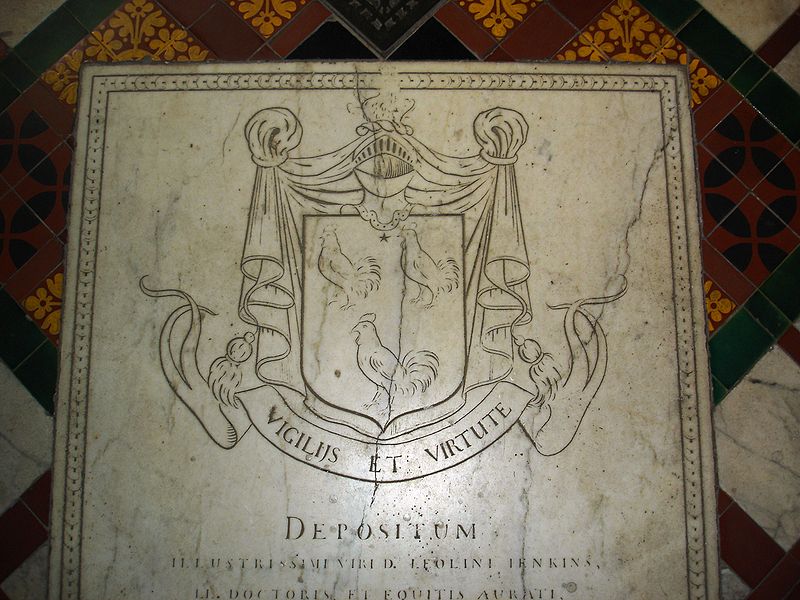
Have you ever signed a document disposing of something valuable, like a house or your estate? Did you find you needed to get it witnessed, and that the witnesses couldn’t be family members, and had to put their addresses on the document too? Then it may surprise you to learn that you are following legal precepts established by a long dead Welshman; this one, in fact:

[caption id="attachment_14376" align="alignnone" width="631" caption="Sir Leoline Jenkins (hat tip Wikipedia)"](h/t Wikipedia)[/caption]

whose tomb is at Jesus College, Oxford; oddly, no more than ten minutes’ amble from where I am sitting, carving out this post. I like the way his “Llewellyn” has been semi-Englished to “Leoline”. Right now, he is probably spinning, at a fair clip, for he is the originator of the Statute of Frauds.

Read more...
