BP has clearly decided that it needs to do what it takes to get the Administration to de-escalate its campaign against the oil producer, and is signaling that it is willing to cut its dividend, something it has fiercely resisted, as a peace offering. BP’s chairman, Carl-Henric Svanberg has been summoned to meet with Obama next week, and the oil company is clearly keen to be able to say afterwards that the meeting that the two sides had at least reduced their hostilities, and better yet had made some progress.
There has been quite a bit of consternation on the other side of the pond over the now-likely dividend cut. 40% of BP investors are in the US; they’ll presumably won’t fight the reduction too hard. But BP has no doubt had to sell the idea to shareowners outside the US, particularly in the UK, where the oil company pays 13% of FTSE dividends. But it’s hard to argue that investors did not see it coming; on Wednesday, Financial Crookery (hat tip Richard Smith) pointed out that the market was already expecting a reduction of 45%.
Presumably, BP is simultaneously negotiating with the Administration while trying to manage expectations. It would be foolish to do otherwise; it is almost never a good idea to have top executives negotiate with each other, especially in a situation which is already charged. Another approach which would be viable would be for the two sides merely to agree on the shape of the table, as in what issues need to be resolved in what timeframe, and who will be tasked from each side.
As far as the substance is concerned, BP appears to want the Administration to quit criticizing it in public (or at least to tone it down a lot) and to set some limits on what BP will be held responsible for. According to the Financial Times:
They will promise to retain sufficient cash to meet all legitimate claims, which analysts say could range from $5bn to $40bn. However, BP will reject the administration’s calls for the company to pay the wages of all rig workers laid off as a result of the government’s deep-water drilling ban.
Yves here. The key issue, which is going to be central in both the negotiations with the government and in court, is what constitutes a “legitimate claim.”
BP does not appear ready yet to say how much it will reduce dividends, and it does not need to make that decision until July 27. The oil producer is having a discussion with its board on Monday, it may make some preliminary decisions then. From Bloomberg:
The London-based company’s options include paying the dividend in a form of equity and placing the payment into an escrow account until the spill cleanup is complete, analysts said.
“They’re going to see what the political pressure looks like before they make the decision on the dividend,” Jason Gammel, an analyst at Macquarie Securities USA Inc., said in a Bloomberg Television interview. “The most likely thing is that they would suspend the dividend for one to three quarters.”
If press has an accurate reading of the state of play, BP has put some initial stakes in the ground, and appears to be looking for signals from the US before it decides what to offer in the way of dividend reductions.
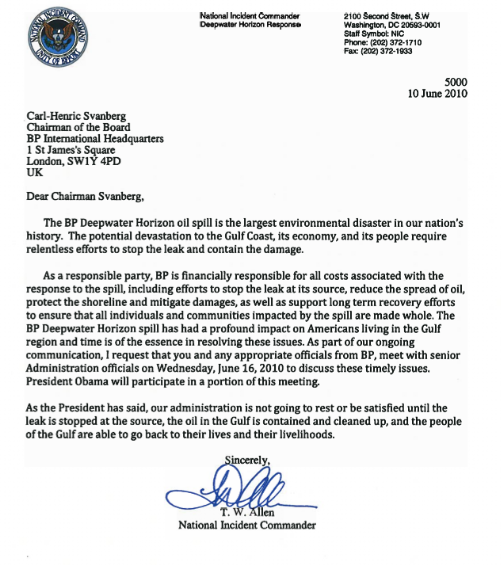
The President and Congress are under pressure to take action against BP, and the letter below from the Administration throws down a gauntlet (hat tip reader Swedish Lex):
Now if Team Obama sticks to its guns, it should demand that no dividend be paid until the amount of damages in known with a high degree of certainty. That may well prove to be more than the one to three quarters. As Bill Black argued in the New York Times:
The fundamental truth of litigation is that it does little good to eventually win a legal claim for damages or restitution if you cannot collect on the claim. If the corporation puts assets out of the reach of the U.S., the citizens will lose.
Dividends not only put money out of the reach of the U.S., but also reward the people most responsible for causing the damage. BP’s officers and employees, in their capacity as shareholders, are the most obvious example of this, but shareholders are also responsible as owners of the corporation. The deal shareholders make when they invest is that if the corporation cannot pay its debts to creditors the shareholders get nothing.
BP could be insolvent if it is held responsible for the tremendous damages it has caused. The U.S. should not have to tell BP not to pay dividends (or senior executive bonuses). Of course, if BP acted prudently it would not have a horrific record of regulatory violations, several of which led to multiple deaths. It is no surprise that BP intends to pay dividends and bonuses. But any smart huge, unsecured creditor of BP should act to protect its ability to recover damages by suing to block the dividend payment. This is not “socialism” or government putting its boot on BP’s neck — this is a question of competence as creditor.
Yves here. The consensus now is that the damage resulting from the leak will not threaten the solvency of BP. But the leak has not been capped, and the new estimate of 25,000 to 30,000 barrels a day could prove to be low. In addition, the oil from this leak is a heavier grade of crude than in the last monster Gulf leak, the Ixtoc spill in 1979, and thus is likely to do more harm per barrel of output. And Ixtoc leak, which was easier to contend with (it took place at only 160 feet) still took ten months to halt. Remember, those damage estimates of $5 billion to $40 billion assume that the relief wells due to come on in August are successful. If not, the extent of the disaster and the resulting losses could mushroom considerably beyond anything the financial community has penciled out.
Another reason for Team Obama to be tough with BP is that there is good reason to believe that the company has acted in bad faith. BP’s insistence on keeping scientists and monitoring equipment away until the initial efforts to plug the leak failed makes no sense except as a deliberate effort to lower damages. Say BP had contained the leak in the first month. It has first claimed 1,000 barrels a day, but then acquiesced to the government guesstimate of 5,000 barrels a day, which would have been the official tally, not the 20,000 to 40,000 a day that has been subsequently determined to be the likely output. Anyone who suffered damage would have to argue that it was indeed due to BP, which in many cases would be credible only if the volume of oil was considerably larger than the BP claims. That in turn would involve costly discovery and expert testimony (which would be contested by BP experts).
While this sort of misrepresentation may have seemed useful to BP, the Administration relied on BP’s 5,000 a day estimate. And had the leak been a mere 5,000 a day, the supposed worst case scenario, that it might persist for three months, would result in a significant but not horrific level of damage. But BP’s obfuscation led to a less aggressive disaster response and made what was bound to be a bad situation for the Administration worse. Before you buy BP’s claim that it was really really hard for them to figure out how bad the leak was, the oil driller claimed in 2008 to have developed a new technology for measuring oil flow from leaks.
What do you think? How will you evaluate what comes out of next Wednesday’s meeting between BP and Obama? What do you see as appropriate measures? What would you see as a sign that the President has conceded too much ground?


Bill Black is spot on here. This is a business case, pure and simple. Those who want to make political hay out of this disaster are invited to take a hike and not return.
Evaluating the Wednesday meeting: At the very least, the dividend ought to be canceled in toto, (better yet, put in escrow) until the well is shut off and all the damages have been precisely estimated. Should BP refuse, invoke National emergency and put BP America into receivership. No more pussyfooting! Get tough Barry!
Appropriate measures?
1) Accelerate inspections of the other deep water rigs in the Gulf and allow operations to resume for those who pass the tests. Of course, MMS cannot be left alone to perform said inspections. No one in his/her sane mind should trust these REMFs.
2) Tell (demand and force) BP to get off the back of the press.
3) Better protection for the workers charged with the clean up. Some rumors from the Gulf are rather disturbing. BTW, no gag orders from BP to the workers should be tolerated, period!
4) Salazar must be removed ASAP. A hard nosed, in your face Secretary of the Interior ought to be in charge here. Tell the Senate that any resistance will be met by a flurry of future Presidential signing statements that would invalidate ANY pet projects of any resistant. Obama must start to be feared and loathed by those who won’t get with the program.
As an aside, considering the US Chamber of Commerce said the taxpayers should pick up ( a big) part of the tab for the damages in the Gulf, and just for the hell of it, Obama himself should publicly tell the US Chamber of Commerce to fuck off! With his gift for rhetoric, he could quarter these mofos in no time. They’re against him anyway, so he got nothing to lose.
See, this is the part that I don’t understand about this whole thing. We are discussing thing that is not event remotely essential to the emergency at hand.
Think about it. Do we argue about what will the house flooding do to insurance, lawyer cost and bank balance? right in the middle of house flooding from rupture pipe? First thing to do is shutting off the main water line and check if there is enough equipments and tool to soak up those water before the house becoming soggy and under mold attack. Sitting down and discussing insurance rate and bank balance are low in priority list.
We haven’t even permanently capped that broken well yet.
In my estimate, the cost of building “system” to soak up oils and prevent further damage shouldn’t be more than $3Billion
1. Immediately design build ships. RIGHT NOW. One big and one small pump ship to soak up deep water plume, a dozen or so big size oil skimmer, and portable coastal facility to processed oil that has reached the beach. These equipments takes months to build, shouldn’t cost more than $1-200m a piece. But VERY EFFECTIVE. (like in big house flooding, it is wise to buy water pump instead of loading up on broom and paper napkins)
2. immediately construct a “boomer” factory. The amount we have is puny. not enough. they are for ship oil spill. and it’s too expensive. This facility wouldn’t cost more than $2-300m. All off the shelf plastic/textile machines.
a) a soaker boom made out of disposable (light weight plastic/organic material) that can be dispose of in incinerator. after they are done being used. We gonna need thousands of miles of this thing, not just few yards. They have to be BIG and disposable.
b) the boomer disposal processing has to be automatic to reduce cost for it’s gigantic capacity need. (they are plastic and oil anyway, small incinerator/electricity generator is perfect)
c) various small permanent coastal facilities to process the captured oil on the beach. (we gonna have this oil problem for YEARS) busing low wage workers is TOTAL waste of money. They will only clean up the beach for days at most. not years. $1m a pop seems excessive to me.
d) This is the labor intensive part (cleaning up wild animal, inspections, and detail work cleaning up beaches where people live.)
e) what to do with fishermen/aqua farmer.
HANDING out chump changes to make people work WILL NOT help the economy, responsibly clean up the gulf, or fix the economic damage. The big money they are arguing will go to a) politicians b) lawyers c) scam artists d) PR companies.
I GUARANTEE YOU the gulf will still be dirty after $60B, 5 years and international trade war with UK if we keep doing what we are doing.
This instead of sensible $3-6B facilities, long term clean up policy and job placement program. this is Timex/Swatch solution time, instead of thinking about how to get the money buying Rolex!!!!
YOU CANNOT turn this oil spill disaster into low wage job program and political circus. This is BIG industrial disaster with tons of potentially carcinogenic liquids. You gonna need big machines to clean it up. Huge ship pumps, thousands miles of booms, fleet of small processing facilities, etc. bunch of fishermen and semi literates persons with broom won’t do it.
This is also NOT an opportunity to fix mississippi delta flow. That’s like thinking about house redecoration in the middle of big basement flood.
$5-6B at most if done properly, and it won’t need to be paid all at once. And we should have at least 4-5 big factories and big ships at the end of the program.
Instead of pay days for fat cats, scam artists, politicians.
I am VERY disappointed with Obama.
Well, it’s probably fairly certain what’s going to happen next: The media-negotiations are drawing to a close. BP has been made to throw itself publicly at the feet of Washington, [at least on our tv screens, and that’s all that matters, right?] all the big players can now get back to business as usual.
What can we expect of Barack Obama? Good question. The realist in me says that nobody can govern today. Up against “the power of vested interests, the shrillness of minorities, short-termism, and the superficiality of much of the media,” governing is a relic of some golden age. I expect that Barack Obama will continue to box valiantly but ineffectually inside this wet paper bag. I think as a pragmatist he enters into agreements where he willingly allows himself to be co-opted, if he believes that the net difference is an improvement in his position– well, that’s how the story goes, anyway. What this has to do with “Hope”, with it’s connotations of idealist action is basically: Not much.
The focus should be on BP solvency, not a $2.5 billion dollar dividend payment. This week is more stage craft, but when push comes to shove, and it will, America’s finest lawyers will, representing BP, outfuck this admin and its taxpayers to an even greater degree than Wall Street has succeeded in doing the exact same thing in THAT context.
Tang: “…outfuck this admin and its taxpayers to an even greater degree than Wall Street has succeeded in ..”
Nothing, nobody will ever ‘outfuck’ the taxpayers to a greater degree than Wall Street has done. Never, ever!
Re next week’s meeting: last year the president summoned the wall street banksters to the White House. Two did not show up (a.o. Goldman Sach’s Blankfein). The blogs presented weather report and train schedules, proving that those bankster could have easily made it. Obama did accept their absence, and hence has given BP’s chairman an excuse not to show up at all.
Also, recall Obama visiting Wall Street to commemorate the first anniversary of TARP: the banksters did not show up.
Now, the Obama administration wants BP to pay for all the fallout, including pay to workers not being able to work due to the drilling ban imposed by that same administration.
Where are Obama’s call for the banksters paying all of the unemployment costs, etc., etc. etc.: all the costs of the fallout from the financial crisis?!
Another big difference: BP, and other oil companies provide a service to society (we are not all hiking and biking, and wearing multiple layers warm cloths in winter time). Wall Street provides none (that is to say: not anymore. It’s just gambling without gambling laws and without tax payments).
Yet another difference: BP and Transocean did cut corners. They shouldn’t have done. But many companies cut corners all the time and get away with it, as 99% of the time nothing all too bad happens.
Contrast that with Wall Streets innovations of the past two decades: this financial crisis, and its horrible consequences was absolutely sure to happen. It was inevitable. It was baked in the cake by Wall Street. The banksters knew it, but ‘continued dancing was long as the music was playing’.
Obama should get his priorities straight!!
What will happen after this negotiation? Our Nemotode-in-Chief will announce that all the necesary concessions have been made, BP has assured him that all claims will be settled ‘in the due course’ (i.e. not sooner than 2017), and that we should all return to our regularly scheduled programming. Obama has no interest in pursuing BP, and a very major issue in getting the public to turn to something else, so more bland soothing will issue from his orifice.
Why do I think this? Well as one recent example, the man, not to call him our national Executive, announced that he favored an impartial, credible, international investigation of the assault on the Mavi Marmara while the news cycle was heavily on this. Now, he quietly announces that any investigation Israel produces will be more than sufficient, move along, there’s nothing to see.
It would be a good thing if we would hear no more talk in the hopeful tenor about Obama, how ‘he may finally have seen the light,’ he’s going to come throuogh on this one, his rhetoric will finally be matched by etc., etc., etc. Because to me, this perpetuates the myth—and it has never been anything _other_ than a myth—that Obama has a liberal, progressive, solution-oriented, or even public-sprited cell in his body: he doesn’t. Nothing in his personal record as an elected official before he took office as President ever, _ever_, EVER demonstrated and such interest or capacity. From the time he took office as President we have seen the DIAMETRIC OPPOSITE of any knd of reformist, problem-solver, or [skip that metaphor and pick another] paladin of justice. A few weasel words led those sick unto death of Shrub Bush to think that his low calorie equivalet would do things better/different/rightly. Obama is never going to come through for we, the people on anything whatsoever.
Just watch how the BP thing plays. This is not an act. He’s not ‘a wimp.’ He’s not ‘deferential to the system.’ He _is_ the system, distilled to its essential oil. Believing that he really cares and will finally throw mortified reformers a meager scrap will only result in unbroken disappointment. He knows exactly what he is doing, what he stands for, and that with which he will have no truck.
Time to stop believing in Barack Obama: the starkest sell-out to power we’ve seen in our time.
“Stage craft” is realistically cynical. Like wealthcare ‘reform, and financial ‘regulation’, Iranian ‘diplomacy’, the Palestinian ‘Peace Process’, war ‘de-escalation’, ‘transparency’, ‘cap and fade’, gay rights, whaling, etc. ad nauseum, this administration is proving to be a bait-and-switch, wolf-in-woolringer for the kleptocracy—all sound and fury signifying nothing. Orwell’s fiction doesn’t hold a candle to reality.
Paying out any dividend would be a clear-cut case of Akerloff looting, as the racket’s entire array of assets won’t be sufficient of pay all the legitimate claims.
That would normally be just an idle complaint, as the rackets always go ahead and loot anyway with full government collaboration, most infamously (but not at all exclusively) in the case of the bankster “bonuses”.
I admit that I’m somewhat surprised any amount of political pressure could have forced Obama to momentarily feel he has to get tough in action and actually make a demand on BP which BP finds seriously unpleasant.
If there’s really any there there to any of this (i.e. if it’s not all just prearranged kabuki, as I still think the SEC-Goldman flap is likely to turn out) it’s at least momentarily impressive.
But Obama’s record is unanimous: Except where he’s bullying cowardly “progressives”, every single time he at least pretended to be getting angry and be “getting tough”, he shortly afterward caved in. The most clear cut example so far was the “Volcker rule” hype and the charade of trotting out the old guy pretending he now had clout.
So if he really keeps the boot on BP, it’ll be a first.
Needless to say, anything remotely in the public interest Obama does he does under extreme political duress and not because he believes in it.
If I had to bet, at most maybe BP will pretend to forego the dividend (but it’ll just be laundered another way, like the way Goldman pretended to have top execs forego “bonuses”), and Obama will happily represent that sham concession as a major concession. “In return”, he’ll probably hand them some incredible liability-lessening gift.
In the end, if this dividend flap doesn’t end up being disaster capitalist theater which redounds to BP’s financial advantage and yet further socializes the costs, I’ll be surprised.
(I’ve been toying with the idea that Obama really consciously considers himself a Republican by right and that he became a nominal Democrat purely out of opportunism.
By the time I finished reading this piece
http://www.nytimes.com/2010/06/13/magazine/13midterms-t.html?ref=magazine
I could picture him actually switching parties before the next election. On the evidence of that article it really seems like he loathes, not just the Democratic party’s “progressive” wing, but the entire structure, while he truly respects and admires the Republican party.)
I do agree, in a minor tone, with the above expectations from Obama; in my book he is a push over and not particularly smart. It seems that the best we can hope for is a tough negotiation with BP. If they agree to pay damages up to $40b, they probably can easily pay $120b, I would try for $250b and see how well I do. Obama should get some of our Iranian Americans to do the job; he’ll be surprised.
Going to court is a losing proposition. Sooner or later damages will run into the Middle Ages majority of our justice system that supports business over the country continually and drastically.
All these talks about the dividend is just silly. This is diverting from the real issue, which is BP paying a few billion dollars (most likely) for this disaster that is going to cost hundreds of billions of dollars.
Like everything else these days cutting the dividend is just a sop to appease the voters. Even if they cut the dividend they can just boost it up again next year, which will achieve exactly nothing.
What nobody seems to be talking about is that this problem may have links back to the financial system deregulation. BP before its merger with Amoco was considered a rather sleepy little British oil company with a good safety record and known for its environmental projects including solar panel development.
So what went wrong? Problems seem to have started when John Browne took over and engaged in expanding the business by merging with amoco and atlantic richfield with the help of the banks. BP started to adopt some of the business ideas from amoco which had a pretty bad reputaion for safety. As a result John Browne set aggressive profit goals, and BP managers drastically cut costs to meet their quarterly targets. From this point forward BP’s safety slipped and it went into the lobbying business.
So we have lax regulation, cultural problems between BP and amoco and a financial environment where BP had little option but to expand and cut costs. US business culture, lobbying, US politics, bank deregulation, regulator laxness, loose monetary policy all played there part. Now where have we heard all this before?
At the end of the day if Obama pushes too hard then most likely BP will demerge with the amoco US subsiduary filing for chapter 11 while the rest of BP goes back to being a sleepy little oil producer. If Obama wants to do something usefull, then he should instruct investigators to inspect every installation BP owns and demand they get they up to standard. This will cost BP a lot more than messing about with dividends. Priorities should be to Fix the leak, inspect all the companies involved and get them to correct all safety violations and then to change US business culture.
If onshore winds hold for the next week, Obama will be forced into a hard line on BP. If he doesn’t the state of Florida will. NOAA is predicting heavy onshore crude making landfall in Florida over the next week, similar to what has been washing up in the uninhabited marshes of La.
Florida is a huge state with the resources to fight BP, and there are a lot of wealthy interests in the tourism industry who are mad as hell.
The BP fight is ultimately about which business interests hold most sway. This is Washington – ‘the people’ don’t matter too much.
BP probably wishes they had sovereign immunity as Pemex did with Ixtoc.
Of more concern the blowout is another indication that incompetence has been institutionalized in more and more organizations. When there is no downside to risk taking it seems low probability risks are ignored.
We seem to put unwarranted faith in the the reliability of manufactured goods and techniques. Not everything is a toy whose technology will be passe in two or three years.
What reason do we have to suspect that any management is better than AIG which allowed the FP unit to give away 80 Billion?
The letter shown in the article covers everything I want the US to demand from BP; making them responsible financially for stopping the leak, cleaning up the oil, paying for restoration of damaged shorelines, and compensating those impacted economically by this disaster. Throw in the fines as laid down by the Clean Water Act, and they could easily be on the hook for nearly $100 billion, although no doubt a lot of negotiation of that final fine amount will take place in the future.
BP currently has around $11 billion in cash reserves, and their assets are valued around $106 billion. If necessary, and especially if BP starts making “we’ll have to declare bankruptcy” noises, I’d like to see the US seize their assets in country and immediately sell them to competitors to cover the costs of this disaster. I have zero sympathy for foreign shareholders; they knew BP cut corners on safety, and the consequences of this kind of disaster should have been obvious to everyone.
Corporations need to learn there are consequences to screwing up like this.
You know who you are.
Your talent for writing could be taken seriously if you didn’t keep harping on Obama for offenses put into place by Republican Supreme Court appointed Georgie POTUS Bush and his intentional decimation and underfunding of government bureaucracies most visibly FEMA (great job, Brownie).
And if you are really interested in seeing a cure for the BP situation rather than just shilling for Republicans, why aren’t you demanding records of former POTUS Bush Vice President Cheney (not a part of the executive branch of government) meetings with energy company executives for the purpose of reforming these same bureaucracies back to prior Bush decimation conditions for regulation and oversight of the commons and the world’s natural resources.
Corporatist Obama, and indeed, government in general, will prove to be British Petroleum’s bitch, by the rolling over and the spreading of creeks. The body isn’t even cold, yet politicians are calling for more offshore drilling.
Another reason for Team Obama to be tough with BP is that there is good reason to believe that the company has acted in bad faith. BP’s insistence on keeping scientists and monitoring equipment away until the initial efforts to plug the leak failed makes no sense except as a deliberate effort to lower damages. Say BP had contained the leak in the first month….
How is this possible? Obama went on television and claimed that his administration was calling all of the shots early in the game. He said that the buck stopped with him. If he was telling the truth there is no way that BP could have kept videos away from scientists without the administration’s approval.
It has first claimed 1,000 barrels a day, but then acquiesced to the government guesstimate of 5,000 barrels a day, which would have been the official tally, not the 20,000 to 40,000 a day that has been subsequently determined to be the likely output.
The new figures would have to be higher because BP made the flow easier by cutting away the obstructions so that it could use a method that would allow it to recover more of the oil. How much oil is escaping is still an issue because some of what is coming form the well is natural gas. As much as I think that BP management is incompetent it is hard to make the same case for its engineers so I prefer to wait until all of the calculations are complete before we can make any conclusion about the extent of the spill.
Anyone who suffered damage would have to argue that it was indeed due to BP, which in many cases would be credible only if the volume of oil was considerably larger than the BP claims. That in turn would involve costly discovery and expert testimony (which would be contested by BP experts).
That is the problem for the media and the government. The damage is unlikely to be as extensive as they claim. The PEMEX leak released more oil into the Gulf and the damage was not great. The well should be shut off in a month or two and there won’t be that much oil released to have a meaningful impact on the Gulf’s ecosystem. Ten years from now there won’t be much of a sign of the spill unless the government does something stupid as it is prone to do.
It makes sense to have BP pay people who were directly effected by its spill. That means fishermen who can’t work because the government has stopped them from working. It does not mean rig workers who can’t work because Obama is stopping activity. (That has nothing to do with BP.) It also does not mean compensating tourist oriented businesses in areas that have not seen oil on the beaches. The tourists did not stay away because of the oil but because CNN and government bureaucrats made false statements that caused fear among the public.
I see this as a tipping point. Buy shares in tar sands players and energy companies in politically safe areas of the world. Buy lots of gold. Make a bet against the US stock market and stay away from long treasuries.
It’s OIL company. You are in the same boat as Goldman Sachs when it comes to social responsibility.
Of course they are going to cut corner, cutting cost, under engineered, etc.
It’s a taken. The problem now, it seems we also have massive political corruption and management incompetency. As of this moment, it is a huge leadership and management problem.
Huge folly. Cascading ever larger problems. No foresight, no political willingness.
Actually, most of the oil companies are very responsible and have a great track record when they drill in the Gulf. BP does have a problem because it tried to transform itself into a company that promoted carbon trading and supported government subsidies for unprofitable initiatives. It took its eye off the ball and cut back on its quality control processes.
That having been said, all BP is responsible for is the damage that it caused by its errors. That does not include the Obama administration’s idiotic decision to suspend drilling at depths greater than 500 feet even though the experts that it consulted did not make that recommendation. This has turned into a political fiasco. And it does not include the damage to the tourist industry that was done by the media hype.
BP’s new management will have to let the courts decide this whole thing, after the appeal process runs its course. By the time that happens there will be little evidence of any lasting damage and the courts will not be as likely to
Sorry. I hit the send button too soon and did not finish the last paragraph.
BP’s new management will have to let the courts decide this whole thing, after the appeal process runs its course. By the time that happens there will be little evidence of any lasting damage and the courts will not be as likely to hand out goodies for non-damage.
Over the last two weeks, Obama has made two very stupid mistakes. The first was insulting the intelligence of americans as he pumped a terrible jobs report. The second is this ridiculous statement as he seeks to blame republicans for the oil spill:
“I think it’s fair to say, if six months ago, before this spill had happened, I had gone up to Congress and I had said we need to crack down a lot harder on oil companies and we need to spend more money on technology to respond in case of a catastrophic spill, there are folks up there, who will not be named, who would have said this is classic, big-government overregulation and wasteful spending.”
As an Obama voter, I find Obama’s increasing level of ignorance disconcerting.
As part of the deal to cut the div, the no-fly zone for the GOM will be increased by the same percentage as the div cut percentage — and no pictures of environmental damage will be allowed in the press. The crisis is over sooner than we all imagined. Thank God that BP is playing ball! Everyone can back on vacation to the beaches again — and for the lucky few, you may bump into the First Family, who I hear, play a great game of tarball!
MY TAKE sure hope both get it!
Dwight Baker
PO Box 7065
Eagle Pass, TX 78853
Tel 830-773-1077
Dbaker007@stx.rr.com
June 10, 2010–3:01 PM
Letter of Welcome to the USA and Introduction to the Tame Nature overshot Plan.
Mr. Carl-Henric Svanberg, BP’s chairman
Chairman Svanberg,
A Pre-Welcome as you make plans to visit us in the USA. With your added understanding and ability to cope with these problems facing us in oil and gas will make things get much better. As you join us addressing all the issues as an engineer to bring this on going disaster to an end. That is a fact not fiction, much of the free press in the USA has been drenched in miss understanding and that has led to breeding hate anger and hostility toward many in oil and gas here and abroad. The seemed endless media hype chatter has brought about a forlorn look in peoples eyes for they have no clue what to do or what has been going on for one reason or another. And without good will going in and coming out all deals will soon fall apart.
And that has been my prime moving force to tell the facts as they are then give a solution built on good sound oil and gas engineering schools of thoughts and my plus twenty five years of field experience. For what else can be done other than that, for the many folks that have no hope of this blow out matter coming to a quick and easy solution will understand base common sense and logic.
Thus I propose a few good ideas to help BP get beyond these problems and give immediate more hope from the 70% of people in the USA that have serious and dubious doubts of anything good to come from BP.
1. The USA has a huge workforce of indigenous folks in oil and gas, many of them are spread around the globe and many are working in the Gulf of Mexico and they need re-assurance their jobs will not be lost. BP must push for, good will, and can no longer seek for bad press aimed at our Administration. Kind smiles and genuine caring must be the focus while you are here in control. I kindly submit it is time to hand off the ball of fixing the problem. I will work the work of getting the Tame Nature overshot plan to become a reality for all in the loop to see and work toward implementing the sooner the better. I will not become a public figure at all. I will only work behind the scenes if not then I will not work at all. Too many of that unknowing crowd in the USA now and I will not be associated with them. The other thing I would suggest be done is pass along the well kill effort to a crew of Wild Well fighters in the USA your choice. Doing that would again bring a sigh of relief to many on the Gulf Coast where some of the worst hate anger and hostility has been broadcast on TV and put in print.
2. Admission of faults and guilt is your prerogative; those issues are yours and the board to decide. But one thing for sure BP has a bird’s nest on the ground in the Gulf of Mexico and the huge gasoline market in the USA, so with that in mind “What is the cost to fight a losing battle”?
3. Please delegate someone people savvy the role of floorwalker in the control center. That is not a job becoming you. Your time must be spent first and foremost bringing a halt to the oil and gas gushing out —then on the other hand you must engineer a delicate touch to be put on all the environmental groups that have proven real time facts —-but some in BP have shunned those causing a rift in any type of good will. Again “What is the cost to fight a battle already lost” in the Free Press based on scientific evidence?
I stand to aid you in your work and Bp all I can in the near term goals of stopping the oil and gas.
Following is a letter recently sent to President Obama and at the end his reply.
Cheers have a nice flight call anytime.
Dwight Baker
This week, Obama says this: ““I think it’s fair to say, if six months ago, before this spill had happened, I had gone up to Congress and I had said we need to crack down a lot harder on oil companies and we need to spend more money on technology to respond in case of a catastrophic spill, there are folks up there, who will not be named, who would have said this is classic, big-government overregulation and wasteful spending.”
On March 31st, Obama said this:
“This is not a decision that I’ve made lightly,” he said when he unveiled his proposal on March 31.
“Oil rigs today generally don’t cause spills,” he added two days later. “They are technologically very advanced. Even during Katrina, the spills didn’t come from the oil rigs, they came from the refineries onshore.”
http://www.mcclatchydc.com/2010/06/11/95755/obama-overlooked-key-points-in.html
These two statements cannot honestly co-exist. As an Obama voter, I’m left with no other conclusion but that Obama is a liar and a continuation of George W. Bush’s presidency
These two statements cannot honestly co-exist. As an Obama voter, I’m left with no other conclusion but that Obama is a liar and a continuation of George W. Bush’s presidency
First, why would anyone expect Obama to be honest when his record indicated that he was a political hack? Second, why would anyone expect a difference between the Democrats and Republicans? Third, are you missing Bush yet?
Double standard. GM did exactly the same, all the banks did exactly the same. Why do European standards only get enforced vs European companies when they play according to US rules in the US.
Because this is about politics and the administration is desperate.
To avoid the specter of “Obama’s Katrina”, he needs to point the finger at BP early and often. But this papal summons is unusually theatrical. If it were winter, they could kneel in the snow.
Perhaps this is standard practice for Chicago, or Harvard.
Yes, but when Obama summoned the banksters CEOs to a sit-down, three of them said they couldn’t make it because it was foggy and their private jets couldn’t take off. And he meekly thanked them when they phoned in.
Obama sometimes talks a tough game against corporations, but his actions are telling.
Oh, and he can be plenty tough. He recently played a major role in forcing the Japan PM to resign over the Okinawa bases. So he can play hardball. Whether he will here, who knows.
But this is different. The oil washes up on beaches. You can’t hide that or cover it with spin. There are going to be a large number of seriously pissed-off Gulf residents soon.
But this is different. The oil washes up on beaches. You can’t hide that or cover it with spin. There are going to be a large number of seriously pissed-off Gulf residents soon.
Actually, very little oil has washed up so far in most areas. Residents have been upset at the media hype that has caused the tourist trade to dry up even though there was little evidence of oil in most locations. They are also upset at Obama’s decision to halt drilling in areas deeper than 500 feet. The best and safest oil rigs will leave the Gulf and head for South America, the Middle East, and West Africa. Those rigs, and the jobs that go with them, will not be coming back to the Gulf States.
I suspect that it will not be long before the people in the Gulf States shift some of their attention from BP to the White House.
I don’t know where you are getting your information re the conditions on the beaches, but it is incorrect. From Bubba, who has a home on the Alabama coast:
You don’t have to go far, http://www.al.com and see it first hand. We are ground zero for the worst environmental disaster in US history. My wife was at a friends condo last night on the beach. She said they just stood on the balcony and watched oil soil the beach-everyone awe struck. The state has closed the back bay area (a place we boat year round) to recreational traffic. This is unprecedented. Anyone who says it isn’t bad here isn’t here. This place will have environmental problems for the next 20 years. BP will fail financially trying to clean up this mess.
The BP spill is the Wall St crash but with blood washing up on the beaches. As much as Obama would like to pretend it didn’t happen, it’s much more difficult for him to “extend and pretend” since it is much more clear cut as to the who/what/and how of the disaster, but his “fix” will be essentially the same: extend and pretend.
Despite all the talk about hope and change, Obama is all about preserving and extending the existing power structure. Obama will make a big fuss, but underneath it all, nothing substantial will change, and he will stick the taxpayers with the cleanup/bailout costs.