Yves here. As the US is committing to yet more military escalation, not only are we stripping social safety nets but also further neglecting our already-crumbling infrastructure. Most of you have read before about the sorry, dangerous condition of US bridges due to underinvesting in maintenance. This warning about dams and levees ought to raise alarms but probably won’t. Unlike a bridge falling down, floods due to dam or other water-restraining system failure is easier for politicians to treat as “shit happens,” since a weather event of some sort will be the trigger.
We’re having a lot of flooding here (not specifically where I am, where we get at most a few hours of select roads being inundated; we are in a rocky area so persistent heavy rains drain quickly into the sea), including most recently a tourist city, Hat Yai, with a regional airport being flooded out and requiring a national emergency response. The damage even made the landing page of the BBC:
Parts of Thailand are battling record floods, which have killed at least 33 people and prompted authorities to deploy military ships and helicopters to support relief efforts.
The deluge has hit 10 provinces across the country’s south over the past week, with the city of Hat Yai, a business hub bordering Malaysia, recording its heaviest rainfall in 300 years – 335mm in a single day.
Photos show vehicles and houses submerged in the city, while desperate residents await rescue on their rooftops.
Relentless rains have also ravaged neighbouring countries. In Vietnam, the death toll has risen to 98 in a week, while in Malaysia, more than 19,000 people have been forced from their homes.
In Indonesia, at least 19 people have been killed and at least seven others remained buried under landslides in North Sumatra, according to the Indonesian National Search and Rescue Agency.
More than 2 million people in Thailand have been affected by the floods [out of a population of 73 million], but just 13,000 have been moved to shelters.
The vast majority are cut off and unable to get help, according to Reuters news agency.
The Thai military, which has been put in charge of tackling the crisis, said it is preparing to dispatch an aircraft carrier and a flotilla of 14 boats loaded with relief supplies, along with field kitchens that are said to be able to deliver 3,000 meals a day.
Medical teams on board the aircraft carrier will convert it into a “floating hospital” if required, the navy said.
Since flooding in low-lying areas is common here, even if the frequence and severity of this year is not, I’m not certain if and when recriminations about arguably preventable damage will start. Americans tend to be more vocal about property damage, but I harbor doubts in the end that there is either the will or the resources to get out in front of this looming threat.
By Jeff Masters. Originally published at Yale Climate Connections
“America’s infrastructure is the foundation on which our national economy, global competitiveness, and quality of life depend,” begins the 2025 Report Card for America’s Infrastructure from the American Society of Civil Engineers, or ASCE, a trade group.
The report, issued once every four years, gave America’s infrastructure an overall grade of C, up from a C- grade in its 2021 report. ASCE credited the improvement to the Bipartisan Infrastructure Law of 2021, plus federal partnerships with state and local governments and the private sector.
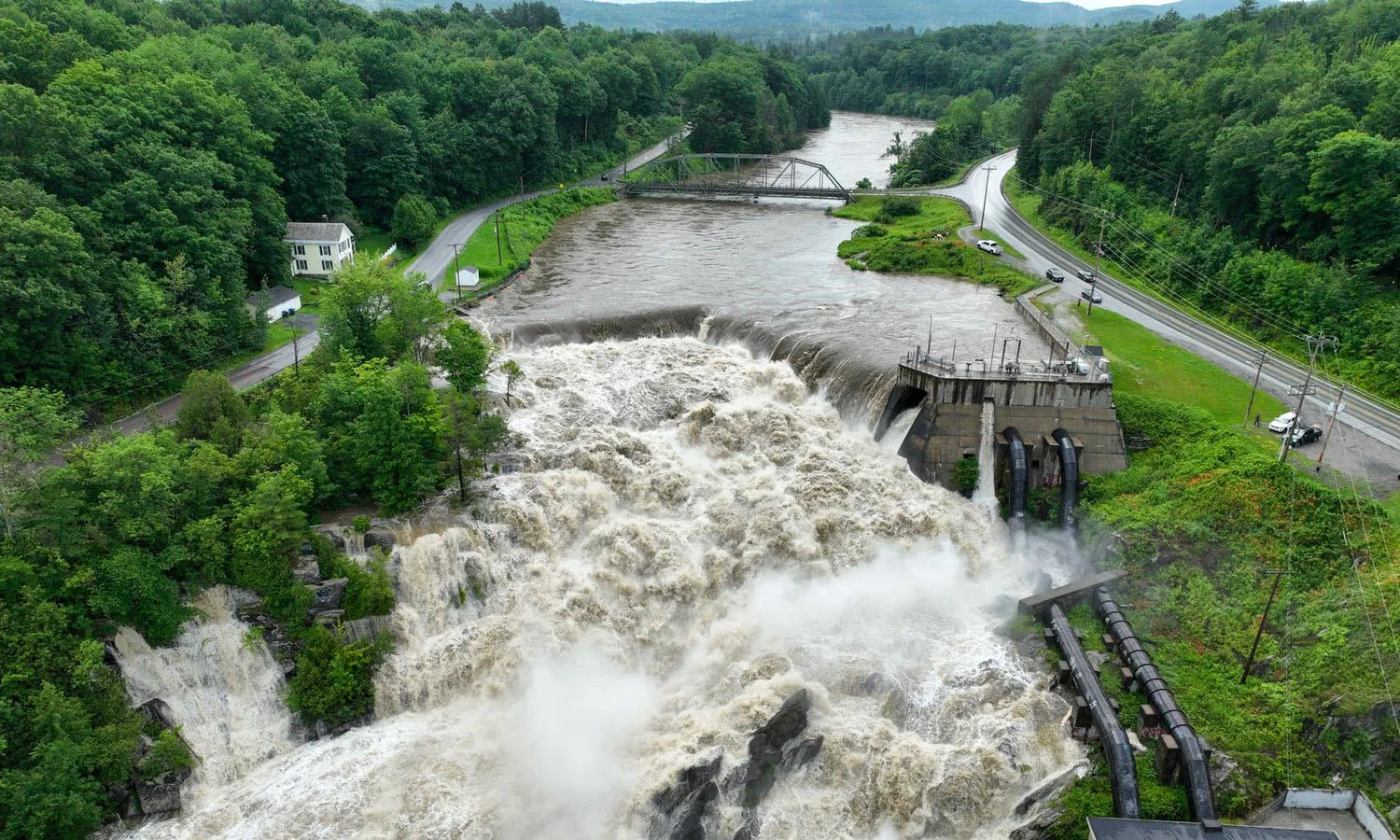
But dams, levees, stormwater, and wastewater infrastructure components received D to D+ grades. That’s concerning given that climate change is increasingly stressing dams, levees, wastewater, and stormwater systems through heavier precipitation events. What’s more, the federal government has shown little interest in sustaining the funding needed to continue improving infrastructure.
A “D” grade, in ASCE’s words, means “the infrastructure is in fair to poor condition and mostly below standard, with many elements approaching the end of their service life. A large portion of the system exhibits significant deterioration. Condition and capacity are of serious concern with strong risk of failure.” Each of ASCE’s assessments since the first was issued in 1998 has given U.S. dams a “D” or “D+” grade.
ASCE called for investments of over $165 billion for dams, more than $70 billion for levees, and by 2044, $690 billion for wastewater and stormwater systems. That adds up to about $1 trillion.
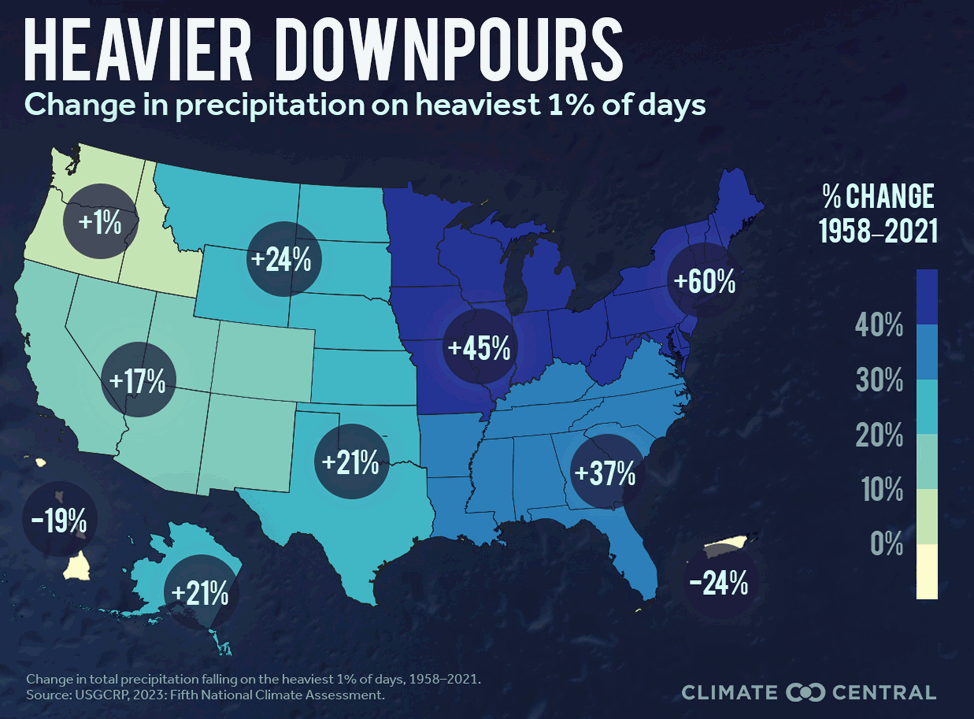
Climate Change Is Increasing the Risks to Water-Related Infrastructure
Increased precipitation in the U.S. in recent decades, partially the result of climate change, has caused an additional $2.5 billion a year in U.S. flood damages, according to a January 2021 study in the Proceedings of the National Academy of Sciences. The researchers, climate scientists at Stanford University, found that between 1988 and 2017, heavier precipitation accounted for more than one-third of the damage.
“There is real economic value in avoiding higher levels of global warming,” study co-author Noah Diffenbaugh said in an interview with E&E News. “That’s not a political statement. That’s a factual statement about costs. And it also shows that there’s real economic value to adaptation and resilience because we’re clearly not adapted to the climate change that’s already happened.”
Aging infrastructure and more frequent and intense rainstorms cause additional strain to the nation’s dams. Since 2018, heavy rains have resulted in approximately 30 dam failures or near failures just in the Midwest, according to ASCE. Some examples:
Minnesota, June 2024: The 115-year-old Rapidan Dam, which had gone through several rounds of repairs since 2002 and was assessed to be in poor condition in 2023, failed. The failure resulted in the destruction of a power station and destroyed part of a riverbank.
Michigan, May 2020: Heavy rains from a 1-in-200-year rainstorm destroyed two 96-year-old dams, the Edenville Dam and Sanford Dam, and damaged four other dams, causing $250 million in damage.
U.S. Dams Need Over $165 Billion in Upgrades
Drawing upon the latest data from the Association of State Dam Safety Officials, ASCE estimated the cost of rehabilitating all non-federal U.S. dams (which comprise 96% of the country’s more than 92,000 dams) at $165 billion. Of that amount, $37 billion is needed to address high-hazard dams, defined as those whose failure would result in loss of life and significant property damage. Additional money, which was not quantified in the report, would be needed to upgrade federal dams.
Over 2,500 dams are considered “high-hazard.” This class of dams has increased by 20% in number since 2012, driven mostly by increased development in downstream areas.
The U.S. Army Corps of Engineers says the dams it maintains are designed to serve for 50 years. Yet the average age of America’s dams is 64 years, and over 70% of U.S. dams are more than 50 years old. Old dams are a hazard: Approximately 75% of all U.S. dam failures occurred in dams over 50 years old.
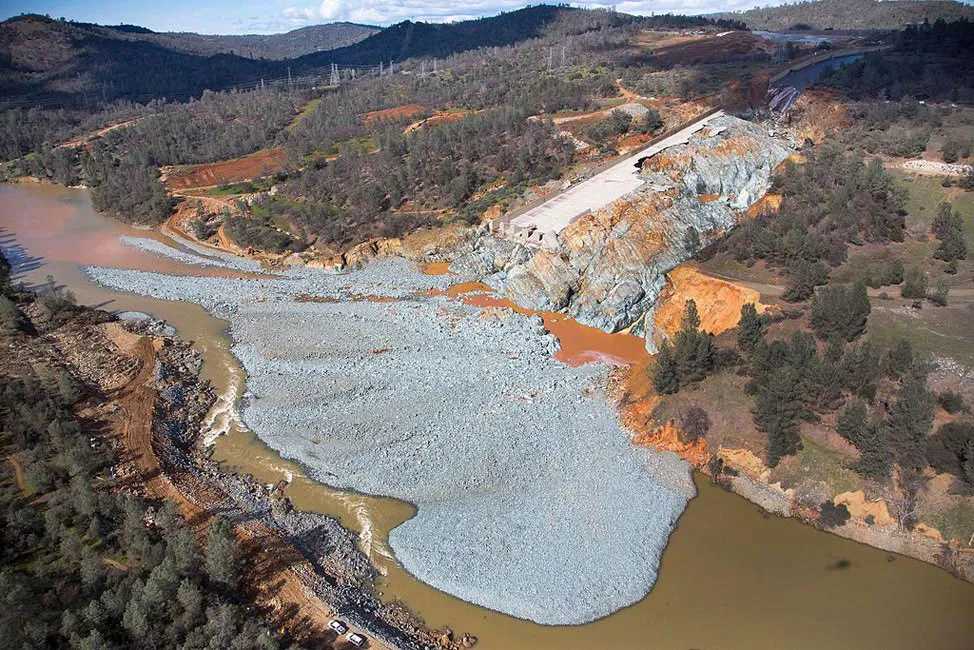
A key problem for old dams is that their reservoirs gradually fill up with sediment as they age, reducing their storage capacity and increasing the risk that the dams will overtop and fail. This problem is exacerbated by climate change, because increased drought and wildfire in the surrounding watershed increase the amount of debris flowing into reservoirs during heavy rains. In addition, dams built for flood-control purposes for the climate of the 20th century may no longer be up to the task for the warming climate of the 21st century, when heavier downpours can be expected to put pressure on infrastructure not designed for such extreme flows.
Worse Than Most: Vermont’s Dams
In Vermont, the average age of the state’s dams is 89 years, and many were not built using modern codes and standards. In other words, they are not designed to withstand increasingly heavy and frequent rainstorms. Following historic flooding in July 2023, state dam inspectors found that 57 dams were overtopped by flooding, 50 dams sustained “notable damage,” and five dams failed.
U.S. Levees Need Significantly More than $70 Billion in Upgrades
“Twenty-three million Americans nationwide live and work behind a levee,” the report notes. “The National Levee Database contains over 24,000 miles of levees across the U.S., but nearly two-thirds have not been assessed for risks posed to the communities behind them.”
In that context, the Civil Engineers’ 2025 report card grade of D+ for the nation’s 40,000 miles of levees is concerning. The ASCE said that the cost of bringing the nation’s levees into a state of good repair was significantly more than the $70 billion it estimated in 2021.
U.S. levees are, on average, 61 years old, many built using engineering standards less rigorous than current best practices. The good news is that fewer than 3% of U.S. levees are rated high or very high risk, down from 4% in 2021.
Wastewater and Stormwater Systems Are 70% Underfunded
“The nation’s sewers are estimated to be worth over $1 trillion and include nearly 17,500
wastewater treatment plants that operate to protect public health and ensure the well-being of communities,” the report said.
In 2024, the wastewater and stormwater annual capital needs were $99 billion, but funding was just 30% of that – $30 billion per year. The report said, “Assuming the combined wastewater and stormwater sector continues along the same path, the gap will grow to more than $690 billion by 2044.”
The report’s D and D+ grades for stormwater and wastewater infrastructure, respectively, were unchanged from the 2021 report, despite the injection of $46 billion allocated by the Bipartisan Infrastructure Law and Inflation Reduction Act in 2021 and 2022 to assist the stormwater, wastewater, and drinking water sectors.
Smart Infrastructure Spending Is Essential
Although massive investments in our infrastructure are essential, the money must be spent wisely. Many infrastructure upgrades don’t account for future climate extremes. As sea level rise expert Robert Young of Coastal Carolina University wrote in a 2022 New York Times op-ed, “most of the funded projects are designed to protect existing infrastructure, in most cases with no demands for the recipients to improve long-term planning for disasters or to change patterns of future flood plain development. At the very least, we need to demand that communities accepting public funds for rebuilding or resilience stop putting new infrastructure in harm’s way.”
Some of the projects funded in the 2021 Bipartisan Infrastructure Law were of questionable wisdom. For example, it allocated funds to elevate 19 single-family homes in the Florida Keys. I love the Keys, but cruel math says that it is not cost-effective to defend the low-lying islands, which are all but certain to be swamped by rising seas in the coming decades. A state-commissioned 2020 report by the Urban Land Institute found that spending about $8 billion to combat sea level rise and storm surges in the Keys would only prevent about $3 billion in damages over the period 2020-2070 — a return of just 41 cents on each dollar spent. In contrast, the study found that in Miami, a similar investment would yield a return of over $9 for each dollar spent.
And civil engineer Chuck Marohn, founder of the nonprofit strongtowns.org, argues that infrastructure spending encouraging sprawl is to be avoided, since “when you sprawl outward, every new house adds more to the public obligation to maintain. More pipes, more roads, more services. But there’s no corresponding bump in tax productivity. Instead, you create what we call a “bad party” — a place where every new resident consumes more than they contribute.”
Bob Henson contributed to this post.


It’s funny the article quotes Charles Marohn since he’s long criticized the ASCE for releasing bloated estimates for infrastructure costs. I’m sure much of the concern here is valid, but I’d take these infrastructure grades with a grain of salt.
How does repair of existing infrastructure add to sprawl? I’m not sure why he was added in here as a quote. He focuses more on non automobile orientated development and core downtowns with walk ability. Fixing aging dams and wastewater systems had little to do with his focus. He makes strong points about how a block of 4 old semi run down businesses has a bigger economic impact than a block turned into a chipotle and Starbucks with a big giant parking lot for a community.
How about the govt takes/taxes 1/4 of the dollars to be spent on data centers for this. At least 10 years from now we will have something for everyone.
Most infrastructure is public and requires public money to maintain. I suspect that as with most things that require public money, requirements will be exaggerated. Military spending with unending increases in now over a trillion-dollar annual budgets accounts for over 55% of discretionary federal spending is the worst example of this. Considering what we spend for actual or preparation for unnecessary wars and trillions for civilization ending nuclear bombs and the hardware to deliver them, the dollars needed in the article seem to be not that many. Eisenhower’s “Humanity Crucified on a Cross of Iron” comes to mind. How many Israeli bulldozers preparing to expand residential housing, have we paid for.? Defense contractors spend in most congressional districts ensuring support for bigger spending. Similarly, infrastructure involves every district and if explained should garner the necessary support. I believe we should cut the obvious even dangerous defense bloat, and with only modest tax increases as for gas for roads and bridges, we can meet the article’s stated needs. These issues are examples of our failed politics. Lawyers are heavily represented in Congress. There are many political science grads. How many engineers serve?
I would take these infrastructure grades as generous – by getting these upgrades and projects on-line would create a great opportunity for training and employment – Works Progress Administration style…why not.
Far better than the company-store type of set-ups, or pushing buttons, creating apps-for-that where companies require ten years experience for a product 2yrs after release, wall-mart dead end jobs, uber grindstone, poverty wage bs. — Rather see jobs doing real things with real on-the-job training and advancement that benefits real world people and things. Not some finacialized engineered rentier activity with advertizing by some idiot actor pushing -weve done your homework or rent through us paristical platform
Same in uk , its reagan thatcher politics
The infrastructure we build is of extremely low quality. It falls apart very quickly. Our design philosophy regards the structures we build as static objects that are designed and built and then considered “finished.” In earlier societies, builders treated the structures they created as living systems. Their buildings interacted with the environment, exchanging energy and water. Our structures are rigid and brittle and fail because they are built to resist the environment. Our obsession with power and control. There are brick buildings in Europe that are 700 years old and in perfect condition. The materials we use, like Portland cement and rebar cause rapid failure. The highest priority considerations for our infrastructure is cost efficiency, ease of manufacture, and standardization. In other words. Short term profit. We have the infrastructure we deserve.
Repairing and strengthening dams is fine, but the entire watershed above it needs to be managed, too. Here in Vermont all that is needed for a “heavy cut” permit is for the consulting forester to request one. The town will be notified but the transaction is between the land owner and the forester.
I think a sensible activity would be to look at all the dams, use that as the stream outlet and then evaluate what drains to that point. We may find that doing things at some distance from the dam can be helpful.
I have grown to loathe the term “infrastructure” when the better description is “public works”.
An enormous amount of sewers, dams, levees, and other urban pubic works (parks! TVA!) were built as part of WPA, CCC, or other federal projects during the 1930s. These things wear out, and expecting local governments to bear the full cost of rehabilitation or replacement is ridiculous.
Even municipal engineering records were part of WPA projects, e.g. Minneapolis has incredibly detailed and downright beautiful full-color sewer records that bear the “funded by WPA” mark with the year.
Here’s a link to WPA projects in Santa Barbara,CA that were public works but not “infrastructure”. I played minor league baseball at Laguna Field (pictured) before it was demolished. The Sheffield Reservoir would be infrastucture, but Laguna Field, Los Banos (50M lane swimming), and SBCC La Playa Stadium–not discussed– (footbal/track/soccer) were all recreational constructs.
https://www.independent.com/2023/10/24/the-history-of-santa-barbaras-once-glorious-field-of-dreams/
Addendum:
Santa Barbara City College (SBCC) operates and maintains La Playa Stadium, the 10,000-seat sports complex located at 721 Cliff Drive across from Leadbetter Beach Park. The City of Santa Barbara owns the stadium and adjacent parking area, so a partnership agreement between SBCC and the City govern stadium use. This benefits the Santa Barbara community by providing for free public use of the stadium on scheduled days and times. Works Progress Administration funds built the stadium in 1938, and SBCC pays for all stadium maintenance, including this year’s $2 million improvement project to replace the field’s synthetic turf and the damaged drainage system underneath it.
I would be interested in the views of senior US Corps of Engineers officials on the willingness of the US Congress to allocate funds to infrastructure maintenance as compared to new construction, particularly construction and maintenance of dams. We seem to be enamored with dams, often seeking to have one named after our heroes. I note that river restoration, like the ongoing restoration of the Klamath River, in Oregon and California, entailing the removal of 4 dams, tend to generate more public support and more measurable benefits than did the dams they remove.
When you present 100 reasons to build a hydropower plant in the United States, American environmentalists will come up with 1,000 counterarguments, and the relevant stakeholders will head to the courthouse to file lawsuits.
“As the US is committing to yet more military escalation, not only are we stripping social safety nets but also further neglecting our already-crumbling infrastructure”
No offense, but in 2025, U.S. military spending accounted for 18.3% of fiscal revenue, compared to 44.3% in 1965. Why was the United States able to achieve this in the 1960s but not in the 2020s?