Yves here. Wolf Richter is correct of highlight falling population growth, even potentially contracting levels, as a big deal. The justification for liberalized immigration in advanced economies is the need to maintain population growth or at least prevent shrinkage is to bolster economic growth. The two things that generate economic growth are population increases and productivity gains. Population growth drives overall demand for housing, and the many things that depend on household formation, like durable goods purchases. The prospect of stagnant population levels also drives worries about so-called demographic decline, as in an aging public not having enough younger workers/earners to support them.
Americans have gotten so used to large annual levels of immigration that it’s not well recognized that, after the big historical immigration wave, the modern immigration surge is a comparatively new development. I did a study for a top financial services firm just after 2000 on trends that might affect how they approached marketing (my role effectively was to sort through all sorts of prognostication and sort out what was sound). One of the big trends was the totally unexpected US population growth of the 1990s. Demographers nearly to a person forecast a stagnant or shrinking US consumer base due to the birth rate having fallen below replacement level, as was occurring in Europe and Asia. It was a shock when the 2000 Census showed a marked increase due to undocumented and otherwise not properly captured immigration, mainly from Latin America. That led to second-order support for US population growth, since Hispanic women then had children at above replacement rates.
Mind you, for the health of the planet, societies need to learn to manage shrinking levels of citizens. But this big shift in the US is unlikely to lead to serious efforts to get in front of this challenge.
By Wolf Richter, editor at Wolf Street. Originally published at Wolf Street
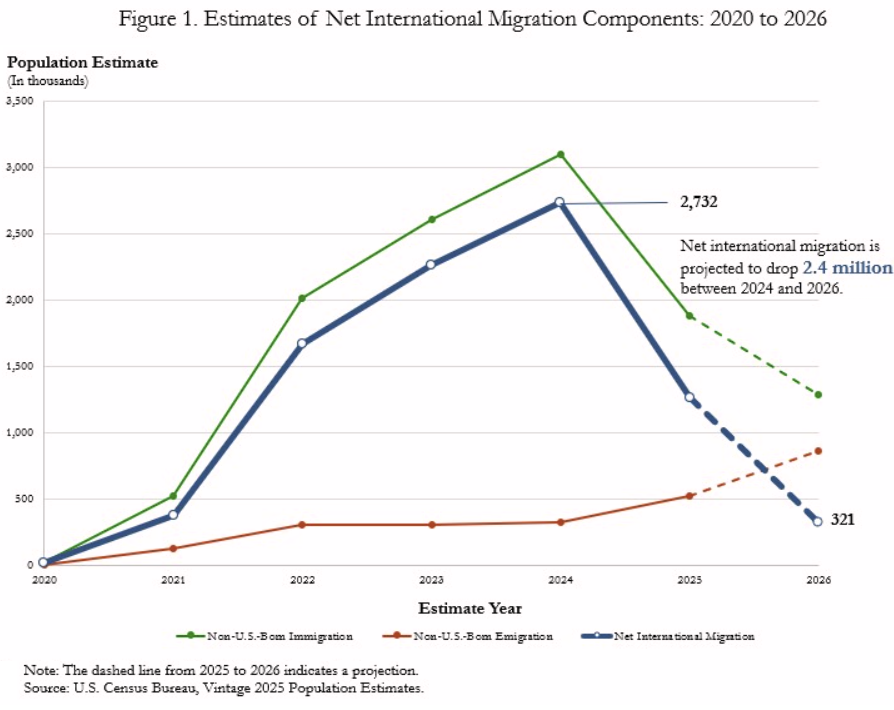
“Currently, the estimates of NIM [Net International Migration = immigration minus emigration] are trending toward negative net migration. If those trends continue, it would be the first time the United States has seen net negative migration in more than 50 years,” the Census Bureau said in a comment on its population estimates released today.
Net International Migration – immigrants minus emigrants – in the 12 months to July 1, 2025, plunged by over half to 1.26 million people, but that period is still a mix of six months of Biden’s immigration policies and six months of Trump’s immigration policies.
“If current trends continue,” the Census Bureau said today, NIM is “projected to further decline to approximately 321,000” in the 12 months to July 1, 2026. And it may turn negative the following year (green line = non-US-born immigrants; brown line = non-US-born emigrants; bold blue line = Net International Migration):
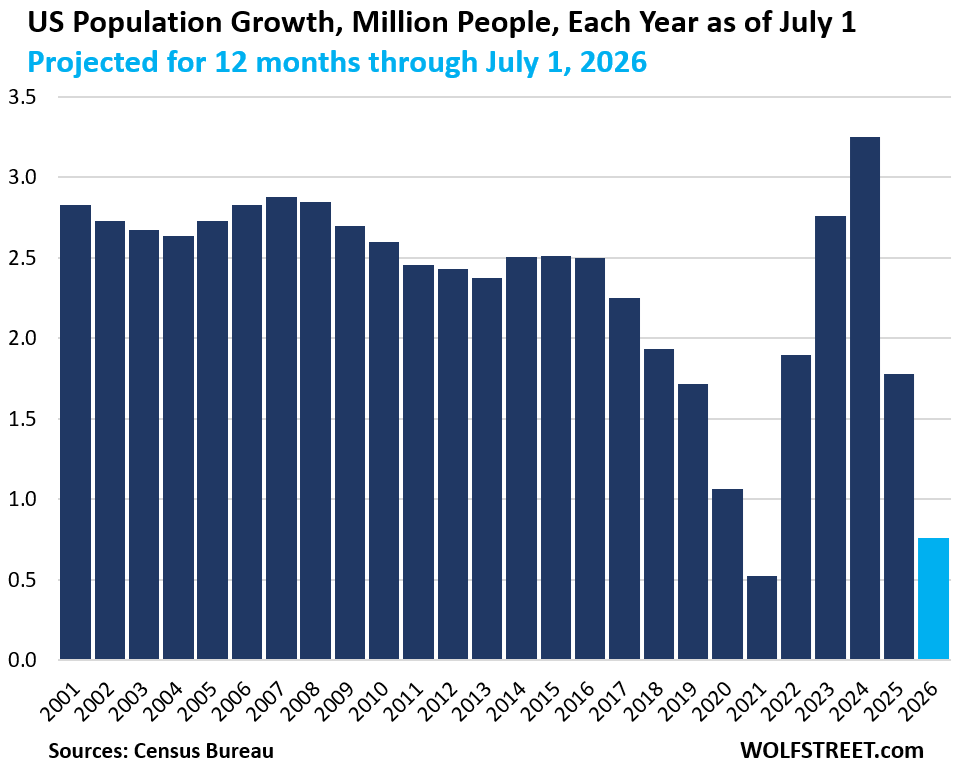
The total US population increased by 1.78 million people (+0.5%) to 341.78 million in the 12 months to July 1, 2025.
The increase was the result of 1.26 million people from net migration – the mix of six months of Biden’s immigration policies, and six months of Trump’s immigration policies – and 519,000 people from natural growth (births minus deaths).
For the 12-month period through July 2026, the total population would increase by only 756,600 (+0.2%), shown in light blue in the chart below, according to projections by the Census Bureau today.
But it cautioned that projections are always based on the prior 12-month trend, so the trend through July 1, 2025, which included six months of Biden’s immigration policies, and that a full 12 months of Trump’s policies could produce even lower population growth for the 12 months to July 1, 2026 (to be released in December 2026). Chart from the Census Bureau:
The Census Bureau had been struggling to account for the sudden and huge waves of immigration under the Biden administration that caused the Census Bureau to dramatically underreport population growth for those years. But in December 2024, using new data sources, including from ICE and the Department of State Bureau of Consular Affairs and Refugee Processing Center, it revised up its population estimate by a huge amount: Over the three years through December 2024, the US population had increased by nearly 9 million people, according to the further revised data released today.
Then came the 2025 crackdown on illegal immigration, the deportations, and the “voluntary deportations,” plus tightening up of legal immigration, that produced another sudden and huge change that even the prior year’s new data sources could not pick up – one of the issues being that the data sources could not track people who’d left and were no longer living in the US.
And so the Census Bureau had to find additional data sources to track the people who were no longer in the US:
“Measuring emigration presents unique challenges because this population is no longer in the United States to respond to a survey or census. Further, there are very few mechanisms to remove the records of these people from administrative data after they have emigrated.”
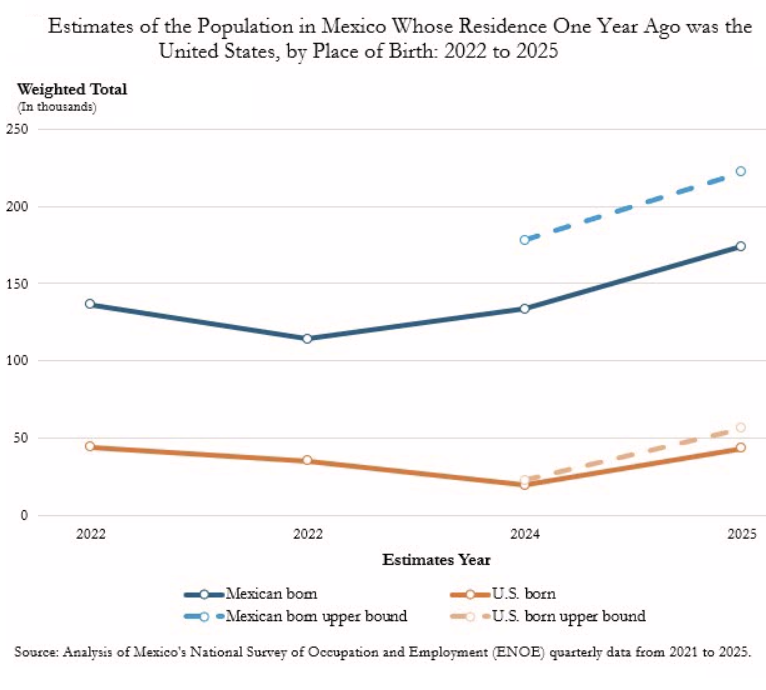
The new sources of the data for emigration include, among others, repatriations data from the Department of Homeland Security and data from Mexico’s National Survey of Occupation and Employment, which includes a question about a respondent’s Residence One Year Ago (ROYA), which produced an estimate of Mexican-born and US-born people whose ROYA was in the US but were now living in Mexico (emigrants).
The chart below by the Census Bureau shows the population now in Mexico whose residence one year ago was in the US (blue = Mexican-born; brown = US-born; dotted lines = upper bound of the Mexican survey data:
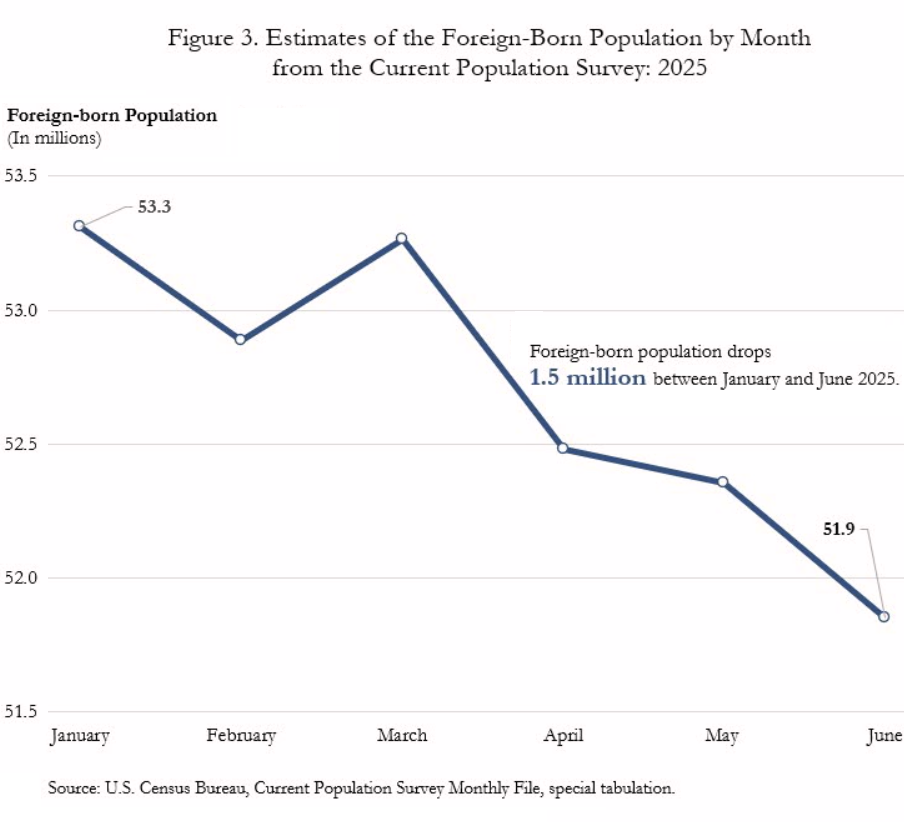
The Census Bureau also conducts a separate monthly survey for the Bureau of Labor Statistics, the “Current Population Survey” (CPS), which the BLS uses for its labor force data. This survey includes the data on the foreign-born population in the US.
Today, the Census Bureau showed the trends through July 1, 2025, accounting for the first six months of the Trump administration immigration policies.
The foreign-born population per the CPS declined by 1.4 million over these six months, from 53.3 million in January 2025 to 51.9 million in June 2025.
But the Census Bureau cautioned:
“While the change in the foreign-born population in a survey over time can imply emigration, it can also reflect survey non-response, coverage error or the impact of population controls.”
And it said that the CPS is based on a “relatively small sample size” compared to the American Community Survey (ACS), “especially for the foreign-born population.” The ACS is the Census Bureau’s huge population-survey data trove.
And it said:
“We have historically used ACS data instead of CPS data to estimate the size and geographic distribution of the foreign-born population. However, the CPS provides more current estimates with the monthly files, making it a valuable benchmark that informed the emigration research for Vintage 2025.”
Hugely important for Employment and Housing.
The Bureau of Labor Statistics will incorporate these new population data into its employment-related data, whose survey results it extrapolates to the overall US population. This affects total employment, the labor force, unemployment, participation rates, the employment-to-population ratio, etc.
We have seen in the second half of 2025 that growth in nonfarm payrolls in the private sector was weak, while the federal government and state governments shed jobs. But the unemployment rate has remained very low, and applications for unemployment insurance have remained very low, and average hourly wages have continued to rise at a solid clip.
Many observers, including us here, and including the Fed, have noted that one of the reasons for low growth of private sector payrolls combined with the low unemployment rate and the solid wage pressures must have been the dramatic slowdown in population growth in 2025, especially in the second half when the new immigration policies were being implemented.
And the housing market is going to feel it. The construction industry has been putting up on average 1.45 million new housing units per year, for-sale and rental units, single-family and multifamily all combined. Each housing unit on average is occupied by 2.5 people in the US overall. So very slow population growth, and even slower as projected, would further reduce demand in the housing market amid this surge in new supply. Bring on the new supply! Lots of new supply and slow population growth may solve a lot of problems in the housing market.
And consumer spending has been losing the engine of population growth. Yet, consumer spending, adjusted for inflation, has continued to grow at a solid pace, on rising incomes and big capital gains.


Consumer spending is not just losing the engine of population growth. It is losing the power of the consumers purse. Other than the top 10%, the proletariat is strained for resources: increased pay and benefits. The CPI is a gamed joke!
Just a point on immigration and growth – immigration pushes absolute economic growth, but not necessarily wealth per person. If you get down to basics, the wealth generated by a country is the productivity average per person. If the incomers on average produce lower productivity than the existing average, it reduces wealth pp (yes, I know this is super simplified). This is of course why so many countries put an emphasis on young, educated immigrants, but this is essentially stealing the best and brightest from poorer or more troubled countries.
As a general point, the huge drop in birth rates (which is actually a drop in people coupling up, not babies per person) seems worldwide and general now – we see it in Asia, South America, even in traditional highly fertile Middle Eastern countries. Only a few traditionalist cultures seem immune. I don’t think anyone has come up with a solution, assuming its necessarily a bad thing.
Aye. I think this point is underappreciated, even though it’s obviously true when one thinks about it. It we have enough immigration to increase population by 5% but our GDP rises only 2%, are we really better off? GDP-per-capita is surely the better metric… But that’s not what our politicians use.
And as for stable or even falling populations, I think you’re right to question whether or not that’s “necessarily a bad thing“. After all, we CANNOT have exponential population growth until the end of time. If we do, we’ve eventually run out of physical room for people and start pushing them out into the sea. At some point we must stabilize.
But it is worth noting that the economy changes with a stable or falling population, specifically in that the need for new housing and new infrastructure largely goes away. If population falls rapidly, you could end up with problems with abandoned housing or now-oversized infrastructure that cannot be adequately maintained with the workforce at hand. So I suspect that a slow population decline would be smoother.
But if housing costs drop, and even signifficantly, labor costs will drop, and purchasing power will increase for other things, so all will go to healthcare, cause education will be done by AIs, amarright?
I think falling population is neother a good or a bad thing. It is just a thing and we will have to cope with it one way or another. But I’d say we can be very certain that an policy attempts to change it will fail. Either by being too wrak to actually do anything or being so strong it has very unfortuante consequences. We just have to look at the one child policy of China (and the five pests campaign) to see how such a zero sum policy can lead to massive unintended consequences.
The way I see it, population decline is neither a good nor bad thing – its a reality of life now, whatever the core reasons for it (there seems to be no consensus among demographers on this). Leaving to one side distributional issues, I don’t see it as a problem for economic growth if productivity can be increased proportionately, although in reality this would mean a very rapid increase in capital intensive investment. The Japanese, as usual, are ahead of everyone else on this, but even with their famously consensual brand of government it is causing huge strains.
There is also a deeper question of ‘growth’ and how to measure it in relation to actual human welfare, and whether we can decline in growth while improving welfare – I think we can, but its a debate that has not really gained any traction yet at the levels that matter. For now, we are entering a world of zero sum economies, where every economic unit is trying to grab more than its share of wealth before planetary limits hit us hard.
I believe GDP includes legal fees even for unnecessary litigation. It also includes medical fees even for unnecessary treatment. It might contain insurance fees to cover both. At least in my part of the economy……medical and surgical…..an easy half of the fees of the half of treatment and litigation that is necessary are inflated. So if more immigration means more total joints that are not necessary and paid for by the government which is the case now at least in California is that really progress?
Yeah, this is something the “GROAF the population at all costs!” policies the Liberals pushed in Canada led to. The Visual Capitalist graph of real GDP per capita between 2014-2024 is stark ; Canada (the world’s poster boy for turbo megacharged infinite immigration) on a per person basis tread water AT BEST, and in reality the average person is almost certainly poorer due to the housing price explosion, deteriorating services, and all the rest of the strains attributable to population growth.
But the banksters looove it.
No matter how you slice it, less humans the better.
A gradual reduction due to lower procreation is definitely the better way to go than the plan of the oligarchs which is genocide, war, AI slavery and Gaza-fying the majority.
Afaik, Japan 1990-now is an example of “gradual reduction” in a developed economy. IIRC an economist Dean Baker blog post mentioned this was good for most Japanese workers. Basically Japan has had near full employment as every working-age person was needed to maintain society plus the increased elder-related jobs.
Japan is a nation that allows very limited immigration, so the effects may be different than a high-immigration nations like USA. Even with the Trump limited immigration policy, I doubt immigration would become as limited as island Japan.
Japan & macroeconomic gurus feel free to comment if my understanding is correct.
Thank you for pointing out the difference in immigration policies. Sometimes it seems like USians feel that some sort of open borders policy is the norm everywhere, and it is not. While the extreme liberals wring hands about ‘diversity’ or lack thereof in the US, I don’t see many Asian countries, for example, longing for a larger white European immigrant populations, which is perfectly OK!
Agree with you and motorslug – we have too many people on this planet already and consciously reducing levels gradually is the way to go. I’m not all that sanguine the world can accomplish that, since every time we see a trend noting a population decline, it’s presented by those with economic concerns as a problem.
I see the argument all the time that we need moar immigration as the USian population ages, otherwise who will take care of the olds? Who will do all the work? Well, we tried bringing in a bunch of foreigners to work on the real cheap in the past, and I’d thought we later decided that slavery was a bad idea…
Humanity has undergoing a process of domestication for the pasr 5,000-7,000 years. The few want to use humans as chattel, for their personal benefit. As such, they will always wring their hands when the herd shrinks in numbers. A hungry herd, easily replaceable is much more easy to control. Remember the Black Plague in Europe and in England? How polloi’s wages went through the roof, through the roof I am telling you, and they dared to wear clothes made from prohibited textiles colored with prohibited colors (for their statusI mean)..?
The current few seem to be taking a different view in that they want far fewer of the plebs. After all the plebs as they see them (and that includes all of us here) tend to complain a lot and get in the way of their plans. It may seem like a comspiracy theory, but from what i can see there is a significant proportion of them beginning to think that AI/robotics can do allthe grunt work, along them to do away with the majority of humanity and leaving them to live in their ideal world. Notice the attempts to break the taboo around the idea of nuclear war.
And their is precedent for this. The Nazi hunger plan effectively amounted to Europe can produce enough food for a population of x. The population of Europe is x + y. Therefore y has to be eliminated.
No, the fall in population in Japan did NOT improve conditions for Japanese workers,
Japanese society really is group oriented. Young men joining the workforce in the 1990s were much less likely to get lifetime employment and instead were “freeters” as in more casual workers even if for a big company or companies. They had much lower earnings, They rarely were able to get married. They were effectively rejects in Japanese society.
One of the somewhat baffling outcomes of demographic decline is that instead of making workers more valuable, if anything its the opposite. Japan, Taiwan, China and South Korea all have very significant youth unemployment problems, which is in most cases partially obscured by the number of young people either ‘engaging’ in the gig economy or in just ‘lying low’.
It may be that structural issues in countries with financial repression and export oriented sectors means that the upper percentile of young people are prospering (big wages for well qualified college leavers), while the majority are becoming dispensable. Japan and other Asian countries dealt with this in the past by having a deliberately low productivity service sector to soak up unemployment. This trick doesn’t seem to be working any more.
Well, not sure if it translates to the larger set, but my experience in South Korea was that the younger – and even not-so-younger – folks preferred unemployment to taking the DDD (Difficult, Dirty, Dangerous) jobs that were on offer. Met a fair number of Filipinos who were on what I called a 90 Day Job Schedule – they’d work up until their 90 day tourist visas expired then blow down to Pusan to hop a ferry over to The Land Of The Rising Sun. Spend a day there, come back, get a new visa, and back to work.
Also knew a secretary at our office who was essentially working two full-time jobs because her husband did not want to take anything that wasn’t white collar. Want to guess how much work he at least put into housework and child maintenance? She was a very nice – and very frazzled – lady…
and yet, even with negative pop. growth in California in general and San Diego in particular (since 2020), the builders are always screaming that more housing is needed. Never mentioned is that every new development sees the available homes tuned mostly into short term rentals and does nothing the alleviate the over-priced rental market.
I am sure that the Market, with the combined genious and generations of intense study and dedication to the topics related to the economy, these Phds and economic titans, these veritable economic gods, will come up with optimaly efficient solutons and actions beneficial to all stakeholders concerned. I would think, with all the money and brain power devoted to this science of economics – those solutions ought to pour out like water from a cloud or perhaps a spring, or like spring itself in a glorious outburst of color and life.
That they do not seems to reinforce the notion that they are little more that lap dog post-hoc rationalizers for the elite.
The latest UN data forecasted a USA population of about 380m in 2050 — which might turn out to be a tad optimistic.
There was a huge immigration wave into the USA in the late 19th century, which led to a backlash (culminating in the Immigration Act of 1924). Between 1925 and 1965 (when the immigration laws were substantially liberalized), there was remarkably little immigration into the USA. So the current backlash might be history rhyming, if not exactly repeating itself.
A big difference this time around is that the USA’s fertility rate is much lower than it was back then (especially in contrast to the postwar baby boom). What might also be different this time is if lots of USA citizens — especially well-educated high-income ones — decide to emigrate. Globalization cuts both ways.
Seeking perpetual population growth for the sake of perpetual economic growth is nothing but an unsustainable Ponzi scheme.
But if you get in on the ground floor…. ;-)
Courtesy of Grumpy Engineer we could see some of these numbers here in comments yesterday. Net immigration is falling hard, yes, and will probably turn negative soon. Is there anything fundamentally wrong with some population loss? Possibly in debt-based economies it appears to be absolutely wrong but my question is more “fundamental”. Is anything wrong with human population contracting somehow? Or do we have to go for planet exhaustion ASAP?
I don’t think we can evade the fact that the fundamental problem is not the number of people, its how much we consume and how we consume. Even within the developed world, there is a huge disparity – the average Swede (for example), uses a lot less of the worlds resources than the average Canadian. We could get rid of 80% of the worlds population tomorrow and not solve the planets problems if that 20% kept consuming and polluting at the rate of the most ‘advanced’ countries.
I do think that rapid population decline – which now seems inevitable – is both a desirable and manageable problem. But it requires comprehensive policy changes and a lot of joined-up-thinking, a very scarce resource these days.
I’m back in school pursuing a much-delayed undergraduate degree (the plan is to head off to law school shortly). I have to take a few required courses, among which is a geological science course. It surprised me to learn that population projections are a part of that field, and that the Reverend Thomas Malthus retains some degree of influence, despite having been, to my sense, thoroughly discredited by Marx and Engles.
I hadn’t thought of the impact on the housing market of this immigration crackdown. It still isn’t worth it.
If the US government really, really, wanted to clamp down on immigration to the USA, then employer fines could have considerable power.
Trump, et all, know how to sanction people/countries all over the world, but not US employers who employ non-citizens.
Large employers, such as Trump donors, like cheap, disposable labor,
The US military is a large employer, and even if only citizens enlist for military employment, the enlistees’ hands may have been forced by the lack of decent jobs due to wage suppression at the low end by immigration.
Trump and his friends likely appreciate wage suppression for their business profitability.
Elected Democrats and Republicans could promote effective employer sanctions/fines as a way to control immigration.
The program could be self funded, a popular point with “balanced budget” politicians.
But they won’t.
My understanding, especially from various postings here by NC, is that all this effort is directed at immigrants themselves, to scare them off and convince others to just join the servitude bound scheme of H2-B (I am spitballing here) working visas, which makes you an indentured worker… So why go after the employer when you can go for the employer…
They tried that in the Immigration Reform and Control Act of 1986. At the time, the NAACP and AFL-CIO endorsed employer sanctions using the nativist argument that immigration undercuts wages. They both reversed course soon after, as they got criticism from the left.
Bush tried it, too, with publicized raids on certain industrial sites. In some cases, the tactic ended up killing whole towns.
I don’t have the answer. I’d thought the same as you for a while, before reading Aviva Chomsky’s book on the subject. Some form of amnesty and a borderless movement for worker’s power, however pie-in-the-sky it may be, is the only satisfactory path I’d want to go down.
In my view, a borderless labor movement would, similarly to water seeking its own level, tend to bring unskilled/low wage wages down.
My late brother had a small roofing company in Los Angeles some years ago and he told me he could not raise his workers’ wage rate for a 20 year period and remain competitive in bidding.
While an economist might assert that “labor creates its own demand” , I don’t ascribe to that view.
If a union is restricting its labor supply to an employer during a strike, it doesn’t seem to welcome an influx of new workers willing to work for less as they are referred to as “scabs”.
With all the USA recent immigration, the USA seems to have become a more unequal society, not more equal.
Maybe inequality is partially correlated to new labor arriving in the USA?
One can make the case that the USA has enjoyed freedom from foreign invasions, tapped/grabbed vast internal resources and extracted vast resources from the rest of the world, so the USA SHOULD “share the USA economic bounty” with the rest of the world via more immigration.
In the past. that economic sharing seems to come from the USA low wage sector’s slice of the economic pie.
But, one can suspect that this economic sharing is now rippling up through the USA college educated middle class, via out-sourcing overseas and in-sourcing educated workers.
The American working class “got old before they got rich”. The U.S. is on a terminal trajectory toward a managed decline model similar to Japan, but without Japan’s level of social cohesion or per capita savings. Even with a foreign population at roughly 3%, compared to over 10% in most OECD nations, Japan is currently facing a political backlash due to the sudden visibility of its demographic shift, amplified by foreign tourists.
The demographic arbitrage of bringing in younger workers who were already subsidized, raised, and educated by other nations held up the US dependency ratio. But like all arbitrages, the movement is towards equilibrium, and this was never a long-term solution. “The wise do at once what the fool is eventually forced to do.” Unfortunately, our fools would rather choose to die on their thrones, and countercyclicality still rules the economic superpowers.
The shift in economic planning has already moved from labor-intensive growth to resource-intensive AI computation: Silicon over education, watts over calories, society as an externality. Young families are nowhere in this picture. Is it any wonder that this “AI boom” is the gerontocracy’s desperate attempt to find a digital labor force that doesn’t require a pension or a vote.