Yves here. Your humble blogger is making an exception to our general rule of not allowing AI content on the site by featuring this holiday sampler from Thomas Neuburger, which combines a climate update with AI fakery examples. The latter ties into our post earlier today on AI fraud and rising concerns that some videos, even when subjected to forensic exams, cannot be determined to be genuine or not.
By Thomas Neuburger. Originally published at God’s Spies
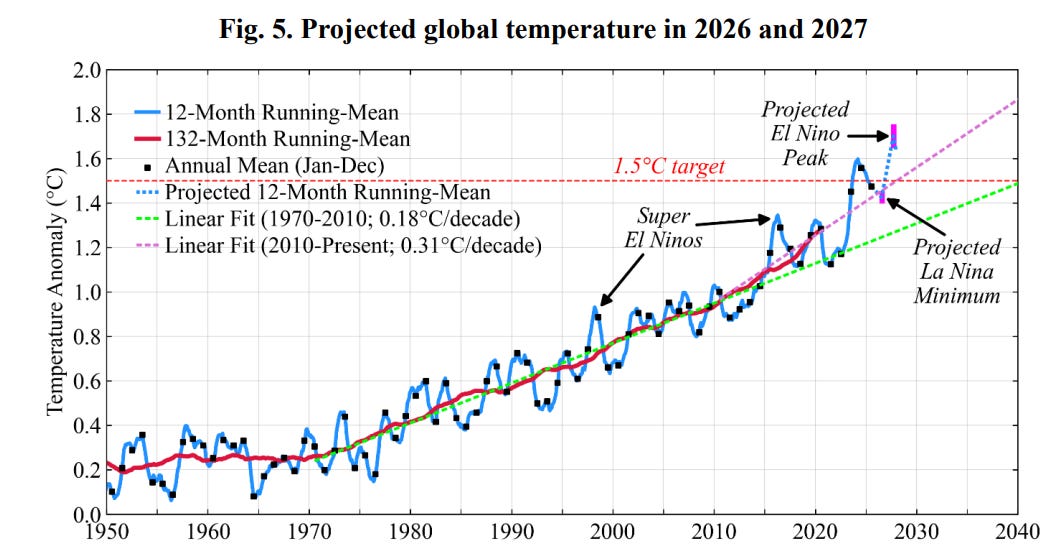
“We project a global temperature record of +1.7°C in 2027, which will provide further confirmation of the recent global warming acceleration.”
—James Hansen
Climate: You’re Soon To Be Here
For those who wish to stay informed, here’s Jim Hansen’s climate latest (available here). Emphasis mine below.
Abstract. Global temperature in 2025 declined 0.1°C from its El Nino-spurred maximum in 2024, making 2025 the second warmest year. The 2023-2025 mean is +1.5°C relative to 1880-1920. The 12-month running-mean temperature should decline for the next few months, reaching a minimum about +1.4°C. Later in 2026, we expect the 12-month running-mean temperature to begin to rise, as dynamical models show development of an El Nino. We project a global temperature record of +1.7°C in 2027, which will provide further confirmation of the recent global warming acceleration.
No tipping points showing yet, but acceleration confirmed. Elsewhere in the paper he says that the “accelerated rate” is “0.31°C per decade.” If that rate stays stable (i.e., no further acceleration), it yields the following in the next few decades:
         2035 — +1.81 °C
         2045 — +2.12 °C
         2055 — +2.43 °C
         2065 — +2.84 °C
Remember, that’s not based on models. It just takes today’s rate of change and sees where it leads — and assumes no further acceleration.
As you’re reading this, ask:
- What will a +3 degrees warmer world look like?
- Will you be alive in 2065 or so?
The ten-year-olds in my family will be 50 by then. The middle of their lives. Not good.
(My prediction for ppm CO2, similarly accelerated, is here. Hint: 2050 tops 500 ppm. Ouch.)
AI Forever (For a While)
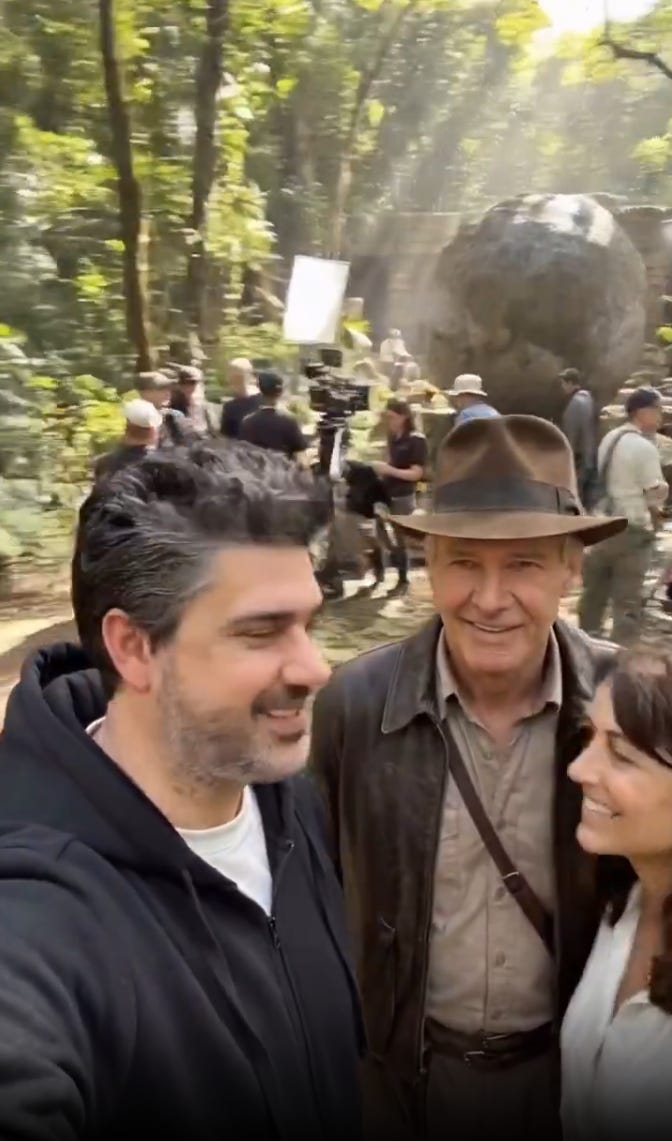
We haven’t hit Peak Tech yet (we will, and grade schoolers will see it), so we haven’t yet seen the peak of AI fakery. But check out this short video (screenshot below). It’s must-watch and less than a minute long.
When our grandkids are adults, gathered around 2110 fires, what tales they will tell of our marvels, long since gone!
The faces are almost correct, and the casual friendly gestures are quite human-like. For example, in the first setup (Lord of the Rings), the redbearded Gimli’s closing movements are quite natural, as is Harrison Ford’s smile in the Indiana Jones setup. Karen Allen’s face isn’t right yet, as are some others. But they’re getting there.
For another, check this out:
Or this:
Music
The above reminds me of that now-ancient classic, “What kind of fakery is this?” by the once-remembered Amy Winehouse.
For the big-band experience, try this. Enjoy!


In the video “Lord of the Ring 80s family sitcom” the body proportions seem quite wrong for a number of characters. Typically, the head is too big, the torso too short, and what about the oddly proportioned and twisted pelvis of “father Aragorn”?
The video “Greek gods movie cast” rehashes gaming / heroic fantasy aesthetics.
Unfortunately, Gresham’s law also applies to the cinematographic sector, so all this will probably dominate the screens in the future.
As for climate change, a few years ago I got the definite feeling that we were doomed, and every year the information about the evolution of the climate and the resulting projections have been reinforcing my impression. I will not be alive in 2065, but I should be able to live long enough to see the average temperature solidly above 2 degrees.
Has AI has potential to kill the cinematographic industry? No more filming and no or little of people willing to watch AI-produced crap?
I tend to think there is an economic factor: if AI makes it straightforward to generate good-looking movies, and the tools are widespread, then:
1) Many people will be able to produce something — and a deluge of content will be upon us. Since the maximum size of the audience is fixed, and the time it can devote to searching for and then viewing films is physically limited, the income per film will crash — just like songs have only a marginal worth on Spotify (where many of them are actually generated, not composed and played).
2) Because it will be general knowledge that plentiful of films can be produced cheaply, people will refuse to pay outrageous prices to go view them in theatres, and be extremely reluctant to fork money for ever-increasing subscriptions to streaming networks; as for distributing them on physical media, the minimum scale for a production run will make the endeavour inherently unprofitable. If producers attempt to demand a higher price for their films, people will simply look elsewhere for something cheaper.
Hence, the film industry in its current configuration will not be able to be sustained: there will be no place for film majors with their heavy infrastructure or studios; or for super-expensive star actors and actresses; or for theatres; or for streaming companies with expensive VOD infrastructure and their own production teams. Maybe Youtube will end up being the only viable (because of Google’s advertising infrastructure and dominant position) channel for hosting and distributing all those videos — genuine artistic productions and slop alike.
If I were to imput the Roman Republic novel series by Colleen McCullough and get a decent TV series, I would watch it…
I am not sure the stars will go away. As people get lonelier they seem ever more willing to hand over unlimited cash for a tenuous connection to whoever is the vibe-thing of the moment. The mechanics of how the cash will get handed over is hard to figure out though.
Film industry is not going away.
See Ari Folman’s The Congress.
Is there any good resource tracking the climate impacts on food? I find occasional headlines about some climate-impacted drought killing crops in a region, but it’s hard to track over time and know how many parts of the world are affected
I recall someone here knowledgeable about climate once remarking that scientists had assumed linearity or something like that, rather than possible runaway tipping points. Or maybe it was policy makers.
Either way. It’s gonna be lit. There are points of no return and we don’t necessarily know when we’ve hit them.
Obama was the point of no return.
Jim Hansen is one of the greats, and he’s absolutely right to be sounding the alarm: we are running out of time and may already be past some safe thresholds. That said, I’ve always been puzzled by climate science’s insistence on drawing straight lines through data that are clearly not linear.
Of course, you can fit almost any curve to a short run of data. But in this case there’s a strong physical and economic rationale for thinking in exponentials, not straight-line “accelerations.” Exponentially rising temperatures are driven by exponentially rising CO2 concentrations, which in turn reflect an economy built around exponential growth in energy and material throughput.
What Hansen calls “acceleration” is actually a built-in feature of exponential processes: the slope increases in proportion to the level, which implies a doubling time. Using the temperature trend shown here, that doubling time is roughly 25 years (depending on whether one fits all the data or the post-1980 period). On that basis, there’s little ambiguity about where we’re heading: 2°C arrives around the late 2030s, plus or minus a few years, without any need for further acceleration.
What’s more troubling is that damage is arriving much faster than temperature itself. Insurance industry data suggest severe climate-related losses are doubling roughly every decade – a far steeper curve than the temperature plot. In other words, even if warming were to proceed “smoothly,” the economic and social consequences are already behaving non-linearly.
The uncomfortable takeaway is that the straight lines may be comforting but the world we’re entering won’t be.
As for AI, let’s just call it what it is – AS for artificial secretary. Or maybe artificial special secretary might be more appropriate?