Yves here. John Helmer explains how the electric war in Ukraine has been an example of Russian, or perhaps more accurately, Putin’s restraint. Helmer’s early coverage suggested that the Russian General Staff was keen about using the campaign against the grid and production facilities to drop the hammer on Ukraine. However, as we have pointed out, Russia has been running a coalition war, economically if not militarily. It depended on the support of China and India, which emboldened other Global South states to follow suit, in defying the US/NATO shock and awe sanctions and continuing to trade with Russia. And these countries, particularly China, have been uncomfortable with Russia invading a neighbor, even though they accepted that this was the least bad of Russia’s option.
But those considerations mad it necessary for Russia to behave in the internally conflicted manner of prosecuting the war but in the most minimal manner possible, as in focused on achieving Russia’s security objectives, meaning securing Ukraine’s neutrality. That stance had some advantages for Russia, since a less bloody-minded prosecution of the war would at the margin reduce resentment in Ukraine and potentially even in Russia after the war. Recall many in Russia have relatives in Ukraine.
Putin has mentioned in a recent stern statement to Europe that if you insist on war with us, we’ll oblige and we are ready now. Part of those remarks was saying that Russia had not conducted a full-on war in Ukraine, so effectively, Europeans have no idea what they were asking for. Experts pointed out early in the war, for instance, that it was unheard of for Russia not to take out cell and internet service and to leave broadcast capabilities intact. So the limits on the electric war so far are part of that picture.
By John Helmer, the longest continuously serving foreign correspondent in Russia, and the only western journalist to direct his own bureau independent of single national or commercial ties. Helmer has also been a professor of political science, and an advisor to government heads in Greece, the United States, and Asia. He is the first and only member of a US presidential administration (Jimmy Carter) to establish himself in Russia. Originally published at Dances with Bears
In an unusually frank analysis of the General Staff’s electric war campaign since 2022, Vzglyad, the semi-official platform for security analysis in Moscow, has acknowledged that three years of strikes against Ukrainian energy targets have fallen short of their military objective because the targeting has been restricted by President Vladimir Putin’s tit-for-tat order.
But now that order has changed. Or has it?
Ukrainian military bloggers were reporting on Tuesday afternoon (December 23) that “as a result of the morning strikes of the Russian Armed Forces, the Rivne, Ternopil and Khmelnitsky regions of Ukraine were completely de-energized. There is a risk of disconnection in Vinnytsia, Chernigov, Zhitomyr, Dniepropetrovsk, and Kharkov regions.” The capacities for repair and replacement of damaged energy facilities has “almost dried up”, they add.
If this is the current situation, does this mean that the successive waves of electric war operations – October 10-12 and 16-20, 2022; October 22-27, 2023; March 29-30, 2024; June 1, 2024; and November 7, 2024 — failed in their cumulative impact?
Answers a veteran military engineer and specialist in electric warfare: “The electrical spare parts coming from Europe via rail could have been stopped. The yards containing spare transformers, service vehicles and equipment could have been put out of commission; multiple high-voltage cable towers — easy targets! — could have been hit at the same time. Coupled with strikes on the substations, service equipment yards and supply logistics, such a campaign would have quickly overwhelmed the Ukrainian capacity to effect repairs in anything resembling a timely fashion. Why hasn’t this happened, or why is it, apparently, happening only now?”
“Can you imagine the war continuing if the 33 main Ukrainian electrical substations and the towers carrying the lines to and from them had been destroyed in the autumn and winter of 2022/23? If the railways from Poland and Romania had been de-electrified, had their rolling stock and engines smashed? If the rail and highway bridges carrying Ukrainian re-supply had been bombed?”
“Unless the decision-makers in the Kremlin are stupid, which we know they are not, striking again in 2023, 2024, and 2025 without finishing off the Ukrainian electrical grid can only be explained as a political decision – that’s to say, President Putin’s decision.”
In Moscow on Tuesday, this is publicly admitted for the first time, albeit by inference between the lines and under a byline that is fake.
Vzglyad, the state-funded publication of military, intelligence, security and economic analysis, headlines its report with an irony — “Zelensky’s stubbornness is finishing off the Ukrainian energy industry”. The text which follows makes clear that stubbornness has been a problem from the beginning of the electric war – not in Kiev but in Moscow.
Note that unlike most Vzglyad reports, no source has been cited by the author, Nikolai Storozhenko. No trace has been found of this name as an active writer for Vzglyad. The name belonged famously to a literary historian and Shakespeare scholar in Moscow in the mid-19th century. The use of such an obvious alias carries the invitation to knowing readers to understand this as a semi-official editorial.
Click to read the Russian original.
In this verbatim English translation, pictures, captions, and data charts have been added for the English reader.
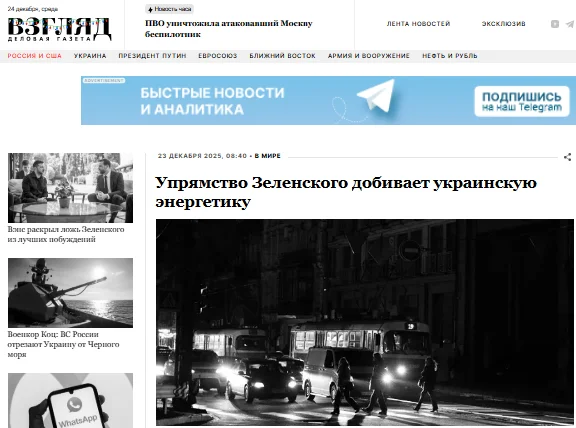
Source: https://vz.ru/world/2025/12/23/1380463.html

December 24, 2025
Zelensky’s stubbornness is finishing off the Ukrainian energy industry
By Nikolai Storozhenko
By the end of 2025, Ukraine’s energy capacity has been reduced by more than half. Residents of Kiev, for example, receive electricity for an average of 8 to 11 hours a day. The consequences of this are felt primarily by the Armed Forces of Ukraine, but also by the Ukrainian economy as a whole. But Ukrainians can only blame the head of the Kiev regime, Vladimir Zelensky, for this – Russian strikes are being carried out only in response to his actions.
To begin with, we recall that Ukraine’s energy supply facilities did not immediately become targets for attacks by Russian forces. This happened only at the end of 2022, in response to the explosion of the Nord Stream pipelines and the attack on the Crimean Bridge.
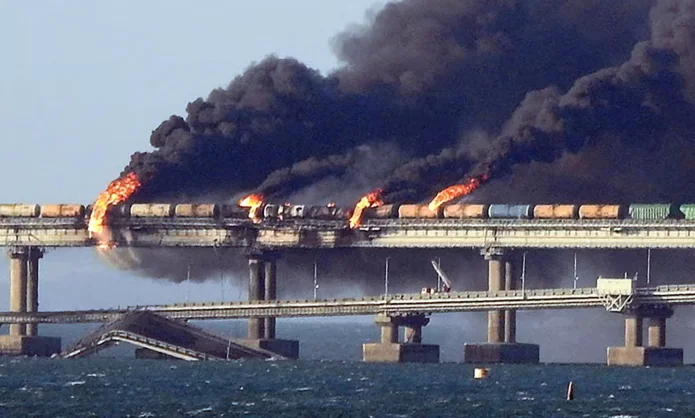
The first Crimean Bridge attack, October 8, 2022. Click to read analysis of the modus operandi -- https://johnhelmer.net/the-ukrainian-m-o-for-the-crimean-bridge-attack-this-is-how-the-operation-worked-to-the-point-of-detonation/ For a US military school analysis: https://lieber.westpoint.edu/kerch-strait-bridge-attack-retaliation-international-law/
However, since at that time the target of the strikes was mainly thermal energy and large generating facilities, the effects of the strikes were quickly stopped. By the end of 2023, Ukraine’s energy system had recovered almost completely.
This is why the attacks on Ukraine’s energy sector continued in 2024 and 2025. By then it was a completely different war, a reaction to the Ukraine’s systemic war against Russian oil refining. But that wasn’t the only thing making the difference.
Firstly, the facilities restored by Ukraine received supposed protection. As we now know from the details of the Ukrainian corruption scandals, this protection was often only in reports or ineffective (lined with sandbags on the sides), but it was still there. Secondly, and more importantly, the restored generation units began to be dispersed as much as possible, and large facilities were covered by air defence.
The main difference from 2022 is that it was already a full-fledged infrastructure war. The strikes of 2022 were loud and powerful, but they were individually targeted blows, like a slap in the face, the purpose of which is to bring the opponent back to reality and end the conflict with the threat of force. The focus of the punches has also shifted. Previously, these were the power plants themselves, but now they accounted for only one-fifth of the missiles and drones, while the rest were aimed at substations and power lines.
The fact is that it is possible to knock out thermal generation without system work, but what to do next? Up to 60% of the pre–war generation of Ukraine’s energy system is nuclear power plants, and you can’t really hit them. But consumers can be cut off from them, and the nuclear power plants would then have to reduce production. Hydroelectric power plants, which had previously been ignored, also came into focus.
As a result, the pace of recovery of the Ukrainian energy sector has decreased after the transition to systemic war. 70% of the damage was repaired only after nine months, and the cost of this has increased from $1.5-$2 billion after the 2022 strikes to $3-$4 billion dollars in 2024.
On the other hand, the leadership of the Russian Armed Forces at that time clearly did not give up hope that the Ukrainian side would come to its senses. However, by roughly November 2024 the strategy of pressuring Ukraine towards peace by shutting down its energy sector had come to naught. The ‘Black Winter’ which the Ukrainians were afraid of did not happen, and the entire 2024-25 heating season passed with a minimum of shocks and blackouts. Kiev had not been turned off at all.
How does 2025 stand out against the background of the previous two acts of the infrastructure war? First of all, the impact firepower is much higher. The number of missiles and drones has increased. According to Ukrainian sources, 5,200 in eleven months of 2025 compared to 4,500 in 2024. Second, the strikes have become more concentrated and are usually aimed at a single region, thus overloading the air defence system. In addition, the range of weapons used for this purpose has expanded (not only the Geran series is in business).
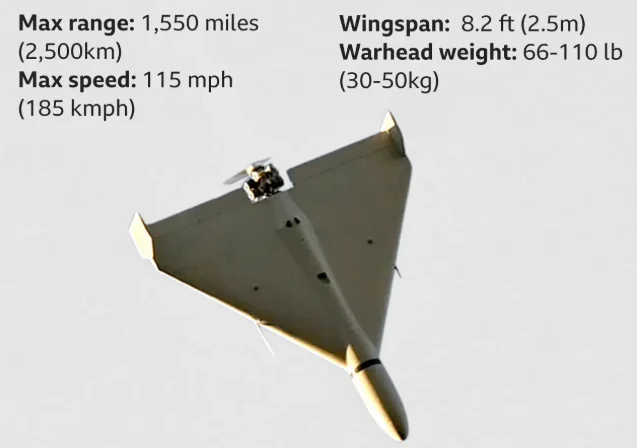
Source: https://en.wikipedia.org/wiki/HESA_Shahed_136
As a result, by the end of this year, according to the statement of Andrei Belousov, head of the Russian Ministry of Defense, more than 70% of thermal power plants, as well as more than 37% of the hydroelectric power plants providing energy to the military industry and the Ukrainian armed forces have been put out of operation. According to the Russian military, Ukraine’s energy capacity has been reduced by more than half as a result. This has also had a direct impact on Ukraine’s ability to resist. And, naturally, the damage to Ukraine from these strikes has grown significantly.
But even despite the increase in imports, the energy system itself is operating under conditions of austerity. For example, in December 2025, electricity is available to Kiev’s domestic consumers for an average of 8-11 hours a day. Moreover, half of this time falls on a late evening or night – that is, when consumers don’t really need it. The result is official warnings that a real energy collapse awaits Ukraine this winter. Funds for the repair of energy facilities in the country are almost exhausted.
The novelty of 2025 is massive strikes on Ukrainian gas production and underground storage facilities. In 2022-2023, such cases were episodic, and the damaged facilities were promptly returned to operation. In 2024, Ukrainian gas was seriously affected for the first time (damage in the amount of $500 million, reduction of production by 40%). In 2025, the damage estimate has reached $2 billion, and 60% of production is now out of service. In addition, the strikes themselves are no longer episodic and have been going on systematically since January. And they take into account the specifics of Ukraine’s need for this gas: the most powerful strikes followed in the autumn, disrupting Kiev’s plans to accumulate reserves by winter.
In addition, the focus on forcing the Ukrainian energy sector to peace terms has had the immediate effect of spurring migration. During the six weeks of autumn (October – first half of November), about the same number left Ukraine as had exited in the nine months, from January to September; that was about 300,000 people in total. The same effect was observed in 2024: the peak of departures – 200,000 people in June – occurred during the period of strikes on the energy sector. This is a double disadvantage for the economy — fewer workers and fewer consumers. For more on the Russian strategy of depopulation, read this.
The strikes themselves have significantly inflated the cost of living in Ukraine. Business already pays 10-11 UAH (Rb18-20) per kilowatt hour, which is almost 2.5 times more than the household tariff. However, during rolling blackouts, you have to switch to generators, and then a completely different math applies. Even the most economical generators have a price tag starting from 20 UAH (Rb36.5) per kWh. For low-powered generators, which are mainly used by small businesses, the cost can reach a cosmic 40 UAH (Rb73).
Of course, there is a separate category of industries which have achieved protection against blackouts. However, such protection costs about the same amount of money, since they have to pay for energy at the cost of its purchase in European Union (EU) countries.
In the 1990s and 2000s, cheap energy was the competitive advantage of Ukrainian products on the world market. However, running on a diesel generator makes energy for Ukrainian businesses at least twice as expensive as in EU countries (€0.4//kWh versus €0.15-0.2). And even the basic tariff is equal to the European one.
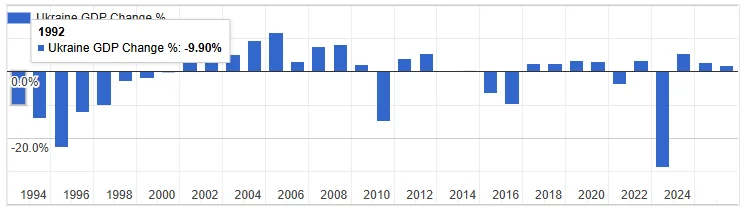
As a result, during October international experts have adjusted the optimistic forecast of GDP growth from the Ukrainian Ministry of Economy (0.7-1.2%). Now the International Monetary Fund (IMF) estimates growth of no more than 0.5%; the World Bank, a decrease of 0.2%.
ANNUAL UKRAINE GDP MOVEMENT IN PERCENT, IMF CHART, INCLUDING 2025-26 FORECASTS
WORLD BANK CHART FOR UKRAINE GDP, 1998-2024
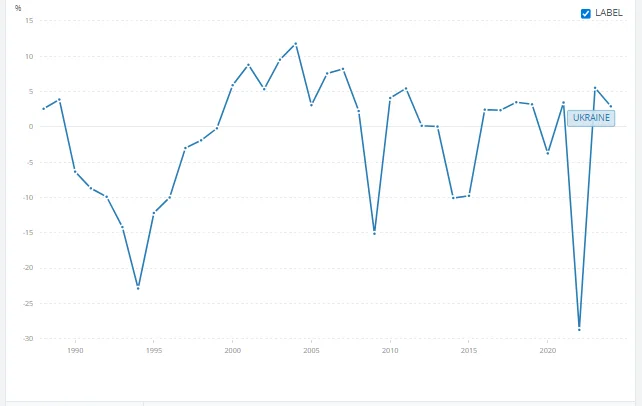
Source: https://data.worldbank.org/indicator/NY.GDP.MKTP.KD.ZG?end=2024&locations=UA&start=1988&view=chart
Their pessimism is based on the impact of the strikes and the cost of energy for Ukrainian businesses. With each passing day, there are fewer reasons to maintain production (processing) in Ukraine.
The EU is nearby, there are no problems with energy and labour, and the association agreement with the EU protects Ukrainian imports from duties. In this sense, there is still the big question — what will finish off the Ukrainian economy first, blows to the energy sector or Zelensky’s stubbornness.
A recent news story vividly illustrates this. It turns out that Trump’s team offered Zelensky an energy ceasefire back in July (with a guarantee that Russia would sign and maintain it). He refused and became very busy attacking Russian refineries.
 So the fall in Ukrainian GDP by the end of the year can be properly attributed to Zelensky. And that may be deducted from his corrupt severance pay. It was he who, by attacking the Russian fuel infrastructure, forced Russia to respond to the Ukrainian energy sector in a truly serious way in 2025.


The idea that “Putin could have blacked out Ukraine at any time, but chose not to” is greatly exaggerated. In fact, doing so would require a sufficient stockpile of missiles and drones, as well as the complete neutralization of Ukraine’s air defenses. This year may have been the first time he could have achieved that.
First, that claim appears nowhere here. My point about knocking out Ukraine’s critical infrastructure early on was limited to cell phones, the Internet, and broadcast. Many non-Russia military experts have expressed mystification that Russia did not do that.
Second, John Helmer’s contacts, who are very close to and may include those in the General Staff, disagree. Russia only targeted transmission early on and then surgically, much to the consternation reported by Helmer of the General Staff. It seems at a minimum they could have done vastly more damage with the same weapons with different targeting.
Whatever the reasons for Russia’s restraint, and I agree international considerations were high on the list, it seems to me the longer campaign is seriously draining Europe /NATO. Maybe that wasn’t a side effect.
Quite.
And Ukraine and Europe/NATO are even helpfully rolling kit, resources, and troops up to the lines to help Russia do that.
I am calling a friend in Kiew regularly as I am worried about him. He lives in the very center near a hospital and the famous Sophie Cathedral, the most important church of medieval Rus. He still has electricity most of the times and the internet works. But in other parts of Kiew there’s nothing half a day. Some suburbs don´t have electricity at all. Much worse is the situation in Odessa were there is no electricity for days on end. Interestingly the heating still works in all of Kiew which is quite surprising as the electric power stations also provide the heating. In Odessa though there is no heating either.
I think Russia is in a dilemma. They want regime change, neutrality and a non antagonistic stance of whoever is im power in Kiew. But they most definately don´t want to occupy all of Ukraine to achieve that. They also don´t want a power vacuum in Ukraine as Russia and major parts of Ukraine are joined at the hip. So the calculation is enough pressure to topple the current government but not enough to destroy the state as such. An occupation of Ukraine might have unforeseen consequences in Russia herself. Russia defines herself as a multi ethnic country. But the more Ukrainian territory is absorbed because “Ukraine is really Russia” the more Russian ethnic nationalism is increased. Interestingly because of the crackdown in Russia on extreme Russian nationalists these people are now fighting on the Ukrainian side. For now it is a manageable problem for Moscow but who knows for how long.
Interesting NATO..
There is not much doubt that Russia has had to hold back on attacks on the electrical grid over the years so as to keep his allies such as China, India and Brazil backing Russia. But the attacks have stepped up on the grid and I think that it has to do with the “negotiations.” Russia’s allies are now fully understanding what Russia is up against and how not only is Zelensky refusing to negotiate, but that the UK and most EU countries are acting like rabid dogs in wanting this war to continue. And they see that Trump is just flip-flopping his way with negotiations and not really trying – while continuously sending weapons, ammo, intel, etc. to the Ukraine. So probably Russia’s allies have thought about it and then told Putin that you know what? Just go ahead and do your thing. We get where you are coming from now.
I have doubts. I think in a long war of attrition, it is a more successful strategy to keep the system on the edge of collapse, continually draining resources to repair it, creating greater uncertainty, and making the system increasingly vulnerable to attack as well as internal failures. In addition to draining more resources, the gradual degradation of the energy systems raises the pressure on people to leave, as noted above. This is also a form of attack on the EU, as streams of desperate refugees are associated with substantial social costs, which may increase when their welcome runs out, and they feel betrayed by their NATO owners. I’m sure the importance of waging a careful and lawful Special Military Operation in Ukraine and the new Russian territories is high both to maintain international support and to avoid hurting a ‘brotherly people’, but I don’t think the prosecution of the campaign was that much of a compromise, and the attrition of capabilities and political stability in the west, and obviously in Ukraine has been extremely successful.
I think there is an additional political angle, over and above Russia’s relationship with its BRICS (and non-BRICS) partners.
There seems to have been an evolving vision in the Kremlin for what post-war Ukraine should look like. I am not completely sure – no-one is – where that vision has evolved to now, but I suspect it is leaning more and more into the “direct control” territory. Consider.
– In 2022, including long after the failure of the Istambul talks in March-April, there were no “external” regime change ambitions, at least none that were visible. Zelensky could stay, so long as he signed on to Russian terms. I personally hypothesize that Putin might have looked to Georgia in 2008 as an example – where after defeat to the Russians, the Georgian elites themselves replaced the pro-American Saakashvili regime with something more neutral – but who knows, really. The point is, no need to destabilize the country and its economy further with infrastructure strikes, except the bare minimum necessary to a) make a point to the Ukrainians and b) satisfy the needs of the military.
And yes, I remember that this is the time when Medvedev was running around with his map of partitioning much of Ukraine between Russia, Poland and Hungary. Medvedev, however, is playing a very particular fiddle to a very particular (nationalist) audience – remember, for the past 25 years the political mainstream has basically been “putinists”, “loyal quasi-left opposition”, and “right-wing nationalists”. Certainly his words have typically been far more aggressive than Putin’s actions.
– In 2023 there is a sort of a muddled-middle, partly because half the year was spent awaiting the Ukrainian (really, American) counter-offensive. Which in military terms should have entailed blowing out Ukrainian infrastructure before the assault got underway, but for some reason this was not done. Meanwhile, a few Ukrainian politicians were exchanged for Azov commanders, which led to Russian media speculating – maybe we’ll now replace the “bad regime” of Zelensky with a “good regime” of Medvedchuk & Co. In which case, again, no need to hit infrastructure to make life for the “good regime” more complicated once it’s in place.
– In 2024-2025 we get a more coherent demand for regime change, including for legal reasons (as in, who do you sign the peace deal with), but increasingly as in the context of a military capitulation. We also get guys like Marat Khairullin publishing hypothetical maps with “Russian-controlled DMZ” extending beyond Russian-annexed regions, and rhetoric in the media (including from Putin himself) about “historically Russian cities”.
Now here is the thing – if you are going to occupy a place, you do not need to worry quite as much about smashing up its infrastructure, because you’ll be rebuilding the whole area anyway. I mean, yes, it’s always nice to capture a city or a region intact. But there is a qualitative difference between – we are going to have this area controlled by a friendly regime, and so should not give it too many problems like 20-hour a day blackouts, versus we’re going to either take this place directly or control it via troop deployments, so whatever we smash now, we fix tomorrow. The experience of Mariupol and other cities and towns in the Donbass is instructive, because the Russians found out that a) irrespective of war damage, you basically have to rebuild everything anyway due to 30 years of underinvestment by Ukraine; and b) the Russians CAN rebuild everything, slowly but surely, especially if 10 thousand North Koreans show up to help (as they recently did).
So. I am not at all discounting Putin’s awareness of the sensitivities of the various BRICS states, or the Russian government’s (which still includes, per Lavrov, a number of individuals who dream of going back to pre-2022 conditions) reluctance to make this a “total war”. But I think there is this other angle of evolving Kremlin visions for the post-war world – and not just with Ukraine, same with the armed forces expansion, for example – that ought to be considered.
“…..you basically have to rebuild everything anyway due to 30 years of underinvestment by Ukraine…..” — This is an excellent point, which to some extent obviates the need for RU to tiptoe around and avoid blowing things up. At a certain point, it’s cheaper to build anew from the ground up than to renovate and repair an existing structure.
I don’t think the Kremlin’s viewpoint has evolved much since late 2021; if anything, Putin has been remarkably consistent in his public statements. What has evolved are:
a. the frontline situation, which (paraphrasing Hirohito) is developing not necessarily to UKR’s advantage
b. the away-from-the-battlefield attacks, in which UKR is beginning to cross over the fine line separating ‘clever and resourceful’ from ‘desperate and unhinged’
c. the reality of industrial attrition warfare, in which RU is outproducing both UKR and its western sponsors
d. the political situation in the west, with the USA dumping Project UKR into the lap of a quarrelsome (and economically stagnant) Europe
Given the above, I think RU will keep pressing forward either until UKR cracks (i.e., change of government and a negotiated settlement) or until RU simply takes what territory it wants and leaves a rump UKR for Europe to deal with. Either way, things could drag on for years. And the electric war will continue to gather pace.
I remember laughing at Medvedev’s map and the idea that western UKR would be carved up by its EU neighbors, but perhaps I was wrong. It seems anything goes in today’s world.
The West has started attacking BRICS / Global South merchant vessels (Turkish, Omani and Chinese flagged vessels with Russian-loaded cargoes have been attacked). I don’t think these countries will keep Russia leashed much longer….
Also, the post doesn’t really focus on a second major reason for not de-energising the Ukraine: Russia is running a meat grinder in the Donbas with air bombardment, missile and artillery superiority (10x at least, judging by the casualty rates). Never interrupt your enemy when he is making a mistake! Turning out the lights stops the speedy dispatch of fresh new to the front, prolonging the time that it will take Russia to debellify the Ukraine.
Plus people get used to wartime deprivation. The worst days of a blackout are the first weeks. After a month or so, everybody that is going to die from lack of heat, sewerage, hospital treatment etc. has died and you are dealing with a hardened rump. Turning out the lights in Kiev needs to be the matador, not the picador.
Merry Christmas!
May be attrition is reaching a point in which conscription is increasingly difficult in Ukraine and it is possible to make it collapse with the attacks on energy facilities and the massive displacements of people it causes. Or might it facilitate conscription? In any case it will be very disruptive on Ukraine’s capacity to keep going. I have the opinion that the Russians would like to capture Kramatorsk-Slaviansk without fighting too much so this might be the moment when they turn out the lights to stop that speedy dispatch of fresh soldiers to the front.
When I listen the few pundits who have real credibility, one comment has appeared often.
That Russia didn’t want the war and hoped they could negotiate. I think they have been working on that principle for a while. Maybe there was a hope that Trump would win, and if Russia had really been pounding Ukraine it might have given Biden more support. Then after the election and for at least until the Alaska summit they kept hoping Trump would actually do a settlement. Along with Z and the Euros, it finally came clear peace isn’t on the table.
It looks like there is less than 40 large power plants across the country split between nuclear, hydro and coal/gas.
To take out the substations or the actual plants or the transmission lines leading out would not take that many bombs/drones etc. also there are transmission lines from other countries, again not many so easy to destroy.
To totally destroy the electrical infrastructure isn’t difficult especially given the weapons Russia has. Which leads me to think it didn’t because they didn’t want to not because they couldn’t.
And you don’t have to destroy it all. Enough damage makes none of it work.
Or only provide to very small areas. And if their attrition war is also for their grid they are getting them just enough damage to use up all their spare parts and then blow them up again.
Question, how is the gdp of Ukraine not massively negative? They have lost large sections of their economy?
For the same reason hurricanes boost GDP? Ignore the damage, but count the repair.
For what it’s worth, in Russian media I’ve seen three main reasons for the “slow progress” of the “energy war” from the Russian side:
– taking the grid down all at once would mean an emergency shutdown of all the Ukrainian nuclear power plants (main source of electricity), and Russians don’t want to take the risk of accidents
– almost every strike is (according to the Russian MOD) actually a response to an Ukrainian strike, trying – obviously in vain – to make the Ukrainians cease from striking Russian energy infrastructure
– making the situation in Ukraine more miserable in phases is assumed as the best way to get the Ukrainians finally overthrow Zelensky’s regime as they lose all hope (regardless of the 24/7 propaganda)
Well, if you add hundreds of billions of dollars and euros on the plus side of the ledger every year (nothing productive), you can hide a lot of real economy damage.
GDP is a measure of spending, not wealth.
“And these countries, particularly China, …even though they accepted that this was the least bad of Russia’s options.” Could you elaborate on this or maybe give sources. I would like to understand, how you know they accepted it was the least bad of Russia’s option.
You do not need to look at sources. Actions tell the tale. It’s the fact of China’s support via not joining in UN votes on resolutions against Russia and continuing to trade with Russia. This is despite China repeatedly positioning itself as favoring peaceful resolution of conflicts and backing Russia in supporting an invasion in support of separatists. Recall Russia recognized the breakaway republics, then signed a mutual defense treaty. It would be exactly analogous for the US to recognize Taiwan and sign a mutual defense pact with them….just about the last thing geopolitically that China would want to legitimate.
There are kinds of separatism i guess. Not the same Donbass separatism as Taiwan separatism in most senses one can think. A priori China might not be wanting to legitimate any kind of separatism but the CW has been providing China with all reasons needed to legitimate the Donbass takeover by Russia (kind of brothers reuniting) while Taiwan separatists can be increasingly seen as the posh neocolonial natives whose wealth depends on posing as the bridgehead of the empire in front of China mainland.
I’m sure there’s a team of analysts at the Russian MOD going over what parts of the grid gets repaired first after every strike. That information could tell a lot about what the Kiev government deems important.
Rebuilding generation and transmission infrastructure is a huge, time consuming ordeal. It will take many, many years. Whether rebuilt by Russia or Ukraine, neither is immune to the very practical limitations of lead times, materials, engineering and trades to make this happen. 750 or 330 kv power transformers weigh 100 tons or more and are the size of a garage. They are most often built to custom specifications for specific grid locations. Tons of dielectric materials and tens of tons of copper windings are done with much skilled labor. There are thousands of gallons in insulating oil. Switch gear, relays, operational communications and breakers are less complicated, but not bought at a store. Destroying thermal or hydro turbine halls will require years to rebuild.
I never bought Helmer’s theory that initial attacks were to discern how the system operated. Independent Ukraine and Russia had integrated grids, so Russia would have known everything important in 2022. One cannot have an interconnected grid not knowing what assets and operations happen beyond a political boundary. Maps and planning software easily identify weak points. Transformers and transmission lines run at high temperatures and would be identifiable on the ground or likely with satellites. Ukraine no doubt had huge redundancy in 2022 from Soviet designs and industry needs, giving it flexibility to operate and restore after attacks. Understanding restoration practices would be helpful.
How ever this ends, picking up pieces will take a very long time.
“Experts pointed out early in the war, for instance, that it was unheard of for Russia not to take out cell and internet service and to leave broadcast capabilities intact.”
Does Russia benefit from surveillance of cell and internet service?
Had Russia been fighting only Ukraine, the Russian military in 2022 demonstrated that it was more than sufficient to bring Ukraine to the negotiating table to sign an agreement acceptable to Russia. When NATO intervened as a backstop, it was obvious to Russian planners that their (then downsizing) military and weapons production needed to be ready for war with all of NATO – and that required time. There were also “real” game-changer weapons nearing production, but building up stockpiles required time.
Meanwhile, there was no proof (yet) of NATO’s incapability to increase military output (despite infinite money), nor was it demonstrated that most Western weapons systems were Lamborghinis without wheels – designed for profit, not functionality. Meanwhile, the drone warfare revolution occurred during and because of the SMO, leading Russia to need to catch up in production while developing new doctrine and strategies.
Meanwhile, attrition warfare has ground on, reducing the Ukrainian guerrilla-age population (young males) as casualties, emigrants, or going AWOL using lessons learned from the Syrian civil war or Chechen wars. Had Russia gone fast and collapsed the Ukrainian regime (including by electric war), it would have driven a massively larger flood of young men into guerrilla forces (echoes of US arrogance in losing the Iraq war).
Meanwhile, attrition warfare has reduced European (and US) weapons stocks to weeks in a full-out war. In 2023, NATO still had substantial weapons stockpiles, and Russia had not yet developed effective anti-missile solutions to counter Western missiles, now rendering them mostly ineffective. And we now have reports from Doctorow on J. Nap that Iran has shot F-35s down with Russian AAD systems – airframes is one area that, at least on paper, NATO has significant advantages – but we have seen this story with other Western military hardware.
With the power of hindsight, I would argue that the Russian war approach greatly decreased the likelihood of full-scale warfare (always war-gamed to escalate to nuclear) while reducing the potential for a large-scale decades-long guerrilla war (as for the US in Afghanistan and Iraq and Vietnam and . . .) – see Russia and the second Chechen war.
And Revenant’s point above is spot on. Leave the electricity on and bridges intact to facilitate the transport of military age males to the Russian buzz-saw to die at a 10:1 rate on the front lines, in an effort to maintain the fig-leaf that Ukraine could win.
LOL, reports from Doctorow. Did he saw it on TV?
I don’t think the Russians had any choice but to run the war the way they have. When it became clear that there is no way to trust the west to keep its word, and that the west would rearm Ukraine for round 2 in 5 or 6 years, the only option was to kill as many military aged men as possible, to preclude the possibility of round 2. A quick knock out blow would not have done this for them, only the slow attrition which has killed/crippled up to 2 million Ukrainian men and moved half of Ukraine’s pre-war population into the EU and kept them there long enough that they are not coming back.