Yves here. Readers have taken issue with the fine technical points on some previous Michael Kern posts, so corrections and refinements are encouraged. Having said that, one would assume that any glitches in this article on SMRs would reflect less than exact coverage in sources Kern relied upon.
By Michael Kern, a newswriter and editor at Safehaven.com and Oilprice.com. Originally published at OilPrice
- The shift to Small Modular Reactors (SMRs) is driven by rising global electricity demand, especially from AI data centers, and the limitations of intermittent renewable energy sources, positioning nuclear as the essential source of 24/7 “firm” baseload power.
- SMRs bypass the financial risks of traditional megaprojects like Vogtle by offering shorter construction timelines (3–5 years) and a lower initial cost, trading “economies of scale” for “economies of unit production” through factory-built components.
- Key challenges for the SMR industry include the need for mass production to achieve economic viability, managing the waste issue, and navigating the geopolitical risks associated with a highly concentrated global uranium fuel supply chain.
Nuclear power is currently having its “Silicon Valley” moment. After decades of being treated as a dinosaur technology—too slow, too expensive, and too politically toxic—the industry has pivoted toward something it calls the Small Modular Reactor (SMR). The goal is to stop building energy cathedrals and start building energy appliances.
The market fundamentals are finally in place for a new era. Global electricity demand is rising at twice the rate of total energy demand, pushed over the edge by the relentless growth of AI data centers and the slow-motion electrification of the global vehicle fleet. Generation from the world’s fleet of nearly 420 reactors is already on track to reach an all-time high in 2025. This is about a global realization that “intermittent” renewables cannot carry the load of a 24/7 civilization alone.
Baseload power is no longer a luxury; it’s the price of admission for the modern economy.
Why Small Is the Only Way Big Nuclear Survives
If you’ve spent any time reading about energy, you know the term “Small Modular Reactor” is used as a catch-all… it actually refers to three distinct shifts in how we think about the atom.
First, “Small” means anything up to 300 MWe. That is roughly a third of the output of a traditional Gigawatt-scale plant… enough to power about 250,000 homes or a massive industrial complex.
Second, “Modular” is the real economic engine. Instead of custom-designing every pipe and valve on a muddy construction site, components are factory-built and shipped via truck or rail.
Finally, “Reactor” is where the physics get messy. Current designs aren’t just “shrunk down” versions of the 1970s light-water tech.
We are seeing a move toward Generation IV concepts: molten salt reactors that can’t melt down because the fuel is already liquid, and gas-cooled reactors that can provide the 700°C+ process heat required for making steel or hydrogen.
Why Megaprojects Died in Georgia
Traditional nuclear projects like the Vogtle plant in Georgia or Hinkley Point C in the UK have become legendary for their cost overruns. They aren’t just power plants; they are multi-decade civil engineering nightmares that consume capital faster than they produce watts.
Vogtle ended up costing over $30 billion… nearly double the original estimate.
No private investor wants to sit on a $30 billion debt for fifteen years before the first dollar of revenue trickles in. SMRs attempt to bypass this “Valley of Death” by shortening construction timelines to roughly 3–5 years and lowering the initial check to something a mid-sized utility or a tech giant can actually afford.
It’s an attempt to trade “economies of scale” for “economies of unit production.”
The East Is Building While the West Files Paperwork
The “Nuclear Renaissance” is already happening; it just hasn’t reached the Atlantic yet. Of the 52 reactors started since 2017, nearly half are Chinese, and the other half are Russian.
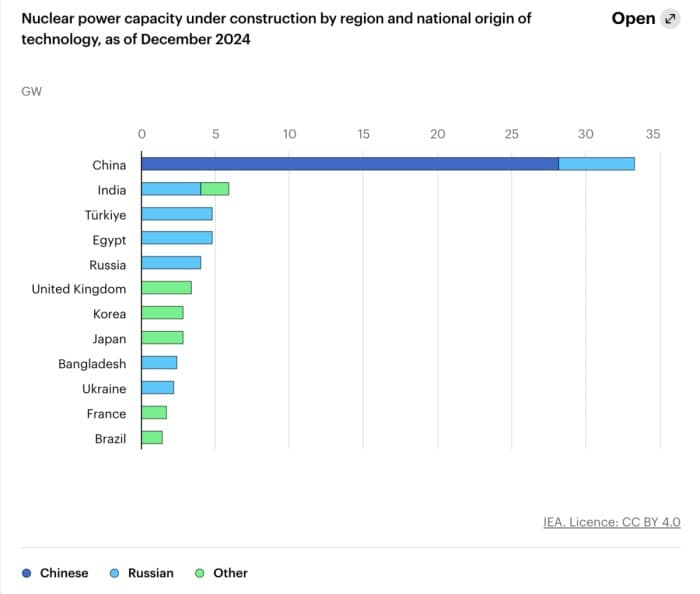
(Source: IEA)
And the bottleneck isn’t technology…it’s fuel. Russia currently controls 40% of the world’s uranium enrichmentcapacity. Energy security is a hollow promise if you have to buy the uranium from your primary adversary.
AI Is the Insatiable Beast That Only Fission Can Feed
The tech giants aren’t buying nuclear because they’ve suddenly developed a passion for carbon-free baseload. They’re doing it because their AI roadmaps are hitting a physical wall… a single ChatGPT query consumes roughly ten times the electricity of a Google search.
Amazon, Google, and Microsoft have realized that wind and solar are essentially “part-time” energy sources.
When the sun goes down and the wind stops, the data centers don’t. This creates a massive, expensive problem called “intermittency” that batteries aren’t ready to solve at a multi-gigawatt scale. The SMR is the only thing on the menu that offers 24/7 “firm” power with a small enough footprint to sit next to a server farm.
For the first time in history, the primary driver for nuclear power is coming from the private sector, not the state.
- Microsoft: Signed a 20-year PPA to resurrect Three Mile Island (Unit 1).
- Google: Ordered 6–7 reactors from Kairos Power for 500 MW of clean energy.
- Amazon: Bought a stake in X-energy and signed an MoU with Dominion for SMR siting.
- Oracle: Announced a massive data campus powered by three modular reactors.
These companies have the credit ratings and the long-term horizons to do what traditional utilities can’t: they can guarantee “offtake.”
By signing 20-year Power Purchase Agreements (PPAs), they provide the bankability that SMR manufacturers need to start their assembly lines.
Picking Winners in a Graveyard of Energy Startups
The SMR market is a graveyard of good ideas that ran out of money. To win, a company needs three things: a simple design, a licensed site, and a customer with deeper pockets than God.
The market is split between the “Old Guard” shrinking proven tech and “Disruptors” chasing Generation IV designs.
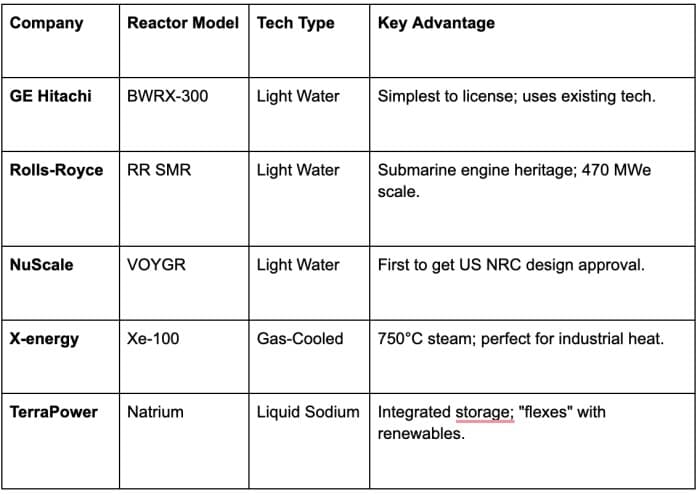
The $2,500/kW Target: Chasing the Chinese Cost Curve
This is where the marketing brochures usually stop being honest. If you build one SMR, it is the most expensive electricity on Earth. The “Modular” promise only works if you build them like airplanes—in a factory, at scale.
The IEA projects SMR investment will hit $25 billion annually by 2030. That sounds like a lot until you realize that building the first factory for these modules could eat half that budget before the first reactor is even shipped. The “learning curve” for SMRs is a steep and expensive climb. Studies suggest that “learning-by-doing” can reduce capital costs by 5% to 10% for every doubling of production. However, a report by Germany’s BASE suggests that an average of 3,000 SMRs would have to be produced before they reach true economies of mass production.
This is the central friction of the industry. No CEO wants to tell their board they are the “guinea pig” for an unproven $1 billion reactor.
Private funding alone won’t work. The long timelines for permitting mean the “breakeven point” for a large reactor is 20-30 years after project start. SMRs cut that timeline in half, but it’s still a tough sell for commercial lenders.
This is where Green Bonds and Public-Private Partnerships come in.
Over $5 billion in green bonds have been issued for nuclear so far, and the U.S. DOE’s Advanced Reactor Demonstration Program is throwing billions at prototypes. But the real bridge across the “Financial Valley of Death” is the credit rating of Big Tech. When Google or Amazon signs a 20-year PPA, the debt becomes bankable.
Fukushima-Proofing the Atom With Passive Physics
SMR proponents love to talk about “passive safety”—designs where physics (gravity and convection) cool the reactor even if the power goes out. It’s essentially “Fukushima-proofing” by design. Because these units are smaller, they have a lower radioactive inventory per reactor, allowing them to be placed on the sites of retired coal plants. The need:
- Gravity-Driven Cooling: If power is lost, cool water is naturally pulled into the core.
- Smaller Cores: Less radioactive inventory means the “exclusion zone” can be significantly smaller.
- Underground Siting: Placing reactors below grade adds a natural barrier against external threats.
But the waste issue remains messy. A 2022 Stanford study claimed that SMRs might actually produce more waste per unit of energy because smaller cores “leak” more neutrons, making the surrounding shielding more radioactive over time. The industry’s rebuttal? They claim they can “burn” this waste as fuel in the next generation of breeder reactors. Both sides are technically correct, but the breeder reactors aren’t here yet, and the waste is.
If we build thousands of SMRs and ship them to remote mining sites or developing nations, we are “distributing” nuclear material across the globe. That is a security nightmare. The fix is “Battery-Style” SMRs: built, fueled, and welded shut in a factory. They are shipped to a site, run for 20 years, and shipped back. The end-user never touches the fuel.
Teaching the NRC to Move at the Speed of Light
The U.S. Nuclear Regulatory Commission (NRC) was designed to regulate massive, one-off light-water reactors. Applying 1970s regulations to 2025 technology is like trying to get a Tesla licensed using rules written for steam engines.
In July 2024, the ADVANCE Act was signed into law, explicitly directing the NRC to streamline the process for microreactors and SMRs. By December 2025, the NRC had already met 30 of its 36 planned deliverables under the act. It’s an attempt to stop the “licensing-by-exhaustion” strategy that has killed so many designs in the past.
International harmonization is the next frontier. If a design is approved in Canada (like the BWRX-300), why does it need to spend another five years and $100 million being “re-approved” in the U.S. or the UK? Strategic leadership is being built in concrete while the West waits for a policy consensus.
The $1.5 Trillion Industrial Heat Prize
Most people think of nuclear as a way to keep the lights on. But electricity is only about 20% of global primary energy demand. The real monster in the room is Industrial Process Heat. If you want to make steel, cement, or glass, you need temperatures that wind and solar simply cannot provide through a wire without massive efficiency losses. Today, 89% of that high-temperature demand is met by burning fossil fuels.
The SMR—specifically the High-Temperature Gas Reactor (HTGR)—is the only zero-carbon technology that can sit “inside-the-fence” with a chemical plant and provide 750°C steam. According to a 2025 study by LucidCatalyst, the potential market for industrial SMRs could hit 700 GW by 2050.
We’re talking about a $1.5 trillion investment opportunity.
The top five markets for this aren’t utilities… they are synthetic aviation fuels, coal plant repowering, maritime fuels, data centers, and chemicals.
In October 2025, the European Commission launched its first pilot auction for industrial heat decarbonization. Companies like France’s Blue Capsule are designing reactors specifically for this market.
If SMRs can’t crack the industrial heat market, Net Zero is a mathematical impossibility.
Why Desalination Might Be the Secret Middle East Play
In the Middle East and North Africa (MENA), energy security is inseparable from water security. Arab states currently account for more than 50% of global desalination capacity. Desalination is an energy hog. Traditionally, it’s been powered by oil and gas, but the GCC nations have pledged net-zero goals for 2050–2060.
SMRs offer a “dual-purpose” solution: they provide baseload power for the grid and the massive amounts of heat or electricity needed for Reverse Osmosis (RO) or Multi-Effect Distillation (MED).
In Jordan, an IAEA team recently evaluated studies for using SMRs to pull drinking water from the Red Sea to Amman. In Saudi Arabia, the world’s largest desalinated water producer, the government is looking at nuclear as the cornerstone of its move away from an oil-based economy.
The economics are starting to pencil out. Using the Desalination Economic Evaluation Program (DEEP) model, 2025 data shows that high-temperature helium-cooled reactors can produce water at an economically viable range of $0.69 to $1.04 per cubic meter.
Microreactors Are the Frontier Batteries for the Arctic and the Mine
While the 300 MWe reactors get the headlines, a subset of the industry is going even smaller. Microreactors (under 10 MWe) are being designed as “nuclear batteries” for the most austere environments on Earth.
The U.S. Department of the Air Force is the lead customer here. In May 2025, they issued a Notice of Intent to Award a contract to Oklo, Inc. for a microreactor pilot at Eielson Air Force Base in Alaska.
Why Alaska?
Because shipping diesel to remote Arctic bases is expensive, dangerous, and a massive logistical vulnerability.
The Eielson project is a 30-year PPA where the vendor owns and operates the reactor. It is “Mission Assurance” in a 50-below-zero environment. But it’s not just the military.
Remote mining operations in Canada and Australia are looking at microreactors like the eVinci (Westinghouse) or the KRONOS (Nano Nuclear). For a mine that currently spends $50 million a year on diesel fuel, a microreactor that runs for 10 years without refueling isn’t just a “green” choice… it’s a massive competitive advantage.
Navigating the Yellowcake Landmine in Kazakhstan and Niger
Now, we have to talk about the fuel. Everything we’ve discussed depends on HALEU (High-Assay Low-Enriched Uranium), and right now, the supply chain is a geopolitical landmine. Kazakhstan currently supplies over 43% of the world’s uranium. That is a terrifying level of concentration, especially given the civil unrest seen in the region.
Then there is Africa.
The 2023 military coup in Niger effectively knocked out a reliable supplier for Europe. In 2025, no production was reported from the SOMAÏR mine.
The West is finally waking up. In late 2025, Urenco USA produced its first run of enriched uranium above 5% in New Mexico. Centrus Energy launched commercial enrichment activities in Ohio, targeting HALEU production to meet a $2.3 billion backlog. But new mines take 7–10 years to come online. We are currently in a “seller’s market,” with uranium prices hitting a range of $86 to $90 per pound in new contracts. If the fuel supply isn’t diversified, the SMR revolution will be choked in its cradle.
Overcoming the Duck Curve
The modern grid is struggling to handle the “Duck Curve“—the massive fluctuation in supply caused by solar and wind.
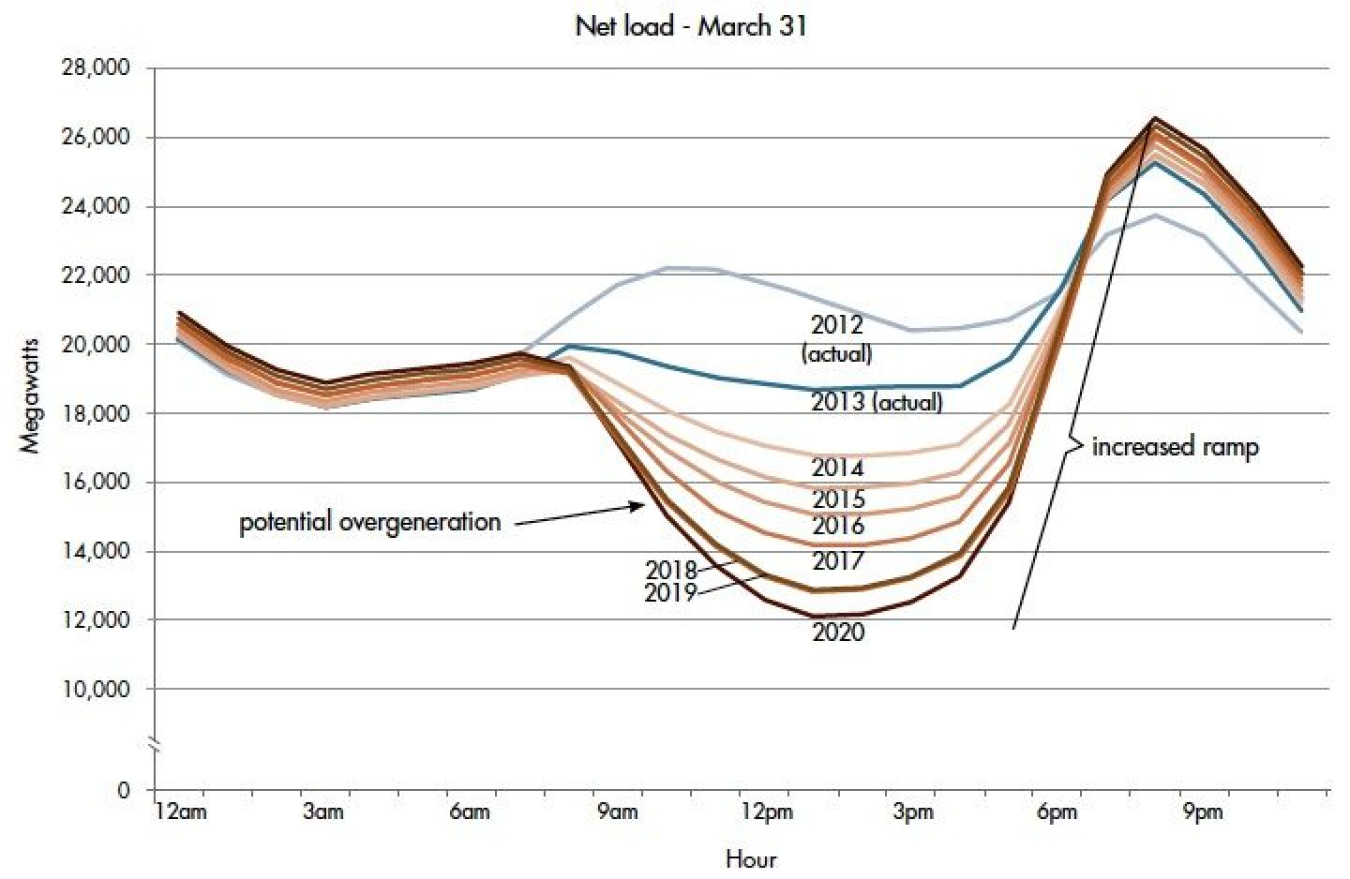
(Source: DOE)
Traditionally, nuclear was considered “inflexible” baseload… you turned it on and left it at 100% for two years.
SMRs are being designed with Load-Following capabilities.
TerraPower’s Natrium reactor, for example, includes a molten salt heat storage system. This allows the reactor to run at a constant temperature while the storage system “flexes” the electrical output to the grid. When the sun is shining, the reactor stores heat. When the sun goes down, it releases it to generate power.
It turns the nuclear reactor from a “firm floor” into a “flexible battery.” This is the missing piece of the renewable energy transition. Without this flexibility, we are forced to keep gas-fired “peaker” plants on standby, which defeats the purpose of the carbon-free goal.
Resurrecting the Rust Belt With Coal-to-Nuclear Pivots
There are over 300 retired or retiring coal plant sites in the United States alone. These sites are energy goldmines. They already have the grid connections, the cooling water access, and, most importantly, a workforce that knows how to run a thermal power plant.
The SMR is the only technology that can “slot” into these sites without requiring a total overhaul of the local economy.
NuScale is currently working with Dairyland Power in Wisconsin to evaluate VOYGR plants for retiring coal sites. It preserves high-paying jobs in rural communities that would otherwise be hollowed out by the move away from coal. It turns a liability (a dead coal plant) into a 60-year asset.
The 2030 Deadline: A Final Verdict for the Assembly Line Era
We have moved past the era of “paper reactors.” By the end of 2025, the industry has shifted its focus to the three pillars of success: Licensing, Supply Chain, and Offtake. The technology is no longer the main question… the factory is.
The IEA’s APS scenario calls for 120 GW of SMR capacity by 2050. Under today’s policy settings, we are only on track for 40 GW. The gap between those two numbers represents the difference between a grid that works and a grid that fails.
The next five years (2025–2030) will be the most important in the history of nuclear power. SMRs are not a “silver bullet,” but they are the only “firm” floor that makes a clean grid physically possible. If SMR manufacturers can reach a production rate of just one unit per month, the “learning curve” will finally drive costs toward that $4,500/kW target.
If they remain stuck in “bespoke project” mode, they will join the graveyard of 20th-century energy experiments.
The stakes are higher than they’ve ever been.
Between AI’s hunger for power and the world’s desperate need for clean industrial heat, the SMR isn’t just an “option.”
For a carbon-free industrial civilization, it might be the only move left on the board. The atomic renaissance is here; the only question is whether the West can build it fast enough to matter.


Interesting.
At what point, particularly in Europe, will electricity prices stop being governed by fossil fuels ?
I already mentioned this earlier, but the dependency on Russia regarding the nuclear fuel cycle goes much further than what this article states:
“Russia currently controls 40% of the world’s uranium enrichment capacity. Energy security is a hollow promise if you have to buy the uranium from your primary adversary.”
The other aspect is commercial reprocessing of spent fuel, and there Russia appears to control about 75% of the available capacity worldwide, with the Seversk plant representing about 70% by itself. Interestingly, while Russia, Japan, and China are building new such plants, several large facilities were discontinued in the past few years in France, the UK, and the USA.
“But the waste issue remains messy. ” That is an understatement, and in that one paragraph, “critics’ point out small reactors make more shielding radioactive. Boosters argue they can burn the waste fuel (at some unspecified time and technology in the future). Did I miss something or did the paragraph need an editor to figure out what the author was trying to say?
Personally, I am always skeptical of “inherently safe” claims by those desperately seeking investment in SMR (preferably as tax-free federal grants).
My translation is “can’t go wrong in a way I can think of at the moment, but I am really focused elsewhere (the bottom line) so i have not thought very hard on the matter.” Funny, though, I haven’t heard the cheering squad demand to NOT limit liability in the “impossible” event of an “SMR accident.”
In any case, nuclear is NOT a swing fuel as it is always full on. So it does not solve the valley of ducks (ok curve) plotted above unless it replaces renewables – a rather hard sell.
Sales talk. Lots of sale talk.
There is very solid physics and engineering that says it is safe. This isn’t speculation. Oh and China has built most of the Gen 4 designs that have been talked about.
As to the duck curve it’s real but it’s not an issue. The curve was there before solar although less pronounced as it is how people use power. The duck curve is different by season and location around the country/world. The utilities know it’s there, they know what the weather is, what day of the week etc to predict the usage, it’s called day ahead planing.
As to nuclear being always on, or solar or whatever, that there is extra power at any given time, the grid users haven’t figured out the best way to use this very low cost energy. In Texas, some companies are making ice at night when there can be almost zero electricity cost due to lots of wind etc. the ice is then used for cooling during the day. Could store heat for the opposite reason.
TerraGen uses molten salt, which is stored in insulated containers. The actual nuclear plant is smaller than the steam turbine. During times of lower load it stores heat. During times of high load the turbine is run combined from
Storage and reactor heat. A very good idea of using high grade heat.
Typical gen 3 plants use relatively low grade heat so can’t do that design
I am not old enough to have seen the Tacoma Narrows bridge, but there is form when marketing gets ahead of the engineering – I do recall too cheap to meter, and my point remains – why are the boosters NOT demanding the removal of the liability cap?
WRT the duck curve, the answer that is being implemented is natural gas which is displacing coal. Storage systems have been around for decades (pumping water up a dam), but have no significant effect on the overall power balance. And to date, US petroleum energy usage has been flat since the 1990s – renewables are only addressing the growth (with overall electric energy production flat for decades too.
Sure, I can speculate that fifty years in the future SMRs will be big, or maybe Mr Fusion will arise, or Mr Trump or there will be wars with SMRs bombed on purpose, or…. However, the West does not long-term industrial plan because of, Markets!
*sigh* We’ve been here many times before. Modular reactors have been the next big thing since the 1970’s. They don’t work – and it’s precisely because of scale. There is a lot of basic physics at work here, specifically with thermal plants (i.e. plants that use nuclear or other methods to produce steam to drive turbines). To make them work efficiently everything has to be big – very big. This is why the only profitable nuclear plants are 800MW capacity upwards. And despite constant massive investments the only nuclear plants that really work are light water PWR’s. This is what China is building at scale – they are essentially doing what the French did in the 1970’s and 80’s, and even using basically the same design. Even then, Chinese nuclear plants are struggling to match coal, let alone solar with storage in profitability terms.
If small modular nukes really worked, we’d see them at sea. But even with near bottomless budgets, the US, China and Russian Navys are still using diesel and gas turbines for all but highly specialised uses. The new Chinese carrier class are diesel. There is actually a move away from nuclear for submarines as battery tech is becoming much cheaper and more affordable. And this despite 7 decades or more of huge investments in compact nukes.
Just to address the talking points above on energy use. Power use for AI/data centres is a regional problem, but in global terms is always likely to be a minor use relative to the traditional big users of electricity. Electricity demand is actually quite stable in developed countries, nearly all the growth is coming from the up and coming economies, and thats mostly tied to demand for bigger homes, air con., etc. Electrification is extremely important to decarbonise our economies (not least because it is inherently much more efficient), But overwhelmingly the big winner is solar and wind – the drop in prices have been spectacular. But grids need to catch up. Modular reactors may have a role in bridging specific regional problems (such as when isolated grids get overwhelmed), but they simply can’t compete – and aren’t even close to competing – on cost or other grounds as baseline power for typical grids.
Of course, someone, somewhere, may make a breakthrough. But any such design needs to be built, tested, and most of all, be subject to full transparent life cycle cost analysis. None of the flashy designs being touted in press releases every month has come remotely close to proving themselves.
“This is what China is building at scale – they are essentially doing what the French did in the 1970’s and 80’s, and even using basically the same design.”
Just to illustrate: this graph shows the deployment of atomic power plants in France during 1970-2000 period. Standardized design, staged build up, overlapping schedules — industrial policy in action. That was then.
Yes, it’s the right way to do it. But to some degree they actually built too much, too fast. The ‘pause’ of 2 decades or so which was supposed to be all about designing a new generation meant that a lot of construction know-how was lost. The EPR design which was supposed to be the new way forward was and is an unmitigated disaster, mostly it seems because the design engineers went riot without consulting the guys who actually built things. The Germans saw this first – Siemens was the first to bail from the project (this is the reason Germany went for renewables, not those stupid myths about the all-powerful Greens).
The good news though is that we do actually have incredibly cheap and modular fusion nuclear power generators. They are called solar panels and they get unlimited fusion power from the sun at prices that nobody would have believed possible just a decade ago, and multi GW plants can be built where needed in the time it would take to sink the first pile of a PWR project.
Thank you. And beyond all your objections I find the notion that Google wants to go around building nuclear reactors to be scary as heck. Who is to say Google or Amazon will even be around in 20 years?
At least Silicon Valley’s usual vapor ware doesn’t glow in the dark. The AI bubble is a ridiculous excuse to be promoting this.
If demand does not materialize for generative AI and the AI data center construction boom fizzles, I wonder what will happen to long-term PPAs for that purpose. I get the impression from Ed Zitron and Gary Marcus that 2026 will see a “sea change” in enthusiasm for LLMs.
What I know about nuclear reactors I learned from Jane Fonda, Michael Douglas and Jack Lemmon, but I do have some what I’ll call “common sense” reactions to the modular reactor idea.
Once upon a time, puddles of sticky black stuff that had percolated out of the ground could entrap even the mighty mastodon in its goo. Its dangerous smells and deadly stickiness were a warning that petroleum is best avoided. Digging it up would be insane. Now we have CO2 levels near 430 ppm and microplastics floating around in our blood.
Radioactive materials naturally occur in the Earth, their formation traceable to some exploded star rather than the deterioration of living material that once grew upon our planet. When it decays, it produces radon gas, a serious problem in many parts of the country where it can accumulate in basements. It is the leading cause of lung cancer among non-smokers according to the EPA. Surely, it would be insanity to dig up radioactive stuff. Think of the health risks for the miners. Consider what the risks of waste are when such waste remains radioactive for 10,000 years. Then think about the risk of a malefactor getting control of this stuff at any stage of the process. (Oh, but the reactors will be “welded shut.”)
So we’re going to hop from the tar pit to the radon-filled basement and for what? So insane billionaires can play at creating a silicon god? So what’s left of the middle class can play conspicuous consumption games by traveling to fashionably exotic spots? Madness.
Well said HMP! The waste issues always get papered over. I still remember when all our nuclear waste was going to be stored in Yuca Mountain. But instead I believe it is all still sitting in giant waste pools outside reactors.
One needs to look no further than the Navajo Tribe in the SW USA for the legacy of uranium mining in the US:
https://opvp.navajo-nsn.gov/wp-content/uploads/2024/09/Legacy-of-Harm-The-Navajo-Nation-Demands-Justice-for-Uranium-Miners.pdf
And:
https://www.epa.gov/navajo-nation-uranium-cleanup/aum-cleanup
And:
https://inthesetimes.com/article/they-worked-underground-in-the-uranium-mines-theyve-been-surrounded-by-death-ever-since-navajo-nation-war-trump-labor-abandoned-vanadium-cancer-lung-transplant-industry-homeland-southwest-atomic-energy-environment-justice
Strongly agree, and it’s even worse than you said – the toxins aren’t just a security risk from theft, they’re a security risk during war. If one country can bomb another’s reactor and cause massive fallout, a single missile can make a whole region unlivable for centuries or longer.
I was recently provided a SMR investor presentation for a company seeking another $1 billion in investor money. They articulated all the author’s arguments. But I see multiple flaws. The first is that you invest now with the hope of seeing a potential return (exit) in like 10-years. This is not what private money does. This is for an unproven technology with unproven economics.
There is another flaw in all this, which is that the AI data center demand forecasts prove out. I am in the camp that it only works so long as the VC world subsidizes them and provides them with capital in vast quantities. My bet is they won’t. When the massive demand collapses what happens to all the unbuilt SMRs?
The Westinghouse AP-1000 reactor at Vogtel is a Gen 3 which incorporates full shutdown without power.
It is also a modular reactor, being built of lots of modules. Which actually was a huge part of the cost and time over runs. The firms building them just couldn’t do it on time or cost. But the concept is sound and is being done by the Chinese design.
Most of the engineers I’ve heard or read over the last years have said 300mw is not a workable size. Too large for modularity, too small for cost effectiveness. Plenty of other smaller sizes do lend themselves to true modular construction. Will they be cheaper, current models say no, but fast to install.
They say the largest cost/speed improvements will be with the supply chain up to speed and a work force that understands what they are doing. And of course the stupid things like building concrete forms that are reusable because at that scale they are expensive and slow to make on site.
Where non carbon production comes into its own like nuclear is for areas of not great sun or wind. Like the whole east coast of the US. To get enough renewables you’ll need massive numbers of transmission lines from all over the US. Transmissions lines are expensive and increase losses. So while more expensive then solar, probably less expensive when the complete costs are compiled.
In the western US, doesn’t make and sense due to sun and wind resources
“In the western US, doesn’t make and sense due to sun and wind resources”
Don’t tell Bill Gates, or the town of Kemmerer, WY, which ironically is the birthplace of struggling if no defunct J.C. Pennys.
Boomtowns….
https://www.gatesnotes.com/Wyoming-TerraPower-groundbreaking
Boomtown: Greg Brown (live) 3 minutes
https://youtu.be/SO2EuOLGJKM?list=RDSO2EuOLGJKM
A big maybe the primary reason was community support.
Others include, inexpensive land, and workforce.
One big aspect of nuclear plants is a long term high tax base for the local community.
The SMR issue circles back a bit to yesterdays Free Markets and Capitalism discussion. I have never been a fan of nuclear power— hugely over-priced, with no resolution of the waste issue. Very dangerous part of the periodic table and the natural world.
Look at Simi Valley California reactor meltdown, cancer rates, and forever-wasteland (late 1950’s early 1960’s) Salt reactor, like Bill Gates’ company favors.
Look at Fukushima, the irradiated water releases Japan is making now, and those pesky Malaysian shrimp recalls due to Cesium 137 contamination that America’s Big Box grocers are announcing.
Saw a headline that Japan is re-commissioning and re-starting Nukes.
Too Big To Fail.
Federal Backstops.
Waiving Insurance requirements, or creating federal guarantees.
Move Fast and Break things.
Socialize costs, privatize gains.
Still NO answer for Nuke waste. Kick the can down the road,
Literally, Unbridled Greed and Power — power with no full life cycle plan.
Hubris that humans know everything and that human based science can be fail-safe.
There is a metaphysical truth that all things humans create break down and fail. Why take on a known catastrophically dangerous technology and systems for such a temporary blip to slake the demand of a fairly sketchy goal that is AI and LLM?
Oligarchs Contriving Our Jackpot.
Our pendulum has swung back such that there is no check on the greed and power running and ruining things right now. The Environmental movement is dead, and we are literally killing the planet that is our closed loop interconnected spaceship.
https://www.engineering.com/americas-worst-nuclear-disaster-was-in-california-who-knew/
https://www.zocalopublicsquare.org/santa-susana-nuclear-accident/
https://min.news/en/world/5cbe4f3932becc052e547f0fde507286.html (Fukushima water)
https://en.wikipedia.org/wiki/Rocky_Flats_Plant (Denver/Boulder ‘open space’)
I guess Nukes might create some perpetual open space viewsheds. Maybe the Oligarchs can put the contaminated ground in Conservation Easements and get a tax break? A positively Glowing S L I C C*
* Self-licking Ice Cream Cone. Verrrrrry slick!
One problem with aging and death is we are losing so much institutional knowledge– no words from The Elders, no attention given to their wisdom and thoughts.
https://daviswade.com/book-the-wayfinders (why ancient wisdom matters in the modern world)
Great Book
“your primary adversary”
What metrics, what calculus is used to determine “adversary”? why would their be advsaries to human specie’s common goal of reclaiming a habitable planet for those not yet born.
What or who would create an adversary to the common goal of a habitalble planet?
Is the adversary just a term use to gain military funding/backing/ dollars from the public to the private purse?
“It is a universal truth that the loss of liberty at home is to be charged to the provisions against danger, real or pretended, from abroad.” -James Madison
In the 1980’s USAF replaced the line of radars across the North American arctic. Legacy system used diesel since 1950,s supplied in annual deliveries by barge in summer.
USAF studied small reactor but the time lines and small scale…. DEW line still uses annual stock of diesel.
Eielson is on an oil, gasoline pipeline from Cook Inlet, been there since WWIi. The SMR project is too little, too early.
The trade study to make: mix huge storage/batteries to baseload ++ wind and solar and see who comes first, cheap. I suspect that SMR running hyperscaled computer requires battery uninterruptible power supplies with some battery kWh store.
Nuclear waste problem is vastly under stated.
Via Adam Tooze, an X posting by Object Zero on the capacity to produce Reactor Pressure Vessel (RPV) Ingots: https://x.com/Object_Zero_/status/2004001120918573507
The OilPrice article is like a small chapter in the Abundance book, all hat and no cattle.
I’ll believe the NRC can streamline and expedite their review process when I see it. They will always be a bottleneck and the only advice they have taken from nuclear operators in other countries have been to find new things to burden domestic operations with.
The problem with all this will always be the lack of centralized decision making. We have lots of options for handling spent fuel. We’re currently choosing none of them. Nuclear can be incredibly safe and efficient. But you can’t cut budgets and corners with it like you can coal or gas plants. Regardless of how safe it is, people will always look at events like Cherynoble, Three Mile Island, and Fukushima Daiichi as reasons why nuclear is not safe. Never mind that the US doesn’t use any of those designs. Never mind that most of the new concepts aren’t boiling water reactors. We’ll still see people in the US freak out about nuclear.
Another problem here, summed up in past articles posted on NC, is that Oklo and the rest think they can develop these designs as if it were a software project. You can’t do that with nuclear. You need to test and prove things. You need a dedicated work force that is trained to perform according to the special and unique risks that nuclear comes with when used to generate power. All that requires a commitment to investment and support that the likes of Bill Gates have run away from over the last several decades.
Could a Nuclear Renaissance finally be at hand in the US? Sure, but not until an awful lot changes. Even then im not convinced it’s the best solution for a lot of the problems discussed in that article. Especially because the southern US could make huge use of solar thermal plants if they wanted to.
Never any mention of the solution for intermittency as pumped storage hydro. New York Power Authority built 2 large pump storage facilities back when skilled trades, engineering and management were a thing for them (1950-70s). New York State has plenty of water with huge vertical drops and a grid to support such projects. Yet the last plant came on line in the early 70s. In the NYS renewable legislation NYPA was specifically excluded (but now can develop PV and such) and did not call for pump storage. Hochul has called upon the SMR fairies and directed NYPA to supply the Micron plant near Syracuse.
A pump storage plant can be built for less than and SMR last for literally centuries with maintenance. One needs a decade or more for payback on capital. The US doesn’t do those things.
I think sodium is a highly reactive compound and difficult to handle. The US Navy abandoned such programs. But who cares or remmbers.
A very interesting report on the projection of SMR deployment.
Hopefully there will be a follow-up piece discussing Chinese and Russian efforts. After all, they seem to be ahead in deployment, and will compete with the West for the Africa and Middle East markets.