Yves here. We have been reporting from early in the life of this website that potable water was the critical resource that would be first to come under acute pressure, meaning consequential shortages, and that the then-anticipated crisis arrival was around 2040. Like so many climate change and environmental degradation forecasts, consensus projections look to have been unduly optimistic. We have been pointing out that scarcity would generate conflict, including war.
Water bankruptcy is an arresting metaphor for where significant swathes of the world are or are heading. One can quibble, based on fresh input from recent visitors like Nima of Dialogue Works, that the water situation is Tehran is not as dire as the English language press would have you believe. But that is a rearranging-the-deck-chairs-on-the-Titanic level take. The direction of travel is that supplies in not just Tehran but all across the Middle East are coming under more pressure as the entire region becomes even hotter and drier.
We linked to a recent Times of Israel op-ed, The Middle East’s Next War Will Be Over Water. Key sections:
The Middle East is not running out of slogans. It is running out of water. And while pundits remain hypnotized by manifestos, missiles, and terrorist groups the region’s real balance of power is being rewritten quietly, mechanically, and without drama—behind concrete dams, desiccated riverbeds, and rationed taps. This is not an environmental story. It is a story about power, coercion, and survival.
Modern Middle Eastern geopolitics still pretends that ideology drives history. In reality, infrastructure does. Control the flow of water, and you control agriculture, electricity, urban stability, and, ultimately, regime legitimacy. That truth is now impossible to ignore—except, apparently, by the international media class.
Consider Turkey, a NATO member rarely framed as a coercive regional power. Through its vast dam network on the Tigris and Euphrates, Ankara has achieved something armies failed to do for centuries: structural dominance over downstream states. Iraq and Syria do not merely negotiate with Turkey anymore. They wait on it. Every reduced flow tightens agricultural collapse, fuels internal displacement, and hollows out state capacity. This is leverage that does not need threats. Gravity does the work….
Against this backdrop, the Nile Basin exposes how water scarcity escalates from internal crisis to interstate confrontation. The standoff between Egypt and Ethiopia over the Grand Ethiopian Renaissance Dam is not a development dispute; it is an existential contest over hydrological sovereignty.
Egypt, almost entirely dependent on the Nile, views upstream control as a direct threat to national survival. Ethiopia, asserting its right to development, has discovered that dams confer strategic leverage no treaty can fully restrain. This is the same logic playing out elsewhere in the Middle East: whoever controls the headwaters dictates the political weather downstream….
And here is the uncomfortable reality: future Middle Eastern wars may not begin with rockets. They will begin with shortages. They will not be announced by generals but by engineers. And they will not be resolved by summits but by whoever controls the valves….
History is moving through pipes and dams. The question is who is paying attention.
And Israel has already been weaponing water:
Since 1948, and with clinical precision since 1967, Israel has weaponized water as a tool of domination, turning rivers, aquifers, and wells into instruments of control no different than checkpoints or military raids. This is hydrological apartheid.🧵 pic.twitter.com/LZeNgoMLVv
— Thomas Keith (@iwasnevrhere_) July 21, 2025
Another water hot spot is South Asia. From The Economist in November:
Rarely calm, the cross-border politics of South Asia’s great rivers have been roiling of late. In late October Afghanistan revealed plans to build dams on the Kabul river, rankling Pakistan, with which it had skirmished on the border just days before. Also last month, thousands of Bangladeshis took to the streets to protest against India’s influence over the flow of the Teesta river, a tributary of the Brahmaputra (known as the Jamuna in Bangladesh). India has yet to restore the Indus Water Treaty, a water-sharing deal with Pakistan since 1960 which it suspended in April following a terrorist attack in Kashmir. And Indian officials worry greatly about a new dam China plans to build 30km upstream from India’s border on the Brahmaputra (called the Yarlung Tsangpo in Tibet). This dam, at a cost $167bn, would be the world’s largest if completed to plan. The consequences for downstream neighbours are bound to be huge…
Increasing demand for green baseload electricity is pushing countries across South Asia to expand investment in hydropower. At the same time, shrinking glaciers and erratic weather patterns caused by climate change are making river levels and water flows more unpredictable, with an impact on the livelihoods of some 2bn South Asians……
Sharing the waters is tricky in a region riven by distrust. India’s and Pakistan’s conflict over Kashmir is long-running. China and India fight over borders. Bangladesh and Nepal worry about undue influence from both India and China. That makes it tempting for countries to use water to exert pressure on their neighbours. Between 2019 and 2023, there were 191 water-related disputes in South Asia, according to the Pacific Institute, a research group in California. Barring the Middle East, no other region is as water-fraught.
Things will probably get worse. One problem is that, as well as for power generation, countries increasingly use the construction of dams to project strength, hammer down territory and coerce neighbours, says Hari Godara of O.P. Jindal Global University in Sonipat in India. China’s dams in Tibet help it exert influence over a restive region. Pakistan’s dam-building (increasingly helped by China) in the parts of Kashmir it controls serves to reinforce territorial claims and annoy India. In response to China’s new dam on the Brahmaputra, India plans to build its own mega-dam downstream from the Chinese project. As it is, riparian Bangladeshis complain that India gives no warning when it releases torrents of water from existing dams, causing havoc downstream. Water tussles often overlap with other conflicts.

The article below mentions the Colorado Basin as an area of approaching water bankruptcy, but it is not the only spot in the US. In parts of coastal Maine, wells and local aquifers have been so over-exploited that water in some prime areas is cloudy and brackish, too mineral-heavy to be suitable for more than bathing (and even then it leaves a bit of a scum). Residents and visitors have to haul in water for drinking.
By Kaveh Madani, Director of the Institute for Water, Environment and Health, United Nations University. Originally published at The Conversation
The world is now using so much fresh water amid the consequences of climate change that it has entered an era of water bankruptcy, with many regions no longer able to bounce back from frequent water shortages.
About 4 billion people – nearly half the global population – live with severe water scarcity for at least one month a year, without access to sufficient water to meet all of their needs. Many more people are seeing the consequences of water deficit: dry reservoirs, sinking cities, crop failures, water rationing and more frequent wildfires and dust storms in drying regions.
Water bankruptcy signs are everywhere, from Tehran, where droughts and unsustainable water use have depleted reservoirs the Iranian capital relies on, adding fuel to political tensions, to the U.S., where water demand has outstripped the supply in the Colorado River, a crucial source of drinking water and irrigation for seven states.

Water bankruptcy is not just a metaphor for water deficit. It is a chronic condition that develops when a place uses more water than nature can reliably replace, and when the damage to the natural assets that store and filter that water, such as aquifers and wetlands, becomes hard to reverse.
A new study I led with the United Nations University Institute for Water, Environment and Health concludes that the world has now gone beyond temporary water crises. Many natural water systems are no longer able to return to their historical conditions. These systems are in a state of failure – water bankruptcy.
In financial bankruptcy, the first warning signs often feel manageable: late payments, borrowed money and selling things you hoped to keep. Then the spiral tightens.
Water bankruptcy has similar stages.
At first, we pull a little more groundwater during dry years. We use bigger pumps and deeper wells. We transfer waterfrom one basin to another. We drain wetlands and straighten rivers to make space for farms and cities.
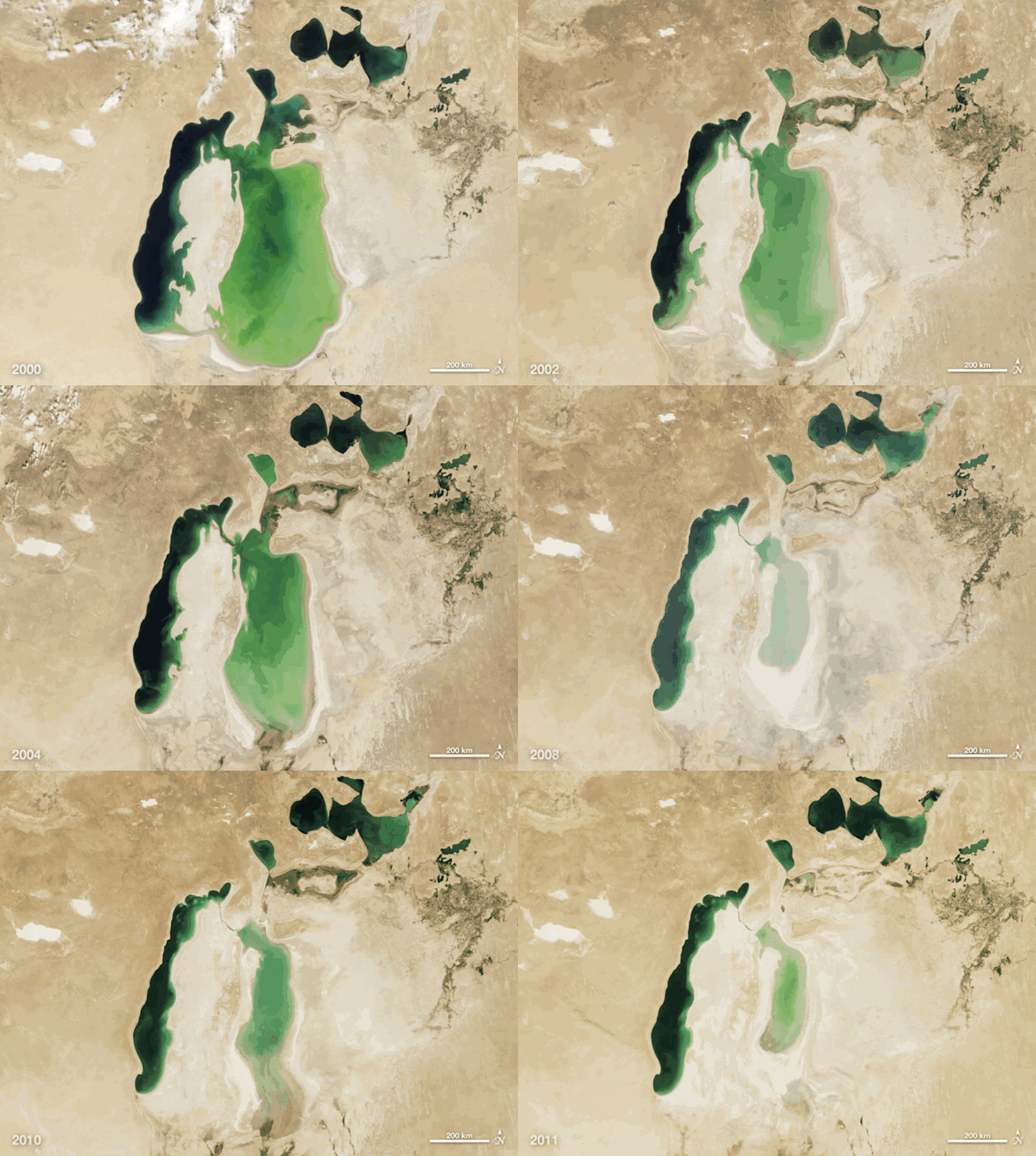
Then the hidden costs show up. Lakes shrink year after year. Wells need to go deeper. Rivers that once flowed year-round turn seasonal. Salty water creeps into aquifers near the coast. The ground itself starts to sink.
That last one, subsidence, often surprises people. But it’s a signature of water bankruptcy. When groundwater is overpumped, the underground structure, which holds water almost like a sponge, can collapse. In Mexico City, land is sinking by about 10 inches (25 centimeters) per year. Once the pores become compacted, they can’t simply be refilled.
The Global Water Bankruptcy report, published on Jan. 20, 2026, documents how widespread this is becoming. Groundwater extraction has contributed to significant land subsidence over more than 2.3 million square miles (6 million square kilometers), including urban areas where close to 2 billion people live. Jakarta, Bangkok and Ho Chi Minh City are among the well-known examples in Asia.

Agriculture is the world’s biggest water user, responsible for about 70% of the global freshwater withdrawals. When a region goes water bankrupt, farming becomes more difficult and more expensive. Farmers lose jobs, tensions rise and national security can be threatened.
About 3 billion people and more than half of global food production are concentrated in areas where water storage is already declining or unstable. More than 650,000 square miles (1.7 million square kilometers) of irrigated cropland are under high or very high water stress. That threatens the stability of food supplies around the world.

Droughts are also increasing in duration, frequency and intensity as global temperatures rise. Over 1.8 billion people – nearly 1 in 4 humans – dealt with drought conditions at various times from 2022 to 2023.
These numbers translate into real problems: higher food prices, hydroelectricity shortages, health risks, unemployment, migration pressures, unrest and conflicts.
Every year, nature gives each region a water income, depositing rain and snow. Think of this like a checking account. This is how much water we receive each year to spend and share with nature.
When demand rises, we might borrow from our savings account. We take out more groundwater than will be replaced. We steal the share of water needed by nature and drain wetlands in the process. That can work for a while, just as debt can finance a wasteful lifestyle for a while.

Those long-term water sources are now disappearing. The world has lost more than 1.5 million square miles (4.1 million square kilometers) of natural wetlands over five decades. Wetlands don’t just hold water. They also clean it, buffer floods and support plants and wildlife.
Water quality is also declining. Pollution, saltwater intrusion and soil salinization can result in water that is too dirty and too salty to use, contributing to water bankruptcy.

Climate change is exacerbating the situation by reducing precipitation in many areas of the world. Warming increases the water demand of crops and the need for electricity to pump more water. It also melts glaciers that store fresh water.
Despite these problems, nations continue to increase water withdrawals to support the expansion of cities, farmland, industries and now data centers.
Not all water basins and nations are water bankrupt, but basins are interconnected through trade, migration, climate and other key elements of nature. Water bankruptcy in one area will put more pressure on others and can increase local and international tensions.
What Can Be Done?
Financial bankruptcy ends by transforming spending. Water bankruptcy needs the same approach:
- Stop the bleeding: The first step is admitting the balance sheet is broken. That means setting water use limits that reflect how much water is actually available, rather than just drilling deeper and shifting the burden to the future.
- Protect natural capital – not just the water: Protecting wetlands, restoring rivers, rebuilding soil health and managing groundwater recharge are not just nice-to-haves. They are essential to maintaining healthy water supplies, as is a stable climate.

- Use less, but do it fairly: Managing water demand has become unavoidable in many places, but water bankruptcy plans that cut supplies to the poor while protecting the powerful will fail. Serious approaches include social protections, support for farmers to transition to less water-intensive crops and systems, and investment in water efficiency.
- Measure what matters: Many countries still manage water with partial information. Satellite remote sensing can monitor water supplies and trends, and provide early warnings about groundwater depletion, land subsidence, wetland loss, glacier retreat and water quality decline.
- Plan for less water: The hardest part of bankruptcy is psychological. It forces us to let go of old baselines. Water bankruptcy requires redesigning cities, food systems and economies to live within new limits before those limits tighten further.
With water, as with finance, bankruptcy can be a turning point. Humanity can keep spending as if nature offers unlimited credit, or it can learn to live within its hydrological means.


That sinkhole in Turkey photo depicts the development of a red algae bloom. It’s not really algae that is blooming. It is a cyanobacteria that is harmful (deadly) to animals; including humans. People on the US coasts call it ‘red tide’ as it can develop in both fresh and salt water. It kills coastal marine animals regularly in California.
It’s not just the air (fires) but also the water (ocean) that can kill you. AGW will take most of us.
An awareness of the issue is appreciated. But like the UN-SDGs and Project Drawdown, a lack of local planning and solution implementation makes “What Can Be Done” unrealistic. We’ve known for decades that the Colorado river needs attention. Instead, 80% +/- is allocated to ag/ including not just a little bit that is used to water alfalfa that is subsequently sent overseas to feed Saudi cattle. Let’s hope they figure out what to do with the increased methane.
/s This is a lot of fuss over something the Market can solve and solve most Pareto optimally. Simply privatize all fresh water sources and let demand and supply handle things. Sometimes the Market may not be ‘gentle’ but it is fair[‘fair’?]. If some people die of thirst, that is OK. They may have suffered from insufficient purchasing power due to their personal flaws. If a few hundred billionaires can water their giant lawns at their many mansions, … that is … that is OK, it is OK? right?. Just because someone is poor and dying from thirst it does not mean they could enjoy water more than Thiel or Bezos, Gates or Musk, Ellison or Page, Brin, Huang or Balmer or one of their lessors among the supper rich might enjoy their many green lawns and pristine swimming pools./s
/s The hidden hand of the market will solve all our problems and bring ‘us’ to an utopia of functionally endless resources.
https://waterknowledgehub.org/learn/iwrm-tools/water-markets
This maybe explain why saudi Arabia is pushing so hard seawater desalination. They are number one in the world. You would think it was China but i guess they dont yet see how dangerous low fresh water is in the future
You guys do know that movement of water and ice-melt has caused the Earth’s movement and spin to change, right?
They’ve caused “shifts in mass cause the planet to wobble as it spins and its axis to shift location — a phenomenon called polar motion.They also cause Earth’s rotation to slow, measured by the lengthening of the day.” (https://www.jpl.nasa.gov/news/nasa-funded-studies-explain-how-climate-is-changing-earths-rotation/)
We’ll be lucky if it’s just dehydration that kills us, frankly.
This article made me consider the possibility that the occupation of Minnesota might be because of water. Water permitting is how Minnesota is currently fighting against data centers. Further, Minnesota has made export of drinking water illegal despite many efforts by rich Texans/Californians to try this, most recently by train (I was the geologist on the MN DNR staff that reviewed the permit application in 2018-19).
Could the selection of Minnesota for ICE occupation be retaliation for not kissing the ring of the tech bros and (thirsty) coastal elite?
damn Yves…I don’t know how you do this much work a day. But thank you.
Greenland is a big chunk of ice. The businessman Donald “where’s my cut” Trump thinks
it could be a nice little earner for (himself and) the USA… Build bottling plants, melt the ice,
flog the bottled water to a thirsty world…
Now you know why President Trump wants Greenland…
I’ve often wondered why ‘we’ aren’t ‘just’ towing the calving icebergs to where water is needed.
And all this flooding … going to waste … why not acres of rain barrels beside the acres of solar panels.
Reliable surface water is a rarity these days…
Every drop in my section of the western flank of the Sierra Nevada that falls from 12,000 feet on down has to pass by me, unmolested by thousands of farms wanting their take along the way-as it goes on the Colorado River.