Yves here. This post exposes yet another climate scam, here manure digesters touted as reducing methane from cattle. Note to readers: your reflex should be to regard any techo-fix that preserves modern lifestyles and enriches venture capitalists as either a total con or only at best yielding marginal benefits.
By Brian Bienkowski, the managing editor of The New Lede, who was previously the senior editor of Environmental Health News for nearly a decade an was also the founder, producer and host of the Agents of Change in EJ podcast from 2020 to 2024. Originally published at The New Lede
A Wisconsin project dubbed the “world’s largest manure biogas project” emits nearly 5,000 metric tons of climate-warming methane annually, roughly equivalent to emissions from 30,000 gasoline-powered vehicles, according to state data that adds to concerns about the impacts of large-scale manure digesters.
The biogas project in question, owned by BC Organics, LLC, emitted 4,921 metric tons of methane in 2024, at least in part due to a leak at the facility, according to its 2025 filing with the Wisconsin Air Management program. The facility also reported more than 26,000 metric tons of CO2 emissions in 2024.
BC Organics takes in roughly 900,000 gallons of manure from 11 farms daily, and runs the waste through 16 anaerobic digesters to capture methane and produce renewable natural gas.
Such digesters are increasingly common in the US to deal with the massive amounts of waste generated at large-scale livestock and dairy farms. There are an estimated 394 manure-based digesters operating in the US, with more than 70 under construction, representing a 55% increase over the past decade.
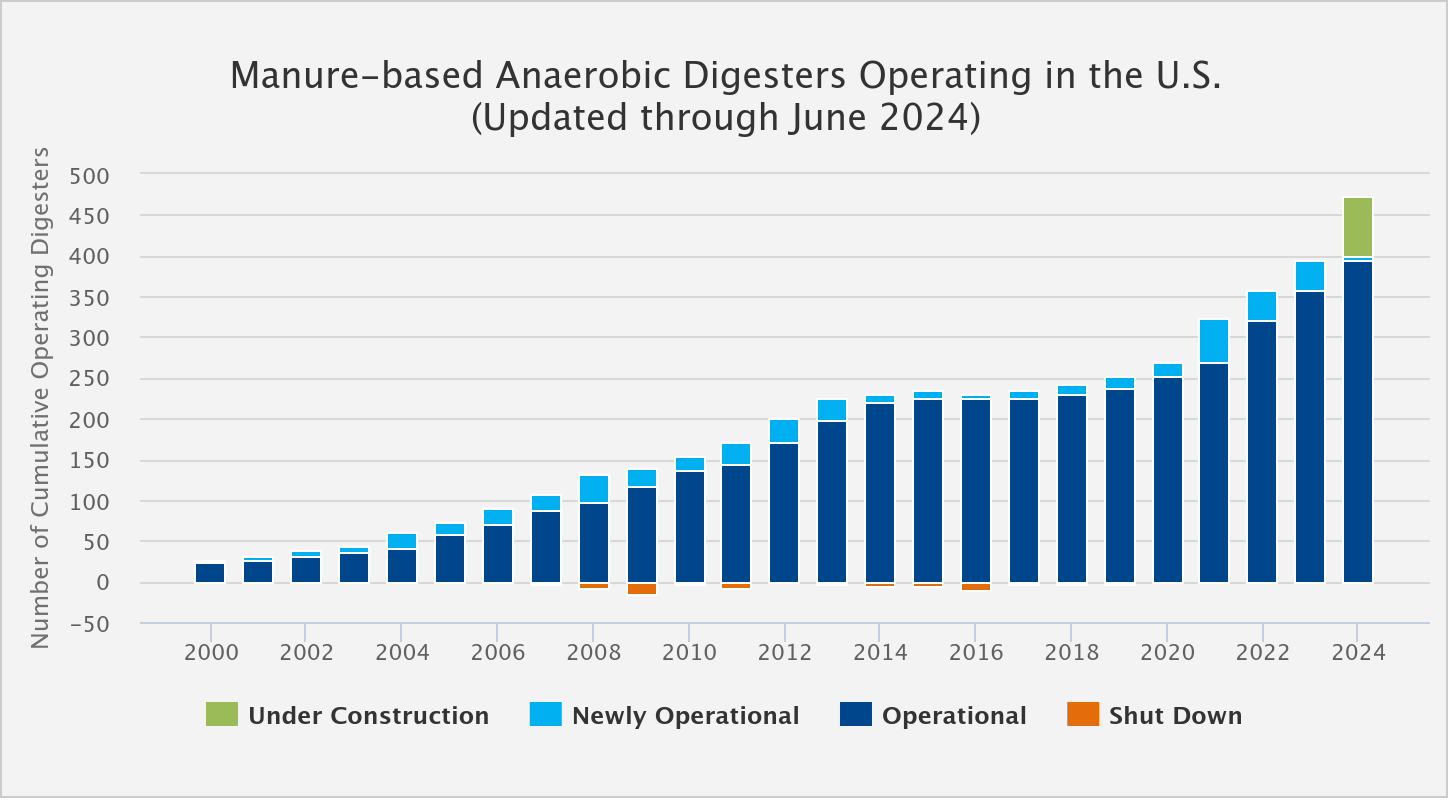
The selling point of such projects is their ability to reduce climate-warming emissions — especially methane — from animal waste. Manure digesters reduced greenhouse gases by more than 13 million metric tons in 2023, according to the most recent data available from the Environmental Protection Agency (EPA).
However, critics and researchers say a large amount of methane is still emitted into the air from these facilities, as seen in the case of BC Organics. And government incentives for more digesters are only encouraging more concentration of livestock and more waste.
Digesters are “not the climate solution that they’re touted to be,” said Brent Kim, an assistant scientist at the Johns Hopkins Bloomberg School of Public Health who researches the benefits and potential harms of digesters.
He and colleagues published a study last year that found manure digesters “only address a fraction of livestock-related greenhouse gas emissions” and that their hazards may outweigh their benefits. He said while research shows some benefits from digesters, including reducing odors and pathogen loads in manure, “the potential for new pollutants to be introduced into the air” remains.
“There’s flaring … the gas is often burned or flared on site,” he said. “That can introduce not only methane but nitrogen oxides, sulfur oxide, particulate matter and other potential respiratory hazards.”
A Potent Pollutant
Methane, which is a much more potent greenhouse gas than carbon dioxide, is often converted to a “carbon dioxide equivalent” to measure its climate impact. BC Organics’ 2024 methane emissions are the equivalent of 140,000 metric tons of CO2, or the emissions of more than 30,000 gasoline vehicles each year.
The annual total emissions of methane from all facilities in the US — including power plants, landfills, refineries and other sources — is the equivalent of 60.4 million metric tons of CO2, according to the EPA Greenhouse Gas Inventory, which does not include agricultural sources.
In Wisconsin, the annual methane emissions are the equivalent of 1.5 million metric tons of CO2, according to the EPA inventory. BC Organics’ methane emissions alone total nearly 10% of the emissions from all of the state’s non-agricultural sectors. Its methane emissions dwarf those from other, smaller manure digesters in the state. The next highest methane emission total from a manure digester project was just 307 pounds, according to state filings.
BC Organics is likely reducing the overall methane emissions from participating farms given that it uses captured methane to produce renewable natural gas. It’s unclear how much those savings are, but the project’s website says it produces 1,630 MMBtus (Million British Thermal Units) of renewable natural gas — which is generally more than 90% methane — per day.
Company officials did not return a request for comment on methane reductions, emissions or leaks. In its 2024 filing with state regulators, BC Organics responded “yes” when asked if there were “deviations or leaks” that resulted in emissions. The company also wrote that they “did have some venting off the digesters.”
Craig Czarnecki, the air management outreach coordinator at the Wisconsin Department of Natural Resources, said the department discovered a leak in June 2024 during an inspection.
“The department is working with BC Organics to address potential leaks and odor complaints,” Czarnecki said. “BC Organics has been installing equipment upgrades to prevent future leaks. The new components are to be fully installed by the end of May 2026.”
He added that BC Organics has a confidentiality agreement with the department so specifics of the upgrades cannot be disclosed, and that inspections for “major” sources like BC Organics occur on a two-year cycle.
Loan Delinquency
BC Organics was part of a push by the Biden administration to invest in biogas projects, including manure digesters, however, a January directive by the US Department of Agriculture (USDA) announced a three-month pause on loans aimed at promoting anaerobic digesters due, in part, to loan delinquency. The agency cited $102.6 million in delinquent loans for anaerobic digesters but did not name the companies in delinquency.
An analysis by The New Lede of the USDA’s Lender Lens portal showed four anaerobic digester loans in delinquency that total $102.6 million — with $100.1 million of the delinquent loans belonging to BC Organics, which is between 181 and 360 days delinquent on the loans that were originally for more than $104 million combined. The only other USDA loans for anaerobic digester projects in delinquency are $891,179 for Dovetail Energy LLC in Ohio, and $696,492 for Ringler Energy LLC in Ohio, according to the portal.
BC Organics is currently seeking a permit renewal in the Town of Wrightstown, where it is located. Town officials discussed the renewal in a March meeting, but went into closed session for the discussion despite the rest of the meeting being open to the public.
William Verbeten, chairman of Wrightstown, said the town’s focus “remains on the health, safety and welfare of the town’s residents, our visitors and the greater Wrightstown community as a whole” as the board considers renewing the permit.
“Any renewal of the conditional use permit will emphasize these considerations and ensure that BC Organics lives up to the promises it made to the town when it first requested and obtained the permit,” he added.


A fast commentary. There is a lot of confused stuff in this article so I don’t know what parts of it are credible and what parts aren’t. This phrase is an example:
As i see it BC Organics runs a “biomethanation” plant or anaerobic digesters. Methane, or “biomethane” with about 60% methane content is the product of such plants not “renewable natural gas” which is something that doesn’t exist, an invention of the writer. The confusion in terms tells me the writer didn’t know what was he writing about and makes the whole article something to be taken with tons of salt. It doesn’t explain what with that “biomethane” is done and where, apart from leaks (these leaks are indeed a thing!), such methane emissions come from. Cattle manure is by itself, if not treated, a large source of methane emissions.
If there aren’t leaks i don’t see any problem about biomethanation of manure. This is common practice in Europe and you obtain some energy while burning methane into carbon dioxide. Makes sense if it is done correctly.
Here is report from government EPA specifically about farm based biodigesters. There are other types, sewage, landfills etc.
If you look you’ll see a line item
Environmental benefits. Which lists how much less methane is released by these processes.
https://www.epa.gov/agstar/agstar-data-and-trends
Done correctly ?! That is a very funny idea in the current full speed ahead and damn the torpedoes atmosphere of a frontier society we imagine we are in – it will be done as cheaply as possible and so what if it don’t work?
It’s a shame since this technology seemed promising for use at the local village or homestead level to provide cooking fuel.
In addition, our local sewage authority installed a digester, which in combination with a field of solar panels covering the settlement tanks allows the plant to be energy self sufficient. If say a hurricane knocks out power, the plant can continue to function rather than dump raw sewage into the river, as happened in Newark, NJ during Hurricane Sandy in 2012.
Factory farming seems to have turned a useful idea into a monstrosity, so perhaps it does not scale well. OTOH perhaps there are unacknowledged inefficiencies even at a smaller scale…
Methane is an extremely potent greenhouse gas, which takes decades to break down in the atmosphere. Anything that captures methane and ultimately oxidizes it to carbon dioxide instead of releasing it directly into the atmosphere is a Very Good Thing.
A leaky bio-derived methane capture operation, or even just wasting the methane by flaring it (like Oman, for example, routinely did before LNG became a thing) is way better than doing nothing.
Capturing biomethane is not a panacea: it’s expensive, often over-subsidized, often badly implemented, and will never be more than a teeny niche climate solution. But from a net carbon emissions standpoint, it’s always, always a net gain.
“[Y]our reflex should be to regard any techo-fix that preserves modern lifestyles and enriches venture capitalists as either a total con or only at best yielding marginal benefits.”
Yes, that is a good way to say it, and what–as an ecologist–I tell people about so-called green capitalism initiatives. To invoke the old Arkansas traveler joke: You can´t get there from here.
Why not both?
Sadly I have some real work experience with these sludge dumpers and this article doesnt tell the half of it. My experience started when the EPA rubber stamped an application for one of these companies to dump their sludge on a farm field next door to my house.
They brought about 200 full size tractor trailers each hauling a tank containing about 10,000 gallons of toxic sewage sludge and they dumped it all over the fields over the course of 5 days.
I spent literally hundreds of hours fighting with the EPA to get FOIA documents, networking with other people in the state suffering from this same company (Its the one in default, Dovetail and Ringler are the same company, owned by the same people.)
Without writing a dissertation on this topic, let me hit everyone up with some highlights.
These digesters are advertised as “green” solutions to disposing of farm manure. They put the manure into a giant tank and let bacteria break it down and they collect the methane and other gases. Then they have to clean the gas and dry it and they can sell it and/or they use it to run a GIANT LOUD ENGINE 24/7 and make electricity to sell back to the grid.
Once these things get built though, instead of farm waste these companies get paid by various industrial food operations to take their waste, or they get paid to take municipal sewage sludge which is filled with all the toxic junk cleaned out of the sewer water. I got a copy of the financials for one of these companies and it showed that about 90% of their revenue came from the fees they were paid (by factories, municipal sewer plants, etc.)
Only 10% of revenue came from selling the gas or electricity.
The way the rules are set up, a company just gets a landowner to sign a letter giving authorization, the EPA checks to make sure the name on the letter matches the owner of the property (sometimes), and then they authorize the “biosolids application”
The company then calculates how much toxic sludge they are allowed to dump and then dumps it. Thats it, nobody checks. In my case, after calling the EPA daily I finally got them to come out and look at the fields. They didnt notice anything wrong so it took a few more days of calling and a phone call from the local TV news station. Finally a bunch of EPA employees came out and decided the company had actually dumped too much sludge so they wrote them a letter telling them not to do it again…
Through FOIA requests I was able to find that when the EPA first contacted the company to see how much they dumped and how they did their calculations, the company didnt even know how to calculate the legal limit of sludge they could dump!
Suffice it to say that the real world example of how this works is the companies have a huge incentive to dump as much sludge as they can. This particular company (Ringler/Dovetail/Renergy) loved to dump sludge on rainy days so they rain would wash all the “fertilizer” off the fields. They literally were caught doing this repeatedly and the EPA did nothing.
Finally after 1000s of hours of work by 1000s of concerned citizens, we were able to get the EPA to start enforcing laws against the Ringlers and now they seem to be finally going out of business. But not before they took millions in “green energy” subsidies and dumped who knows how much toxic garbage in the environment.
Funny thing about the whole story was the company was owned by a guy named Alex Ringler. His dad William Ringler actually ran everything but he couldnt have his name on any of the paperwork because the EPA had sent him to prison for a previous environmental felony! The EPA of course knew all about this but didnt care.
Thank you for telling your story.
I know a MAGA farmer who double his herd and put in the methane digester. He said he did it because of credits coming from California. No way he would have done it without the cash flow working. He doesn’t believe in climate change.
Straus Family Creamery in West Marin, CA has been running a manure-to-electricity setup for over a decade. Seems to work for them, at a modest scale.
https://www.strausfamilycreamery.com/carbon-neutral-farming/methane-digester/
Don’t ever pass up a chance to eat Straus ice cream. It’s a religious experience.
I note mention of a large outstanding loan, over US $100 mil, and the Wrightstown committee is considering okaying a renewal of licence?
Put another way, just say someone has borrowed four times from people you know, to a total of US$100 mil. Then they come to you and ask to keep using the unpaid money to the other four people, (which is really one person, four times), to keep their business going, but with no stated means to repay the original loans…. When asked about the outstanding loans, they say , nah, I’m good for it! …would you say , sure, no probs, go right ahead….
Most likely, Grift inc.
If it smells like cow s$#t….
In rural India, a Ghandian movement made plans for human methane digesters. According to the drawings, human waste of all kinds would enter an enclosed pit, tapped to capture the emergent gas. Supposedly, this scheme produced enough energy for all the village’s cooking and lighting needs.
Side note: when the digester was done producing methane, the residue was mined for fertilizer and another pit was dug.
Methane digestion is not only for cows.