Yves here. It pains me to have to take seriously the idea that exploitative gig work might still be beneficial. But this article presents data shows that it is a preferable income-generating strategy to crime. That also implies that on a risk-adjusted basis, petty crime pays badly.
By Hugo Allouard, Grazia Cecere, Jose De Sousa, Professor of Economics University of Paris II Panthéon-Assas, Olivier Marie, Professor of Labour Economics Erasmus University Rotterdam; Professor of Labour Economics Maastricht University, and Ines Picard. Originally published at VoxEU
Food delivery platforms lower barriers to legal work for disadvantaged groups. Using the staggered rollout of Deliveroo and Uber Eats across France, this column shows how expanding access to legal income for such groups can reduce crime even when the jobs are temporary, flexible, and low-paid. The policy goal should be to pair accessible entry-level work with pathways to skill development and stable employment.
In June 2019, the New York Times reported on food delivery riders in France (Alderman 2019), many of them young migrants for whom platform work had become a rare foothold in the labour market. One migrant summed up the sentiment of many: “riding a bike, even on precarious terms, was better than more nefarious ways of making money like selling drugs”. This captures an insight at the heart of the economics of crime: when legal work is accessible, the opportunity cost of offending rises (Becker 1968). The question is whether this logic holds up on a large scale, and whether delivery gig platforms can expand access to legal income for the people most at risk of criminal activity.
In a recent paper (Allouard et al. 2025), we provide causal evidence on this question. Barely 15 years ago, platform-based gig work was almost non-existent. By 2021, an estimated 4.9 million people in the US (Garin et al. 2023) and 4.1 million in the EU 1 relied on gig work as their main source of earnings, with food delivery accounting for the bulk of these jobs.
Platform work offers flexible scheduling with very low barriers to entry (Mas and Pallais 2017), making it accessible to groups shut out of conventional hiring (Burtch et al. 2018, Laitenberger et al. 2023). Young men with limited qualifications, migrants facing discrimination (Bréda et al. 2021), and individuals with minor criminal records are the most likely to take up delivery work and the most overrepresented in crime statistics (Hjalmarsson et al. 2024, Marie and Pinotti 2024).
We exploit the staggered rollout of Deliveroo and Uber Eats across France between 2015 and 2019 to estimate the causal effect of platform entry on local labour markets and crime. We also identify which groups drive the take-up of gig work and the resulting changes in offending.
Why Gig Work Could Reduce Crime
Two economic mechanisms connect access to gig work to lower criminal activity. The first is income substitution: in the classic framework of Becker (1968), individuals weigh expected returns from crime against legal earnings. A large empirical literature confirms that better job opportunities reduce offending (Hjalmarsson et al. 2024). Readily accessible gig jobs – requiring no CV, no qualifications, no prior work history – raise the opportunity cost of offending. Conversely, restricted access to employment due to discrimination or criminal records can sustain both labour-market exclusion and criminal involvement (Kline et al. 2022, Cullen et al. 2023).
The second mechanism is incapacitation. Time spent on deliveries – concentrated in evenings and weekends, when offending rates peak – is time not spent in situations that increase criminal risk. This mechanism mirrors evidence that structured time use more broadly reduces offending (Jacob and Lefgren 2003).
Crucially, neither mechanism requires full labour-market activation: even partial, irregular engagement with delivery work can alter time use and raise the relative attractiveness of legal income, which is what the flexible, on-demand nature of gig delivery makes possible (Hall and Krueger 2018, Chen et al. 2019).
Both mechanisms predict reductions concentrated in specific crime types – through income substitution in drug dealing and opportunistic theft and incapacitation in vandalism and violence – which allows us to test the channels, not just the overall effect.
The French Natural Experiment
France provides a clean setting for identifying the causal effects of platform entry. Deliveroo and Uber Eats launched in France in 2015 and expanded gradually: platforms operated in 11 police jurisdictions in 2015, 39 in 2017, and 233 by 2019 (Figure 1, Panel a). This geographic rollout does not reflect pre-existing differences in crime or unemployment trends, allowing us to identify causal effects by comparing early-treated areas with never-treated or not-yet-treated areas.
Figure 1 Platform rollout and food delivery workers in France
a) Platform rollout by year and police jurisdiction, 2015–19

b) New registrations (solid red) and active riders (dashed blue), 2012–19
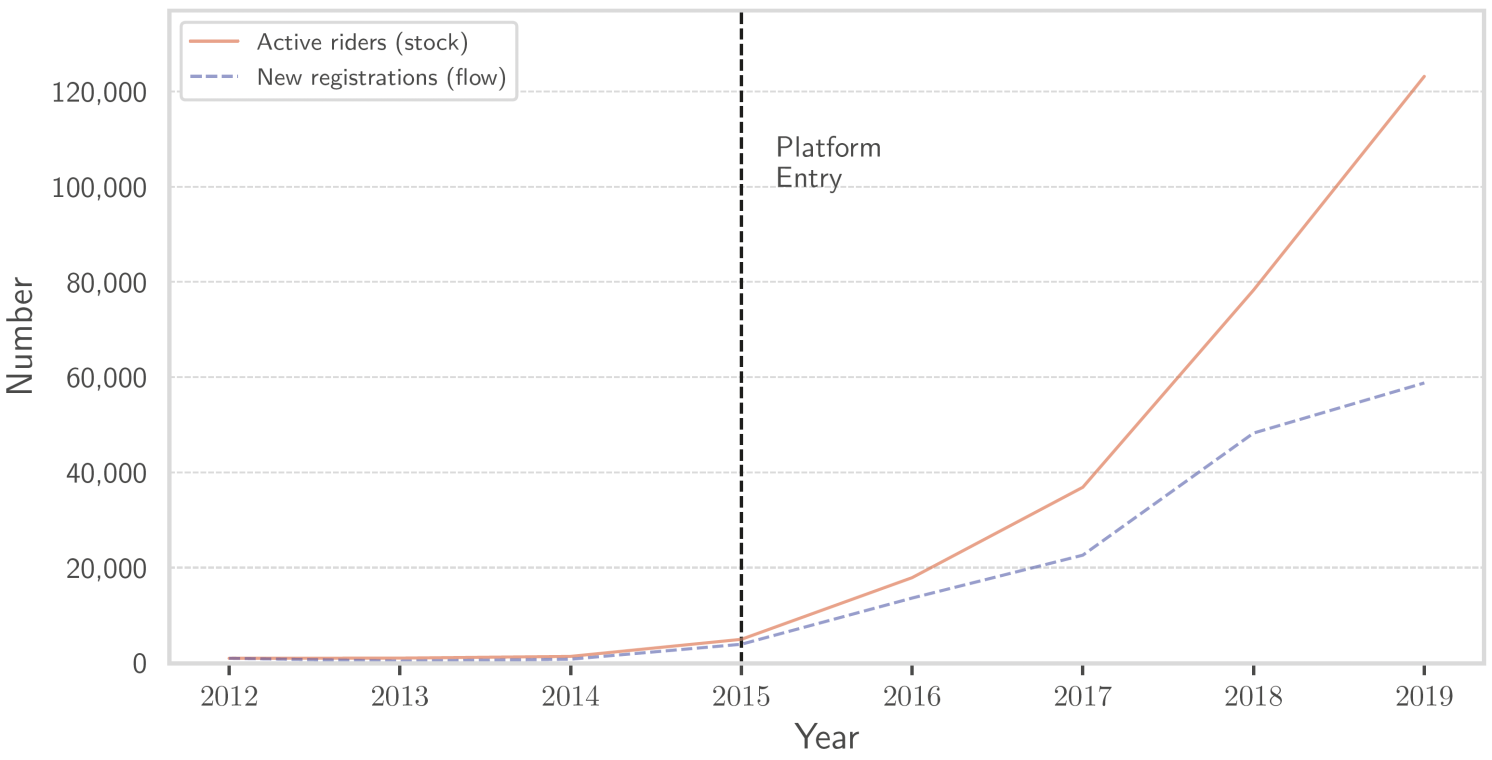
Notes: Panel a displays the staggered rollout of major food delivery platforms across France between 2015 and 2019, aggregated at the level of police jurisdictions. Red indicates the first year of platform entry. Panel b shows annual counts of food delivery workers. The dashed line reports new registrations (annual inflow of newly registered riders); the solid line reports the stock of active riders (micro-enterprises with positive declared turnover in at least one of the previous two years). The vertical dashed line marks platform entry in 2015.
As Figure 1 Panel b shows, the effect on rider numbers was immediate and large. The stock of active riders rose from near zero in 2014 to around 120,000 by 2019. Individual-level data from public business registration records allow us to characterise riders. They are overwhelmingly young men; about one-third are foreign-born; and of the two-thirds born in France, nearly half have a non-European-sounding first name. These are precisely the groups facing the steepest barriers in the conventional labour market.
Labour Market Adjustments
Our estimates confirm that platform entry causes a sharp rise in delivery-worker registrations, concentrated almost entirely among men – around 62 additional registered riders per 10,000 men. Among men, foreign-born individuals respond twice as strongly as the French-born, reflecting the acute barriers migrants face in conventional hiring. This differential take-up is key to our identification: if platforms affect crime through labour market channels, the effects should be largest precisely among these groups.
Aggregate unemployment and inactivity rates do not change significantly following platform entry. The shock is too targeted to move population-wide indicators. But the picture sharpens when we look at the groups taking up delivery work. Male unemployment declines by around 1.5% after entry. The most striking result is for male migrants: their inactivity rate falls by nearly 9%. This drop is consistent with platforms drawing men out of inactivity rather than from registered unemployment. For many migrant men, rider jobs represent their first foothold in formal employment.
We also find no displacement from other low-wage sectors. Employment in restaurants and supermarkets does not fall, ruling out the concern that platforms simply substitute one form of precarious work for another.
Crime Falls – But Only Where the Theory Predicts
Figure 2 shows the impact of platform entry on four categories of crime. The pattern of effects matches our theoretical mechanisms.
Overall recorded crime falls by around 3% after platform entry, with violence against the person down nearly 7%. The largest declines are in vandalism and destruction of property (−15%, Panel a) and drug offences (−15%, Panel b). The fall in vandalism is particularly consistent with the incapacitation channel. These offences are disproportionately committed by adolescents and young adults and tend to be concentrated in the evening and weekend hours that delivery shifts occupy. The reduction in drug offences aligns more closely with income substitution: platform work provides a legal, accessible alternative to low-level dealing for individuals facing barriers to formal employment.
Figure 2 Impact of platform entry on crime
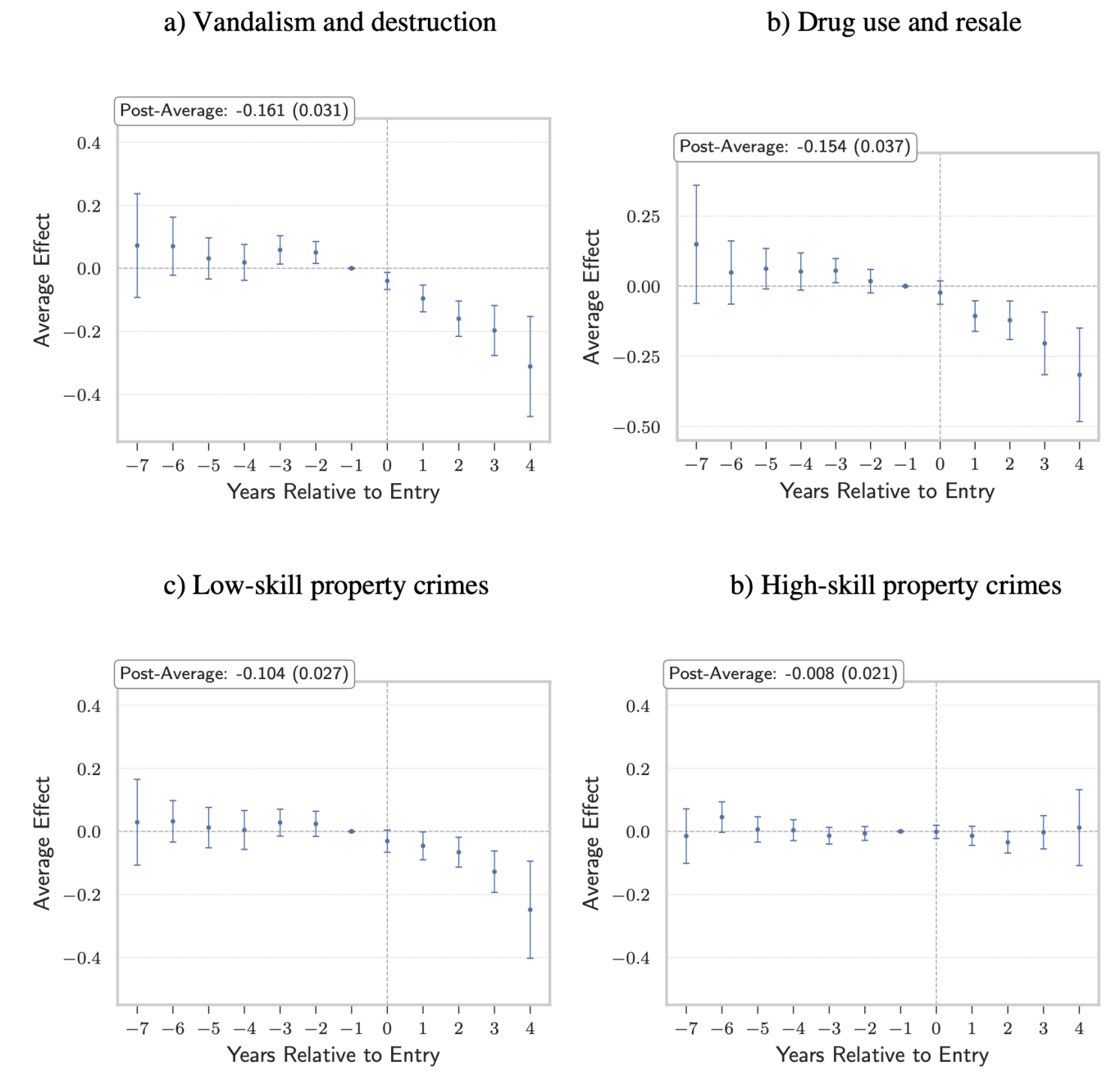
Notes: Event-study estimates of the effect of platform entry on annual crime rates across French police jurisdictions, for individuals aged 15–54. The vertical dashed line marks the year of platform entry. Post-entry percentage changes shown below each panel. Full technical details in Allouard et al. (2025).
The distinction between property crimes by skill intensity sharpens the picture further. Low-skill property crimes such as shoplifting and street robbery, which require little planning and are most common among individuals without stable income, fall by around 10% (Panel c). By contrast, high-skill property crimes such as burglary and vehicle theft, which require experience, networks, and higher fixed costs, show no detectable effect (Panel d). Platform access shifts behaviour at the margin of entry-level criminal activity, not professionalised crime.
What Rules Out Alternative Explanations?
A natural concern with our identification is that platforms do not enter randomly. They target areas with larger markets and more economic dynamism. Entry may therefore coincide with local economic improvements that would have reduced crime regardless. Pre-entry trends in crime and labour market outcomes are reasonably flat across all groups, which is reassuring, but cannot entirely rule out coincidental entry into areas on the cusp of a boom.
Two tests provide stronger evidence. First, we exploit the legal minimum age of 18 for delivery work. If crime falls because of platform access, reductions should appear only among those eligible to become riders. Broader economic trends would affect all ages equally. Using court records that identify offenders’ ages, we find that the decline is concentrated entirely among adults, with no effect among minors. Second, excluding the three largest cities – Paris, Marseille, and Lyon – while retaining their suburban commuter zones, where most riders live, leaves the results unchanged. Together, these tests point firmly to platform access as the driver.
Policy Implications
Our findings show that expanding access to legal income for disadvantaged groups can reduce crime even when jobs are temporary, flexible, and low-paid. This has direct relevance for debates around the EU Platform Work Directive, adopted in 2024, which extends employment protections to gig workers.
The goal of greater stability is welcome. But the reforms must preserve what makes delivery platforms valuable for the most disadvantaged workers: their non-discriminatory, low-barrier hiring (no CV, no interview, no language test). If tighter regulations raise screening costs, platforms may become more selective, closing the door on the workers who benefit the most. The challenge is to extend rights without importing the discriminatory filters of the conventional labour market.
The long-run question is whether these jobs are a genuine gateway to stable employment or a dead end. The short-run gains are real regardless. But the early evidence is sobering: gig experience yields far weaker labour market gains than traditional work, and offers especially little progression for workers with immigrant-origin names (Adermon and Hensvik 2022) – the group most likely to take up delivery work. Evidence on refugees points in the same direction (Degenhardt and Nimczik 2025).
The policy goal should be to pair accessible entry-level work with pathways to skill development and stable employment. Whether gig platforms can become a genuine gateway, rather than a revolving door, is one of the most important open questions in labour market integration policy.
See original post for references


So give people the chance to quickly get into paid work and provide for themselves and their families and crime goes down. I would posit that it’s not the fact that it’s a gig job but that it’s OK income, easy to sign up for and peers in the local community see it as culturally acceptable work. Part of it also might be not having to work for a French boss, only a virtual one.
Bugs: Here in Italy, there are two other complicating factors, both very interesting. The delivery services keep losing cases in the labor courts for mistreatment of workers and insufficient pay. They lost bigtime here in Torino.
From a kicker in an article in La Stampa about these verdicts, which keep happening: “Dietro la comodità della nostra cena c’è un sistema di “lavoro povero” che pochi conoscono e che i giudici stanno smantellando. «Guadagno 2 euro per un’ora di attesa»”
Two euro a hour. Maybe the pay is higher in France.
Another aspect is recent cultural criticism of the use of riders as a form of slavery. I have read essays by Alessandro Robecchi and Paola Zonca in Fatto Quotidiano, both of whom state the moral equation to just that.
Lousy work may be an entry into the workforce. But then where does one go?
I do not know whether the figure you give for Italy is gross or net per hour.
The situation has been investigated in France. The figures are:
1) Average gross income €1480/month for average working hours 63/week, i.e. €5.87/hour.
2) However, contributions to social security, maintenance of equipment, etc, take away on average €597/month. This means the net income is about €3.50/hour. Actually, it is often worse since 75% of those deliverers have to rent the Deliveroo or UberEats account from a third party to get assignments! That’s right, there are parties that manage to further extract rent from the delivery people on those gig platforms. The average final income ends up varying betwen €840 and €880/month.
3) If you wonder why anybody would accept such conditions, 64% of deliverers do not have any kind of residence permit (illegal immigrants or asylum seekers).
4) Most of them have health troubles because of the gig work (low-back pain, urinary problems, depression, chronic fatigue) and have had at least one accident related to their activity.
Their situation reminds me of how porters were exploited in the 19th century, including those intermediaries gatewaying orders and taking their cut.
4) Most of them have health troubles because of the gig work (low-back pain, urinary problems, depression, chronic fatigue) and have had at least one accident related to their activity.
It would be interesting to calculate the net cost to the taxpayer for funding those health troubles.
Thank you for this description. I frequently cross routes with bikers working these schemes. Tend to be migrants (not always), young (not always) and bikes are electric (nearly 100%). Yet their uber eats, deliveroo, whatever, backpacks are cubic stuff which looks rather uncomfortable and adapted for the loads, not for the back of the person doing the deliveries. It seems to me that the least important piece in this business is the human one.
Less crime. In can believe that but instead of dignifying this exploitative scheme it suggests that policies can be changed to reduce crime and at the same time provide some income for the youngers. I can think of many public jobs which might do the same but being more humane.
Now imagine how much more beneficial the old-fashioned, regular full time jobs are.
Bingo. That’s sort of what I meant above. The issue is the friction of getting hired, which the apps have eliminated partly because if your last name is something like Djalo or Abadi, your application won’t automatically go in the trash. They just want a reasonable scan of a driver’s license, an insurance attestation, and off you go. The kids (these are mostly young men) lend each other documents and switch off driving so there’s some autonomy as well. And again, no French boss hassling you.
There was an interesting article in the Guardian a few years back (I think it was them anyway). It was basically a cost benefit breakdown of robbing a bank, comparing the UK and USA. Basically the average money stolen in US bank robberies was slightly higher, but the average jail sentence was much higher. In both cases pretty much all bank robbers were caught and sent to jail. I can’t remember the exact values, but basically a year on minimum wage in either country would earn you more than the average for a bank robbery. And that was even worse if thr “income” was divided by the number of years in prison.
Gig work is a legalized exploitation of labor in service to extremely poor business practices that expedite profit at the expense of long-term growth and the general public’s well-being.
I was writing resumes way back when some clients had to develop elaborate strategies to hide temporary employment because HR depts thought people who had to resort to temp jobs were strictly bottom of the barrel hires. That bias still exists but not for most workers. Now it only kicks in when you try for upper management all of whom must have a private college in their background as well a smooth history of upward (nepo/crony) career trajectory. That or really good references.
Call it cronyism or networking or maybe even corporate Hinduism (if you had been meant to be a veep, you would have been born a veep), just don’t call it a class war.