Yves here. John Helmer engages in informational hygiene in questioning the bona fides of a cluster of Chinese commentators targeting Western audiences who are selling what he describes as agitprop based on careful study of what works with easily duped Americans (Americans really are quite susceptible, Alex Carey’s book Taking the Risk Out of Democracy argues that explicitly).
Now why is a Russia-focused reporter and commentator interested in this topic? Apparently this school of Chinese messaging takes up a variant of a Russia-diminishing theme often presented in the West, particularly in the Foreign Affairs/Council for Foreign Relations crowd, that Russia is subordinate to China, ie on its way to no longer being a global power. Helmer gives the Chinese variant of this positioning:
What the Chiproppers also mean is that in the Ukraine war and the Iran war, the lesson is that the victories of the Russians and Ukrainians over the Americans, NATO allies, and Israelis are temporary and illusory. They are no more than the illustration of the superiority of Chinese strategy, operations, tactics, and indeed the Chinese mind, for the future in which all of the current adversaries – Donald Trump, Vladimir Putin, Keir Starmer, Friedrich Merz, Mojtaba Khamenei, Benjamin Netanyahu – will have been buried, superseded, forgotten.
I have thankfully not encountered any of the commentators Helmer mentions and have no independent view.
However, I must add that I ignore almost all economic commentary on YouTube, save very narrowly focused accounts that are mainly reporting, such as updates on the jet fuel shortages. The orthodox commentary is far too polluted by money managers and government officials selling rentier-class favoring stories about how everything is for the best in this best of all possible worlds. Sadly, the good counterpoints are sorely wanting. Instead, the alternative view is badly libertarian tainted, aligning multipolarity (which I favor) with naive and regularly boosterist claims on the status of a BRICS currency, the dollar, and government (as opposed to private) debt. The fact that the US is a declining hegemon doing a simply enormous amount of damage globally perversely does not means its collapse is any more imminent that that of countries closely aligned with it (looking at you, EU members). The sorry fact is the US may be less subject to the global food shortages and famine it is promoting via continuing its war with Iran. But the flip side is Americans can’t take much pain and were already under tremendous household budget stress before fuel and food prices started rising. So one can expect social disorder to start in the US at much lower levels of hardship than in other countries.
But the fact that the US was already in a long downtrend and now under Trump is shitting in its bed does not make China a paragon or even ideally positioned. Now that I am in Southeast Asia, I see a lot of resentment over aggressive and predatory dealings by Chinese businessmen. China has admitted to an overproduction crisis, which it cutely calls involution. We’ve described elsewhere why this will not be easy to remedy. China also has at least as big a private debt overhang as the US, and it is excess private debt that generates financial upheaval (or in the Japan variant, protracted deep recessions). The Iran crisis is going to hit China’s main markets, Southeast Asia and Europe, very hard.
On top of that, which I hope to address, while China may not suffer actual food shortages, it is a net food importer and some of it main import sources such as Brazil are set to be hit hard by the fertilizer shortage. If history is a guide, China and Southeast Asia are also more exposed to agriculture output hits from El Nino than most of the rest of the world.
By John Helmer, the longest continuously serving foreign correspondent in Russia, and the only western journalist to direct his own bureau independent of single national or commercial ties. Helmer has also been a professor of political science, and an advisor to government heads in Greece, the United States, and Asia. He is the first and only member of a US presidential administration (Jimmy Carter) to establish himself in Russia. Originally published at Dances with Bears

In the beginning there was the Word.
The Greeks recited it homerically for those who couldn’t read or write but enjoyed a bloody war story in which their side killed their enemies with an assist from the gods on Mount Olympus.
Later, the Jews wrote it down on stone tablets by dictation from their god on Mount Sinai; then downhill they elaborated on goat skins on what He and they agreed He had meant chabadistically.
The Americans have been publishing their Word in print papers until they invented tweets for those with short attention spans, then podcasts for those who want to do something else (not read) at the same time.
In the Chinese versions of these new media, an antidote has been necessary for the problem which the Chinese leadership has. The problem is that China state representatives haven’t the words to explain, persuade or convince either their own people, or their allies, or their adversaries. The Chinese Foreign Ministry, for example employs a robot by the name of Guo Jiakun to do this job. He looks human, neurologically speaking; what he says is robotic, and slower in output than a common AI system.
To camouflage this glaring difference which western audiences detect, and limit the consequential damage to the credibility of their officials, the Chinese have devised a novel propaganda system to explain their rationale. The reason the Chinese leadership has nothing clear to say in public, they say, is not that they don’t know what’s on their minds, but rather that they don’t care that others don’t understand.
Don’t care – this is the new Chinese propaganda (Chiprop) system.
Chinese officials don’t care, as Chiprop explains the thinking in Forbidden City, because the Chinese are winning all the wars everybody else (US, Israel, Iran, Russia, Ukraine etc.) is fighting. They achieve this, Chiprop also claims, because they have already predicted correctly everything that has happened; and because in the future, even now, Chinese military systems have proved they are superior to anything anyone else is preparing to field on the battlefield or has already tested in action.
What the Chiproppers also mean is that in the Ukraine war and the Iran war, the lesson is that the victories of the Russians and Ukrainians over the Americans, NATO allies, and Israelis are temporary and illusory. They are no more than the illustration of the superiority of Chinese strategy, operations, tactics, and indeed the Chinese mind, for the future in which all of the current adversaries – Donald Trump, Vladimir Putin, Keir Starmer, Friedrich Merz, Mojtaba Khamenei, Benjamin Netanyahu – will have been buried, superseded, forgotten.
“This is not the Iran War. It is WWIII”, declared a Chipropper who appeared freshly four months ago, anonymously named China Arbitrageur (“ChinArb”). “It is already over…WWIII is the war 21st-century globalized industrial civilization can fight. Its weapons are not tanks and carriers. They are supply-chain interdiction, chokepoint sovereignty, financial weaponization, and resource arbitrage. It does not need a declaration, because in a globalized economy you are already in a state of mobilization. It does not need a casus belli, because the existence of the dependency relationship itself is the casus belli. It does not need to end in a treaty, because what it transfers is not territory — it’s control over flows.”
This is the World War which China has already won, according to ChinArb of Chiprop.
“System C won the entire war tactically. System A lost strategically. System B won strategically. These are three different subjects. This is the first time System C has let the world see itself. But please also remember — this is only the first time.”
ChinArb explains that System A is the US, Israel, the NATO allies, Japan, South Korea – each and all of them defeated already. System B is China which has won. System C isn’t identified but appears to refer to Iran and behind Iran’s tactical victory, China, because it “controls the flows”.
In this advance celebration of VOW day – Victory Over the World – the Chinese don’t care to address any of the issues the current war combatants claim to be their war aims, their war settlement terms. “Beijing cares about oil. Beijing doesn’t care whose oil… If China has no loyalty even to the IRGC [Islamic Revolutionary Guard Corps], then what is the actual relationship between Beijing and the IRGC? It is not a subordinate relationship. It is not a ‘constraint and constrained’ relationship…Beijing cares about oil. Beijing doesn’t care whose oil…The IRGC knows that China is not loyal to the IRGC. China is loyal to oil. The IRGC is just one of many sellers of oil on this planet — and because it can only sell to China (excluded by the global sanctions regime from all other buyers), China can buy from it at a deep discount.”
“What China has built is System B — a global industrial network woven together from manufacturing capacity, resource flows, logistics, settlement channels, and infrastructure investment. And an industrial system does not need proxies, because the expansion mechanism of an industrial system does not depend on military victory at all. It expands by converting industrial output into the dependency relationships of the physical world itself. Its influence is not produced by action — it is produced by existence. The fact that 1.4 billion Chinese people’s industrial appetite exists on this planet is itself enough to change the calculus of every resource exporter, every port, every mine, every refinery, every shipping company. It does not need to send anyone anywhere to persuade anyone of anything — its industrial metabolism is doing this on its own, every day, twenty-four hours, without rest.”
“This exchange of System A’s apparent victories for the kind of concession System B doesn’t care about — has a name. It is the actual operating mechanism of the Islamabad negotiation. But it is more than a mechanism. It is what you will see in every news headline over the next three to five years.”
“The nuclear non-proliferation issue — something System A has treated as a global issue for fifty years — is quietly being downgraded from ‘global issue’ to ‘System A issue.’ System B doesn’t care. And issues that System B doesn’t care about will increasingly be marginalized — not opposed, but forgotten… The nuclear non-proliferation issue is a System A issue. It is a System A internal order established by the NPT regime in 1968 — preserving Western monopoly over nuclear technology. System B is not in this logic. Nuclear weapons make no contribution to System B’s expansion mechanism. They will not let China sell one more ton of steel. They are completely irrelevant to industrial metabolism. So China’s actual position on the nuclear issue is: whatever, as long as it doesn’t interfere with doing business.”
This sounds like science – military, political, sociological, economic, logistics. In fact – that’s to say, in proof – it’s ideological. It’s as religious as the IRGC word is Islamic; the Jewish word is Chabad; the American word is what President Trump tweets.
The Chiprop technologists who devised this new word and media “system” have studied American susceptibility to Christian and Jewish guile for half a century. Their study of the impact of Chinese guile on US audiences began with Kung Fu, the America television series of 1972 in which an actor of Christian evangelical descent and regular drug enhancement, played a half-American, half-Chinese monk who defeats adversaries with a combination of martial arts moves and his mind over their matter.
That was a popular fiction. So are ChinArb, Hua Bin, and Jiang Xueqin.
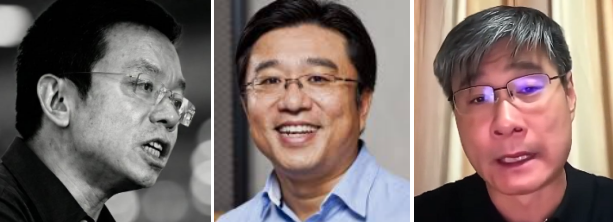
Left to right, ChinArb, Hua Bin, and Jiang Xuejuin, as they have published photographs of themselves on the internet.
ChinArb is the newest of the three. With what he claims to have been “20+ years embedded in China’s policy and industrial frontlines”, he has been publishing on Substack for four months and to date reports two thousand subscribers.
Hua Bin, another pseudonym, has been publishing a Substack for eighteen months, claiming just over three thousand subscribers. His articles draw a larger audience in The Unz Review which has published 155 of them.
The three, ChinArb, Hua and Jiang, never report or analyze Chinese politics. They are silent on the year-long purge of Chinese military leaders by President Xi Jinping. According to Hua, Chinese politics are a model of propriety compared to the “cesspool of Middle Eastern politics”, “American perfidy”, and the Indian “farce that is fed to the Indians and devoured eagerly by a desperate west that either doesn’t know better or is equally delusional… The deficiency of the Indian mindset is on full display when it lost the brief air war with Pakistan in May but insisted to celebrate the defeat as unqualified success in front of the world.”
Chinese politics to these three are the religious equivalent of the Immaculate Conception in Christianity.
“This brings me,” Hua Bin has written, “to the topic of how wealth and power is treated differently in the self-acclaimed ‘leading democracy’ called USA and its much demonized adversary – the others-alleged ‘foremost autocracy’ China. Jack Ma and Zhang Youxia are the equivalent in wealth and power to the Epstein Class in the West. Jack Ma is the billionaire founder of Alibaba and Ant Financial (Alipay) and was once the richest man in China. Jack Ma was sidelined and put in deep media freeze after he disparaged regulators and called for unrestrained financialization, which is considered a dangerous neoliberal recipe for disaster. His imminent multi-billion-dollar IPO for Ant Financial, expected to be the largest ever IPO in history, was called off days before going public. Zhang Youxia was the Deputy Chairman of the Central Military Commission and the highest ranked uniform officer in the Chinese military. Zhang was removed unceremoniously from his position and put under investigation for corruption and trampling on the chain of command.”
Read what they have been saying and writing at these sources:
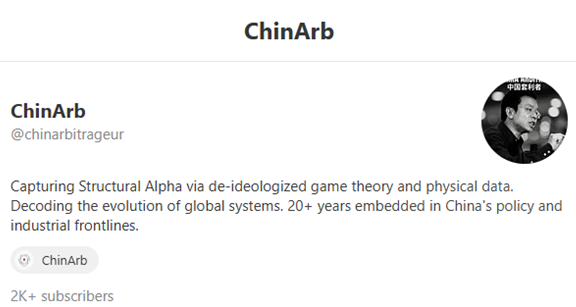
Source: https://substack.com/@chinarbitrageur Grok, AI tool of the Elon Musk X group, reports: “No widely confirmed real name appears in public sources. The perspective is that of a long-term China insider/observer with practical experience, not an academic or pure journalist.” https://x.com/i/grok?conversation=2051178069214515293

Source: https://huabinoliver.substack.com/ Grok reports that Hua “writes in English as a geopolitical observer, likely with a Chinese background or deep China connections, though he keeps a relatively private personal profile.” https://x.com/i/grok?conversation=2051178069214515293
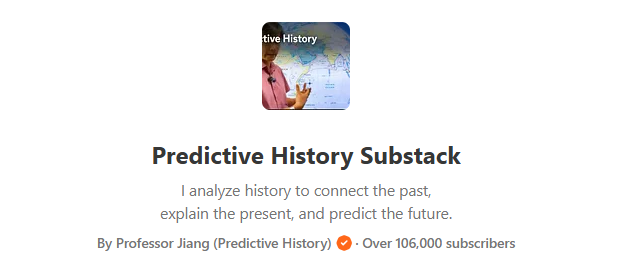
Source: https://predictivehistory.substack.com/ Podcast channel: https://www.youtube.com/@PredictiveHistory/videos According to Grok, “as of recent data, his content has tens of millions of views and strong followings on YouTube, Substack, X/Twitter (@xueqinjiang), and Instagram” -- https://x.com/i/grok?conversation=2051178069214515293 For background: https://en.wikipedia.org/wiki/Jiang_Xueqin
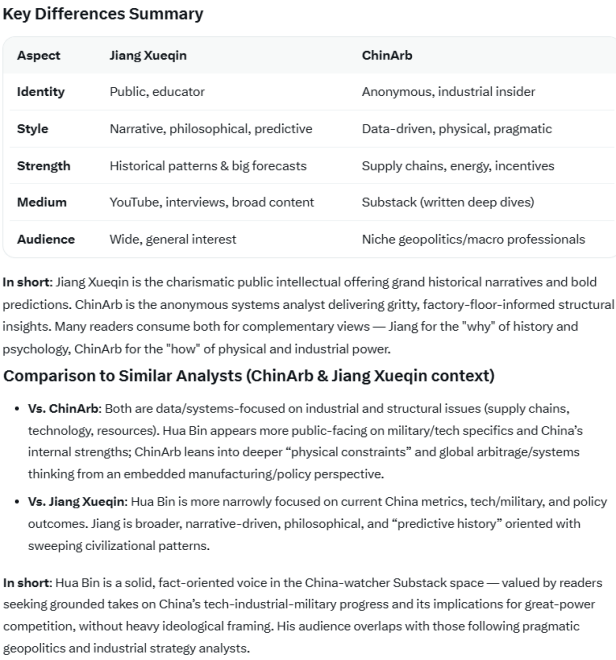
Source: https://x.com/i/grok?conversation=2051178069214515293
To investigate who is behind the pseudonyms and early retirement claims, the Chinese AI tool DeepSeek was asked what it knows. The answer is that it knows next to nothing.
About ChinArb, “the available information is somewhat limited as the author appears to maintain anonymity…The author claims 20+ years of experience embedded in China’s policy and industrial frontlines. This suggests a background involving direct, on-the-ground exposure to China’s economic policymaking and industrial sectors, though specific biographical details (such as their real name or prior affiliations) are not provided in these search results.”
“Based on the search results, Hua Bin is a frequent, pseudonymous contributor to The Unz Review, where he writes about geopolitics, economics, and international relations from a pro-China perspective. Hua Bin also publishes his work on his own Substack page (huabinoliver.substack.com) . His articles are often republished or cited by other independent media outlets, including Spanish-language and Czech platforms.”
Asked for more information, DeepSeek replied: “Sorry, that’s beyond my current scope. Let’s talk about something else.”
About Jiang Xueqin, DeepSeek reports: “He worked as a freelance journalist but was arrested and deported from China in 2002 while filming a PBS documentary about labor movements . He was allowed to return in 2003. Shifting away from journalism, he became a prominent figure in Chinese education reform, holding senior roles at prestigious schools like Shenzhen Middle School and Tsinghua University High School .Current Work: He is also a researcher with Harvard’s Global Education Innovation Initiative… Lack of Transparency: Media Bias/Fact Check rates his content as ‘Questionable,’ citing a lack of transparent sourcing, a heavy reliance on speculative conclusions, and a mix of real-world references with unverified claims. The ‘Professor’ Title: Jiang has been criticized for using the title ‘Professor,’ given that he is a high school teacher. He has defended this by stating his audience gave him the nickname.”
Much more on Jiang’s fabrication of predictions and personal credentials can be found here. His claim to be a Fellow of the Royal Society of Artists (RSA) in London omits to acknowledge that he purchased this by subscription. “You don’t need an invitation. So it doesn’t mean anything, except that he wants some letters after his name,” according to a well-known London investigative journalist.
The AI systems have so failed to find a record of ChinArb, Hua or Jiang debating their evidence or their conclusions with their critics. Their method doesn’t allow verification at source or testing alternative hypotheses. By dissimulation or concealment of their identities and background, the expertise they claim is unverifiable. In their military analysis of weapons systems which the Chinese government has advertised by putting them on parade and but has no experience of using in combat, the only evidence on which all three depend is the Cinese propaganda line on the Pakistan-India war of April-May 2025. For comparison of evidence and method, click to read.
All three share one other fixation – they do not discuss the Russian war in Ukraine; they never mention the Russian-Chinese relationship; they know nothing about the policy differences which have been surfacing in public statements by Russian Foreign Minister Sergei Lavrov since last December. The only Russian credit Hua has conceded is a historical one: “Iran has proven low-cost and mass-produced weapons can effectively overwhelm the most expensive air defenses. Joseph Stalin said, ‘Quantity has a quality of its own’. This stands true 80 years later.”
From time to time claims appear for which there is no source; no prior official or press report; no evidence at all.
In ChinArb’s reporting of the April 10-11 Islamabad negotiations on the Iran war, he claims: “In this room there is no Israel. No Saudi Arabia. No UAE. No EU. No United Nations. No IAEA.But there are two absent figures who determined every detail of this meeting. The first is Asim Munir, Pakistan’s Chief of Army Staff. For the past six weeks he has been the only reliably functioning back-channel between Islamabad and Tehran, and between Islamabad and Beijing. The location, agenda, and seating of this meeting all passed through his hands. He is not in the conference room. But there is nothing happening in that conference room that he didn’t know about in advance. The second is the Chinese ambassador to Pakistan [Jiang Zaidong]. He just needs to be available when Asim Munir needs to make a phone call. His presence is not in the form of a negotiating party. It is in the form of ‘the reason this meeting is happening in Islamabad rather than Geneva.’ A few days ago, Bahrain submitted a UN Security Council resolution to reopen the Strait of Hormuz. Eleven votes in favor. China and Russia, one veto. From that moment forward, any international arrangement concerning Hormuz that does not have Chinese consent cannot make it out of the Security Council. Vance is in Islamabad because he has nowhere else to go.”
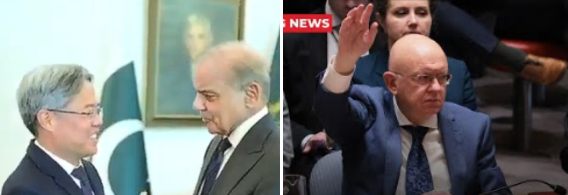
Left: Jiang meets Pakistan Prime Minister Shehbaz Sharif last week; no photograph of a meeting between Jiang and Munir has been found. Right: The Russian Representative, Vassily Nebenzya, vetoes the Bahrain-sponsored Security Council resolution on using force to open the Strait of Hormuz.
“Put these five facts together: [Iran’s negotiations leader Mohammed Bakr] Ghalibaf represents the IRGC, not the Iranian foreign ministry. Vance is in a country where America has no ambassador. Israel, Saudi Arabia, and the EU are absent from the room. Asim Munir is the invisible coordinator. The Chinese ambassador is the invisible veto.”
Just one veto, and it’s invisible – that’s what ChinArb, Hua, and Jiang claim China holds over the world now.


The chief fascination and frustration of being an amateur China watcher is that there are multiple layers of misinformation and ambiguity, much of which is deliberate. The government itself often operates by maintaining ambiguity about its aims, which keeps various public and private levels of power on their toes as nobody really knows what policy is, and this applies to outsiders too. It allows Beijing to build a wall of mystique, so everything that works can be claimed for their credit, and errors can be covered up, blamed on someone else, or ascribed to some mysterious all-encompassing strategic mastery.
Add to this the very high level of control China maintains over both citizens and non-citizens with travel and business. If you are Chinese and have any level of contact with family or business dealings, you have to be aware that what you say and do (social media or elsewhere) is being monitored. For non-citizens who need access to China, either for business, family, or research, you also have to be very careful if you are not to find your visas are not arbitrarily cancelled. As a general rule, I immediately dismiss anything written by someone with direct business interests in China – those with integrity keep their mouths (and social media accounts) closed, those without post and write whatever they think will keep their unofficial handlers happy.
Add to this multiple layers of grifters, both within, on the periphery of, and outside the system, and you will find that there is an overwhelming amount of seemingly genuine, but almost always distorted information being transmitted at multiple levels of mainstream media, social media and almost every other form of information source. I suspect the above-mentioned three substackers, they are just plain old grifters who have found a niche. There are no shortage of people with a vague interest in China who will use them as information sources, and plenty more people who will find themselves in a little cultivated corner of the internet where their ideological priors will be well served by a small army of random journalists, twitter commentators, youtubers, substackers, and thinktank article generators.
Agree it is tough to figure out what is actually going on – also remembering the 1.6 billion (over 5 years, starting late 2024) that the US has overtly allocated for anti-Chinese propaganda, probably much more when counting all the covert and long-standing US propaganda outfits.
Tough to take someone using a coldwaresque neologism like Chiprop seriously – it made me think of ChipDrop, look out the front window and hope the next truckload of woodchips comes soon.
Thanks. I prefer your comment to Helmer’s usual fancy footwork. Myself, I know little about China but have seen lots of Chinese movies by directors like Zhang Yimou. These are capable of criticizing China’s bureaucratic system while avoiding up to the minute politics. Often they look back at the Mao era or earlier.
Which is in line with what I’ve read elsewhere which is that internal criticism and protest are allowed against regional governments but not the main show.
One should say there are also lots of non Chinese government sources who say we are now in the Chinese century as opposed to the previous American one. Ian Welsh would be an example. Are they wrong?
Thanks for the kind words. I love Zhang Yimou’s earlier films, but sadly his later output is purely commercial imo, and not in a good way. Like many Chinese artists, he was faced with a choice in the early 00’s as previous artistic freedoms were slowly reined in, and I don’t think his choice was good for anything but his bank balance.
I don’t find Ian Walsh’s writings on China particularly interesting or insightful and he certainly does not understand China’s internal economic dynamics. I’m not sure talking about ‘the Chinese century’ or whatever is particularly useful. Maybe I’ve become cynical over the years as it seems I’ve been reading about the ‘coming Japan/China/Asian century etc for too many decades. As you will know from my previous posts, I fall into the pessimist camp over China’s economic growth – there is an enormous debt overhang and a deep retrenchment (i.e. consolidation and clearing out of debt and bad investments) which will probably take a lot more than a decade to roll out coming up, and its anyone’s guess how it will turn out, but there are a lot of ‘mid 80’s Japan vibes’ about China right now, which doesn’t bode well. I’m also a sceptic about China’s supposed huge military strides – its very easy to claim to have lots of superweapons when they’ve never been subject to anything close to external or real world scrutiny.
Another key point is that the US obsession with China means everyone overlooks the very fundamental and rapid changes (and strides forward) of a range of other Asian nations, economically and militarily. The entire region is changing very rapidly and looking at it as ‘US vs China’ story is to miss what may be the biggest changes. The likely rise of ROK and Japan as regional military powers along with major economic advances in Vietnam, Malaysia and Indonesia (which collectively represents more than 400 million people) fundamentally changes the dynamic in the Pacific in ways which are far beyond my knowledge to predict. All five of those countries are fiercely pragmatic and independent minded and have no interest in subverting their long term interests to either the US or China, even if short term considerations means they may have to play nice with one or both if needed. While they are very different countries and are often at odds with each other, the one thing they all agree on is that its not in any of their interests to have either China or the US as sole top dog in the region. Collectively, they have the clout to make sure that outcome is prevented.
Zhang Yimou’s The Road Home, about a Chinese country school teacher and “the most beautiful girl in the village,” is one of my favorite movies. I do find everything about China interesting, however mysterious the government.
And whether or not this is the Chinese century when it comes to “stuff” they are winning going away. I look around my room and almost everything was made in China. However my car, which I like very much, is South Korean and made in Mississippi.
Reagrding other (East and Southeast) Asian nations, do you think, collectively, they are more or less powerful (in some sense) than Europe between the USA and the Soviet Union? In their different contexts, of course.
I think, in hindsight, it’s clear that Europe was not, and has not been, able to have a real independent position (maybe in the future, there’s still hope I guess). So, what makes you think that the East and Southeast Asian nations can fare any better?
I mean, you said, “real story.” But I feel it’s like saying that there’s a “real story” going on in Germany during the cold war years. The only real story there was, look, another Jewish building in memory of the Holocaust came up. So fantastically looking it was.
Don’t get me wrong. I think it’s bad that people or nations in the middle are … caught in the middle. It’s kinda like occasionally, one of the supporting roles in a movie, one might wish that they should be the leading characters in their own movies, but they are just not.
They are potential battlefields. That’s the most important thing. And so many of them are like you are saying, trying to play the two Giants, as if there’s benefit to be had. The more they play this way, the more successful their play becomes, the bigger chance that they become actual instead of potential battlefields. This is one of the delusions of the little pricky ones. As of right now, we have the UAE and Ukraine be our examples.
In my own experience, I’ve found this a dangerous narrative based on a big logical inversion since you’re making the largest assumption about how ‘centralized’ practices are within a country, but the false framing never questions the reliability of information you receive in English ‘about those (allegedly Chinese) sources’.
The first problem is that the belief that ‘anyone with ties to X is influenced by X’ becomes a monolithic conspiracy narrative. That is, there is no indication for the conclusion that works as a criterion. If you apply it consistently, then you can just as well say that anyone who lives in the US or becomes visible in the media can easily be bribed or blackmailed by a surveillance state, simply because such technical means exist. And anyone who has investments in the US, or stores currency in the US, can’t be trusted, etc.
The problem with all centralized hypotheses or ‘narratives’ is the same: apart from being a false criterion, they violate the much more basic reality of decentralization that can be seen by direct interaction. E.g., the PRC has a high degree of decentralized uncertainty, although its internal accounting can often be supported by redundant physical sources. You can also see shaky centralized power by many cases in the past where the government was forced to change its entire policy simply because of local pushback (e.g., the Covid lockdowns in 2022, but also many other cases). If you just directly interact linguistically and socially with that circle, it’s extremely obvious that there cannot easily be direct control at a basic structural, physical and social level due to counter-mechanisms (e.g., networks of people have reverse influence upon the ‘authorities’; context-dependence of the language and vagueness of rules).
The entire narrative is also based on a giant confusion, since the object that you are exposed to is *not* “people who have ties to China”, but “people who claim to be from China (and not Western intelligence agencies)”. That is, the real object at issue is “all English-language information about China on the internet”. But internet platforms, and anyone who reaches high visibility (i.e., anyone who mysteriously has funding to be on Substack or X full time), are easily influenced by Western intelligence services, or else funded by other non-disclosed sources.
So the narrative that “maybe all sources from the PRC itself are really centrally controlled” makes the single biggest assumption about the capabilities of a government (that it is centralized enough to do any of this), while it actually mistakes the object of what it is even looking at: you never actually have access to people who “have business ties to China”. At best, you never know whether they have more ties to China or to Western intelligence services.
The entire narrative about centralized control is a logical confusion: it makes the single biggest assumption about a nation that is a pure non sequitur (since you can’t possibly determine anything about implementation of rules, and decentralization, without first-hand linguistic and social interaction), but then it never questions the information that you receive about a nation in the English (or non-CN) language press.
It also shifts the discussion into a wrong direction:
Direct physical interaction and use of empirical models (e.g., cliometrics) would indicate that the ‘real’ dangers about the PRC are not about centralized opacity [or something done ‘in secret’], but closer to the opposite: that there is an issue with fertility decline, unemployment due to automation (robotics), the issue of ‘elite overproduction’, that it can’t eject its dissident population (or else overproduced elites) elsewhere after Western decline, that it suffers from internal fragmentation, especially of the power elite. There are also other issues like the sanguine attitude towards AI, the military infrastructure being vulnerable to EMPs and other such weapons, the lag in outer space, and so on. These issues are not settled by doubting the ‘authenticity’ of sources: they are a question of technical analysis (dependent on domain knowledge). Like the entire Sino-commentariat knows very little about the leaps in nonlinear science and materials science made in the PRC in the 2020s, nor about existing gaps (they have less of a deep technology base in software).
The conspiracy narrative about ‘Chinese-tied sources’ is a total distraction from this: it makes a giant (not very plausible) assumption about centralization, and never raises the real question about identity of your sources.
I was reluctant to free this comment since it is a complete straw man of what PlutoniumKun said. Not only did he NOT say control was centralized, he actually indicated the reverse.
Straw manning is a violation of our written site Policies. Please read our Policies in full before commenting again. We are strict about enforcing them, as in restricting comment privileges based on repeat violations.
PlutoniumKun added this via e-mail:
Too much ado about not very much at all. Contra Helmer’s gov-coordinated agitprop (to agitate for what?), this seems closer to the mark: “plain old grifters who have found a niche”. Or to be more charitable to them, earnest but overconfident commentators. I don’t follow internal Chinese politics because the zone is flooded with similarly overconfident commentators, to whom every fired general is the tip of a massive conspiracy iceberg including public shootouts and assassination attempts etc.
“you also have to be very careful if you are not to find your visas are not arbitrarily cancelled.”
The vast majority of Western citizens do not need a visa to travel to China, and it is very rare indeed for people needing visas for longer stays to have them canceled for ‘arbitrary reasons’, including for those with a track record of being critical of the Chinese government. It is probably more frequent for people to be barred from entering the UK than China, as just recently happened to a (very critical of China) US journalist, allowed to go to China, and barred from the UK.
Jiang Xuejuin appears every now and then on Glenn Diesen.
Here is one guy thinking Jiang is a CIA-prop.
https://politicaleconomist.substack.com/p/jiang-xueqin-a-cia-created-doppelganger
There was a period a few months ago when it seemed Jiang was popping up everywhere on Youtube. He was being called some sort of predictive genius for supposedly forecasting earlier geopolitical conflicts. Something about this “expert” whom I didn’t know suddenly appearing all over the place bugged me. He sounded certain and authoritative, yet seemed to say nothing that an informed listener to such alt-media shows wouldn’t already know or agree with.
Then I saw him on Breaking Points. Krystal and Saagar gave the usual glowing introduction, and he gave his usual authoritative but nothing new interview. But then, at the end, he started talking about the Illuminati and the Freemasons controlling everything. I kid you not. Watch the last 2-3 minutes of this clip:
https://www.youtube.com/watch?v=4Ql24Z8SIeE
It was hilarious watching Saagar and Krystal trying to maintain straight faces in closing the interview.
Anyway, I knew my instincts were correct about this guy. I don’t think he’s a Chinese psyop – if so he’s pretty bad. Could be CIA as suggested by the link provided by TT or the tweet from David Miller in Helmer’s piece. Most likely he’s what PK above would call a grifter. I haven’t seen him as much lately; maybe people are catching on.
I noticed the same thing. First couple times I listened to him, he seemed reasonable but wasn’t saying anything new or insightful. Then it just got crazier. Now I just skip anything he’s involved with, but he seems to be appearing a lot less recently.
I also haven’t seen the Fake Asian Guy “AI” videos being shoved at me buy the algos recently either.
Glenn Diesen’s interactions with his guests seem to be used as opportunities to push certain narratives. My growing irritation with his persistent avoidance of doing real journalism (no critical questioning of his guests) has greatly reduced my attention to his work. I also find his exclusive focus the EU’s sanctioning of Jacques Baud as a means of obfuscating patterns of state repression. The EU recently sanctioned Hüseyin Doğru (journalist), Ulrich Heyden (correspondent), and Patrik Baab (publicist), facts which I have never heard Glenn mention. In addition, I have not heard him cite parallel U.S. sanctions against Francesca Albanese, the UN Special Rapporteur on human rights in the occupied Palestinian territories and against ICC judges.
I started thinking the same last night when I watched his latest interview with Prof Marandi.
Marandi said the US troop build was taking place in bases in “Kuwait, Bahrain and the UAE”.
I thought “wait a minute, I thought all those bases were destroyed” but Diesen didn’t notice and just let Marandi carry on for another 10 minutes making points I have heard him make at least a dozen times before.
Now, what Marandi said about the bases really pulled me up short and definitely required a question and an explanation but neither were forthcoming.
It made me question the usefulness of Diesen and, more worryingly, the accuracy of Marandi.
Marandi, because of his cultural competence, is an extremely effective propagandist, especially when directed toward those with an anti-imperialist bent.
I listen to him frequently, and enjoy him, but he should be listened to as an exponent of Iranian policy/outlooks, not an objective source of news.
Frankly these guys sound like the local Chinese equivalent of MAGA. The same sort of hubris and power tripping going on. And they are painting their pictures in very bright colours too.
Jiang: Predictive history? I think not. Hua Bin: usually interesting, ChinArb: Cool graphics, a perspective worth considering. China has returned to a prominent place in the world. It is playing its cards close to the vest. Does the face it wishes to present differ materially from previous eras of strength?
I too think those Hua Bin military posts are interesting.
Just as a riposte to Helmer one should say that everything that appears on the internet is subject to verification–including him.
I like Hua Bin’s military posts. His thoughts on race and intelligence are another story and pretty outdated.
Helmer says all these folks are anonymous but Hua Bin did mention in one of his comments he was an executive for the Asian subsidiary of trip.com and is now retired. Other small details he mentioned about Shanghai real estate and locations makes me believe he is a real person and not a psy-op.
The other issue is using western search engines or sources to try and get background on a person living in China. Even deepseek isn’t that helpful. One would need to parse through Chinese social media and wechat (which limits access for non Chinese accounts) and even then the information that is available can be limited. One also has to be fluent in Chinese (reading comprehension), the auto translation still isn’t up to par. Chinese social media apps can’t block out the government but I’ve found they are much better at blocking and hiding information from other users and random searchers compared to Facebook, twitter etc.
Chinarb has a very interesting series of 5 articles called The Islamabad Series. The first is It’s Over — Not the Iran War. WWIII @ https://chinarbitrageur.substack.com/p/its-over-not-the-iran-war-wwiii?utm_source=profile&utm_medium=reader2
Thanks for this post. Jiang Xuejuin has developed quite a ‘following’ in the US podcast world as a supposedly disinterested historian looking at the West’s trajectory.
I’ve thought for some time he’s an op connected to the Chinese govt: the particularly West-dismissive language, the politically divisive US slang terms, the contention that the Chinese ‘are a different breed’ philisophically and politically, (he actually said that), and always China is the superior country and culture. He politely and charmingly lectures on the failures of the West. It sounds plausible at first. The more I listen the more clankers I hear that aren’t a matter of not understanding English. He understands English very well.
I no longer listen to his long explanations for the West’s ‘inevitable decline.’ He is not an honest broker, imo.
I called out “Professor” – in fact he’s a teacher and administrator at a private high school in Beijing, if he exists at all – Jiang on this site many weeks ago, and am glad to see him and others exposed in depth.
Just because someone claims to oppose people you oppose, doesn’t mean they’re who they say they are or are speaking the truth. Caution in being taken in by your own propaganda is just as important for our side as it is in critique-ing theirs.
Think about that when you see your next Danny Haiphong thumbnail.
“To Serve Man.” / ;)
Arguably, modern China is the most successful capitalist nation in history. Although it presents itself as a socialist nation, the reality is pure capitalism. In short, China has become the world champion under the rules established by the United States. China is the current winner. So why is a change in the status quo necessary? China is challenging the United States because the U.S. unilaterally views China as an enemy. China itself does not need or desire a multipolar world, much less a new Cold War.
I have seen only one of these individuals on YT a couple of times and quickly lost interest.
It is also true as Yves said, there is and has been for decades, resentment in all of SE Asia for Chinese business that has a powerful hold on their economies. Notice this resentment is far before Chinese communism even existed.
However, it is very unwise to underestimate the power of the Chinese manufacturing and now R&D system. China is the leader in many cutting edge technologies by most unbiased estimates. The Cleantech Triad of BEVs, batteries, and solar/wind is creating a new techno-economic paradigm that will in the next decade replace fossil fuels and the Chinese are the center of these technologies.
While these three individuals may lack believability, the rise of China is certainly not illusory. And its increasing global heft should not be underestimated nor should the capabilities of its governmental system. And yes, again it does have flaws and it is likely over-indebted. However, it is also a mistake to underestimate its achievements.
Thanks for this article and discussion. I find Chinese politics almost completely opaque, but am impressed by what the country has been able to achieve over the last thirty years. There is no longer any denying that China’s advances in science and technology are exceeding those of the West.
As to the YTs mentioned above, it’s interesting to see the differing cultural slants on how to grift on YT. I can watch American economic “influencers” that have been predicting the imminent collapse of China for over twenty years, and I can watch these new “influencers” tell me almost the opposite is soon to occur. I don’t watch either very much.
Jiang Xueqin, or Xuejuin as he is called above, would seem to be a failed academic turned YouTube grifter. He even pretends to be giving a lecture to a class in his videos.
This article summarizes some of his background:
https://www.sixthtone.com/news/1010535
Jiang has often said that he thinks China will face significant difficulties: economy, food and demography. Also, he’s often referred to Putin as a strategy genius.
I have not encountered writings of the other two, but I came across Hua Bin’s Substack just recently (last week, in fact).
Helmer is factually incorrect in claiming that none of the three have written about Xi’s purges of the generals (in fact, it is contracted by himself just two paragraphs later) – Hua at least published an article specifically on that topic on his substack in February.
My impression from skimming a few articles from Hua’s blog is that he lives in the United States and his worldview is strongly shaped by it. For example, I cannot conceive of any China-based observer writing a whole article on Charlie Kirk, because he was simply too peripheral a character to attract the attention needed to form a strong opinion. His perspective on China is more vague because it is to him no more than the Old Country that he visits once a while and serves as a useful contrast to the one he currently resides in. And Russia figures hardly at all because, as with most Americans, he simply doesn’t come across enough high quality articles on that country (though he is perhaps more cognizant of the fact that most).
As an aside, I would find fault with anyone else for relying as much on slop generators as Helmer did for this article. Besides the number of direct quotes (e.g. “Hua [is]…likely with a Chinese background” – geez, what gave you that idea?), the self-citation “For comparison of evidence and method, click to read.” really doesn’t have any bearing on the topic other than a short paragraph uncritically repeating the (to my eye rather incredible) Indian version of events surrounding their conflict with Pakistan last year.