We are in yet another low kinetic action period in the Iran conflict where pressures are continuing to build. The massive funeral ceremonies for Ayatollah Ali Khamenei and the other martyrs in the Iran war demonstrated and validated the intensity of desire for revenge on Trump, Netanyahu, and other responsible parties. This intensity of sentiment will strengthen the hand of already-ascendant hardliners and assure that the already-very-likely-to-fail Memorandum of Understanding (MOU) will indeed fail. Trump by adding fuel to those fires is further undermining the very small prospects that the MOU could succeed. And the US, after a brief interruption, is again having some success in contesting Iran’s efforts to limit Strait of Hormuz traffic to the Iran-approved lane on the north side, near its coast.
We will also turn to the mystery of why paper oil prices keep falling when they are at implausibly low levels and inventories are still tightening. Derivatives maven Satyajit Das, in an important Financial Times article that we will discuss soon, explained long form why oil futures markets lack features that force convergence between contract and real world prices. Philip Pilkington also gave a illuminating follow-up talk on his arguments about how the futures markets are seriously misaligned with what he sees in physical markets.
Finally, we will turn to a thorny question: what if, despite conclusively defeating the US on the battlefield, as in administering so much punishment to US forces and allies in the theater that the US and Israel can’t even manage a similar scale (and remember failed) attempt any time soon, that Iran may fall short on important objectives?
Most readers have seen headlines and likely videos or other accounts of the massive turnout in Tehran for the funeral for the Supreme Leader and other martyrs in the US-Israel campaign against Iran, despite the difficulty of getting to the site and daytime temperatures over 32C (90F).1 Some overviews from Westerners at the commemoration:
I've just visited the largest funeral in history, where millions mourned Sayyed Ali Khamenei, the Iranian leader who was assassinated by the US-Israeli coalition along with members of his family
It is practically impossible to understand what this scene is like, or what it… pic.twitter.com/37Hzc0NFN8
— Max Blumenthal (@MaxBlumenthal) July 5, 2026
You can scroll though the crowd and site shots to listen to the interviews, starting at about . You will see the depth of attachment to the murdered Supreme Leader.2
If you have been following the Iranian media or Iran-officials and insiders on Twitter, you will see many statements that demand the MOU terms be complied with, in full, as Iran interprets them.3 But the MOU was never an enforceable document, but only a framework for negotiations. That is not to say that Iran is not entirely within its rights to assume a non or barely-negotiable position. But as we pointed out, it seems inconceivable that the negotiators did not recognize that the US could not deliver on some of the MOU provisions, such as getting third parties to pony up $300 billion for Iran reconstruction and full sanctions relief, which the E-3 look set to stymie with respect to European sanctions. Now add to that the strong sentiment among many Iranians, that Iran should not negotiate with the US.
If you listen to the Lascaris interviews, you see some mourners discuss what sounds like a Shia obligation to oppose “arrogant” leaders and governments. Trump doubled down on his domineering tendencies in a fresh interview with Axios (note the main point was to present Trump as immune to Netanyahu’s manipulation in case Trump gives him an audience next week as requested):
Trump told Axios he’s following the funeral of former Iranian Supreme Leader Ali Khamenei, who was assassinated on the first day of the war in a joint U.S.-Israeli operation.
- Trump claimed the Iranians “are begging to make a deal,” but said both sides decided to take a week off from the talks until the events around Khamenei’s funeral end. In the meantime, he said, neither side will shoot at the other.
- “They are all there. One shot [and we can take them all out], but we are not going to do that because then we would have nobody to negotiate with,” Trump said.
- He added that he was surprised to see some Iranians crying at the funeral, saying he thought people hated Khamenei. “Maybe it’s fake tears,” Trump mused.
So the effect of the funerals has been to harden the already pretty firm opposition in Iranian society to a negotiated outcome. Some confirmation from Iran International English on Twitter:
The head of the Iranian parliament’s national security committee said the Islamic Republic’s armed forces had moved from a “deterrent doctrine” to an “offensive, deterrent and regret-inducing doctrine.”
Ebrahim Azizi said the world should know that the Islamic Republic would avenge the killing of Ali Khamenei, military commanders and members of the “resistance front.”
He said Iran would seek revenge for all those killed, including Khamenei and military commanders.
On the Strait of Hormuz front, Iran had been saying for days that the only authorized channel was on its side. But tanker tracking data consistently shows more vessels using the Oman side. So Iran started taking firmer measures. From Bloomberg two days ago in Tankers U-Turn in Hormuz, With Some Taking Iran Route Instead:
At least eight ships attempting to leave the Persian Gulf along the Omani coast turned back between Friday and Saturday…Some of the vessels continued with their transits by switching to a route closer to Iran…
Some had made it as far as the tip of the Musandam Peninsula that sticks out into the chokepoint, before making sharp reversals. One crude tanker, two products tankers, and one bulk carrier then sailed northward to take an outbound route as dictated by Iran…
It’s unknown why the ships have U-turned, though Iran has repeatedly said that vessels should only transit the strait through the authorized route designated by the Islamic Republic.
Transits seem to be back to the recent normal, although that may be the result of Iran holding back from taking action during the funerals and creating competing headlines. To review:
A review of commercial vessel traffic through the Strait of Hormuz, visible via https://t.co/bYX0jXrfTw over the past 24 hours, shows only one merchant vessel completed its transit using the U.S.-supported traffic separation scheme through Omani waters (south). The overwhelming… pic.twitter.com/rshgSLheeX
— OSINTdefender (@sentdefender) July 4, 2026
The IRGC allowed a limited number of ships heavily escorted by the US military to cross the Strait of Hormuz via the Omani route without being bothered (as far as we know) for the whole week.
Today, the 4th of July, the IRGC is tightening its grip shutting the Omani route again https://t.co/cYExW3NXBq pic.twitter.com/yR4gofbaC8
— JustDario (@DarioCpx) July 4, 2026
But see the latest information:
Strait of Hormuz over the last 24 hours.
US tanker escort is back with a large group of tankers going out and coming in.
We tracked 3 VLCCs inbound ending with "prosperity". If you look at the VLCCs waiting in Fujairah, there will be another 3 to 4 Prosperity VLCCs going in.… pic.twitter.com/kZBP2YOfGb
— HFI Research (@HFI_Research) July 6, 2026

Things are hotting up in Yemen:
Iran broke the sanctions on Sanaa, Yemen, for the second day. After 11 years, Iran's airline Mahan Air landed in Sanaa and transported 200 wounded and a senior Ansar Allah Yemeni delegation to Iran. That is huge because it defies the regional and western procedures against Yemen.
— Elijah J. Magnier 🇪🇺 (@ejmalrai) July 5, 2026
And there is what sure looks like a provocation in the Bab El-Mandib environs:
BREAKING: A cargo vessel was attacked 30 nautical miles southwest of Yemen's Al Hudaydah port on Sunday, per UKMTO.
The vessel sent a distress alert stating it was "under attack by unknown armed assailants." A skiff opened fire on the bulk carrier before retreating to a larger… pic.twitter.com/xWZWQT0uAV
— The Hormuz Report (@HormuzReport) July 5, 2026
And Israel keeps up its violations of the MOU and even its “stay in Lebanon” deal. From Aljazeera’s live feed:
Israeli forces launch air strikes on Nabatieh in southern Lebanon despite signing a US-brokered agreement with Lebanon last month to end hostilities.
On the bigger mystery of oil pricing, Satyajit Das provided a very important analysis in Why the ‘oil price’ isn’t always the oil price. Please read it in full. Key sections:
The Iran war has now once again starkly highlighted the differences between physical and paper commodities, the distinction between availability and price, and the real-life complications that can often intrude when handling real stuff rather than purely financial securities.
With limited data about dealings in the spot market for immediate delivery of oil, coverage has focused on the near-month futures contract price. But while the futures price hovered around $100 per barrel during the most intense kinetic action, actual cargoes were changing hands at levels 80 to 100 per cent higher. Diesel and jet fuel prices were at a similar premium, reflecting widening refining spreads and shortages in key locations….
Politicians, eager to downplay rising energy costs, emphasised the lower futures prices rather than actual physical costs….ignoring the fact that futures prices are poor indicators of actual prices.
To be fair, the relationship between spot and futures prices in oil, as for most commodities, is actually quite complex.
Unlike financial assets, such as currencies, interest rates, and equities, oil is physical and not homogenous…
There are storage, insurance and transport costs….
Importantly, the basic arbitrage-based futures pricing model doesn’t hold. As the futures price is agreed today to be paid at a deferred date, a forward seller could (if the future prices are higher than the current spot price) purchase the required quantity of the asset immediately, fund and store it, then deliver on the agreed forward date.
A forward purchaser could replicate the transaction by selling in the spot market and investing the proceeds until the agreed future date, when the maturing investment could be utilised to fund the purchase. The cost of the immediate purchase or sale, funding and storage until delivery determines the futures price.
In theory, this standard model — adjusted for quality differences, insurance and transport costs — could be used for oil. In practice, this is difficult because the institutional structure of oil markets impedes the process where the future price is forced to this equilibrium level through arbitrage.
One problem is that physical oil is difficult to short. Mechanisms common in financial assets, like borrowing the asset for short-selling, are not widely available…
Another is that the participants in the physical and futures market differ….
Another consideration is liquidity. Daily oil derivative trading volumes are up to 60 times physical oil trades.
These factors mean that actual futures prices for commodities don’t follow arbitrage models and are often lower than the spot price — or in “backwardation” in the industry argot.
There’s a lot more in this highly informative article, but these tidbits alone give an idea of how physical oil prices can diverge from the futures markets for extended periods of time.
Mario Nawfal hosted several conversations with oil experts and economists in the wake of the discussion with Philip Pilkington that we showcased.4
Recall that Philip Pilkington argued, in his first interview with Mario Nawfal that we featured over the weekend, that investor trading is significantly driven by “information” like Trump words like “gusher” getting into headlines, and the level of short positions. Momentum trading is very profitable until it isn’t.
Pilkington returned to the crack spreads issue and conceded that the high level could reflect refiner price gouging, as opposed to high prices for oil. But Trump has been jawboning for refiners and retailers to cut prices. Pilkington argued that if the crack spreads were still high in a week or two, that would confirm his analysis.
Pilkington also cleared up official disinformation, that the “10 million barrels out of the Gulf” claim included Saudi oil being shipped via pipeline to Yanbu which are estimated at a bit in excess of 5 million barrels a day. So that means only 5 millionish is coming through the Strait of Hormuz. A bit is being routed over land via Iraq. But with pre-war Strait of Hormuz estimated at over 20 million barrels a day, and demand destruction looking modest at best, the shortfall looks to be on the order of 14 million barrels a day, which is still coming out of inventories.
Nick Wade, in a new post, Local Glut, Global Headline, debunks the oft-flogged claim that there is now an oil surplus:
The market’s “global glut” argument mistakes a localised bottleneck for a global condition, then treats the price fall that it has caused as confirmation.
Two finite mechanisms are pushing prices down: coordinated strategic reserve drawdowns, and the clearing of the Gulf’s wartime backlog. Both are one-off and both are draining.
UAE and Iraq heavily discounted the trapped oil that exited the Gulf to clear the backlog, and China’s teapots opportunistically bought it cheap. Iran didn’t match that temporary discount, leaving its unsold oil floating at sea while it focused on longer-term buyers.
The pattern of a localised, rather than a global, glut is visible across West African crude too. Those prices have fallen unevenly, rather than in lockstep, reflecting a single mechanism unwinding rather than a global surplus.
A global surplus should broaden across grades and regions, and eventually ease product markets too. What we are seeing instead is concentrated distress in the grades and routes tied most closely to China’s absence and the Gulf backlog.
OPEC output in June remained roughly a quarter below February levels, and US crude inventories are near a multi-decade low. That fits a one-off backlog clearance pushing the price down worldwide while the underlying position stays tight – not a global surplus in the making…
If the world did have too much oil, the size of the price fall in each country would be roughly in-sync, adjusting for things like oil quality and shipping cost, not on how much of that country’s recent demand was really just a temporary substitute for Gulf oil. Yet the latter is exactly what we saw: Congo and Angola, which were bought almost entirely as substitutes, have fallen the most. Nigeria, which has other buyers and uses beyond that emergency demand, has fallen by much less. That pattern only makes sense if this is one temporary cause unwinding at different speeds in each country, not evidence of a real global surplus.
We pointed out in comments that Iran was indeed shipping but not selling a lot of oil. From Bloomberg on July 2:
Iran’s Floating Oil Hoard Swells as Major Buyers Stay Away
A hoard of Iranian oil is building up at sea as the Islamic Republic struggles to find buyers before the expiry of a 60-day window granted by Washington. More than 90% of these cargoes on water have no clear destination, with vessels indicating “for orders” or Singapore as their next port of call. Tehran faces obstacles in trying to sell the oil, including European Union and UK restrictions, a lack of demand in major Asian markets, and concerns that Washington could reimpose sanctions if negotiations collapse. More than 20 million barrels of Iranian crude have been idling in Asian waters for at least seven days, up nearly 18% from a week earlier, according to Kpler Ltd. Estimates for the overall volume of the country’s oil on water — either in transit or stationary — have ranged from 58 million to 68 million barrels since the US sanctions waiver kicked in last week, according to data from Vortexa and Bloomberg calculations.
More than 90% of these cargoes on water have no clear destination. The vessels are either indicating “for orders” or Singapore as their next port of call, a sign they may conduct ship-to-ship transfers in the Malacca Strait.
A failure to quickly sell the crude would deprive Tehran of much-needed revenue and could weaken its hand in negotiations with Washington. The Islamic Republic has until mid-August to find buyers after the US lifted sanctions on the oil in June and ended a blockade of Iranian ports, part of an interim peace deal.
But Wade says in light of the temporary gluts that Iran is keeping its supply at sea, waiting for better prices:
The result has shown up in the level of Iran’s oil on the water, the shipping industry’s term for crude that’s loaded and at sea but not yet delivered. It has risen to 58-68 mb, according to Vortexa, with more than 20 mb idling in Asian waters for at least a week and over 90% of cargoes showing no confirmed destination.
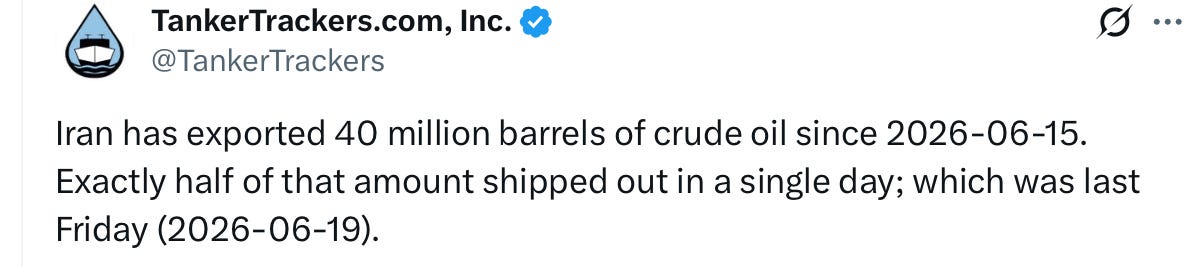
Most of that ostensibly stranded oil looks deliberate rather than accidental. TankerTrackers recorded roughly 20 mb leaving Iran in a single day on 19 June. Historically, Iran’s exports to China have been around 1.4 mb/d, with reported short-period peaks around 2.2 mb/d. So this single convoy was the equivalent of nine to fourteen days of Iran’s normal sales to China. That looks less like normal spot selling than pre-positioning: either for pre-arranged buyers, for floating storage near Asia, or for optionality ahead of another possible disruption. This fits the earlier point made in Better Flows more reasonably than an account of Iran being caught out by the market. Iran was positioning ahead of a possible new closure of the strait, not caught out by a market it didn’t see coming.
More on the anomalous pricing:
This is completely insane…or evidence of official use of paper shorts to drive oil prices down. What the chart says is that exactly zero other times in the past 15 years have MM's been this short oil. Outside of a massive global recession (or manipulation), it's difficult to… https://t.co/LtRNzIXsAI
— Chris Martenson (@chrismartenson) July 5, 2026
The highest Brent short positioning relative to global onshore crude oil inventories in history. pic.twitter.com/aJqSteQEkU
— HFI Research (@HFI_Research) July 6, 2026
Finally, over the weekend in comments, we noted how some readers seem to reflexively reject information because they are on Team Anti-globalist, so they behave as if they have an emotional investment in Team Anti-globalist doing well.
BettBeat called this tendency out too: The Triumphalism Trap: How Anti-Imperialist Media Manufactures Its Own Consent
At the end, it has a video embedded from Dimitri Lascaris that discusses the same cognitive bias and why it is counter-productive.
In that spirit, and in seeking generally to promote critical thinking, we offer a tweet by Brett Erickson:
I think that many are overstating the DEGREE to which Iran has “won” the U.S./Iran War.
While all but the most deluded see that the United States has been woefully outplayed in this conflict, the extent to which Iran is able to monetize their leverage of the Strait of Hormuz remains to be seen.
Although some may claim that Iran tolling the Strait or receiving their frozen assets constitutes a victory, the reality is far less simplified.
Like many things, the degree to which Iran has a lasting victory comes down to the age old answer of: “it depends”.
Iran has likely seen ~$100B of damage to their economy as a result of this conflict. An economy that was already in poor position to begin with.
If Iran is able to actually extract $40B of revenues from tolling the Strait of Hormuz? Yes, that’s a MASSIVE victory.
But what happens if the far more likely revenue flow amounts to $5B – $10B per year? That’s a very different calculation.
What happens if they only try $12B of frozen assets compared to $100B? That’s a very different calculation.
As is the case with most complex scenarios, the reality of an outcomes significance amounts to:
“It depends”
Now this is clearly too simple a calculus, and puts it in a money frame. Robert Pape keeps pointing out that the real issue is power and Iran establishing itself itself as dominant in the region, as opposed to merely getting a financial recovery. Big sums from fees and tolls would show Iran’s standing cannot be denied, but lesser amounts, if say the US is indeed run out of the region and Israel is severely weakened, would be a major success, if not as comprehensive.
See you tomorrow!
______
1 Professor Marandi, who was not even able to get very close to the prayer hall, said it would take two hours of walking to get in range as he had.
2 I was appalled by former JCPOA negotiator Alan Eyre casting strong doubts the estimates of crowd sizes and even worse, the idea that the mourning was genuine, as opposed to a big bunch of the usual suspects rounded up by the Iran government. If you listen, Eyre often opts for an angry, dismissive tone of voice. From a machine-generated transcript of his talk with Mario Nawfal:
I’m not surprised at all. I mean, again, lots of people like this guy. Lots of people were upset he was killed. So in terms of the numbers, who knows? But he was in power for 40 years. Even if he were hated, which he wasn’t, at least by certain segments of the population, you know, the the government knows how to turn out people for things like this. So you take that the government’s ability to mobilize people and the fact that at least certain segments of the Iranian population generally looked up to this guy. Yeah. You get numbers in the numbers in the street even though it’s what 36 degrees Celsius in Tehran.
Eyre says that the crowd could have been 2 million. Nawfal says the media reports are 9 million. Back to Eyre:
I wouldn’t surprise it doesn’t surprise me. And I’ll wait for the for the you know crowd size estimation is an exact science you know and and you know people inflate it in different directions based on their political leanings. I don’t know the numbers. I read the same things you do. But, you know, I’m willing to take it as a certainty that millions of Iranians are showing their grief by turning out to mourn the assassinated leader and at this and his family. Let’s not forget, you know, the his daughter-in-law, his son-in-law, his 12month-old grandchild. They were all killed also. So, I’m willing to accept all of that. and also the fact that there are large segments of the Iranian population who genuinely are seriously opposed to the Islamic Republic.
3 Readers know I don’t agree with some of these views, as in alternate interpretations are more consistent with the text.
4 The Nawfal talk with Jeff Currie was shocking. Currie had made the bold call that the oil cliff would arrive around July 4; other experts who believes that would come into play were saying mid-July to mid-August. Currie seems to have descended into mumble mumble. Pilkington correctly seemed mystified by his comments, particularly that Ukraine attacks on Russia were doing meaningful harm to its refinery output. Currie seemed unaware that Russia has always imported some refined product and that shortages in Crimea and other “end of route” areas in peak driving season are common in Russia.


‘“They are all there. One shot [and we can take them all out], but we are not going to do that because then we would have nobody to negotiate with,” Trump said.’
That may have not been Trump’s own idea. I was reading a few days ago that Laura Loomer was on his case to kill the leadership at that funeral. The hundreds of people that would have been killed as well would have been a price that Loomer would have been ready to make. Of course this massacre would have triggered a massive counter attack on Israel and the US and the war would have been back on again and more intense than before. Likely though, Loomer would have seen this as a plus.
Trump should strap Loomer up with a bunch of bombs under her dress and tell her to get as close as she can to the Ayatollah. It gives him some level of plausible deniability.
She probably has room in that echo chamber down there for a MOAB.
The most notable aspect of the Tehran funeral for me was the small coffin of Khameni’s granddaughter. If ever there was a moment for Americans to feel collective shame, this was it. But no, July 4 and Taylor Swift’s wedding were too important to neglect.
Those of us with a possibly-unhealthy predilection for nationalized shame have been living it since Minab.
Personally I spent the weekend trying to wrap my head around what it’d be like to live in a society where 9 million people turn out for anything.
That tiny coffin had an effect nearly as powerful as the drone shot of the graves at Minab.
I’m glad this point is being made because it seems to me that Iran can only leverage Hormuz once, and that leverage loses potency every day. Every country in the region is now looking for ways around Iran, all day every day. I expect Hormuz will get less and less important over the coming years as people find alternatives.
I doubt it’s about the money for the Iranians (although money is a bonus) – they are asserting their sovereignty over their regional waters against the will of the UN.
It’s what they have always wanted to do, and now they have the excuse that the UN SC is doing crap all to protect Iran against unprovoked and illegal armed attack. and thus UN has no moral authority to enforce anything anymore.
So, mostly an opportunistic action, but with a twist of staring down international organizations that are not playing fair due to a neo-colonial capture. See also: IAEA and IMO.
‘the UN SC is doing crap all to protect Iran against unprovoked and illegal armed attack’
It’s worse than that. A coupla months ago the UN voted to criticize Iran’s attacks on Israel and US bases in the region but NOT the Israeli and US attack on Iran that caused this-
https://press.un.org/en/2026/sc16315.doc.htm
Yes. And, while many people have pointed out that because the oil is sourced in the Middle East, it can always be bombed there regardless of its transportation method – and this is obviously correct – there is a quite tangible difference between Iran broadcasting a radio message to tankers going through Hormuz “Now closed! If you try to pass, you will be struck and sunk!” and Iran carrying out big missile+drone strikes on regional oil and gas infrastructure.
That is, Hormuz can be turned on and off *somewhat* freely unless you get mines involved, and so if there’s another regional aggravation by Israel (and I’m sure there will be several more before it collapses as all colonial projects eventually and necessarily must) then it can hypothetically be quickly resolved and things can go back to the status quo quickly, albeit with some grumbling from the Gulf States and insurance companies. Whereas hitting oilfields and refineries can take them out for weeks, perhaps months, perhaps even years depending on what and how much you hit.
Iran is obviously aware of this, and hence why it would be in their best interests to try and expel as much as the US military from the region as possible, and weaken Israel as much as possible, so they can actually exert their regional hegemony more credibly. While the Gulf states are now aware that the US will not, and actually cannot adequately protect them in a true crisis, I imagine they believe – not completely without merit – that the backing of the US is still better than having no backing from anybody. Hypothetically China could step in, but they seem consistently uninterested in foreign military adventures of any kind.
It’s why the part of the MoU arrangement that I’m most anxiously awaiting is what Iran and the US believe constitutes “the area around Iran” in terms of where the US would have to withdraw from. If this is some absurd 50 kilometer band around Iran’s borders, then, to paraphrase Foch, we don’t have peace, we have a 10 year armistice. If this expels the US out of the Gulf entirely, plus Iraq, Syria, perhaps Saudi Arabia, and maybe even Jordan, then it’s hard to look at that and say “Iran has lost”.
I actually think Iran had a much stronger hand at the time of MoU discussions and misplayed it. They leaned on Oman to join as co-administrators of the strait, perhaps for legitimacy’s sake. But they needed to lock down that arrangement and ensure Oman was on their side before the MoU was signed. They gave the US a massive free win by leaving Oman’s participation undetermined through the MoU signing, only to be epically disappointed afterwards when the US pressured Oman to allow separate passage on their side.
They seemed to think the Oman-Iranian control was sufficiently agreed upon, and they were confident they’d go into the MoU and later period with decisive control of the Strait. But then Oman said no, there would be a separate transit route outside Iranian control. This was exactly the time Yves pointed out that the Iranians stopped being so honest, or started making demands not clearly stated in the MoU. To me, that means they believed the MoU would give them exclusive control of the Strait, beliving Oman was locked in with them. They screwed this up and have been trying to re-establish total control of the Strait during a non-kinetic (or minimally kinetic) phase without needlessly antagonizing others.
This was a massive epic screw-up on the Iranians’ side. I do believe they could have either gotten Oman fully on board with their scheme, or said during the MoU discussion period that “we own the strait’. Yes it would violated various sea-laws, but in terms of maximizing their power/leverage, they could have simply asserted that they own the strait and others should play along.
This isn’t a moral judgment, just an acknowledgment of power politics at work. The US and Israel attacked them in violation of all manner of laws, so if laws were going to get rewritten/reinterpreted, Iranians could have chosen to create a new reality on the ground (Iranian control of the Strait) and new laws to support that reality. It may have antagonized China or other allies, who knows?
But the fact that the Iranians made public statements suggesting Oman was on board with their plan around the time of the MoU signing only to later have Oman support a completely separate route was a major mistake on their part and showed poor planning. Both the US (through its wargames like the Millennium challenge) and Iran for 20 years have known that Iran’s great leverage was the Strait control. For Iran to come out of the kinetic phase without clear, exclusive control of the strait was a major screw-up in my view. They needed to establish control preferably with Oman or without if necessary, and be able to selectively block transits of unfriendly countries’ boats. Now they’re trying to recover that exclusive control weeks after the MoU was signed by saying Oman-side transits are illegitimate… But without willingness to use kinetic means to enforce control, it is not a strong position.
I remember an Arthur Berman interview here a few weeks ago saying the game was permanently changed, saying (paraphrase) “If you had fought really hard to control an important mountain, would you give it up? I wouldn’t.” He was right. Iran had the mountain (control of the strait), and should have kept it. But they fumbled it.
Maybe a lot of people are overestimating Iran’s position; I don’t know as I’m no news junkie. But I suspect another element is that people expected Iran to play their hand better than they have from the MoU signing onwards, because I think a lot of people correctly saw that Iran had a strong position.
My 2 cents.
Agreed. I think what we are seeing is that Iran gave up their most important point of leverage (the Strait closure) as part of the MoU. What Oman is doing is legal and consistent with the language of the MoU, so they are hoist by their own petard.
The Strait closure was the one thing the US absolutely had to change in order to avoid catastrophic political consequences. Now that that’s gone, it seems the US feels they don’t need to comply with any of the MoU terms. So they’ll just repudiate them, via the usual sophistry and claims that the agreement didn’t mean what it said and they never signed it anyway, or signed a different agreement, and agreements with terrorists don’t count anyway. While it might be counterfactual and Orwellian, it’s also a tried and true tactic for the US (it didn’t originate with Trump, although he employs it more frequently than most) and the electorate rarely punishes its leaders for doing it. Iran even anticipated this and mentioned in their public statements that they expected it to happen, which makes the mistake even more notable.
Iran may have felt that it wasn’t a big deal to reopen it since they could close it again at any time. But it looks like they will find it harder than they thought. When they closed it the first time, it was while they were under extreme duress and heavy attack by the US. They could legitimately argue that they needed to do it to survive. The situation is very different now. The US has largely stopped attacking. There is an MoU in play and some of the terms are being honoured, and although it’s pretty clear that many others won’t be, it has yet to officially fail. Could they get away with it again, without the US stepping so clearly into the role of villain this time? I think China and Russia would certainly have a few things to say about it if they tried.
Hard agree, but I will go to further and say they should have refused any meetings at all, let alone signed an MoU
Well, there is that and expanding on the point, Iran has to make good on ambitions other than IRGC survival.
The country doesn’t want be heavily excluded from many global relations.
Now on ADS-B for Persian Gulf. Two USAF KC 46. There must be enough civil aviation that the refuelers need to display ICAO position, or maybe they are showing off!
One appears to be returning from east of SOH, where it ran “racetracks”, the second is moving to the east to possibly “take up station”.
I do not go to ADS B often but the past few days USAF refuelers have been working over SOH.
I have ived and read a good deal of History in my 7 decades of life and I can not recall any assassination or War that equals this for Stupidity.
One minor consequence will be tens of Millions of deaths by starvation that would otherwise not have happened.
Another consequence is the crackdown of “Western Elites” on their populaces, which is, at the moment, more obvious in the EU with its censorship.
When Governments lose their legitimacy all they have left is force, that has happened in the EU and it’s going to be overt here in the USA soon.
By soon, I mean Months.
The Stupidity is astounding.
Covid, Is that you?
And Covid says, “Here, hold my bier.”
I was thinking Libya, but yeah
https://www.quora.com/What-was-Britains-response-to-famine-in-India
The picture in the link above tells the story.
Re: Taco not comprehending that Iranians loved the Ayatollah Khamanei as evidenced by huge crowds at the funeral
I really think he is that stupid. Or suffering from mental illness, from living inside his own head for so long that he lacks the ability to process any real-world information that contradicts his carefully manufactured delusions.
He’s (intentionally) surrounded by people who are telling him the Iranian people want regime change and it with be welcomed with cheering in the street. Same people who tell him USrael is winning the war. No wonder when a blink of reality forces through the wall of misinformation he is confused.
I suspect Trump is far from the only one who is confused. There is plenty of willful blindness (= common stupidity) to go around in the US ruling “elite,” who are afflicted with morbid optimism regarding their ability to manipulate desired outcomes.
It isn’t just trump though. When you tell people the best/simplest western analogy for the Ayatollah is probably the pope, they scoff. Just imagine if him and his cardinals were murdered for no reason, how many would go to that funeral?
Xians are quite fond of their superiority complex and refuse to think of any other religion as equal (equally stupid and illogical) but Islam is the lowest rung for them. Of course trump isn’t really a xian, so Dr John’s suggestion is likely the main reason.
You get these occasional moments when he sees something that’s inconsistent with his world view and it registers and he suffers a moment of doubt. Almost always he reacts by shoring up his world view and inventing a way to reject or explain away the new information. You can see it happening in real time here (‘fake tears’).
“If global energy supplies remain constrained, the U.S. government will prioritize U.S. consumers over international markets. This would take the form of export restrictions.
These restrictions could take several forms. The first would be halting U.S. crude exports, which would keep more oil at home, but would also strain storage capacity and hurt shale producers and refiners in the process. The more likely option would be taxing exports of refined products, which would lower domestic prices and push the burden onto global markets.”
Listen now
U.S. Oil Export Restrictions Coming Soon || June 29, 2026
Peter Zeihan
Jul 6, 2026 · Peter Zeihan Podcast Series – Patreon Episodes · S3 E224
Peter Zeihan is confidently wrong more often than anyone I’ve followed for any length of time.
Seconded….
‘If global energy supplies remain constrained, the U.S. government will prioritize U.S. consumers over international markets.’
But at that stage, wouldn’t they prioritize the Pentagon over US consumers?
The oil companies are salivating to charge the US consumers more.
Plenty of enemies within of the US Strategic reserve before this war.
The Das piece in the FT is excellent, thanks.
It’s probably not helping matters that the public discourse where oil is concerned centres around a futures market for a not-entirely-fungible (because different grades) commodity which people don’t consume directly — they consume various distillates downstream of refining — leading to the cognitive equivalent of trying to handle drosophila with boxing gloves … 🤦♂️
I started reading the hyper sensitivity post and due to time constraints quickly switched to this one, where of the first points was the disconnect of oil markets and futures and I thought it worth commenting the same basic dynamic is at work. Feedback loops with no circuit breakers and it all goes spiraling down the rabbit hole. Debt jubilees were devised as a circuit breaker to compound interest and we keep finding ourselves in the same doom loop.
I think there should be some consideration of the mechanics. Structure is recursive. It builds on priors like rings of a tree, yet there has to be the connections to the larger ecosystem.
Nodes and networks. The node is synchronization. Everything on the same wavelength, functioning as one. The network is harmonization. All the energies traded around, creating overall equilibrium.
As multicellular organisms it is our nervous system that coordinates all the cells and organs into one fairly coherent entity. It’s the circulation system that sustains harmony across this ecosystem of cells and organs.
Obviously this doesn’t cut through all the chaos, but it is the dynamic driving it.
I would argue that Iran clearly “won” the battle (see damage to US bases/ability to project power, minimal damage to Iranian military power bunkered where US ordinance cannot reach); however, a battle is not a war, with both sides expecting more war (Vance said as much; Iran’s leaders have said as much), a classic self-fulfilling prophecy. Iran has shown a carefully thought-out strategy and significant pain tolerance. The US has shown low pain tolerance (even of moderately higher gas prices) with the war already less popular than the Vietnam War, and an absence of strategery (Decapitate and Pray!).
See SMO – after each Russian battle win (there have been losses), there is consolidation of gains and shaping actions (low kinetic) for the next battle, perfectly describing the current situation – economic, diplomatic, and logistical maneuvering. Note Russian attrition of NATO and support for Iran demonstrate this is a single war with two theaters – Russia cannot allow the US to win and open a new front in the Caucuses (soft underbelly?); NATO attrition in the SMO dramatically altered the war’s course, as did Russian aid in restoring Iranian air defenses after the cyberattack and Identifying 5th columnists via Starlink in the war’s initial shaping battle/phase, and now with drone technological upgrades, satellite ISR, etc.
Underlying this multi-theater war (which includes China) is the US belief that re-establishing hegemony is existential (even risking MAD) in an already multipolar world where US relative strength is diminishing at an accelerating rate. Peaceful acceptance of multipolarity always was extremely improbable (even assuming wise leadership) for a nation that has been at war almost every year of its existence.
“Underlying this multi-theater war (which includes China) is the US belief that re-establishing hegemony is existential.”
This seems 100% correct. Back in 2022, numerous observers pointed out that the Ukraine War was existential for Russia — but few saw that that the West was taking massive risks in search of highly doubtful outcomes — ie acting as if the West were the team down by 10 points in the final minutes of the fourth quarter.
Now we are operating on three fronts (Russia, West Asia, and China, the latter for now primarily economic). That’s massive overreach, and if it’s not motivated by existential fears, I am surely missing something.
We still have some folks disliking to say we are now in WWIII — perhaps out of a pedantic insistence that major powers be conspicuously seen shooting at each other across direct battle lines using weapons operated by their own troops rather than by hapless proxies. We may well get there some day, but the risks being taken by the West are already desperate, the crimes open and beyond comprehension, and the economic stakes nothing less than civilizational.
WWII took awhile to ramp up. It really began with the Japanese invasion of Manchuria in 1931.
Hell, you could argue WWI and WWII are just one “German-Eurasia” war beginning in 1914 with an interregnum between 1918 and 1931.
Ukraine could very well be the “Manchuria” of the next world conflict, which won’t reach its hottest phase for another 5 or 10 years or more.
I’ve been mystified by China’s behavior–drawing down their SPR instead of buying Iranian oil. Buying would help Iran. Is China Iran’s fair weather friend? Did Trump and China do a deal when Trump was there? Did they actually trust him?
All I can figure is that China is showing its benevolence to Asian neighbors by supplying them with oil–good PR. Another option is that Iran’s oil is the wrong grade and they’re lacking the required complementary grades for refiners. A third option is that China is making a profit on its stored oil and is not interested in buying Iranian crude until Iran cuts the price on its glut in tankers.
Any thoughts?
1. Substitution of Russian oil for Iranian oil at better prices
2. China could be fudging the data to throw off arrogant Westerners who think they know what’s going on there.
i dont remember where i heard it, but the thing that makes most sense to me…aside from PR of being nice to their neighbors/trading partners…is that it was some strategic ploy to help lead trump down the garden path of drawing down reserves and continuing to export like crazy…because we’ll win any day!!
China started back up right around when tank bottoms/operational minimums started getting out of fringeland and closer to mainstream.
ive said it a few times…but i wish my dad were still around, jawing with oilmen at the marina.
I agree with this, that it actually increases China’s leverage on the US. Resuming imports en masse can act as a lever to restrain the US if needed, and I think this is probably important to them to have up their sleeve considering the warmongering against them.
But wouldn’t it have been far more damaging to Trump for China to have not cut the imports? That would make more of a requirement for the SPR to be drawn down even further to balance the oil markets.
Either “no” or not so much.
China did export some oil to Vietnam and the Philippines early in the war. but those cargos may have been arranged before the export ban took effect:
https://oilprice.com/Latest-Energy-News/World-News/China-Sends-Fuel-to-Struggling-Southeast-Asia-Despite-Export-Ban.html
I have not found the underlying article, but Alexander Mercouris gave a recent long0-form recap of a story he read recently, of how the Iranians massively pissed the Chinese off. They had negotiated a Chinese investment pact (I assume after the JCPOA was signed) only to have Iran solicit and accept investment from Western companies.
I’m actually skeptical there’s any sort of psychological games, baiting, or 5D chess in what China is doing. I lean towards the hypothesis that they just didn’t want to buy high when the price of physical deliveries shot up.
My thinking is simply that mind-games are totally out of style for most Chinese governments, and especially under Xi. He’s always seemed an extremely rigorous practitioner of wu wei (“non-action”)
Now what I don’t believe is that China is acting without Iranian coordination. If Iran asked for some minor, low-cost tweaks (like timing or shifting exports away from US allies), I expect the Chinese gov happily obliged.
Funeral: ” Morale is to the material, as three is to one.”Napoleon
Oil: If Trump escalates will ‘oil prices’ follow suit. Then what happens to the future’s market?
Iran finds itself in the classic position of not being able to turn military success into political and economic benefits. This is usually a problem for the attacker, because the military campaign either fails, or is unable to produce the political end-state that was expected. But here, it’s obvious that Iran had objectives which went beyond survival and military victory. We don’t know exactly what they were (we only know what they have said) nor do we know whether there were competing sets of objectives among the centres of power. But they will not necessarily be easy to obtain not least because, as Vance’s recent statements show, the US system is incapable of publicly recognising that it has lost, and drawing the obvious public conclusions. And there is little point in Iran restarting the fighting, since it’s hard to see what more it could usefully gain. All they can do is hope that political and economic pressures will eventually force a change, but as I’ve said several times, I really wonder how well the Iranians understand the detail of political dynamics in Washington.
I agree, the US system is incapable of recognising that it has lost, and incapable of making agreements. To be crude: It is paid and bribed not to recognize it. The arrogance, hubris, normalcy bias and disconnect is clear and to be expected from a declining, corrupt hegemon.
While many in the anti-imperialist, and independent media may have painted an unrealistic picture of Iran’s victory, Iran is dealing with a financial/economic/political world still dominated by the USD and western financial institutions. Some wishfully underestimate the power of the empire to fight back, if you will. Iran and their close allies (Hezbollah, Ansar Allah etc.) are still heavily outnumbered, outgunned, and outfinanced.
What kind of “victory”? Yes, Iran survived, they successfully forced the US/Isr. and vassals to deplete their magazines. This feat alone is remarkable, given the asymmetry of power. But, as you and others have pointed out: the expectations of economic benefits remains to be seen.
Michael Hudson commented some weeks ago at least, that Iran would not see any of its money from the US. If this turns out to be correct. then Iran’s victory is significant yet limited.
Of course the Iranian assets are already evaporated 😁. Their money is “frozen”. So it wasn’t embezzled, it was just lent out interest-free, and now, with a mountain of debt amounting to 40 trillion, there’s simply no money left. This is the same the unelected bureaucratic monstrum in Brussels did with ~30 billion of Russian assets.
Agree on all points.
It’s clear to me that they should have pushed their advantage to completely remove the US presence from the Gulf, including the crushing of Israel.
The only thing that I can figure is they are now happy to just wait and watch Western economies plummet
As long as Trump can keep diddling with oil prices, it appears that Iran’s “nuclear option” failed and Trump can stiff them by ignoring the MOU. If oil supply hits the cliff, then Iran will be in the driver’s seat again, because Trump will feel that he has to do something, which would most likely involve lashing out with another futile attack. Israel has an itchy trigger finger too. Can they both restrain themselves enough to get past the US election in November, after which Trump won’t feel constrained?
As the huge funerals are going on in Iran, I think it’s helpful for Americans to think back to the aftermath of the World Trade Center attacks. The overt circumstances were not terribly similar, but the effect on the national conscience and national mood was definitely in the same ballpark in the US and in Iran after the assassination of their leadership.
The prevailing mood in the US was widespread sadness, fury, and an overt desire for revenge on the perpetrators. This was true of course even for people who had nothing to do with the World Trade Center and couldn’t even locate it on a map. Vast nations can be thrown into mourning, and the reaction is pretty much what you would expect even when it doesn’t seem to logically make much sense.
I think it’s fair to ask how much of this is naturally occurring, and how much of it is whipped up by national leadership intent on capitalizing on an opportunity to rally their populations, as national leaders are wont to do when it serves their purposes. I’m not accusing anyone of anything in this case, but there is a long history of using real world events as a way to start wars or sustain them, as well as other things. Humans still seem to be sufficiently tribal that tribes can be turned against each other with relative ease. It’s one of the things I would like us to overcome in the near future if we want to have continued existence on the planet.
Of course, our hearts go out to any society that has experienced a tragedy or loss of life. Best wishes to all going forward.
Couple of things.
1. Re: Iran “winning” or not.
I am reminded somewhat of the Russo-Japanese War over 100 years ago. The Japanese were the clear military victors, defeating the Russians both on sea and on land. However, when the time came to negotiate over peace terms, the US “helpfully” stepped in as a “neutral mediator” – eager to limit Japanese gains in light of its own regional ambitions. As a result, the “deal” that the Russians ended up getting was a lot less harsh than it might have been, for example they got to keep half ot Sakhalin Island (taking the other half at the end of World War 2).
I know this does not exactly track to the Iranian case. But the point is that “it ain’t over ’till it’s over”. You can “beat” the US militarily, but as of right now, the ceasefire has attained very few of Iran’s stated objectives, so if you somehow freeze the conflict now, it’s not really a victory, much closer to a draw – all but guaranteeing a restart of the conflict down the road. To be sure, fighting a superpower to a draw is still no mean feat. But a lot more has to happen for Iran to ensure its own security going forward…
2. I am not an expert on Shia Islam, but I remember reading a history of Iran last year that expounded on the concept of “role models”. In other words, a practicing Shia ought to have a personal “role model” of what it is to be a “good muslim”, and this is in part the role filled by the religious scholar class. In other words, any ayatollah is not just a “supreme leader” – he is a sort of a personal icon for millions of the faithful, and his loss, accordingly, is almost like losing a member of the family. Or something along those lines.
Which, of course, goes a long way to explain what we are now seeing in Iran over the course of Khamenei’s funeral. Just don’t tell anyone in Washington…
3. Ok, a tangent related to Note 4 – the Russian refineries. I already tried to make this point over the weekend, so I’ll keep it short.
Per the various Russian energy analysts that have been poking their head out like Punxsutawney Phil. The problem is NOT so much refinery capacity or throughput per se. Because even with unscheduled outages from drone strikes and such, there is still a lot of overcapacity on diesel and probably “even Steven” on gasoline and jet fuel – in aggregate, across the system as a whole.
The issue is the logistics of distributing refined product across, literally, the largest country in the world. Because if refinery A trips offline due to a drone strike, now you have to redirect the flows from refinery B, and so on down the line. AND – and this is new to me – because Russian product demand moves geographically (!!!) in the summer season. Basically, everyone hops in their car and drives south, but there is a limit to railroad capacity for additional product transport.
Apparently, Russia had already faced these distribution issues in 2023-2025, especially in the southern regions during the summer – peak was August-September, what we would call “around Labor Day” – but they managed to get through with limited shortages as the Ukrainian disruptions weren’t as bad. This time around, they (with US guidance) hit different nodes in the refinery network, and “squeezed” the Novorossia highway to Crimea – which worked, because last year the government banned fuel transit across the bridge, setting itself up for just such a squeeze. The strategic solution is basically more transport capacity running north-to-south, especially rail, and a more agile distribution system to redirect shipments as specific refineries trip offline – but no-one is especially optimistic that the government will be able to do any of this in the short term. Not the least as they sat on their hands for three years previously (not dissimilar to how they sat on their hands with anti-drone measures until large scale attacks began in earnest, per Putin himself, though he put it more diplomatically).
In the meanwhile, aside from military measures to try and stem the drone attacks (and this is a whole big separate topic), the reason for product imports is to essentially fill local demand in some of the outer regions like Vladivostok, thus freeing up internal transport capacity (both road and rail) for the regions that really need it. Parenthetically, it has also been pointed out that at least one “Indian” refinery that is presently exporting product to Russia is actually owned by Rosneft, so in a way, the Russians are selling the stuff to themselves, though of course the actual accounting is somewhat more complex.
I may be mistaken, but what is somewhat complicating the issue is that Russian refineries usually time maintenance and repairs (non-battle-damage) before or after the summer season, but this year the government leaned heavily on them to delay or shorten the spring maintenance – and it’s starting to show now.
And of course, as you mentioned earlier, panic buying and speculators are not helping the situation.
Frankly, the thought has occurred to me that Ukraine has timed the strikes for a maximum effect.
I haven’t heard Pape say this, but I would say it’s right on the money.
The analysis in the western press seems to be way too focused on financial calculations. What’s the price of oil, is Iran going to get its $300 billion, how much has the war cost, how much will it cost to rebuild damaged or destroyed targets.
In fact, the entire history of the Middle East since World War II has been centered on the US attempting to dominate and capture the region. Noam Chomsky famously quotes the US state department saying that the oil in the Middle East is “a stupendous source of strategic power and one of the greatest material prizes in human history.” I think this one sentence says more than many weighty tomes about how the US has acted on this particular region of the planet since it became a world power and how the great game is being played.
Pape is right: The fact that the US is essentially being kicked out of the Middle East and it’s relationships with local clients are being destroyed or weakened is without a doubt the most consequential outcome of Trump’s war (and doubtless the thing he will be blamed for the most in future smoke-filled back rooms in the US). Hard to say if this is ultimately a good thing or a bad one, but I like to think it will be for the better. Life in the Middle East since World War II has been pretty hellish.
Yes, Pape has most assuredly said that. He has repeatedly said that the US side sees the “deal” as a business transaction, as in “How much do I pay to get out of this?” The Iranians have different and more complex objectives.
just finished “After the Prophet” by Lesley Hazelton – looking forward to reading it a second time before having lunch again with the friend who suggested the author and the book when i had asked previously, ‘what’s the difference between Shia and Sunni’ – later, when reading about the author, i saw she had written a biography of Muhammad – decided to read “The First Muslim” first, seemed logical – we had lunch a month ago, after i had read “The First Muslim” and had just begun “After The Prophet”, and mentioned the entangled circumstances surrounding Muhammad’s death, both before and after the Prophet’s death, that set in motion what would become the split – my friend smiled and said finish the book – fate, families, fortunes, assassinations and battles set in motion a split still going on – without going into a book review i would have to agree with XXYY’s reasoning from what Pape has said – and with regards to the books, Yves’s comment to XXYY about Pape, and what i’ve read in these two books, ring truth to “The Iranians have different and more complex objectives.” –
Ms Hazelton excellent research is evident in notes, sources and extensive bibliographies, and her writing style is engaging – the friend who suggested the author and “After The Prophet” is a local Dr who is from Lahore – some family from Pakistan will be visiting him later this month and looking forward to our next lunch where i will meet his brother and we can talk about both books – it’s why the second read, before we meet-up for lunch – the US just celebrated 250 years, the Muslim world goes back to the 7th century – definitely more complex – complex doesn’t even begin……..
My friend, it pleases me beyond measure that there are still people like you walking the planet, who read difficult books (repeatedly!) for pleasure and in order to improve their knowledge of the world and engage in deep conversations with friends. These are the kinds of things I like to think of as normal human behaviors, but it’s been getting tougher to hold on to that belief in the last few decades. I’m not sure if people are actually changing, or just that we are submerged in an information system that is increasingly shallow and can’t see beyond the next 30 seconds.
(I have a friend who thinks the rise of attention deficit disorder in humans is just the effect of forced evolution on our kids whose environments are increasingly fast-paced and never allow them to think a thought for more than a minute or two.)
I hope your lunch with your friend is as interesting as it sounds like it will be, and please give him our best wishes.
P. S. What is the difference between Shia and Sunni?
thank you – the circumstances before and after Muhammad’s death were Shakespearean and Machiavellian on steroids – Aisha, the Prophet’s last, youngest and most favored of his living wives, long after his first wife died – Aisha was his 9th wife iirc and never had a son or daughter for the Prophet – Fatima was the daughter of Muhammad and his first and most beloved wife, Khadija, her son was Ali – Aisha’s jealousy knew no bounds and was a 10th degree black belt conniver – it was assumed that because Ali was the first to accept Islam from the Prophet and a blood lineage to Muhammad, that he would succeed as leader of Islam – Muhammad died in Aisha’s dwelling and just before he died he called for a scribe, assumed to relegate leadership in written form to Ali, which other’s prevented – the story of the split tumbled from there in a manner with too many players and is too complicated to describe is a short comment, which is why i mentioned the author and the 2 books, well worth the read – i have been fortunate to have Pakistani, Persian as well as Turkish friends over the years that enjoy discussing history and the influence on cultural and world events – they have always appreciated my curiosity – i traveled in Pakistan in the mid 70’s under unusual circumstances that kindled the curiosity about Islam – sad to say i do not have much faith for my fellow citizens to move beyond their silos and why NC has been a godsend since discovering it in 2015 – thanks again for your comment –
So basically Muhammad’s succession was never clear, and his followers split into two camps, the two camps continuing to exist until today?
Holy smokes.
Yes. IMO trump thought the prize that would be worth the risk would be returning to dominating Iran through a Pahlavi puppet as we did before the Iranian revolution. But this time I suspect the current us would take total control of the gulf, threatening to withhold sales to china or others, take tolls or joint partnerships that divert revenues/oil to the us. The gulf states might not think just how much protection might cost if us gains total control, or that Iran might be a more reasonable protector. Or that Iran’s resisting coalition has protected them in the past.
The west is already seizing tankers at sea justified by ‘rules based order’ sanctions. Not hard to write new rules.
I tried to comment on the BettBeat article, but it’s one if those substacks where you have to pay to comment. So I shall comment here.
The article exhibits an academic purity which has little to do with the real world. Journalists all have an agenda. The MSM is entirely pro-globalist, pro-war, and hostile to any movements or nations which deviate from that route.
Consider Nicaragua. The FSLN remain in power, and the country has the lowest crime rate and the best health care and literacy in Central America. And it is under constant attack from the US, UK, and EU.
Should I, as a privileged westermer, say ‘on the one hand, but on the other’ and help to pick holes in the Sandinistas’ revolutionary fabric, thus demonstrating my impartiality (and hence superiority)?
Or should I git down and support the revolution?
We only have one life to live. I’m not wasting mine in fantasies of impartial otherness.
Good point about Nicaragua.
The Inevitability of Diplomacy, Ambassador Chas Freeman
https://chasfreeman662157.substack.com/p/the-inevitability-of-diplomacy
The BettBeat Media article “The Triumphalism Trap: How Anti-Imperialist Media Manufactures Its Own Consent,” is terrific.
Some great one and two-liners from this article:
“For independent commentators who position themselves against Western establishment media, an alternative career ladder has emerged and it is significantly more consequential than most consumers of this media understand.”
“Access journalism has a left flank and it operates by the same mechanism as its establishment counterpart, minus the salaries and plus the ideological cover of dissent.”
“Some great thinkers in the anti-imperialist tradition understood something that its contemporary media sphere has largely forgotten: opposition to empire does not license silence about the crimes of those who claim to oppose it.”
“Rosa Luxemburg, writing in 1918 about the Bolshevik revolution she supported, made the point in a formulation that has never been improved upon “Freedom is always and exclusively, freedom for the one who thinks differently.” She wrote this not as a critic of the revolution from the outside but as a revolutionary insisting that revolutionary politics required the freedom to criticize revolutionary states, or it would become something other than revolutionary.”
In my opinion, this article articulates one of the fundamental reasons why the modern Left is so weak–“solidarity” comes to mean silence about the crimes of one’s preferred side.”
IMO, you conflate the “Left” with anti-imperialist, anti-war types. Many in this camp are more so-called Right wing Libertarian (Judge Nap, Col. MacGregor, even Scott Ritter) as well as Left/Libertarian (Max Blumenthal, Aaron Mate, Ajamu Baraka, Medea Benjamin). Anti-authoritarians come in many types. The old-school Left in the US is largely non-existent for many reasons, but that is not really one of them
I also think what is left out of this is the “fight fire with fire” issue and the public relations wars. With the dominance of western mass media and the reporting of distortions, lies by omission and outright falsehoods, the alternative media find it easy to counter with facts. They can establish credibility relatively easily in that regard, but yes some have lost credibility by painting a too optimistic picture of BRICS, the Resistance, Iran, Russia etc. We have criticized those who go too far, as Yves says and get “way ahead of their skis”. We as informed, critical thinkers can evaluate the content, the facts, the context etc. and make our own determination.
To oversimplify: for all the faults of the collective anti-imperialist/anti-war crowd, they are badly needed in the public relations wars. It is up to us as honest, relatively informed audiencesto evaluate the information.
I was actually thinking about an Iranian best buddy in grad school who became part of the New Left anti-Vietnam movement while in the U.S. and then left the U.S. to become Khomeini’s Ambassador to the United Nations. To make a long story short, he later just managed to barely escape with his life once the Ayatollah formally moved against the Iranian Left in Iran.
To me, the fact that there now exists significant right-wing anti-imperialist types as well as Left libertarians, who together with a recalibrated left mind-set, (not DSA dogmatists) offers intriguing possibilities for the political future.
The success of the Bolshevik revolution, in my opinion, was the worst thing that ever happened to the modern Left.
Earlier USian belief in the success of the Bolsheviks was later tempered and fractures grew.
Lenin had shocked his council with his most anarchist work, State and Revolution.
Let me turn a phrase:
Events overtook what principles could be found therein.
I look for first principles.
Rosa Luxemburg
Would that she had lived to offer further insight.
Rosa Luxemburg
Her last work.
Her direct statement on the layout of a new society.
If I was a party with an interest in keeping prices at the pump low, I’d sell futures at $70 regardless of the actual state of the physical market. I would only do that if I had very deep pockets, e.g. the ability to print money, since my choices at expiration would be to either buy oil at whatever the spot price will be at that date, simply settle in cash if I can’t get my hands on physical, or fail to deliver. You can start to see that each of these choices has increasingly dire consequences for the actual economy.
I suspect some agency of the US Government thinks it can play this game and pull the oil out of a hat when settlement day arrives. We’ll see in a few weeks.
Mother Mary can these oil bulls stop peddling in conspiracies please? There is clearly enough oil regardless of the futures market chicanery.
I swear to Goodness I’ve been hearing this for months at this point and I’ve stopped caring.
I have zero expertise in any of this, and also feel, to some degree, exasperated by the doomsaying. In spite of this, I still see little reason to doubt oil being by a cliff.
I do have a newfound appreciation for the malleability of ‘markets’, though. With Iran appearing to be on the back foot as of now, I also would not be surprised if, somehow, the impending crash was relatively cushioned. I also would not be surprised if tomorrow oil implodes and mass panic sets in.
In essence, the future is more opaque than ever, to me, and I find my only option is preparing for the worst, while praying that some miracle makes that effort out to have been unecessary, Br’er John.
The 2008 housing crisis took months to come to pass, even though things were going sour long before.
Just because one can’t understand how something works does not mean it can’t happen.