“[F]ew things have provoked more outrage [in Brazil] than Trump’s attack on PIX, the country’s beloved instant-payment system.”
The Trump administration is trying to rebuild the tariff wall that was knocked down last year by the US Supreme Court. This time it is using Section 301 of US trade law, which allows the government, via the Office of the United States Trade Representative (USTR), to investigate and punish foreign countries whose trade policies are deemed to be unfair.
One of the first countries targeted was Brazil, which last Wednesday became the subject of additional 25% tariffs on exports of over 3,000 products to the US, including sugar, clothing and machinery.
The move comes just weeks before the beginning of Brazil’s presidential campaign that will pit incumbent President Luiz Inácio Lula da Silva against Flávio Bolsonaro, son of far-right former President Jair Bolsonaro. The Trump administration has trotted out a surfeit of reasons for the tariffs, from springing Jair Bolsonaro from jail, to scrapping Brazilian tariffs on US ethanol, to Amazon deforestation (as if they cared…), to turfing Chinese companies out of Brazil.
Trade between Brazil and China reached a record $171 billion in 2025, more than double Brazil’s $83 billion in trade with the US. Washington would like nothing more than to see a US client government installed in Brasília that will pull the country out of China’s orbit and secure its resources for US capital, as appears to have already happened in Colombia, Chile and Peru.
That said, the biggest driver behind the move appears to be another issue entirely: Brazil’s publicly controlled digital payments system, Pix, which is leaving the global payment duopoly, VISA and Mastercard, and US tech giants increasingly out of the equation. The system, launched in 2020, allows almost instant money transfers between people, companies and government entities 24 hours a day, seven days a week, from any device with an internet connection.
Brazil and US clash over future of payments as popular Pix system stirs global interest https://t.co/ODw63aDF0t https://t.co/ODw63aDF0t
— Reuters (@Reuters) July 21, 2026
In the tweet below, the USTR claims that since the launch of Pix, the country’s central bank “has acted as a regulator to disadvantage US electronic payments services providers and preference its national champion Pix”:
The Brazilian central bank encourages use of Pix over other services by mandating that participating institutions offer Pix for free to individuals and by capping the fee those institutions may charge businesses for Pix transactions.
Electronic Payment Services: In November 2020, the Brazilian central bank established the instant payment system Pix, and the bank has acted as a regulator to disadvantage U.S. electronic payment services providers and preference its national champion Pix.
The Brazilian central…
— United States Trade Representative (@USTradeRep) July 16, 2026
In other words, the US Trade Representative is imposing additional tariffs on Brazil because its government and central bank are preventing US banks and financial companies from engaging in fee gouging on its publicly run payments system. According to the USTR’s arguments, these entities are being forced to offer access to the payment system on the main screen of their mobile apps and are banned from charging commissions to individuals for using the service.
Some more background from the Wall Street Journal:
[F]ew things have provoked more outrage here than Trump’s attack on PIX, the country’s beloved instant-payment system that Washington cited as a key justification for its decision this week to impose a 25% tariff on many Brazilian goods.
From coconut sellers to billionaires, more than 90% of Brazilian adults—more than 140 million people—regularly use PIX, a government-run program that allows users to transfer money in seconds on cellphones at no cost. In less than six years since its creation, PIX now handles more transactions in Latin America’s biggest economy than credit and debit cards combined.
As we warned back in November, it was only a matter of time before the Trump administration escalated its attacks on Pix:
Launched by the Central Bank of Brazil in November 2020, Pix is, in the central bank’s own words, “an instant payment scheme that enables its users — people, companies and governmental entities — to send or receive payment transfers in few seconds at any time, including non-business days.”
It is similar to US payment apps like Zelle, but instead of being controlled by a consortium of fee-gouging banks, it is controlled by the Brazilian central bank…
As John P Ruehl writes for Economy for All, “Fast payment systems exist worldwide. However, Brazil’s Pix stands out for its rapid mass adoption, massive user base, international standing, and high degree of central bank control.”…
Where Are the Fees?
Two things set Pix apart from most other instant payment systems in use around the world: first, it is free of charge to individuals and micro businesses while the processing fees for regular and large businesses are still much lower than those for debit or credit cards; and second, it must be adopted by all licensed financial institutions operating in the country.
The rate of uptake since [its launch in 2020] has been nothing short of blistering. A 2022 Bank of International Settlements report found that Pix had the fastest adoption curve among all real-time payment systems in the world. Three years later, the system boasts 175 million users of all income levels — equivalent to around 80% of the country’s population — and accounts for nearly half of the country’s financial transactions, reports the New York Times.
But not everyone is pleased by its success:
[T]he Office of the U.S. Trade Representative is investigating PIX, claiming that Brazil has given an unfair advantage to the digital payments system by requiring all banks to offer it.
“This places a lot of power in the hands of Brazil’s government.”…
There are dark sides and downsides to the Pix payment system, however. Its rapid success is accelerating the demise of cash, one of the last vestiges of privacy and anonymity in our digitally surveilled world.
As is happening in many other less-cash economies, it is becoming harder to pay with cash in Brazil. It was recently announced that physical currency will no longer be accepted as payment at tolls along one of Brazil’s busiest highways, the BR-101 Sul/RS. NC reader Duda, from Brazil, wrote the following in response to our last article on this topic:
Cash transactions are really disappearing – when I try to pay in cash, usually the other part doesn’t have change anymore. They prefer receiving in pix because it’s more secure against theft and the money is instantly in their accounts.
I can go weeks without any money in my wallet and it doesn’t make any difference.
Pix could also serve as a precursor to a programmable central bank digital currency (CBDC), which the Central Bank of Brazil is already piloting. As we have previously warned, citing the Washington DC-based political analyst NS Lyons, CBDCs, unless carefully constrained in advance by law, could enable the single greatest expansion of totalitarian power in history.
As for Washington, its main concerns regarding Pix appear to be three fold:
1. Pix’s threat to the US’ payment card duopoly, Mastercard and VISA. After covering their operating costs, Visa and Mastercard retain over 50% of their revenue as operating profit. Such extraordinary rates of profit come as a direct result of their monopoly control over the channels through which payments must pass.
“Visa and Mastercard control points through which already existing value must pass,” writes Gary Wilson in an article published by Monthly Review Online.
Their monopoly position allows them to appropriate a portion of the surplus value produced throughout the economy. They collect a toll as money moves from buyer to seller.
Pix threatens the tollbooth. It demonstrates that a public payment system can conduct enormous numbers of transactions without handing a cut to two U.S. corporations. Washington’s tariff is an attempt to compel Brazil to preserve a source of monopoly revenue for U.S. finance capital.
That toll is now threatened by the much lower rates offered by Pix. As Reuters reports, while card transaction volumes have continued to grow in absolute terms thanks to the fact that Pix brought more than 70 million Brazilians into the financial system, credit cards’ share of transactions has fallen to about 15% from roughly 20% before Pix’s launch. The share for debit cards has dropped to around 10% from about 26%.
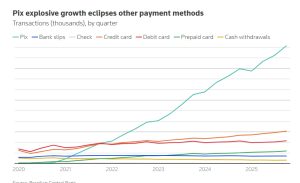
With the recent launch of Pix Instalments, primarily aimed at the 60 million Brazilians with no credit card, the central bank’s digital payment system could begin to hurt the US duopoly’s credit card business.
2. US tech giants risk losing access to Brazilian financial data. The more the Brazilian public uses Pix, the less likely it is to use the mobile payment apps being offered by (largely US) tech companies. As the New York Times reported last year, US trade authorities have complained that, by protecting consumer data that PIX collects, the Brazilian government is hurting US firms that use such data to make business decisions and develop new products.
“U.S. companies see this data as critical,” said Ignacio Carballo, a senior consultant at Payments and Commerce Markets Intelligence, a research firm based in San Francisco. “This places a lot of power in the hands of Brazil’s government.”
And out of the hands of US companies, which “never managed to gain a strong foothold in Brazil” anyway, Daniel Santos Kosinski, a professor of economics at the State University of Rio de Janeiro, told Rest of World. Because Pix is free to use, it “is an extremely capable competitor and tough to beat.”
3. Pix could serve as an example to other “Global South” nations. This is arguably the biggest threat Pix poses to US financial interests. According to the Central Bank of Brazil, there have already been more than 50 expressions of interest in learning about the Pix system, through consultations and even visits to the bank.
Pix’s success has raised “debates on public digital goods,” Gisele Truzzi, a digital law expert at Truzzi Advogados, a private law firm based in São Paulo, told Rest of World, in reference to burgeoning discussions over whether more countries should consider developing their own real-time payments systems instead of relying on private players.
This, at the very least, “means a headache for Visa and Mastercard”, notes an article in The Economist on the “storm clouds gathering over America’s financial supremacy”:
As America pursues what Scott Bessent, the treasury secretary, recently described as “economic statecraft in the 21st century”, in which global access to the dollar and the American economy is “no longer unconditional”, and other countries try to respond in kind, the global financial system is splintering into regional and national systems. This is happening first in payments…
Eventually, innovations in digital money may mean many more retail payments can bypass incumbent channels entirely. But in the medium term, as Mr Prasad notes, bilateral and multilateral deals linking national payments systems like Pix and UPI may allow countries to shield significant flows from existing card and correspondent-banking systems.
This could hurt the American payments incumbents. The rise of “sovereign” systems, especially in Europe, a big source of Visa’s and Mastercard’s international business, could erode their enviable operating margins of over 50%. In their latest annual reports, both brought up “preferential” treatment of domestic payments systems as a risk to business.
PIX is also viewed as a potential monetary blueprint for the BRICS alliance, as it seeks to create an international payment platform aimed at reducing reliance on the USD. Lula is keen to encourage this trend. By mid-2026, Brazil’s central bank had signed agreements to share information about Pix with 65 international counterparts, including rich economies like Germany and Canada as well as emerging-market peers such as South Africa and Türkiye.
As Reuters reports, there are already “signs that instant-payment systems from different countries could one day interconnect, adding to unease in Washington amid talk in major emerging economies of reducing dependence on the U.S. dollar.”
The country that is driving this trend (of reducing dependence on the US dollar) the most is, of course, the US itself. Herein lies the paradox. As the research analyst Luke Gromen hints at in the tweet below, US authorities are desperately trying to shore up US global financial power while at the same time doing their utmost to erode global trust in US financial governance by weaponising the US dollar and other financial assets.
"…now, having threatened most nations on Earth with tariffs or sanctions in the past 18 months, & having failed to specifically define what I mean by 'illicit', 'political terrorism', or 'political violence', who wants to buy my bonds & stablecoins so I can seize them at will?"… pic.twitter.com/qv42rBdcsb
— Luke Gromen (@LukeGromen) July 17, 2026
Back in Brazil, Flavio Bolsonaro has offered a number of enticements to the US in the event of an electoral triumph in October, including “freeing” Brazil from the Mercosur trade bloc in order to strengthen ties with the US. He has also pledged to ensure that Pix will not be linked to other “non-Western” payment systems. At the same time, however, he has asked the US to postpone the 25% tariff until after the elections, which Lula has called, quite rightly, an “act of treason”.
It is as yet unclear whether the US’ overt support for Bolsonaro will end up being a benefit or a curse. Across Latin America, the Trump administration has enjoyed near-total success in tilting the electoral playing field towards its preferred candidates. In Brazil, however, the last time the US imposed additional tariffs on Brazilian goods, of 50%, after Jair Bolsonaro was sentenced to 27 years in jail for leading a failed coup attempt, it led to a resurgence in support for Lula.
With three months to go until the first round of this year’s presidential elections, most polls have Lula sitting comfortably ahead. According to a new Quaest poll, Lula leads across every demographic group except among evangelical voters and residents of Brazil’s South.
Also, while the Trump administration’s overt meddling in Latin American elections over the past year has helped bring in pro-US governments, public views towards the US appear to have soured in the region. A new Pew Research Center survey finds that views of the United States have grown more negative over the last year in five of six Latin American countries surveyed.


I have had an interest in Brazilian culture and history since I was assigned to a project that included Brazil, back in 1498. My strongest impression is that Usonians never pay attention to Brazil and don’t know anything about it. Funny kind of Spanish they speak there, doncha think?
This is on the mark: “And out of the hands of US companies, which “never managed to gain a strong foothold in Brazil” anyway, Daniel Santos Kosinski, a professor of economics at the State University of Rio de Janeiro, told Rest of World.”
The reason the U.S. of A. is at half the dollar value of Chinese trade with Brazil, by and large, is plain ole Yankee neglect. So that jangada has sailed.
There is one area the Yankees haven’t neglected: evangelicals in Brazil, many of whom are looney, which is why I’d expect them to favor the unsavory Bolsonaro in the polling. Unfortunately, the polling data as reported in the article about Quaest don’t clarify if the Brazilian South is Rio Grande del Sul and Santa Caterina states, or if the giant São Paulo state is in play. Something to watch.
What’s obvious here is that Brazilians have turned on-line transactions into a kind of utility, and the oh-so-typical response from U.S. elites is how to skim money off the public. It’s the same attitude that is so deeply embedded in U.S. culture about health insurance — skim, skim, skim.
Christopher Columbus, is that you?
:-]
A publicly controlled payment system! Outrageous! Where is the vigorish, the skim, for Donnie and the Boys? Gangsterism thinly veiled by economic jargon. This is getting old, unseemly, tiresome, crude, desperate. The inner control freak looks ever more threadbare.
Rubio report on Cuban “subversion”
“Many of the most significant upheavals in recent American political history — from the George Floyd riots to the rise of Antifa to the explosion of pro-terrorist activism on American college campuses — can be linked, in some way, shape, or form, to Cuban influence,” the report says.
Add that to what Scott Bessant said above and add that to
Coffee Break: The Worst People on Earth Have Big Plans for Us All – 07/20/2026 – Nat Wilson Turner
And that appears to add up to totalitarianism – I think.
But that can’t happen here because Making America Great Again, Saving Democracy and abundance are at the top of everyone’s agenda….. for who, when or whom are the only questions in need of answer.
The entire time reading this I kept wondering, if the US had this type of system in place since 2020, what would trump and his cronies be doing with it?
What would sleepy joe and the zionazi dems have done?
What about christo-fascist controlled states like FL and TX, would they pass laws limiting what type of payments can be made?
I like the idea of a USG bank along the lines of what ND does and branches in all Post Offices, offering free payment transfers between accounts. But a fully digital, app-based non-cash system is too close to dystopian for me.
To be truthful I do not think that the Trump regime hostility to this payment system is about US financial institutions losing out on price-gouging fees. I think that it is all about the US wanting to have control over every digital platform that they can so that they can control what goes on there and are not kept in the dark so to say. We saw this with Tik-tok where the US could not tolerate a social media platform that was not controlled by Silicon valley and so they forced its sale on the grounds of national security. In fact the same reason they use to keep Chinese digital EV cars coming to the US. if Pix become the blueprint for countries around the world, those countries will go dark for the US so will be much more difficult to control.