Yves here. Turkiye does not want the Black Sea to become a Russian lake. But at what cost?
By Andrew Korybko, a Moscow-based American political analyst who specializes in the global systemic transition to multipolarity in the New Cold War. He has a PhD from MGIMO, which is under the umbrella of the Russian Foreign Ministry. Originally published at his website
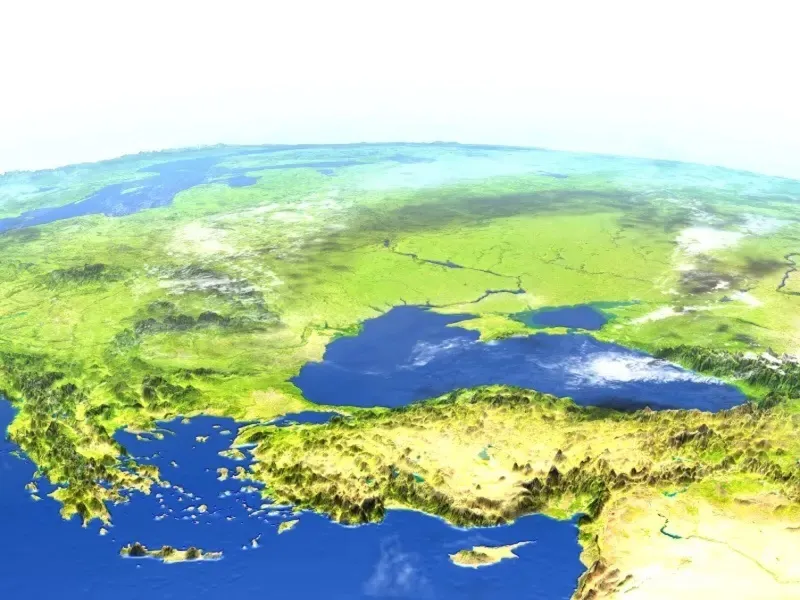
Turkish Foreign Minister and former spy chief Hakan Fidan confirmed during a joint press conference with his Ukrainian counterpart that Turkiye will ensure Ukraine’s maritime security after the ongoing conflict ends. In his words, “Türkiye has agreed to lead the maritime component, and we have a common understanding on this with our allies. Planning efforts on this issue are also being carried out by the naval forces of the relevant allied countries.” This represents a serious threat to Russian interests.
The form that it takes remains to be seen, but Turkiye might escort Ukrainian ships exporting grain even before the conflict ends after Russia’s “systematic strikes” took one-third of Ukraine’s export capabilities offline. According to Reuters, “agricultural exports like grains and vegetable oils remain Ukraine’s biggest source of foreign currency earnings”, and the proceeds hypothetically help pay off European loans. The European members of NATO therefore have a financial incentive to support any Turkish escort mission.
The US might also request this service of Turkiye as part of a quid pro quo over any potential F-35 sale. Trump recently decided to “escalate to de-escalate” with Russia so it follows that he might ask some of his country’s junior partners like Turkiye to do more of the “heavy lifting” in this regard. Turkiye is already part of the “cordon sanitaire” along Russia’s southern periphery in the South Caucasus, Caspian Sea, and Central Asia as explained here so expanding it to include the Black Sea wouldn’t be surprising.
It would certainly be provocative from Russia’s perspective if it occurs during wartime, however, but whether or not Russia would strike Turkish ships at the risk of sparking World War III remains to be seen. The same goes for if Turkiye somehow or another tries to protect Ukrainian ports, such as if it deploys some of its fleet there on the pretext of “deterring” Russia from taking offline any more of Ukraine’s agricultural export capabilities, even if this is just a cover for protecting maritime military logistics.
The potential long-term implications of Turkiye guaranteeing Ukraine’s maritime security are even more concerning for Russia than the potential short-term ones during the ongoing conflict. The 1936 Montreux Convention limits foreign warships in the Black Sea to just nine, but NATO members Turkiye, Bulgaria, and Romania can have as many as they’d like since they border that body of water. The accelerated development of their naval capabilities in the coming years therefore can’t be ruled out.
NATO has long wanted to turn the Black Sea into a “NATO lake” just as some believe that it’s since done to the Baltic Sea following Finland and Sweden formal membership in the bloc after being shadow members thereof since the end of the Old Cold War. To that end, Turkiye might help Bulgaria, Romania, and Ukraine develop their naval forces across the coming years, with the goal being to collectively outmatch Russia’s Black Sea Fleet, which has been degraded by Western-backed Ukrainian attacks.
Despite official rhetoric to the contrary, Turkiye indisputably poses a serious threat to Russian interests, one that’ll continue growing as it takes on more containment responsibilities in alignment with its role in the “cordon sanitaire”. Russia can therefore either accept this as the “new normal” and consequently agree to unilateral concessions, which would go against everything that the special operation was supposed to achieve, or compete with Turkiye across the entire southern front in defense of its interests.


Assuming the post-conflict rump Ukraine (Ukrainlet?) still has access to the Black Sea, that is.
The last time Turkey had an armed confrontation with Russia (from memory about 2018 when Turkey shot down a couple of Russian planes) Russia retaliated by stopping Russian tourism in Turkey, and Erdogan quickly came to heel.
At that time you could buy about 6 lira for a pound – now its over 60! I don’t think Turkey will antagonise a very large source of desperately needed income in the short or medium term.
This time Russia suddenly found some sanitary issues with Turkish fruits and banned imports – within hours of Fidan’s announcement. One could not be blamed to think this is the final attempt by Turkey to take advantage of it’s position as relay of Russian energy to EU and WU product to Russia.
I mean, even Merz has started to make noises about the need to restore Russian energy to save what’s left of German industry. If EU makes another 360 and opens the pipelines and crossing points, Turkey will lose leverage and a huge amount of middleman payments.
It’s not just Russian tourists that Turkiye need but it imports from Russia oil, gas, steel, grain and wheat. Are they really going to put all that at risk in return for a Trump promise? And Turkish ships can escort all the grain ships that they want but as soon as those grain ships dock in the Ukraine – Blam! Some of the decisions coming out of Turkiye are making me wonder if Erdogan is beginning to lose the lot and is becoming senile.
Don’t forget the Akkuyu nuclear power plant, currently under construction. The way the deal is structured, the plant is going to be actually owned and operated by a Rosatom subsidiary; Turkey will be the offtaker for the electricity (70% minimum purchase commitment), plus I think the Turkish government is providing some of the construction loans. Rosatom also provides the fuel and for spent fuel disposal.
Simply freezing the site and pulling out all Russian personnel is another lever to pull, especially painful once the thing enters commercial operation.
Erdogan has always tried to “sit in multiple chairs at once”, as the Russian saying goes. I suspect Moscow believes Turkey to not be completely suicidal to escalate in the Black Sea past a certain point. From where I sit, I actually worry about whoever comes AFTER Erdogan – if it’s a pro-American “reformer” of some description, then fur just might start flying a bit…
This is the policy of the day,but Turkey, Erdogan, seems always on the fence peering in all directions.
More like ‘Erdogan seems always on the fence peeing in all directions.
That’s a huge leap from “Turkiye will provide maritime security after the war” to “Turkiye might escort Ukrainian ships exporting grain even before the conflict ends” with no reasoning behind it. Zero indication that the Turks are thinking of doing that, which would suicidal for any ship attempting to do so. We have seen much more capable US destroyers staying far away from Iranian shores, there is no way less capable Turkish ships would be willing to risk more capable Russian threat.