Category Archives: Free markets and their discontents

Illustrating How Infrastructure Deals Result in High Fees and Diminished Service

It isn’t hard to understand why infrastructure deals (the sale of government owned assets to private investors) are inherently a ripoff. We’ve had such a vogue for private contracting that a lot of services that are almost certainly more cheaply run by the government (e.g., logistical support for the military as proven by Iraq profiteering by Blackwater) that it’s a pretty safe assumption that most assets now held by government bodies are the the sort of thing that it makes sense for the government to own: high cost to build, long lived, not terribly complex to maintain assets.

Infrastructure investors like to see returns in the mid to upper teens. The deals are complicated to put together, so the fees are high. The deal needs to generate enough to pay the fees and generate the required returns. Since it is pretty much impossible to run something like a parking meters “smarter”, the usual course of action is a combination of increasing charges to the users (taxpayers who in the past used it for free or much less) and cut maintenance costs.

The Sydney-based investment bank Macquarie pioneered this business. Reader Crocodile Chuck pointed us to one of its latest capers. From the Sydney Morning Herald:

Read more...

Shades of 2007: Synthetic Junk Bonds

Aha, the level of financial innovation spurred by super low interest rates is starting to have that “I love the smell of napalm in the morning” feel to it.

The Financial Times reports that there is a frenzy to create synthetic junk bonds, ostensibly to satisfy the desire of yield-hungry investors. Any time you see a lot of long money flowing into synthetic assets rather than real economy uses, it’s a sign that Keynes’ casino is open for business (“When the capital development of a country becomes a by-product of the activities of a casino, the job is likely to be ill-done.”)

The author compare this development to that of the asset backed securities CDO market, one of our betes noirs which blew up spectacularly in the crisis. There are some similarities and differences.

Read more...

More Public Infrastructure Sale Tales of Woe

Coming to a state or city near you, and quite possibly the one you are in….bankers bearing promises of solving budget woes by selling public infrastructure to private investors. This is in best case scenario makes about as much sense as using your house as an ATM to pay expenses, and in a worst-case scenario, is more like burning your furniture to heat the house. But desperate times lead to desperate and often short sighted measures.

Reader May Sage pointed us to this Truthout article, which we recommend reading in full. Key extracts:

Read more...

Matt Stoller: Angelo Mozilo, Tea Partier?

By Matt Stoller, a fellow at the Roosevelt Institute. His Twitter feed is http://www.twitter.com/matthewstoller Mozilo’s emails expose a political philosophy borrowed from Ronald Reagan. I was combing through the Financial Crisis Inquiry Commission resource materials, and I found an interesting email from former Countrywide CEO Angelo Mozilo to his senior executives. It was written in […]

Read more...

Guest Post: Half a century of large currency appreciations – Did they reduce imbalances and output?

By Marcus Kappler, Helmut Reisen, Moritz Schularick, and Edouard Turkisch. Cross posted from VoxEU.

If China only allowed its currency to appreciate, the global economy would rebalance and stabilise – or so the argument goes. This column studies the historical record of large exchange-rate revaluations. It supports the idea that currency appreciations have an impact on the current account but argues that this can come at a cost – the reduction in exports risks putting the brakes on global growth.

Read more...

Matt Stoller: The Liquidation of Society versus the Global Labor Revival

By Matt Stoller, a fellow at the Roosevelt Institute. His Twitter feed is http://www.twitter.com/matthewstoller.

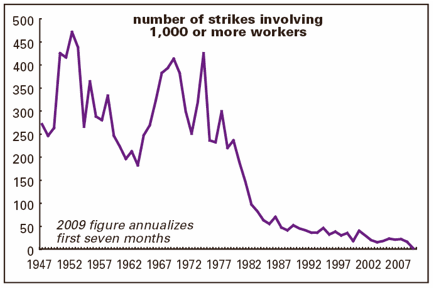
Today, the city of Providence, Rhode Island sent out layoff notices to every single teacher in the city. Every single one of them. If you want to understand why this is happening, why wages in the US keep getting cut, this chart tells the story.

That’s the number of strikes since 1947. What you’ll notice is that people in America just don’t strike anymore. Why? Well, their jobs have been shipped off to factory countries, their unions have been broken, and their salaries until recently have been supplemented by credit. It’s part of a giant labor arbitrage game, that the Federal Reserve and elites in both parties are happy to play. Strike, and you’re fired. Don’t strike, and your pay is probably going to be cut. Don’t like it? Sorry, we can open a plant abroad. And we have institutions, like the IMF, to make sure that we get goods from those factory-countries, and get them cheap.

Read more...

Guest Post: Cooking up trouble – Soaring food and fuel prices in North Africa and the Middle East

Yves here. I thought this post was useful not only in describing how high food prices posed a particularly difficult policy problem for North African countries, but also in providing important background.

By Ronald Albers and Marga Peeters; cross posted from VoxEU.

World food prices are now even higher than their peak just before the global crisis. During periods of high commodity prices, North African and Middle Eastern governments have a long tradition of subsidising food and fuel products. But this column shows that food price inflation and consequently subsidies were also high during periods when global commodity prices were falling. Now these countries have an opportunity to correct this.

Read more...

More Reasons to Be Leery of Infrastructure Sales: Abuses of Rights for Fun and Profit

Yesterday, we discussed a mundane reason to be leery of the sale of assets owned by the public to private parties: the outcome, almost without exception, is a ripoff. Even if the owners manage to orchestrate the bidding well enough to assure that the entity fetches a decent price, the cost of doing the deal and the investors’ return requirements assure that charges to the public will rise faster than if the property was left in government hands (and this does not preclude the owner scrimping on maintenance and service levels). Macquarie Bank has been the world leader in this business, and reader Crocodile Chuck gave some useful examples:

Read more...

Wisconsin’s Walker Joins Government Asset Giveaway Club (and is Rahm Soon to Follow?)

Mike Konczal (thanks to ed at ginandtacos) reported earlier today on the latest release of a movie coming to states and cities all over the US, namely the sale of state and local government assets to alleviate pressures on strained budgets.

For those new to this concept, the term of art is the anodyne “infrastructure sales” and the company that more or less invented this lucrative business is Macquarie Bank of Australia (known down under as “the millionaires factory”), although US firms clearly intend to exploit the once in a lifetime opportunity presented by widespread state and municipal budget distress and downgrades.

The problem, of course, is that these deals put important public resources paid for by taxes (or even worse, financed by bonds and thus potentially not even yet fully paid for) in the hands of private investors. They then earn their returns by charging user fees of various sorts. The public must rely on the new owners for reinvestment and maintenance, and depending on how the deal is negotiated, may have ceded control as far as fee increases are concerned. This is tantamount to selling the family china only to have to rent it back in order to eat dinner.

Read more...

SEC Expert on Why It is a Wuss at Litigation

As readers may have noticed, I grumbled over the weekend about the decision by federal prosecutors not to bring charges against Countrywide’s Angelo Mozilo. I attributed it to two causes: extreme deregulation (you can’t prosecute if virtually nothing is a crime) and timid prosecutors. A lively debate arose in comments, with our Richard Kline contending that the real reason no Big Name had been brought to justice is that a trial would make it all too evident that there were plenty of other powerful people who had committed equally heinous acts. Can’t expose how widespread corruption is, now can we?

Other readers argued the revolving door issue, which was (in essence) don’t ruffle the law firms that will be your prospective employers. I begged to differ, in that tough, effective prosecutors were magnets for new law school grads precisely because they were great training grounds. Someone who came out of those boot camps would be more valuable than a largely untested staff member at a regulatory agency.

I got this e-mail from someone who has seen the SEC from the inside:

Read more...

Jeffrey Sachs on the Budget: “Do we really have to have our own Egypt here in the United States?”

This is astonishing. Jeffrey Sachs manages to speak candidly about what is going on about the Obama budget cuts and related politics on an MSM outlet. To put it mildly, this is a marked contrast with his prior stance on liberalization of financial markets and development. Hat tip Jesse via e-mail:

Read more...

Doug Smith: Social Impact Bonds – Right Result, Wrong Way (Part 1)

By Douglas K. Smith, Member, Board of Directors, SeaChange Capital Partners

Social impact bonds, a useful experiment underway in England, is gaining attention on this side of the pond, including from the Obama administration. We are glad to see this at SeaChange (a non-profit group seeking innovative ways to bring capital to the non-profit sector). What is deeply concerning, though, is how some elites are packaging and promoting social impact bonds as yet one more example of everything the market does is good while everything government does is bad. Moreover, these same elites betray a stunningly superficial grasp about how markets actually work.

Read more...

Chamber of Commerce Law Firm Studied Disinformation, Smear and Coercion Campaign Against Opponents

On the one hand, it’s a badge of honor of sorts to see the most powerful political lobby, the Chamber of Commerce, have its operatives moving from the “ignore you” to the “fight you” stage of engagement. The flip side is that the tactics that they are willing to consider don’t reflect at all well on their commitment to principles like the rule of law or decency.

ThinkProgress today broke the story of the dirty works being considered. Readers may be aware of a massive leak of e-mails of the security firm HB Gary Federal which made the mistake of trying to hack the computers of Anonymous, the group that has taken to punishing organizations that cut off donations to Wikileaks.

Anonymous obtained and leaked the internal messages and rubbed HB Gary’s face in it a bit too.

The e-mail dump exposed some dirty laundry, namely that of a disinformation campaign that HB Gary plus two other “security” firms Palantir, and Berico Technologies (which together called themselves Team Themis had started to map out for a law firm the Chamber of Commerce works actively with, Hunton & Williams.

Read more...

Is the Proposed NYSE-Deutsche Börse Merger All It’s Cracked Up to Be?

The financial media is duly falling in line and giving a thumbs up to the proposed merger between the New York Stock Exchange and Deutsche Börse. Mayor Bloomberg contends it is both good for New York City and provides customers better service in an era of increasingly global equity trading. Industry analysts approved. Not surprisingly, stocks of other exchanges are up based on takeover speculation.

Your truly is wary about concentrations of power in the financial arena, and consolidation of stock exchanges has the potential to go in that direction. One critic of the deal was former Goldman Sachs co-chairman John Whitehead. Admittedly, some of his objections sound quaint, echoing the hand wringing of the 1980s when the Japanese acquired trophy assets such as the Rockefeller Center. From Bloomberg:

“I speak out rarely, and this is one time when I can’t hold myself back,”

Read more...