While the headline focuses on her outlook for housing, Whitney is bearish across the board, seeing little reason to cheer on the employment and bank earnings fronts. She sees a 10% fall in housing prices in the next six months (!), which will hit bank earnings (Whitney has argued since at least early 2009 that banks have been goosing earning by underreserving for losses) and the economy generally (a further decline in home equity plus lack of mobility of consumers wanting to sell their houses but facing a declining market has implications for consumer spending generally). She point out that consumer credit is tightening, which puts a crimp on small businesses (both via lower revenues and via restricted access to funds), the biggest engine of hiring, and on top of that, municipalities and states are cutting spending and shedding jobs.
From Fortune (hat tip Glenn Stehle):
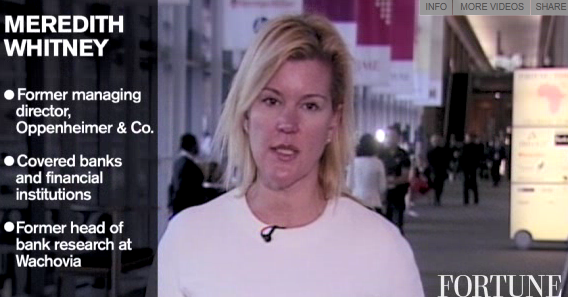
Click here to view the segment.
A similar grim take from Barry Ritholtz via John Mauldin:
Today, residential real estate confronts numerous headwinds: Credit, once given to anyone who could fog a mirror, is now tight. Today, demand is far below what it was during most of the past decade. Home prices are still unwinding from artificially high levels, and remain over-priced. Inventory is elevated. A huge supply of shadow inventory is out there: Speculators and flippers who overpaid but have held onto their properties await modestly higher prices to sell. Bank owned real estate (REOs) continues to increase. That’s before we get to the fact that unemployment remains high, and is unlikely to improve anytime soon. Oh, and wages have been flat for a decade.
This are not encouraging factors about housing.
This is known, or at least should be by those who have looked at the data. I cannot explain why some economists still have not figured this out.
In my analysis, price stands out as being the prime mover of the next leg down. High unemployment, and a decade of flat wages aren’t helping to create any new housing demand. And the millions in homes they cannot afford will eventually add more pressure to inventory and prices. Indeed, we are still working
But the bottom line is Home prices remain too high: There can be no doubt that home prices have moved way down from the 2005-06 peaks. How did I reach the conclusion that, even after a 33% decrease in prices, home prices are high?
By using traditional metrics: Whether we are looking at US housing stock as a percentage of GDP or Median income versus home prices or even ownership versus renting costs, prices remain elevated. Indeed, we see prices remain above historic means.
Consider price relative to income. From 1977 to 2010, the median US home price was 4.1 times median household income….Home prices are still above that mean. Oh, and that mean is artificially elevated due to the 2002-07 boom. It’s the same with home prices relative to rentals, or housing value as percentage of GDP….
Further, we should not assume that prices merely mean revert back to historic levels. What usually happens when markets get wildly overvalued – and a ~3 standard deviation price move sure qualifies — is they get resolved not by reverting to the mean, but by careening far beyond it.
In other words, brace yourself for further downside. Extend and pretend is finally about to run into ugly reality.


The correction of the asset bubble that grew out of easy credit continues. And, it has every appearance of getting worse.
Roubini now posits that we are headed for a double dip recession and we have overplayed bailout and stimulus cards to the extent that the bond vigilanties are railing for austerity.
The housing mess isn’t just the result of a simple excess supply. It’s a problem founded in a fiat currency and legions of financial services people chasing yield. A yield that is being held artificially low by our government chartered banking cartel.
What is developing is a very dangerous set of conditions and let us hope that the public anger is limited to this coming election.
I don’t think America realizes yet how deep of a trouble the country is in. The power that be still think they can re-inflate the bubble by printing money. They think QE $2T, and $80B stimulus will do it. But it won’t. 2001-2006 was not normal years. It was payed by Yen carry trade, high dollar, china climbing the manufacturing ladder, loose banking regulation, relatively cheap oil. They have to bring the interest rate to about -6% at least. (which is QE about $6T.) Imagine the amount of cash flying out of the printing press at that rate.
The days of cheap oil, cheap money, no regulation are over.
People like Krugman cannot accept that America’s economy is now too small to substitude variables above to re-inflate good ol’ days of 2006.
My take: house price will go down until people can afford the price again. 20-30% easy. State/local property tax/income will keep going down reaching sustainable level.
High oil price due to Israel v. arab, palestine, Iran war will stay. It is historic high, unlike 90’s recession when it hit $20.
Price of gas in europe (belarus, ukrainian, russia, turkey) will also stay recessionary level due to geopolitical conflicts. Europe will go into deep recession.
What’s more entire Asia can eat 5-10% inflation easy while maintaining dollar peg.
US is falling right into gigantic debt hole.
“Extend and pretend is finally about to run into ugly reality.”
DEFINITELY NOT if the conniving scoundrel Bernanke can help it. Just wait for his bag of tricks … and that rascal has a bag full of it!!
What ugly reality cannot fiat money creation extend and pretend more?
IMO, the music is only going to stop when the US dollar ceases being the world’s Reserve Currency….as in the crisis that makes that so.
The US does not have fiat money creation. It has money creation backed by taxpayer debt and private debt. It can morph to fiat if the debt-based system collapses, but heaven help us if that happens.
Paul,
Please do your homework, your statement is absolutely incorrect.
Just as “not as bad” is the new “good”, our feckless economic leaders try to convince us that because an asset has fallen a long way, it must surely now rise or at least stop falling.
Ritholz points out that the 1977 to 2010 price/income ratio is skewed by the massive bubble. More distressingly, his selection of this period coincides with a generalized credit bubble. Unless we choose to continue with unsustainable levels of debt, we should extend the period we analyze.
Longer term, the price/income ratio is closer to 3 than four. It is a long-term, mean-reverting ratio with not insignifigant volatility. Under today’s dire economic conditions, massive real unemployment and housing stock, it would be normal to see the ratio drop below 3. Merely saying it will drop somewhat below 4.1 is simply short-sighted and delusional.
Median home price to median household income will drop close to 2.5, implying a FURTHER 25-30% drop in prices from here.
Unless, of course, we continue our present policies, in which case…well, who cares then, because we will all be screwed no matter where Case-Shiller is!
Re: Unless, of course, we continue our present policies, in which case
There are no other policies possible; either politically or ideologically. As somebody on this site (I think) said: This policy will continue until the top 10% are drained of their wealth by the top 1%; or it dawns on the 10% (less the top 1%) that they are being drained and they organize the dumbasses (the bottom 90%) into some sort of “revolution”.
Housing will be “reasonably priced” again when a single family residence is back to 1998/99 price levels.
Everything over and above that price range was fluff.
Got this link via Patrick net:
http://www.bullionbullscanada.com/index.php?option=com_content&view=article&id=13125:the-second-bubble-bursts&catid=47:us-commentary&Itemid=132&source=patrick.net
Two interesting charts. Housing already is at 1990’s levels. The problem might be that wages are at 1930’s levels – but with everybody now supporting housing with two incomes.
Unfortunately the key factor is housing pricing is mortgage rates. As log as they remain at record lows housing may not be that overvalued, but if/when rates adjust to “normal” levels, housing will definitely be too expensive relative to incomes. Of course this just points out again the level of headwinds ahead. Rather than a dramatic drop in pricing (I still see some further downside, but not “dramatic”) I expect to see stagnation for a long long long time.
If this is the case, then I would think the USA (and states thereof) should consider some pretty fundamnetal changes to the way business is being done now. Included should be a move to recourse lending, a move away from fixed rate lending and phasing out the mortgage tax deduction. Seems like an odd time to start doing this, but timing is never perfect and getting something sensible done might just start a trend.
so now we have Barry Ritholtz being elevated to Meredith Whitney’s level? Isn’t that sort of like taking an article from Zero Hedge and putting it along side something from El Erian. Ritholtz has a popular blog, but I am not sure it is popular because of his “original research” it certainly is not in the same league (planet) as for example Mankiw’s or Roubini’s. By comparison Cramer has a popular show but hopefully you wouldn’t cite Jim’s words of wisdom to build a case.
I think we are on the slippery slope of circular references when bloggers start citing other bloggers. Maybe there is something to what Athreya had to say in his paper on bloggers and economics.
Um, Ritholtz manages money for a living. Blogging is a side gig. Just saying.
Rithotlz is spot on. Housing prices should reflect the net present value of the implied market rents those houses can yield. Rents in turn are a function of income. There is no way around this basic fact, unless you are willing to assume people will spend an ever increasing percentage of their income on housing. Such an assumption contradicts both logic and historical evidence. The bubble years were an anomaly, driven by expectations of being able to quickly flip houses for capital gains, and are no longer relevant.
Regardless of how much further house prices have to fall (10% is probably a fair estimate), once they do reach bottom, they are extremely unlikely to start rising faster than income. Given the stagnation we have experienced in income, this means home prices will probably be flat for a looooooong time.
Calculated Risk (I won’t link because it is on Yves’ blog roll) has been predicting another leg down in housing with the expiration of the housing tax credit (government subsidy to buy houses). A lot of demand came forward to use that supplement and it artificially goosed prices.
(I wish people would actually read Krugman’s columns and blog posts rather then spin some meme about Krugman that people like Ferguson and Kudlow spin. Ditto with Dean Baker. I note that Krugman correctly predicted in January and February 2009 that the Obama stimulus would be insufficient and that high unemployment would persist given the huge collapse in aggregate demand the U.S. economy suffered post Lehman. Rithholz and Whitney are both honest analysts, not economists. But they avoid ideology, in contrast to Mish Shedlock who was right about housing bubble, but because of his strict adherence to the Creed of Austrianism (Hayek), he has got most everything else wrong. (I note that Austrianism and Minsky-Keynesian make similar predictions about excessive credit, asset bubbles, and their consequences; it on how to clean up afterwards that the differ). I have found more useful information on his blog, Calculated Risk, Brad DeLong’s, and Naked Capitalism then in a year of reading the Washington Post or the Wall Street Journal).
If you think – as I do – that those sites are useful, then I can advise Steve Keen’s Debtdeflation blog (http://www.debtdeflation.com/). Not only did he call correctly the crisis (his “roving cavaliers of credit” is a masterpeice and was reproduced here), but he is also the first I’m aware of of giving a mathematical analysis of what is going on in “modern economics”. Frightful.
WallStreet needs to be fed! There will be another bubble-the question is where. New financial “innovation” investment vehicles in emerging markets? Small business backed securities(SBABS)?
There is a lot of pension/401k money to pump and dump…
Yea, the McMansions are a crap investment but general housing is still the middle class hard asset of choice. What should we buy with our devaluing dollars-art?
Volcker pointed out that Americans prefer consumption to productive enterprise and housing has fueled our luxury driven tastes. How to produce a SLK300 Roadster for 40K? Sell it in volume! This is our little problem in order to have these wonderful toys lots of folks need to step up but they have been using their home equity the past 15 years to fuel this luxury consumption binge so what to do? Open a Small business, the American Dream, borrow on my credit cards or use the home equity line and suddenly I am a self employed but in reality only if the the house continues to appreciate for the next refi round.
Modern business is about volume and it doesn’t survive without cheap available credit which housing equity provided but that well is being depleted and so what to do next?
I don’t examine the thousands of individual real estate markets around the country but I am extremely familiar with the one I was renting in and in which I recently made a purchase.
There has been a flight to quality. Houses that sold at no discount for bad features (too many steps, busy corner, bad outdoor access from indoor space, tiny lot) 4 years ago are unsellable now, while premium properties of the same square footage next door with correctable defects have only dropped 10-15%, despite having increased in price by a factor of 2 or 3 between 1995 and 2006.
The number of buyers has shrunk, but the property universe has shrunk dramatically as well, even though the number of homes for sale has stayed relatively constant. So prices of premium properties has not been greatly affected. And, the rental stock is so poor that paying a 25% premium over the cost of renting the identical house is not a dumb choice.
There is an investment aspect to real estate in the aggregate, and then there are indiviudal sale and purchase decisions. There are places where it is a fine time to buy an individual house for your own use, and places where there is no reason to rush. There are certainly national factors that affect desire and level of comfort with percent of income spent on housing, and in the aggregate the US has invested far too much on housing and treats it too favorably in the tax code; it boxes out more productive activity. But individual purchases come down to individual needs, and return on the investment is one dimension of many. In our case, despite prices still being elevated, we needed to get our family of 5 out of a small rental before we killed each other. Could we have saved 10% by waiting another year? Wasn’t worth it. You do make money in real estate when you buy, certainly.
“Whitney is bearish across the board”
I almost expected a picture of a mama bear walking across a board. :)