Yves here. This post contains very useful information about the viability of the US exploiting Venezuelan oil, on the optimistic assumption that it could succeed in conquest or regime change. But it is simultaneously a peculiar exercise in messaging and thus also makes for also a useful critical thinking exercise.
The short version is that this article explains why Venezuela’s oil is not of much strategic value to the US and its infrastructure would take a lot of investment over a long time to bring up to snuff. Yet Trump has shifted his justification from narco-terrorism to, erm, retaking the oil and other assets, in going to war with Venezuela (recall a blockade is an act of war):
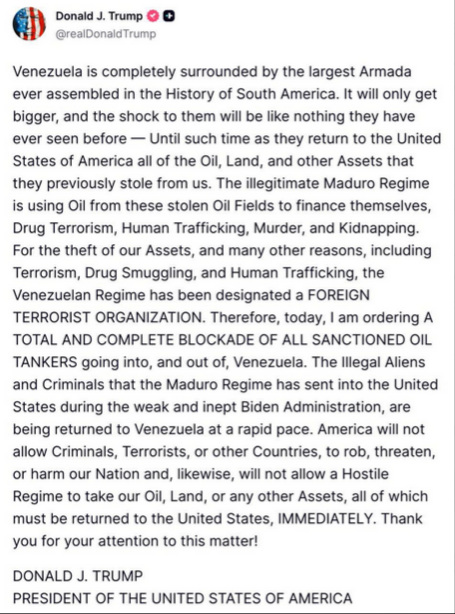
Recall that after the weapons of mass destruction justification for the Iraq war fell apart, the Administration then provided a series of pretexts, even as most observers argued that the oil was the reason. Iraq then had the world’s second largest proven reserves, and they were highly prized light sweet crude. And while the US still has substantial control over Iraq’s oil exports, the US were slow to invest in Iraq’s oil infrastructure. I cannot find the source, but I recall reading that the majors were not comfortable the US level of exploitation of the Iraqi resource.
A 2024 article in The Cradle describes the state of play:
In July, the Iraqi Central Bank halted all foreign transactions in Chinese Yuan, succumbing to intense pressure from the US Federal Reserve to do so. The shutdown followed a brief period during which Baghdad had allowed merchants to trade in Yuan, an initiative intended to mitigate excessive US restrictions on Iraq’s access to US dollars.
While this Yuan-based trade excluded Iraq’s oil exports, which remained in US dollars, Washington viewed it as a threat to its financial dominance over the Persian Gulf state. But how has the US managed to exert such total control over Iraqi financial policies?
The answer lies in 2003, with mechanisms established following the illegal US-led invasion of Iraq.
Since the signing of Executive Order 13303 (EO13303) by President George W Bush on 22 May 2003, all revenues from Iraq’s oil sales have been funneled directly into an account at the Federal Reserve Bank of New York.
A 2012 Aljazeera story intimated that the Western firms, even though they won the critical oil concessions after the war, had not done as well as they had hoped, confirming the idea that the exploitation of the Iraq resource was not handled in an expeditious manner.
I am sure some readers know this chapter much better than I do, so input would be very much appreciated. But my impression is that the later theories, that Iraq was a stepping stone on the way to subjugating Iran, and the oil was at most a secondary objective, are on target.
So war against Venezuela is not about narco-terrorism, and not about the oil, what is the reason? Subduing Cuba could be a justification, but this is an awfully costly way to go about it. It looks like a very badly conceived plan to restore America’s manhood, via throwing a perceived-to-be-weak country against the wall. Remember when Trump tried punching similarly-underestimated India with secondary sanctions to get them to stop importing Russian oil, that did not work out either. But Trump managed to find his way awkwardly to an off ramp. He told the Europeans that he would sanction Russian oil buyers if they did, and so when they refused, he could retreat. How does he get out of this misguided escalation?
John Mearsheimer, in a new discussion with Judge Napolitano, is bemused at the mess Trump has gotten himself into, but you will see he skipped over the issue of why we picked this fight in the first place. See starting at 2:34:
Mearsheimer: Well, I think what the administration is trying to do here is figure out a way to get out of the corner that they’ve boxed themselves into in this Venezuela situation. I mean, we decided early on that we were going to get tough with Venezuela that it was this great threat to the United States and that we would be able to deal with it rather easily. But that’s not proved to be the case at all.
And what you see the Trump administration doing is fishing around for a way to deal with this problem. And that basically means getting rid of the Maduro government and taking this huge problem that we’ve created off the table.
And you remember at first Trump was talking about the fact that the CIA was operating inside Venezuela. And then he escalated further and we started destroying those boats and killing innocent people on board those boats. Then he started talking about a land invasion or hinting at a land invasion. Then he said that the airspace over Venezuela was closed they’re seizing tankers and they’re talking about putting some form of blockade on Venezuela.
All these different approaches are due to the fact that the Trump administration is unable to figure out how to deal with the Maduro government in a way that they can save face. They are in a real pickle. The administration is in a real pickle. And that’s what explains what’s going on with the seizing of this particular ship and the blockade that’s now been announced by Trump.
Napolitano: You know, you mentioned the changing I wouldn’t even call them theories, the changing arguments advanced for the interference with Venezuela in 2017, his first year of his first term when he addressed the joint session of Congress. He famously introduced the person he said was the president of Venezuela and it was this young man Juan Guyaido who by the way today is a grad student uh in Miami, Florida. Anyway, at the time introduced him as the true president. The Congress gave him, you know, a profound and lengthy um standing ovation and we were going to get him back there because he’s the one who won the election. All right, fast forward and well, it’s fentinyl. Well, it turns out the Drug Enforcement Administration, his own, says, “No, the fentanyl is made in Mexico. Then it’s cocaine.” Then his Drug Enforcement Administration said, “No.” Venezuela once did send cocaine here, but they don’t anymore. Then two days ago, he said Venezuela stole our land and stole our oil. Could he possibly think that a natural resource under Venezuela belongs to the United States? My point is, you’re right. He’s boxed in and now scrambling for a justification for the boxing in. The boxing in, according to Colonel Wilkerson, is costing a billion dollar a day.
Mearsheimer:. But I just want to say what you said is very important and what I said is very important, but we’re talking about two different things. And it just shows you how desperate the administration is. You were talking about the rationale or the different rationales plural for what they’re doing and how that shifts and I was talking about the different strategies that they’re using and how that has been over time and what you see is that they’re flailing. He’s boxed himself into a corner.
Now to the main event.
By Matthew Smith, Oilprice.com’s Latin-America correspondent. Originally published at OilPrice
- Despite accusations from Venezuelan and Colombian leaders, the immense growth in U.S. domestic oil production and reserves significantly diminishes the strategic need for Washington to seize Venezuela’s oil fields.
- The U.S. Gulf Coast refining industry has largely transitioned away from Venezuelan heavy crude due to facility closures and a shift toward alternative suppliers like Canada, Mexico, and domestic shale sources.
- Restoring Venezuela’s dilapidated oil infrastructure to major export levels would require over a decade of work and tens of billions in investment, making a military seizure economically impractical for the United States.
President Trump’s massive naval build-up off the coast of Venezuela and the threat of invasion was labelled by the country’s illegitimate President Nicolas Maduro as a bloody grab for oil. Other Latin American leaders, notably Colombia’s leftist President Gustavo Petro, are making similar assertions. A long history of U.S. intervention to secure vital fossil fuel resources, coupled with Venezuela controlling the world’s largest proven crude oil reserves totaling 303 billion barrels, supports this rationale. There are, however, many reasons indicating that Washington’s military campaign is not a thinly veiled attempt to seize control of Venezuela’s vast petroleum reserves.
An autocratic Maduro not only survived Trump’s strict sanctions but treated them as an opportunity to consolidate his grip on power. Even civil dissent manifesting in the form of violent protests and the threat of a coup from within Venezuela’s military failed to topple the authoritarian Maduro regime. By 2021, Venezuela’s economy had returned to growth, thanks to growing oil exports in defiance of U.S. sanctions and the regular flow of condensate from Iran. Tehran even provided the expertise and parts to refit Venezuela’s ailing refineries to boost fuel production, at a time when an energy crisis engulfed the country.
Even with the Trump White House offering a $50 million bounty and ratcheting up sanctions, Maduro thus far has maintained his grip on power. In response the White House, since August 2025, has amassed a large naval armada in the southern Caribbean, ostensibly to stop the flow of cocaine to the United States. Although Trump’s goal is unclear, many analysts claim his aggressive gunboat diplomacy is designed to topple Maduro. Venezuela’s illegitimate president and some regional leaders argued publicly that the White House campaign is a violent grab for Venezuela’s vast oil reserves, which at 303 billion barrels are the world’s largest.
Maduro, less than a month ago, accused Washington of seeking to use military force to appropriate the country’s vast petroleum resources illegally. President Petro of neighboring Colombia, at around the same time, asserted in a CNN interview that “(Oil) is at the heart of the matter,”. He went on to declare, “So, that’s a negotiation about oil. I believe that is (US President Donald) Trump’s logic. He’s not thinking about the democratization of Venezuela, let alone the narco-trafficking.”
After the U.S. Coast Guard seized a sanctioned tanker, the M/T Skipper, off the coast of the pariah South American state carrying 1.9 million barrels of Venezuelan heavy crude last week, the rhetoric intensified. Venezuela and Colombia’s presidents both strongly accused Washington of piracy and theft. Maduro called it an act of international piracy after earlier declaring that Venezuela would not become a U.S. oil colony. Petro stated, “They have just seized a ship, it is piracy, oil, oil, that is, they are demonstrating why they are doing what they do. Oil, oil and oil,”.
Both Latin American leaders ramped up their rhetoric despite the tanker operating in defiance of U.S. sanctions. The tanker was transporting 1.9 million barrels of Merey, Venezuela’s main export-grade heavy oil, with an API gravity of 15 degrees and 2.15% sulfur content, to Cuba, then to Asia, with China and India key buyers of U.S.-sanctioned oil. The Skipper’s repeated transportation of sanctioned Venezuelan crude oil led the U.S. Coast Guard to receive a court-issued warrant for the tanker, which expired only days after the seizure. This is the first tanker seized by the U.S. since strict sanctions on Venezuelan crude oil were imposed in 2019.
The White House and State Department have consistently denied accusations that the military action against Venezuela is motivated by securing control of the country’s crude oil. U.S. government representatives have repeatedly reaffirmed that the mission called Southern Spear is about preventing the flow of drugs and illegal migrants to the United States. While those goals are part of the military operation, there are signs the U.S. mission aims to pressure a highly unpopular Maduro into stepping down so Venezuela can return to democracy. Indeed, there is very little rationale for the claims that Washington needs control of Venezuela’s vast oil reserves.
The U.S., as the world’s leading petroleum producer, does not need to forcibly obtain Venezuela’s vast oil reserves. Over the last 20 years, U.S. production has grown at a stunning clip. U.S. Energy Information Administration (EIA) data show it more than tripled, from 4.2 million barrels per day in September 2005 to 13.8 million barrels per day in September 2025. Importantly, it is anticipated that U.S. oil production will continue to climb, with the EIA predicting it could reach 18 million barrels per day by the early 2030s. This tremendous expansion is supported by the solid growthof U.S. proved oil reserves, which between 2003 and 2023 doubled from 23 billion to 46 billion barrels.
The stunning growth of U.S. petroleum reserves and production over the last two decades, because of the shale oil boom, is so significant that by 2019, the world’s second-largest consumer of fossil fuels emerged as a net energy exporter. In fact, by September 2025, the U.S. EIA reported oil imports of just under 250 million barrels, which was more than a third less than the 397 million barrels imported for that month 20 years earlier. This point is important because, unlike the period from 1958 to 201,8 when the U.S. imported more oil than it produced, the country is now no longer economically reliant on foreign petroleum imports.
Some analysts argue that even with U.S. oil reserves and production expanding at such an impressive clip, demand for Venezuela’s low-cost heavy crude remains strong. You see, during the 1980s, Venezuela’s heavy crude emerged as an attractive feedstock for U.S. Gulf Coast refineries. This was due to lower prices than the WTI and Brent benchmarks, copious production volumes of around 2 to 3 million barrels per day and the close vicinity of those oilfields to the United States. Venezuela’s stable democracy, with Caracas sharing close ties with Washington as a staunch ally against communism in Latin America, enhanced the attractiveness of the country’s crude oil.
At that time, many Gulf Coast refineries were built or retrofitted with the equipment needed to process the heavy sour crude oil produced in Venezuela. This left them unable to refine lighter, sweeter petroleum grades cost-effectively, making those facilities dependent on Merey as well as other Venezuelan heavy oil grades like Hamaca and Boscan. For these reasons, some analysts claim Venezuela’s heavy oil is essential for the profitable operation of a swathe of Gulf Coast refineries and bolstering U.S. energy security. This, they assert, is the reason for Trump’s aggressive gunboat diplomacy and the planned seizure of Venezuela’s vast heavy oil reserves.
While this was true three or four decades ago, it is far from reality today. You see, plummeting refining margins and soaring operating costs led the U.S. refining industry to contract sharply from the mid to late 1990s. This forced the closure of a swathe of higher-cost Gulf Coast refineries, particularly those processing heavy sour crude oil grades, to shutter or be converted to more profitable uses over that period. EIA data shows 27 Gulf Coast refineries with a combined distillation capacity of 832,426 barrels per day were permanently shut down from January 1, 1990, and January 1, 2025. Many others were converted to refine lighter, sweeter grades of crude oil or to process biofuels.
Since the early 2000s, Gulf Coast refineries still dependent on heavy sour crude oil have been forced to find alternative supplies. It was Canada, the world’s largest producer of heavy crude, followed by Colombia and Mexico, which filled the gap. A combination of sharply weaker oil prices, malfeasance and tighter U.S. sanctions weighed heavily on Venezuela’s oil production. Between 1997, 2 years before Hugo Chavez’s revolutionary presidency, and 2015, petroleum output plummeted from 3.5 million to 2.7 million barrels per day. During 2020, it plunged further, hitting an all-time low of 570,000 barrels per day.
While Venezuela’s petroleum production has recovered, particularly after U.S. energy supermajor Chevron was granted a restricted license to lift oil in the pariah state, shipments to the U.S are at all-time lows. For September 2025, the U.S. imported 3 million barrels of Venezuelan crude oil, which is less than 1/13 of the 41 million barrels received in that month 20 years earlier. Those numbers underscore just how irrelevant Venezuelan petroleum is to a significantly diminished U.S. refining industry, particularly given that domestic production is still growing at a healthy clip. Indeed, over that period, the number of operable U.S. refineries has fallen from 148 in 2005 to 132 at the start of 2025.
Even if the U.S. seized Venezuela’s vast petroleum resources it would take at least a decade and tens of billions of dollars to rebuild shattered industry infrastructure. Venezuela’s current oil production today, which OPEC data shows to be 934,000 barrels per day, is a far cry from the nearly 3 million barrels per day lifted 30 years earlier. An investment of $58 billion is needed to lift production to a modest 1 to 2 million barrels per day, which is insufficient to return Venezuela to a major petroleum exporter. For that to occur, an investment of $10 to $12 billion annually for at least a decade, likely far longer, is required to rebuild heavily corroded wellheads, pipelines, processing plants and storage facilities.


“Even if the U.S. seized Venezuela’s vast petroleum resources it would take at least a decade and tens of billions of dollars to rebuild shattered industry infrastructure.”
So if it costs a billion a day to keep this armada touring the Caribbean, it would be like a month or two of armada to fix Venezuela production??? :p
He says, “an investment of $10 to $12 billion annually for at least a decade, likely far longer, is required to rebuild heavily corroded wellheads, pipelines, processing plants and storage facilities,” like it’s a bad thing. Haliburton won’t mind doing it. But I agree that this is a secondary benefit. If a war in west Asia closes the straits, something’s got to be ready to fill the void.
Um, did you not get the sanity check here? It will take >10 years to make enough in the way of infrastructure repair and improvement to boost output.
In addition. Venezuela heavy sour crude is not a substitute for the light sweet crude from the Gulf ex Iran. So Iran shutting the Gulf of Hormuz won’t be remedied by Venezuela crude, since Iran crude is heavily sanctioned and not used much in the West.
It’s only a substitute for Iran heavy sour and can be used in refineries to mix with light sweet to approximate Urals (mid weight) which is used for diesel among other things. That is why Biden initially went begging to Venezuela after the shock and awe sanctions. Russia had been IIRC the #7 provider to the US due to the particular character of its crude, and was not fungible US grades.
I didn’t say that war was coming soon.
No one is going to invest much if it does not make economic sense to do so. Venezuela’s heavy sour crude is not economical to develop save at what I have seen as prices over $100 a barrel, which has to mean at least $80. Oil is in a glut and there’s not much reason to think that will change soon.
And by >10 years from now, oil use will be even lower.
Remember, we’re talking about the infinitely subtle and supple mind of Donald Trump, a highly stable genius, wich can see ahead around 558 corners on a dark night in a bad fog. Never underestimate the hamburger filled brain fuelingTrump’s Baldrick-like cunning,.
Kudos for the Blackadder reference! I’m going to steal that and use it from now on.
And that’s if the U.S. (and the world) miraculously avoids a major recession/depression which would drive oil demand even lower resulting in even lower prices- prices incompatible with necessary oil industry capital expenses like exploration, drilling, pipelines, refining capacity…
Also, many analysts are predicting an impending sharp reduction. in fracked oil & gas. A cynic might think that the current Venezuelan threat is designed to keep their oil off the market in order to increase oil prices.
yeah. the Permian peaked with conventional oil 50 years ago.
what theyre doing out there, now, is literally scraping the barrel.
and when a frac well peaks, its more like a gas well than a conventional oil well…it doesnt taper off, it collapses.
the people i know who work out there say there’s scuttlebutt that such a collapse of the field is expected…just not talked about openly.
last i looked, eagle ford, there in south texas, was moribund.
and cousin, who has a side gig as a fishing charter captain out of port aransas, says that almost all the rigs he sees on his routes out in the Gulf are abandoned.
both of these latter may just as well be features of too low a price…its expensive to do deep water and shale.
as for just sequestering the venezuelan oil…thats a real thing.
and i still believe, all these years later, that that explains the american oil major’s slow walk in exploiting iraqi oil.
usa empire is still sitting on the spigot…and will keep it closed, and off the market, until the stuff is truly scarce…and worth $500+ per bbl.
itll be the same with Iran, nigeria, and wherever else the usa suddenly finds terrists or soshulists or whatever.
sequestering such resources(like Titanium in Somalia) is a strategy of empire just as much as taking them right now.
There’s a tale I recall of my youth, that I often return to in resource pondering, when we would at times gather at a bachelor uncle aged cousin who had a fish tank filled with random change and we would grab hand fulls of coins and play poker, putting it back after the game. There was an event in his conjugal life and the fish tank started being progressively less and less full, and this became one of my first lessons in distribution in real life. First the quarters go. Four items, one dollar. Then you’re looking at the dimes which are still pretty valuable but more work because item per volume or something. Then you get to the nickels and the workload gets very high and heavy, 2 buck of nickels is about ten bucks of quarters. This is where we are basically as a society imnsho. Then there’s pennies. At that point you want to use them up, just to finish the job. And voila! in the US they’re just like “all these pennies…lets just get rid of them…”
Wood Mackenzie estimates
Beyond that it would take $20 billion during the next 10 years to add another half a million barrels per day.
They do mention the oil price development, but think the main limitation is the Venezuela’s membership in OPEC, which will not allow it to produce as much as it could.
As a side note, it’s not Venezuela preventing US companies to work on the Venezuelan oilfields, but USA; Chevron is still operating in Venezuela as it has US Treasury Department’s license to do so.
What is also not commonly known is that much of the heavy Venezuelan crude has a vanadium contamination problem (Vanadium is bad for most refineries, as well as power plants and ICE engines). Most oil has some vanadium, but some deposits have comparatively larger amounts of it that make it a more difficult issue in processing). This can be dealt with, but it basically has to be processed at a refinery purpose-built to handle vanadium contaminated feedstock. There are currently very few refineries like this up and running. Saudi Arabia spent quite a while tooling up to exploit that Manifa oil field for this reason. Given the makeup of the Trump cabinet- I doubt anyone there understands this issue. There are some refineries on the gulf coast that can process this oil, but I do not see them adding any capacity. We are not even modernizing refineries in the US anymore, let alone building new capacity. In fact we had around 300 refineries in the 80’s and are now down to somewhere around 120-130, I believe. If Venezuelan oil production increases, whether they do it natively, or someone like the US comes in and ramps it up, it will not be coming to the US.
I have always felt that the major goal of US foreign policy was to prevent the industrial development that occurs when a nation discovers oil- They export the oil early on, then start using it themselves, and then they eventually overtake their own production and become a large net-importer (as the US has done). This is called the “Export Land Model”. I think the strategy is to cause chaos and prevent industrial development, and thus keep this oil in the ground and available for later use by the already developed (ie- Western) world. Although I am not a practicing geologist, my degree is in geology with a concentration in oil and gas geology, and I don’t see how anyone that has studied in the field can come to any conclusion other than that we are going to run into the peak oil cliff at 100 mph. I have only ever seen efforts by non-geologists/economists/think tanks work to obscure this by ridiculous, manipulative claims. So it seems to me that this problem is known at high levels and they are working to mitigate peak oil by preventing industrial development from spreading- but that is only a theory and I have never seen any of the cognoscenti cop to it anywhere.
While I am on this subject, it blows my mind how often I see claims that the US is a huge oil producer/exporter. Last I looked we use about 19-20 million bpd, and if you strip away all of the obfuscatory counting of things that are not actually oil or shady things like counting refinery gains, we are actually only pulling about 6-7 million bpd of actual crude out of the ground. The only way we can say we are exporting oil is if we count exported refined product that comes from previously imported feedstocks- this is done to trick people into keeping the party going IMO. We should be doing much more to conserve crude oil reserves.
Let’s Look at it a bit differently—using those handy Pentagon Units proposed some days ago—1 PU=~5B$
10-12b$/yr=only 2 or 3 PU’s gets the stuff flowing…that’s like the NPS for a Year
And a decades worth to get a gusher only ~30 PU’s. Pocket Lint (well,our taxes :( for the PTB.
Means a lucrative ROI and still plenty left (335B$/FY) for the MIC’s gunzzzzz…s/
Shhoooot…
In his intro para, the author describes Maduro as the illegitimate president. In the second para, he calls Maduro autocratic, followed in the second sentence by calling the Maduro government an authoritarian regime.
hmm, western media propaganda at its best. Let’s refuse to send any election observers to Venezuela, then we can simply declare the election results illegitimate and use any prejudicial adjectives to describe Maduro.
If it is not about oil or drugs, maybe staunch opposition to Israel is the reason. Trump will do anything and everything Bibi demands. Attempting regime change in Venezuela could also be one such demand. And as Bibi is scheduled for another trip to Washington on 29 December, could the invasion be launched just before then?
Yes. It’s little democratic Israel that, via Steven Miller, according to the WaPo, that changed the plans from war against the Mexican drug cartels to Venezuela claiming it was allied with Iran, and training ground for hezbolla. Israel wants to move Latin America to the right, a la Argentina’s Millei, the recently right wing governments in Bolivia and Chile which have switched their allegiance to Israel’s genocidal policies as self defense.
I’ve seen that explanation but it was tied to the notion that Maduro would wilt under the threats and leave quietly. I don’t think he’s going to invade for Bibi.
Indeed. I only made it to “autocratic” before deciding to skip the rest due to gross pro-Western bias.
Of course it’s about the oil. Oil=$$$ and $$$ is what wars are always fought over. Helen of Troy really wasn’t that hot.
Once you learn the stock phrases of the sort you’ve referenced here with respect to Maduro, you can’t unsee them and it becomes jarring/annoying after a while because the mindless repetition of them is so embarrassingly obvious. They’re everywhere in any western corporate media “reporting” about any country with which the US State Department has issues.
What’s the mechanism for this? How is the chorus maintained so tightly? It can’t be mere coincidence.
https://www.nytimes.com/2025/12/17/us/politics/venezuela-blockade-military-escort-trump.html
It seems the “blockade” was another one of Trump’s tweets with no planning or arrangement with the Pentagon in advance. Meanwhile the expected purpose of the Wednesday TV speech–to announce hostilities against Venezuela–didn’t happen. It looks like as usual the plan is that there is no plan. TACO again?
Trump did say he was blockading only oil, but it is not as if his word counts for much.
It tries to provide a nerdy rebuttal of Maduro’s and Petro’s “It’s about the oil” claims. It frames Bolivarian Revolutionary politics as illegitimate and autocratic and lets that waft over Petro too. Then it provides technical arguments that a) the US domestic consumers doesn’t need the oil, and b) US refiners don’t want the oil, c) US friendly firms aren’t keen to renovate the Venezuelan production infra. That may be so but it omits discussion of consumers, refiners and production firms on Washinton’s naughty list. In strategic geopolitics I’d think control of oil resources is as much about who doesn’t get the stuff as who does. Dog in the manger.
Saying the arguments are nerdy is not an effective refutation.
Oil is in a glut now and price prospects are poor. Developing Venezuela’s oil makes sense only at high prices; it’s too nasty to be worth it otherwise. Many say over $100 a barrel so I would assume a minimum of $80. And that level has to be sustained. So your argument about consumers is not accurate.
I pointed out that the view that oil justification for the Iraq War was widespread. But the leisurely exploitation of the vastly more attractive Iraq resource said otherwise. And we have since learned the real reason was that it was the first target to knock off all the countries in the Middle East that Israel did not like, to culminate in Iran.
I only meant to opine that Matthew Smith’s logic in the Oilprice article seems incomplete to refute “It’s about the oil” since he wrote only about the demand from the USA and the business cases for US refiners and US-friendly developers. That was the limit of my attempt at a critical thinking comment.
Apart from that, I find the “It’s about the oil” argument hard to accept for reasons more like those you’ve set out. If “getting the oil” were the motive then it’s clearly much, much easier to change the sanctions and just go do business. Regime change by military force, otoh, guarantees no stable basis for doing the business and entails all kinds of risks, potentially catastrophic. It’s like the difference between acquiring a business competitor and hiring hit men to decapitate it. Western capitalists congratulate themselves on their pragmatism so if it were just about the oil then changing the sanctions would be an option.
How then to explain what’s going on? I agree with you that roughing up nations with independent policies, i.e. being disobedient, is most likely and is consistent with the history of US use of military force. Nations that want to act independently need a strong deterrent.
A minor thought that crossed my mind: it might still be about the oil for Trump. This is the thing you’ve discussed before about leaders having bad information. Compare with Trump’s understanding of the effects of tariffs. Those like Rubio who curse leftist politics in Latin America and seek regime change for its own sake may find it useful for Trump to believe it’s about oil.
Destroying the idea of socialism for the high priesthood of mammon in the US is worth any cost.
A quiet but increasingly effective factor may be the expanding number of electric vehicles on the road. The Wednesday 10-11 AM live radio program Home Power Hour online from WCOMFM ascribes the slight lowering of the price of gas to the supply/demand factor. Count ’em as you drive… major shift!
How can you do that, especially when the growth is in China…?
Strategic defense of territory with the ability to deter force projection see USA vs Yemen, is a game changing reality.
In order to have reasonable control over supply chains the United Snakes must take over the entire western hemisphere very quickly before anyone there gets the drones and missiles needed to stop them. This has nothing to do with Donnie Baby or whoever is in “power” , it is existential to the continuity of our culture. Canada as the 51st state, taking over Greenland, not allowing Chinese capital investment near the Panama canal all part of the same thing.
What with rising alternative regional power players offering potentially less exploitative, more materially advantageous economic development models, a contraction of U.S. hegemonic focus to areas closer to home is probably the smart move at this juncture so long as our near neighbors offer no strong objections.
More discussion on this from a Napolitano interview with Alistair Crooke from a comment in Links a few days ago: Alastair Crooke : Trump’s Different Imperial Model.
TLDR: America becomes portrait-format Russia.
Runs north-south, not east-west. Encompasses many nationalities and religions and vast undeveloped spaces.
But if Trump is Catherine the Great, who is Potemkin… and who is the horse?
I’m wondering if this whole thing is really a mix of egos and arrogance on the part of people like Trump and Rubio. Obviously the aims go well past Venezuela and include countries like Brazil, Cuba and Nicaragua with Venezuela being the first domino to fall. Trump tried in his first term to take Venezuela using Juan Greedo as a figurehead to be President but that attempt flamed out. The Collective West recognized him as the “legitimate” President but every time he went out in public, risked having the locals beat him up.
So now Trump is having a second go because Trump never forgets anybody that crosses him and he knows how to hold a grudge. So for Trump, it is all about his ego hence using an armada to force Maduro to step down only he won’t. Apart from doing the right thing for his country, Maduro recognizes that if Trump did not have him killed, he would have him imprisoned for life in some US prison. And Trump would have Rubio in his ear saying to take the oil and it will be a cakewalk with the locals throwing flowers in front of invading US troops.
And for all we know, Trump believes him. But if Trump wants an out, all he has to do is sign a great economic deal with Maduro, call victory and go home. But maybe like the Ukraine, he will get himself into another quagmire instead of just walking away like he should.
Trump may have caught a case of Irish Alzheimers from Biden, of forgetting everything except the grudges.
1. The US has consistently tried to knock off every left wing government in the hemisphere, save the soft left Costa Rica. So IMHO this is more of that looking for new pretexts.
2. Maduro is unfinished business from Trump 1.0. Trump cannot stand to be seen as a loser.
There’s that bold claim of the “TRUTH” behind Trump’s Venezuela strategy but the whole article offers nothing of the sort. Just making the case that, one, the US is self-sufficient in petrol and two, it would be costly to seize production and refining of heavy Venezuelan oil.
So what is it, if it’s not drugs or oil?
Marco Rubio’s sheer obsession and revenge for failing to install Guiado in 2017?
He was just a “mere” senator back then. Now that he’s part of the executive, he’s got greater leverage to execute the regime changing operation and reenact a dramatic border concert organized by Sir Richard Branson maybe?
The US destruction of Iraq didn’t have a single overwhelming reason behind it. It was, in hindsight, a combination of multiple factions in Washington DC being able to agree on an invasion for multiple, often overlapping reasons. That, and opportunity: Iraq was weak.
Something similar might be happening with Venezuela. There are multiple reasons appealing to different imperial factions, and those in control of Venezuela now are in a weak position.
I really don’t know. Maduro had been weakened the entire time of his presidency due to crippling US sanctions.
Could be part ideological then. The ascendancy of “communist” China. Any socialist regime in US backyard should be crushed or it will infect North American house.
Or, Yves is right, Trump (and the US) asserting its (dwindling) manhood – the supposed alpha gorilla in the neighborhood.
Is there more to be said about other countries with “interests” in this dirty work that could have or desire a stake in the spoils of some kind?
How significant is it that Venezuela is an OPEC member?
Does anyone still remember that before the Iraq War, a large number of American intellectual elites – whether on the left or the right – supported the Iraq War? Although a few years later, the majority of the left-wing elite expressed repentance.
Don’t do what you think is a good deed easily
Pretty low standards, if any, at Oilprice, with Venezuela repeatedly mocked with imaginary “pariah” claims. Let’s think… which country has visibly descended to pariah status?
Maybe an overstep on my part.
With warfare being pursued finacially. Does it really matter how much investement is made for oil, minerals housing, food etc … so long as the debt is securitized against the target state, its resources and infrustructure, payable in interest to the securitized vehicles in dollars (USA security investements). Through this debt leverage the target state becomes debt bonded to pay back the investement and the governance of the target state in no longer a matter of concern as whatever develops even a democracy or republic (historically a strong man/fascist/dictator is the result etc) That new, or, even remaining structure is now a bond servant without the ability or tools to be a soveriegn that can exercise its own resources for the benefit of it’s own people.
If things go bad the return is resource extraction at 10 cents on the buck going into a global market system that is paying at 1.3 dollars –which goes nice for investors and bondholders and still (with high precision and predictability) maintains the bond servitude relationship.
pour on debt add splash of interest then squeeze the lemon until dry shake it with ice and serve it up. Recycle the lemon for the next round . drink up
I probably got that all wrong but just looking at the financial warfare thingy – the new old grift with the neo twist
Please tell me where we have ever done that. The answer is never.
The estimate is that the Iraq War cost over $3 trillion. And as I indicated, we were plenty leisurely about resource exploitation of Iraq. And the oil companies got the concessions, not the US.
USA oil companies got the concessions…. I guess it is the US corporate financial interests that now control the extraction of resources and debt leverage these countries to circumvent control by a nation of its own resources, infrustructure and ability of it’s people to benefit or excersise political control
Sorry
The use of costly military support… use of taxpayer money to support private interests/corporations. Not sure if linked properly
<a href="http://thecradle.co/articles/why-does-the-us-still-control-every-penny-of-iraqi-oil-revenues" rel="nofollow ugc"
"Since the signing of Executive Order 13303 (EO13303) by President George W Bush on 22 May 2003, all revenues from Iraq’s oil sales have been funneled directly into an account at the Federal Reserve Bank of New York.
EO13303, titled “Protection of the Development Fund for Iraq and Other Property in Which Iraq Has an Interest,” has been renewed annually by every US president, including Joe Biden in 2024. This executive order essentially places control over Iraq’s oil revenues under the discretion of the US President, leaving Baghdad with limited control over its resources and earnings."
Iraq’s dependence on the US for access to its own oil revenues, combined with its growing debt has significant impacts on its sovereignty, while its involvement in the regional war also will have implications on its relations with the US."
"While Iraq may no longer be under formal occupation, the mechanisms of financial control established after the 2003 invasion persist. These controls not only limit Iraq’s economic development but also entangle it in broader geopolitical struggles. "
The Cradle does have a reputation for poor fact-checking and frequently references unreliable sources, leading to its deprecation
I think this is essentially the premise of John Perkins’ Confessions of an Economic Hit Man
But I don’t know how reliable his story might be
https://www.goodreads.com/book/show/2159.Confessions_of_an_Economic_Hit_Man
Let’s see what we have here. It’s not fentanyl. It’s not cocaine. Not really the oil except maybe to sit on it like a dragon on his hoard. An existential need to control the hemisphere before someone else (That would be China.) does so. Translation: The US paid little attention to the Americas assuming it was ours to do with as we wished. Then, golly gee, those perfidious Chinese and even the Russians are actually doing stuff! Stuff that benefits the recipients not just them. And then, of course, Israel. Israel wants to expand its influence in South America or so I read. If true, and why not, everything else is in the act, Donnie is sure to spring into action. Why not? The golden oldies in this dog’s breakfast are Donnie’s obsessive need to be the winner, to pay back even the faintest suggestion of a snub, of disrespect, or laughing at him like Obama did. Poor baby. Finally, Marco and Cuba. My God it has been 65 years. Seems like long enough to let it rest until you consider that there are those of out fellow citizens who want to re-fight our civil war. So go at it. What do you have to lose other than the last lingering shards of positive regard for the good old US of A. PS: Why is it always just dandy to spend uncounted billions on military adventures … which have not been notably successful since 1945 … but pennies must be pinched and the undeserving put in their place when it comes to something like, Promoting The General Welfare.
Interesting discussion and article thx. This sort of fits with Trump’s reply the other day, that US pressure on Vnzla was about oil, drugs, everything. Paraphrased, but that’s more or less what he says.
Vijay Prashad’s article on the why of it all agrees with many of the comments posted here
Only the last three paragraphs contained some information worth reading. If the propaganda were removed, it could have been condensed to about 100-200 words, in which case, maybe the author couldn’t have made rent.
In any case, since much of the material to build a refinery would be sourced from China, including rare earths*, needed to rebuild (assuming a drone guerrilla war doesn’t keep them offline), which the US is trying to cut out as a buyer, it seems unlikely that it would ever be rebuilt under the Trumpian (ever shifting) vision. Not that that would matter a whit to Trump.
Rare earths are critical to cracking, as well as extreme temperature steels, sensors, etc., etc., etc.
The technicians of irrationality who manage U.S. public opinion demonstrated during the run up to the Iraq war that a rotating carousel of flimsy justifications works just as well as one solid argument. We are seeing the same tactic applied to Venezuela, and many people will buy it. Tump is America’s id unleashed. His demonstrations of cruelty and violence please his supporters, and the illogical justifications for attacking Venezuela are just convenient pretexts for the ugly psychodrama.
like “professional” wrestling?
What imo attracts his hardcore supporters to him is not so much the spectacle he provides as the suffering he inflicts on the “undeserving”.
“Killing all the right people”, and all that.
Oil and drugs regardless, as commentators have observed, the real US goal is to destroy another socialist country. An added source of outrage for our elite leaders is that the president of Venezuela is a former city bus driver.
Near the end of the article is a phrase which really caught my attention:
“…an investment of $10 to $12 billion annually for at least a decade, likely far longer, is required…”
The implication was that the US Oil Majors wouldn’t be willing to invest that much, ergo, they aren’t responsible for the rush to topple Maduro.
But such prohibitively high investment costs for US Corps – burdened by the financial pressure for quick ROI – could be more reasonable for China.
So, maybe it’s more about denying China the opportunity to invest in – and eventually get, and profit from – Venezuelan oil than in actually capturing the oil for US Corps? And in the meantime, keeping that oil out of the global market helps keep the price up, which is fine for those same Oil Corps….
Mention is not made about what the price of oil is required to make fracking feasible. Lower oil prices can close fracking operations which would reduce the supply of oil which would eventually cause the price of oil to rise again.