Yves here. I have to admit to being naive. I had thought that death by liposuction was limited to clinics in places like Mexico and Turkiye, or to illegal operators in the US, as in those practicing without a medical license. But the article below, in a fine job of reporting, described multiple cases of deaths and serious harm from liposuction at private-equity backed Elite Body Sculpture and other plastic surgery chains in the US. Yet “spas” like these continue to engage in dangerously misleading advertising even when it could be barred. Among other things, this is yet another example of lack of concern about women’s health, since they are overwhelmingly the buyers of these services.
By Fred Schulte. Originally published at KFF Health News
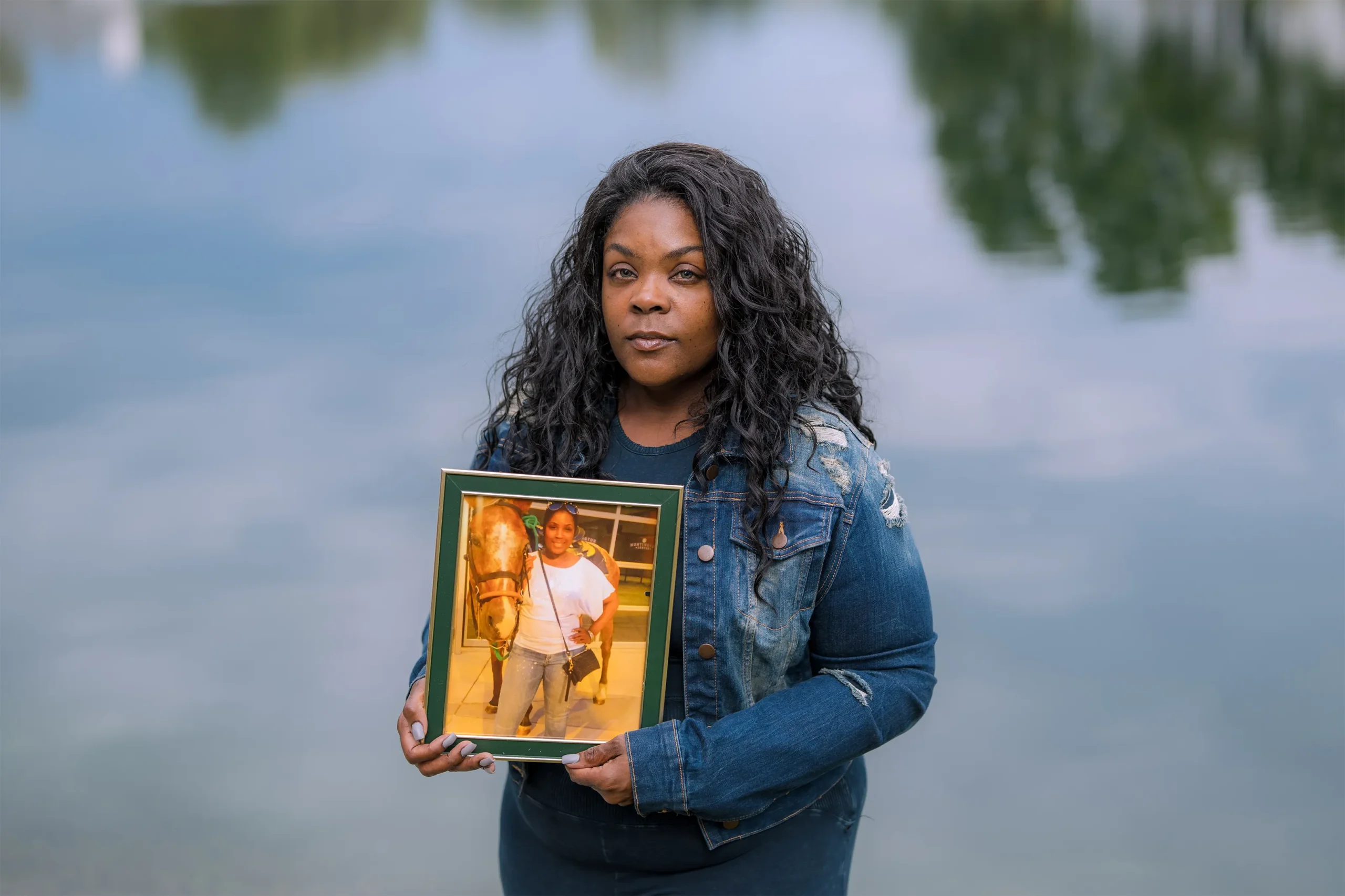
Lenia Watson-Burton, a 37-year-old U.S. Navy administrator, expected that cosmetic surgery would get rid of stubborn fat quickly and easily — just as the web advertising promised.
Instead, she died three days after a liposuction-like procedure called AirSculpt at the San Diego office of Elite Body Sculpture, a cosmetic surgery chain with more than 30 offices across the U.S. and Canada, court records show.
Cosmetic surgery chains setting up shop in multiple states depend heavily on advertising to attract customers: television, print, social media influencers, even texts hawking discounted holiday rates. The pitches typically promise patients life-changing body shaping with minimal pain and a quick recovery.
Yet there’s no federal requirement that surgery companies post evidence supporting the truth and accuracy of these marketing claims. No agency tracks how frequently patients persuaded by sales pitches sustain painful complications such as infections, how effectively surgeons and nursing staff follow up and treat injuries, or whether companies selling new aesthetic devices and methods have adequately trained surgeons to use them safely.
In 2023, Watson-Burton’s husband and six children and stepchildren sued Elite Body Sculpture and plastic surgeon Heidi Regenass for medical malpractice, alleging that the thin cannula the surgeon used to remove fat perforated Watson-Burton’s bowel, causing her death.
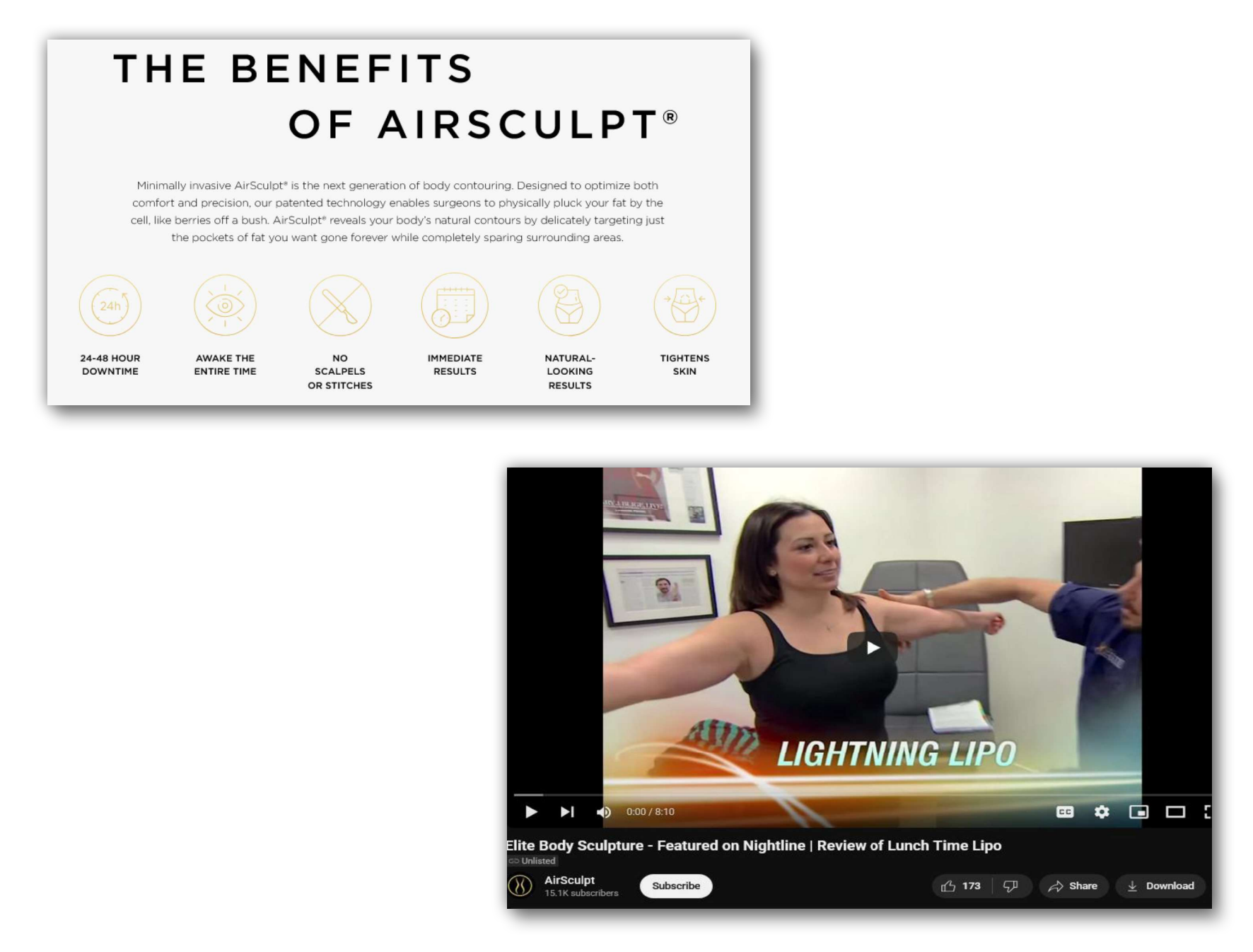
The suit also accused Elite Body Sculpture of posting false or misleading advertising on its website, such as describing the clinic’s branded procedure AirSculpt as “gentle on the body” and stating: “Our patients take the fewest possible risks and get back to their regular routine as soon as 24-48 hours post-operation.”
Watson-Burton was one of three patients who died after having liposuction and fat transfer operations performed by Regenass from October 2022 to February 2023, court records state. Families of all three women sued the surgeon, who denied wrongdoing in legal filings. The parties settled the Watson-Burton family case in 2024. Two other wrongful death cases are pending, including a suit by an Ohio woman who alleges her mother relied on promises on Regenass’ website that the operation in California would be safe with a quick recovery.
Neither Regenass nor her attorneys responded to repeated requests for comment. Emails and phone calls to Elite Body Sculpture’s Miami headquarters were not returned.
State and federal authorities do have the power to prohibit false or misleading medical advertising of all types, though enforcement is spotty, particularly when promotions pop up online. That means patients must do their own homework in evaluating cosmetic surgery marketing pitches.
“While consumers should be able to trust that ad claims are substantiated because the law requires them to be, the reality is that it pays for consumers to bring a skeptical eye,” said Mary Engle, an executive vice president at BBB National Programs.
‘Up a Cup’
Founded by cosmetic surgeon Aaron Rollins, Elite Body Sculpture says in Securities and Exchange Commission filings that it offers a “premium patient experience and luxurious, spa-like atmosphere” at its growing network of centers. The publicly traded company, based in Miami Beach and backed by private equity investors, markets AirSculpt as being “much less invasive than traditional liposuction” and providing “faster healing with superior results.” The ads say that AirSculpt “requires no scalpel, or stitches, and only leaves behind a freckle-sized scar!” and that patients “remain awake the whole time and can walk right out of their procedure, enjoying dramatic results!” Some risks are disclosed.
Rollins, who recently made headlines for putting his Indian Creek mansion on the market for $200 million, did not respond to repeated requests for comment. A lawyer for Rollins, Robert Peal, responded to an email but didn’t comment. On Nov. 4, the company announced that Rollins had resigned as executive chairman of the board of directors of AirSculpt Technologies and as a member of the board.
Many AirSculpt patients opt to have fat that is removed from their stomachs or other places injected into their buttocks, often called a Brazilian butt lift. Others use the fat to enhance their breasts, a procedure the company brands as “Up a Cup.” Since March 2023, at least seven patients have filed lawsuits accusing Elite Body Sculpture of running misleading advertising or misrepresenting results, arguing, among other things, that they felt more pain or healed much more slowly than the ads led them to believe they would, court records show. One of the lawsuits has been dismissed, and the company has denied the allegations in others.
The Watson-Burton family argued in their lawsuit that some marketing claims about AirSculpt were simply not true.
For instance, Elite Body Sculpture’s website stated that AirSculpt has “automated technology” set to “turn off” before the cannula penetrates the body too deeply and possibly causes serious injury, according to the suit. That feature didn’t protect Watson-Burton, who paid $12,000 for the operation, hoping for a “quick and timely recovery” before a scheduled U.S. Navy deployment, according to the lawsuit.
Rather than being gentle on the body, AirSculpt was “extremely painful, highly invasive, unsafe, required more than a short 24-hour recovery period and could and did damage internal organs,” according to the suit.
Watson-Burton called the San Diego center on Oct. 27, 2022, a day after the operation, to report “severe pain” in her upper abdomen, but staffers took no action to evaluate her, according to the suit. The next morning, an ambulance rushed her to a hospital, where emergency surgery confirmed the gravity of her injuries. Surgeons noted her injuries included three perforations of the small bowel and sepsis.
Watson-Burton died on Oct. 29, 2022. An autopsy report cited complications of the cosmetic surgery, ruling she died after becoming “septic following intraoperative small bowel perforation.” Her death certificate lists the cause as “complications of abdominoplasty.”
In court filings, Elite Body Sculpture said Watson-Burton had “experienced an uncommon surgical complication.” The company denied that it made any “specific guarantee or representation that injury to organs could not occur.” It denied any liability or that its ads made misrepresentations.
The dispute never played out fully in court. The parties settled the case in August 2024, when Elite Body Sculpture agreed to pay Watson-Burton’s family $2 million, the maximum under its insurance policy. Regenass, the surgeon, who did not carry liability insurance, agreed to pay $100,000 more, according to the settlement agreement.
Promises Not Kept
Social media pitches and web advertising also led Tamala Smith, 55, of Toledo, Ohio, to Regenass for liposuction and a fat transfer, court records state.
Smith was dead less than two weeks later, one of two other women who died following elective operations Regenass performed from December 2022 to February 2023, court records show. The surgeon operated on the two women at Pacific Liposculpture, which runs three surgery centers in Southern California, court records state.
The families of both women are suing Regenass, a board-certified plastic surgeon, and the surgery center. In both cases, which are pending in California courts, Regenass and the surgery center have denied the allegations and filed dismissal motions that deny responsibility for the deaths.
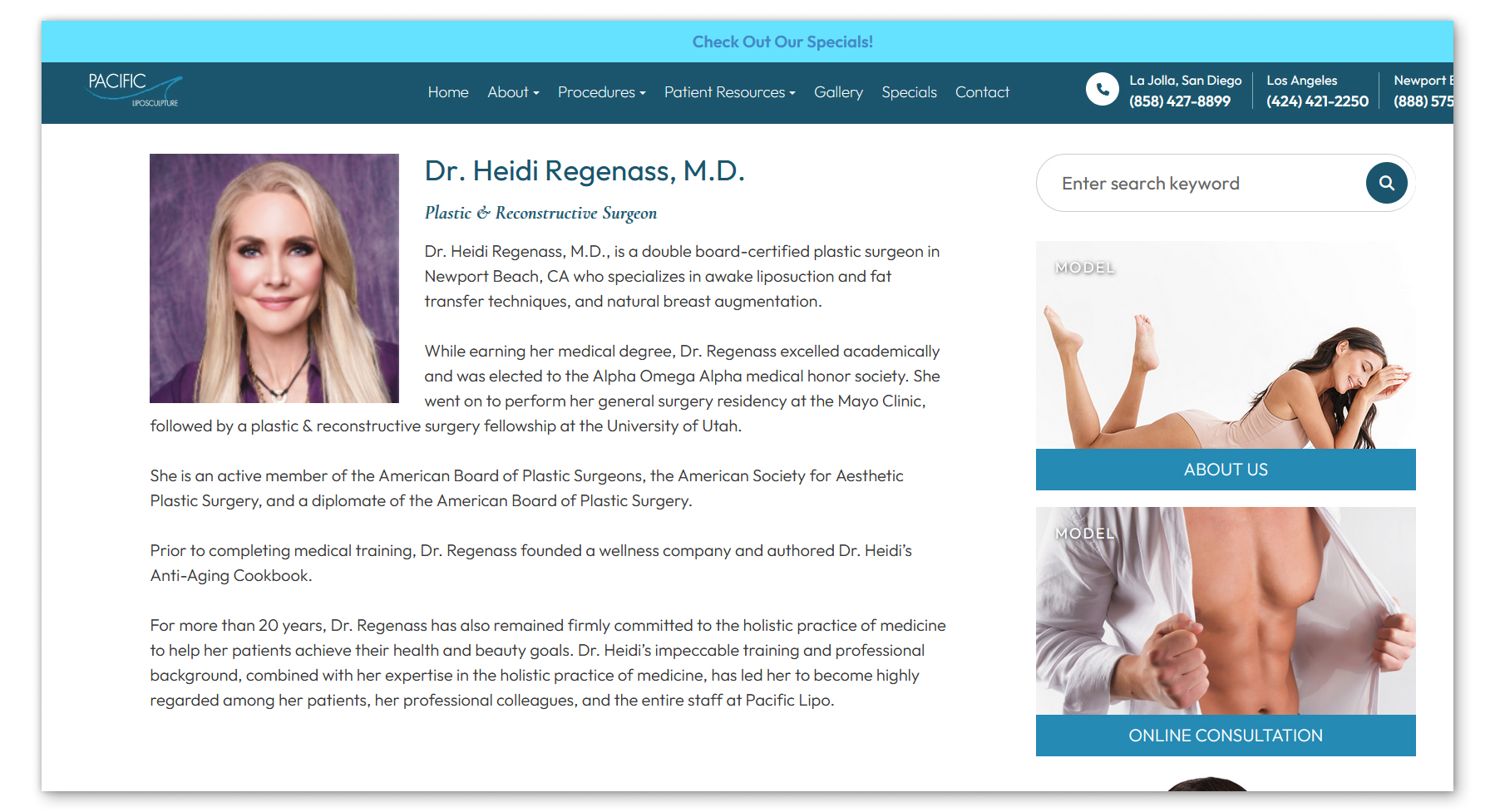
Smith was a traveling registered nurse working the overnight shift at a hospital in Los Angeles. She chose Regenass after viewing the doctor’s Instagram page, according to a lawsuit filed by Smith’s daughter, Ste’Aira Ballard, who lives in Toledo.
The ads described the surgeon as an “awake liposuction and fat transfer specialist,” while her website assured patients they would feel minimal pain and be “back to work in 24-48 hours,” according to the suit.
During the three-hour operation on Feb. 8, 2023, at Pacific Liposculpture’s Newport Beach office, Regenass removed fat from Smith’s abdomen and flanks and redistributed it to her buttocks, according to the suit. Smith called the office at least twice in subsequent days to report pain and swelling, but a staffer told her that was normal, according to the suit. Smith never spoke to the surgeon, according to the suit.
When Ballard couldn’t reach her mother, she called the hospital only to learn Smith hadn’t turned up for her overnight shift for two days. The hospital called police and asked for a welfare check at the extended-stay hotel in Glendale, California, where Smith had been living.
An officer discovered her body on the bed “surrounded by towels and sheets that are stained with brown and green fluids,” according to a coroner’s report in the court file. A countertop in the room was “covered in medical paperwork detailing post-operative instructions from a liposuction clinic,” according to the report. Ballard said she learned of her mother’s death when she called Smith’s cellphone; a police officer answered and delivered the devastating news.
“Oh, my God, I fell to the floor,” Ballard said in an interview with KFF Health News and NBC News. Ballard said she still has not gotten over the shock and grief. “It bothers me because how does someone that dedicated their life to save other people’s lives end up deceased in a hotel, as if her life didn’t matter?” she asked.
Ballard said her mother trusted Regenass based on her web persona. She believes her mother, a registered nurse, would not have gone to the surgeon had she known someone had died after an operation Regenass performed at the Pacific Liposculpture San Diego office. Terri Bishop, 55, a truck driving instructor who lived in Temecula, California, died on Dec. 24, 2022, about three weeks after undergoing liposuction and fat transfer at Pacific Liposculpture, a company with a history of run-ins with state regulators.
Pacific Liposculpture did not respond to requests for comment. In court filings, the company has denied that the operations played a role in either patient’s death and moved to dismiss the cases. The company also argued that Ballard waited too long to file suit.
Bishop, who had a history of smoking, diabetes, and high blood pressure, died from “arteriosclerotic cardiovascular disease aggravated by viral pneumonia (Influenza A H1 2009),” according to a Riverside County medical examiner’s report made part of the court record. The family disagrees and is arguing that Bishop died from blood clots, a known complication of surgery. A trial is set for June 2026.
In Smith’s case, the Los Angeles County medical examiner ruled the nurse died of “renal failure of unknown cause.” The autopsy report noted: “This is a natural death since an injury directly from the surgery cannot be identified.”
Ballard is demanding further investigation to get to the bottom of what happened to her mother.
“I don’t think they were straightforward with the risk and complications that could occur,” Ballard said. “I think they are promising people stuff they can’t deliver.”
Ballard filed a complaint against Regenass with the California Medical Board, which the board is investigating, according to documents she provided to KFF Health News and NBC News. She believes regulators need to be more transparent about the backgrounds of surgeons who offer services to the public. She also hopes the investigation will shake loose more details of what happened to her mother.
“I just don’t understand how she came back to me in a body bag,” she said.
‘Buyer Beware’
Concerns about sales pitches for cosmetic surgery date back decades.
Witnesses testifying at a June 1989 congressional hearing held by a subcommittee of the House Small Business Committee in Washington heard a litany of horror stories of patients maimed by surgeons with dubious training and credentials. Subcommittee Chairman Ron Wyden (D-Ore.) said patients were victimized by deceptive and false ads that promised a “quick, easy and painless way to change your life — all through the cosmetic surgery miracle.”
Calling for reform, Wyden added: “So, cosmetic surgery consumers are largely on their own. It’s back to a buyer beware market, and it smacks more of used car sales than medicine.” Wyden now represents Oregon in the U.S. Senate.
All these years later, there’s far more territory to police: an onslaught of web advertising, such as splashy “before and after” photos, online posts, and podcasts by social media influencers and others courted by surgery companies in a costly effort to attract business. Elite Body Sculpture, for instance, spent $43.9 million in “selling expenses” in 2024. That came to $3,130 per “customer acquisition,” according to the company’s SEC filings.
Under Federal Trade Commission guidelines, medical advertising must be “truthful, not deceptive, and backed up by competent and reliable scientific evidence,” according to Janice Kopec of the agency’s Bureau of Consumer Protection.
Any claims that are “suggested or reasonably implied” by ads also must be accurate. That includes the “net impression” conveyed by text and any charts, graphs, and other images, according to the FTC. The agency declined to elaborate.
Medical businesses are free to decide what documentation, if any, to share with the public. Most cosmetic surgery sites offer little or no such support for specific claims — such as recovery times or pain levels — on their websites.
“There is no requirement that the substantiation be made available to consumers, either on a website or upon demand,” Engle, who is also a former FTC official, said in an email.
The law permits “puffery,” or boastful statements that no person would likely take at face value, or that can’t be proved, such as, “‘You’ve tried all the rest, now try the best,’” Engle said.
Where to draw the line between acceptable boasts and unverified claims can be contentious.
Athēnix, a private equity-backed cosmetic surgery chain with locations in six cities, defended its use of terms such as “safer” and “better results” as puffery in response to a false advertising lawsuit filed against the company by Orange County District Attorney Todd Spitzer in California in August 2022.
Spitzer argued that Athēnix touted its “micro-body-contouring” technique as “safer” than traditional liposuction and offered “outstanding results with less pain and downtime” without backing that up, according to the suit.
“There is no study or evidence to support these statements and no scientific consensus about the use of these new techniques,” Spitzer argued.
The parties settled the case in July 2023 when Athēnix agreed to pay $25,000 without admitting wrongdoing, court records show. Before the settlement, Athēnix argued that its use of terms such as “safer” and “better results” was “subjective” and “puffery” — and not false advertising.
While there’s little indication that local or state authorities are stepping up scrutiny of cosmetic surgery advertising, federal authorities have signaled they intend to crack down on dubious advertising claims made by drug manufacturers.
In a letter sent to drug companies in September, FDA Commissioner Marty Makary wrote that “deceptive advertising is sadly the current norm” on social media platforms and that the agency would no longer tolerate these violations.
‘Bad Advice’
To prove medical negligence, injured patients generally must show that their care fell below what a “reasonably prudent” doctor with similar training would have provided. In their defense, surgeons may argue that complications are a risk of any operation and that a poor outcome doesn’t mean the doctor was negligent.
Some lawsuits filed by injured patients add allegations that advertisements by surgery chains misled them, or that surgeons failed to fully explain possible risks of injuries, a requirement known in medical circles as informed consent.
Caitlin Meehan had such a case. She underwent a $15,000 AirSculpt procedure at Elite Body Sculpture’s clinic in Wayne, Pennsylvania, outside Philadelphia. She agreed to the surgery in March 2023, she said, because the company’s website described it as “Lunch Time Lipo,” according to a lawsuit she filed in late August. The suit alleges that the doctor she discussed the procedure with “maintained that there are no serious, life-threatening, lasting and/or permanent complications,” according to the suit.
During the procedure, however, gases became trapped beneath her skin, causing a widespread swelling called subcutaneous emphysema, according to the suit. Meehan was shocked to see her face, neck, and upper body severely swollen, causing her shortness of breath.
A friend who drove her to the appointment asked the staff to call an ambulance, but staff members said that wasn’t necessary, according to the suit. After an hour’s drive home, Meehan said her skin felt like it was burning and she called 911. She spent four days in the hospital recovering and remains scarred, according to the suit. The suit is pending, and the company has yet to file an answer in court.
Scott Hollenbeck, immediate past president of the American Society of Plastic Surgeons, said recovering from liposuction in a day “seems unrealistic” given the bruising and swelling that can occur.
“The idea that you could return to work 24 hours after effective liposuction seems like extremely bad advice,” Hollenbeck said.
‘I Felt Horrible’
Ads that promised patients minimal discomfort also have come under attack in patient lawsuits.
More than 20 other medical malpractice cases reviewed by KFF Health News made similar allegations of unexpected pain during operations at cosmetic surgery chains using lidocaine for pain relief in “awake liposuction.”
One patient suing Elite Body Sculpture in Cook County, Illinois, alleged she “was crying due to [the] severe pain” of an operation in September 2023. She alleged the doctor said he couldn’t give her any more local anesthetic and pressed on with the procedure. The defendants have not filed an answer in court. The practice didn’t respond to a request for comment.
Engle, the former FTC official, said that while claims of discomfort are somewhat subjective, they still must be “truthful and substantiated,” such as supported by a “valid, reliable clinical study of patients’ experience.”
NBC News producer Jason Kane contributed to this report.


I am very short sighted (circa -10 with astigmatism) and sometimes toy with the idea of lens implant surgery. Laser correction likely would not work for my prescription. However, the idea of having my eyes cut up when they do not have to be puts me off, as well as the fact that everyone offering these treatments is doing so in order to make money and may not disclose the full risks. So I stick with contact lenses and glasses. The idea of even thinking about cosmetic surgery though fills me with abject horror.
I’m with you, Stephan. My pre-operative consultation with the staff and owner/doctor at the lens replacement mill I was referred to put me off the whole procedure. Not to mention the complete lack of any discussion regarding cost. This has become routine for insurance covered health(un)care!
The thought of replacing (!) my lens (es) with pieces of pladtic has become abhorent to me.
I have with glasses for 60 years, but will have surgery when my developing cataracts become worse – I already have much difficulty driving at night.
My wife had surgery to fix her cataracts and had good results, with improved vision as her vision was very bad to start with: but especially with such procedures, YMMV.
Cataracts are a bit different. I likely would have surgery if I had those in later life.
I’m 73 and have one good eye, so I’m able to compensate. Down the road i may have no other option.
One of my major concerns is that there is _no_ recourse.
There are some promising animal drug trials, but with the specter of current, guaranteed huge profit margins in this medical specialty, I don’t expect any movement soon.
This is a well-established surgery with a very high success rate (98%). Waiting too long increases the odds of less than ideal outcomes.
https://www.eyecenteroftexas.com/2020/07/cataract-surgery-success-rate/
I know three people who had cataract surgery. All were delighted.
That was my recent experience: I was likely close to legal blindness in my right eye due to cataracts, and the surgery was painless, problem-free and life altering.
I was beginning to have problems driving because of a cataract in my right eye. I had a replacement lens installed 5 years ago in the regular procedure for cataract surgery these days. I could have had the single focal length lens put if for free under Canadian medicare but opted for the multi-focal length version for an extra 1400 CAD. The operation was quick (total time in hospital of about 1.5 hours), painless, and now I see better than I have for over 60 years. The multi-focal length lens means I see perfectly at all distances great than about 80 cm. It was worth the extra expense.
The procedure is much improved over what my parents went through 30 and 40 years ago. They required a small operating team and an overnight stay in the hospital. Something went wrong with my mother’s op and one eye was bloodshot until her death 15 years later. She did see well though.
I was born with congenital cataracts and had surgery in 1995 at the age of 23. Very smooth operation, secondary cataracts dealt with easily using laser.
Would I have had vitreous body collapse as early as I did without the op, who knows? Still, I consider the operation a success giving me much better quality of life despite the “floaties”
Older family members have had very successful surgery for the aging version of cataract.
You do, of course, have to research your surgeon.
I really do not consider this operation “cosmetic”.
My wife, mother, father in law and mother in law all have had cataract surgery. Fantastic results except my mother in law. She had one eye done for cataracts, leaving her second eye to be done later. Multiple operations and routine 6 hr round trip drives to a specialist culminating 5 years later in the specialist giving up. She was then referred to two eye specialists at hospitals a few hours away to consider cornea transplants. One refused treatment saying that her eye was in too poor a condition to even try. The other said – you have nothing to lose. You are going blind anyway. The cornea transplant was successful. Vision was stabilized and chronic pain ended. The original laser clinic felt that they could handle eye diseases and there was no need to worry. The surgeon who did the transplant also did the cataract surgery on the second eye – without problems in a hospital setting. Sometimes skill matters a lot, and routine operations do not prepare you for non-routine operations, though they do help with over-confidence.
Yes! Someone close to me had lens replacement surgery for cataracts and her vision has returned to “normal,” with only reading glasses required for small print.
My late mother had cataract surgery on both eyes about 30 years ago because her eyesight had become quite poor. During the surgeries, I waited in a nearby room at the eye hospital where I could watch closeups of her eyes being operated on. That was a bit too much for me so I read a book instead. But my mother said she suffered no pain and everyone at the hospital was very efficient.
We came home the same day following each surgery. Then I took care of her which, IIRC, consisted of a couple of weeks of applying eye drops every day and otherwise keeping her eyes covered with patches. She had no problems. Her vision was better than mine after it was all over. Cataract surgery is probably less risky now than it was back then.
I had a rough year with 2 laser surgeries – one for torn retina and one to preemptively laser my retina in weak areas to essen my chances of a detachment. In between, I suffered from a vitreous hemorrhage which the first doctor (on call over a weekend) wanted to perform a full on surgery on. Luckily, I had the frame of mind to ask to wait until Monday to see my regular retinal specialist. He errs on the side of conservative and we took a wait and see approach. I was able to avoid that surgery.
All this to say that this was extremely difficult. I would never choose to have a surgery that was not medically necessary. I’m even quite hesitant to take medication because … big pharma….
This is not about concern for women’s health. Capitalism doesn’t care if a victim is a woman, man. child, animal, or lichen. It’s just that adult females are more susceptible to this business, because they care more about their looks than males do. They are willing to spend more, suffer more, and risk more. All of the beauty industry is geared towards females for that reason. As an example of opposite, porn industry is geared towards men, and it’s all because of the same reason, money.
That remark is ignorant and arrogant.
It is open and pervasive in the Deep South (IM Doc has heard this from his former students; I witnessed it first hand when I lived in the South) that the doctors are negligent in caring for women older than reproductive age. They are patronizing and dismissive.
There is also the more general tendency (and this is well documented) to discount health complaints from women, to train in many surgeries on men only (pervasive in orthopedics), to ignore certain health risks in women (cardiovascular diseases is a biggie). For one of many many examples, see this article from Nature, Women are poorly represented in clinical trials. That’s problematic.
Another example was the Covid vaccine side effects of 1. notable changes in menstrual periods, including reduction in frequency or even cessation and 2. post menopausal bleeding. #1 was so common that readers reported they had women in mixed groups in bars discussing it. #1 was also the reason many nurses refused to take the Covid shots, that they were afraid that the menstrual effects could mean a reduction in fertility (and IM Doc reported cases to me of families in despair because daughters, IIRC typically in their 30s, did cease menstruating entirely; I had a friend report that that happened to her late 30s daugher who fortunately did not want to have kids). Yet the very few articles that reported on this side effect regularly quoted dismissive MDs: “Oh, women have flaky periods [in fact, many are as regular as clockwork]. This is just stress.”
Neglect of women’s health is very well documented, as Yves has shown above. Look at all the women dying in childbirth in America, even in this day and age. I agree with you on capitalism only being concerned with money, but neglect of women’s health concerns goes beyond that.
Good Lord, we are getting reddit level comments.
There is extensive evidence of women receiving less then ideal care or having complaints dismissed. The numbers get worse when isolating for race with black women routinely being denied care with higher rates of mortality and maternal mortality.
Men undergoing cosmetic surgery has been rising, including liposuction and gynocomasitia surgery.
https://carolinacosmeticsurgery.org/blog/men-and-aesthetic-surgery-surprising-statistics-behind-the-growing-trend
Nominative determinism in action: Regenass.
Happy New Year, y’all!
Not a new thing, sadly, Carl Hiassen’s book from the 90’s –Skin Tight –is about an incompetent plastic surgeon (did you know that you don’ have to be board certified to call yourself a plastic surgeon?) who kills a patient during liposuction and then uses mob friends to cover it up.
A very funny (dark) book
In the 1995 movie Clueless, Alicia Silverstone’s character Cher explains to the audience that she lives with her father because her mother died during “a routine liposuction” when Cher was a baby. At the time I thought the joke was just SoCal making fun of itself.
An issue not discussed beyond who does these procedures, is where are they done? More and more procedures that used to be done in hospitals are being done in office clinics or ambulatory surgery centers. Ambulatory Surgery Centers (ASFs) are state licensed facilities that provide outpatient services with admission and discharge within 24 hours. There is an ASF trade association. Studies indicate that complications between hospitals and independent surgery centers are comparable. A question is whether there may be more severe, catastrophic complications in surgery centers. There are many horror stories to be found when searching the internet. There is a 2024 Chicago case where a jury made a $66 M award for a liposuction and Brazilian but lift procedure for a patient who was allowed to bleed to death in recovery. This may be the largest Cook County or even Illinois jury award against any doctor. I am not aware of any resulting license actions against either this clinic or doctor. Malpractice awards do not trigger an investigation of guilty doctors in most states. It requires a formal complaint by an aggrieved party to potentially lead to an investigation of bad care. This practice of non-investigation of malpractice awards is the position of the Federation of State Medical Boards. I am surprised by the number of plaintiff law firms advertising liposuction expertise on the internet. Regulations for ASTs vary among states. Many states require that their regulators be informed of any patient who needs to be hospitalized within 24 hours of any procedure. Some states do not.