Yves here. The brave government and people of Cuba have finally lost their fight to choose their way of government. Despite the very high cost that long-term US economic strangulation has imposed on the island, there is a possibility that this exercise was more a show of US macho, in succeeding in throwing a small and nearby country against the wall. Since this Administration has the brains and attention span of a gnat, they may not have the stick-to-it-ness to impose meaningful institutional change.
By Andrew Korybko, a Moscow-based American political analyst who specializes in the global systemic transition to multipolarity in the New Cold War. He has a PhD from MGIMO, which is under the umbrella of the Russian Foreign Ministry. Originally published at his website
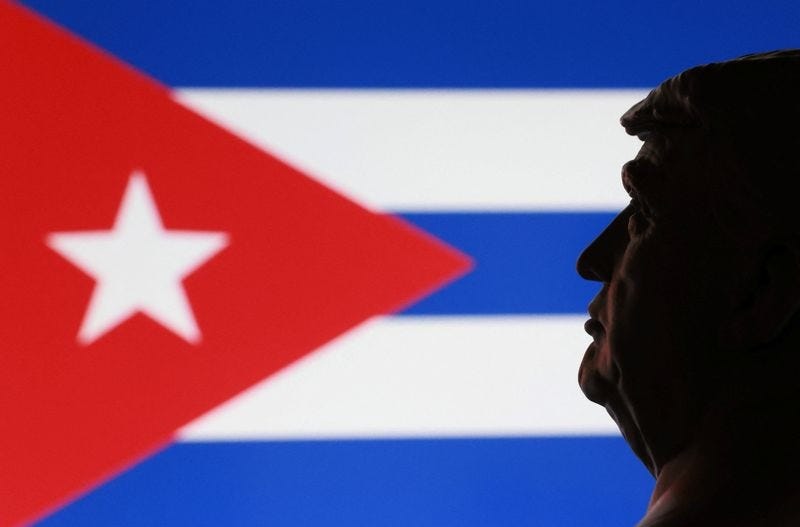
No one should doubt that this would be done under duress since the whole population is being held hostage by this Hybrid War, which isn’t fair nor internationally legal, but this is the reality as it objectively exists.
It was assessed in early February that “The US Is On The Brink Of Subordinating Cuba” due to the predictably crippling effect of its de facto oil blockade on the island nation after obtaining proxy control over Havana’s Venezuelan supplier upon capturing President Nicolas Maduro the month prior. Just like in that case, it was also assessed in the same analysis that “the Venezuelan precedent proves that the US can accept ‘regime tweaking’ in lieu of regime change.”
This concept “refers to keeping the targeted state’s power structure in place after some (at times significant) changes that advance the meddling state’s interests.” According to a recent report from the New York Times right after Cuba’s islandwide blackoutcaused by the US’ de facto oil blockade, “The Americans have signaled to Cuban negotiators that the president must go, but are leaving the next steps up to the Cubans”, though provided that they accept turning their country into a US “client state”.
The outlet described Trump 2.0’s policy as “regime compliance” instead of regime change, hyperlinking to one of their reports about this here from two days prior where they attribute this policy to Marco Rubio, who’s one of the US’ most powerful officials in decades. It’s essentially the same as the “regime tweaking” concept that was first used to describe the US’ special military operation in Venezuela. Both “regime tweaking” and “regime compliance” aim to subordinate targeted states to US hegemony.
Circling back to the Cuban case in light of its islandwide blackout and the New York Times’ recent report about Trump 2.0’s “regime compliance” goal there, this is veritably the most realistic outcome of its US-instigated crisis and arguably the best realistic (keyword) outcome for the Cuban people too. To be sure, all political changes in their country should be initiated by them instead of foreign forces, just like anywhere, but that’s not the reality there nowadays and pretending otherwise is delusional.
The US is responsible for Cuba’s energy crisis that threatens to have very severe humanitarian consequences the longer that it continues, and the island’s government has no realistic chance of breaking its de facto oil blockade. Neither Russia, China, nor anyone else is going to risk war with the US over Cuba’s political future either no matter how much some at home and abroad wish that they would. To be clear, acknowledging reality doesn’t mean endorsing it, so nobody should conflate the two.
With this in mind, the best for the Cuban people right now is the resignation of their president in exchange for alleviating some of their energy crisis, likely with a priority being given to hospitals, schools, and other such facilities for fuel that the US will self-interestedly describe as “humanitarian aid”. No one should doubt that this would be done under duress since the whole population is being held hostage by this HybridWar, which isn’t fair nor internationally legal, but this is the reality as it objectively exists.
More concessions would be inevitable, but it’s difficult to imagine any alternative since the US could expand its de facto oil blockade to strikes against military, police, and political facilities and later even major food-producing areas to force a defiant Cuba into submission. The odds of the island’s government surviving this siege unscathed are nil, so either they martyr themselves (expecting that the military, police, and citizenry will too) or submit to the US to save everyone, albeit as its clients from then on out.


The Cuban president just criticized the United States and urged the people to resist. Could this be a facade, and is he secretly preparing to surrender? Or has his inner circle excluded him from the decision-making process and betrayed him?
I’ve followed Cuba and its history since 1967, from Canada. At this point it is impossible to predict what the Cuban state will do. I would say if I were an American I would not travel outside the US for the next few years. Luxemburg coined the phrase — Barbarism or Socialism. The world is at that point. It will be a long protracted battle waged at different levels, in different places, etc. And to riff off the celebrated phrase “the unequal development of capitalism” we are now entering a new phase in the unequal undevelopment or disdevelopment of the US empire. Trebles all round.
Maybe I’m wishfully thinking, but I don’t think Cuba has lost its fight to choose its government. It hasn’t even begun to fight yet. And I don’t think the oil blockade will break the will of the Cuban people. I doubt they will let Trump choose their president, despite the dark nights. The Cuban people are well educated and well informed. They know that if the USA is allowed to run Cuba then Cuba will soon be another Haiti.
One thing that puzzles me about the negotiations apparently going on between the USA and Cuba is that retired president Raul Castro’s grandson is doing the negotiating for Cuba because the USA chose him. If the Cuban foreign secretary is not the negotiator then the job would ordinarily go to Raul’s son Alejandro Castro Espin. He has negotiated with the USA before. He has also been rumored to be in line to be a future president of Cuba. But the grandson? Something funny is going on.
Another thing is that Cuba being an island it will be much harder than in Venezuela for the USA to buy Cuban military officers.
Pretty raw for Rubio to claim Cuba being a failed nation because of Socialism while ignoring several decades of repression and sanctions. Thing is, the Cuban army, police and security services are still in place so will not just stand down for Trump and co. And the Cuban people have lived their ideals for the past coupla generations and will not instantly flip over to neoliberalism. So it is not over yet. And of course there is the question of all the Cuban diaspora in Florida which Trump has said that he wants to bring back to the island. And it won’t go down will if Batista’s grand-nephew turning up with a land documented saying that he owns central Havana – but ignore the fresh ink smudges. How is Rubio going to enforce the claims of the Cuban diaspora without stirring revolt among people who have lived on those lands for generations? Trump’s Cuba troubles have just begun.
lights out, oil gone in cuba. should’ve employed sunlight, no embargo there.
inhumane. outside of a brief blip under obama, this is us foreign policy. all who do not submit shall be starved.
it’s unthinkable, and it’s reality. how much can one care if one does not endure the pain?
China does not have to send a tanker to Cuba just:
“no deliveries of rare earths, drugs or drug precursors until you deliver an tanker of (whatever they need) to Cuba”
or:
“no deliveries of anything to Taiwan until you deliver an tanker of (whatever they need) to Cuba”
just for fun I would like Iran to do something like “any non-US/IS country who delivers a tanker of oil to Cuba will be allowed X shiploads of their choice through the strait of Hormuz”
Call me obtuse, but I can’t see why the Chinese and/or Russians aren’t even trying to interfere with large scale humanitarian relief. NOT missiles, a la 1961, but food, fuel fertilizer, what have you. Yes, it will make the US mad(der), but at this stage so what?
It would be inconvenient to send humanitarian supplies because both the unreasonableness of the American government and the inability of the Cubans to be politically useful. Restated, the minimal risks are still seen as too great compared to the possible rewards especially as moral behavior such as disaster relief is considered relatively unimportant.
A pox on their children. Wars do come back home. American people do allow this to happen. One thinks that this might end up happening with them as well, done by their own government. And then it will be too late.
From the post: “Neither Russia, China, nor anyone else is going to risk war with the US over Cuba’s political future…”
Russia has just announced it’s sending 725k barrels of oil and 27k tonnes of natural gas to Cuba. It’s arriving soon. It looks like it’s the US that will have to decide if it wants a war with Russia in addition to its war with Iran. Doesn’t seem like a good idea to me.
See https://www.intellinews.com/russian-oil-tankers-close-in-on-cuba-after-island-s-worst-blackout-in-decades-432425/