In the previous Armed Madhouse article, I argued that War Power has evolved into a self-reinforcing institutional ecosystem whose incentives increasingly favor preparations and actions carrying unacceptable risks of catastrophic armed conflict escalation. That assessment naturally raises a more important question. If War Power is becoming progressively less capable of performing the historical function for which it evolved—the management of international conflict—what institutional ecosystem might eventually succeed it?
History suggests that civilizations rarely abandon essential social functions. Instead, they replace increasingly costly institutions with new ones that perform the same function more effectively. Blood feuds gave way to criminal justice. Trial by combat yielded to courts of evidence. Dueling disappeared as legal institutions provided less destructive means of managing conflict. In each case, the replacement was driven not primarily by moral enlightenment, but by the emergence of institutions capable of accomplishing the same objective at far lower social and economic cost.
This article argues that War Power may be approaching a similar historical transition. The destructive potential and economic burden of modern armament continue to increase, while advances in communications, sensing, computation, verification, and information analysis are expanding the range of conflict-management institutions that civilization can realistically construct. The central question is not whether humanity desires a more peaceful world. It is whether new methods of managing international conflict can be developed to avoid disaster.

I propose the term Peace Power for an emerging institutional ecosystem dedicated to managing international conflict through the systematic production of calibrated trust rather than through primary reliance on coercive force. I further propose Trust Engineering as the engineering discipline devoted to designing, evaluating, and improving the trust architectures upon which Peace Power depends.
This essay does not present a finished blueprint for replacing War Power. Rather, it argues that technological change has made possible a new direction in institutional evolution. Peace Power represents not a utopian aspiration but a possible next stage in civilization’s continuing search for more capable, less costly, and less dangerous institutions for managing international conflict.
War Power as an Historical Phenomenon
For most of human history, organized violence was civilization’s primary mechanism for managing conflicts that could not otherwise be resolved. In a world lacking reliable international law, independent verification, rapid communication, and trusted institutions, military capability became the ultimate arbiter of disputes. War Power evolved because it performed a function that no alternative system could perform.
Over centuries, this necessity produced far more than weaponry and armies. It gave rise to an extensive institutional ecosystem: military organizations, alliances, intelligence services, defense industries, logistics networks, command structures, diplomatic protocols, strategic doctrines, military education, and supporting political institutions. Together these components constituted what we now recognize as War Power.
Like every successful institutional ecosystem, War Power produced benefits as well as costs. It deterred aggression, established political boundaries, protected trade routes, enforced treaties, and occasionally prevented some conflicts through credible deterrence. It enabled states to survive in an international environment where trust between rivals was often limited and independent verification was largely impossible.
The remarkable longevity of War Power should therefore not surprise us. Institutions endure because they solve important societal problems. For centuries, no alternative existed that could manage international conflict with comparable effectiveness. Under those historical conditions, investment in military capability was not irrational. It represented civilization’s least costly available method for coping with existential uncertainty between states.
The Obsolescence of War Power
Successful institutions are rarely abandoned suddenly. More often, they become obsolete because changing conditions alter the balance between the benefits they provide and the costs they impose. History is filled with institutions that were once rational responses to the problems of their time, yet gradually lost their justification as superior alternatives emerged.
Blood feuds gave way to criminal justice because organized legal systems could resolve disputes more reliably and at far lower social cost. Trial by combat disappeared as rules of evidence proved more effective than physical contests at determining contested facts. Dueling persisted for centuries as an accepted means of defending personal honor, only to disappear once courts and civil institutions could provide a less destructive alternative.
Nineteenth-century depiction of a formal pistol duel. Dueling was once regarded as a legitimate institution for resolving disputes between gentlemen.

These institutions were not abolished on moral grounds because they were violent. They were replaced because they became economically and politically inferior methods of performing essential societal functions. War Power should be examined from the same historical perspective. For centuries, military action was the prevalent method for managing consequential international conflict. Despite its enormous human cost, there were no institutions capable of performing that function more effectively. Under those conditions, investment in War Power was a rational adaptation to an uncertain and often dangerous international environment.
In the past, episodic warfare alternated with intervals of peace during which civilization could advance and nations prosper. Today, every episode of confrontation between major powers has become a game of nuclear roulette, with the potential to escalate into a global civilizational catastrophe. The costs associated with the War Power system have grown enormously, not only in monetary terms, but in extraordinary risk.
The central question today is whether that historical cost-benefit equation is beginning to change. Modern conflict no longer threatens only armies, cities, or even nations. Nuclear weapons, autonomous systems, cyber warfare, and other technologies have dramatically increased both the potential scale of destruction and the economic burden of maintaining credible military capabilities. At the same time, advances in information technology are expanding the range of institutions capable of producing reliable verification, transparency, and calibrated trust between states.
These two trends are occurring simultaneously. The costs of relying upon War Power continue to rise, while the feasibility of alternative conflict-management structures is beginning to increase. This does not mean that war has suddenly become impossible or that military capability has ceased to matter. History rarely changes so abruptly. Rather, it suggests that War Power may be approaching the same historical transition experienced by other once-essential institutions whose costs eventually exceeded their benefits.
Institutional transitions rarely occur through sudden replacement. More often, they unfold through a gradual shift in relative capability as an emerging institutional ecosystem progressively assumes functions that had previously depended upon its predecessor. For the foreseeable future, War Power and Peace Power are therefore likely to coexist. As trust-producing institutions become more capable, the balance of responsibility for managing consequential international conflict can progressively shift from coercive power toward trust-producing power, much as earlier civilizations gradually transferred functions from blood feuds to courts or from dueling to systems of law.
Why This Historical Moment Is Pivotal
Skeptics may reasonably ask why this historical moment should prove more significant than previous eras in humanity’s long struggle to reduce the destructiveness of war. Every generation has hoped to lessen the costs of conflict. Why should ours be different? The answer may lie not in changes to human nature, but in changes to civilization’s technological affordances.
Every civilization is constrained by the technologies available to it. New technologies do more than improve existing institutions; they make entirely new classes of institutions possible. The emergence of writing enabled legal systems and bureaucratic states. Printing transformed education and scientific collaboration. Railroads and telecommunications made modern nation-states and continental economies practical. Digital computing enabled global financial networks whose speed, complexity, and security would have appeared magical to earlier generations.
This pattern reflects a more general principle. Every institution has an implicit informational and computational requirement. Civilizations cannot construct institutions whose information-processing demands exceed the technologies available to them. Modern financial systems, global logistics, air traffic control, satellite navigation, and internet commerce all became practical only after advances in computation dramatically expanded humanity’s capacity to process information reliably and at scale.
This observation has important implications for international conflict. For most of history, reliable trust production on a global scale was computationally impossible. Independent verification was slow or unavailable. Communications were limited. Evidence was fragmentary. Monitoring was episodic. Under those conditions, military capability became civilization’s least costly mechanism for managing uncertainty between rival states. War Power was therefore not simply a military solution. It was civilization’s practical substitute for trust production when the informational requirements for more sophisticated institutions exceeded what existing technologies could support.
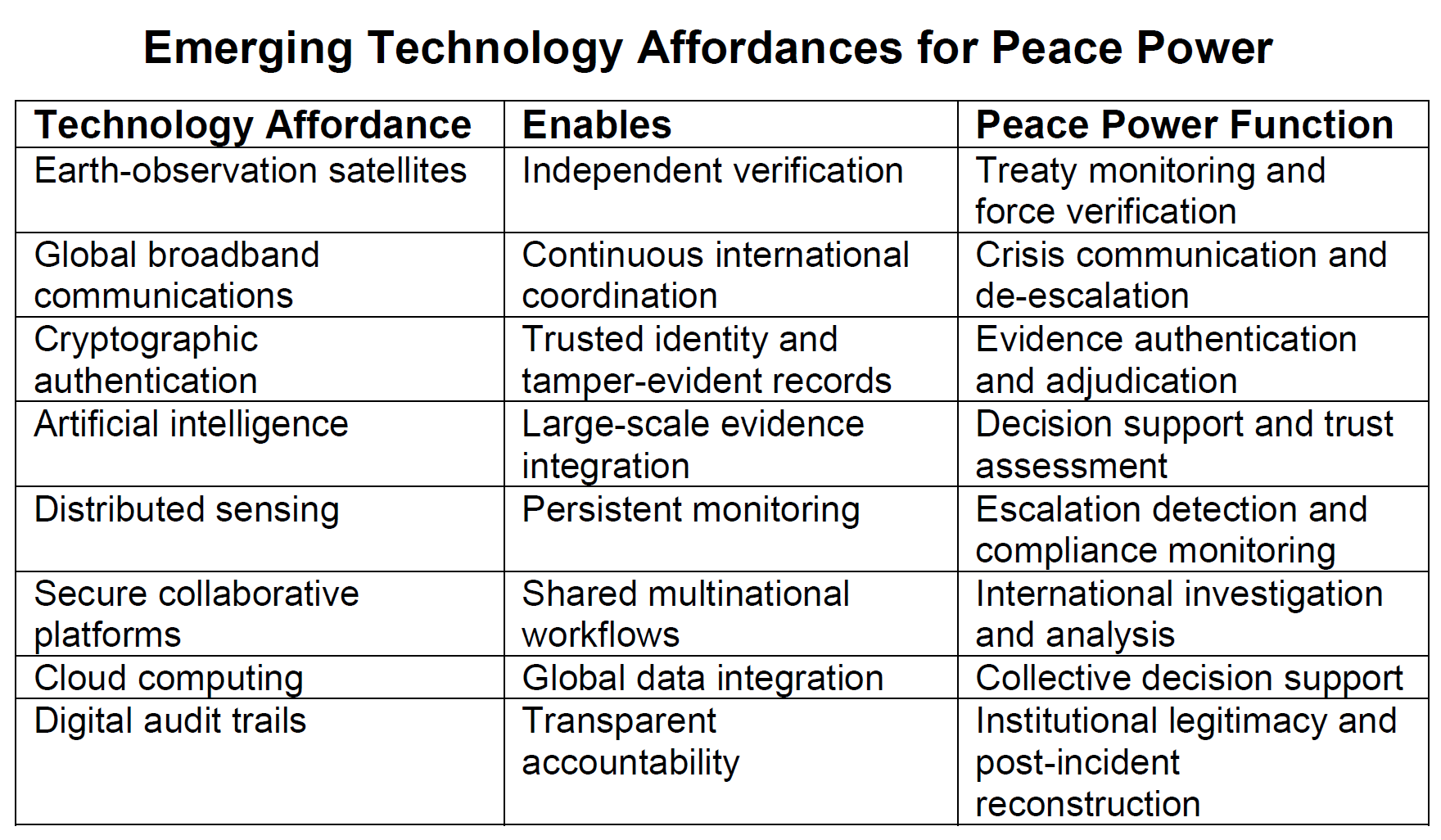
Today, those constraints are beginning to change. Global communications now connect governments and institutions continuously. Satellite observation provides independent verification of events once hidden from international scrutiny. Distributed sensing, cryptographic authentication, continuous monitoring, massive data integration, collaborative digital platforms, and increasingly capable analytical systems collectively expand humanity’s ability to verify information, detect deception, assess competing claims, and synthesize evidence from many independent sources. None of these technologies, by themselves, creates Peace Power. Technology does not determine institutional evolution. It expands the set of institutions that become feasible. Collectively, these emerging capabilities enlarge the institutional design space available to civilization.
The history of aviation provides an instructive analogy. Early pioneers correctly believed that controlled flight was an engineering problem long before practical aircraft existed. Their contribution was not the final solution, but the recognition that flight belonged within the domain of engineering rather than fantasy. The aviation ecosystem that followed emerged through decades of incremental advances in aircraft design, navigation, airports, weather forecasting, regulation, and air traffic control.
Peace Power should be viewed in much the same way. No complete architecture yet exists for producing calibrated trust at the scale required for managing international conflict. But the technical prerequisites for such an ecosystem are increasingly present. The central claim of this essay is therefore not that Peace Power has already arrived, but that trust production itself has entered the stage of engineering feasibility. If that proposition is correct, then the practical institutions of Peace Power will emerge gradually through experimentation, demonstration projects, performance measurement, institutional learning, and the accumulation of many complementary innovations rather than through a single transformative invention.
Peace Power
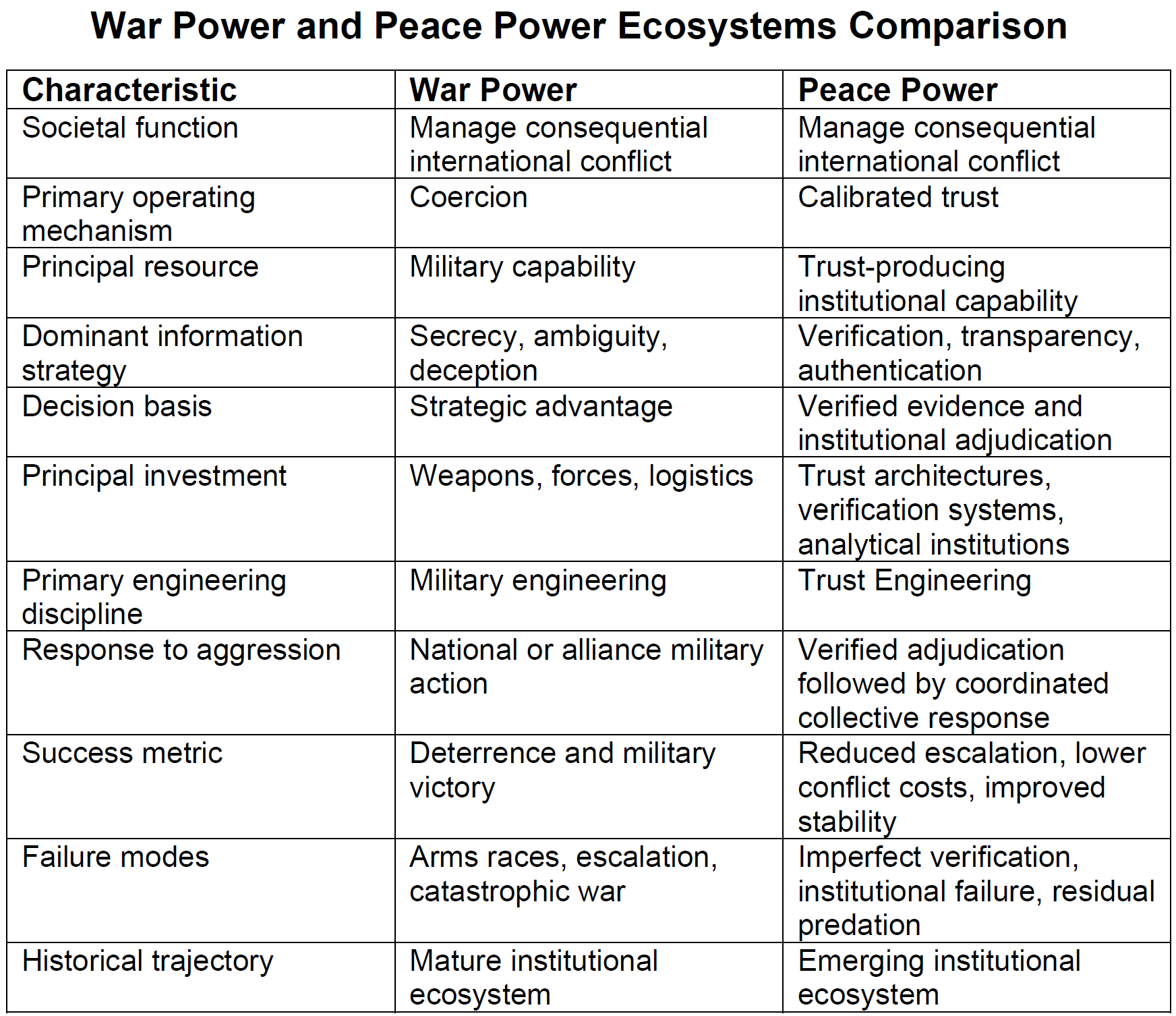
I propose the term Peace Power for an emerging civilizational capability dedicated to managing international conflict through the systematic production of trust rather than the reliance on coercive force. Peace Power should not be understood as the absence of military capability, nor as a doctrine of unilateral disarmament or political idealism. Nations will continue to possess competing interests, strategic rivalries, territorial disputes, and legitimate security concerns. Conflict is an enduring feature of international affairs. The objective is therefore not to eliminate conflict, but to create institutional capabilities that enable it to be managed with progressively lower economic cost and dramatically lower catastrophic risk than armed warfare.
Peace Power should not be confused with diplomacy. Diplomacy is one important component of Peace Power, just as military operations are one component of War Power. Neither term describes a single institution. War Power denotes an ecosystem composed of militaries, intelligence organizations, alliances, defense industries, logistics, strategic doctrine, education, political institutions, and supporting technologies. Peace Power likewise denotes an ecosystem whose interacting institutions are dedicated to producing calibrated trust through verification, transparency, secure communications, independent monitoring, collaborative analysis, confidence-building, and other trust-producing capabilities. Like War Power, its effectiveness will arise not from any single institution but from the interaction of many complementary ones. What distinguishes Peace Power from traditional peace advocacy is its affirmative commitment to building enabling structures.
Throughout history, civilization has solved difficult societal problems not merely by expressing desirable aspirations, but by constructing institutions that made those aspirations practical. Courts replaced blood feuds. Financial systems replaced the physical movement of gold. Public health systems replaced ineffective responses to epidemic disease. Durable progress resulted from building new institutional capabilities rather than simply advocating desirable outcomes.
Peace Power follows the same historical logic. Its purpose is to cultivate an ecosystem of institutions whose common function is the production of calibrated trust for the management of consequential international conflict. These institutions need not eliminate disagreement. They need only make verification, cooperation, and conflict management sufficiently reliable that reliance upon coercion progressively becomes less necessary.
Like every major institutional transition, this evolution is unlikely to occur abruptly. For the foreseeable future, War Power and Peace Power are likely to coexist, with Peace Power progressively assuming functions that have historically required reliance upon coercive institutions. No single innovation will create this transition. It will emerge through the gradual development and integration of verification systems, transparency mechanisms, secure communications, distributed sensing, independent auditing, collaborative decision-support, diplomatic confidence-building measures, and many other trust-producing structures that cannot yet be fully anticipated.
A mature Peace Power ecosystem must also possess credible mechanisms for responding to predation. Trust-producing institutions cannot assume universal cooperation. Their function is to establish sufficiently reliable verification, adjudication, and legitimacy that deliberate aggression can be identified with broad international confidence. Once aggression has been authoritatively established through transparent institutional procedures, the Peace Power ecosystem enables coordinated collective responses ranging from diplomatic isolation and economic sanctions to, in the gravest circumstances, jointly authorized military action. In this way, Peace Power does not eliminate coercive force; it progressively subjects its legitimate use to increasingly trustworthy processes of verification, adjudication, and collective decision-making.
More fundamentally, Peace Power seeks to reduce uncertainty not only about facts but also about legitimacy. Verification establishes what has occurred. Adjudication determines whether established norms have been violated. Collective institutional processes determine what responses are justified. By reducing uncertainty across all three stages, Peace Power enables states to coordinate responses with greater confidence, lower informational friction, and broader international legitimacy than has historically been possible.
Peace Power therefore represents neither a utopian destination nor a single institutional innovation. It is the long-term evolution of civilization’s capacity to manage conflict by investing in the production of trust as deliberately as previous generations invested in the production of military power.
Trust Engineering
If Peace Power represents an emerging civilizational capability, then it naturally raises another question: who designs, evaluates, and improves the institutional structures upon which that capability depends? History again provides a familiar answer. Whenever technological advances create opportunities for entirely new forms of societal capability, new engineering disciplines emerge to ensure that those capabilities develop safely, reliably, and productively.
Steam power gave rise to mechanical engineering. Electrification required electrical engineering. Aviation demanded aeronautical engineering. Modern computing produced software engineering and cybersecurity. In each case, the engineering discipline emerged because society required systematic methods for designing increasingly complex systems whose performance could no longer be left to intuition or trial and error.
Peace Power requires a comparable discipline. I propose the term Trust Engineering for the systematic design, evaluation, and continuous improvement of institutional structures that produce calibrated trust for high-consequence decision-making. The objective of Trust Engineering is not to persuade people to trust more. It is to design institutions that become objectively more trustworthy through transparency, verification, independence, redundancy, accountability, auditability, and continuous calibration against observed outcomes. This distinction is fundamental.
Traditional discussions of trust often focus upon individual attitudes or interpersonal relationships. Trust Engineering treats trust as an institutional design problem. Its concern is not whether particular leaders or nations feel confidence in one another, but whether the structures through which information is gathered, verified, communicated, and evaluated consistently produce decisions that are better aligned with reality.
The distinction is more profound than a change in methodology. Traditional peace efforts have relied heavily upon moral suasion, diplomatic goodwill, or the hope that leaders will exercise greater restraint. Trust Engineering begins from a different premise. It assumes that durable improvements in international stability arise not primarily from better intentions, but from better institutional design. Its objective is to construct environments in institutional incentives progressively shift from rewarding successful deception toward rewarding successful verification.
Viewed in this way, the primary object of Trust Engineering is not trust itself but trust architecture: the institutional structures through which evidence is acquired, authenticated, integrated, evaluated, and communicated for consequential decision-making. Trust is the behavioral consequence of those architectures. Well-designed trust architectures produce trust judgments that are better calibrated to reality by improving verification, reducing informational friction, exposing deception, and continuously incorporating new evidence. Like every engineering discipline, Trust Engineering seeks not perfection but progressively better performance under conditions of unavoidable uncertainty.
This shift has important implications for international strategy. Throughout history, states have often gained advantage through secrecy, misdirection, and strategic ambiguity because reliable verification was difficult or impossible. As verification technologies and institutional trust architectures improve, the expected value of these strategies begins to decline. Trust Engineering does not abolish deception, just as modern banking has not abolished fraud. It seeks to reduce the practical returns to deception by making verification progressively more reliable, independent, and continuous. War Power evolved within an information ecology that rewarded secrecy and duplicity. Peace Power would evolve within an information ecology that increasingly rewards verification and transparency.
The analogy with mechanical engineering is instructive. Mechanical engineers cannot fully eliminate friction. They reduce it sufficiently to allow complex systems to operate efficiently, reliably, and safely. Trust Engineering performs an analogous function for institutions. By improving the quality of verification, transparency, and accountability, Trust Engineering can reduce the informational friction that otherwise diminishes the efficiency of diplomacy, commerce, governance, and international conflict management.
No single invention will accomplish this objective, and there will never be a universal “Trust Engine.” Instead, Trust Engineering will express itself through countless specialized innovations: improved verification systems, more reliable methods of information authentication, independent auditing mechanisms, collaborative decision-support tools, transparency protocols, confidence metrics, and institutional designs that cannot yet be fully anticipated. Collectively, these innovations will form the enabling structures of the Peace Power ecosystem.
Like every engineering discipline before it, Trust Engineering should therefore be judged not by the promise of perfect solutions, but by its capacity for significant improvement. The measure of its success will be whether civilization becomes progressively more capable of managing conflict through calibrated trust while reducing its dependence upon increasingly costly and dangerous forms of military coercion.
Buildinging the Peace Power Ecosystem
If the Peace Power concept is to be realized, it must be developed in a manner similar to that of every successful complex societal ecosystem: by constructing many complementary facilities rather than searching for a single transformative invention. The Peace Power ecosystem will therefore be assembled from numerous independently valuable building blocks that progressively reinforce one another. Some will be theoretical. Others will be technological, institutional, educational, or political. Together they will expand civilization’s capacity to manage international conflict through increasingly trustworthy institutions.
The first requirement is a coherent conceptual framework. Every engineering discipline begins by defining the problem it seeks to solve, the principles that govern successful solutions, and the criteria by which progress can be measured. Trust Engineering requires the same intellectual foundation.
Second, emerging information affordances must be deliberately applied to conflict management. Advances in communications, satellite observation, distributed sensing, cryptographic authentication, collaborative digital platforms, and analytical systems provide capabilities that previous generations simply did not possess. The challenge is not to invent these technologies, but to integrate them into institutions that systematically improve verification, transparency, and decision quality.
Third, the Peace Power ecosystem must be decomposed into manageable subsystems. Rather than attempting to engineer international trust as a single undertaking, individual functions should be identified and developed independently: verification, authentication, auditing, confidence-building, information synthesis, escalation monitoring, treaty compliance, and many others. Progress in each subsystem strengthens the ecosystem as a whole.
Fourth, meaningful performance metrics must be established. Engineering disciplines advance because they measure success objectively. Trust-producing institutions should likewise be evaluated according to their ability to improve verification, reduce informational friction, lower transaction costs, decrease strategic uncertainty, and reduce the risk of conflict escalation. Without measurable performance, continuous improvement is impossible.
Fifth, institutional sponsorship must emerge. Universities, research organizations, governments, international institutions, foundations, and private organizations all have roles to play in developing the knowledge, standards, educational programs, and professional communities required for a mature engineering discipline.
Sixth, political advocacy remains essential—not as a substitute for engineering, but as a means of securing sustained investment in its development. Every major public infrastructure, from transportation networks to public health systems, required political commitment before its long-term societal benefits became fully apparent. Peace Power will require similar commitment.
Finally, engineering disciplines establish credibility through demonstration projects. They solve bounded problems before attempting comprehensive transformation. One promising example is the long-standing Himalayan border dispute between India and China. Neither nation seeks a major war, yet both devote substantial resources to managing a persistent territorial confrontation. A Peace Power demonstration project would not attempt to resolve the underlying political disagreement. Instead, it would seek to reduce uncertainty through improved institutional capability: shared verification procedures, authenticated communications, independent monitoring, transparent incident reporting, collaborative data analysis, and confidence-building mechanisms. Success would be measured not by diplomatic agreement, but by measurable reductions in escalation risk, military friction, and the costs of maintaining stability.
This incremental approach reflects the historical development of every successful engineering discipline. The Wright brothers did not create commercial aviation. They demonstrated that controlled flight was tractable. The aviation ecosystem that followed emerged through decades of accumulated innovations in aircraft design, navigation, airports, weather forecasting, maintenance, regulation, and air traffic control. Peace Power should be understood in the same way. It will not appear fully formed. It will emerge through the gradual accumulation of successful institutional innovations, each contributing another building block toward a more trustworthy and less dangerous international order.
Conclusion
Civilizations do not stand still. They continuously replace institutions whose costs eventually exceed their benefits with new institutions better suited to changing technological and economic realities. Blood feuds yielded to criminal justice. Trial by combat gave way to courts of evidence. Dueling disappeared as more effective institutions emerged for resolving disputes. In each case, civilization preserved the essential societal function while replacing the institutional mechanism through which it was performed.
War Power may now be approaching a similar historical transition. The destructive potential and economic burden of modern armed conflict continue to increase, while advances in communications, computation, verification, sensing, and information analysis are expanding the range of institutional designs available to civilization. Whether these changes ultimately prove sufficient to support a mature Peace Power ecosystem remains an open question. What no longer seems reasonable is to dismiss the possibility without investigation.
Peace Power is not presented as a finished institutional alternative to War Power, and Trust Engineering is not an established discipline. No universal “Trust Engine” is proposed, nor is perpetual peace promised. The claim is that conflict management through trustworthy verification, legitimate adjudication, calibrated trust, and coordinated collective action is a tractable engineering problem. If this proposition is correct, then the practical institutions of Peace Power will emerge as the Trust Engineering discipline matures: through experimentation, demonstration projects, performance measurement, institutional learning, and continuous refinement.
Whether that opportunity is realized will not depend upon technology alone. It will depend upon whether governments, universities, research organizations, engineers, diplomats, and citizens choose to regard the engineering of trust architectures as a productive field of inquiry and institutional development rather than an unattainable aspiration. Civilization has repeatedly advanced by replacing increasingly costly conflict-management institutions with more capable ones. Peace Power is the hypothesis that another such transition may now be within humanity’s reach. The future will determine the speed and scope of civilization’s transition from War Power to Peace Power. Our responsibility is to explore the opportunity before us, to build the ecosystem of Peace Power, and to pursue the great rewards it promises for humanity’s future.


Brooks and Agosta: ‘… social stability occurs within the space created by the triad of familiarity-trust-cooperation. It is best maintained when there is coaccomodation between the grass roots and their institutions. The best way to ensure coaccomodation is some form of representative democracy’
They regard trust as difficult and necessary to build, but at root it doesn’t scale well. Their solution involves smaller polities, around thirty thousand or so.
‘The weak link in the triad of social stability in today’s world is, as it has always been, trust… Contemporary humanity may not have time to establish trust to engage in a global change of behavior, even if trust is not broken again, which seems unlikely based on the human experience during the Great Tragedy.’
A Darwinian Survival Guide takes an evolutionary rather than engineering approach, and calls itself ‘profoundly optimistic.’ Worth a look.
Thanks, but to really persuade I submit this argument would need to account for why existing instances of “peace power” are at present clearly failing. E.g., the “transition from War Power to Peace Power” has been attempted in Japan, but it is now on the verge of definitive failure.
Since 1946, the Japanese Constitution has included Article 9 that renounces war. As we approach its eightieth anniversary, the ruling LDP openly declares its intent to revise the Constitution, changing Article 9 to enable participation in imperial adventures with the United States and Israel. This is very clearly their aim in revising the original intent of Article 9. At present, the LDP and their pseudo-opposition have a majority in the legislature, and as we saw with the vote for a law against “desecration of the flag” just yesterday, they don’t care if their actions have even a veneer of legitimacy.
Minister of Defense Koizumi has already floated the idea that Japan should join the Ukraine conflict “for training purposes”, and PM Takaichi has already held private discussions with Trump about the possibility of Japan sending the SDF into the Strait of Hormuz. Under the current order, both of these actions are unconstitutional, but there are no provisions in Japan to impeach those who break their oath to uphold it.
The LDP has announced a number of other intended changes for the Constitution that would undermine support for “Peace Power”, such as the elimination of all language of human rights, changes to permit human torture, etc. Constitutional revision will be subject to a national referendum, but the renunciation of “Peace Power” seems already fait accompli as the public is largely disengaged, and there are no limits on the amount of capital that can be used to manipulate public opinion.
Here, I don’t think reductive “culturalist” readings of the Japanese situation will suffice to dismiss this looming failure of “peace power” as the issues are, at the end of the day, really not so different from what we also find in many Western countries, i.e., mass apathy and disengagement with politics, state capture by capital, mass media that is subservient to the state, a disorganized and demoralized political left, etc. etc.
The Peace Power concept is aimed at preventing international conflicts. Domestic militarism can’t ignite foreign wars if Peace Power structure is capable of averting conflict. Military establishments are expensive and dangerous in the modern world, and wars are proving to be increasingly stupid. I am working on the Peace Power concept because I believe that after the next nuclear near miss or a limited nuclear exchange the world will be anxious to find a way to avoid apocalypse, and something like Peace Power will be implemented.
Again, and with all due respect, “peace power” currently exists and is failing.
What does “the next nuclear near miss” mean when we are already closer to a nuclear conflict than any time since the doomsday clock started ticking?
https://thebulletin.org/doomsday-clock/
Needless to say, Japan is the only country to have actually experienced a nuclear attack, and yet ironically it is now the country that is about to capitulate on “peace power”. Only Japan and (I think) Costa Rica have such a policy in their constitutions, and in the near future it may be only Costa Rica. I don’t see that your proposal can really get traction until the reasons for the failure of “actually existing peace power” are meaningfully addressed.
peace power is “surrender all the things we’ve taken, and we’ll act like the current state of things is the balanced reality”,
rinse, repeat.
This is very interesting Haig. Can you recommend readings on this matter? I find particularly interesting the institutional changes you suggest might occur.
In the past, gentlemen risked their lives in duels. War was an affair of noblemen. However, modern warfare is fought by soldiers, not presidents, generals, or CEOs of weapons manufacturing companies. Since those in power profit from war and can pass its costs onto the general population, serious efforts to eliminate war are unlikely. Peace is difficult to monetize.
this is true, but morals change. Even the current neo-liberal capitalism, amoral by its nature, will not last forever.
Is this really different from what, say, Bismarck sought in late 19th century? Most successful statesmen abhor wars on principle–they are too costly and destablizing, and some social and technological changes, like those of the 19th century, intensify the cost. The better ones among them try to build systems of alliances, treaties, and most important, informal understandings (like Bismarck’s own League of Three Emperors) that provide for means of preventing conflicts from breaking out.
But these systems almost invariably fail because they require the strongest states to make sacrifices–like Germany in Bismarck’s time or US in post WW2 world. They were strong enough to grab more than they got if they tried to take them by force, but trust is earned only by those who don’t resort to too overt acts of thuggery, and this is where things break down: state leaders cannot be expected to commit to sacrificing what they could potentially gain, even at cost of losing trust… especially if they feel they are only sacrificing the trust from their “inferiors.” In an odd sense, this idea of “democracy,” not as a system of politics, but as an ideological label, has become a sort of modern day racism, why “we” are inherently superior to those “other” people who need not be included in the internation system, whose trust we don’t need, on top of the disturbing tendency already to see institutions and trust as means to manipulate, deceive, and scam other people–but that was what happened in 1914, too, ultimately: the institutions ultimately traceable to Bismarck himself dismissed by Germans themselve as mere “scraps of paper.”
It is indisputable that the power of information management tools has expanded dramatically in the last 50 years. The question is if that change is sufficient to displace War Power from its dominant role in international affairs. I believe it is. Ultimately, the cost/effectiveness balance will tilt so heavily in favor of Peace Power, that the plutocrats and their political minions will accept the transition. An increasingly interconnected world will not accept having its infrastructure smashed up repeatedly in order to settle disputes. The most important question is if the transition to Peace Power will happen consequentially after a nuclear war or preventatively to avert the disaster.
“Dueling disappeared as legal institutions provided less destructive means of managing conflict.”
I propose that dueling be reinstituted, engaged by the principal authorities who approve of war (Presidents, Emperors, Kings) and if they cannot do it, their biological sons or daughters may take their place.
All the money saved goes to the society they rule for life quality improvement purposes, space exploration, whatever. Then everyone can have conserved earnings. We would all be living like kings.
That is a fascinating idea and it gets me thinking about other ways to extend it. I think that if the US or Europe tried to institute a draft it would fail. In the 60’s, there was originally widespread compliance with the draft, followed by radicalization, and widespread protests. Now, I imagine the response would be more like ridicule. Things have changed, perhaps because of better communication technologies like social media and YouTube, and a pronounced decline in trust of the government and other institutions. An example of how things have changed is the widespread revulsion to Israel’s atrocities, despite the wishes of the Federal government, the media, and many other powerful entities.
Trust engineering seems like a great idea. I wonder if the idea could be extended to our relationship with governments at all levels. surveillance technologies are being used by governments (and businesses) against citizens. Could we turn the tables and use the technologies of trust engineering to surveill government? Maybe radical transparency could allow citizens to trust their governments a bit more. I can imagine the focus of the transparency could be both on budgets, and on mission, for example is the government department actually accomplishing anything useful.
Your idea is full of possibilities. Thanks.