Yves here. It is annoying, but sadly predictable, that this study on the impact of early retirement on cognitive decline looked at men only. This analysis looks to have done a credible job of trying to control for men who left work early due to mental health or job performance problems, which could have been early indicators of dementia.
Since I now live in what social scientists might call a self-organized retirement community, greatly dominated by men (some of whom came for the weather and the cost advantage, the inexpensive golfing and sailing, but most for Thai women) and my YouTube feed serves up talks giving advice of various sorts to this cohort, I find it striking how many seemed to have expected retiring to an exotic locale to be transformative in some way, and then have the illusion fade with time.
The article appears to assume but does not address the way that men are on the whole work-defined and are at a bit of a loss when they lose the community and often the status that came with their job. Women are stereotyped as being natively more social and therefore immune, to which I take exception as a decided introvert. That is a long way of saying, and it is admittedly beyond the scope of a study like this, of how much of the cognitive benefit of continued work is due to having a routine, feeling needed, and regularly interacting with people, versus performing tasks that require at mental and/or physical performance.
This is a long-winded way of saying whether societies should take far more active steps to keep those willing and able to work in harness, but also to find rewarding charitable work. Food banks, reading to the blind, taking a handicapped person to the doctor or out on errands, mentoring a child all are very important activities that for most would be rewarding on an interpersonal and potentially a mental activity level. Plus altruism generally raises the giver’s level of happiness.
By Noah Kouchekinia, PhD candidate University of California, Irvine; David Neumark, Distinguished Professor of Economics University of California, Irvine; and Tim Bruckner, Professor and Chancellor’s Fellow, Wen School of Public Health University Of California, Irvine. Originally published at VoxEU
Dementia affects an estimated 6 million Americans. This column uses data from the Health and Retirement Study spanning 1996-2018 to assess the impact of employment before retirement on cognitive decline, which is a key precursor to dementia. The authors find that employment declines driven by local labour demand shocks are associated with cognitive decline of men ages 51-64, suggesting a role for work in slowing cognitive decline. Efforts to promote work at pre-retirement ages would not only reduce reliance on disability insurance and enhance retirement security, but would also promote healthy ageing by delaying cognitive decline.
Dementia affects an estimated 6 million Americans, and is the leading cause of neurological disability and the third leading cause of overall disability among older adults (over 65 years). Employment near retirement age appears to reduce the risk of cognitive decline, which is a key precursor to dementia (Coe et al. 2012, Bonsang and Perelman 2012, Celidoni et al. 2017, Mazzonna and Peracchi 2017). The potential link between work and forestalling cognitive decline and dementia suggests there may be large social benefits from higher employment at older ages.
However, we know less about whether employment at mid-life, when cognitive decline already starts, delays cognitive decline. Whereas severe cognitive impairment (and dementia onset) typically occurs after age 65, pathologically meaningful cognitive decline is detectable as early as age 40 (Salthouse 2009, Singh-Manoux et al. 2012, Yang et al. 2024), and over 32% of adult men aged 51-64 years in the US are not working. The goal of our new research (Kouchekinia et al. 2026) is to assess the causal impact of employment on cognitive decline to employment before the retirement window.
In the face of population ageing, policymakers are already focused on promoting employment beyond normal retirement ages, motivated by many factors including – in the US – the solvency of Social Security. But given the high social costs of dementia and cognitive decline, evidence of an employment–cognition link at pre-retirement ages could alter the benefit-cost calculation regarding policies intended to increase employment at these younger ages – such as reforms to Social Security Disability Insurance (Maestas 2019) or broader hiring subsidies – although ideally we would like more evidence of cognitive benefits of employment for the specific target populations.
The potential benefits of higher employment at pre-retirement ages could extend beyond improved cognitive functioning, and also include prolonged work, less reliance on disability insurance, and enhanced retirement security via later claiming of Social Security benefits and greater accumulation of savings from working longer. In addition, of course, the evidence that exogenous increases in employment around retirement ages helps forestall cognitive decline points to an additional benefit from policies that push back retirement (which are generally being adopted for different reasons – to improve the finances of public pension systems). Importantly, however, the ability of policy to boost employment at younger, pre-retirement ages, compared to boosting employment at ages very close to retirement, is likely much stronger because employment rates are much higher and public pension payments are not yet available to support non-employment.
Prior Work
Descriptive work finds that working longer is associated with reduced cognitive decline (e.g. Dufouil et al. 2014, Leist et al. 2013, Lupton et al. 2009, Roberts et al. 2011). But this work does not establish a causal impact of employment in reducing cognitive decline, because unmeasured factors related to mental health – such as adverse mental health shocks – may drive decisions about the timing of leaving paid work, or lead to sub-par work performance that can precede leaving a job. Hence, researchers have used quasi-random variation in employment to isolate the causal effect of employment.
Most of these empirical studies with arguably more rigorous causal study designs focus on policy changes to ages at which retirement benefits or Social Security are received, or other exogenous changes affecting employment around the retirement age – including discontinuities created by retirement and pension policies (e.g. Atalay et al. 2019, Bonsang et al. 2012 Celidoni et al. 2017, Coe et al. 2012). This work generally shows that extending employment near retirement ages delays the onset of cognitive decline, consistent with the hypothesis that stimulating cognitive and/or social activities in the workplace may delay cognitive decline (Salthouse 1991).
Because the studies cited above rely on plausibly exogenous retirement policy changes, they focus on a narrow age range (the mid- to late-60s). Thus, it remains an open question whether employment at earlier pre-retirement ages delays cognitive decline.
Our Approach
Our research exploits a different source of exogenous variation in employment than does research using retirement reforms or sharp policy changes at particular ages. We use 12 waves of the Health and Retirement Study (HRS) dataset spanning 1996-2018. The HRS has a large number of older adults, rich information on employment history and trajectories of cognitive decline, and broad geographic coverage.1
Our primary research strategy uses County Business Patterns data to construct a predictor of employment changes at the local labour market level (commuting zones, or CZs).2 In particular, we predict changes in local labour demand based on baseline variation in the composition of industries across CZs, which we use to weight national industry-specific growth rates to predict changes in local labour demand. Thus, for example, if a CZ has a large share of employment in the auto industry, and auto industry employment declines nationally, then that CZ would have a predicted negative shock to labour demand. We then use predicted changes in local labour demand to generate variation in employment of older workers that is not related to other changes that might drive both their employment and their cognition. This procedure relies on ‘exogenous’ changes in employment, rather than, say, a decline in cognitive capacity that leads them to leave the workforce – exactly the kind of variation that would provide misleading evidence of a positive causal effect of employment on cognition.
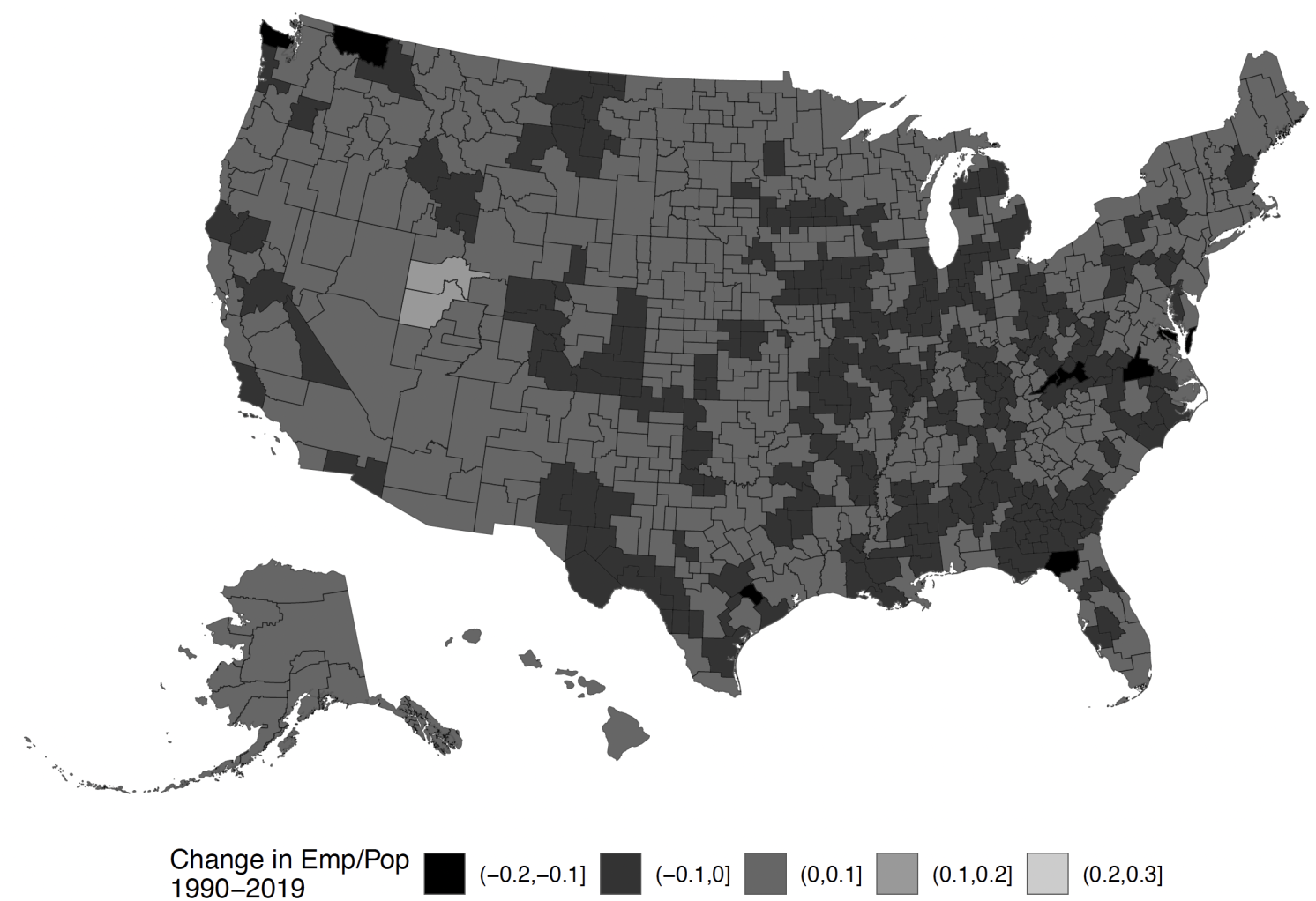
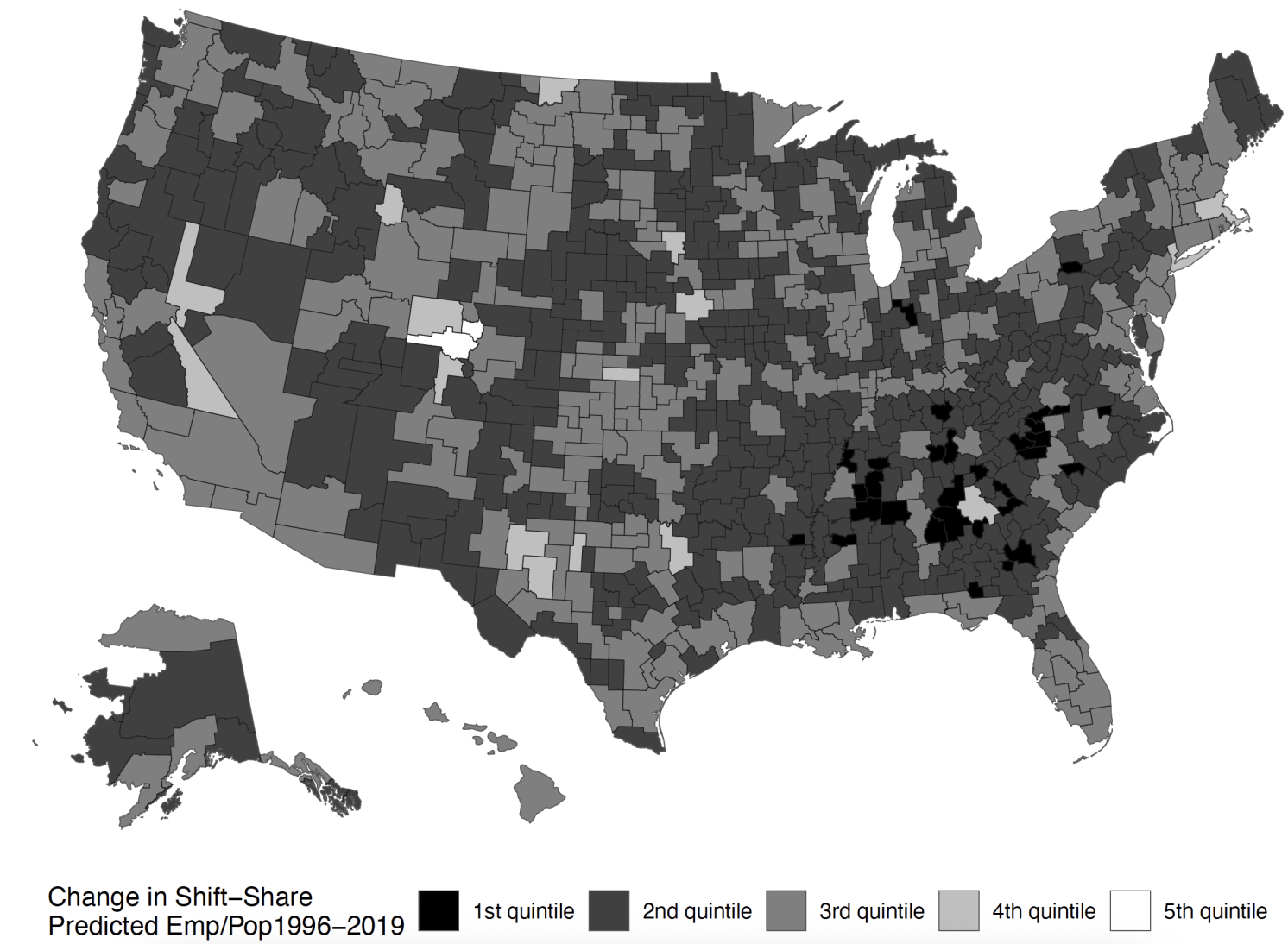
There is substantial geographic variation in CZ level employment that supports the utility of local area shocks as an instrument. Figure 1, Panel A, shows this for men ages 51-64. We focus on this group because the predicted local labour demand shocks work best for them for predicting actual employment changes. The different shading illustrates the geographic variation in employment change, as well as large reductions in employment for 51-64 year-old men in many areas of the southeast. Panel B displays the predicted change in the employment-to-population ratio by CZ. Note there is a correlation with the geography of realised changes in employment, which is the basis for our empirical strategy.
Figure 1 Change in (employment/population) by commuting zone
A) Men ages 51-64
B) Shift-share instrument prediction
The Evidence
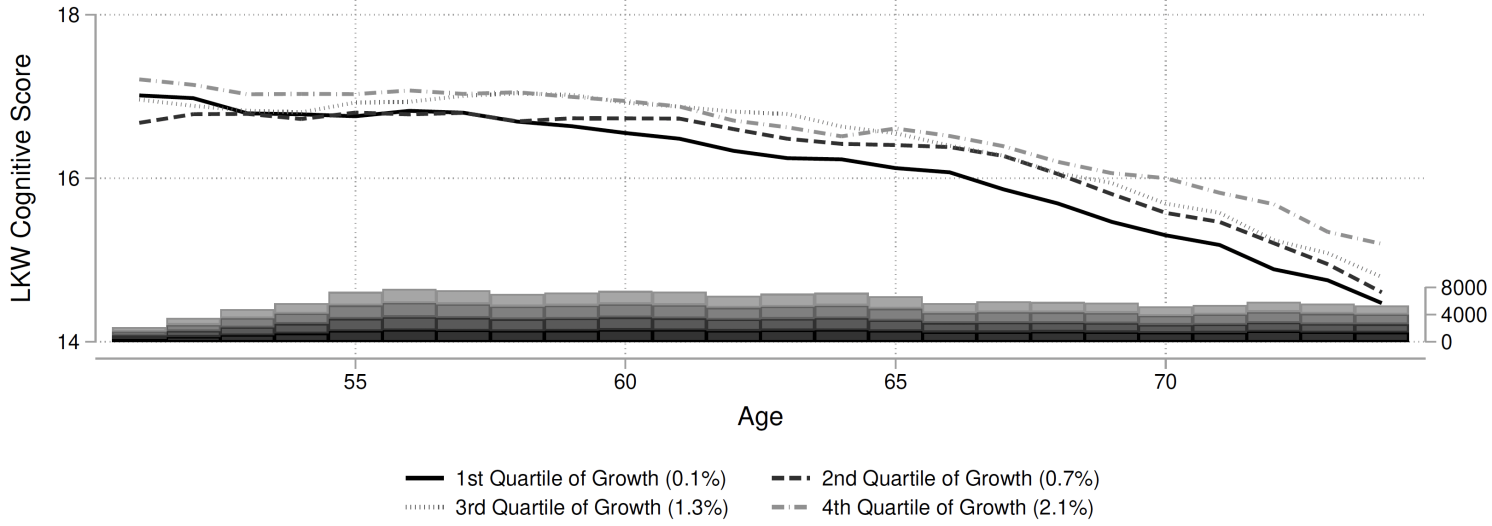
We find that employment declines driven by local labour demand shocks are associated with cognitive decline of men ages 51-64. There is a straightforward way to display this visually. Among the HRS participants in our sample, cognitive performance gradually decreases with age. In Figure 2, we display the trajectory of the global (Langa-Weir) cognitive score available in the HRS, broken down by CZs in the first to fourth quartiles of employment growth (from lowest to highest). Respondents in the CZs in the lowest quartile of employment growth start their early 50s with scores at the same level as the other three quartiles. However, a gap emerges over time, particularly as respondents enter potential retirement years. Relative to the top quartile, there is a full one-point gap for participants in their 70s between the bottom and top quartiles of CZ employment growth. This suggests a role for work – related to local variation in employment – in slowing cognitive decline.
Figure 2 Cognitive trajectories (global cognitive score) based on quartiles of CZ employment growth
Our estimate that identifies the causal effect of employment conveys the same message: higher employment in men’s pre-retirement years helps forestall cognitive decline.3 Moreover, in our view the magnitude is sizable. To put the estimate in perspective, in our sample period, the employment rate decline of men from age 51 to 61 (before eligibility for Social Security at age 62) is 18 percentage points. Suppose this employment decline was halved, so it fell by only 9 percentage points. Based on our estimate, this change would boost the average cognitive score by one-tenth of a standard deviation. This turns out to be approximately the same as the average cognitive decline that men experience over this age range, implying that cutting the pre-retirement employment rate decline in half would forestall the average cognitive decline that occurs over this age range.
Conclusion
Our work has some limitations, including the inability to determine which aspects of work, or of employment loss, causally affect cognition. We suspect that the relation between work and cognition at pre-retirement ages is heterogeneous in ways that depend on both the nature of work and the characteristics of the people studied. More research would be useful in understanding other ways that both work, and non-work activities, might help forestall cognitive decline. Finally, it is always useful to be cautious about drawing strong policy conclusions from limited amounts of evidence, and as we have explained, there is little extant work on the causal impact of work on cognition at pre-retirement ages. Nonetheless, our findings – especially if replicated by others – hold clear policy implications. Federal efforts to promote work at pre-retirement ages would not only reduce reliance on disability insurance and enhance retirement security, but would also promote healthy aging through delaying cognitive decline.
_________
- We obtained restricted-use data on county of residence and industry of employment (RDA #2023-095). The conditions of using these data impose restrictions on the geographic granularity at which we can report statistics.
- This is a Bartik-style shift-share instrumental variable (Bartik 1991).
- Our paper reports many auxiliary analyses that confirm the robustness and validity of these estimates for men ages 51-64. However, our research strategy is less successful at establishing whether results are similar for women of the same ages, or older women or men, because the local labor demand shocks do less to predict their employment changes – likely because many older people stop working for reasons related to retirement rather than local demand, and women’s jobs are more typically industries where there is not much local variation in labor demand.
See original post for references


I expect to hear more of this sort of thing as the shortfall in social security funding approaches.
As the post touches on, claims about the cognitive benefits of extending work probably needs to look at things like the impact of long covid, the long term use of pain killers by aging working class workers, and maybe the psychological impact of being forced into retirement vs. true voluntary retirement (I was fortunate to retire at a time of my choosing but many coworkers were pushed out in larger waves carefully crafted not to trigger age discrimination liability and some were devastated at least in the short term).
Oh come on! Here’s some anecdata for you:
Back when I still lived in urban America I would potter around town in a “classic” car that appealed to a certain generation. From engaging with the men who approached to admire my car it became evident to me that the biggest losers in the 21st century globalization/layoff mania were men in the 51-64 cohort.
Many of these guys were dressed in rags and clearly living on the street. They’d lost everything when their blue-collar jobs were destroyed, in particular their housing and family relationships. Living rough was the biggest contributor to their cognitive decline, let me assure you!
Lifelong learning and general high level of activity seem to slow cognitive decline. There are a whole lot of people who are not lifelong learners, they are incurious and passive. Paid work forces them both to learn and be active. Once that is gone, we find out who is a lifelong learner and who is not.
A wife who retires tends to maintain active with continued work doing household management; the couple still has to eat and wear clean clothes, and only the wealthy get outsiders to help with these. The husband may decide to outsource his traditional household duties to handymen, oil-change places and yard crews, leaving him with essentially no work to do, and if he is not a lifelong learner, decline follows. I know these are sweeping generalizations and gender roles and retirement habits are increasingly not so rigid or predictable. But I think ‘learn and stay busy’ are important elements.
As the commenters above have noted, cognitive decline is related to income level, having a safe place to live, and those who have acquired creative pursuits that last a lifetime,i.e.; playing an instrument, reading challenging content (NC?), and pursuing challenging Crafts, etc.
The primary accelerator of decline: modern TeeVee (especially the ‘News’).
American academics who celebrate work. Maybe work is but part of the puzzle, as this crowd demonstrates every day in comments.
I would fully agree with Yves and Earthling that there are many other ways to slow cognitive decline. In fact, my current work is stunningly boring (no way to change that right now), and I am sure I am not the only one feeling that – h/t to David Graeber’s BS jobs. I dream of a PhD or something to stimulate my brain post-early retirement (I know academia is not perfect). Also, studies have shown that learning and speaking multiple languages slows decline, and this sort of thing is perhaps also more approachable for a greater number of people than academic study. In general, I suspect learning any new skill helps. Lots more to explore for these authors in future studies.
Finally, I have to say that all the retirees I know are all super-busy and happy, they look like years melt off of them when they leave work ;-)
My friends too! We are among the super-busy and happy. These old dudes skeeving on Thai girls are so sad.
In the two years since retiring I have:
~gotten master gardener certification (still finishing apprenticeship). I support the earth and plants and pollinators. Environmental stewardship. Joy!
~become a volunteer facilitator for trauma healing and non-violence conflict resolution workshops in state prisons. Easily the most personally rewarding thing I’ve ever done. It’s amazing to watch a soul begin to heal.
~joined or led multiple seminar/reading groups, exploring Shakespeare, Homer, Romans, Rilke, Da Vinci, too many artists and philosophers to name. [Incidentally, for any here drawn by the ‘life of the mind’, consider https://catherineproject.org]
The blessing of retirement isn’t that you don’t have to work. It’s that you don’t have to do bullshit jobs that generate surplus wealth for materialist jerks in order to put a roof over your head.
Plus, you get to hang out more with people who care about the same things you do.
And really, WHAT JOBS? It’s not like there’s a surplus for all these old folks whom the authors want shackled to AI and other modern office bullshit so their brains don’t melt.
I realize that raising the age at which one can collect full Social Security benefits will eventually entail an increase in the age at which one can collect reduced benefits, and that, even if it doesn’t, it will change social mores and expectations around retirement, pushing early retirement back, and thereby benefiting the older members’ of the study’s target group. But this sentence still seems incredibly sinister to me.
I am not averse to the idea that even a person with a repetitive, mechanical, mind-numbing job disconnected from any discernible social good still unconsciously claws a sense of meaning and purpose from it, that they aren’t aware of until it’s gone, and they are left with nothing. Maybe this is the best we can do. But it seems like the discussion of retirement age is driven by people blissfully ignorant of the fact that they are privileged in having work that offers them novelty, agency, and fulfillment (though I personally would not want any of what Maria Bartiromo gets from her job, except for the money).
https://www.mediamatters.org/fox-business/fox-business-maria-bartiromo-pushes-raising-retirement-age-social-security
But maybe none of it actually matters. One of the patterns I’ve noticed in American public life is that, when elites deign to register any expression of popular discontent, they use it as an opportunity to further entrench the status quo. Don’t like private, for-profit health insurance? Here’s a legal requirement to buy it.* Don’t like Israel? Here’s NDAA Section 224. Next up: Worried about cognitive decline? Compete with people 40 years younger than you for one of the few remaining, de-skilled jobs until you die.
*I always thought that Trump’s elimination of the individual mandate under Obamacare was (from his perspective) especially stupid, as it was the law’s least popular feature.
Why ever stop working? Surely humans only exist to labor from cradle to grave.
Along with your thought, whenever I read such an post, my first thought is the line, “Would you like fries with your burger?” I feel that type of work and type of life would be the most important determinations as to what may lead to dementia.
And for the concern of “solvency of Social Security,” why not remove the cap on social security taxes?
I have no issue with being busy or active. There is just a destructive culture of tying one’s whole being to what labor one does or does not engage in.
It’s a perversion of the blessing and curse that conscious life offers. It encourages humans to demote themselves to the status of tools.
Having free time or being bored and still do nothing is not a sin.
The authors have come up with some very clever instruments to get around the fact that retirement is sometimes the result of an individual’s decision.
It is certainly plausible that having to go to work affects a person’s behaviour in ways that may help to maintain cognitive fitness. For example, in most jobs it is difficult to consume alcohol and usually it is not an enjoyable environment for drinking.
But what the paper cannot overcome is that once retired (whether voluntarily or otherwise), individuals are free to make different choices than they made while they were holding down a job. It may well be the case that some people who didn’t drink alcohol until after work now feel free to start drinking at lunchtime. This is not good for their measured cognitive health, but the individual may feel it brings a substantial improvement in quality of life.
Forestalling cognitive decline is not the highest priority of the entire population. Regular readers of Naked Capitalism know that covid infection is associated with cognitive decline, and yet the overwhelming majority of the population is unwilling to be inconvenienced by preventive measures like wearing an N95.
Probably plenty lower ranking folks all around the US of A who are pretty dang positive the boss is deep in cognitive decline that is a secret cuz they cover for them.
As best I can tell, any benefit to my cognition by working as a substitute teacher after retiring (mostly) from law is completely undercut by the increases in blood pressure and the constant risk of total brain meltdown from dealing with modern student attitudes and behaviors.
And this is in a relatively small vaguely blue collar service sector town in the desert. I can only imagine – and shudder in horror – what Big City teachers go through with the little … cherubs.
The easy answer to this conundrum is to realize a bit of wisdom. My Zen Master, Kobun Chino Roshi, told me once that there was no relation of pay and work. We work. We get paid if others appreciate our work. Not the same thing. This is obvious when we compare the wages of a farm worker with those of a CEO of an agricultural conglomerate. Those who only work for money are nothing more than mercenaries, but those who must work for basic necessities are little more than slaves.
So, Kobun’s answer is to just do something, hopefully something useful.